
Squeezing from Every Side
The last two sections pulled a wire along its length and pushed a block sideways. Both loadings had a direction. This one does not.
Drop a steel ball into the sea and let it sink. There is no single direction in which it is being loaded. Every square millimetre of its surface is pushed inwards, perpendicular to the surface, by exactly the same pressure. Nothing is pulled, nothing slides. The ball simply becomes a slightly smaller ball.
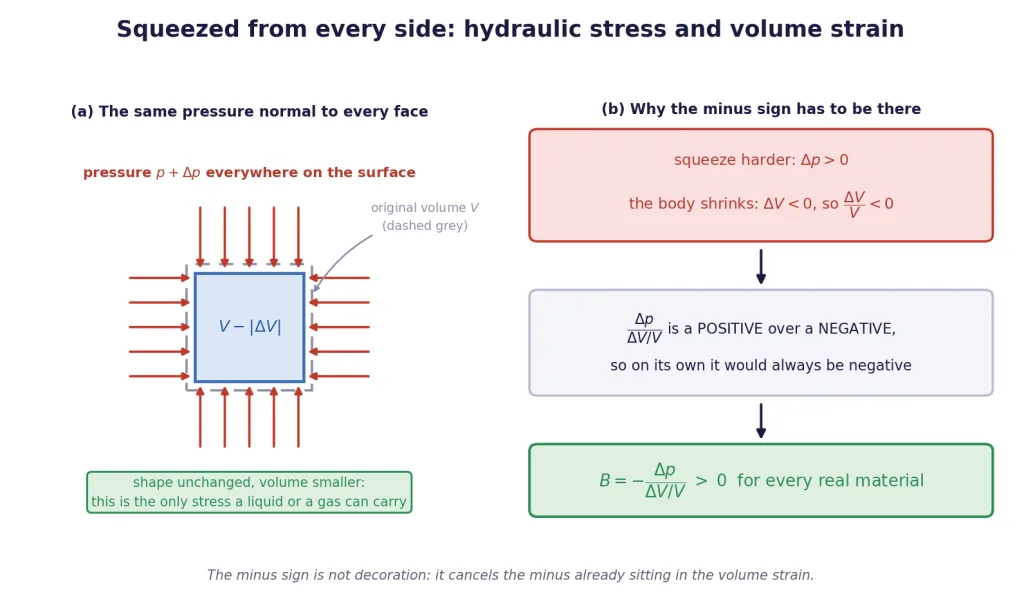
Hydraulic stress and volume strain
Key Point - hydraulic (volume) stress:
When a body is surrounded by a fluid, the force per unit area on it is perpendicular to the surface everywhere and the same everywhere. That force per unit area is the pressure, and a change in it, , is the hydraulic stress. SI unit pascal, Pa, dimensions - the same as every other stress in this chapter.Key Point - volume strain: the fractional change in volume. It is dimensionless, like every strain. Note the geometry: the shape does not change at all. A cube stays a cube, a sphere stays a sphere; only the size shrinks.
Put the three loadings side by side and the pattern is clean:
| Stress | Direction of the force | Shape | Volume | Modulus |
|---|---|---|---|---|
| Tensile or compressive | along one axis, perpendicular to the loaded face | changes | changes | |
| Shearing | tangential to the loaded face | changes | unchanged | |
| Hydraulic | perpendicular to every face, everywhere | unchanged | changes |
The definition, and the minus sign
Look at the right-hand half of the figure and follow the bookkeeping, because this is where marks get lost.
Squeeze harder, so . The body shrinks, so , and therefore . The quotient is a positive divided by a negative: it is negative. Every time. For every material.
That would be an absurd thing to call a modulus - the stiffer the material, the more negative the number. So the definition carries a compensating minus sign:
Key Point - bulk modulus: The minus sign is not decoration. It exists so that comes out positive, because an increase in pressure always produces a decrease in volume. SI unit pascal (Pa), dimensions .
Two working forms follow immediately, and they are what problems actually use:
In practice most problems ask for the magnitude of the fractional compression, and then with no signs to worry about at all. Just make sure you know which one the question wants, and never report a negative bulk modulus.
Notation
means Poisson's ratio, not stress; elsewhere often denotes stress, with or for Poisson's ratio, so watch the convention in whatever else you read. Hydraulic stress is simply written . The bulk modulus is , and its reciprocal, compressibility, is .
[Board Important] In the definition, always say why the minus sign is there. "The negative sign indicates that an increase in pressure produces a decrease in volume, so that is positive" is the sentence that earns the mark.
Compressibility, and the Numbers That Separate the States of Matter
Turning the modulus upside down
tells you how much pressure it takes to squeeze something. Sometimes the more natural question is the other way round: given a pressure, how much does it squeeze? That is the reciprocal.
Key Point - compressibility: The fractional change in volume produced per unit increase in pressure. SI unit Pa (equivalently m/N), dimensions - the dimensions of the reciprocal of pressure.
A big means a small : hard to compress. A big means a small : easy to compress. Nothing more to it than that, but the two words point in opposite directions and questions exploit the confusion.
Compressibility is the more convenient number when you want a feel for a material, because you can quote it "per atmosphere". For water, Pa. One atmosphere is Pa, so
Water loses about 0.0046% of its volume per atmosphere. That is the sense in which liquids are "practically incompressible" - not that they cannot be compressed, but that ordinary pressures do almost nothing to them.
The values, printed here
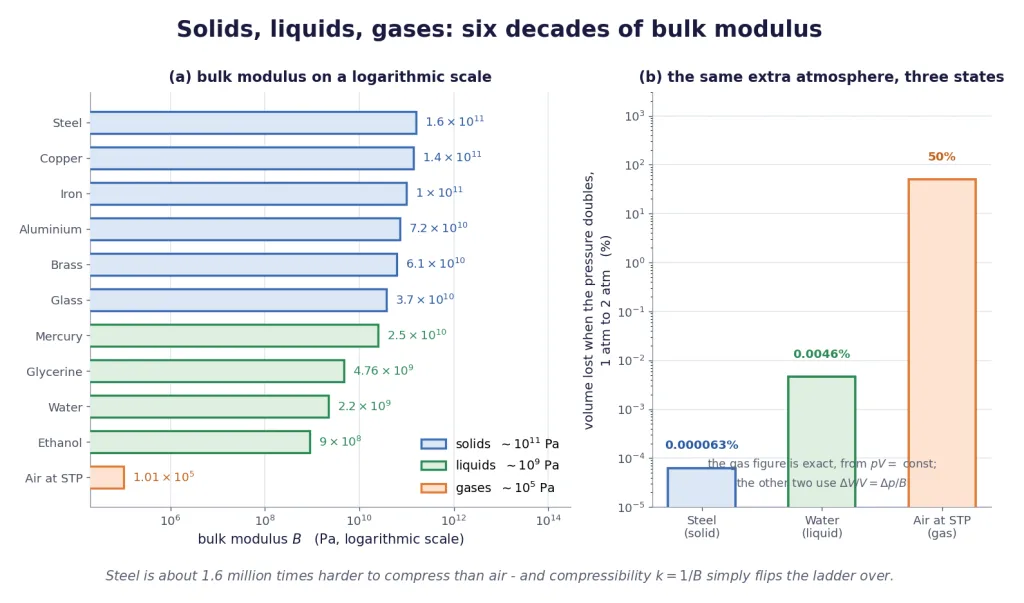
| Material | State | (Pa) | (Pa) |
|---|---|---|---|
| Steel | solid | ||
| Copper | solid | ||
| Iron | solid | ||
| Aluminium | solid | ||
| Brass | solid | ||
| Glass | solid | ||
| Mercury | liquid | ||
| Glycerine | liquid | ||
| Water | liquid | ||
| Carbon disulphide | liquid | ||
| Ethanol | liquid | ||
| Air at STP (isothermal) | gas |
Typical measured values at ordinary temperature; real samples vary by a few per cent. Mercury is the outlier among liquids, sitting up among the solids.
Six orders of magnitude
Read that table down the middle column and the three states of matter sort themselves out:
Key Point:
- Solids: Pa - the least compressible.
- Liquids: Pa - about a hundred times more compressible than solids.
- Gases: Pa - about a million times more compressible than solids.
Steel is about times harder to compress than air at atmospheric pressure. That is six orders of magnitude, and it is the cleanest single number separating the states of matter anywhere in mechanics.
Why the ladder looks like that
The reason is the spacing between the particles and how tightly they are held.
- In a solid, atoms sit in contact, held in a rigid arrangement by strong interatomic forces. Compressing the solid means pushing atoms closer than their equilibrium separation, and the repulsion there rises very steeply. Hence a huge .
- In a liquid, the molecules are still touching but are not locked into a lattice; the binding is weaker, and drops by a factor of a hundred or so.
- In a gas, the molecules are far apart and barely interact at all. Almost all of the volume is empty space, and pushing the molecules closer costs very little. Hence a tiny .
So the ordering is a direct readout of molecular structure, and it is worth being able to say that in one sentence.
[NEET Important] The comparison question - "which is most compressible, a solid, a liquid or a gas?" - is answered by gases, and the reason to give is that gas molecules are far apart and weakly coupled. Watch the wording: most compressible means smallest bulk modulus, and least compressible means largest. The two words invert.
Down in the Ocean
The classic application - and the source of most numerical questions on this topic - is a body taken deep under water.
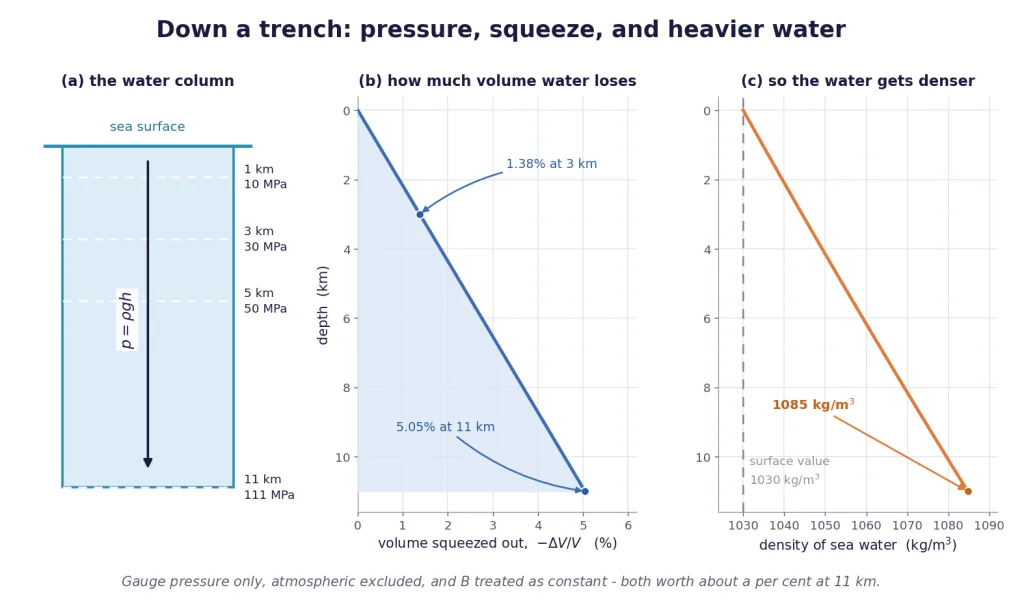
Step 1: get the pressure right
The pressure due to a column of liquid of density and depth is
This is the gauge pressure - the amount by which the pressure exceeds atmospheric. The absolute pressure at that depth is .
Key Point - say which pressure you used. The hydraulic stress on a body lowered from the surface into the sea is the change in pressure it experiences, which is the gauge pressure ; the atmosphere was already pressing on it at the surface. If a problem instead lowers a body from a vacuum, or asks for the absolute pressure, add Pa.
How much does that choice matter? At 3000 m in sea water, Pa, so atmospheric pressure is 0.34% of the total - negligible, but you should still be able to say which one you took. At 10 m depth it would be a third of the answer, and there it matters a great deal.
Step 2: fractional compression
Nothing else is needed. Notice what does not appear: the size of the body, its shape, its mass. A pebble and a submarine hull of the same material lose the same fraction of their volume at the same depth.
Worked, for water itself. At the average depth of the Indian Ocean, about 3000 m, using fresh-water values kg/m and m/s so the arithmetic stays clean:
Water at the bottom of the Indian Ocean occupies about 1.4% less space than the same water at the surface. State the value of you used - with the answer would be 1.34%, and mixing 9.8 and 10 inside one problem is how sign-and-value errors creep in.
Step 3: the density that goes with it
Squeeze the same mass into a smaller volume and it gets denser. Since with fixed,
and expanding for small compressions gives the form usually quoted:
Key Point: The fractional increase in density equals the fractional decrease in volume. Use the exact when the compression is more than about 1%.
The deepest point in the ocean. The Challenger Deep is about 11 km down. With sea water, kg/m and m/s:
which is about 1100 atmospheres. Then
and the density becomes
an increase of about 55 kg/m.
Being honest about the approximations
Three of them are hiding in that calculation, and a good answer names them.
- The linearised density. Using directly gives kg/m, while the exact mass-over-volume route gives 1084.8 kg/m. The two differ by 2.8 kg/m, about 0.25%. At 5% compression the linear formula has started to fray; at the 1.4% of the previous calculation it is still fine.
- assumes the water is incompressible - but we have just finished saying that it is not. Integrating with the density rising as the water is squeezed gives Pa at 11 km rather than Pa: the simple formula is about 2.5% low. At 3 km the discrepancy is only 0.7%.
- is treated as a constant. In reality the bulk modulus of water rises by roughly a tenth over 1000 atmospheres, which pushes back in the opposite direction.
None of this changes what you should write in an exam - use and - but knowing the size of the errors is the difference between quoting a formula and understanding one.
Solids at depth, and the radius of a squeezed sphere
For a solid object lowered to the same 11 km, swap in the solid's own . Steel, with Pa, would lose
that is 0.069% - seventy times less than the water around it.
One more relation is worth having, because it turns a volume answer into a length answer. For a body squeezed uniformly in all directions, every linear dimension shrinks by the same fraction, so if then
So a steel sphere of radius 10 cm at a depth of 5000 m, where Pa, has and shrinks in radius by
about 10 micrometres. Computing the new radius exactly, as , agrees with this to four significant figures - the factor of is safe for any compression you will meet.
[JEE Tip] A depth problem is three lines: , then , then whatever the question wants - a volume, a density or a radius. The only real decisions are which (fresh or sea water), which , and whether atmospheric pressure is included. Write all three down before you start.
The One Modulus That Works for Liquids and Gases
Why is different
and both need the material to hold a tangential force statically, and a fluid at rest cannot do that - it flows instead. Hydraulic stress asks for nothing of the kind. The force is perpendicular to the surface at every point, everywhere the same. A liquid can carry that, and so can a gas.
Key Point: is the only elastic modulus defined for all three states of matter. and exist for solids alone. That is why a table of bulk moduli can contain water and air, while a table of shear moduli cannot.
An isothermal gas:
Gases are the odd case, and they are odd in an instructive way.
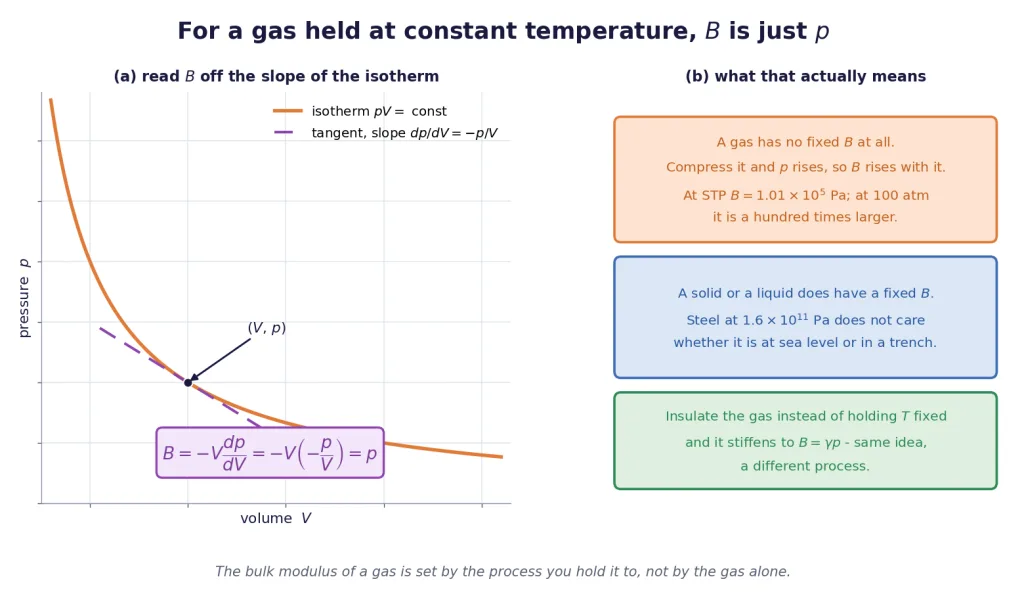
Hold a fixed mass of ideal gas at constant temperature. Boyle's law says
Differentiate both sides with respect to :
Now put that into the definition of the bulk modulus, written with derivatives instead of finite changes:
Key Point - the isothermal bulk modulus of a gas: The bulk modulus of an ideal gas held at constant temperature is numerically equal to its pressure. At STP, Pa, so Pa - which is exactly the value in the table two blocks back.
Sit with that for a moment, because it says something a solid never says.
A gas has no fixed bulk modulus at all. Steel's Pa is a property of steel; it is the same at sea level and in a trench. A gas's is whatever its pressure happens to be right now. Compress it to 100 atmospheres and its bulk modulus becomes 100 times larger - the gas has genuinely become a hundred times harder to compress further. Compressibility of a gas is , which likewise changes as you use it.
And the process matters too. Squeeze the gas quickly, with no heat escaping, and it warms up as you do so, which stiffens it. That adiabatic case gives , where is the ratio of the specific heats, about 1.4 for air. Same gas, same pressure, a bulk modulus 40% larger, purely because of how you did the squeezing. The adiabatic case belongs to thermodynamics, and it is mentioned here only so that the phrase "isothermal bulk modulus" makes sense to you when you meet it. For this chapter, constant temperature, .
A caution on the linear formula for gases
is a small-change relation. For a solid or a liquid that is never a problem, because is always minute compared with . For a gas it fails badly as soon as is comparable with itself.
Take air at 1 atm and add one more atmosphere. The linear formula, with Pa, predicts , that is, the gas vanishes completely. What actually happens, from constant, is that the volume halves: a 50% reduction, not 100%.
Key Point: For a gas, use the linear relation only when . For a finite pressure change, go back to and work exactly.
The three moduli, finally side by side
| Young's modulus | Shear modulus | Bulk modulus | |
|---|---|---|---|
| Stress | , perpendicular to | , tangential, the loaded face | , normal everywhere |
| Strain | (radians) | ||
| Shape | changes | changes | unchanged |
| Volume | changes | unchanged | changes |
| Formula | |||
| Sign convention | none needed | none needed | minus, so |
| Exists for | solids | solids | solids, liquids, gases |
| Typical metal value | Pa | Pa | Pa |
All three carry the unit pascal and the dimensions , because strain is always dimensionless.
The section in six lines
- Hydraulic stress is , normal to every surface; volume strain is ; shape does not change.
- , and the minus sign exists so that is positive, because forces .
- Compressibility , in Pa: the fractional volume change per unit pressure rise.
- Solids Pa, liquids Pa, gases Pa - six orders of magnitude, gases most compressible.
- At depth : , , , .
- For an ideal gas at constant temperature, ; it is not a fixed property of the gas.
[Board Important] Three definitions are worth memorising word for word here: hydraulic stress, volume strain, and bulk modulus with the reason for the minus sign. Between them they answer almost every two-mark question this topic generates.
Solved Examples
Values used in this section, unless a problem states otherwise: Pa, Pa, Pa, Pa, kg/m, Pa. Every constant is restated inside the solution that uses it.
Example 1: The average depth of the Indian Ocean
The average depth of the Indian Ocean is about 3000 m. Find the fractional compression of water at that depth, given Pa. Use kg/m and m/s.
Solution:
Pressure due to the water column. This is the gauge pressure; atmospheric pressure is excluded, because the water was already under it at the surface and only the change in pressure produces the extra squeeze.
Volume strain from the definition of :
Final Answer: , that is a compression of about 1.36%.
Takeaway: The answer carries a minus sign if you report it as , since the volume decreases; the bulk modulus itself is still positive, which is exactly what the minus sign in the definition is for. Note also that was used throughout - with the answer would be 1.34%, and mixing the two inside one problem is a guaranteed way to lose a mark.
Example 2: The bottom of the deepest trench
The deepest point of the ocean is about 11 km down. Taking kg/m, m/s and Pa, find the gauge pressure there, the fractional compression of the water, and its density.
Solution:
Gauge pressure: That is about 1100 atmospheres. Including Pa would change it by 0.09%, so it is left out and the answer is a gauge pressure.
Fractional compression:
Density, from mass over the compressed volume:
Final Answer: Pa, the water is squeezed by 5.05%, and its density rises to about 1085 kg/m.
Takeaway: The quick route gives kg/m instead - 2.8 kg/m lower, an error of 0.25%. At compressions of a per cent or less the two agree; at 5% the linear form has begun to fray. Say which one you used.
Example 3: A copper cube under pressure
A solid copper cube of side 10 cm is subjected to a hydraulic pressure of Pa. By how much does its volume change? Take Pa.
Solution:
Original volume:
Volume strain:
Change in volume:
Final Answer: The volume shrinks by m, that is 0.05 cm, or five hundredths of a millilitre out of a litre.
Takeaway: The cube stays a cube. Each side shrinks by of the volume strain, , which is micrometres on a 10 cm side. Computing the new side exactly as agrees with that to five figures.
Example 4: Compressibility, read as a per-atmosphere number
Find the compressibility of water and express it as the percentage volume change per atmosphere. Then find the pressure needed to reduce the volume of a sample of water by 0.10%.
Solution:
Compressibility:
Per atmosphere, with Pa:
Pressure for a 0.10% reduction. Turn the definition round:
Final Answer: Pa, or 0.0046% per atmosphere; and 22 atmospheres are needed to squeeze water by a thousandth of its volume.
Takeaway: Twenty-two atmospheres is the pressure 220 m underwater, and it buys you a tenth of a per cent. That is what "practically incompressible" means in numbers - and it is why the hydraulic brakes in a car work at all, since the fluid transmits pressure without swallowing the pedal's motion.
Example 5: A steel ball at depth
A steel ball of radius 10.0 cm is lowered to a depth of 5000 m in the sea. Find the fractional change in its volume and the change in its radius. Take kg/m, m/s and Pa.
Solution:
Gauge pressure at that depth:
Volume strain:
Radius. For a uniform squeeze every linear dimension shrinks by a third of the volume strain, since :
Final Answer: The volume falls by 0.0315%, and the radius shrinks by about m, that is 10.5 micrometres.
Takeaway: The factor of deserves a check rather than blind trust: computing the new radius exactly, as , gives the same m to four significant figures. The linearisation is safe for any compression a solid will ever see.
Example 6: Finding from measurements
One litre of a hydraulic oil is subjected to an extra pressure of Pa and its volume falls by 5.0 cm. Find the bulk modulus and the compressibility of the oil.
Solution:
Volume strain, converting both volumes to the same unit:
Bulk modulus:
Compressibility:
Final Answer: Pa and Pa.
Takeaway: Pa sits right in the liquid band of the ladder, just below water's Pa - a sanity check you can perform in your head. If a calculation ever hands you a liquid with Pa, you have made an arithmetic slip somewhere.
Example 7: A glass block under ten atmospheres
A glass block of volume 0.50 m is subjected to an additional pressure of 10 atmospheres. Find the change in its volume. Take Pa and Pa.
Solution:
Pressure change:
Volume strain:
Change in volume:
Final Answer: The block shrinks by m, that is 13.7 cm.
Takeaway: Half a cubic metre of glass loses less than fourteen millilitres under a pressure ten times atmospheric. Watch the word additional: the stress is the pressure change, so the atmosphere the block was already sitting in does not enter.
Example 8: The bulk modulus of air
Show that the isothermal bulk modulus of an ideal gas equals its pressure, and hence find for air at STP. Compare it with steel.
Solution:
Start from Boyle's law for a fixed mass at constant temperature:
Differentiate, using the product rule:
Substitute into the definition:
At STP, Pa, so Pa. Against steel:
Final Answer: ; for air at STP that is Pa, and steel is about times less compressible.
Takeaway: A gas has no fixed bulk modulus. Compress the air to 100 atmospheres and its becomes 100 times larger, because simply tracks . A solid's is a property of the material; a gas's is a property of its current state.
Example 9: Where the linear formula breaks
Air at 1.00 atm is compressed isothermally until the pressure is 2.00 atm. Find the fractional change in volume exactly, and compare with what predicts.
Solution:
Exactly, from :
By the linear formula, with Pa and Pa: which claims the gas disappears entirely.
Final Answer: The exact answer is a 50% reduction. The linear formula gives 100% and is simply wrong here.
Takeaway: is a small-change relation, valid while . For solids and liquids that is always true, since is enormous. For a gas, equals itself, so a pressure change of one atmosphere is not small and you must go back to .
Example 10: The same squeeze, three states of matter
An extra pressure of one atmosphere, Pa, is applied to steel, to water and to air at STP. Find the fractional volume change in each, and comment.
Solution:
Steel, Pa:
Water, Pa:
Air, where the change is not small compared with , so use with :
Final Answer: 0.000063% for steel, 0.0046% for water, 50% for air.
Takeaway: Water is about 70 times more compressible than steel; air is about a million times more compressible than steel. Notice that the gas had to be handled exactly while the solid and the liquid were fine with the linear formula - the same distinction as in the previous example, now with a reason attached.
Example 11: Density of water at 4000 m
Find the density of sea water at a depth of 4000 m. Take the surface density as 1030 kg/m, m/s and Pa.
Solution:
Gauge pressure:
Volume strain:
Density, from mass over compressed volume:
Final Answer: About kg/m, an increase of roughly 19 kg/m.
Takeaway: The linearised route, kg/m, is only 0.4 kg/m away here - at a compression under 2% the two agree to within 0.04%. Compare that with the 2.8 kg/m gap at 11 km and you can see exactly where the linear formula starts to matter.
Example 12: Reading the definition backwards
The bulk modulus of a certain liquid is Pa. (a) What is its compressibility? (b) What pressure is needed to reduce a 2.0 litre sample to 1.99 litres? (c) If instead the same pressure were applied to a solid with Pa, what fraction of its volume would it lose?
Solution:
(a)
(b) The volume strain required is so
(c) With the same and the solid's much larger ,
Final Answer: (a) Pa; (b) Pa, about 123 atmospheres; (c) , that is 0.0125%.
Takeaway: Part (c) is part (b) with one number swapped, and the answer drops by a factor of 40 - exactly the ratio of the two bulk moduli. Every one of these problems is the same single relation, , rearranged for whichever of the three quantities is missing.