
The Rigid Body Was Always a Convenient Lie
For seven chapters you have been told that a body is rigid — that the distance between any two points in it never changes, no matter what you do to it. That assumption made rotational motion tractable, and it was worth making.
It is also false. Every bit of it.
Push hard enough on a steel girder and it bends. Hang a load on a steel wire and it gets longer. Stand on a concrete floor and the floor sags — by a few microns, but it sags. Nothing is rigid. What varies from one material to another is only how much it deforms, and whether it comes back.
That last question is the whole of this chapter, and this section is about answering it honestly.
The three-step test
Take any solid. Do these three things in order:
- Measure it while nothing is pushing on it.
- Apply a force. It changes shape or size — always, even if you cannot see it.
- Remove the force. Now measure it again.
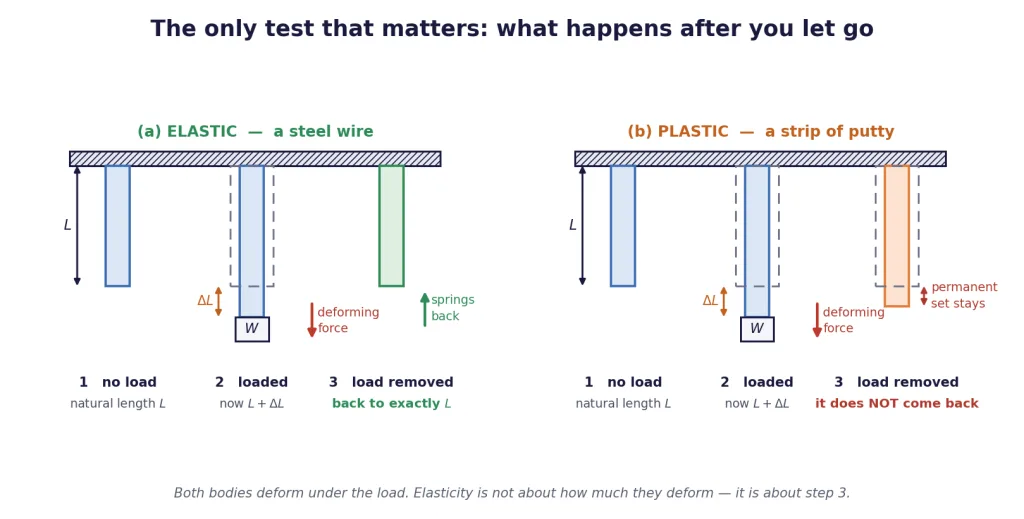
Step 3 is where materials split into two families.
Key Point — the two definitions:
Elasticity is the property by which a body regains its original size and shape once the deforming force is removed. The deformation that is undone in this way is called elastic deformation.
Plasticity is the property of a body that does not regain its original size and shape — it keeps a permanent set. Putty, mud and soft wax are close to ideal plastics.
Read those definitions once more and notice what is not in them. Neither says anything about how far the body moved in step 2. A steel wire that stretches by a hundredth of a millimetre and returns is elastic. A rubber band that stretches to four times its length and returns is elastic. A lump of putty that squashes by a millimetre and stays squashed is plastic. The amount of deformation is not the test. The return is the test.
Why anyone should care
This is not a museum piece. Elastic behaviour decides the thickness of the cables in a suspension bridge, the shape of a railway track's cross-section, the depth of a beam in a roof, the alloy in an artificial hip joint, and how thin the fuselage of an aircraft can be made before it stops being an aircraft. Every one of those decisions is a calculation with the quantities this chapter is about to build.
[Board Important] The definitions of elasticity and plasticity, in exactly these words, are a standard one-mark or two-mark opener. Write "regains its original size and shape" — dropping either half loses the mark.
Inside the Solid: A Lattice of Tiny Springs
Fine — solids spring back. Why? A steel wire has no visible spring anywhere in it. Where does the pull come from?
Zoom in far enough and the answer is sitting there in the crystal.
The energy well between two atoms
Two neighbouring atoms in a solid are not touching, and they are not indifferent to each other. They interact through a potential energy that depends on their separation , and that function has a very particular shape:
- Push them too close and shoots up steeply — the electron clouds refuse to overlap. The force is strongly repulsive.
- Pull them far apart and climbs back towards zero — the attraction fades out. The force is attractive.
- In between there is a minimum. At that separation, call it , the potential energy is lowest and the force between the atoms is exactly zero.
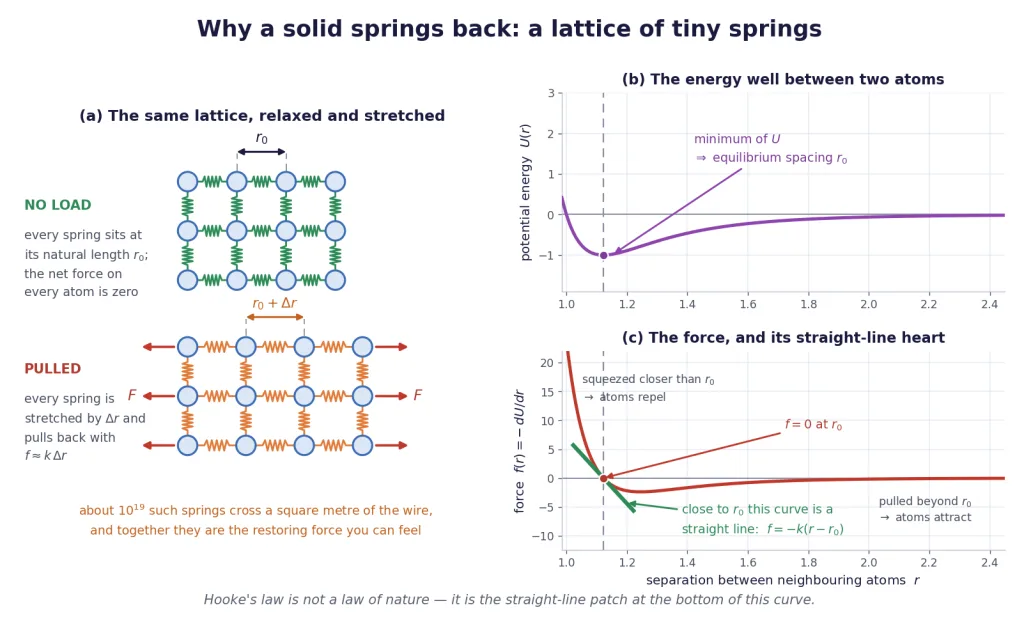
That separation is the equilibrium spacing, and it is what the crystal settles into when nothing is disturbing it. For a typical metal is about m, and the depth of the well is around 0.47 eV per bond.
The straight-line patch at the bottom
Now here is the step that makes everything else in this chapter work.
Take the force curve and look only at the region very close to . Any smooth curve crossing zero looks like a straight line if you get close enough to the crossing. So for small displacements,
which is exactly the equation of a spring, with a stiffness that you can read off as the slope of the force curve at . For a typical metallic bond comes out around 60 N/m.
Key Point — the picture to carry for the rest of the chapter:
A solid behaves like a three-dimensional lattice of tiny springs, one for every bond, each of natural length and stiffness . Stretch the solid and every spring along the pull is stretched a little; each one pulls back; and the sum of all those tiny pulls is the restoring force you feel.
Does the arithmetic actually work?
It does, and it is worth doing once because the numbers are astonishing.
Stretch a 1.00 m wire by 1.0 mm, a fractional stretch of 0.001. With m there are about atomic layers along that metre, so each bond must lengthen by only
which is about one three-thousandth of an atomic diameter. Now count the bonds crossing a square millimetre of the wire's cross-section: roughly one per , giving about of them. Each pulls back with N, so together
Two hundred newtons — about the weight of a 20 kg sack — to stretch a millimetre-thick steel wire by one part in a thousand. That is the right answer for real steel, and it came out of nothing but a spacing and a spring constant.
Why compression fights back harder than tension
Look at the force curve again and notice it is not symmetric about . The repulsive wall on the left is much steeper than the attractive tail on the right.
Squeeze a bond to and it pushes back with about N. Stretch the same bond to and it pulls back with only about N — roughly eight times less. That asymmetry is why solids resist being crushed far more stubbornly than they resist being pulled apart, and it is the atomic reason a stone pillar is a sensible structural idea while a stone rope is not.
[JEE Tip] Questions that hand you and ask for the equilibrium separation are asking you to set . Questions that then ask for the "force constant of the bond" are asking for at that separation. Nothing else is going on.
Deforming Force and Restoring Force
Two forces are in play whenever a solid is deformed, and mixing them up is the most reliable way to get a free-body diagram wrong.
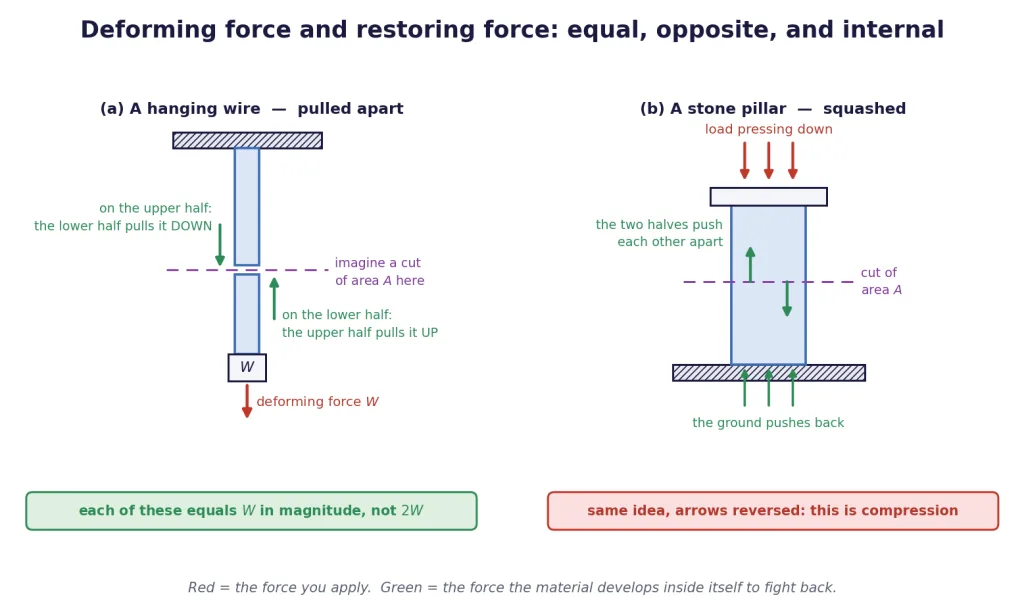
- The deforming force is what you apply — the hanging weight, the hydraulic press, the wind on a tower. It is external. Drawn in red throughout this chapter.
- The restoring force is what the material develops inside itself in response. It is internal, it comes from all those stretched interatomic springs, and it always acts so as to undo the deformation. Drawn in green.
Why they are equal while the deformation is steady
Hang a load on a wire and wait. Nothing is accelerating any more; the wire has settled at some new length and stays there. Now imagine slicing the wire across at any level and look only at the piece below the cut. Two forces act on that piece: the load pulling down, and whatever the upper piece is doing to it across the cut. Since the piece is in equilibrium,
Key Point: While a deformed body is in static equilibrium, the internal restoring force at any section is equal in magnitude and opposite in direction to the deforming force. This is a consequence of Newton's first law applied to a piece of the body, not a separate law of elasticity.
The , not , trap
Here is the error, and it catches people every single year.
A wire hangs from the ceiling with a weight at the bottom. The ceiling pulls up on the wire with ; the weight pulls down on the wire with . Two forces of size . So — the argument goes — the wire must be carrying .
It is not.
Key Point: The tension across any cross-section of that wire is , not . The two forces of size act at the two ends of the wire; they do not add at a cross-section in the middle. Take the free body of the lower piece and the answer falls out in one line: only one and one internal force act on it, so they must be equal.
The same thing happens when two people pull on the opposite ends of a rope with 200 N each. The tension in the rope is 200 N, not 400 N. Nothing about elasticity changes that.
The same idea in compression
Stand a stone pillar under a roof. The roof presses down on the top; the ground presses up on the bottom. Cut the pillar anywhere and the two halves push each other apart with a force equal to the load. The interatomic springs are now compressed rather than stretched, so they push instead of pulling, and the deformation is a shortening rather than a lengthening. Everything else is identical.
[NEET Important] "Restoring force is equal and opposite to the applied force" is true only while the body is in equilibrium. In the instant after you first apply the load, before the body has settled, the two are not equal — that difference is what accelerates the material into its new shape.
Perfectly Elastic, Perfectly Plastic, and Everything in Between
Real materials do not sit neatly in one camp. They sit on a line between two idealisations that nothing in the world quite reaches.
The two extremes
Key Point — the idealisations:
A perfectly elastic body regains its original size and shape completely and instantly, no matter how large the deforming force was, and does so every time without ever tiring.
A perfectly plastic body keeps all of the deformation and recovers none of it, no matter how small the deforming force was.
Neither exists. They are the ends of a scale, useful for locating real materials on it.
The closest real approximation to a perfectly elastic body is a quartz fibre, which recovers essentially completely over a very wide range of loads and is used for exactly that reason in delicate torsion balances. The closest approximation to a perfectly plastic body is putty — or wet mud, or plasticine — which keeps almost everything you do to it.
Where real solids sit
Every real solid behaves elastically up to a point and plastically beyond it. That point has a name — the elastic limit — and it is the load beyond which the body no longer returns all the way. Section 3 draws it properly on a graph and puts the other landmarks around it; here you only need the idea.
| Material | Behaviour under a small load | Behaviour under a large load |
|---|---|---|
| Quartz fibre | recovers essentially completely | recovers, over a very wide range |
| Steel | recovers completely | permanent set, then it snaps |
| Copper | recovers completely | permanent set at a much smaller load than steel |
| Rubber | recovers completely, after a large stretch | tears rather than taking a permanent set |
| Lead | recovers only a little | flows and keeps its new shape |
| Putty, wet mud | keeps almost all of it | keeps all of it |
A qualitative ranking, arranged by how much of the deformation survives after unloading.
Elasticity is not the same as strength
These two get confused constantly, so pin them apart now.
- Elasticity is about coming back. Does the body return to its original size and shape when you unload it?
- Strength is about not breaking. How large a force can the body take before it fails?
They are independent. Glass is highly elastic — it returns perfectly from any deformation it survives — and yet it is weak and shatters easily. Lead is not very elastic at all — it deforms permanently under quite modest loads — and yet a lead sheet is not easy to tear. A material can be elastic and weak, or inelastic and tough, or any other combination.
Key Point: Elastic strong. Elastic stretchy. Elastic means it comes back.
[Board Important] "Name the material that is the closest approximation to a perfectly elastic body" has one expected answer: quartz fibre. "Closest to a perfectly plastic body": putty.
Which Is More Elastic — Steel or Rubber?
This is the single most-tested misconception in the chapter, and almost everyone gets it wrong the first time. Take the question seriously before reading on.
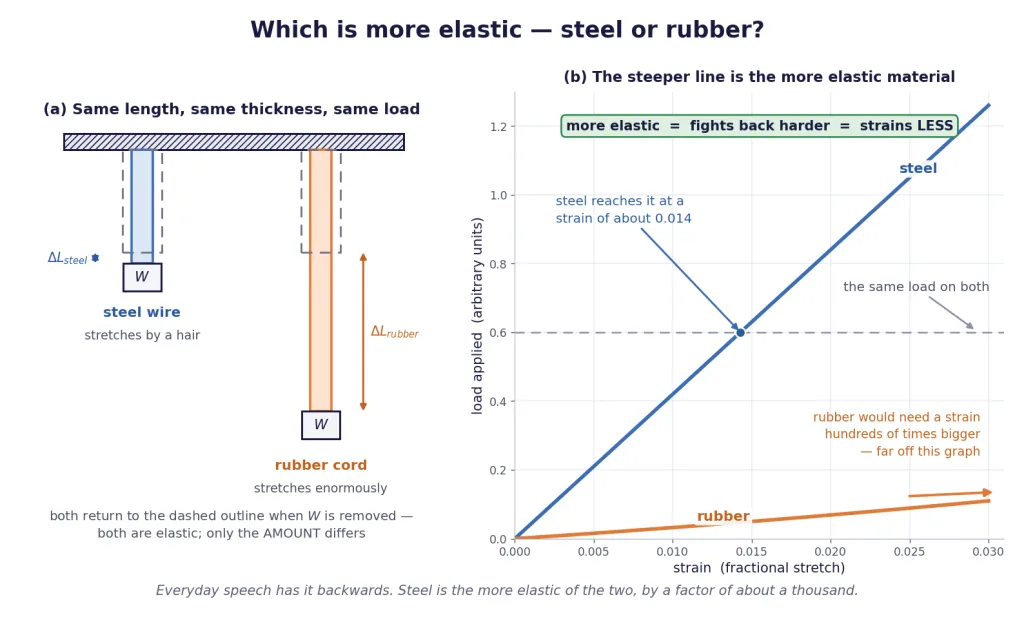
A steel wire and a rubber cord have the same length and the same thickness. You hang the same weight on each. The steel stretches by a few thousandths of a millimetre. The rubber stretches until it is nearly twice as long. Both return to their original length when you take the weight off.
Which one is more elastic?
The answer, and the reason
Steel — by a factor of about .
Everyday speech has trained you to hear "elastic" as "stretchy", which is why rubber feels like the obvious answer. But go back to the definition. Elasticity is about the restoring force the material develops, about how hard it fights back against being deformed. And the honest measure of that is:
Key Point — the operational definition:
Of two materials under the same deforming force, the one that deforms less is the more elastic. It is developing a larger restoring force for the same deformation, which is exactly what "more elastic" means.
Equivalently: the material that needs a larger force to produce the same fractional change in size is the more elastic one.
Put concrete numbers on it. Same length, same thickness and the same weight means the same stress in each — say Pa. Steel, with Pa, then strains by : a 1.00 m wire lengthens by five thousandths of a millimetre. Rubber, with Pa, strains by 1.0 — it doubles in length. The ratio of the strains is . Steel resists two hundred thousand times harder, and that is exactly what makes it the more elastic.
Where the misconception comes from
Three things feed it, and naming them helps:
- Language. "Elastic band", "elasticated waistband" — everyday English uses elastic to mean stretchy. Physics does not.
- Visibility. The rubber's recovery is dramatic and you can watch it happen. The steel wire's recovery is a quarter of a millimetre and invisible. Both recover fully; only one puts on a show.
- The wrong comparison. People compare how far it went rather than how hard it pulled back. Same load, same length, same thickness — then compare the deformations, and the smaller one wins.
The atomic version of the same statement
Go back to the lattice of springs. Steel's bonds are stiff — the well is deep and narrow, so is large, and a given displacement produces a large restoring force. Rubber is not a simple crystal at all; it is a tangle of long coiled molecules, and stretching it mostly uncoils them rather than pulling atoms apart. Uncoiling is easy. That is why rubber stretches so far under so little force, and why it is nevertheless perfectly capable of returning: the coils spring back.
Key Point — the summary sentence, worth memorising: For a given load, less deformation means more elasticity. Steel and quartz are more elastic than rubber; rubber merely stretches more.
Where this is going
You have now met the ideas. What you do not yet have is a way of measuring any of this, and the reason is that raw forces and raw extensions are not comparable across objects. A 100 N load means one thing on a hair and another on a bridge cable; a 1 mm stretch means one thing in a 1 m wire and another in a 100 m one.
Section 2 fixes exactly that, by defining stress and strain. Section 3 then puts them together into Hooke's law and the stress-strain curve, and from Section 4 onward the moduli — the actual numbers you calculate with — arrive one at a time.
[JEE Tip] Any question phrased as "which of these is the most elastic" is answered by whichever material shows the smallest deformation for the same load, or equivalently has the largest modulus of elasticity. It is never the one that stretches most.
Solved Examples
Constants used throughout this section, unless a problem says otherwise: m/s; a typical interatomic spacing m; a typical metallic bond stiffness N/m. Every one of these is stated again inside the solution that uses it.
Example 1: Sorting the everyday world
Classify each of the following as showing mainly elastic or mainly plastic behaviour, and say what evidence decides it.
(a) A steel spring in a weighing machine. (b) A ball of wet clay pressed by a thumb. (c) A rubber band stretched to twice its length and released. (d) A copper wire bent into a hook and let go. (e) A glass rod flexed very slightly and released.
Solution:
Apply the three-step test to each. Everything hangs on step 3.
(a) Elastic. Release the load and the pointer returns to zero. If it did not, the machine would be useless — a weighing machine is literally an elasticity meter.
(b) Plastic. The dent stays. Wet clay recovers essentially none of the deformation, which is why it is one of the standard near-ideal plastics.
(c) Elastic. It returns to its original length. The fact that it stretched enormously on the way is irrelevant to the classification.
(d) Plastic. The hook keeps its shape — that is the entire point of bending it. The copper has been taken past its elastic limit deliberately.
(e) Elastic. A small flex is fully recovered. Glass is highly elastic; it is merely also brittle, which is a different property.
Final Answer: Elastic: (a), (c), (e). Plastic: (b), (d).
Takeaway: The size of the deformation never decides the classification. (c) deformed by 100% and is elastic; (e) deformed by a hair and is elastic; (b) and (d) are plastic because the deformation survived the unloading.
Example 2: Reading a three-step measurement
A wire is 2.000 m long. A load is hung on it and it settles at 2.006 m. The load is removed and the wire settles at 2.002 m. Find (a) the total extension while loaded, (b) how much of it was elastic, (c) the permanent set, and (d) whether the wire was taken past its elastic limit.
Solution:
(a) Total extension while loaded.
(b) The elastic part is the part that came back when the load was removed.
(c) The permanent set is what is left over.
(d) Was the elastic limit exceeded? Yes, unambiguously. A permanent set exists at all, which by definition means the wire did not return to its original length. Two thirds of the deformation was recovered and one third was not.
Final Answer: 6.0 mm total; 4.0 mm elastic; 2.0 mm permanent; the elastic limit was exceeded.
Takeaway: Elastic and plastic behaviour are not exclusive — a real wire can show both in one loading. The recovered fraction here is , and a wire is called elastic only when that fraction is 1.
Example 3: How far do the atoms actually move?
A steel wire 1.00 m long is stretched by 1.0 mm. Taking the interatomic spacing as m, find (a) the fractional stretch, (b) how many atomic layers lie along the wire, and (c) how much each individual bond lengthens. Compare that with the size of an atom.
Solution:
(a) The fractional stretch. which is one part in a thousand, or 0.1%.
(b) The number of layers. Each layer occupies one spacing :
(c) The stretch per bond. The total extension is shared equally among all bonds, so each one lengthens by
The comparison. An atom is about m across, so Each bond has stretched by one thousandth of an atomic diameter — and of course it has, because that is the same fractional stretch as the whole wire. Every part of the wire stretches by the same fraction.
Final Answer: fractional stretch ; about layers; each bond lengthens m.
Takeaway: The fractional stretch of the whole wire is exactly the fractional stretch of every single bond in it. That is why a fraction, and not a raw length, is the right thing to measure — a point Section 2 will make into a definition.
Example 4: Adding up the tiny pulls
Continuing from Example 3: take the bond stiffness as N/m and the number of bonds crossing a square millimetre of cross-section as one per . Estimate the total restoring force in a wire of cross-section 1.0 mm stretched by one part in a thousand.
Solution:
Bonds crossing the cross-section. Each bond claims an area of about m. The cross-section is 1.0 mm, which is m, so
The pull in one bond. From Example 3 each bond is stretched by m, so
Add them up.
Sanity check. 200 N is the weight of about 20 kg. Hanging a 20 kg mass on a millimetre-thick steel wire and getting a stretch of 1 mm per metre is exactly what happens in a school laboratory.
Final Answer: about 200 N.
Takeaway: The macroscopic stiffness of steel is nothing but atomic springs pulling together. An estimate built from a spacing and a bond stiffness lands on the right answer, which is the strongest evidence that the lattice-of-springs picture is not a metaphor.
Example 5: Which way does the bond push?
For a pair of atoms the interatomic force is zero at the equilibrium separation . Using the shape of the force curve, state the direction of the force when the separation is (a) and (b) , and say which of the two is larger in magnitude. For a typical metallic bond the magnitudes are N and N respectively.
Solution:
(a) At the atoms are closer than equilibrium. The electron clouds are being forced to overlap, so the force is repulsive — it pushes the atoms apart, back towards .
(b) At the atoms are further apart than equilibrium. Now the attraction dominates, so the force is attractive — it pulls them back together, again towards .
Both restore. In each case the force points back towards . That is precisely what makes a stable equilibrium and the solid a solid.
Which is larger? The repulsion at a 10% squeeze is about eight times the attraction at a 10% stretch.
Final Answer: repulsive at , attractive at ; the repulsion is about 8 times larger.
Takeaway: The energy well is steep on the left and gentle on the right. That single asymmetry is why solids resist crushing far more than pulling, and why "equal and opposite for equal displacement" is only true very close to .
Example 6: The wire that everyone loads with
A wire hangs from a ceiling with a 5.0 kg mass at its lower end. Take m/s. Find (a) the deforming force, (b) the force the ceiling exerts on the wire, and (c) the restoring force acting across a horizontal cut made half way up the wire. The mass of the wire itself is negligible.
Solution:
(a) The deforming force is the weight of the hanging mass:
(b) The ceiling's pull. Take the whole wire plus load as one body. It is in equilibrium, so the upward pull of the ceiling balances the total weight, which (with a massless wire) is 49 N. The ceiling pulls up with 49 N.
(c) The restoring force at the cut. Draw a free body of the piece below the cut. Two forces act on it: the load pulling down with 49 N, and the pull of the upper piece across the cut. Equilibrium gives
Why it is not 98 N. The two forces of 49 N act at the two ends of the wire, one at the ceiling and one at the load. They are not both transmitted across a section in the middle. Any cut, anywhere along this wire, carries 49 N.
Final Answer: 49 N in all three parts.
Takeaway: Cut it, isolate one piece, and write . That one habit removes the error permanently, and it works no matter how complicated the loading gets.
Example 7: Ranking three wires
Three wires P, Q and R have the same length and the same thickness but are made of different materials. Under the same load they extend by 0.18 mm, 0.45 mm and 1.20 mm respectively. All three return fully to their original length when the load is removed. (a) Rank them from most elastic to least elastic. (b) Are any of them plastic? (c) How many times more elastic is P than R?
Solution:
(a) The ranking. Same load, same length, same thickness — so the comparison is decided by the deformation alone, and less deformation means more elastic:
(b) Plastic? None of them. All three returned fully, so all three behaved elastically at this load. Elasticity is about the return, and all three passed.
(c) How many times. The restoring force per unit deformation goes inversely with the extension, so P is about 6.7 times more elastic than R.
Final Answer: P > Q > R; none is plastic; P is about 6.7 times more elastic than R.
Takeaway: "Which is more elastic" and "which stretched more" are opposite questions. Read the stem carefully; the wire at the top of one list is at the bottom of the other.
Example 8: A spring taken too far
A helical spring has a natural length of 20 cm. Pulled with a moderate force it reaches 24 cm, and on release it returns to 20 cm. Pulled much harder it reaches 40 cm, and on release it settles at 26 cm. For each trial state whether the behaviour was elastic, and find the permanent set.
Solution:
Trial 1. Extension while loaded cm. Final length cm, so the permanent set is Nothing is left behind. The behaviour was fully elastic, and the load stayed within the elastic limit.
Trial 2. Extension while loaded cm. Final length cm, so
Interpretation. The spring recovered 14 cm of the 20 cm and kept 6 cm. The elastic limit lies somewhere between the two loads used.
Final Answer: Trial 1 fully elastic, zero permanent set. Trial 2 partly plastic, 6 cm permanent set, 14 cm recovered.
Takeaway: The same body is elastic under one load and plastic under a larger one. "Is steel elastic?" is not a well-posed question until you say how hard you are pulling.
Example 9: Is a "rigid" body really rigid?
A steel rail 10.0 m long shortens by 0.50 mm when a train stands on it. Find the fractional change in its length, express it as a percentage, and comment on whether treating the rail as rigid in Chapter 6 was reasonable.
Solution:
The fractional change.
As a percentage.
The comment. Five thousandths of one per cent. If you were computing the rail's moment of inertia, or where its centre of mass is, or how it rotates, an error of that size is far below anything you could measure and the rigid-body assumption is excellent.
But — if you are the engineer deciding how thick the rail must be, that half-millimetre is the answer you need, because it is what tells you the internal forces the steel is carrying and whether they are safe. Same rail, same number, and it is negligible in one calculation and central in the other.
Final Answer: , or 0.005%; the rigid-body assumption was excellent for the dynamics and useless for the design.
Takeaway: "Rigid" is a statement about what you are calculating, not about the material. This chapter is the calculation for which it is never good enough.
Example 10: Elastic, or just strong?
Two students argue. One says "steel is more elastic than glass because glass shatters". The other says "glass is more elastic than steel because it returns perfectly from any bend it survives". Settle the argument.
Solution:
Separate the two properties. Elasticity asks: does it come back? Strength asks: how much can it take before it fails? These are independent questions about a material.
The first student is answering the wrong question. "Glass shatters" is a statement about how much glass can take, not about whether it recovers. Brittleness is a failure property. It has nothing to say about elasticity.
The second student is using the right test — recovery on unloading — and glass does indeed recover essentially completely from any deformation short of fracture. On the recovery test glass scores very well.
The honest answer. Glass is highly elastic and weak. Steel is highly elastic and strong. Comparing them on elasticity means comparing how much they deform under the same load, and on that test they are broadly comparable, with steel somewhat stiffer. Neither student's reasoning was sound.
Final Answer: The second student used the right test but the first student's evidence was about strength, not elasticity. Glass is elastic and brittle — both at once, with no contradiction.
Takeaway: Brittle is not the opposite of elastic. The opposite of elastic is plastic. The opposite of brittle is ductile. Two different axes, and Section 3 puts both of them on one graph.
Example 11: The load that just fails to come back
A copper wire returns exactly to its original length after each of the loads 10 N, 20 N, 30 N and 40 N. After 50 N it comes back to within 0.1 mm of its original length, and after 60 N it is left 1.2 mm longer than it started. What can you say about the elastic limit of this wire, and how would you narrow it down?
Solution:
What the data show. Up to and including 40 N the recovery is complete — that is elastic behaviour throughout. At 50 N a permanent set of 0.1 mm has appeared, so recovery is already incomplete. At 60 N the permanent set is 1.2 mm, twelve times bigger.
Bracketing the elastic limit. The elastic limit is the largest load for which recovery is still complete. The evidence puts it between 40 N and 50 N.
Narrowing it down. Repeat the experiment with loads at 42 N, 44 N, 46 N and 48 N, unloading and measuring each time, and find the largest load that still leaves no measurable permanent set. In practice the limit of the measurement decides the answer: with an instrument that resolves 0.01 mm you can place the limit far more sharply than with one that resolves 0.1 mm.
A caution. The 0.1 mm at 50 N is small, and a careless experimenter would call it zero and report the wrong limit. "No permanent set" always means "none that this instrument can see".
Final Answer: The elastic limit lies between 40 N and 50 N; narrow it by loading in small steps between those two and watching for the first measurable permanent set.
Takeaway: The elastic limit is found by the return, load by load, never by watching the loading alone. Section 3 turns this experiment into the stress-strain curve, where the elastic limit becomes a labelled point rather than a bracketed guess.