
How to Use This Problem Bank
Ten sections of theory, and now the part that actually earns marks. What follows is 49 worked problems, arranged easy first and hard last, covering everything from "which modulus is this?" up to the multi-step arrangements that decide ranks.
Work them with a pen and paper. Cover the solution, try it, then compare — including the check at the end of each one, because the check is where the marks usually leak away.
The four questions to ask before you write anything
Nearly every mistake in this chapter is made in the first ten seconds, before any arithmetic starts. Ask these four, in this order:
- Which deformation is it? Is the body getting longer or shorter (longitudinal), is its shape changing while its volume stays put (shearing), or is it being squeezed from every side at once (hydraulic)? That single answer picks the modulus: , or .
- Which area do I divide by? For longitudinal stress, is the face the force is perpendicular to — the cross-section. For shearing stress, is the face the force acts along. Getting this backwards is the single most expensive slip in the chapter.
- Which length is on the bottom? The strain is always the change divided by the original dimension. For shear, the length underneath is the distance between the two faces, measured perpendicular to the sliding.
- Is the load constant along the body? If the body's own weight matters, or the bar tapers, or it is spinning, the tension is different at every cross-section and you cannot use one for the whole thing.
Key Point — the master formulas, all in one place: The minus sign in is there so that comes out positive — pressure up means volume down. The minus sign in is there for the same reason: pulling a rod longer makes it thinner, so the two strains have opposite signs and the ratio would otherwise be negative.
Notation
on its own always means Poisson's ratio, never stress. Stress is written as , or named in words, or given a subscript: for longitudinal, for shearing, for hydraulic and for a yield strength. The shear modulus is and the bulk modulus is . Elsewhere often denotes stress, with or for Poisson's ratio, so check the convention in whatever else you read.
The material data used below
Unless a problem states its own numbers, every solution here uses this table. Each problem also restates the constants it uses inside its own solution, so you never have to scroll back.
| Material | (Pa) | (Pa) | (Pa) | (kg/m) |
|---|---|---|---|---|
| Steel | 7800 | |||
| Copper | 8900 | |||
| Brass | 8500 | |||
| Aluminium | 2700 | |||
| Glass | 2500 | |||
| Bone (compression) | — | — | 1900 | |
| Water | — | 0 | 1000 |
Typical values for the chapter's worked problems. Real samples vary by several per cent, and answers below are quoted to two or three significant figures for that reason.
On the value of : every problem states whether it uses m/s or m/s, and no problem mixes the two. Where a source of data is quoted in atmospheres, one atmosphere is taken as Pa.
[Board Important] Every solution below writes the formula on its own line before any number goes into it. Do the same in the exam. A correct formula with an arithmetic slip still earns most of the marks; a bare number earns none.
Solved Examples
Part 1: Which Stress Is It, and Which Modulus?
Four warm-ups whose whole content is the decision in step 1 above. Get fast at these and the rest of the chapter becomes arithmetic.
Example 1: Sorting five everyday deformations
For each situation below, name the type of stress, the matching strain, and the modulus you would need to put a number on the deformation.
(a) A nylon tow-rope pulling a stalled car. (b) A brass coin lying on the bed of a deep lake. (c) A rubber pad glued between a washing machine and the floor, pushed sideways as the drum spins. (d) A granite pillar holding up a roof. (e) The blade of a screwdriver as you turn a stiff screw.
Solution:
Run the test each time. Longer or shorter along one axis? Longitudinal. Shape changed, volume kept? Shearing. Squeezed inward from every side? Hydraulic.
Work through them.
| Situation | Stress | Strain | Modulus |
|---|---|---|---|
| (a) nylon tow-rope | longitudinal, tensile | ||
| (b) coin on the lake bed | hydraulic | ||
| (c) rubber pad under the machine | shearing | ||
| (d) granite pillar | longitudinal, compressive | ||
| (e) twisted screwdriver blade | shearing (torsion) |
- The two that catch people. (b) is not a "squashing" problem in the sense — the water pushes on the coin from all directions at once, not on two opposite faces, so it is a volume problem and needs . And (e) is not a problem either: twisting a rod slides each thin layer over the next, which is shear applied around an axis.
Final Answer: (a) tensile, ; (b) hydraulic, ; (c) shearing, ; (d) compressive, ; (e) shearing, .
Takeaway: Tensile and compressive are the same stress with opposite signs, and both use . Only "from every side at once" gets you , and only "sliding one face across another" gets you .
Example 2: Two claims to judge
State whether each of these is true or false, and give the reason.
(a) Young's modulus of rubber is greater than that of steel. (b) The stretching of a coiled spring is determined by its shear modulus.
Solution:
(a) is FALSE. For the same stress, rubber stretches enormously and steel barely moves. Since a big strain for a given stress means a small . Steel sits near Pa and rubber near Pa — a factor of about a hundred thousand the other way.
Why people get it wrong. In everyday speech "elastic" means "stretchy", so rubber sounds like it should win. In physics the modulus measures resistance to deformation, so the stiff material has the larger .
(b) is TRUE. Pulling the two ends of a helical spring apart does not stretch the wire lengthwise in any important way. What actually happens is that each little element of the coiled wire gets twisted about the wire's own axis. Twisting is shear, so the spring constant of a helical spring is set by , not by .
The check that makes it obvious. Unwind the spring into a straight wire of the same length and hang the same load on it. It extends by a fraction of a millimetre. Wound into a coil, the same wire and the same load give centimetres. The extra compliance comes entirely from twisting, and twisting is governed by .
Final Answer: (a) false — steel's is about times rubber's; (b) true — a helical spring extends by torsion of its wire, which is a shear deformation.
Takeaway: "Stretches more" means a smaller modulus, not a larger one. And a spring is a shear device wearing a stretching disguise.
Example 3: One copper cube, one force, three different answers
A solid copper cube of edge 4.0 cm is acted on by a force of magnitude N, applied three different ways: (a) as a pull perpendicular to two opposite faces, (b) as a tangential push along the top face with the bottom face fixed, and (c) as a hydraulic pressure of the same magnitude of force per unit area on every face. For copper take Pa, Pa and Pa. Find the deformation in each case.
Solution:
The stress is the same number in all three cases. Each face has area That is the whole point of the problem: identical stress, three different responses.
(a) Longitudinal. about micrometres longer.
(b) Shearing. about micrometres sideways.
(c) Hydraulic. a contraction of about cubic millimetres.
Rank them. The shear displacement is the biggest, because is the smallest of the three moduli. That ordering — for a typical metal — is worth carrying around.
Final Answer: (a) m; (b) m with rad; (c) m.
Takeaway: The stress does not know which modulus you are going to use — you do. Same force, same area, same , and three completely different deformations, because the geometry of how the force is applied is what selects the modulus.
Example 4: Reading the question, four sentences at a time
For each one-line description, write down the formula you would reach for first.
(i) A steel rod is clamped between two immovable walls and then heated. (ii) A solid glass sphere is lowered to a depth of 500 m in the sea. (iii) A rubber block bonded to the floor has its top surface pushed 2.0 mm sideways. (iv) A wire is stretched so that its length rises by , and its diameter is measured before and after.
Solution:
(i) The rod wants to expand by and is not allowed to. The forced-back strain is , so the stress is Longitudinal stress, so — and notice neither nor survives.
(ii) Pressure on every side at once. Get the pressure from , then
(iii) One face slides over another, shape changes, volume does not.
(iv) Two strains at right angles to each other, so this is Poisson's ratio: and if the volume is also wanted, .
Final Answer: (i) ; (ii) with ; (iii) ; (iv) .
[NEET Important] In an objective paper you will not have time to derive anything. Train yourself to go from the words of the stem to the formula in one step, exactly as above — that is what the first four examples are for.
Takeaway: Identify the deformation before you touch a calculator. Three lines of correct identification beat two pages of arithmetic done with the wrong modulus.
Part 2: Elongation Under a Load
Now the workhorse. Everything here is one formula rearranged, but the rearrangements are where the marks are.
Key Point:
Notice what is not in it: the shape of the ends, how the load got there, or the material's density (unless the wire's own weight is part of the load).
Example 5: A structural steel rod, start to finish
A steel rod of radius 8.0 mm and length 1.5 m is pulled along its length by a force of 45 kN. Taking Pa, find (a) the stress, (b) the strain and (c) the elongation.
Solution:
Cross-sectional area. The force is perpendicular to the circular end faces, so
(a) Stress.
(b) Strain, straight from the definition of : which is .
(c) Elongation.
Is the rod safe? A structural steel yields somewhere around Pa. We are at Pa — inside the elastic region, but only by about . A real designer would not accept that margin, which is exactly what the next few problems are about.
Final Answer: stress Pa, strain , elongation mm.
Takeaway: Do it in the order stress strain elongation, always. The intermediate stress is the number you compare against the yield strength, and skipping straight to throws away the one check that tells you whether the answer means anything.
Example 6: A copper bar of rectangular section
A copper bar of rectangular cross-section 12.0 mm by 24.0 mm is pulled in tension by a force of 38 000 N, and the deformation stays elastic. Taking Pa, find the strain, and the extension of a 2.0 m length of it.
Solution:
The area is a rectangle, not a circle. No anywhere:
Stress.
Strain. that is, .
Extension of 2.0 m.
A useful way to store the answer. A strain of means " mm of stretch for every metre of bar", whatever the length. Quoting the strain rather than the extension is what makes an answer portable.
Final Answer: strain (about ); a 2.0 m length extends by mm.
Takeaway: Strain is the answer that does not depend on how long the bar happens to be. Give the strain and the extension follows for any length.
Example 7: The most a chairlift cable may carry
A ski-lift is hung from a steel cable of radius 1.2 cm. The design rule is that the stress in the cable must never exceed Pa. What is the largest load the cable may carry, in newtons and in kilograms? Take m/s.
Solution:
Area of the cable.
Rearrange the definition of stress. The permitted stress and the area fix the permitted force:
Convert to a mass. about tonnes.
Two things the answer does not depend on. The length of the cable does not appear — a 10 m cable and a 500 m cable of the same section break at the same load. Neither does : how far it stretches on the way is a different question from how much it can hold.
Final Answer: about N, which is a load of roughly kg.
Takeaway: A strength question needs an area and a limiting stress, and nothing else. If you found yourself reaching for or for the length, you answered a stiffness question by mistake.
Example 8: Designing a wire backwards from the stretch you will allow
A steel wire 8.0 m long is to carry a load of 4.0 kN, and it must not stretch by more than 2.0 mm. Take Pa. What is the smallest diameter that will do, and what stress does the wire then run at?
Solution:
Start from the elongation formula and make the subject.
Substitute, with everything in SI.
Turn the area into a diameter.
The stress it then runs at. comfortably inside steel's elastic region, so the design is limited by stiffness, not by strength.
Which way to round. A smaller wire stretches more, so you must round the diameter up, never down. A 10 mm wire would be very slightly too thin; specify 11 mm or 12 mm.
Final Answer: a minimum diameter of about mm, running at a stress of Pa.
Takeaway: Real design questions run the formula backwards. And when you round a designed dimension, always round in the direction that makes the structure safer.
Example 9: A long rope stretching under nothing but its own weight
A uniform steel rope of length 250 m hangs vertically from a winch with nothing attached to its lower end. Steel has density kg/m and Pa. Take m/s. Find (a) the greatest stress anywhere in the rope, (b) how much the rope stretches, and (c) the longest such rope that could hang without snapping, if steel's breaking stress is Pa.
Solution:
Where is the tension largest? At the top. A cross-section at a distance below the top carries everything hanging under it, a length , so The bottom carries nothing; the top carries the whole rope.
(a) The maximum stress, at : The area has cancelled, which is the whole reason a thicker rope does not help.
(b) The stretch. The tension varies along the rope, so add up the stretch of each little piece:
Read the factor of two. is exactly what you would get by hanging half the rope's weight from the end of a weightless rope. The average tension along the rope is half the maximum, and "average tension" is all a linear material cares about.
(c) The longest rope that holds. Set the top stress equal to the breaking stress: about km — and again independent of how thick you make it. The 250 m rope of parts (a) and (b) is running at about a twentieth of that limit, which is why it is nowhere near failing.
Final Answer: (a) Pa at the top; (b) mm of stretch; (c) a maximum hanging length of about km.
Takeaway: Self-weight elongation is , the same as putting half the weight at the free end — and the maximum hanging length does not care about the thickness at all, because both the weight and the area grow together.
Example 10: The rope and the cage together
The same 250 m steel rope, of cross-sectional area cm, now carries a mine cage of mass 1200 kg at its lower end. With kg/m, Pa and m/s, find the total elongation and the maximum stress.
Solution:
Superpose. The rope is a linear elastic body, so the extension caused by the cage and the extension caused by the rope's own weight simply add.
The cage's contribution. Its weight is carried in full by every cross-section:
The rope's own contribution, from the previous problem:
Total. Almost five centimetres — which is why a mine cage does not stop where you expect it to.
Maximum stress, again at the top. The top section carries the cage plus the whole rope:
A number worth noticing. The rope's own weight is N against the cage's N — it is nearly two-thirds of the payload. At 500 m it would exceed it. That is the real limit on how deep a single-rope hoist can go.
Final Answer: total elongation mm; maximum stress Pa at the top of the rope.
Takeaway: Superpose, do not average. The load's own plus the rope's own — two separate terms, added, with the factor of two belonging only to the second.
Example 11: Four hollow columns under a building
A structure of mass 60 000 kg rests on four identical hollow steel columns, and the load is shared equally. Each column has an inner radius of 25 cm and an outer radius of 50 cm. Taking Pa and m/s, find the compressive strain in each column.
Solution:
Load per column.
Area of an annulus — subtract, do not use the mean radius.
Stress.
Strain.
Feel the size of it. A column 5 m tall shortens by micrometres — about a tenth the width of a human hair. Buildings do not visibly settle under load because steel columns are enormously oversized for the stress, and they are oversized because the real enemy is not crushing but buckling.
Final Answer: a compressive strain of about in each column.
Takeaway: For a hollow section, . Every year somebody writes instead, which here would give m and an answer three times too big.
Part 3: Comparing Two Wires
The single most-asked question type in the chapter. Nothing here needs a calculator if you set it up as a ratio.
Key Point: For the same load, Long, thin and floppy stretches most. Write the ratio first and cancel everything that is common before any number goes in.
Example 12: Two wires that stretch by exactly the same amount
A steel wire of length 5.2 m and cross-sectional area m stretches by the same amount as a copper wire of length 4.0 m and cross-sectional area m when both carry the same load. What is the ratio of Young's modulus of steel to that of copper?
Solution:
Write the elongation for each. Same load in both:
Set them equal — that is the whole content of the phrase "stretches by the same amount":
cancels. Rearranging for the modulus ratio:
Substitute.
Sanity check the direction. The steel wire is longer and thinner, and yet it stretches only as much as the copper one. It must therefore be the stiffer material — , and the ratio should come out above 1. It does. If you had got , you inverted a fraction.
Final Answer: , so steel is about times as stiff as copper.
Takeaway: "Same load, same extension" is a ratio equation, not two separate calculations. You never need to know , and you never need to know either modulus on its own.
Example 13: Longer, thinner and softer, all at once
Wire B is twice as long as wire A, has half the radius, and is made of a material whose Young's modulus is one third of A's. Both carry the same load. By what factor does B stretch more than A?
Solution:
Start from the proportionality.
Take the ratio term by term.
Substitute the three factors.
Read where the 24 comes from. Doubling the length costs a factor of 2. Halving the radius costs a factor of 4, because the area went down by four. Thirding the modulus costs a factor of 3. Multiply.
The lesson in one line. Radius is the most powerful lever you have, because it enters squared. Halving a wire's thickness has the same effect on its stretch as making it four times longer.
Final Answer: wire B stretches times as much as wire A.
Takeaway: Radius enters as , so thickness beats length and modulus for sheer leverage. Deal with the squared factor first and the rest is easy.
Example 14: Three wires under the same load — which stretches most?
Three wires each carry a load of 20 N. Wire P is steel, 2.0 m long, radius mm; wire Q is copper, 3.0 m long, radius mm; wire R is aluminium, 1.5 m long, radius mm. Take Pa, Pa and Pa. Rank them by extension.
Solution:
Areas first.
Now for each.
Rank.
Check the stresses too, because they decide safety. which is the largest of the three, and already approaching aluminium's yield. The thinnest wire is both the stretchiest and the closest to failure — two separate reasons, both traceable to the same small area.
Final Answer: aluminium stretches most ( mm), then copper ( mm), then steel ( mm).
Takeaway: The shortest wire here stretches the most. Length is only one of three factors, and being thin and soft beat being short.
Example 15: Cut the wire in half, then use both halves
A wire of length extends by mm under a certain load. The wire is now cut into two equal halves. (a) One half alone is used to carry the same load — what is its extension? (b) Instead, the two halves are hung side by side and together carry the same load — now what?
Solution:
(a) One half alone. Same material, same area, half the length, same force:
(b) Two halves side by side. This is a parallel arrangement. Both halves have the same length and the same area, so both stretch by the same amount, and each therefore carries half the load:
Now apply the formula to one of them, with half the length and half the force:
Cross-check with the spring picture. A wire is a spring of stiffness . Halving doubles ; putting two such springs in parallel doubles it again. Four times the stiffness, so a quarter of the extension. Same answer.
And what if the halves are rejoined end to end? Then you are back to the original wire — a series pair of stiffness- springs is a spring of stiffness — and the extension is mm again, as it must be.
Final Answer: (a) mm; (b) mm.
Takeaway: Parallel wires share the extension and divide the load; series wires share the tension and their extensions add. Or in one sentence: in parallel the stiffnesses add, in series the compliances add — exactly like springs, because a wire is a spring with .
Part 4: Wires Joined Together
Three arrangements, three different bookkeeping rules. Get the rule right and the arithmetic is the easy part.
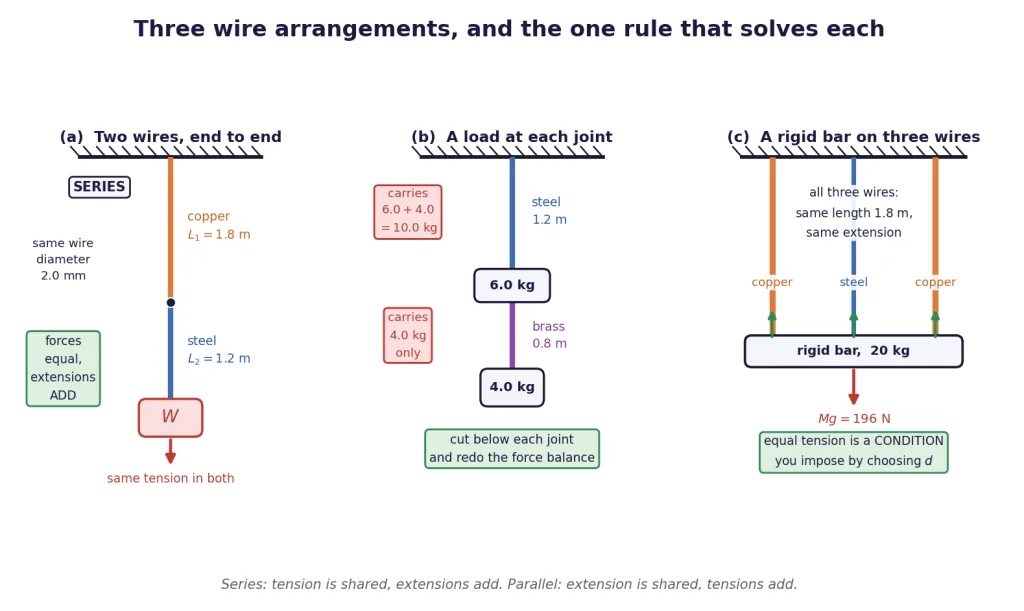
Example 16: A copper wire and a steel wire joined end to end
A copper wire 1.8 m long and a steel wire 1.2 m long, both of diameter mm, are joined end to end and hung from a support. A load is attached to the free end and the total elongation of the pair is measured as mm. Find the load, and how the elongation splits between the two wires. Take Pa and Pa.
Solution:
The rule for series. Cut anywhere and you find the same tension, so each wire carries the full load . The extensions add.
Common area.
Write the total extension in terms of .
Evaluate the bracket.
Solve for .
Split the elongation. The two pieces are in the ratio , that is : Copper is both longer and softer, so it does most of the stretching. Their sum is mm, as required.
Final Answer: the load is about N; the copper stretches mm and the steel mm.
Takeaway: In series, factor the common tension out and add the compliances . The softer, longer wire always takes the larger share of the extension.
Example 17: A load at each joint
A steel wire 1.2 m long hangs from a ceiling. From its lower end a mass of kg is hung, and from that same point a brass wire m long hangs, carrying a further kg at its lower end. Both wires have diameter cm. Find the elongation of each wire. Take Pa, Pa and m/s.
Solution:
The rule here. The tension is not the same in both wires, because there is a load hanging between them. Make an imaginary cut in each wire and add up what hangs below it.
Cut the brass wire. Below the cut hangs only the lower mass:
Cut the steel wire. Below that cut hangs the kg, the brass wire and the kg: (The wires' own weights are neglected, as the data implies.)
Common area. The radius is cm m:
Elongation of the steel wire. that is, mm.
Elongation of the brass wire. that is, mm.
A check on the ratio. Brass carries of the steel's load over of the length with of the modulus, so its extension should be of the steel's. And . Consistent.
Final Answer: the steel wire elongates by mm, the brass wire by mm.
Takeaway: Cut below each joint and re-count what is hanging. A load applied part way down changes the tension above it but not below it, and that is the whole problem.
Example 18: A rigid bar carried by three wires, all pulling equally
A rigid bar of mass 20 kg hangs symmetrically from three vertical wires, each m long. The two outer wires are copper and the middle one is steel. What must the ratio of their diameters be if all three are to carry the same tension? Take Pa, Pa and m/s.
Solution:
The tension in each, from the force balance. Equal tensions plus symmetry give
The condition the bar is rigid. Because the bar cannot bend or tilt, all three wires must extend by exactly the same amount. They all start at the same length, so all three have the same strain:
Turn equal strain into a condition on the areas. Strain is , and the tensions are equal by requirement, so
Hence
Read it physically. Copper is the softer material, so a copper wire must be fatter — by about in diameter — to stretch as little as the steel one under the same pull. Make them the same thickness instead and the stiff steel wire would take the lion's share of the load.
Final Answer: , with each wire carrying N.
Takeaway: A rigid bar is a statement about strains, not about forces. Write "all extensions equal" first, then combine it with the force balance — that pair of equations solves every problem of this family.
Example 19: Where must the load hang for the bar to stay level?
A light rigid bar m long hangs horizontally from two vertical wires attached at its two ends. Both wires are m long with cross-sectional area mm; the left one is steel and the right one is copper. A load of 100 N is to be hung from the bar. (a) Where must it be attached for the bar to stay horizontal? (b) What tension does each wire then carry, and (c) how far does the bar drop? Take Pa and Pa.
Solution:
The horizontal condition. If the bar stays horizontal, both wires must stretch by the same amount: Same length, same area, so the stiffer wire simply takes proportionally more.
(b) Combine with the force balance :
(a) Now the torque balance fixes the position. Take moments about the point where the steel wire meets the bar, and let the load hang a distance from that end: So the load must hang cm from the steel end — nearer the stiff wire, which is what you would guess, because the stiff wire needs the bigger share.
(c) The drop. Use either wire; both must give the same number: Check on the copper side: The same mm, which confirms the bar really is level.
Final Answer: the load must hang m from the steel wire; N and N; the bar drops mm.
[JEE Tip] This is the three-equation template that JEE keeps coming back to: force balance, torque balance, and compatibility of extensions. Two of them are mechanics you already know; the third is the only new thing this chapter adds.
Takeaway: When a rigid body hangs on more than one wire, the geometry supplies the missing equation. Force balance alone is not enough — you always need the statement about how the extensions must be related.
Part 5: Things Being Squashed — Bones, Pillars and Columns
Compression is longitudinal stress with the sign flipped, so the formulas are identical. What changes is that the numbers now come from bodies and buildings.
Example 20: The human pyramid
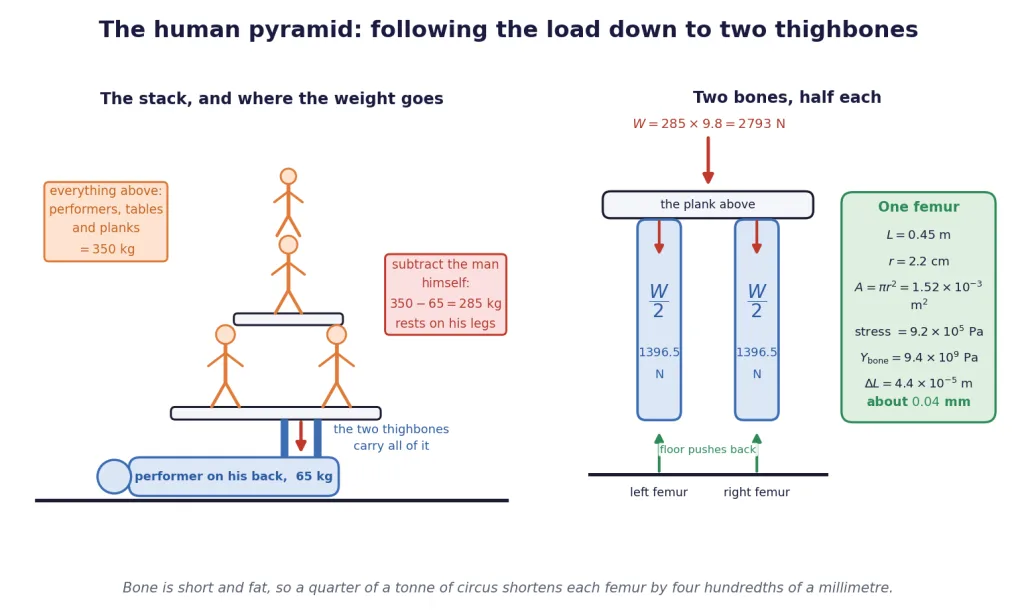
In a circus act the whole of a balanced human pyramid rests on the legs of one performer lying on his back. The combined mass of everybody in the act, together with the tables and planks, is 350 kg. The performer at the bottom himself has a mass of 65 kg. Each of his thighbones is m long with an effective radius of cm. Taking Pa and m/s, find how much each thighbone is compressed by the extra load.
Solution:
Work out what the legs actually carry. The performer's own body is not pressing down on his own thighbones through the plank — the question asks for the compression caused by the extra load above him:
Turn it into a force, and split it between two legs.
Cross-sectional area of one femur.
The stress in the bone.
The compression. about mm, or cm.
As a fraction.
Final Answer: each thighbone shortens by about m, a strain of roughly .
Takeaway: Subtract the bottom performer's own mass before you start. And notice how small the answer is: bone has a modest , but it is short and fat, and area beats modulus every time.
Example 21: What load would a thighbone actually fail at?
Bone will fail in compression at a stress of about Pa. For the femur of the previous problem, of effective radius cm, find the force that would break it, and express it as a multiple of the body weight of a 65 kg person. Take m/s.
Solution:
Use the same area.
Breaking force. about 26 tonnes-weight on one bone.
As a multiple of body weight. A 65 kg person weighs N, so
So why do people break their femurs? Because real falls do not load the bone squarely along its axis. A sideways impact bends the bone, and in bending the stress concentrates on the outer surface and can be tens of times the average — and bone is far weaker in tension and in shear than it is in straight compression. Standing on it, the femur is absurdly over-engineered; twisting it is another matter.
Back to the pyramid. The pyramid produced Pa in the bone. That is about half of one per cent of the failure stress. The act is safe by a factor of nearly 200 — as far as the thighbone is concerned.
Final Answer: about N, roughly 406 times the person's own body weight.
Takeaway: Compare every stress you calculate against the material's limit. An answer of " Pa" means nothing on its own; "half a per cent of the breaking stress" means everything.
Example 22: A concrete pillar under a water tank
A concrete pillar of square cross-section 40 cm by 40 cm and height m carries a water tank of total mass 90 tonnes. Concrete has Pa and a crushing strength of about Pa. Take m/s. Find the stress, the strain and the shortening of the pillar, and say whether it is safe.
Solution:
The load.
The area.
The compressive stress.
Strain and shortening.
Is it safe? The pillar runs at about of its crushing strength — a safety factor of roughly against crushing. That is a normal design margin for a static load, though a real engineer would also check buckling and the strength of the foundation.
Final Answer: stress Pa, strain , shortening mm; safe, at about of the crushing strength.
Takeaway: The whole calculation is , then divide by , then multiply by . What makes it an engineering answer rather than a physics answer is the last line, where you compare it with the limit.
Example 23: A reinforced column — how does the load split?
A short column consists of a concrete block of square section 30 cm by 30 cm with four steel reinforcing rods embedded in it, of total cross-sectional area cm. The column carries an axial load of 400 kN. Steel and concrete are bonded so that they shorten together. Take Pa and Pa. Find how the load divides, and the stress in each material.
Solution:
This is a parallel arrangement. Bonded together and the same length, so both materials must have the same strain . The forces they carry are what differ.
Areas. The steel occupies part of the section, so the concrete area is what is left:
Write each force in terms of the common strain. Since ,
Evaluate the bracket.
The common strain.
Back-substitute for the forces and stresses. Their sum is N, as it must be.
The point of reinforcing. The steel is only of the area but carries of the load, and it runs at almost seven times the stress of the concrete — exactly the ratio . In a parallel arrangement, stress divides in the ratio of the moduli.
Final Answer: steel carries kN at Pa; concrete carries kN at Pa; the common strain is .
Takeaway: Same strain, so stresses are in the ratio of the moduli, and forces in the ratio of . The stiff material always grabs more than its share of the load — which is the reason reinforcement works and also the reason it can fail first.
Part 6: Shear — Sliding, Not Stretching
The one place where using the wrong area is almost guaranteed unless you are deliberate about it.
Key Point: Here is the face the force acts along — the face being dragged — and is the perpendicular distance between the dragged face and the fixed one. For small , in radians equals .
Example 24: A copper cube stuck to a wall
A solid copper cube of edge cm has one face cemented firmly to a vertical wall. A mass of 150 kg is hung from the opposite (outer) face. For copper Pa. Take m/s. Find the vertical deflection of the loaded face.
Solution:
Identify the deformation. The hanging weight drags the outer face downwards while the cemented face cannot move. One face slides relative to the other, parallel to itself — that is shear.
The shearing force.
The right area. The force acts along the outer face, so is the area of that face:
Shearing stress.
Shearing strain.
The deflection. The perpendicular distance between the fixed face and the loaded one is the cube's edge: about micrometres.
Final Answer: the loaded face drops by about m, with a shearing strain of rad.
Takeaway: In shear, both and mean something different from what they mean in tension. is the face the force runs along; is measured across the block, perpendicular to the sliding. Get those two right and the rest is one division.
Example 25: The force needed to move a block a stated amount
A brass block with a base cm by cm and a height of cm is bonded to a rigid bench. What tangential force applied to its top face will move that face sideways by mm? For brass, Pa.
Solution:
Work out the shearing strain first, because it needs no force at all: Note is the height, cm, not an edge of the loaded face.
Turn strain into stress with the modulus.
The loaded face is the top, so
The force. about kN, or four and a half tonnes-weight — to move the top of a brass block by one hundredth of a millimetre.
Why so enormous? Because for a metal is around Pa. Metals resist shear almost as fiercely as they resist stretching, which is exactly why you cannot deform a machine part with your hands.
Final Answer: about N.
Takeaway: Go strain stress force when the displacement is given, and force stress strain when the force is given. Both directions are the same three quantities; only the order changes.
Example 26: A rubber pad in an engine mounting
A rubber block cm by cm and cm thick is bonded between two steel plates, the lower one fixed. A horizontal force of 480 N is applied to the upper plate. The rubber has Pa. Find the shearing stress, the angle of shear in degrees, and the sideways displacement of the upper plate.
Solution:
The bonded face area.
Shearing stress.
Shearing strain.
In degrees.
The displacement.
Compare with the brass block above. Almost a hundred times less force, and the displacement is a hundred times bigger — because for rubber is about times smaller. That enormous compliance in shear is precisely what an engine mounting is for: it lets the engine move a millimetre or two instead of transmitting the vibration into the chassis.
A caution about the small-angle step. At rad, , so using instead of costs about . Fine here. For rubber sheared through or more it would not be.
Final Answer: shearing stress Pa, angle of shear , displacement mm.
Takeaway: A small is a design feature, not a defect. Anywhere you want motion to be absorbed rather than transmitted, you put in something with a shear modulus five orders of magnitude below the metal around it.
Example 27: Shearing a rivet
Two steel plates are joined by a single rivet of diameter mm, and the plates are pulled apart with a force of kN. (a) Find the shearing stress in the rivet. (b) If the plates themselves have a cross-sectional area of mm at the joint, find the tensile stress in a plate and compare. (c) If the rivet material can stand a shearing stress of Pa, how many such rivets are needed for a joint carrying 20 kN?
Solution:
How the rivet is loaded. The two plates try to slide past each other, and the rivet is cut across by that sliding. The relevant area is the rivet's circular cross-section, the plane on which the shearing happens:
(a) Shearing stress in the rivet.
(b) Tensile stress in a plate. The two are comparable — which is exactly how a joint should be designed. A joint far weaker than the parts it joins is a wasted structure; a joint far stronger is wasted metal.
(c) How many rivets for 20 kN. Each rivet may carry
Round up, never down. You cannot fit two-thirds of a rivet, and rounding down would overload the joint. Three rivets are needed, and they will then run at Pa, safely under the limit.
Final Answer: (a) Pa; (b) Pa in the plate, comparable to the rivet's; (c) three rivets.
Takeaway: The plate is in tension, the rivet is in shear, and the two use different areas. The plate's area is its section perpendicular to the pull; the rivet's is its own circular section lying in the sliding plane. Confusing them is the classic error in every joint problem.
Part 7: Squeezed From Every Side
Everything in this part is one equation and its rearrangements.
Key Point:
The minus sign exists so that comes out positive: raising the pressure always decreases the volume, so and always have opposite signs. In problems you almost always want the magnitude of the fractional change, so work with magnitudes and put the "decrease" in words.
Example 28: A brass cube in a hydraulic press
A solid brass cube of edge cm is subjected to a hydraulic pressure of Pa. Brass has Pa. Find the contraction in its volume.
Solution:
Original volume.
Fractional change.
Actual change.
In friendlier units. One cubic millimetre is m, so about the volume of a small drop of water, taken out of a cube the size of your fist by a pressure of 50 atmospheres.
A shortcut worth knowing. Because each edge contracts by of the volume strain, the edge shortens by micrometres. That is where the relation for a uniformly compressed solid comes from.
Final Answer: the volume decreases by about m, that is mm.
Takeaway: Get the fractional change first, then multiply by the volume. Doing it the other way round means carrying a huge modulus through the arithmetic and inviting a power-of-ten slip.
Example 29: An aluminium block under fifteen atmospheres
Find the fractional change in the volume of an aluminium block subjected to an extra hydraulic pressure of 15 atmospheres. Aluminium has Pa, and one atmosphere is Pa.
Solution:
Convert the pressure to SI first. This is the step people skip.
Apply the definition.
As a percentage. about two thousandths of one per cent.
What this tells you about solids. Fifteen atmospheres is the pressure at a depth of roughly 150 m of water, and it changes the block's volume by two parts in a hundred thousand. Solids are, for almost every practical purpose, incompressible — and this number is why.
Final Answer: , that is about .
Takeaway: Convert atmospheres to pascal before anything else. The commonest wrong answer in this family is exactly times too small.
Example 30: Finding the bulk modulus from a measurement
A sealed vessel contains litres of an oil. When the pressure on it is raised by atmospheres, the volume falls to litres. Take one atmosphere as Pa. (a) Find the bulk modulus of the oil and its compressibility. (b) Compare with air at atmospheric pressure held at constant temperature, for which Pa, and explain the size of the ratio.
Solution:
(a) The volume strain. Work in litres — the units cancel:
The pressure change in SI.
The bulk modulus.
Compressibility is just its reciprocal. which reads as "a fractional volume loss of for every extra pascal", or about per atmosphere.
(b) The comparison with air. The oil is about eighteen thousand times harder to compress.
Why the ratio is so large. In a liquid the molecules are already touching. To reduce the volume you must push the molecules themselves closer than their equilibrium separation, and the interatomic repulsion that resists this is enormous. In a gas the molecules are hundreds of diameters apart and almost all of the volume is empty space; reducing the volume merely means giving them less room to fly about in, and nothing has to be squashed at all.
Final Answer: Pa with Pa; the oil is about times less compressible than air, because a liquid's molecules are already in contact while a gas is mostly empty space.
Takeaway: Volume ratios can be computed in whatever unit the data comes in. Only the pressure has to be converted to pascal, because is asked for in pascal.
Example 31: How hard must you squeeze water?
By how much must the pressure on a litre of water be raised to compress it by ? Water has Pa, and one atmosphere is Pa.
Solution:
Translate the percentage.
Rearrange the definition for .
In atmospheres.
Where "a litre" went. Nowhere. The answer does not depend on how much water there is, because both sides of the equation are fractional. Quoting the litre in the question is a deliberate distraction.
A feel for the number. Eleven atmospheres is the pressure about 110 m down in the sea, and it buys you a volume reduction of one part in two thousand. Water is very nearly incompressible — but only very nearly, which is what makes the ocean-depth problems in this chapter possible at all.
Final Answer: the pressure must be raised by Pa, about atmospheres.
Takeaway: Anything expressed as a percentage change is already a strain — divide by 100 and use it. And a quantity of material that cancels out is a hint, not a mistake in the question.
Example 32: Sea water at depth, and how much heavier it gets
At a certain depth the gauge pressure in the sea (that is, the pressure in excess of atmospheric) is atmospheres. At the surface, sea water has a density of kg/m and a bulk modulus of Pa. Take one atmosphere as Pa and m/s. Find (a) the depth, (b) the fractional change in volume, and (c) the density of the water there.
Solution:
Say which pressure you are using, out loud. The compression is produced by the pressure in excess of what the water was already under at the surface. So is the gauge pressure, and atmospheric pressure is deliberately excluded:
(a) The depth. From , using the surface density: (Strictly the water below is slightly denser, so the true depth is a metre or two less; at this precision it does not matter.)
(b) The volume strain. a contraction of about .
(c) From volume to density. A fixed mass in a smaller volume is denser:
The increase. a rise of about — the same fraction as the volume loss, which is the check that the algebra is right. To first order,
Why the approximation is safe here. Expanding for gives , and the term contributes only — about three parts in a thousand of the answer for . So kg/m against the exact ; the difference does not show at three figures.
Final Answer: (a) about 602 m deep; (b) a volume contraction of ; (c) a density of about kg/m, an increase of kg/m.
Takeaway: Use gauge pressure for the compression, and say so. And remember that only because the mass is what stays fixed — that is the whole content of the density step.
Part 8: Sideways Effects, and Converting Between the Four Constants
Remember the convention: here is Poisson's ratio, and stress is written .
Key Point: Any two of , , , fix the other two, which is why an isotropic solid has only two independent elastic constants.
Example 33: How much thinner does a stretched rod get?
A steel rod of diameter mm and length m is pulled by a force of 10 kN. For steel take Pa and . Find (a) the elongation, (b) the decrease in diameter, and (c) the fractional change in volume.
Solution:
Area and stress.
(a) Longitudinal strain and elongation.
(b) The lateral strain follows from Poisson's ratio. The rod gets micrometres thinner — about a thirtieth of the thickness of a human hair.
(c) The volume change. an increase, because .
Is the linearised formula good enough? Multiply out the real deformed dimensions instead. The new length is and the new diameter is , so Putting the numbers in gives against the linear — a difference of about of the answer. So yes, at metal-sized strains the linear formula is excellent; at a strain of it would not be.
Final Answer: (a) mm; (b) the diameter falls by m; (c) the volume rises by a fraction .
Takeaway: A stretched rod gains volume unless is exactly . The thinning never quite compensates the lengthening, and the shortfall is measured by the factor .
Example 34: Poisson's ratio from two measurements
A wire m long and mm in diameter is loaded. Its length increases by mm and its diameter decreases by mm. Find Poisson's ratio for the material, and the percentage change in the wire's volume.
Solution:
Longitudinal strain.
Lateral strain, in magnitude:
Poisson's ratio. The definition carries a minus sign so that the answer comes out positive; taking magnitudes,
Check it is physically possible. For an isotropic solid , and metals sit between about and . Our is comfortably in range — a plausible value for a metal.
The volume change. an increase, again.
Final Answer: , and the volume increases by about .
Takeaway: Convert both changes to strains before dividing. The diameter change and the length change are in wildly different units here ( mm against mm), and the only safe move is to make each one dimensionless first.
Example 35: Checking the relations against real metals
For steel, copper and aluminium, take the measured values , and Pa, with , and respectively. Predict and for each from the relations, and compare with the measured , , Pa and , , Pa. How well do they actually agree?
Solution:
The two relations, rearranged for what we want.
Steel, :
Copper, :
Aluminium, :
Lay the comparison out honestly.
| Metal | predicted | measured | error | predicted | measured | error |
|---|---|---|---|---|---|---|
| Steel | ||||||
| Copper | ||||||
| Aluminium |
- What the errors mean. The relations are exact for a perfectly isotropic, perfectly homogeneous solid. Real metals are polycrystalline, are usually rolled or drawn (which gives the grains a preferred direction), and the tabulated , , and are measured on different samples by different methods. Agreement within five to ten per cent is therefore about what you should expect, and that is what we get. Anyone who tells you these relations reproduce tabulated data to three figures has not tried it.
Final Answer: the predictions agree with the measured values to within about in the worst case (copper's ) and about in the best (steel's ) — good enough to be genuinely useful, not good enough to be called exact for real metals.
[JEE Tip] In an exam the data will be self-consistent, so use the relations freely and trust them. The point of this example is to know why real tables do not match perfectly, which is the kind of thing an interview or a conceptual question asks.
Takeaway: The inter-constant relations are exact for an ideal isotropic solid and good to a few per cent for a real metal. Quote them with confidence, but do not be surprised when a data book disagrees in the second figure.
Example 36: From and back to and
A metal has bulk modulus Pa and shear modulus Pa. Find its Poisson's ratio and its Young's modulus.
Solution:
Use the relation that takes and straight to .
Compute the pieces.
Divide.
Now , from either relation. Using :
Cross-check with the other one. Using : The two routes agree exactly, as they must for self-consistent data.
A third route, if you prefer it. The combined form gives , so Pa. Same answer, and it skips altogether.
Final Answer: and Pa.
Takeaway: Always finish by checking your against the second relation. It costs one line and catches every algebra slip, because the two routes are genuinely independent.
Part 9: The Energy Stored in a Stretched Body
The trap in this part is a factor of two, and it catches people every single year.
Key Point: The restoring force grows from to as the wire stretches, so the work done is the area under the force-extension graph, a triangle: and per unit volume, It is never . That would be the work if the full force acted from the very first instant, which it does not.
Example 37: The energy in a taut wire, checked three ways
A steel wire m long with a cross-sectional area of mm is stretched by mm. Taking Pa, find the tension and the energy stored, and verify the answer by three different routes.
Solution:
The tension. From ,
Route 1 — the triangle.
Route 2 — the spring form. The wire's force constant is
Route 3 — energy density times volume.
All three agree. They are the same equation wearing different clothes, and which one is quickest depends entirely on what the question hands you.
Final Answer: the tension is N and the stored energy is J, with an energy density of J/m.
Takeaway: Learn all three forms. A question that gives you stress and but not the dimensions is unanswerable by the first route and trivial by the third.
Example 38: Two wires of the same mass
Two wires are drawn from the same 50 g piece of steel; one is m long and the other m. Each carries the same load of 100 N. Taking kg/m and Pa, compare the energy stored in them.
Solution:
Same mass means the areas are not free parameters. Since , so the longer wire is automatically thinner — halving the area when you double the length.
Compute the areas.
Extensions. Four times as much, not twice.
Energies.
See it algebraically. Substituting into , so for a fixed mass and a fixed load, . Doubling the length quadruples the stored energy.
Final Answer: the longer wire stores four times as much energy, J against J.
Takeaway: When the mass is fixed, length and area are not independent. Substitute early and the whole problem collapses into a single power of .
Example 39: The energy in a lift cable, and where the rest of it went
A steel cable 30 m long with a cross-sectional area of cm carries a load of 15 kN. Take Pa. Find (a) the extension, (b) the elastic energy stored in the cable, and (c) the loss of gravitational potential energy of the load as it settles. Account for the difference.
Solution:
(a) The extension. that is, mm.
(b) The stored elastic energy.
(c) The load descends by exactly that mm, so it loses
The difference is exactly half.
Where does it go? It depends on how the load was applied.
- If the load is released suddenly, the cable overshoots to twice the static extension, oscillates, and internal friction turns the missing J into heat over the next few seconds.
- If the load is lowered gently, so that it is always in equilibrium, then your hand does negative work of J on the way down and the books balance without any heat at all.
Either way the elastic energy stored is J, because that is fixed by the final extension alone.
Final Answer: (a) mm; (b) J stored; (c) the load loses J, and the missing J is either dissipated (sudden release) or absorbed by whatever lowered the load (gentle placing).
Takeaway: The stored energy is always half the load times the extension, never the whole of it. The other half is the single most reliable source of a "where did the energy go?" question in the paper.
Example 40: Toughness read off an idealised curve
A metal has a stress-strain curve that may be idealised as follows: a straight elastic line from the origin up to a stress of Pa at a strain of , then a flat plastic plateau at that same stress until the specimen fractures at a strain of . Find (a) Young's modulus, (b) the energy absorbed per unit volume up to the elastic limit, (c) the total energy absorbed per unit volume up to fracture, and (d) the energy absorbed by a specimen of volume m.
Solution:
(a) The modulus is the slope of the straight part.
(b) The elastic part is a triangle. This quantity has a name: the modulus of resilience, the energy a material can absorb and give straight back.
(c) The plastic part is a rectangle, of height Pa and width : This total is the toughness.
(d) Multiply by the volume.
The number worth remembering. Almost all of a ductile metal's energy absorption happens after it has yielded. That is precisely why a car body is designed to crumple: the elastic region can absorb almost nothing, and the plastic region can absorb more than a hundred times as much.
Final Answer: (a) Pa; (b) J/m; (c) J/m; (d) J.
Takeaway: Toughness is the whole area under the curve; resilience is only the elastic triangle. A material can be strong and yet store almost no energy, and it can be soft and yet absorb an enormous amount.
Part 10: Thermal Stress
A body prevented from expanding is a body being squeezed. This material sits outside the rationalised syllabus body text, but Boards, JEE Main and NEET ask it every year, so it is worked here from first principles.
Key Point: Heat a rod through and it wants to grow by . Clamp it and that growth is forced back, so the rod carries a compressive strain of exactly and a stress The stress does not depend on or on . A short thin rod and a long thick one, of the same material and the same temperature rise, develop the same stress. Only the force differs.
Example 41: A bridge joint that was made too small
A steel girder 24 m long is laid with an expansion gap of mm at one end. Its temperature then rises by °C. Steel has per °C and Pa, and the girder's cross-sectional area is m. Find (a) how much the girder would have expanded freely, (b) the stress it develops, and (c) the force it pushes on the abutment with.
Solution:
(a) The free expansion, if nothing were in the way.
How much of that is allowed? The gap absorbs mm. The rest is refused:
(b) Turn the refused expansion into a strain, using the girder's own length: compressive.
(c) The force. about 210 tonnes-weight pushing sideways on the abutment.
What a big enough gap would have been. Any gap of mm or more leaves the girder completely unstressed. Designers usually add a margin on top of that, which is why expansion joints on a real bridge look uncomfortably wide on a cold morning.
Final Answer: (a) mm of free expansion; (b) a compressive stress of Pa; (c) a force of N.
Takeaway: Compute the free expansion first, subtract whatever movement is permitted, and only then convert what is left into a strain. A fully clamped rod is just the special case where nothing is permitted.
Example 42: The clamped rod, and why the answer does not care how big the rod is
A steel rod of length m and cross-sectional area cm is clamped between two rigid walls with no initial stress, and then heated through °C. Take per °C and Pa. Find (a) the stress, (b) the force on each wall, and (c) show that the stress would be unchanged for a rod m long with an area of cm.
Solution:
- Do it in two explicit steps, so the logic is visible.
Step one — let it expand freely. It would grow by
Step two — now squeeze it back to its original length. The compression needed is that same mm, so the strain is which is, of course, just .
(a) The stress.
(b) The force. about tonnes-weight, from a rod the thickness of a thumb, heated by no more than the difference between a winter night and a summer afternoon.
(c) Change the rod completely. With m the free expansion is m, and the strain is exactly as before — the cancelled. So the stress is again Pa. The force, however, scales with the area: four times bigger, because the area is four times bigger.
The moral. Whether a clamped rod survives depends on the material and the temperature change alone. Making the rod fatter does not protect it — it only makes the force on the walls larger.
Final Answer: (a) Pa; (b) N; (c) the same Pa, with a force of N.
Takeaway: contains no length and no area. If your answer changes when the rod's dimensions change, you have made an algebra error somewhere.
Example 43: A shrink-fitted steel ring
A steel ring is made with an inner circumference smaller than the circumference of the wheel it is to be fitted to. It is heated until it just slips over the wheel and then allowed to cool. Steel has per °C and Pa. Find (a) the temperature rise needed to fit it, and (b) the tensile stress in the ring once it is cold and gripping the wheel.
Solution:
Treat the ring as a bar of length equal to its circumference. Stretching or heating a ring changes its circumference in exactly the same proportion as it changes its diameter, so a "circumferential strain" behaves just like a longitudinal strain in a straight bar.
(a) The strain it must gain to fit. Thermal expansion supplies this as , so A rise of about °C — a hot-water bath will do it.
(b) The stress when cold. Once the ring is on the wheel it cannot shrink back. The wheel holds it stretched by exactly the strain it gained: a tensile hoop stress, because the ring is being held larger than it wants to be.
Check it is safe. Steel yields around Pa, so at Pa the ring is at of yield — tight, but elastic, which is what makes the grip permanent. Design the ring undersize instead and the stress would be Pa: the ring would yield on cooling, permanently stretch, and grip far more weakly than intended.
Final Answer: (a) a temperature rise of about °C; (b) a tensile hoop stress of Pa.
Takeaway: A shrink fit is thermal stress used on purpose. The same equation that buckles railway lines is what holds a locomotive tyre on its wheel — the sign of is the only difference.
Part 11: Reading Graphs, and Six Problems That Use Everything
Example 44: Reading a modulus and a yield strength off a graph
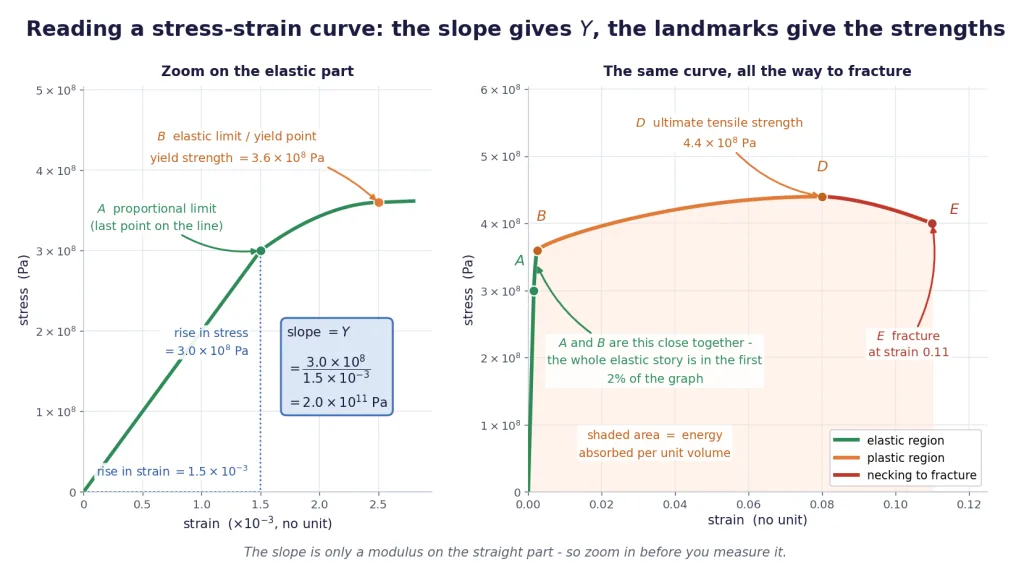
The graph below is the stress-strain curve for a certain ductile metal. Its straight portion passes through the point where a stress of Pa produces a strain of . The curve leaves the straight line at that point, and the material yields at a stress of Pa. Find (a) Young's modulus and (b) the approximate yield strength.
Solution:
(a) The modulus is the slope of the straight portion, and nothing else. Not the slope of a chord to some later point, and certainly not the slope of the curved part.
(b) The yield strength is a stress, read off the vertical axis at the point where the curve stops being straight and the material starts to take a permanent set:
Why the zoomed panel matters. On the full-scale graph, which runs out to a strain of , the whole elastic region is squeezed into the first two per cent of the horizontal axis and looks like a vertical line. You cannot measure a slope off that. Always find the magnified version of the elastic region before you try to measure — and if only the full graph is given, use the coordinates of a labelled point rather than a ruler.
A units check that costs nothing. Strain has no unit, so the modulus must come out in the units of stress, which is pascal. If your answer has any other unit, the arithmetic is wrong.
Final Answer: (a) Pa; (b) the yield strength is about Pa.
[Board Important] Note the enormous difference in the numbers: the modulus is around Pa and the strength around Pa. A modulus is a slope; a strength is a height. They differ by about a thousand for a metal, and if the two answers come out anywhere near each other you have confused them.
Takeaway: Slope for , intercept height for a strength. Two completely different readings off the same graph, and mixing them up is the single most common graph error in this chapter.
Example 45: Stiffer, or stronger?
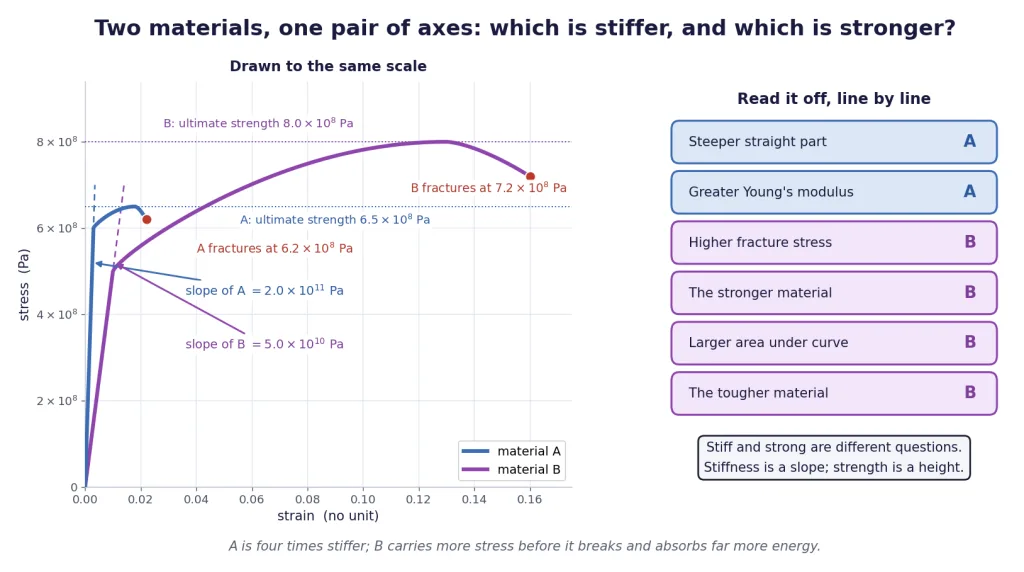
Two materials, A and B, have their stress-strain curves drawn to the same scale on one pair of axes, as shown. (a) Which has the greater Young's modulus? (b) Which is the stronger material? (c) Which absorbs more energy before it breaks?
Solution:
(a) Greater means the steeper straight portion. A's straight line rises to Pa by a strain of , so B's rises to Pa by a strain of , so A has the greater Young's modulus, by a factor of four. A is the stiffer material.
(b) Stronger means it withstands a greater stress before failing. A's curve tops out at Pa; B's reaches Pa. B is the stronger material.
This is the whole point of the problem. The steeper curve does not automatically belong to the stronger material. Stiffness and strength are two different properties measured off two different features of the same graph.
(c) Energy absorbed is the area under the curve. B's curve is only slightly lower for part of the way but extends to a strain of instead of — more than seven times as far. Its area is far larger, so B absorbs much more energy and is the tougher material.
A design consequence. If you want a beam that barely bends, choose A. If you want a component that survives being overloaded, choose B. Glass has a large and shatters; mild steel has a smaller and bends for a long time before it gives up.
Final Answer: (a) A, with Pa against Pa; (b) B, reaching Pa against A's Pa; (c) B, whose curve encloses much the larger area.
Takeaway: Stiff, strong and tough are three separate readings off one graph — the slope, the highest point, and the area. A material can score well on any one of them and badly on the others.
Example 46: Sizing a lift cable properly
A lift cabin of mass 1500 kg is to carry 12 passengers of average mass 65 kg and accelerate upwards at m/s. The steel cable has a yield strength of Pa and a safety factor of 6 is required. Take m/s. Find the minimum diameter of the cable.
Solution:
Total mass being lifted.
The tension is NOT just . The cabin is accelerating upwards, so Newton's second law gives The acceleration adds about to the load, and forgetting it is the classic slip in this problem.
The stress the cable is allowed to run at. A safety factor of 6 means the working stress is one sixth of the yield strength:
Minimum area.
Minimum diameter.
Specify it sensibly. Round up to a standard size — 28 mm or 30 mm. And in a real lift the cable would be braided from many thin wires rather than drawn as one bar, so that a single flaw cannot take the whole cable at once.
Final Answer: a minimum diameter of about mm, so specify 28 mm or larger.
Takeaway: Acceleration first, safety factor second, geometry last. The safety factor divides the stress, not the load — dividing the load by 6 instead gives the same answer here only by accident of the algebra, and gives the wrong answer as soon as the cable's own weight enters.
Example 47: How much does a footbridge beam sag?
A steel beam of span m, breadth cm and depth cm is supported at its two ends and carries a load of 800 kg at its centre. For a beam of length , breadth and depth carrying a central load , the sag is Take Pa and m/s. Find (a) the sag, and (b) the sag if the span is reduced to m with everything else unchanged.
Solution:
The load in newtons.
(a) Carry the units through explicitly. The numerator is and the denominator is
Divide. Units: m. Correct.
(b) Shorten the span. Only changes:
The three lessons hiding in the formula. Depth enters as , breadth only as , and span as . So turning a plank on its edge is worth far more than making it wider, and adding an intermediate support (which halves the span) reduces the sag eightfold. That is why bridges have piers and why floor joists stand on edge.
Final Answer: (a) the beam sags mm; (b) with a m span it sags mm.
Takeaway: Carry the units through a formula you did not derive yourself. If had not come out as metres, you would know at once that a term had been dropped.
Example 48: A mass whirled in a vertical circle
A mass of kg is fastened to the end of a steel wire of unstretched length m and cross-sectional area cm, and whirled in a vertical circle at revolutions per second. Take Pa and m/s. Find the elongation of the wire when the mass is at the lowest point of its path.
Solution:
Why the lowest point. There the wire must both support the weight and supply the centripetal force, so the tension is at its maximum. At the top the weight helps, and the tension is least.
Angular speed.
Newton's second law at the lowest point, taking upward (towards the centre) as positive: Notice how completely the rotation dominates: the weight is under of the tension.
Convert the area — this is where marks are lost. One square centimetre is m, so
The elongation.
Check the stress. just under steel's yield strength of about Pa. The wire survives — barely.
A refinement worth knowing about. The radius of the circle is really , not , so the centripetal term is slightly larger, which makes slightly larger, and so on. Solving that loop self-consistently gives N and mm — a correction of about . Use the unstretched length; the feedback is negligible at metal-sized strains.
Final Answer: the wire elongates by about mm, at a stress of Pa.
Takeaway: Do the dynamics first and the elasticity second. is the easy half; the whole difficulty is knowing that at the bottom and at the top.
Example 49: How much of Everest's strength is being used up?
Mount Everest stands about km above its base. Rock has a density of about kg/m and an elastic limit in shear of roughly Pa. Take m/s. (a) Find the stress at the base of the mountain and express it as a fraction of the elastic limit. (b) Find the greatest height such a mountain could have. (c) Comment on how much you actually trust the answer to (b).
Solution:
(a) The stress at the base is the weight of the column above, divided by the area it stands on. For a column of height and area , The area cancels, which is why a mountain's width does not appear anywhere in this argument.
As a fraction of the limit. Everest is running at about of the elastic limit of its own rock. It is not comfortably safe — it is close to the edge.
(b) The maximum height. Set : about km. Everest is km, so the tallest mountain on Earth is about of the tallest mountain that could exist here — which is a remarkable thing for a two-line calculation to get right.
(c) How much do we trust it? Not to three figures. Push the inputs around:
- Take the rock as granite at kg/m instead: km.
- Take a denser basalt at kg/m: km.
- Take the elastic limit as Pa instead: km — below Everest.
- Take it as Pa: km.
So the honest answer is "about ten kilometres, give or take a factor of nearly two". Both and enter to the first power, so a error in either moves the answer by , and our knowledge of the elastic limit of real rock is nowhere near that good.
- What the estimate is really for. Not to predict Everest's height, but to answer the question why is there any limit at all — and to show that the limit is set by the strength of rock and the strength of gravity, so a lower-gravity world can carry taller mountains. Mars, with m/s, gets a limit of km, and Olympus Mons stands about 22 km high.
Final Answer: (a) about Pa, which is of the elastic limit; (b) km; (c) trustworthy to about a factor of two, since the answer is directly proportional to both the assumed density and the assumed elastic limit.
Takeaway: An order-of-magnitude estimate is only honest if you say how far it could be wrong. Quote km, name the two inputs it hangs on, and say what happens when each of them moves — that is what turns a number into physics.