
How to Use This Section
This is the last section of the chapter, and it is built for one job: to be read the night before the paper, and again in the queue outside the hall.
Nothing new is taught here. Every card below compresses something an earlier section worked through properly, in the same notation and with the same numbers. So if a line here surprises you, that is not a line to memorise — it is a signal to go back and reread the section that owns it.
Six formula cards, two figures, one comparison table of real moduli, one decision chart, one mistake checklist, one 60-second panic list and one fast self-test. Screenshot the two figures.
Five Notation Reminders
This chapter has one genuinely dangerous symbol clash, and the reminders below keep it from costing you marks.
- is Poisson's ratio — not stress, because that is the symbol it carries in the Class 11 syllabus and in most Indian question papers. Stress is written as wherever it can be, and where a symbol is genuinely needed it is for longitudinal stress, for shearing stress and for hydraulic stress. Elsewhere often denotes stress, with or for Poisson's ratio, so check the convention before copying a formula out of another book.
- Strain is , always a pure number. Longitudinal strain is , shearing strain is in radians, volume strain is , lateral strain is .
- The moduli are , and , and compressibility is .
- is the coefficient of linear thermal expansion and the temperature change.
- Two minus signs are load-bearing, and both exist for the same reason — to keep a constant positive. They are explained on the cards where they live, and they are the two places in this chapter where a sign is worth a mark on its own.
Every card that puts a number on the page uses Pa, Pa, Pa, Pa and Pa. Never mix and inside one problem — pick one, write it at the top of your working, and use it everywhere.
Four topics on these cards that the body text does not carry
Thermal stress, elastic hysteresis and elastic fatigue, the relations between the elastic constants, and the wire treated as a spring with all sit outside the rationalised syllabus. Boards, JEE Main, JEE Advanced and NEET ask them every year, so they are on these cards in full.
Card 1 — Stress, Strain, Hooke's Law and the Curve
The two definitions
Key Point — stress: the internal restoring force per unit area across a chosen section of a deformed body. SI unit N/m, called the pascal (Pa). Dimensions — the same as pressure.
Key Point — strain: the fractional change in a dimension. No unit and no dimensional formula. A pure number.
Stress has the dimensions of pressure and is not pressure. Pressure is a scalar that a fluid exerts on whatever it touches, normal to the surface and the same in every direction; stress is an internal quantity that needs a chosen section to be defined at all, and it can act along the section as well as across it. Stress is not a vector — you cannot give it a single direction, because it takes both a force direction and a face orientation to specify it.
The three pairs, which is the whole chapter in one table
| Deformation | Stress | Strain | What changes | Modulus |
|---|---|---|---|---|
| stretch or squash a rod | longitudinal, with normal to the face | length | ||
| slide one face over another | shearing, with along the face | shape, not volume | ||
| squeeze from every side | hydraulic, | volume, not shape |
Longitudinal stress splits into tensile (pulling, the rod gets longer) and compressive (pushing, it gets shorter). The formulas are identical; only the sign of changes.
Hooke's law
Key Point: For small deformations, stress is directly proportional to strain: The constant is a modulus of elasticity, with the same unit as stress, pascal, because strain has no unit. This is an empirical approximation valid over the early part of the curve only — not a fundamental law of nature.
The stress-strain curve, landmark by landmark
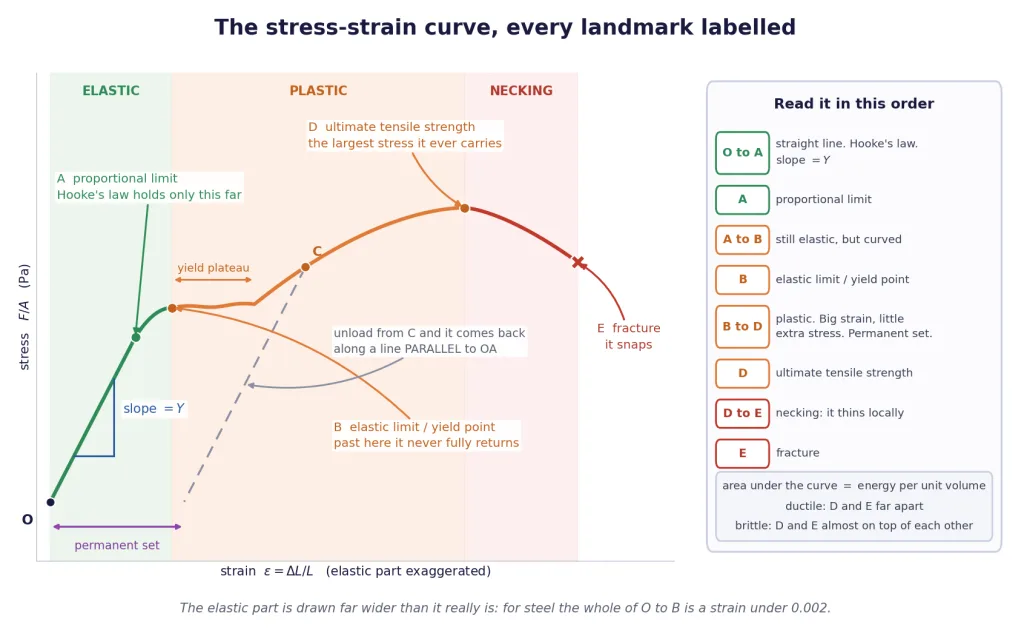
| Landmark | Name | What it means |
|---|---|---|
| to | the proportional region | a straight line. Hooke's law holds. Slope |
| proportional limit | the last point at which stress strain | |
| to | still elastic, but curved | unload anywhere here and it returns to |
| elastic limit / yield point | past here it never fully returns | |
| to | the plastic region | large strain for very little extra stress; a permanent set appears |
| ultimate tensile strength | the largest stress the specimen ever carries | |
| to | necking | it thins locally, so the load it can hold falls |
| fracture | it snaps |
Four readings that get asked directly:
- Unloading from a point inside the plastic region goes back along a line parallel to , not down the original curve, and stops short of the origin. What is left over is the permanent set.
- The area under the curve is the energy absorbed per unit volume. Right up to , that is the toughness.
- Ductile materials have and far apart, with a long plastic stretch — copper, mild steel, gold. Brittle materials have and almost on top of each other and almost no plastic region at all — glass, cast iron, ceramic. A brittle material can be very strong and still store very little energy.
- Elastomers — rubber, the tissue of the aorta — stretch to several times their length, return completely, and yet have no straight portion anywhere. They are elastic and not Hookean. Elasticity and linearity are different properties.
Key Point — the misconception the paper loves: steel is more elastic than rubber. "More elastic" means a bigger restoring stress for the same strain, that is a larger — not a bigger stretch. Steel stretches far less than rubber under the same load, and that is precisely why it is the more elastic of the two.
[Board Important] "Define stress and strain and give the SI unit and dimensional formula of each" is a standard two- or three-mark question. The mark for strain is earned by saying explicitly that it has no unit and no dimensions.
Card 2 — , , and Compressibility
Young's modulus
Key Point: and therefore is a property of the material, never of the particular wire. Cutting a wire in half does not change its .
Everything that gets asked about a loaded wire is contained in at a fixed load: longer stretches more, thicker stretches much less, and the radius enters squared through the area .
Three consequences worth carrying:
- A stretched wire is a spring, with force constant so wires combine exactly as springs do — in series with the same tension in both and extensions that add, and in parallel with the same extension in both and loads that add.
- Breaking stress is a material property. It does not depend on the length. Halve a wire and the load it can carry is unchanged — the stress at which it fails is what is fixed. The greatest length that can hang under its own weight follows:
- Under its own weight alone, a hanging wire extends by the same answer as hanging half its weight at the free end, because the tension grows linearly from zero at the bottom to the full weight at the top.
Shear modulus
Key Point: with the area of the loaded face — the face the force acts along — and the distance between the sheared faces. Rearranged: , , and .
Two things about . It is the angle in radians, and is what makes and the angle the same number. A question that says "sheared through " is handing you a number you must convert — substituting directly inflates the answer by a factor of .
Key Point: A fluid at rest cannot sustain a shearing stress — that is what it means to be a fluid, and it is why liquids and gases have no and no , only . It is also why the chapter is called mechanical properties of solids.
Torsion is shear wrapped round an axis: twisting a rod through an angle shears every element of it, and the torsional rigidity is the couple per unit twist, , which grows as the fourth power of the radius.
Bulk modulus and compressibility
Key Point: Why the minus sign is there: raising the pressure always decreases the volume, so and always carry opposite signs and the ratio is intrinsically negative. The minus sign in front cancels that, so that comes out positive for every real substance. It is not decoration and it is not optional.
Key Point — compressibility: SI unit Pa (that is, m/N). It measures how easy a substance is to squeeze, where measures how hard.
For an ideal gas compressed isothermally, is constant, and differentiating gives — so a gas has no fixed bulk modulus at all: squeeze it harder and it gets harder to squeeze.
The comparison table — print it, learn the pattern, not the digits
| Material | State | (Pa) | (Pa) | (Pa) | (Pa) | |
|---|---|---|---|---|---|---|
| Steel | solid | 0.29 | ||||
| Copper | solid | 0.34 | ||||
| Aluminium | solid | 0.33 | ||||
| Glass | solid | 0.22 | ||||
| Rubber | solid | about | about | about | about 0.50 | about |
| Water | liquid | none | none | none | ||
| Air at STP | gas | none | none | none |
Typical values for ordinary engineering grades. Real samples vary by a few per cent with composition and treatment, and rubber varies by far more than that.
Five things to read off it, all of which have been examination questions:
- Liquids and gases have blank cells under and . They cannot be stretched and they cannot be sheared. is the only modulus that means anything for all three states.
- The three states separate by orders of magnitude in — around Pa for solids, Pa for liquids, Pa for gases. Air is more compressible than steel by a factor of about .
- is always smaller than . A solid is easier to shear than to stretch. If a calculation ever hands you , something has gone wrong.
- Steel has the largest of the common metals — roughly times copper and nearly times aluminium. That, and not its density or its cost, is why cranes, girders and bridge cables are made of it.
- Rubber's is about times smaller than steel's, but its is not. Rubber is easy to stretch and nearly impossible to compress — which is exactly what means.
[NEET Important] Ranking questions recur every year. Least compressible to most compressible: steel, copper, aluminium, glass, water, air. And largest to smallest among the solids: steel, copper, aluminium, glass, rubber.
Card 3 — Poisson's Ratio and the Relations Between the Constants
Poisson's ratio
Key Point: Why the minus sign is there: stretch a wire and it gets thinner, so is positive while is negative and the raw quotient is negative. The minus sign in front makes positive for every ordinary material. Same job as the minus sign in , for the same reason.
Dimensionless, with no unit. Typical metals sit between and ; the theoretical bounds for an isotropic solid are
is the incompressible limit — a material whose volume does not change at all when you stretch it, which is why rubber sits at about and why its is enormous compared with its .
The volume change of a stretched rod
Two lines of algebra get you there: the new volume is proportional to , so the fractional change is .
Read the bracket:
- means stretching increases the volume — true of every ordinary metal.
- means the volume is exactly conserved.
- would mean stretching a rod shrank it, which is why is a hard ceiling.
[JEE Tip] The linearised form is accurate enough to use without apology. At a longitudinal strain of with , multiplying out the actual deformed dimensions gives a volume change of against the linear — a difference of , far below the precision of any data you will be handed.
The relations that tie all four together
Key Point: Any two of , , , determine the other two. An isotropic solid therefore has only two independent elastic constants, however many symbols you have learned.
The fourth relation rearranges to the form most useful in a hurry:
How well do they actually work? Honestly
Key Point: These relations are exact for a perfectly isotropic, homogeneous, linearly elastic solid. Real materials are none of those things exactly, and on real tabulated data they agree only to roughly ten per cent. Do not expect a handbook's , and for the same metal to satisfy them to three figures. They will not.
Tested on the chapter's own independently measured moduli, predicted from and lands within for brass, about for copper and aluminium, about for steel, and to for iron and glass — a mean error of about . Poisson's ratio computed three different ways scatters by a similar amount: for brass the three routes give , and ; for glass they give , and .
The reasons are honest ones. Real metals are polycrystalline and only approximately isotropic; "steel" and "glass" are families rather than single materials; the three moduli are measured by three different experiments on three different specimens; and the table values are rounded to two significant figures.
What this means in the exam: inside a problem, treat the relations as exact — the setter intends them to be used that way, and the numbers will have been chosen to fit. Outside a problem, do not use them to cross-examine a table of measured values, and never claim that they are exact for a real material.
The shortcut, honestly stated
Key Point: For an ordinary metal, . This is a sanity check and an estimator, not an identity.
Measured runs from about to about — steel , aluminium , copper , glass — so is always a slight underestimate: about to low for copper, aluminium and glass, and about low for steel. Those three soft metals are the best case, not the typical one — brass, nickel, tungsten and steel run to low, which is why averaging across a full table of materials gives the figure of about quoted when the shortcut was first introduced. Use it to catch a blunder or to pick between options an order of magnitude apart. Never use it to replace a value the question gave you.
Setting in gives , which is the incompressible limit — another way of seeing that the shortcut is an approximation and which way it errs.
Card 4 — Strain Energy, Thermal Stress and the Two Engineering Results
Elastic potential energy
The restoring force grows linearly from zero as you stretch, so the work is not but the integral of a force that was smaller for most of the journey.
Key Point: The factor of one half is not optional. It is the average of a force that started at zero, and dropping it doubles your answer. This is the single most common arithmetic slip in the chapter.
Strain energy density, in all three forms
Divide by the volume :
Key Point: in joule per cubic metre. Learn all three: problems hand you different data, and the third form is the one to reach for when the question gives a stress.
Two comparisons that follow immediately and are asked constantly:
- At the same stress, , so the material with the smaller stores more. Copper beats steel.
- At the same strain, , so the material with the larger stores more. Steel beats copper.
Answer the wrong one of those two and the answer inverts — always check whether the question fixed the stress or the strain.
The energy is also the area under the stress-strain curve, which is why rubber, with a tiny , stores enormously more energy per unit volume than steel before it fails: its curve is low but it runs to a strain of several hundred per cent.
Thermal stress
Key Point: A rod clamped between rigid supports cannot expand when heated. The expansion it would have undergone is forced back as an elastic compression, so The stress is independent of the length and of the cross-section. A rod half a metre long and one twelve metres long, of the same material and the same temperature rise, carry exactly the same thermal stress. Only the force grows with the area.
The two-step way to see it, which is also the way to answer "derive it":
- Let it expand freely: it would grow by , so the strain it wants is — no length in it, because the cancels.
- Now squeeze it back to length : the stress needed is that strain, which is .
Heating a clamped rod puts it in compression; cooling it puts it in tension. Same magnitude, opposite sign. This is why railway lines are laid with gaps, bridges sit on rollers and steam pipes carry expansion loops.
Hysteresis, after-effect and fatigue
- Elastic hysteresis: for rubber the loading and unloading curves do not coincide. The area enclosed by the loop is the energy dissipated as heat in each cycle — which is exactly what a shock absorber, an engine mount and a car tyre are designed to exploit.
- Elastic after-effect: the delayed return to the original shape after the load is removed. Negligible for quartz fibre, severe for glass.
- Elastic fatigue: the loss of elastic strength under repeated cycling. It is why a wire snaps after enough bendings and why bridges are rated for a finite number of load cycles.
Beam sag
Key Point: A beam of length , breadth and depth , supported at its ends and loaded at the centre with , sags by
Three design lessons live in the exponents, and the question is almost always one of them:
- Depth is cubed. Double and the sag falls to .
- Breadth is linear. Double and the sag merely halves. This is why a plank on edge is far stiffer than the same plank laid flat.
- Span is cubed too. Halve and the sag falls to ; a stiffer material helps only linearly, through .
The bending stress is largest at the top and bottom surfaces and zero at the neutral axis in the middle, so material near the middle carries almost nothing. Remove it and you get the I-section girder: nearly the same stiffness for far less metal.
The maximum height of a mountain
The rock at the base of a mountain of height and density carries a force per unit area of . Because the sides of a mountain are free — nothing presses inward on the flanks — this is not bulk compression. It is a shearing situation, and the mountain stands only while that stress stays below the elastic limit of rock.
With an elastic limit of Pa, a density of kg/m and m/s, this gives km. Using m/s gives km. Everest is km.
Be honest about what that number is worth. is linear in both the assumed density and the assumed elastic limit, and neither is known to better than a factor of two. Sweeping from to kg/m and the limit from to MPa gives heights from about km to about km. The result is an order of magnitude, not a measurement — and that is exactly why it is impressive that it lands so close.
[Board Important] "Why can a mountain not be arbitrarily tall?" is a standard three-mark question. The marks are for the words shearing stress and elastic limit of rock, plus the formula and one number. Calling it compression loses the first mark.
Card 5 — Choosing the Right Modulus from the Wording
This card is the most valuable one in the section, because picking when the answer needed is the commonest way to lose marks in this chapter. It is never a calculation error. It is a reading error, made in the first five seconds.
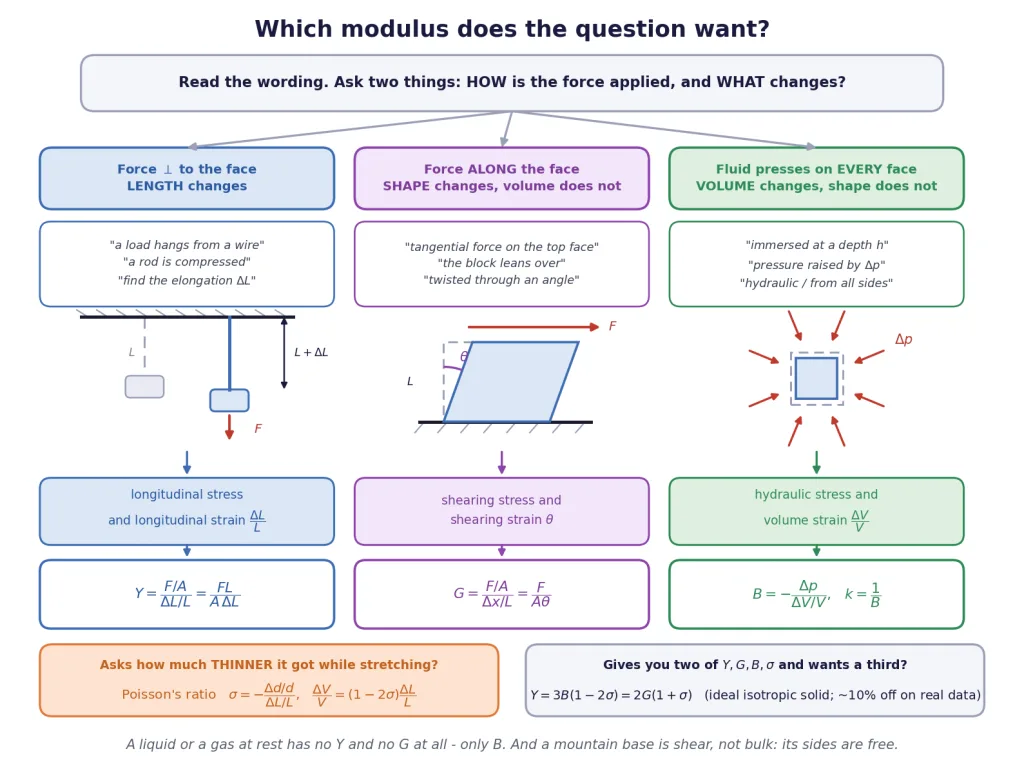
The two questions that decide it
How is the force applied, and what changes? That is the whole test.
| If the force is… | and what changes is… | it is | reach for |
|---|---|---|---|
| perpendicular to the face it acts on | the length | longitudinal | |
| along the face it acts on | the shape, at constant volume | shearing | |
| a fluid pressure on every face | the volume, at constant shape | hydraulic |
The cue words, which is what you will actually recognise
| Wording in the question | What it is telling you |
|---|---|
| "a load hangs from a wire", "a mass is suspended" | |
| "the rod is compressed along its length", "find the elongation" | |
| "the wire is clamped between rigid walls and heated" | , through |
| "a tangential force on the upper face", "the base is fixed to the floor" | |
| "the block leans over", "the top face is displaced sideways by " | |
| "the rod is twisted through an angle", "torsional" | |
| "lowered to a depth in the sea", "immersed" | |
| "the pressure on it is increased by " | |
| "uniform pressure from all sides", "hydraulic" | |
| "the volume decreases by " | , or |
| "how much thinner does it get as it stretches?" | |
| "given and , find " | the inter-constant relations |
Six traps that live in exactly this decision
- A liquid or a gas has no and no . If a question offers you Young's modulus of water, it is testing whether you know that. The only modulus a fluid at rest has is .
- The mountain base is shear, not bulk — because the sides are free. This one is set every year and the wording "pressure at the base" is deliberately misleading.
- A body immersed in a fluid is under hydraulic stress, even if it is a wire. Immersion changes the modulus you need, not just the numbers.
- The right area for shear is the face the force acts along, not the one it acts across. For a cube of side the two happen to be equal, which is why cube problems hide the error and slab problems expose it.
- Shear changes the shape and not the volume; hydraulic stress changes the volume and not the shape. If a question tells you the volume did not change, it has told you it is shear.
- Compressibility is , not . Read the unit in the options: Pa means a modulus, Pa means a compressibility.
[JEE Tip] When two of , , , are given and a third is wanted, do not hunt for the one relation that fits. Write down and , and every other combination falls out of those two by elimination — including and .
Card 6 — The Mistakes That Cost the Most Marks
Every one of these was flagged somewhere in the earlier sections. They are ordered roughly by how often they actually turn up in answer scripts.
1. Reaching for the wrong modulus. The one that costs the most, by a distance, because it wastes the whole question rather than one mark. Force across the face and the length changes means ; force along the face and the shape changes means ; fluid on every face and the volume changes means . Read the wording before you read the numbers.
2. Dropping the factor of one half in the energy. , and . The restoring force grew from zero, so the work is the average force times the distance. Using doubles every answer, and the doubled value is always one of the options.
3. Losing a minus sign, or misunderstanding what it is for. Both minus signs in this chapter exist to keep a constant positive. In it is there because raising the pressure lowers the volume. In it is there because stretching a wire makes it thinner. If your or your comes out negative for an ordinary material, you have dropped one of them.
4. Using the wrong area for shear. For shear, is the area of the face the force acts along — the loaded face — and is the distance to the fixed face. For a cube these coincide and nothing goes wrong; for a slab, a pad or a block they do not, and the whole answer moves.
5. Forgetting to convert an angle to radians. Every shear formula wants in radians. "Sheared through " means rad. Substituting multiplies the answer by .
6. Treating breaking stress as if it depended on length. It does not. It is a material property. A wire cut in half supports exactly the same maximum load. What does depend on the length is the maximum length that can hang under its own weight, — a different quantity answering a different question.
7. Claiming the inter-constant relations are exact for real materials. They are exact for an ideal isotropic solid only. On real tabulated data they agree to roughly ten per cent, and up to twelve per cent for glass and iron. Use them freely inside a problem; do not use them to argue with a table of measurements.
8. Treating as an identity. Measured runs from about to , so is always a little low — about to for copper, aluminium and glass, but to for brass, nickel, tungsten and steel, so about on average. It is an estimator for picking between distant options, nothing more.
9. Giving strain a unit, or a modulus none. Strain is a pure number: no unit, no dimensional formula. Every modulus, and stress itself, is in pascal with dimensions . Compressibility is the exception that catches people: Pa.
10. Making the thermal stress depend on the rod. contains no and no . Two clamped rods of the same material, one short and thin and one long and thick, develop identical stress under the same . Only the force notices the area.
11. Confusing "more elastic" with "stretches more". Steel is more elastic than rubber. Elasticity is the size of the restoring stress for a given strain, that is — not the size of the stretch. Rubber stretches enormously and is the less elastic of the two.
12. Confusing strength with toughness. Glass is strong and stores almost no energy; rubber is weak and stores a great deal. Strength is the height of the stress-strain curve, toughness is its area. A brittle material can be excellent at one and useless at the other.
13. Mixing up which material stores more energy. At the same stress, smaller wins. At the same strain, larger wins. Check which one the question fixed before you answer.
14. Reading the curve backwards. is the proportional limit, the elastic limit, the ultimate tensile strength, fracture. The maximum stress is at , not at — a necked specimen breaks at a lower load than the largest it ever carried.
Key Point: Three more that cost single marks each — forgetting that the shear area is the loaded face, quoting when the options are in Pa, and mixing with inside one problem. Pick one value of , write it at the top of your working, and use it everywhere.
The 60-Second Revision
You are in the queue outside the hall. This is the irreducible minimum.
Stress and strain. Stress , in pascal, dimensions , not a vector. Strain fractional change, no unit. Three pairs: longitudinal with , shearing with , hydraulic with .
Hooke. Stress modulus strain, an approximation valid only up to .
The curve. to straight, slope . proportional limit, elastic limit, to plastic with a permanent set, ultimate tensile strength, fracture. Unloading from the plastic region runs parallel to . Area under the curve energy per unit volume.
The moduli. , so and . with the loaded face. , positive because of the minus sign. in Pa. Fluids have only .
Poisson. , dimensionless, , metals to . , so conserves volume.
The relations. , hence and . Two independent constants only. Exact for an ideal solid, about off on real data.
Energy. ; stressstrain in J/m. The half is compulsory.
Thermal. , . Independent of and . Heating compresses, cooling stretches.
Applications. for a rope or a pillar, with a safety factor on top. : depth cubed, breadth linear, span cubed. I-section because the neutral axis carries nothing. km for a mountain, and it is shear.
Habits. Name the deformation first. Check the area you are dividing by. Convert angles to radians. Keep the half. Keep the minus signs. Pick one value of .
The Fast Self-Test
Cover the answers. Sixteen questions, five minutes. Anything you miss tells you which card to reopen tonight.
- Give the SI unit and the dimensional formula of stress, and of strain.
- Why is stress not a vector?
- Name the three stress-strain pairs, and the modulus that belongs to each.
- Up to which landmark on the stress-strain curve does Hooke's law hold?
- What does the slope of the straight part of the curve give you? What does the area under the whole curve give you?
- Where is the largest stress on the curve — at or at ?
- Write in terms of , , and , and the force constant of the wire treated as a spring.
- In the shear formula , which face is ?
- Which two moduli does a liquid at rest not have, and why?
- Why is there a minus sign in the definition of ? And in the definition of ?
- State the SI unit of compressibility.
- What does tell you about a material?
- Write the two relations linking , , and . How well do they hold on real data?
- Write the strain energy per unit volume in all three of its forms.
- Does the thermal stress in a clamped rod depend on its length? On its cross-section? On either?
- Why can a mountain not be much more than about km tall, and what kind of stress limits it?
Answers. 1. Stress: N/m or pascal, . Strain: no unit, no dimensions. 2. Because specifying it needs both a force direction and the orientation of the face it acts on, so a single direction will not describe it. 3. Longitudinal with and ; shearing with and ; hydraulic with and . 4. The proportional limit — not the elastic limit . 5. Slope ; area energy absorbed per unit volume. 6. At , the ultimate tensile strength. 7. and . 8. The face the force acts along — the loaded face — with the distance to the fixed face. 9. and , because a fluid at rest cannot sustain a shearing stress and cannot be pulled. 10. In both cases so that the constant comes out positive: pressure up means volume down, and stretching means thinning. 11. Pa, that is m/N. 12. Its volume does not change when it is stretched — it is incompressible; rubber is close, at about . 13. and ; on real tabulated data they agree to roughly ten per cent, not exactly. 14. stressstrain . 15. Neither. contains no and no ; only the force does. 16. Because the rock at the base carries a shearing stress — the sides of the mountain are free, so it is not bulk compression — and once that exceeds the elastic limit of rock the base flows.
That is the whole chapter. Go and get the marks.