
Why "How Much Force?" Is the Wrong Question
Section 1 left you with two ideas and no way to put a number on either. Let us fix that, starting with the reason raw forces are useless here.
Hang 100 N on a human hair and it snaps. Hang 100 N on a bridge cable and nothing measurable happens at all. Same force, opposite outcomes — so the force by itself clearly does not decide what happens to the material.
Now the other half. Stretch a 1 m wire by 1 mm and you have done something quite violent to it. Stretch a 100 m cable by 1 mm and you have barely touched it. Same extension, and again the raw number says nothing.
The fix in both cases is the same, and it is the whole of this section: divide out the size of the object.
- Divide the force by the area it is spread over. That gives stress.
- Divide the change in dimension by the original dimension. That gives strain.
Once you do that, a hair and a bridge cable become comparable, and so do a 1 m wire and a 100 m one. Stress and strain are the quantities in which materials, rather than particular objects, have properties.
Stress
Key Point — stress:
Stress is the internal restoring force per unit area developed inside a deformed body. where is the magnitude of the restoring force across a chosen section and is the area of that section.
SI unit: N/m, given the name pascal, symbol Pa.
Dimensional formula: .
Two things in that definition are easy to skate over and worth pausing on.
First, stress is defined by the restoring force — the internal one, coloured green in Section 1 — and not by the force you applied. In practice you compute it from the applied force, and that is legitimate, but only because the two are equal in magnitude while the body is in static equilibrium. When the body is accelerating, they are not equal, and it is the internal one that the definition means.
Second, is the area of a section you choose. Stress is not a property of the whole object; it is a number attached to a particular imagined cut through a particular point. That will matter enormously in a moment.
Where the dimensional formula comes from
Do not memorise it — build it in two lines, every time:
Which is, note, exactly the dimensional formula of pressure, and exactly the same SI unit. That is not a coincidence, and it is also not the same thing. The next block explains why.
Strain
Key Point — strain:
Strain is the fractional change in a dimension of the body — the change divided by the original value of that dimension. Strain is a pure number. It has no unit and no dimensional formula, because it is a length divided by a length (or a volume by a volume).
Being a pure number is not a technicality; it is the point. A strain of means "one part in a thousand", and that sentence means the same thing for a hair, a wire, a girder and a mountain.
Strains in ordinary engineering are tiny. A steel wire at a safe working load carries a strain of about ; a concrete column carries less. This is why strains are so often quoted as percentages, or in "parts per million", and why you must always check which one a question is using before substituting.
Key Point — symbol convention:
denotes Poisson's ratio, the symbol it carries in the Class 11 syllabus and in most Indian question papers. Stress is written as wherever it can be, and where a symbol is genuinely needed it is for longitudinal stress, for shearing stress and for hydraulic stress. Strain is . Elsewhere often denotes stress, with or for Poisson's ratio, so check the symbol list before copying a formula out of another book.
[Board Important] "Define stress and strain, and give the SI unit and dimensional formula of each" is a standard two-mark or three-mark question. The mark for strain is earned by saying explicitly that it has no unit and no dimensions — not by leaving the space blank.
Stress Is Not Pressure, and Stress Is Not a Vector
Stress and pressure have the same unit and the same dimensional formula. Students therefore conclude they are the same quantity, and then get a whole family of questions wrong. Here is the difference, in two steps.
Step one: stress needs a plane
Take a bar being pulled at both ends by a force , and fix your attention on one particular point inside it. Ask: what is the stress at that point?
The question has no answer until you say which plane through the point you mean.
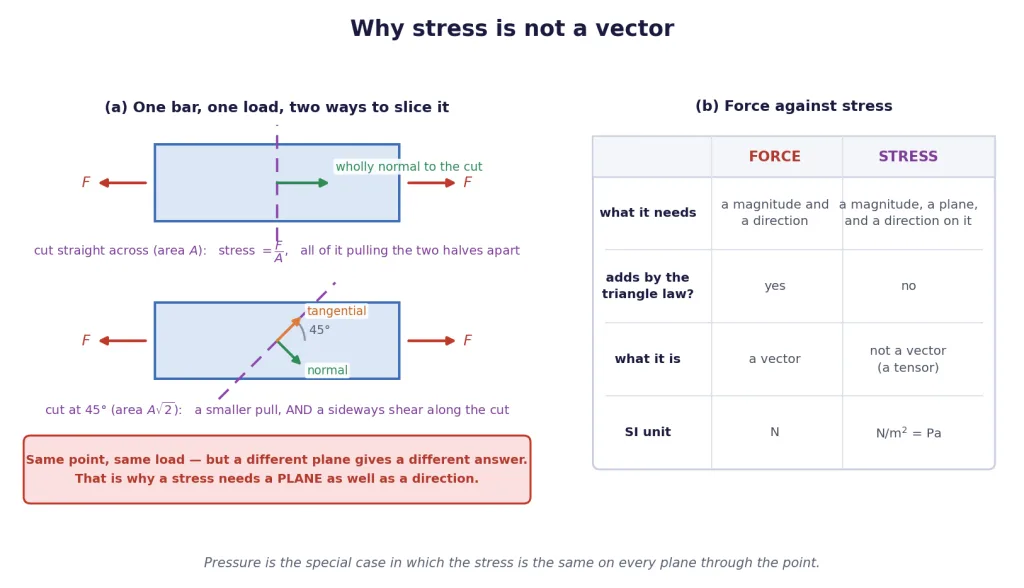
- Slice square across the bar. The cut has area , the force across it is and it is entirely perpendicular to the cut. The stress is , all of it pulling the two halves apart.
- Slice the same point at . Now the cut has area , so the force per unit area is smaller — and worse, that force is no longer perpendicular to the cut. Part of it pulls the faces apart and part of it tries to slide them across each other.
Same point. Same load. Two different planes, two genuinely different answers, one of which contains a sliding component that the other does not have at all.
Key Point: A stress is not attached to a point alone. It is attached to a point together with a plane through it. Change the plane and you change the stress.
Step two: therefore it is not a vector
A vector is completely specified by a magnitude and a direction, and vectors add by the triangle law. A force qualifies: the force acting on the material on one side of a section has one definite direction, and you can add two forces head to tail.
Stress does not qualify. To specify it you need a magnitude, the plane you are talking about, and the direction of the force on that plane — three pieces of information, not two. There is no single arrow you can draw at a point and call "the stress there", and two stresses on different planes cannot be combined by drawing a triangle.
Key Point — the sentence to remember:
Stress is not a vector, because unlike a force it cannot be assigned one specific direction. A force acting on the material on a specified side of a section does have a definite direction; the stress does not, because it depends on which section you chose. (The object that does the job properly is called a tensor, and it is a topic for later. At this level, the examinable statement is simply that stress is not a vector.)
So what about pressure?
Pressure is the special case in which the answer happens to be the same on every plane. A fluid at rest pushes perpendicular to any surface you put in it, with the same force per unit area whichever way you turn that surface. That uniformity is what lets pressure be treated as a plain scalar.
Here is the comparison, laid out:
| Force | Pressure | Stress | |
|---|---|---|---|
| What must you specify? | magnitude and direction | magnitude only | magnitude, plane, and direction on that plane |
| Does it add by the triangle law? | yes | not applicable | no |
| What kind of quantity is it? | vector | scalar | neither — a tensor |
| SI unit | N | Pa | Pa |
| Comes from | an external agent | a surrounding fluid | the material's own internal restoring forces |
How the three quantities differ, despite two of them sharing a unit.
And one more difference that decides many questions: pressure is always normal to the surface and always pushes inward. Stress can be normal or tangential, and it can pull outward. A stretched wire is under a stress that pulls its two halves apart — no pressure ever does that.
[JEE Tip] "Stress is a scalar" and "stress is a vector" are both wrong, and both appear as options. The correct statement is that stress is not a vector, because it cannot be given a single direction. If a question offers "tensor" as an option, that is the best answer available.
The Three Pairs
There are exactly three ways a solid can be deformed, and each one comes with its own matched pair of a stress and a strain. Learn them as pairs — a longitudinal stress goes with a longitudinal strain and never with a volume strain — and half the chapter's confusion disappears.
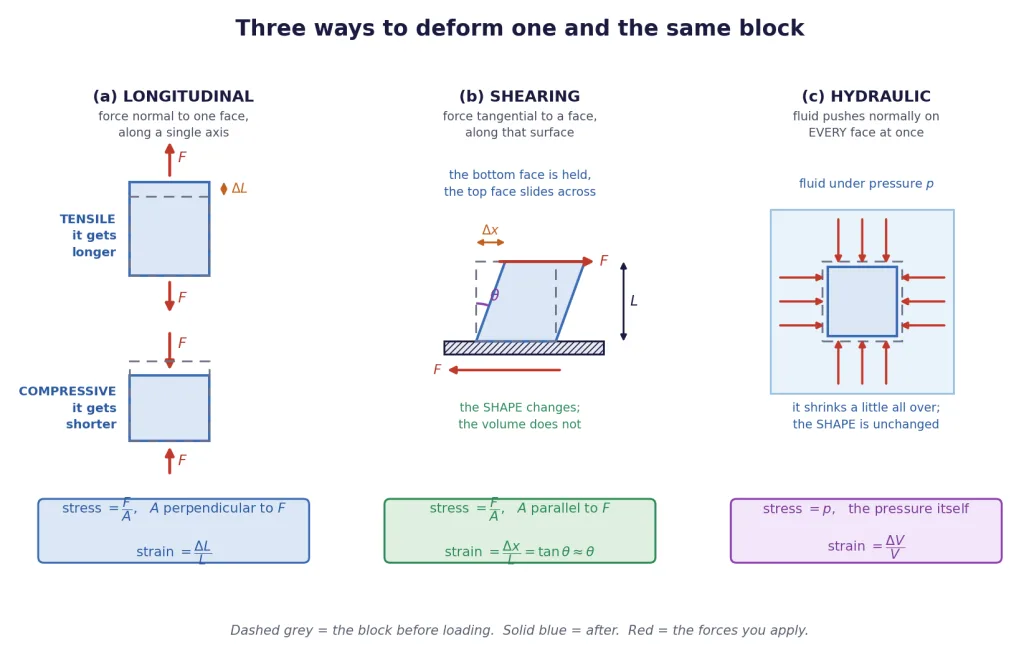
Here they are, all three acting on one and the same block so that you can compare them properly.
1. Longitudinal stress and longitudinal strain
Two equal and opposite forces act normal to the end faces, along one axis. The length changes; the cross-section is only slightly affected.
Here is the area of the face the force is perpendicular to — the cross-section of the wire or bar — and is the original length, not the stretched one.
Longitudinal stress comes in two flavours, and they differ only in sign:
- Tensile stress, when the forces pull the body apart and it gets longer.
- Compressive stress, when the forces push the body together and it gets shorter.
Key Point: Tensile and compressive stress are the two kinds of longitudinal stress. Both are computed as with the cross-section; the only difference is the direction of the forces and therefore the sign of .
2. Shearing stress and shearing strain
Now the forces act tangentially — along the surface rather than across it. A pair of equal and opposite tangential forces on opposite faces makes one face slide sideways relative to the other. The block turns from a rectangle into a parallelogram.
Read the symbols carefully, because they mean different things from the first pair:
- is now the area of the face the force acts along, not across.
- is the sideways displacement of one face relative to the other.
- is the distance perpendicular to the displacement — the height of the block, measured between the two faces.
- is the angle through which a vertical edge has tilted.
The strain is strictly . For the small angles that occur in real solids the difference is negligible: at radians it is about two parts in a million, and even at a whacking it is only about 1%. So in radians is used, and the approximation is a very good one — but must be in radians, never degrees.
Key Point: In shear the shape changes while the volume does not. That single sentence identifies a shearing problem faster than any formula.
3. Hydraulic stress and volume strain
Immerse the block in a fluid under pressure. Now the force acts perpendicular to the surface at every point at once, pressing inward from all sides. The block shrinks a little in every direction; its shape is unchanged.
The hydraulic stress is numerically equal to the pressure applied by the fluid, since the internal restoring force per unit area must balance it everywhere. And the strain is the fractional change in volume, not in length.
Key Point: Under hydraulic stress the volume changes while the shape does not. Compare that with shear, where exactly the opposite happens — a pair worth writing on the same line of your notes.
The three pairs together
| Deformation | The force is | Stress | Strain | It changes |
|---|---|---|---|---|
| Longitudinal (tensile) | normal to one face, pulling out | length, gets longer | ||
| Longitudinal (compressive) | normal to one face, pushing in | length, gets shorter | ||
| Shearing | tangential, along the face | shape only | ||
| Hydraulic | normal, on every face at once | volume only |
The three matched pairs. Note that the letter means a different face in the first three rows than in the shearing row.
[NEET Important] All three stresses are "force over area", which is why the formulas look identical and why the marks are lost on the area, not on the arithmetic. For longitudinal stress the area is perpendicular to the force; for shearing stress it is parallel to it.
Getting and Right
Almost every mistake in a stress calculation is a mistake about or about , not about the division. Three habits remove nearly all of them.
Habit 1: cut, isolate, balance
To find the force across a section, cut there, look at one of the two pieces, and write . Never count forces at the far ends of the body.
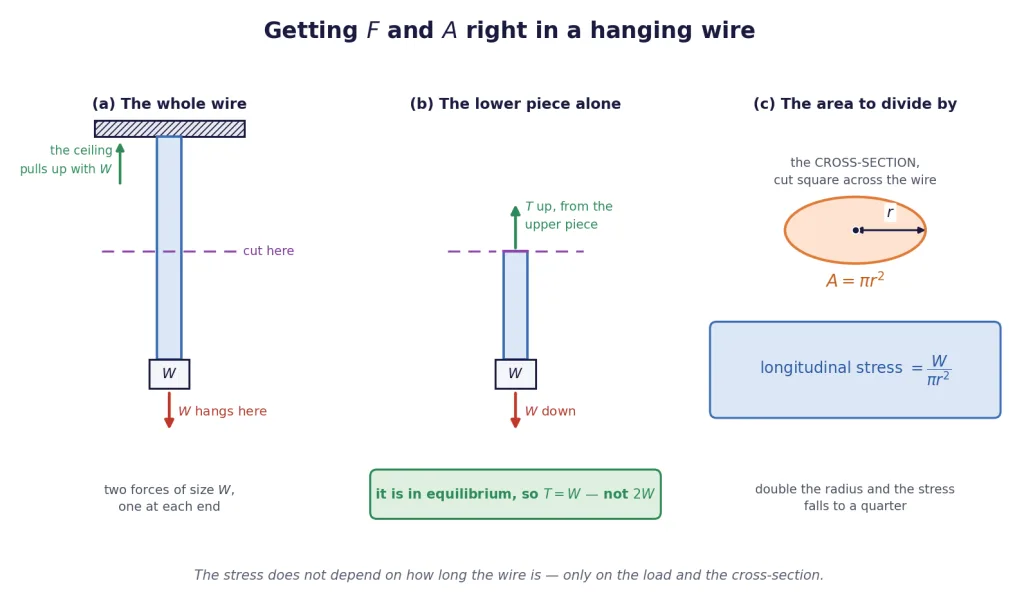
A wire hangs from a ceiling with a load at its lower end. The ceiling pulls up with and the load pulls down with — two forces of size . But cut the wire anywhere and take the piece below the cut: only the load and the internal pull act on it, so
Key Point: The tension in that wire is , not . The two forces of size act at the two ends and are not both transmitted across an interior section. Exactly the same reasoning applies to a rope pulled by two people with 200 N each: the tension is 200 N.
Habit 2: use the right area, in the right units
- For longitudinal stress, is the cross-section — the area you would see if you cut the wire square across. For a circular wire of radius that is ; if the question gives you the diameter, halve it first.
- For shearing stress, is the face the force slides along.
- Convert to SI before dividing. A cross-section of 1 mm is m, not m. A cross-section of 1 cm is m. These two conversions cost more marks in this chapter than any physics.
Since , the stress in a wire under a given load goes as . Double the radius and the stress falls to a quarter. That single proportionality answers a great many objective questions on its own.
Habit 3: know your unit multiples
Stresses in real materials are large numbers, so they are usually quoted with prefixes:
| Written as | In pascal |
|---|---|
| 1 kPa | Pa |
| 1 MPa | Pa |
| 1 GPa | Pa |
| 1 N/mm | Pa, that is 1 MPa exactly |
| 1 bar | Pa |
| 1 atmosphere | Pa |
Unit multiples you will meet in stress problems. The N/mm line is worth memorising — engineers use it constantly and it is exactly one megapascal.
Older Indian question papers sometimes quote a stress in kgf/cm. To convert, multiply by and by : with m/s, one kgf/cm is Pa, so Pa is about 1020 kgf/cm.
[Board Important] Write the conversion of the area on its own line in the answer script. Examiners give a mark for it, and it is the one line that catches a factor-of-a-thousand slip before it reaches the answer.
The Decision Rule: Which Pair Is This?
Everything in this section exists to let you answer one question quickly and correctly when a problem lands in front of you. Here is the rule.
Key Point — the decision rule, in one question:
How does the force sit on the surface it acts on?
- Normal to one face, along a single axis longitudinal. Strain is . Pulling apart is tensile, pushing in is compressive.
- Tangential, along the face shearing. Strain is .
- Normal to every face at once, from a surrounding fluid hydraulic. Strain is .
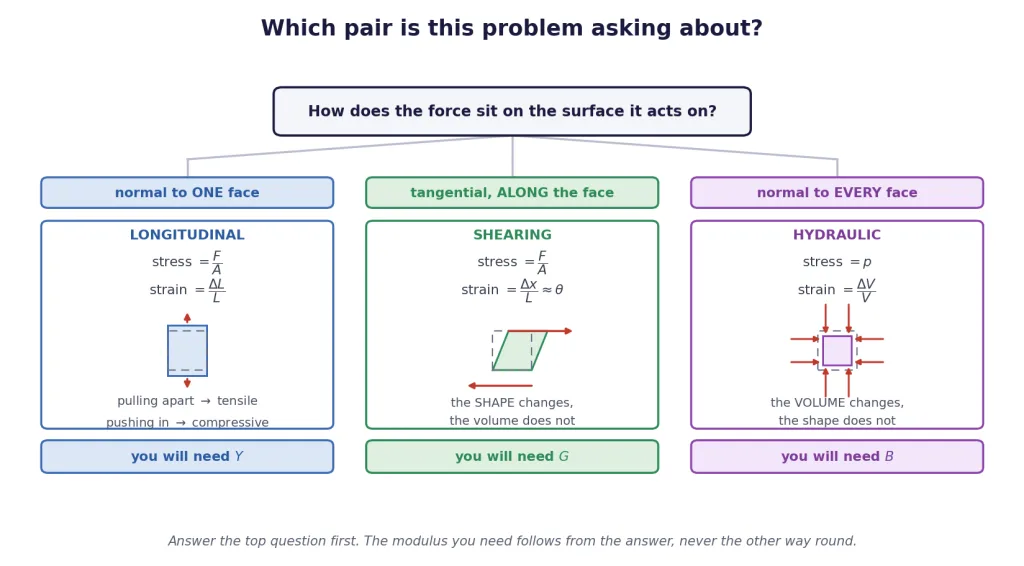
That question decides which pair you are dealing with, and the pair decides which elastic constant you will need — Young's modulus , the shear modulus , or the bulk modulus , developed in Sections 4, 5 and 6 respectively. Answer the question first. The constant follows from the answer, never the other way round.
A faster cross-check: what changed?
If the wording is ambiguous, the deformation itself will tell you:
| What changed | Which pair |
|---|---|
| length changed, shape otherwise the same | longitudinal |
| shape changed, volume unchanged | shearing |
| volume changed, shape unchanged | hydraulic |
Use this when the description of the loading is vague but the description of the deformation is not.
Run the rule on six cases
- A crane cable holding a load. The load pulls along the cable, normal to its cross-section. Longitudinal, tensile.
- A stone pillar under a roof. The roof presses down along the pillar's axis, normal to its cross-section. Longitudinal, compressive.
- A book pushed sideways along a table with your palm on top. The palm's force is tangential to the pages. The book skews; its volume is unchanged. Shearing.
- A steel ball dropped to the bottom of the ocean. Water presses normally on every point of its surface. It shrinks all over and stays a sphere. Hydraulic.
- A rubber block glued between two plates, one of which is pushed sideways. Tangential force on the face, block becomes a parallelogram. Shearing.
- A rivet joining two plates that are being pulled apart. The plates try to slide across each other, and the rivet's cross-section is being sheared along its own plane. Shearing — even though the forces on the plates look like a straightforward pull.
Case 6 is the one that catches people. The forces on the plates are longitudinal; the force on the rivet's cross-section is tangential to that cross-section. Always ask which body, and which surface within that body, you are being asked about.
A caution about the sign
None of the strains defined here carry a sign convention worth arguing over at this stage: is positive for stretching and negative for squashing, and most problems ask only for the magnitude. There is one place in the chapter where a minus sign is genuinely load-bearing, in the definition of the bulk modulus, and Section 6 explains exactly why it is there.
What comes next
You now have the two quantities that make deformation comparable across objects. Section 3 asks the obvious next question — how are they related? — and the answer, for small deformations, is Hooke's law, together with the stress-strain curve that shows precisely where that law stops being true.
[JEE Tip] In a multi-part problem, write down which of the three pairs each part belongs to before doing any arithmetic. Two of the three formulas will then be visibly irrelevant, and you cannot pick the wrong one.
Solved Examples
Constants used throughout this section, unless a problem says otherwise: m/s, density of sea water 1030 kg/m, atmospheric pressure Pa. Each is stated again inside the solution that uses it.
Example 1: Stress in a loaded wire
A 4.0 kg mass hangs from a steel wire of radius 0.50 mm. Take m/s and neglect the weight of the wire. Find (a) the deforming force, (b) the cross-sectional area, and (c) the longitudinal stress. State whether it is tensile or compressive.
Solution:
(a) The force.
(b) The area. Convert the radius first: mm m.
(c) The stress. Cut the wire anywhere and take the lower piece: the internal force is 39.2 N, not twice that.
Which kind? The load pulls the wire apart and it gets longer, so the stress is tensile.
Final Answer: N, m, stress Pa, tensile.
Takeaway: Convert the radius to metres before squaring it. Squaring a millimetre value silently multiplies the area by a million and the stress is then wrong by the same factor — the single commonest arithmetic failure in this chapter.
Example 2: Strain, and why it has no unit
A copper wire 2.5 m long stretches by 1.5 mm under a load. Find the longitudinal strain, express it as a percentage, and state its unit and dimensional formula.
Solution:
Put both lengths in the same unit. mm m, and m.
The strain.
As a percentage.
Unit and dimensions. A metre divided by a metre leaves nothing behind: so strain is a pure number with no unit and no dimensional formula.
A shortcut worth noticing. Because strain is a ratio, the units cancel provided both are the same. You could have divided 1.5 mm by 2500 mm and got without converting anything at all.
Final Answer: , that is 0.060%; dimensionless and unitless.
Takeaway: Strain is the one quantity in this chapter you may compute in any unit you like, as long as you use the same one twice. Stress is the opposite: convert to SI or lose the answer.
Example 3: The dimensional formula, built rather than recalled
Derive the dimensional formula of stress from first principles. Then explain, using dimensions alone, why you cannot tell stress and pressure apart dimensionally, and state one physical difference that does distinguish them.
Solution:
Start from the definition. Stress is a force divided by an area.
Substitute the two. Force is mass times acceleration, so , and .
Now pressure. Pressure is also a force divided by an area, so it gives the identical result, , and the identical SI unit, the pascal.
Why dimensions cannot separate them. Dimensional analysis only sees the combination of , and ; it is blind to where the force came from, which surface it acts on, and how it is oriented on that surface. All three of those differ between stress and pressure, and none of them shows up in a dimensional formula.
One physical difference. Pressure is always normal to the surface and pushes inward, and is the same on every plane through a point. Stress can be tangential, can pull outward (a stretched wire), and changes when you change the plane you are looking at.
Final Answer: for both; they are distinguished physically, not dimensionally.
Takeaway: Equal dimensions never prove two quantities are the same thing. Work and torque share and are completely different; stress and pressure are another instance of the same lesson.
Example 4: Two wires, one load
Two wires of the same material carry the same load. Wire A has radius 1.0 mm and wire B has radius 2.0 mm. Find the ratio of the stress in A to the stress in B.
Solution:
Same load, so the same in both. The stresses differ only through the areas.
The areas.
So The thinner wire carries four times the stress.
The general rule. For a given load, . The material does not enter at all — two wires of different metals with these radii would still be in a 4:1 stress ratio under the same load.
Final Answer: 4:1.
Takeaway: Halving the radius quadruples the stress. That is why a thin wire snaps where a thick one of the same material does not, and why "which wire breaks first" questions are answered from the radii alone.
Example 5: Shearing a cube
A cube of side 20 cm has its lower face fixed to a bench. A tangential force of 100 N is applied to the upper face, and that face slides 0.50 mm relative to the lower one. Find (a) the shearing stress, (b) the shearing strain, and (c) the angle in radians and in degrees. Check how good the approximation is here.
Solution:
(a) The shearing stress. The area is that of the face the force acts along — the top face, m.
(b) The shearing strain. Here mm m and is the height of the cube, 0.20 m.
(c) The angle. The strain is , so and in degrees,
How good is the approximation? Working to more figures, rad against a strain of . They differ by about two parts in a million — utterly negligible. Even at , which no solid ever reaches elastically, exceeds by only about 1%.
Final Answer: 2500 Pa; strain ; rad .
Takeaway: The area for shearing stress is the face the force slides along, and is measured perpendicular to the slide. Get those two right and the arithmetic is trivial; get them wrong and no amount of care afterwards will save the answer.
Example 6: From an angle back to a displacement
The top face of a slab of height 5.0 cm is displaced sideways so that a vertical edge tilts through . Find the shearing strain and the sideways displacement of the top face.
Solution:
Convert the angle to radians. Degrees are never allowed in a strain.
The shearing strain is that angle, since for a small angle:
The displacement. With cm m, which is 0.52 mm.
Check. A tilt of about six tenths of a degree over 5 cm giving half a millimetre of slide is geometrically sensible.
Final Answer: strain ; mm.
Takeaway: A shearing strain quoted in degrees is not a strain yet. Multiply by first — a step that is worth a mark on its own and is skipped constantly.
Example 7: Volume strain, and the pressure that caused it
A solid sphere of volume 1000 cm is lowered to a depth of 200 m in sea water, where its volume becomes 999.4 cm. Take the density of sea water as 1030 kg/m and m/s. Find (a) the volume strain and (b) the hydraulic stress on the sphere, stating clearly whether you are quoting gauge or absolute pressure.
Solution:
(a) The volume strain. Both volumes are in cm, and since strain is a ratio there is no need to convert.
(b) The pressure due to the water column, which is the gauge pressure:
If the atmosphere is included, the absolute pressure is which is 5.0% larger. This solution quotes the gauge value, because the sphere was already sitting under one atmosphere before it went into the water, so it is the extra pressure that produced the extra compression.
The hydraulic stress is numerically equal to that applied pressure, Pa, and the internal restoring forces balance it at every point of the surface.
Final Answer: volume strain ; hydraulic stress Pa (gauge).
Takeaway: Say which pressure you used. Gauge and absolute differ by 5% here and by much more in shallow water, and a solution that does not state its choice cannot be marked right or wrong.
Example 8: Is "volume strain equals three times linear strain" safe?
Each side of a cube of side 10.0 cm shrinks by 0.010% under a uniform pressure. Find the volume strain (a) by multiplying out the actual new volume and (b) by the shortcut "three times the linear strain". Report the difference.
Solution:
The linear strain. , so each side becomes
(a) The exact volume strain. Multiply the three shrunken sides out:
(b) The shortcut. Expanding and dropping everything past the first power gives
The difference. One hundredth of one per cent. The shortcut is excellent here — and notice why: the discarded terms are of order , so the fractional error is about itself, which is small precisely because the strain is small.
When it would fail. At a linear strain of 0.10 the shortcut would be off by about 11%, which is not a rounding error at all. The approximation is earned by the smallness of , not granted for free.
Final Answer: exact ; shortcut ; they differ by 0.010%.
Takeaway: "Volume strain equals three times linear strain" is a first-order approximation, and it is superb at the strains solids actually reach. Knowing why it works tells you the one situation in which it would not.
Example 9: Which pair is it?
Identify the stress and the strain involved in each situation, and name the pair.
(a) A crane cable holding a hanging load. (b) A stone pillar carrying a roof. (c) A book on a table pressed down with the palm and pushed sideways. (d) A steel ball resting on the ocean floor. (e) A rivet joining two plates that are being pulled apart.
Solution:
Apply the decision rule to each: how does the force sit on the surface it acts on?
(a) The load pulls along the cable, normal to its cross-section, and the cable gets longer. Longitudinal stress with longitudinal strain — tensile.
(b) The roof presses down along the pillar's axis, normal to its cross-section, and the pillar gets shorter. Longitudinal — compressive, same two formulas.
(c) The palm's push is tangential to the pages. The stack skews into a parallelogram and its volume is unchanged. Shearing stress with shearing strain .
(d) Water presses normally on every point of the surface at once. The ball shrinks all over and stays spherical. Hydraulic stress with volume strain .
(e) The two plates try to slide past each other, so the material of the rivet is being dragged along its own cross-section. Shearing — even though the load on the plates looks like an ordinary pull.
Final Answer: (a) tensile, (b) compressive, (c) shearing, (d) hydraulic, (e) shearing.
Takeaway: Always ask which body and which surface within it. In (e) the plates are in tension while the rivet inside them is in shear, and the question is only ever about one of the two.
Example 10: The wire pulled from both ends
A wire of cross-sectional area 2.0 mm is pulled by a force of 50 N applied at each end, in opposite directions. Find the stress in the wire. Then state what the answer would be if the wire instead hung from a ceiling with a 50 N weight on its lower end.
Solution:
Convert the area.
Find the force across a section. Cut the wire and take the right-hand piece. Only one 50 N pull acts on it externally, balanced by the internal pull across the cut, so The two 50 N forces act at the two ends; they do not add at an interior section.
The stress.
The hanging case. Identical. The ceiling supplies one 50 N pull and the weight supplies the other; the free body of the lower piece again gives N and the same Pa.
The wrong answer, for reference. Adding the two forces would give Pa, exactly double, and it is the option most often chosen.
Final Answer: Pa in both arrangements.
Takeaway: Two equal and opposite end forces are what tension IS. A wire cannot be in tension with a force at only one end, so the presence of two forces is normal and never doubles anything.
Example 11: Working backwards, and a square bar
(a) What force is needed to produce a stress of Pa in a wire of cross-section 1.5 mm? (b) A bar of square cross-section 8.0 mm by 8.0 mm and length 1.2 m carries a compressive load of 3.2 kN and shortens by 0.30 mm. Find the stress and the strain.
Solution:
(a) Rearrange the definition. mm m.
(b) The area of the square bar. mm m, so
The stress. With kN N,
The strain. With mm m and m,
Which kind? The bar shortens, so both are compressive — a compressive stress of Pa and a compressive strain of .
Final Answer: (a) 150 N. (b) Pa and , both compressive.
Takeaway: A square cross-section is , not . Reading "8 mm by 8 mm" as a perimeter is a surprisingly common slip, and it changes the answer by a factor of 20.
Example 12: Reading and writing the units
A steel rod of cross-section 1.0 cm carries a load of 20 kN. Express the stress in (a) pascal, (b) megapascal, (c) N/mm, and (d) kgf/cm, taking m/s.
Solution:
Convert the area. cm m. Note that a centimetre squared is of a metre squared, not .
(a) In pascal. With kN N,
(b) In megapascal. One megapascal is Pa, so
(c) In N/mm. One N/mm is exactly Pa, that is exactly one MPa, so the answer is 200 N/mm with no further arithmetic.
(d) In kgf/cm. One kgf is N and one cm is m, so one kgf/cm is Pa. Therefore
Final Answer: Pa 200 MPa 200 N/mm kgf/cm.
Takeaway: 1 N/mm = 1 MPa exactly. Recognising that identity turns a conversion question into a relabelling, and it is the unit real engineering drawings are written in.