
Hooke's Law: One Straight Line, and Where It Stops
Section 2 gave you stress and strain. This section joins them together.
Here is the experimental fact, and it is nothing more than an experimental fact. Take almost any solid, load it gently, and the strain you get is directly proportional to the stress you applied. Double the stress, double the strain. Halve it, halve it. This is Hooke's law, written down by Robert Hooke in 1676, and it is the single most useful sentence in this chapter.
The constant of proportionality is called the modulus of elasticity.
Key Point: Since strain is a pure number with no units, carries exactly the same units as stress: N/m, that is, pascal (Pa). Its dimensions are , the same as pressure. If your answer for a modulus comes out in newtons, or dimensionless, you have dropped something.
Notation for This Chapter
Elasticity is the one topic in Class 11 where the same Greek letter gets used for two different things, and it causes real damage in exams.
Key Point — symbol convention:
- is strain.
- is Poisson's ratio, which arrives in a later section.
- Stress is written as , or as , , when a symbol for longitudinal, shearing or hydraulic stress is genuinely needed.
Elsewhere often denotes stress, with or for Poisson's ratio. Neither convention is wrong. What is fatal is switching between them halfway through a solution. Read the symbol list at the top of any question paper, decide which convention it is using, and stick to it.
Why and not just one modulus?
Because there are three ways to deform a solid, and each gets its own version of the same idea:
| The deformation | The stress | The strain | The modulus it defines |
|---|---|---|---|
| stretch or squash a wire lengthwise | longitudinal, | Young's modulus | |
| slide one face of a block sideways | shearing, | angle | shear modulus |
| squeeze a body from all sides | hydraulic, | bulk modulus |
All three obey the same one-line pattern:
and all three are measured in pascal. in Hooke's law is a placeholder that becomes , or depending on which of the three you are doing. Each one gets a section of its own next; here we care about the shape of the law itself, not the individual numbers.
The bit almost everybody gets wrong
Read this slowly.
Key Point: Hooke's law is not a law of nature. It is an empirical rule — a description of what most materials happen to do when you deform them only slightly. It is an approximation, valid over a limited early stretch of the material's behaviour and nowhere else. Newton's laws hold everywhere; Hooke's law holds for small deformations of some materials, and even then only up to a specific point that has a name.
Compare this with . Nothing you can do to an object makes stop being true. But you can absolutely make a wire stop obeying Hooke's law — just pull a bit harder. The proportionality quietly fails, then fails badly, and eventually the wire snaps.
Two consequences follow, and both are examined every year:
- Every formula in the rest of this chapter inherits the same limit. , the stored energy , the relations between the elastic constants — all of them are built on Hooke's law and all of them stop being true beyond the proportional limit.
- Some materials never obey it at all. Rubber and biological tissue are elastic in the sense that matters — they come back — and yet their graphs are curved from the very first millimetre. There is a whole block on them at the end of this section.
[Board Important] A very common two-mark question: "Is Hooke's law a fundamental law of physics?" The answer is no, with a reason: it is an empirical relation valid only for small deformations up to the proportional limit, and there are materials such as rubber which do not obey it anywhere.
The spring you already know
You have met Hooke's law before, in Class 11 mechanics, in the form for a spring. It is the same law wearing different clothes. Put and rearrange:
The bracket is a constant for a given wire, so a stretched wire is a spring with force constant . That idea is developed properly in the next section; for now just notice that the "spring constant" of a real solid comes from the material through and from the geometry through and . Section 1 has already told you why: at the microscopic level the atoms sit in bonds that behave like tiny springs for small displacements, and Hooke's law is that behaviour showing up on a scale you can see.
The Stress-Strain Curve, Landmark by Landmark
Now for the picture the whole chapter is built on.
To get it, engineers do something very deliberate. They take a test cylinder or a wire of the material, grip it in a machine, and pull. The applied force is raised in steps, and at each step two things are recorded: the force (which gives the stress, ) and the change in length (which gives the strain, ). Plot stress up the page against strain across it, and out comes a curve which is a complete biography of the material — how stiff it is, how strong it is, how much warning it gives before it breaks, and how much energy it can swallow on the way.
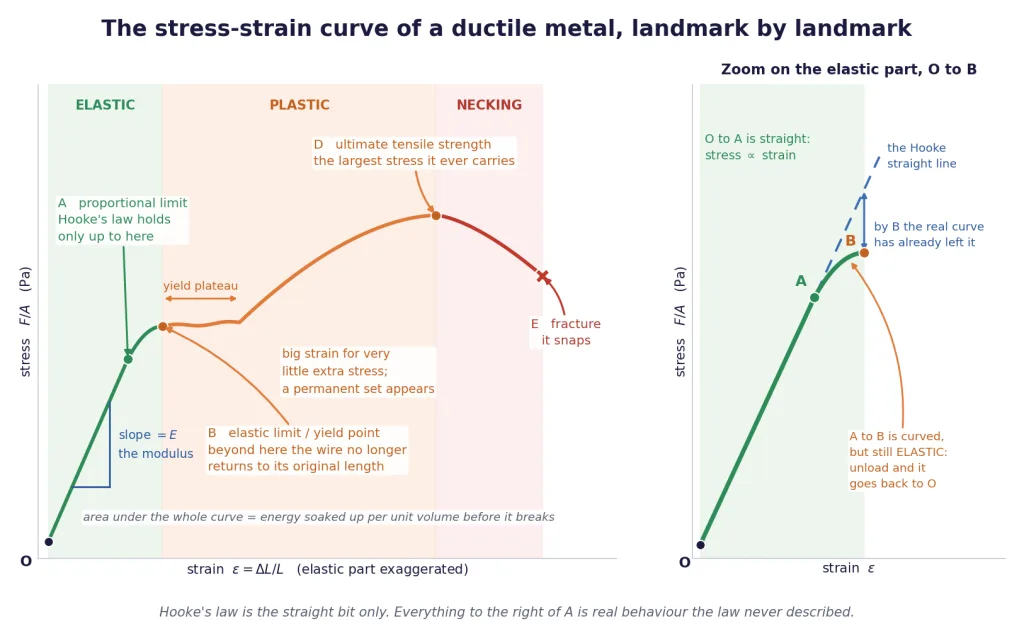
Before we walk the curve, one warning about the axes. In the figure the elastic part has been stretched sideways so you can see it. In a real steel specimen the whole of occupies a strain of about , while the specimen fractures at a strain of about . The elastic region is genuinely a sliver — under one half of one per cent of the width of the graph. Every printed version of this graph exaggerates it, and you should know that it does.
O to A: the straight line
From the origin up to the point the graph is a straight line through the origin. Stress is proportional to strain, which is exactly the statement of Hooke's law, and the slope of this line is the modulus of elasticity of the material.
Key Point: is the proportional limit. Up to , and only up to , is true. The slope of is the modulus — steeper line, larger modulus, stiffer material.
A to B: still elastic, but no longer straight
Push past and the graph starts to bend over. Stress and strain are no longer proportional — but something important is still true. Take the load off anywhere in this region and the specimen goes back to exactly its original length. It has not been damaged; it has only stopped being linear.
Key Point: is the elastic limit, also called the yield point, and the stress there is the yield strength. Below the deformation is entirely reversible. Above it is not. This is the most important single point on the graph.
For many metals and sit so close together that they are treated as one point, and plenty of exam questions will simply say "elastic limit" and mean both. But the distinction is real and worth carrying: between and the material is elastic without being linear.
B to D: the plastic region
Cross and the material changes character completely. It starts to flow. For a while — the flat stretch just after , called the yield plateau — the strain grows and grows while the stress barely moves at all. You are not really pulling harder any more; the metal is simply giving way.
Then it stiffens up again slightly (this is called work hardening) and the curve climbs slowly to the top.
Key Point: In the plastic region to , a large increase in strain is produced by a very small increase in stress, and the deformation is permanent. Remove the load anywhere in here and the specimen does not return to its original length. What is left behind is called a permanent set.
D: the ultimate tensile strength
is the highest point of the whole curve. The stress there is the ultimate tensile strength of the material — the largest stress the specimen ever carries.
Beyond something surprising happens: the curve goes down. The specimen keeps stretching even though the force needed is falling. The reason is that a narrow waist has formed somewhere along the specimen — this is called necking — and all the further deformation piles into that one thin region. The true stress in the neck is still climbing, but the graph is plotted against the original area, so the plotted stress falls.
E: fracture
At it snaps. The stress there is the fracture stress — the stress at which the specimen actually parts.
Notice that and are different points, and that the fracture stress is lower than the ultimate tensile strength for a ductile metal. That sounds paradoxical until you remember the neck.
One phrase, two meanings — settle this now
Here is the thing about the phrase breaking stress. Read strictly off the curve it means the stress at , where the specimen actually parts, and for a ductile metal that is the smaller of the two numbers. That is the honest reading of the graph, and it is the reading used inside this section, where the curve itself is the subject. But it is not how the phrase is used in problems.
Key Point — breaking stress in exam questions: In Board, JEE and NEET questions, "breaking stress" almost always means the maximum stress the material can withstand — that is, the ultimate tensile strength at . Every tabulated "breaking stress" you will be handed (steel Pa, copper Pa, and so on) is a peak value, and every "what is the greatest load this wire can carry" problem wants that peak. From Section 4 onwards, denotes the maximum stress the material can take.
So there is a simple rule for deciding which meaning is in front of you. If the question is about the shape of the curve — which point is highest, why the stress falls after , how far apart and are — then is the ultimate tensile strength, is the fracture stress, and they are different numbers. If the question hands you one number and asks for a maximum load, a minimum area or a factor of safety, that number is the peak at , and the distinction never arises.
The whole thing in one table
Here are real numbers for a mild-steel specimen, which is the set used in the worked examples below:
| Strain | Stress (Pa) | Where you are |
|---|---|---|
| 0 | 0 | , the origin |
| 0.00050 | on the straight line | |
| 0.00100 | on the straight line | |
| 0.00125 | , proportional limit | |
| 0.0020 | , elastic limit / yield | |
| 0.020 | yield plateau | |
| 0.050 | plastic, work hardening | |
| 0.100 | plastic | |
| 0.150 | plastic | |
| 0.200 | , ultimate tensile strength | |
| 0.250 | necking | |
| 0.300 | , fracture |
Check the first three rows against each other: Pa. Same number three times — that is Hooke's law being obeyed, and that number is the modulus. Now try the same division on the last row: Pa. Nothing like it. Hooke's law died a long way back.
[JEE Tip] When a graph question gives you a curve and asks for the modulus, use only two points from the straight part, and prefer to include the origin. Picking a point from the curved region and dividing gives you a meaningless number that is nobody's modulus.
Take the Load Off: Elastic Recovery Against Permanent Set
The curve above was drawn while the load was going up. The really instructive experiment is what happens when you take it off again — and the answer depends entirely on which side of you stopped.
Unload from inside the elastic region
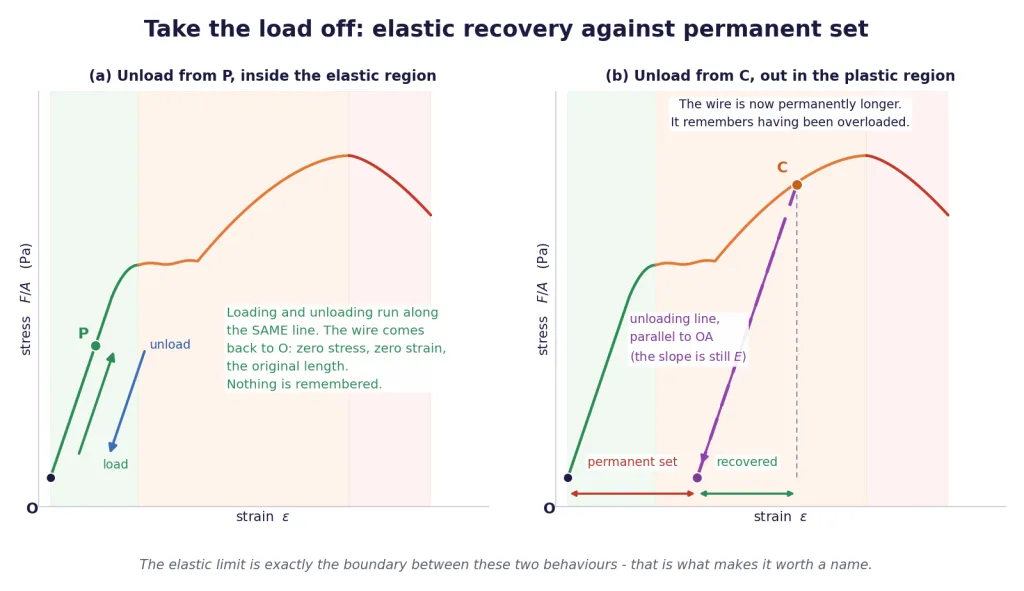
Stop anywhere before — call it — and start removing the load. The point representing the specimen slides back down the very same curve it came up, and arrives at the origin. Zero stress, zero strain, original length. The material has no memory of what you did to it.
That is precisely what the word elastic means, and it is worth being fussy about the definition:
Key Point: A deformation is elastic if the body returns completely to its original size and shape when the deforming force is removed. Elastic says nothing about the graph being straight — only about the return.
Unload from out in the plastic region
Now stop at a point well beyond and remove the load. The specimen does not retrace the curve. Instead it comes down along a straight line parallel to — same slope, so the same modulus — and hits the strain axis at a strain that is not zero.
That leftover strain is the permanent set. The wire is now permanently longer than it started, and no amount of waiting will bring it back.
Key Point — reading the unloading line: The recovered part is elastic and behaves exactly as it always did. The permanent part is plastic and is gone for good.
Notice how small the recovered part usually is. Take our steel at Pa. The recovery is , so out of a strain of the wire gives back and keeps . Over 98% of what you did to it is permanent.
Where this shows up in real life
- A paper clip you bend once springs back. Bend it further and it stays bent. You have crossed .
- Every metal object with a shape — a car door, a spoon, a girder — was made by deliberately taking the metal past and using the permanent set. Plastic deformation is not a failure mode, it is a manufacturing process.
- A bridge cable, on the other hand, must never be allowed anywhere near . Engineers pick a working stress well below the yield strength, typically a quarter or a fifth of it, and the ratio is called the factor of safety.
Key Point: A factor of 4 means the structure is loaded to a quarter of the stress at which it would start to yield.
There is a further subtlety for materials such as rubber, where the unloading curve does not even lie on top of the loading curve and the loop that results has a name and a meaning. That is a topic for a later section; for now, hold on to the clean case.
[NEET Important] "Permanent set" and "plastic deformation" are the same phenomenon under two names. If a question says a wire "does not regain its original length", the load has crossed the elastic limit — that is all it is telling you.
Ductile or Brittle, Straight Off the Shape
You do not need a laboratory report to classify a material. The shape of its curve tells you, at a glance.
Key Point — the test, in one line:
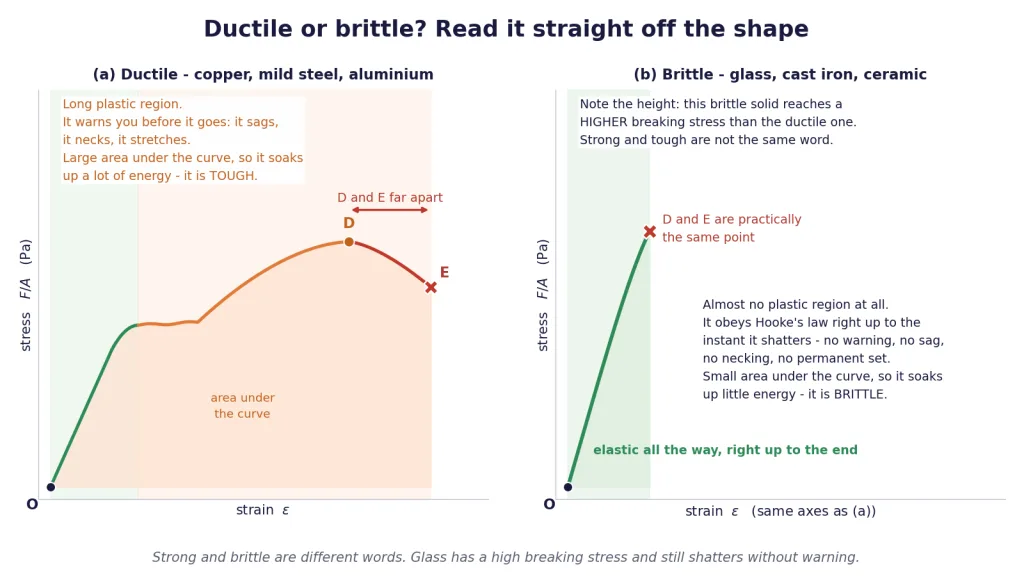
Look at the gap between (ultimate tensile strength) and (fracture).
- and far apart a long plastic region the material is ductile.
- and practically on top of each other almost no plastic region the material is brittle.
Ductile materials — copper, mild steel, aluminium, gold — stretch a great deal before they go. Our steel specimen reaches a strain of at fracture, which is 30% elongation. Crucially, a ductile material warns you. It sags, it necks, it visibly deforms, and there is time to notice and to get out of the way. That is why they are used for cables, girders, rivets and anything that holds people up.
Brittle materials — glass, cast iron, ceramic, concrete in tension — obey Hooke's law almost perfectly right up to the instant they shatter. A typical glass specimen fractures at a strain of about , that is, 0.077%. Compare that with steel's 30%: the steel survives about 390 times the strain. And there is no warning at all — no sag, no neck, no permanent set. One moment it is fine, the next moment it is in pieces.
Strong, stiff and tough are three different words
This is where marks go missing, so let us separate them properly.
| Word | What it means | Where you read it on the curve |
|---|---|---|
| stiff | hard to strain at all | the slope of , that is |
| strong | carries a large stress before failing | the height of the curve, at |
| tough | absorbs a lot of energy before breaking | the area under the whole curve |
| ductile | strains a great deal before breaking | the width of the curve, at |
A material can be strong and brittle at the same time. Glass is a good example: a clean glass fibre can carry a huge stress, so it is strong, and yet it shatters without warning, so it is brittle and not at all tough. Rubber is the mirror image: hopeless at carrying stress, but it strains enormously and swallows a lot of energy, so it is tough without being strong.
Why the area under the curve is the energy
Look at the axes. Stress has units of newton per square metre; strain has no units. Multiply them:
Joules per cubic metre — that is energy per unit volume. So an area on this graph is not an abstraction; it is literally the work done per cubic metre of material in deforming it.
Key Point: The total area under the stress-strain curve, from right up to fracture, is the energy absorbed per unit volume of the material before it breaks. That quantity is called toughness. A fat curve means a tough material.
Put numbers on it with our two specimens. Integrating under the tabulated steel curve gives about J/m. Doing the same for the brittle glass specimen gives about J/m. The steel absorbs roughly five thousand times as much energy per cubic metre. That single ratio is why bridges are made of steel and not of glass.
Notice also how tiny the elastic part of that area is: the triangle alone comes to about J/m, which is only about of the total. Almost everything a ductile metal absorbs, it absorbs plastically — by permanently deforming. The full machinery of elastic potential energy and strain energy density is developed in its own section later; here you only need to know what the area means and how to read it.
[JEE Tip] "Which material is more elastic?" and "which material is tougher?" have opposite answers for steel and rubber. Steel has the far larger modulus, so it is more elastic in the technical sense. Rubber has the far larger area under its curve per unit volume before failure, so it is tougher. Both statements are correct at once; make sure you answer the question that was actually asked.
Elastomers: Fully Elastic, and Never Linear
Everything so far has been about metals. Now meet the family that breaks the pattern.
Stretch a rubber band. You can pull it to several times its original length, let go, and watch it snap back to exactly what it was. By the definition in the block above — complete return when the load is removed — rubber is beautifully, spectacularly elastic. And yet its stress-strain graph does not contain a single straight portion anywhere.
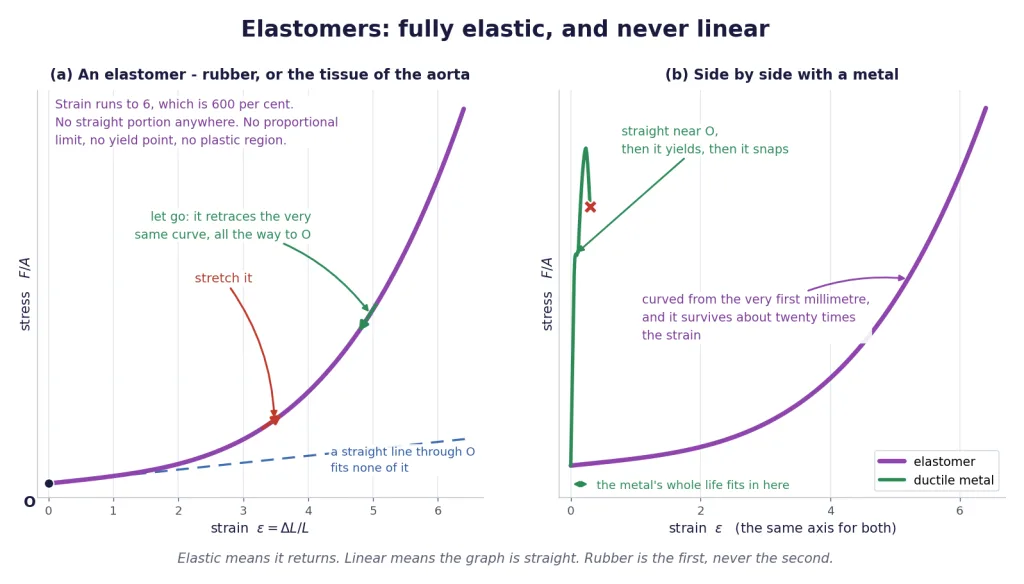
Key Point: Materials that can be stretched to produce very large strains and still return completely are called elastomers. Rubber is the everyday example; the elastic tissue of the aorta, the great vessel carrying blood away from the heart, is the biological one.
Three things about the elastomer curve, and each one is a whole exam question:
- The strain axis runs to several hundred per cent. A metal fractures at a strain of a few tenths. Rubber comfortably reaches a strain of 5 or 6, meaning 500% or 600% elongation. On a shared axis, the entire life of a steel specimen fits inside a sliver near the origin.
- There is no straight portion at all — not even near the origin. The curve starts shallow, stays shallow for a long while as the tangled polymer chains straighten out, and then rears up steeply once they are pulled taut. Hooke's law is never obeyed, not even approximately, at any point.
- There is no well-defined plastic region and no yield point in the sense a metal has. The elastic region is essentially the whole curve.
The consequence: an elastomer has no single modulus
Suppose you try anyway to compute a "Young's modulus" for a rubber cord by taking stress over strain at whatever point you happen to be at. Here is what you get from two points on a typical curve:
| At a strain of | The stress is | Stress over strain |
|---|---|---|
| 1.0 | Pa | Pa |
| 4.0 | Pa | Pa |
The two answers differ by a factor of . Neither is wrong; the question is meaningless. A single number for the modulus only exists if the graph is a straight line through the origin, and this one is not.
Key Point: For an elastomer, stress over strain depends on where you measure it, so quoting one value of for rubber is only ever a rough order-of-magnitude statement. Typical figures of around Pa for rubber against Pa for steel are still worth carrying, because the comparison — a factor of about — is the real point.
Why biology uses them
The aorta has to take the sudden slug of blood the heart throws at it thirty times a minute for eighty years, expand to absorb the pressure spike, and squeeze back to push the blood onward. It needs a material with an enormous elastic range that never takes a permanent set and never fatigues. A steel pipe would be far too stiff to expand at all; a plastic-behaving material would slowly deform and stay deformed. An elastomer is the only option, and the same reasoning explains rubber tyres, shock mountings and the soles of your shoes.
The four traps in this section
Trap 1 — "elastic" is taken to mean "obeys Hooke's law". It does not. Elastic means it returns. Linear means the graph is straight. Rubber is the first without being the second, and between and a metal is also the first without being the second.
Trap 2 — the elastic limit is confused with the breaking point. They are completely different points, usually very far apart. Between and the material is bent out of shape but perfectly intact.
Trap 3 — "more elastic" is taken to mean "stretches more". It is the reverse. A larger modulus means a smaller strain for the same stress, which means more elastic. Steel is more elastic than rubber by this measure, by a factor of about .
Trap 4 — the modulus is read off the wrong part of the curve. The modulus is the slope of the initial straight line only. Dividing the fracture stress by the fracture strain gives a number that means nothing at all.
[Board Important] The standard three-mark question is: "Rubber returns to its original length after being stretched several times over, and yet we say steel is more elastic than rubber. Explain." The answer has two halves. First, elasticity is measured by the modulus, and steel needs an enormously larger stress than rubber to produce the same strain, so its modulus is far larger. Second, rubber does not obey Hooke's law anywhere on its curve, so it does not even possess a single well-defined modulus. Say both halves.
Solved Examples
The mild-steel specimen used repeatedly below is the one tabulated in the notes: proportional limit at strain and stress Pa, elastic limit at strain and stress Pa, ultimate tensile strength at strain and stress Pa, fracture at strain and stress Pa. Where is needed, m/s is used throughout this section.
Example 1: The modulus is a slope, so find the slope
The straight portion of the stress-strain graph of a metal passes through the origin and through the point Pa, and it stays straight up to the proportional limit at Pa. Find the modulus of elasticity of the metal, and the stress at the proportional limit.
Solution:
The modulus is the slope of the straight part. Take any two points on it; the origin is the easiest partner.
Confirm with the other point, which is the whole point of a straight line: Same answer. Good.
The stress at the proportional limit is read straight off: Pa. Since the material is being stretched lengthwise, this modulus is Young's modulus .
Final Answer: Pa; the proportional limit is at a stress of Pa.
Takeaway: The modulus is the slope of the initial straight line, nothing else. If two points on that line give you different answers, either you have misread the graph or one of them is not on the straight part.
Example 2: Finding where Hooke's law dies from a table of readings
A wire 2.0 m long of cross-sectional area 1.0 mm is loaded in steps and the extension recorded:
| Load (N) | 20 | 40 | 60 | 80 | 100 | 120 |
|---|---|---|---|---|---|---|
| Extension (mm) | 0.25 | 0.50 | 0.75 | 1.00 | 1.30 | 1.90 |
Up to what load does the wire obey Hooke's law? Find Young's modulus, and the stress and strain at the proportional limit.
Solution:
- Hooke's law means extension is proportional to load. So compute for every row and look for the first one that breaks the pattern.
| (N) | 20 | 40 | 60 | 80 | 100 | 120 |
|---|---|---|---|---|---|---|
| (mm/N) | 0.0125 | 0.0125 | 0.0125 | 0.0125 | 0.0130 | 0.0158 |
The first four are identical. The fifth is 4% high and the sixth is 27% high.
So the proportional limit lies between 80 N and 100 N. The wire obeys Hooke's law up to 80 N.
Young's modulus from the proportional part. Use N with mm, m, m:
Stress and strain at that point: And as a check, Pa. Consistent.
Final Answer: Hooke's law holds to 80 N; Pa; at the proportional limit the stress is Pa and the strain is .
Takeaway: Never fit a straight line through the whole table. Compute the ratio row by row, throw away every row after it starts drifting, and use only what is left.
Example 3: Reading all five landmarks off a data set
From the tabulated mild-steel curve, state (a) the ultimate tensile strength and the strain at which it occurs, (b) the fracture stress and the fracture strain, (c) the percentage elongation at fracture, and (d) whether the material is ductile or brittle.
Solution:
(a) The ultimate tensile strength is the highest stress anywhere on the curve. Scanning the table, the largest entry is Pa, at a strain of . That is .
(b) The fracture stress is the stress at the last point, where it parts: Pa at a strain of . That is . Note that it is lower than the ultimate tensile strength — the specimen has necked, and the plotted stress uses the original area.
(c) Percentage elongation at fracture is simply the fracture strain as a percentage:
(d) sits at a strain of and at , so there is a strain gap of between them, which is 10% elongation of pure necking. and are a long way apart, so the material is ductile.
Final Answer: (a) Pa at strain ; (b) Pa at strain ; (c) 30%; (d) ductile.
Takeaway: Ultimate tensile strength is the maximum of the curve; fracture stress is the end of the curve. For a ductile metal the second is smaller than the first, and that is not a mistake. Keep the convention straight as well: when a later problem simply says "breaking stress" and hands you a single number, it means the maximum — the Pa at , not the Pa at .
Example 4: Designing to stay inside the elastic region
A steel cable is to carry a steady load of 5000 N. The yield strength of the steel is Pa, and the designer insists on a factor of safety of 4. Find the working stress and the minimum diameter of the cable.
Solution:
Working stress is the yield strength divided by the factor of safety:
Area needed. The stress must not exceed the working stress:
Turn area into a diameter. With , so the diameter is about 10.1 mm.
Check by going backwards. With mm, m and the actual stress is Pa, exactly the working stress. Consistent.
Final Answer: Working stress Pa; minimum diameter about 10.1 mm.
Takeaway: A factor of safety is a divisor on the stress, not on the load. Divide the yield strength by it, then size the cable so the actual stress stays below what is left.
Example 5: How much of the stretch do you get back?
A steel wire 1.5 m long is pulled until it reaches the point on its stress-strain curve, at a strain of and a stress of Pa. The load is then removed. The modulus of the steel is Pa. Find the recovered strain, the permanent set, and the final length of the wire.
Solution:
The unloading line is parallel to , so its slope is still the modulus . Coming down from to zero stress, the strain recovered is
What is left behind is the permanent set:
In millimetres, for this wire. Recovered: m, that is 2.55 mm. Permanent: m, that is 147.5 mm.
Final length:
Final Answer: Recovered strain (2.55 mm); permanent strain (147.5 mm); final length 1.6475 m.
Takeaway: Out in the plastic region almost nothing comes back. Here the wire returns 2.55 mm out of 150 mm of stretch — under 2% — and keeps the rest for ever.
Example 6: Two materials on the same axes
Two materials and are tested and their straight-line portions are recorded. For , a stress of Pa produces a strain of . For , a stress of Pa produces a strain of . Which is the stiffer material, and by what factor? If fractures at a strain of while fractures at a strain of , which would you choose for a suspension cable?
Solution:
Stiffness is the modulus, which is the slope.
The ratio: is about 2.9 times as stiff — for the same stress it strains 2.9 times less.
But the cable question is not about stiffness. fractures at a strain of , which is 2% elongation, so is brittle. survives to 35% elongation, so is ductile and will sag visibly and give warning long before it goes. Choose .
Final Answer: is stiffer by a factor of about 2.9; but is ductile and is the right choice for a suspension cable.
Takeaway: Stiff is not the same as safe. The slope tells you about stiffness; the width of the curve tells you whether the thing will warn you before it kills somebody.
Example 7: An elastomer has no single modulus
For a rubber cord, a strain of corresponds to a stress of Pa, and a strain of corresponds to a stress of Pa. Compute stress over strain at both points. What does the result tell you?
Solution:
At a strain of 1.0:
At a strain of 4.0:
The ratio of the two answers:
What it means. If the graph were a straight line through the origin, stress over strain would come out the same at every point. It does not — it more than doubles between the two. So the rubber does not obey Hooke's law, and it does not possess a single Young's modulus at all. The two numbers above are the slopes of two different chords, not a material constant.
Final Answer: Pa and Pa, differing by a factor of 2.2; rubber has no single modulus.
Takeaway: Testing for Hooke's law is one division repeated. Compute stress over strain at two well-separated points. Same answer, straight line and a genuine modulus. Different answers, and there is no modulus to find.
Example 8: Ductile or brittle from the numbers alone
Specimen has its ultimate tensile strength at a strain of and fractures at a strain of . Specimen is straight from the origin to a stress of Pa at a strain of , where it fractures with no plastic region at all. Classify both, and compare their fracture strains.
Solution:
Specimen : at strain , at strain . The gap is , a full 10% of pure necking after the peak. and are far apart, so is ductile.
Specimen : the curve is straight all the way to the point where it fails, so and are the same point. is brittle.
Its modulus, from the straight line: which is the right ballpark for glass.
Compare the fracture strains: The ductile specimen survives 390 times the strain before it goes.
Final Answer: ductile, brittle with modulus Pa; tolerates about 390 times the strain of .
Takeaway: A brittle material can still be stiff. Glass has a modulus a third that of steel and still shatters at a strain a few hundred times smaller. Stiffness and ductility are independent.
Example 9: Counting the area to compare toughness
Using the tabulated mild-steel data, estimate the total area under the stress-strain curve up to fracture, and do the same for a brittle glass specimen whose curve is a straight line from the origin to Pa. Which is tougher, and by how much?
Solution:
What the area means. Stress in N/m times strain (a pure number) is J/m, so the area is the energy absorbed per unit volume.
The steel, by the trapezium rule on the twelve tabulated points. Each strip contributes (average of the two stresses) times (width in strain). The first few strips are tiny, the later ones dominate. For instance the strip from to gives Adding all eleven strips: Simpson's rule on the same points gives J/m — a difference of about 0.4%, which is the honest size of the uncertainty in reading a curve this way.
The glass is a triangle, so its area is exact:
The ratio:
Final Answer: Steel about J/m, glass about J/m; the steel is roughly 5400 times tougher.
Takeaway: Toughness lives in the plastic region. For the steel, the elastic triangle contributes only about J/m, which is 0.15% of the total. Almost all the energy a metal absorbs goes into permanently deforming it.
Example 10: When does a rod start to yield?
A rod of cross-sectional area 5.0 mm is made of a metal whose yield strength is Pa and whose modulus is Pa. (a) What load makes it start to yield? (b) The rod is 1.2 m long; how much has it stretched at that instant? (c) What happens if the load is doubled?
Solution:
(a) Yielding starts when the stress reaches the yield strength. With m/s that is a hanging mass of kg.
(b) The strain at that stress, still inside the linear region:
(c) Doubling the load to 2500 N puts the stress at Pa, which is beyond the ultimate tensile strength of most mild steels. But even before worrying about fracture, note what you cannot do: you cannot use to predict the new extension, because that formula is Hooke's law and the rod is now deep in the plastic region where Hooke's law does not apply. The extension would be far larger than 3 mm, and only the experimental curve can tell you how much.
Final Answer: (a) 1250 N, about 128 kg; (b) 1.5 mm; (c) it yields, and the elongation formula no longer applies.
Takeaway: The formula stops when the straight line stops. Part (c) is the whole point of this section: the moment you cross the proportional limit, every Hooke-based formula in the chapter becomes useless.
Example 11: Where does Hooke's law stop for this wire?
A wire of cross-sectional area 2.0 mm is made of a metal whose proportional limit is at a stress of Pa. Below what hanging mass does the wire obey Hooke's law? Take m/s.
Solution:
Convert the limiting stress into a limiting force:
Convert force into hanging mass:
Read the answer carefully. Below about 51 kg the wire is linear, so is proportional to the load and every formula works. Above it the wire is still elastic for a while — it will still come back when unloaded — but the extension is no longer proportional to the load.
Final Answer: The wire obeys Hooke's law up to a load of about 500 N, that is, a hanging mass of about 51 kg.
Takeaway: The proportional limit is a stress, so the load that reaches it depends on the area. Double the area and you double the load the wire can take before Hooke's law fails, and the length makes no difference at all.
Example 12: The one that catches everybody
A student writes: "Rubber can be stretched to eight times its length and comes back perfectly, whereas a steel wire snaps after stretching by a few per cent. Therefore rubber is more elastic than steel, and rubber obeys Hooke's law better." Find and correct both errors.
Solution:
Error one: "more elastic". Elasticity is measured by the modulus, which is the stress needed per unit strain. Steel has Pa; rubber is around Pa. To produce the same strain in steel you need about times the stress. Steel resists deformation far more strongly, so steel is the more elastic material, by a factor of about a hundred thousand. Stretching a lot is a sign of a small modulus, not a large one.
Error two: "obeys Hooke's law better". Exactly backwards. The steel curve has a genuine straight portion from the origin to the proportional limit, over which Hooke's law is obeyed precisely. The rubber curve is curved everywhere, so rubber obeys Hooke's law nowhere at all.
What is true in the student's observation. Rubber has an enormous elastic range — it stays elastic out to strains of several hundred per cent, where a metal would have yielded long ago. And rubber is tougher per unit volume: the area under its curve before failure is large. Both of these are real and worth saying. Neither of them is "more elastic".
Final Answer: Steel is more elastic (much larger modulus) and steel obeys Hooke's law over its initial straight portion, which rubber never does. What rubber has is a huge elastic range and a large area under its curve.
Takeaway: Three different properties, three different questions: modulus, elastic range, and area under the curve. Decide which one the examiner is asking about before you write a word.