
Same Chapter, Half the Clock
Section 12 has just taken this chapter apart the hard way — non-uniform bars by integration, rotating rods, rigid bars sitting on three wires at once, composite thermal stress, a mass dropped onto a wire. If you worked through it, you already know far more elasticity than this section will ever ask of you.
So why a separate corner? Because the skill being tested is different.
One paper gives you a hard question and enough time to think. This one gives you a manageable question and almost no time at all. Physics is 45 questions, and inside a 180-minute paper shared with Chemistry and Biology those 45 deserve roughly 45 minutes. One minute each — and Mechanical Properties of Solids reliably supplies one or two of them. Every one has to be finished in well under a minute, correctly, so the time is banked for the questions that genuinely need it.
What is NOT asked from this chapter
This list matters as much as anything else here, because it tells you what to stop worrying about.
Key Point: Elasticity at this level never leaves the core syllabus. No integration over a tapering bar. No rotating rod. No rigid-bar-on-three-wires compatibility. No dropped-mass dynamic extension. No torsional oscillation. Everything on the paper is a statement you recall, one standard formula you substitute into, a set-up you have drilled, a graph you read, or one of the two special formats.
Every item on that list belongs to Section 12. If you find yourself setting up , you have wandered into the wrong section's version of the question.
The four types, and what each should cost you
| Type | What it looks like | Your budget | The right instinct |
|---|---|---|---|
| 1. Direct recall | "Define stress." "Strain has which unit?" "Which modulus applies to a liquid?" | 15-20 s | You either know it or you do not. Never derive a definition. |
| 2. One-step plug-in | , , , stress strain | 25-35 s | Spot the picture, pick the card, substitute once. |
| 3. Standard template | The loaded wire, the body at ocean depth, the ranking of four materials | 25-40 s | Recognise the set-up. You should already know the shape of the answer. |
| 4. Assertion-Reason / Column matching | Two special formats, both drilled below | 35-45 s | Judge each statement alone, then judge the link. |
[Important] A diagnostic worth internalising: if an elasticity question needs a fourth line of working, you have misread it. You are handed two of the quantities and asked for a third. If your page is filling up, stop and reread the stem — you have almost certainly imported an assumption that was never made.
The / arithmetic
Four marks for a correct answer, minus one for a wrong one, zero for a blank. On a doubtful item the real question is not "can I get this?" but "can I get this in 40 seconds?" If two options survive elimination and 40 seconds have gone, take the better one and move on — a 50-50 guess is worth marks on average. What you must never do is spend three minutes rescuing one mark's worth of doubt in a chapter where the very next question might be a one-liner about whether strain has a unit.
The numbers and symbols this section fixes, now
Throughout this section m/s. No problem here mixes 9.8 with 10. The material constants used are these and no others:
| Quantity | Value |
|---|---|
| steel / copper / brass / aluminium | / / / ( Pa) |
| steel | Pa |
| steel / copper / water | / / Pa |
| Poisson's ratio of steel | about |
| density of sea water | 1030 kg/m |
| for steel | per degree Celsius |
Key Point — symbol convention:
means Poisson's ratio, and stress is written (or , , for longitudinal, shearing and hydraulic stress where a symbol is unavoidable). Strain is . The moduli are , , , with . Elsewhere often denotes stress, with or for Poisson's ratio. Check the symbol list on any paper before you copy a formula into it.
What this section does, and what it does not repeat
We will not re-derive the elastic-versus-plastic picture (Section 1), redefine stress and strain from scratch (Section 2), rebuild the stress-strain curve (Section 3), re-derive (Section 4), (Section 5) or (Section 6), re-derive Poisson's ratio and the inter-constant relations (Section 7), rebuild the strain-energy formulas (Section 8), redo thermal stress and hysteresis (Section 9) or re-explain beam sag and mountain height (Section 10). What you get instead is the same material reorganised for recognition speed:
- The sentences that come back almost verbatim.
- The formula table as a recognition exercise, with a hook for each.
- The rankings and comparisons on , and compressibility that reappear every year.
- The two standard templates, with clean numbers.
- Graph reading, and the two special formats, drilled properly.
- Speed habits and elimination tactics.
One housekeeping note. Thermal stress and the relations between the elastic constants sit outside the rationalised syllabus body text, but both are asked, so both appear in the recognition table below and in the practice set that follows.
The Sentences That Come Back Almost Verbatim
This block is pure recall ammunition. Read it as flashcards, not as prose. Every item here has appeared as a complete question by itself.
Stress and strain, word for word
Key Point:
- Stress is the internal restoring force per unit area set up inside a deformed body, . SI unit N/m, given the name pascal (Pa). Dimensional formula — the same as pressure.
- Strain is the fractional change in a dimension: the change divided by the original value. It is a pure number with no unit and no dimensional formula, because it is a length divided by a length (or a volume divided by a volume).
- Stress is not a vector. A force has one direction; a stress needs a magnitude, the plane you are talking about, and the direction of the force on that plane. Three pieces of information, not two. It is not a scalar either. If "tensor" is offered, that is the best answer available.
The unit and the "no unit" are worth separating in your head, because they are asked as two different questions. Stress: pascal. Strain: nothing at all. And a modulus, being a stress divided by a pure number, is back in pascal again.
The three pairs, and which modulus each calls for
Key Point:
- Longitudinal stress with the force perpendicular to the loaded face, and longitudinal strain . Tensile if it stretches, compressive if it squashes. Modulus: .
- Shearing stress with the force tangential to the loaded face, and shearing strain in radians. Modulus: .
- Hydraulic stress , the same on every face at once, and volume strain . Modulus: .
Two one-line consequences that are asked directly. Shear changes the shape but not the volume. Hydraulic compression changes the volume but not the shape.
Why steel is more elastic than rubber
This is the single most-tested misconception in the chapter, and it is worth being able to say in one breath.
Key Point: Elasticity is not "how far it stretches" — it is how strongly the body resists being deformed and how completely it comes back. The measure is the modulus, and the modulus is . Under the same stress, steel gives a strain about times smaller than rubber does, so and steel is the more elastic of the two. Rubber stretches enormously, which makes it feel elastic in everyday language and is exactly the wrong criterion.
Say it as: larger modulus means more elastic. Anything that says "rubber is more elastic because it stretches more" is the distractor.
Why gases have no and no
Key Point: A gas (and a liquid at rest) cannot sustain a shearing stress — apply one and it simply flows, so no fixed angle is ever reached and has no meaning. A gas also has no definite length or shape of its own, so a longitudinal strain cannot even be defined, and has no meaning either. What a fluid does have is a volume, so it can be squeezed, and is the one modulus that exists for solids, liquids and gases alike.
| Solid | yes | yes | yes |
| Liquid | no | no | yes |
| Gas | no | no | yes |
And the follow-up that is asked in the same breath: for an ideal gas compressed isothermally, — the bulk modulus of a gas is not a fixed material constant at all, it depends on the pressure the gas happens to be at. An isothermal gas at one atmosphere has Pa, six orders of magnitude below a metal.
The rest of the recall list
Key Point:
- Hooke's law is an approximation, not a law of nature: stress is proportional to strain only for small deformations, up to the proportional limit and no further.
- On the curve: is the proportional limit (the straight part ends), is the elastic limit / yield point (recovery ends), to is the plastic region, is the ultimate tensile strength (the highest point), is fracture.
- The slope of the straight part is the modulus. Steeper line, larger , stiffer material.
- The area under the stress-strain curve is the energy absorbed per unit volume.
- Elastomers — rubber, the tissue of the aorta — return completely from huge strains and yet obey Hooke's law nowhere. Elastic without being linear.
- The minus sign in exists so that comes out positive, because raising the pressure always lowers the volume, making negative.
- The minus sign in exists so that comes out positive, because stretching a rod makes it thinner.
- Compressibility is , in Pa. Large means easy to squeeze.
- Breaking stress is a property of the material. It does not depend on the length of the wire, so cutting a wire in half does not change the load at which it snaps.
- Strain energy carries a factor of one half: and stress strain, because the restoring force grows from zero rather than sitting at all the way.
The always-true / never-true table
Speed comes from knowing which sentences are safe.
| Statement | Verdict |
|---|---|
| Strain has no unit and no dimensions | Always |
| Stress and pressure share a unit and a dimensional formula | Always |
| Stress is a vector | Never |
| A modulus is measured in pascal | Always |
| Rubber is more elastic than steel because it stretches more | Never |
| A liquid at rest has a shear modulus | Never |
| A gas has a bulk modulus | Always |
| Hooke's law holds right up to fracture | Never |
| Beyond the elastic limit some deformation is permanent | Always |
| The highest point of the curve is the fracture point | False — it is the ultimate tensile strength |
| Young's modulus depends on the length of the wire | Never — it is a material property |
| Breaking load depends on the area of cross-section | Always |
| Breaking stress depends on the length | Never |
| The bulk modulus of an ideal gas is a fixed constant | False — isothermally it equals |
| Poisson's ratio can exceed for an isotropic solid | Never |
| The work done in stretching a wire by is | False — it is half that |
[Important] The four most reused distractors in this chapter are "rubber is more elastic than steel", "strain is measured in pascal", "the highest point on the curve is the fracture point" and "the work done is ". Each appears somewhere almost every year, and each is worth four marks in under fifteen seconds.
The Recognition Table, With a Hook for Each
Sections 1 to 10 derived all of these. Your job here is different: see the situation, name the formula, substitute. No derivation, ever.
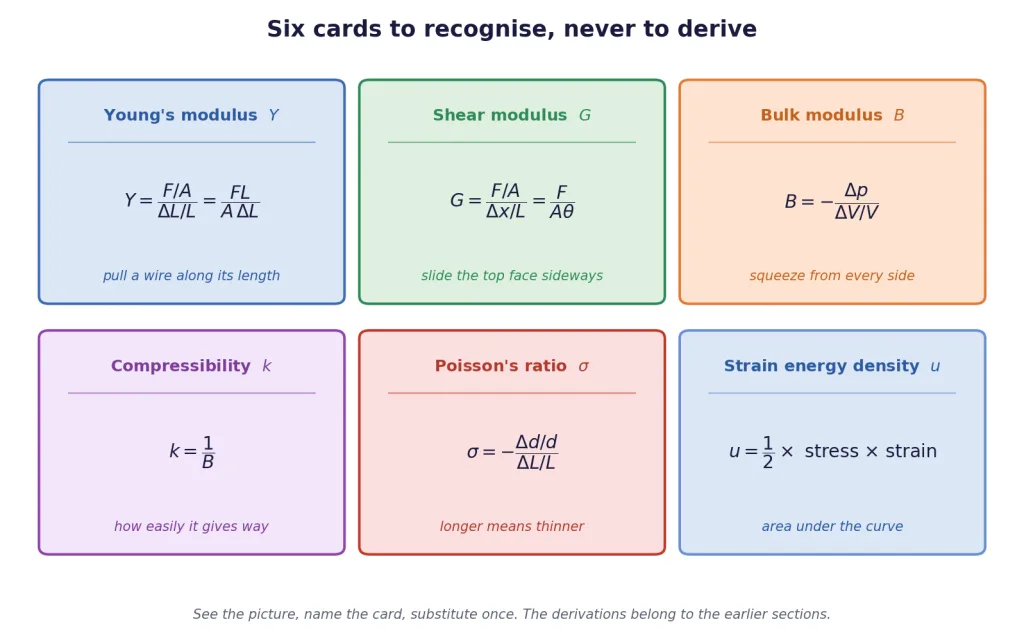
The fourteen you must know cold
| # | Situation | Formula | Memory hook |
|---|---|---|---|
| 1 | any stress | force over the area it is spread across | |
| 2 | longitudinal strain | change over original, always | |
| 3 | shearing strain | the slip divided by the height, in radians | |
| 4 | volume strain | shape unchanged, size not | |
| 5 | any modulus | one pattern, three names, all in pascal | |
| 6 | stretching a wire | upstairs, downstairs | |
| 7 | the extension itself | long and thin stretches most | |
| 8 | wire as a spring | shorter wire, stiffer spring | |
| 9 | sliding a face | is the face the force slides along | |
| 10 | squeezing from all sides | the minus makes positive | |
| 11 | compressibility | the reciprocal, in Pa | |
| 12 | sideways contraction | longer means thinner | |
| 13 | volume change on stretching | at the volume is fixed | |
| 14 | stored energy | , | never forget the one half |
Three more that are asked less often but come up, and are worth carrying:
| Situation | Formula | Note |
|---|---|---|
| clamped rod, heated | independent of length and of area | |
| linking the constants | any two of , , , give the rest | |
| energy density, three forms | pick the one that matches your data |
The last two of those sit outside the rationalised syllabus body text, but they are asked, so they belong on this card.
Typical values worth carrying in your head
| Material | (Pa) | (Pa) | (Pa) |
|---|---|---|---|
| Steel | |||
| Copper | |||
| Brass | |||
| Aluminium | |||
| Glass | |||
| Bone, in compression | — | — | |
| Water | — | — | |
| Air, isothermal, at 1 atm | — | — | |
| Rubber | about | — | — |
Typical values for common materials; individual samples vary, and a question that supplies its own number always wins.
Two patterns hide in that table and both are examined. is roughly for a metal, so if a paper gives you and asks for a plausible , divide by three. And is the same order as for a solid, about a hundred times smaller for a liquid, and about a million times smaller for a gas.
The ratio shortcuts, which are faster than substituting
Most questions in this chapter compare two situations rather than asking for one absolute number. Learn the proportionalities and you never touch a calculator.
Worked in one line each.
- Same wire, load doubled: the extension doubles.
- Same load and material, radius doubled: the extension falls to one quarter.
- Same load and material, length doubled and radius doubled: , the extension halves.
- Same load and material, length doubled and area doubled: , the extension is unchanged. This one catches people.
- Extension doubled: the stored energy goes up four times, since .
Key Point: The single most examined confusion in this chapter is breaking load against breaking stress. Breaking stress is a material property, fixed by what the wire is made of. Breaking load is that stress multiplied by the area of cross-section, so it grows with thickness and is completely indifferent to length. Cut a wire in half and it still snaps at the same load; double its radius and it carries four times as much.
[Important] Two units that get asked directly. The modulus of rigidity is in pascal, exactly like and — it is a stress divided by a pure number. And compressibility is in Pa, which is the only reciprocal-pascal quantity in the chapter and therefore the easiest thing in the world to spot in a list of options.
The Rankings and Comparisons That Recur Every Year
Of all the elasticity items on this paper, the ranking family is the most predictable. Two orderings answer nearly all of them, and they run in opposite directions, which is exactly why they are set.
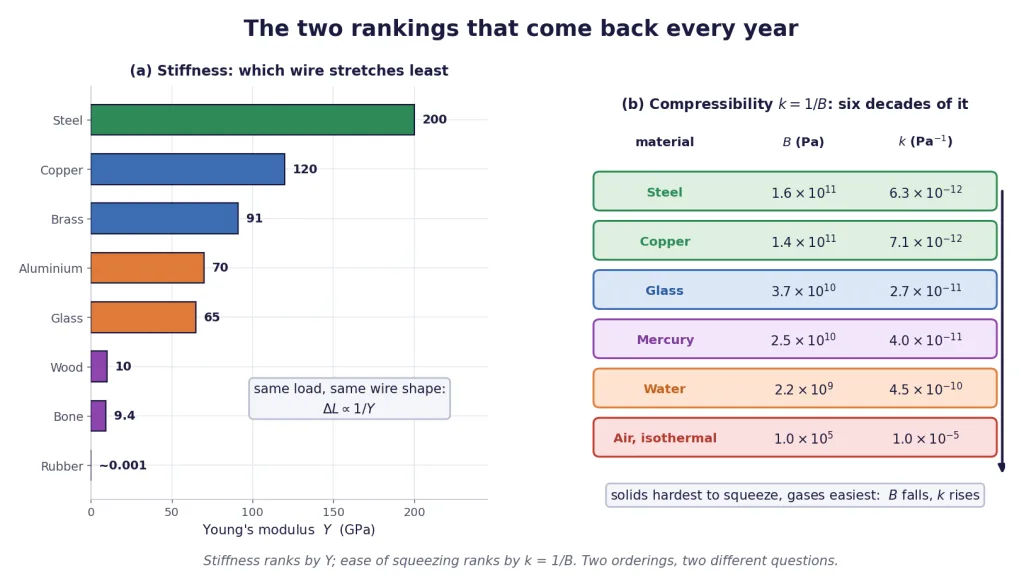
Ranking 1 — stiffness, by
Take four wires of identical length and identical cross-section, hang the same load on each, and ask which stretches most. Since , everything except is common, so
Largest stretches least. With a 100 N load on wires 1 m long and 1 mm in section:
| Material | (Pa) | Extension |
|---|---|---|
| Steel | 0.50 mm | |
| Copper | 0.83 mm | |
| Brass | 1.10 mm | |
| Aluminium | 1.43 mm |
Four identical wires under the same 100 N load; the extension simply tracks .
So the order steel, copper, brass, aluminium runs from stiffest to floppiest — and from most elastic to least elastic, since a bigger modulus means more elastic. Learn the four numbers in that order and this whole family costs you five seconds.
Ranking 2 — squeezability, by and by
Now take the same materials and squeeze them from every side. Here the relevant modulus is , and the natural quantity is often its reciprocal.
| Material | State | (Pa) | (Pa) |
|---|---|---|---|
| Steel | solid | ||
| Copper | solid | ||
| Glass | solid | ||
| Mercury | liquid | ||
| Water | liquid | ||
| Air, isothermal, at 1 atm | gas |
Bulk modulus and compressibility across the three states of matter; note the six-decade gap from a solid to a gas.
Key Point: Large means hard to squeeze. Large means easy to squeeze. The two rankings are exact mirrors of each other, so read the question carefully: "most compressible" wants the largest and therefore the smallest . The state-of-matter ordering is solids least compressible, then liquids, then gases most compressible, and the gaps are enormous — a gas is roughly a million times easier to squeeze than a metal.
The three comparisons that actually get set
(a) Same load, two wires that differ in one thing. Use and change one factor at a time. Nothing else is needed.
(b) Same stress against same strain. These sound alike and give opposite answers, so they are set as a pair.
| The two wires are given | The comparison you want | The answer |
|---|---|---|
| the same stress | strain | the smaller strains more |
| the same strain | stress | the larger carries more stress |
| the same stress | the smaller stores more energy per unit volume | |
| the same strain | the larger stores more energy per unit volume |
The last two rows flip, and that flip is the whole question. Decide first which of stress or strain is being held fixed, then pick the matching form of .
(c) The same force applied two different ways. Put a force on a cube first as a normal pull and then as a tangential push on a face. The stress is the same number both times, but the strain is in the first case and in the second. Since for a metal, the shearing deformation is about three times larger.
Where the ranking questions go wrong
- Reading "most compressible" as "largest bulk modulus". It is the largest compressibility, which is the smallest .
- Ranking by extension when the wires are not identical. If the radii differ, alone does not decide it — does.
- Assuming a large means a large breaking stress. They are completely different properties. Glass has a respectable and a wretched breaking stress; that is precisely what "brittle" means.
[Important] "More elastic" always means larger modulus, never "stretches more". A one-line check that saves you every time: the material with the steepest stress-strain graph is the most elastic one on the page.
The Two Templates
Two set-ups cover the overwhelming majority of elasticity numericals on this paper. Recognise which one you are looking at, write the boxed line, substitute.
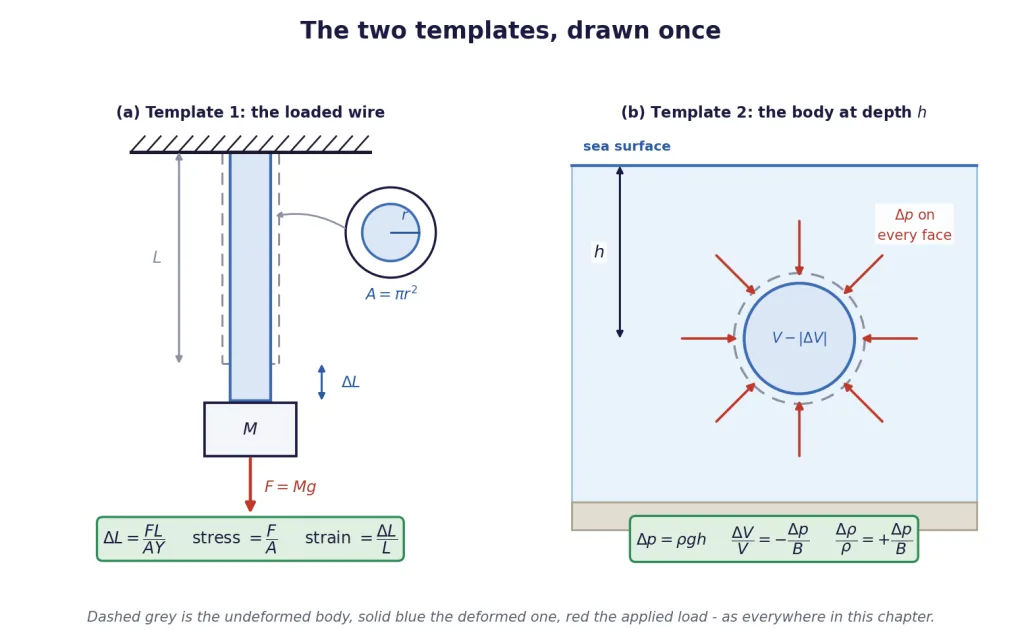
Template 1 — The loaded wire
Everything begins by turning the diameter into an area. A wire is a cylinder, so , and is half the diameter — the commonest slip in this entire chapter is putting the diameter where the radius belongs, which makes the answer four times too small.
The clean numbers. A steel wire 2.0 m long and 1.0 mm in diameter carries a 4.0 kg load, with Pa and m/s:
Everything comes out clean, which is why this exact wire turns up so often. Two by-products you get for free once those four lines are on the page: the wire's force constant N/m, and the energy stored, J.
Key Point: Write the four lines in this order every time: area, stress, strain, extension. Doing them out of order is how people end up dividing by twice or forgetting to multiply the strain back by .
Template 2 — The body at ocean depth
Three things to settle before you substitute, because each is worth a mark.
- Which pressure? is the gauge pressure — the extra pressure due to the water above you. Atmospheric pressure adds Pa on top, which at any depth worth asking about is under one per cent. Unless a question says otherwise, use alone and say so.
- Which density? Sea water is 1030 kg/m, fresh water 1000. The question will tell you; read it.
- Volume falls, density rises. They move in opposite directions and by the same fraction, because the mass is unchanged.
The clean numbers. A solid steel sphere is lowered to 2000 m in sea water, with kg/m, m/s and Pa:
so the sphere loses about of its volume — which is another way of saying that at two kilometres down a steel ball is still, to any practical accuracy, the same steel ball.
The same depth, applied to the water instead. With Pa:
Just under one per cent — seventy times more than the steel, and the clearest possible demonstration of what a bulk modulus smaller by that same factor of about seventy actually buys you.
The template traps, priced
| The slip | What it does to your answer |
|---|---|
| using the diameter as the radius | the area is 4 times too big, so is 4 times too small |
| forgetting to multiply strain by | you report a pure number where metres were wanted |
| leaving the area in mm | out by a factor of |
| using depth in kilometres in | out by a factor of 1000 |
| dividing by in a hydraulic problem | wrong modulus entirely |
[Important] The single most costly slip in Template 1 is the radius against diameter one, and it is easy to defend against: write as your first line, in numbers, before you square anything. It costs two seconds and it is the difference between 0.50 mm and 0.125 mm.
Reading the Curve, and the Two Special Formats
Three tasks live in this block. All three are mechanical once you know the drill, and none of them is really physics.
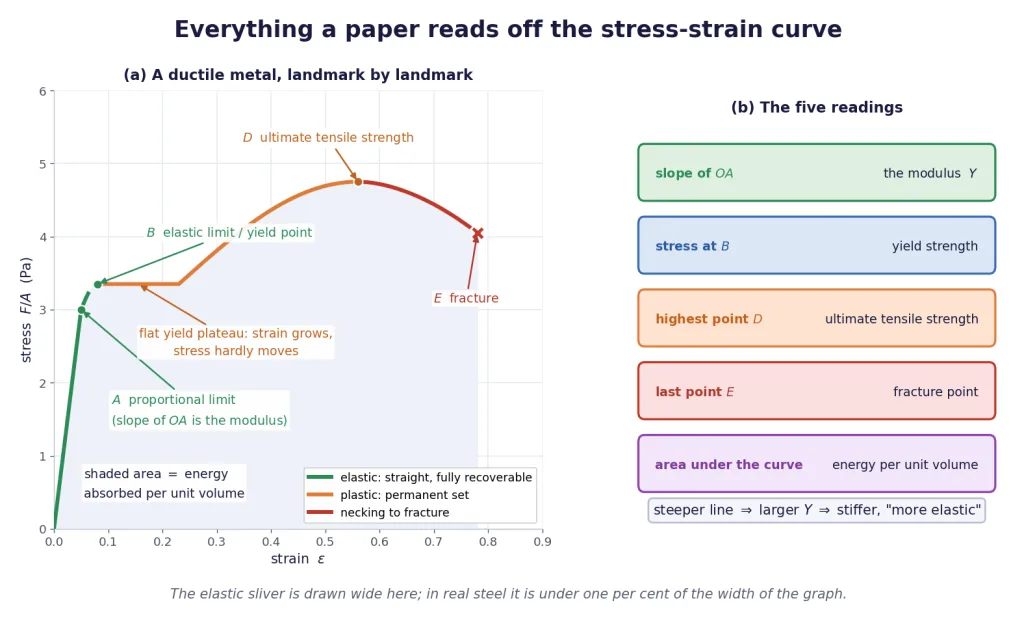
Reading the stress-strain curve
Only five things are ever read off this graph, and each is a whole question.
| What you are shown | What it is |
|---|---|
| the slope of the initial straight line | the modulus of the material |
| the point where the line stops being straight, | the proportional limit |
| the point beyond which recovery fails, | the elastic limit or yield point; the stress there is the yield strength |
| the highest point, | the ultimate tensile strength |
| the last point, | fracture |
| the area under the curve | the energy absorbed per unit volume |
Four fast readings that follow, all of them set as questions in their own right:
- Two straight lines on one pair of axes. The steeper one has the larger . If a line makes an angle with the strain axis, then in the units of the graph, so two lines at and give .
- Ductile against brittle. A ductile material has a long plastic region between and — plenty of warning before it goes. A brittle material fractures at or barely past the elastic limit, with almost no plastic region at all; and sit essentially on top of each other.
- Unloading. From inside the elastic region the point slides back down the same curve to the origin. From out in the plastic region it comes down a straight line parallel to and lands at a non-zero strain, the permanent set.
- Toughness against stiffness. A steep curve means stiff. A large area means tough. They are different properties, and a strong brittle material can be very stiff and store almost no energy.
Key Point: The elastic region on any printed version of this graph is drawn far wider than it really is. In real steel the whole of occupies a strain of about while fracture comes at a strain near — the elastic part is under one per cent of the width of the graph. Knowing that stops you misreading a scale.
Assertion-Reason: the four codes
You are given an Assertion (A) and a Reason (R), and asked to choose:
| Code | Meaning |
|---|---|
| (a) | Both A and R are true, and R is the correct explanation of A |
| (b) | Both A and R are true, but R is not the correct explanation of A |
| (c) | A is true but R is false |
| (d) | A is false but R is true |
Read the option list before you start — the order of these four is not fixed between papers, and picking "option (a)" from memory when the paper has shuffled them is a self-inflicted wound.
Key Point: Three separate judgements, in this order, and never let one influence the next:
- Cover R. Is A true, on its own?
- Cover A. Is R true, on its own?
- Only if both are true: does R actually explain A, or is it merely another true fact about the same topic?
Step 3 is where the marks are, and it is the step people rush. "Both true" is not enough. Ask yourself: if R were false, would A stop being true? If yes, R explains A. If A would survive without R, the answer is (b).
The trap this format is built around in this chapter is the steel-and-rubber pair, because the popular reason and the correct reason point in opposite directions.
Worked, four times.
Item 1. A: Steel is more elastic than rubber. R: For the same stress, the strain produced in steel is far smaller than in rubber. A alone: true. R alone: true. And R is exactly why A holds, since elasticity is measured by . Both true, R explains A.
Item 2. A: Steel is more elastic than rubber. R: A rubber cord can be stretched to several times its natural length, while a steel wire cannot. A alone: true. R alone: true — rubber really does stretch further. But does that explain A? No. It is the fact people mistake for the explanation, and if anything it points the other way. Both true, R does not explain A. Items 1 and 2 have the same assertion and different reasons, and completely different answers. That is precisely how the format is built.
Item 3. A: Strain has no unit. R: Strain is the ratio of two quantities that have the same unit. A alone: true. R alone: true. R explains A directly. Both true, R explains A.
Item 4. A: A liquid has a Young's modulus. R: A liquid at rest cannot sustain a shearing stress. A alone: false — a liquid has no definite length, so no longitudinal strain and no . R alone: true. A false, R true — and notice how a perfectly correct R makes the false A feel plausible.
Column matching: anchor and kill
You are given Column I (four entries, A to D) and Column II (four results, i to iv), and four codes that pair them up.
Key Point: Never work out all four pairings. Find the one you are surest of, use it to eliminate every code that contradicts it, then check whichever single pairing still separates the survivors. Two confident pairings almost always settle a four-option matching question.
The drill:
- Scan Column II for the odd one out — the only entry with a minus sign, the only one that is dimensionless, the only one in reciprocal pascal, the only one carrying .
- Anchor on that pairing and strike out every code that disagrees.
- Count the survivors. If one remains, stop. If two remain, find the single letter where they differ and settle just that one.
- Never check a pairing that all the surviving codes agree on. It cannot change the answer.
A worked anchor.
| Column I | Column II |
|---|---|
| (A) Young's modulus | (i) |
| (B) Shear modulus | (ii) |
| (C) Bulk modulus | (iii) |
| (D) Compressibility | (iv) |
Anchor on (D): compressibility is the only entry in Column I that is not a modulus, and (ii) is the only expression in Column II that is a reciprocal. D-ii is certain, and every code without it dies. Then anchor on (B): it is the only modulus involving an angle, and (i) is the only expression containing . B-i. Two anchors, and the matching is settled: A-iv and C-iii follow without any thought.
A second one, on units.
| Column I | Column II |
|---|---|
| (A) Stress | (i) no unit |
| (B) Strain | (ii) Pa |
| (C) Compressibility | (iii) J/m |
| (D) Strain energy density | (iv) Pa |
Here the odd one out in Column II is (i): it is the only entry that is not a unit at all, so it must belong to the only dimensionless quantity, B-i. Then (ii) is the only reciprocal, so C-ii, and (iii) is the only energy, so D-iii. A-iv is what is left, and it is right.
[Important] Column matching is answered by elimination between the codes, not by solving the physics four times. If you find yourself deriving all four entries, you have already lost thirty seconds you did not have.
Speed Habits: Finishing in Under 45 Seconds
Everything above is content. This block is technique — how to spend the 45 seconds you actually have.
The four-second triage
Read the stem once and put it in a box before writing anything:
| Signal in the stem | Box | First line you write |
|---|---|---|
| "define", "unit of", "dimensions of", "always/never" | recall | the answer |
| a load hangs from a wire, an extension is named | Template 1 | |
| a force acts along a face, an angle or a slip is named | shear | |
| a depth, a pressure, or "from all sides" | Template 2 | |
| "compressible", or a value in Pa | compressibility | |
| a wire gets thinner, or a volume change on stretching | Poisson | |
| "work done", "energy stored", "per unit volume" | energy | the factor , first |
| a graph, or two lines on one set of axes | curve reading | slope modulus |
| two wires or two materials compared, or "ratio" | proportionality | the scaling, not the formula |
| Assertion and Reason | AR | judge A alone first |
| two columns and four codes | matching | find the anchor |
Five ways to kill an option without solving anything
- Units. A modulus is in pascal. Strain and Poisson's ratio have no unit. Compressibility is in Pa. Energy density is in J/m. An option in the wrong units is dead on sight, and there is nearly always one.
- Signs. and and are positive for every real material, and so is Poisson's ratio for every ordinary one. If an option for a modulus comes out negative, you have dropped the minus in the definition.
- Bounds. Poisson's ratio for an isotropic solid must satisfy . Any option above is impossible, full stop.
- Orders of magnitude. Metals sit near Pa, liquids near for , gases near . Strains in engineering are around or smaller. An option offering a strain of 2 for a steel wire is not worth checking.
- Independence. A modulus never depends on the length or the thickness of the specimen; a breaking stress never depends on the length either. If three options contain and one does not, you have probably found it.
Six one-look facts
These have each been a complete question on their own, and none of them needs a calculation.
- Strain has no unit and no dimensions. Stress has both, and they are the same as pressure's.
- Steel is more elastic than rubber, because more elastic means a larger modulus.
- Only exists for a liquid or a gas, and for an isothermal gas .
- The minus signs in and in are there to make the answer positive.
- The area under the stress-strain curve is the energy per unit volume, and the stored energy always carries a factor of one half.
- Breaking stress does not depend on length; breaking load does not either. Only the area of cross-section changes it.
The stopwatch rule
Key Point: Give yourself 45 seconds. At 45 seconds, either you have an answer or you have two surviving options. If it is the second, choose the one your elimination rules favour and move on — the expected value of a 50-50 guess under is , and the two minutes you save are worth more than the mark you are chasing.
The three-question self-test before the exam
If you can answer these three in ten seconds each, this chapter is exam-ready.
- What are the units of stress, strain and Young's modulus? — pascal, nothing at all, pascal.
- Why is steel more elastic than rubber? — because for the same stress its strain is far smaller, so its modulus is far larger. Not because of how far anything stretches.
- A wire of length and area is replaced by one of length and area , carrying the same load. What happens to the extension? — nothing; , and both doubled.
[Important] If any of those three took you more than ten seconds, go back to the recall block and the recognition table. Those two blocks alone carry most of the marks this chapter is worth on the paper.
Solved Examples
Twelve problems at exam level and exam pace. Give yourself 45 seconds on each before reading the solution. Throughout, m/s, Pa, Pa, Pa, Pa, Pa and Pa.
Example 1: Twelve one-liners, from the definitions alone
Answer each in a single sentence, with no calculation.
(a) What is stress, and what is its SI unit? (b) What is strain, and what is its unit? (c) Is stress a vector? (d) Which modulus governs a body squeezed from every side? (e) Which modulus does a liquid at rest possess? (f) Why is steel said to be more elastic than rubber? (g) What does the slope of the straight part of a stress-strain curve give? (h) What does the area under a stress-strain curve represent? (i) Why is there a minus sign in the definition of the bulk modulus? (j) What are the units of compressibility? (k) Does the breaking stress of a wire depend on its length? (l) What is the bulk modulus of an ideal gas compressed isothermally at pressure ?
Solution:
(a) The internal restoring force per unit area, , in N/m, that is pascal. Dimensions .
(b) The fractional change in a dimension — change divided by original. It has no unit and no dimensions.
(c) No. It needs a magnitude, a plane and a direction on that plane. It is not a scalar either; the object that does the job is a tensor.
(d) The bulk modulus .
(e) Only the bulk modulus. A liquid at rest cannot sustain a shearing stress, so it has no , and it has no definite length, so it has no .
(f) Because for the same stress the strain in steel is far smaller, so — and elasticity is measured by the modulus, not by how far something stretches.
(g) The modulus of elasticity of the material — Young's modulus for a tensile test.
(h) The energy absorbed per unit volume of the specimen, in J/m.
(i) So that comes out positive: raising the pressure lowers the volume, so is negative and the minus sign cancels it.
(j) Pa, that is m/N — the only reciprocal-pascal quantity in the chapter.
(k) No. Breaking stress is a property of the material. The breaking load depends on the area of cross-section, and nothing depends on the length.
(l) , the pressure itself. It is not a fixed material constant at all.
Final Answer: (a) restoring force per unit area, Pa (b) fractional change in dimension, no unit (c) no (d) (e) only (f) far smaller strain for the same stress, so a far larger modulus (g) the modulus (h) energy per unit volume (i) to make positive (j) Pa (k) no (l) .
Takeaway: Twelve questions, no arithmetic, well under a minute in total. These are the sentences that come back year after year, and every second saved here is a second available for a numerical.
Example 2: The card gallery, as a recognition drill
Without deriving anything, write down: (a) Young's modulus in terms of , , and . (b) The extension of a wire under a load . (c) The force constant of a wire treated as a spring. (d) The shear modulus in terms of the angle of shear. (e) The bulk modulus, with its sign. (f) The strain energy stored, and the strain energy per unit volume in all three forms. (g) The fractional volume change of a rod stretched by . (h) The thermal stress in a rod clamped between rigid walls and heated through .
Solution:
(a) . Length upstairs, area downstairs.
(b) — the same card, rearranged.
(c) , in N/m. A short fat wire is a stiff spring.
(d) , with the area of the face the force acts along and in radians.
(e) . The minus sign is compulsory.
(f) , and Learn all three; problems supply different data.
(g) , which vanishes at .
(h) — independent of both the length and the cross-section.
Final Answer: as boxed in each step above.
Takeaway: Every one of these is a lookup. Recognise, do not derive — the derivations belong to Sections 1 to 10 and have no place inside a 45-second window.
Example 3: Three single-step numericals with clean numbers
A 6.0 kg mass hangs from an aluminium wire of length 5.0 m and cross-sectional area 3.0 mm. Taking Pa and m/s, find (a) the stress, (b) the strain, (c) the elongation, and (d) the elastic energy stored per unit volume.
Solution:
Convert the area before anything else.
(a) Stress.
(b) Strain.
(c) Elongation. Multiply the strain back by the length — the step people forget.
(d) Energy density.
Final Answer: (a) Pa; (b) ; (c) 1.4 mm; (d) about J/m.
Takeaway: Area, stress, strain, extension — in that order, every time. The two things that go wrong are leaving the area in mm and stopping at the strain when metres were asked for.
Solved Examples (continued)
Example 4: The loaded-wire template, start to finish
A steel wire 2.0 m long and 1.0 mm in diameter hangs from a ceiling and carries a 4.0 kg mass. Taking Pa and m/s, find (a) the cross-sectional area, (b) the stress, (c) the strain, (d) the elongation, (e) the wire's force constant, and (f) the energy stored in it.
Solution:
(a) Radius first, in numbers. The diameter is 1.0 mm, so
(b) Stress.
(c) Strain.
(d) Elongation.
(e) Force constant. A stretched wire is a spring: Check it against the extension: m. It agrees.
(f) Energy stored. Remember the one half.
Final Answer: (a) m; (b) Pa; (c) ; (d) 0.50 mm; (e) N/m; (f) mJ.
Takeaway: This one wire answers six different questions, and every one of them starts from the same four lines. Halve the diameter before you square it. If your answer is 0.125 mm rather than 0.50 mm, that is the mistake you made — using as makes the area four times too big and the elongation four times too small.
Example 5: The ocean-depth template, start to finish
A solid steel sphere of volume 1.0 litre is lowered to a depth of 2000 m in sea water of density 1030 kg/m. Take m/s, Pa and Pa, and ignore atmospheric pressure. Find (a) the extra pressure at that depth, (b) the fractional decrease in the sphere's volume, (c) the actual decrease in cubic millimetres, (d) the fractional decrease in the volume of the sea water itself at that depth, and (e) the density of the water there.
Solution:
(a) The pressure. This is the gauge pressure — the water above you only. Atmospheric pressure would add Pa, which is of the answer and is being ignored, as the question says.
(b) The sphere. about .
(c) In real units. One litre is m, so A litre of steel loses about an eighth of a cubic centimetre two kilometres down.
(d) The water. Same pressure, a bulk modulus about seventy times smaller: about .
(e) The density. Mass is unchanged, so the density rises by the same fraction the volume falls:
Final Answer: (a) Pa; (b) ; (c) about 126 mm; (d) ; (e) about 1039 kg/m.
Takeaway: One pressure, two bulk moduli, two completely different answers — and that contrast is the question. Volume down, density up, by the same fraction, because nothing has left the sample.
Example 6: Ranking four wires, then four materials
(a) Four wires of identical length 1.0 m and identical cross-section 1.0 mm, made of steel, copper, brass and aluminium, each carry the same 100 N load. Rank them by extension and give the numbers. (b) Which of the four is the most elastic? (c) Rank steel, water and air from least compressible to most compressible. (d) Which of steel and water suffers the larger fractional volume change under the same pressure, and by what factor?
Solution:
(a) Everything but is common, so . With :
Material (Pa) Steel 0.50 mm Copper 0.83 mm Brass 1.10 mm Aluminium 1.43 mm Least to most: steel, copper, brass, aluminium.
(b) Steel, because it has the largest modulus. It is also the one that stretched least — which is the whole point, and the reason the everyday sense of "elastic" is a liability here.
(c) Rank by , largest first. Steel Pa, water Pa, air about Pa. So least compressible: steel, then water, then air. Equivalently, rank by compressibility smallest first, which gives the same order.
(d) Same , so : Water, by a factor of about 73.
Final Answer: (a) 0.50, 0.83, 1.10 and 1.43 mm for steel, copper, brass and aluminium; (b) steel; (c) steel, water, air; (d) water, about 73 times more.
Takeaway: Stiffness ranks by ; squeezability ranks by . Two different rankings, running in opposite directions, and the only way to get them the wrong way round is to answer before reading which one was asked.
Solved Examples (continued)
Example 7: Same load, different wire — the ratio drill
A wire of a given material, length and radius extends by 1.0 mm under a certain load. Without recomputing anything from scratch, find the extension when, with the same load: (a) the length is doubled; (b) the radius is doubled; (c) the length and the radius are both doubled; (d) the length and the area are both doubled; (e) the wire is cut in half and one half is used; (f) the same wire is replaced by a copper one of identical dimensions.
Solution:
The only tool needed.
(a) . The extension doubles: mm.
(b) . The area goes up four times, so the extension falls to a quarter: mm.
(c) Both doubled. , so mm.
(d) Length and AREA both doubled. Now is unchanged, so the extension is unchanged: mm. Compare with (c) — doubling the radius is not the same as doubling the area, and this pair is set precisely to see whether you noticed.
(e) Cut in half. Half the length, same load, same area: mm. Note what does not change — the load at which it would snap, since breaking stress is a material property.
(f) Copper instead of steel. , so
Final Answer: (a) 2.0 mm; (b) 0.25 mm; (c) 0.50 mm; (d) 1.0 mm; (e) 0.50 mm; (f) 1.67 mm.
Takeaway: Six answers, no calculator, one proportionality. Radius enters squared, area enters once — keep those separate and (c) and (d) stop looking alike.
Example 8: Shear and bulk in one breath
(a) A metal cube of side 20 cm has its lower face fixed to the floor. A tangential force of N applied to its top face moves that face 0.10 mm sideways. Find the shearing stress, the shearing strain and the shear modulus. (b) A solid copper cube of side 10 cm, with Pa, is subjected to a hydraulic pressure of Pa. Find the fractional and the actual change in its volume. (c) The compressibility of water is Pa. What is its bulk modulus?
Solution:
(a) The area is the face the force slides ALONG. That is the top face, m — not a side face, and not the whole surface.
(b) Hydraulic, so use . With m,
(c) Just invert.
Final Answer: (a) Pa, rad, Pa; (b) and cm; (c) Pa.
Takeaway: In shear the area is the face the force slides along, and the strain is the slip divided by the height, not by the width. In hydraulic compression there is no area to choose at all — only , and the volume.
Example 9: Reading the graph in twenty seconds
A tensile test on a metal specimen gives a graph that is a straight line from the origin to the point Pa, bends over, reaches its elastic limit at a stress of Pa, climbs to a maximum of Pa at a strain of , and fractures at a strain of under a stress of Pa.
(a) What is Young's modulus? (b) What is the yield strength? (c) What is the ultimate tensile strength? (d) What is the fracture stress, and why is it smaller than (c)? (e) Is the material ductile or brittle? (f) How much energy per unit volume is stored at the proportional limit? (g) Two other specimens give straight lines making and with the strain axis; what is the ratio of their moduli?
Solution:
(a) is the slope of the straight part: Which identifies the metal as steel, incidentally.
(b) The yield strength is the stress at the elastic limit: Pa.
(c) The ultimate tensile strength is the stress at the highest point of the graph: Pa.
(d) The fracture stress is Pa, and it is lower than the maximum because past the highest point the specimen necks — a local waist forms, and the graph is plotted against the original area, so the plotted stress falls even though the material at the waist is being torn harder than ever.
(e) Ductile. It fractures at a strain of having yielded at about , so it spends the overwhelming majority of its life in the plastic region. A brittle material would break at or barely past the elastic limit.
(f) In the elastic region the graph is a triangle:
(g) A line at to the strain axis has in graph units, so
Final Answer: (a) Pa; (b) Pa; (c) Pa; (d) Pa, lower because of necking against the original area; (e) ductile; (f) J/m; (g) .
Takeaway: Slope is the modulus, highest point is the ultimate tensile strength, last point is fracture, area is energy. Four readings, and a question that asks for any of them is a twenty-second question.
Solved Examples (continued)
Example 10: An assertion-reason drill
For each pair, choose from: (a) both true and R explains A; (b) both true but R does not explain A; (c) A true, R false; (d) A false, R true.
(i) A: Strain is a dimensionless quantity. R: Strain is the ratio of a change in a dimension to the original value of that dimension. (ii) A: Steel is more elastic than rubber. R: A rubber band can be stretched to several times its natural length while a steel wire cannot. (iii) A: A gas has no shear modulus. R: A gas at rest cannot sustain a tangential stress and simply flows when one is applied. (iv) A: The work done in stretching a wire by against a final force is . R: The restoring force in the wire grows linearly from zero to as the wire is stretched. (v) A: Cutting a wire in half halves the load at which it breaks. R: Breaking stress is a property of the material and does not depend on the wire's length.
Solution:
(i) A alone: true, strain has no unit and no dimensions. R alone: true. And R is precisely why A holds — a length over a length cancels. Answer (a).
(ii) A alone: true, steel does have the far larger modulus. R alone: true, rubber really does stretch further. But does R explain A? No — it is the fact people mistake for the explanation, and taken at face value it argues the opposite. The real explanation is the small strain for a given stress. Answer (b). This item and the next-door version with the correct reason have completely different answers, which is exactly how the format is built.
(iii) A alone: true. R alone: true. Does R explain A? Yes — the inability to hold a tangential stress is the absence of a shear modulus. Answer (a).
(iv) A alone: false — the work is , not . R alone: true. And R is exactly why A fails: the average force during the stretch is , not . Answer (d). Notice again that a correct reason has been attached to a false assertion to make it feel right.
(v) A alone: false — the breaking load is (breaking stress) (area), and cutting the wire changes neither. The half-length wire snaps at exactly the same load. R alone: true. Answer (d).
Final Answer: (i) a; (ii) b; (iii) a; (iv) d; (v) d.
Takeaway: Items (i) and (ii) show the format at work: a true assertion with a true-but-irrelevant reason is (b), not (a). Judge A alone first, then R alone, then the link — and never let a plausible R talk you into a false A.
Example 11: Two column-matching drills
Drill 1.
| Column I | Column II |
|---|---|
| (A) Longitudinal strain | (i) |
| (B) Shearing strain | (ii) |
| (C) Volume strain | (iii) |
| (D) Lateral strain | (iv) |
Drill 2.
| Column I | Column II |
|---|---|
| (A) Young's modulus of steel | (i) Pa |
| (B) Shear modulus of steel | (ii) Pa |
| (C) Bulk modulus of water | (iii) Pa |
| (D) Compressibility of water | (iv) Pa |
Solution:
Drill 1, anchor first. Scan Column II for the odd one out: (i) is the only entry that is an angle rather than a ratio of two lengths, so it must be the shearing strain. B-i.
Second anchor. (iv) is the only entry involving a volume, so C-iv.
The last two are the only pair that can be told apart by the letter used. is along the length, is across the diameter:
Drill 2, anchor on the units. (ii) is the only entry in Pa, so it can only be the compressibility. D-ii, and every code without it dies.
Second anchor, on orders of magnitude. (iv) is the only value near , and water is the only liquid on the list, so C-iv.
The two remaining are both steel. is the larger, is roughly a third of it:
Final Answer: Drill 1: A-iii, B-i, C-iv, D-ii. Drill 2: A-iii, B-i, C-iv, D-ii.
Takeaway: Find the entry that cannot possibly belong to anything else, and anchor on it. An angle among three ratios, a reciprocal pascal among three pascals, one value six decades away from the rest — a single distinctive feature usually kills three of the four codes at once.
Example 12: The forty-five second round
Answer these ten with at most one line of working each.
(a) A wire of Pa is under a stress of Pa. What is the strain? (b) A material has Pa. What is its compressibility? (c) The top face of a cube of side 10 cm slips 0.20 mm relative to its fixed base. What is the shearing strain? (d) A rod with is stretched. What happens to its volume? (e) A wire is under a stress of Pa with Pa. What is its strain energy density? (f) A steel cube and a rubber cube of the same size are given the same stress. Which strains more? (g) Which modulus is defined for a gas? (h) A wire's extension is doubled within the elastic limit. What happens to the stored energy? (i) Which is stiffer, a 1 m steel wire or a 2 m steel wire of the same section? (j) What is the unit of the modulus of rigidity?
Solution:
(a) .
(b) Pa.
(c) rad.
(d) Nothing — . A material with conserves its volume exactly.
(e) J/m.
(f) Rubber, by a factor of about , since and rubber's is tiny. Which is exactly why steel is the more elastic of the two.
(g) Only the bulk modulus , and for an isothermal ideal gas it equals the pressure .
(h) It becomes four times as large: .
(i) The 1 m wire, since — half the length, twice the force constant.
(j) Pascal, the same as every other modulus and the same as stress.
Final Answer: (a) (b) Pa (c) (d) unchanged (e) J/m (f) rubber (g) only (h) four times (i) the 1 m wire (j) pascal.
Takeaway: Ten questions, no calculator, under five minutes in total — and that is the pace this chapter has to run at. If any of them took you longer than thirty seconds, that is the one to revise tonight.