
Sliding, Not Stretching
Young's modulus answered one question: what happens when you pull a body along its length. This section answers a different one. What happens when you push it sideways?
Put a thick paperback on the table, press the flat of your hand on the cover and slide it a centimetre while the bottom cover stays put. The book does not get longer. It does not get thinner. Every page has simply slipped a little over the page below it, and the whole block has gone from a rectangle to a leaning parallelogram. That is shear, and the modulus that measures a material's resistance to it is the subject of this section.
The loading that produces it
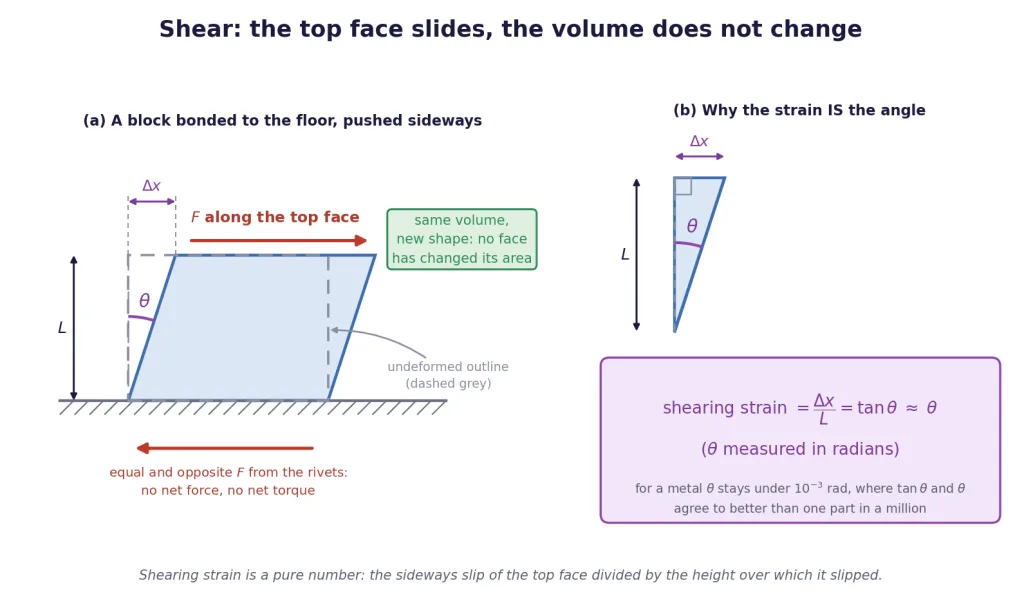
Take a rectangular block, bond its bottom face to the floor, and apply a force to the top face along that face, not perpendicular to it. The floor's rivets supply an equal and opposite force on the bottom face. So the block is acted on by a pair of equal, opposite, tangential forces on opposite faces.
Two things about that pair matter, and both are examined:
- The net force is zero, so the block does not accelerate away across the room.
- The net torque is also zero. The two tangential forces alone would form a couple that spins the block; in a real shear test the supports supply a second couple that cancels it. The body stays put and simply changes shape.
Key Point: Shear is produced by equal and opposite forces applied tangentially (parallel) to two opposite faces, arranged so that both the total force and the total torque on the body vanish. The body then changes shape without changing volume.
Shape changes, volume does not
Look at the dashed grey rectangle and the solid blue parallelogram in the figure. Slide the top by and the base still has the same length, the height is still , and the depth into the page has not moved at all. Base times height times depth is unchanged, so the volume is unchanged.
Compare that with the two loadings you already know:
| Loading | Shape | Volume | Applies to |
|---|---|---|---|
| Tensile or compressive (along one axis) | changes | changes | solids |
| Shearing (tangential) | changes | does not change | solids only |
| Hydraulic (pressure from all sides) | does not change | changes | solids, liquids, gases |
That last row is the next section's business. The middle row is this one's.
Shearing stress, and the area that goes underneath it
The stress is force over area, as always. But which area?
Key Point - shearing stress: where is the area of the face on which the tangential force acts, that is, the face the force lies in and slides along. It is not the cross-section perpendicular to the force. SI unit: pascal, Pa, exactly as for every other stress. Dimensions .
Read that twice. It is the single most common error in the whole chapter and it gets a block of its own next. For tensile stress you take the area perpendicular to the force; for shearing stress you take the area parallel to it. The two rules are opposite, which is precisely why students mix them up.
Notation
- means Poisson's ratio, and nothing else. Elsewhere often denotes stress, with or for Poisson's ratio. Where a symbol for shearing stress is genuinely needed it is , but most of the time shearing stress is simply written .
- is the shear modulus.
- Strain is ; shearing strain specifically is the angle .
[Board Important] A one-line definition question is worth two marks and both marks live in the phrase "applied tangentially to opposite faces". Leave that out and you have described tensile stress instead.
The Right Area: the Mistake That Costs the Most Marks
Here is the thing. Almost nobody gets the shear formula wrong. Everybody remembers . What goes wrong is the number that gets substituted for , and it goes wrong in a way that is invisible until the answer comes out by a factor of two or five.
The rule, in one sentence
Key Point - the area for shear:
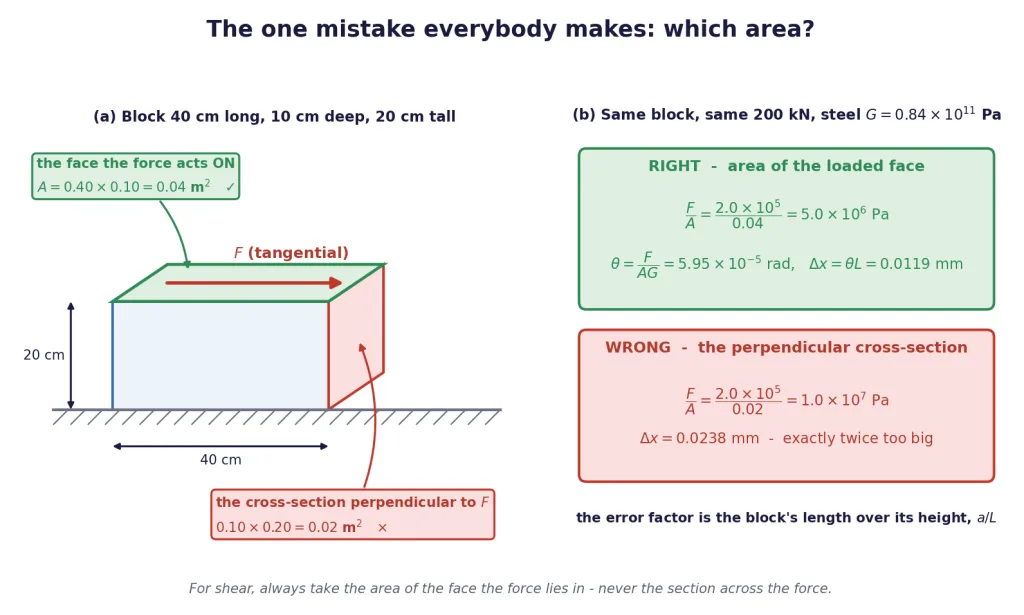
Use the area of the face the force acts on - the face the force lies in and drags along. That face is parallel to the force. Never the section perpendicular to the force. For a block of base and height sheared by a horizontal force on the top face, . Not . Not .
Why it is so easy to get wrong
Because for Young's modulus the rule is the exact opposite. Hang a weight on a wire and the stress is , where is the cross-section perpendicular to the pull. Your hand has been trained for a whole section to reach for the perpendicular area. Shear reverses that training.
A test that never fails: imagine the force as a squeegee wiping a surface. The surface it wipes is the surface it acts on, and the area of that surface is your .
The same block, two answers
The block in the figure is 40 cm long, 10 cm deep and 20 cm tall, bonded to the floor, with a tangential force of N applied along the top face. It is steel, Pa.
Right. The force acts on the top face, so m.
Wrong. Reach for the cross-section perpendicular to the force, m, and every number doubles: the stress becomes Pa and becomes 0.0238 mm.
The error factor here is exactly . In a different block it could be 5, or 0.3. There is no way to spot it from the final number, which is why you have to get it right going in.
Two more traps hiding in the same place
Trap 1 - "the narrow face". A problem may say the force is applied "on the narrow face" of a slab. That phrase is telling you which face the force acts on, and therefore which two dimensions to multiply. A slab 50 cm square and 10 cm thick has a narrow face of m and a broad face of m. Choosing wrongly changes the answer by a factor of five.
Trap 2 - which length is ? The in the shearing strain is the distance between the two sheared faces, measured perpendicular to them - the height over which the slip develops. For the slab above, with the force on the narrow face and the bottom edge riveted, that distance is the 50 cm side, not the 10 cm thickness.
Key Point: and come from different dimensions of the same block. is the loaded face; is the perpendicular distance from that face to the fixed face. Write both down explicitly before you touch the calculator.
[JEE Tip] In objective papers a shear question is very often built so that a wrong choice of area lands you exactly on one of the distractors. If your answer matches an option perfectly on the first try, that is not proof you are right - check the face.
Shearing Strain, the Angle, and
The strain is a pure number, and it is also an angle
The top face has slid a distance ; the faces are apart. The strain is the ratio:
Now look at the right triangle in the first figure of this section. The vertical side is , the horizontal side is , and the angle at the bottom between the original vertical edge and the tilted one is . So
and for the tiny angles real solids actually experience, and are indistinguishable:
Key Point:
The shearing strain IS the angle of shear, in radians. It is dimensionless, exactly like longitudinal strain, because it is a length over a length.
How good is that approximation? At - already far beyond what a metal survives elastically - and differ by about 0.0001%. At , which a soft rubber pad really can reach, they differ by 0.12%. So for metals the approximation is free; for rubber it is still good but no longer exact, and it is worth saying so.
The unit trap. must be in radians in every formula in this section. A question that says "sheared through " is handing you a number you must convert: rad. Substituting 0.1 directly inflates the answer by a factor of 57.3.
The shear modulus
Hooke's law says stress is proportional to strain while the deformation stays elastic. The constant of proportionality for shear gets its own name.
Key Point - shear modulus (modulus of rigidity): with the area of the loaded face and the distance between the sheared faces. SI unit pascal (Pa), dimensions - the same as any modulus, because strain is dimensionless.
Rearranged for the thing a problem usually asks for:
That last one is worth memorising on its own: shearing stress equals times the angle of shear.
What controls the answer
says the slip is
- proportional to the force - double , double ;
- proportional to the separation - a tall block shears further than a squat one under the same stress;
- inversely proportional to the loaded area - spread the same force over twice the face and you halve the slip;
- inversely proportional to - which is what makes rubber squash sideways and steel barely move.
How big is ? Print the numbers
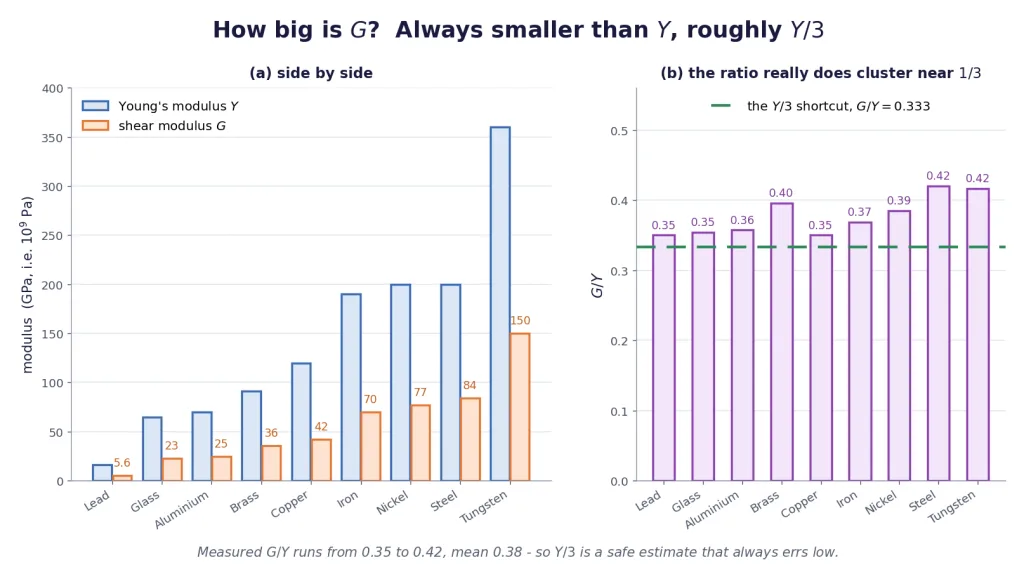
Here are measured values for nine common materials, with Young's modulus beside the shear modulus so you can see the pattern for yourself.
| Material | (GPa) | (GPa) | |
|---|---|---|---|
| Lead | 16 | 5.6 | 0.35 |
| Glass | 65 | 23 | 0.35 |
| Aluminium | 70 | 25 | 0.36 |
| Brass | 91 | 36 | 0.40 |
| Copper | 120 | 42 | 0.35 |
| Iron | 190 | 70 | 0.37 |
| Nickel | 200 | 77 | 0.39 |
| Steel | 200 | 84 | 0.42 |
| Tungsten | 360 | 150 | 0.42 |
Typical measured values for ordinary engineering grades; 1 GPa Pa. Real samples vary by a few per cent with composition and treatment.
The sanity check, honestly stated
Look down the last column. Every entry sits between 0.35 and 0.42, with a mean of 0.38. So:
Key Point: For an ordinary metal, This is a sanity check and an estimator, not an identity. Measured runs from about 0.35 to about 0.42, so is always a slight underestimate - typically 12% low, and about 21% low for steel and tungsten. Use it to catch a blunder, not to replace a tabulated value.
Two things follow that are worth carrying around:
- is always smaller than for a solid. A material is easier to shear than to stretch. If a calculation ever hands you , something has gone wrong.
- An order-of-magnitude estimate is enough for most objective questions. Given Pa and asked to pick from four options spanning to Pa, Pa points straight at Pa and eliminates the rest.
Why the ratio clusters near a third at all is not an accident - , , the bulk modulus and Poisson's ratio are tied together by exact relations for an isotropic solid, and those relations are developed in the section on Poisson's ratio. For now, take the empirical rule and move on.
[NEET Important] , and all have the unit pascal and all have dimensions . A question asking for "the dimensions of modulus of rigidity" is asking for the dimensions of pressure.
A First Look at Torsion
This topic sits outside the rationalised syllabus body text, but JEE Main, JEE Advanced and NEET ask around it every year, so it is introduced here from first principles. This block is deliberately a first look; the full treatment - the twisting couple by integration, the torsional pendulum and its time period - belongs to the JEE Corner section.
Twisting is shearing, wrapped around an axis
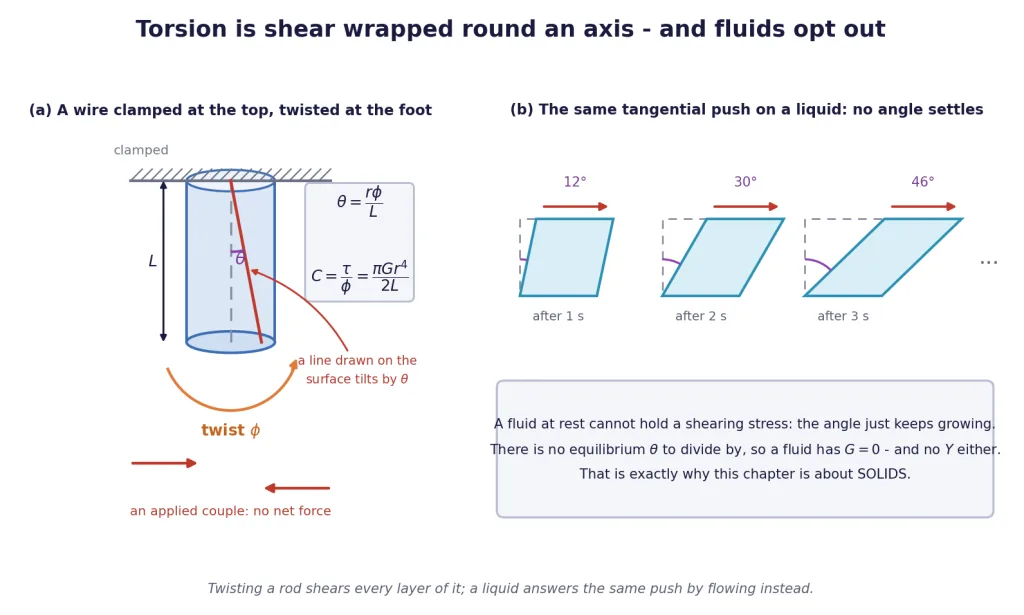
Clamp a wire at the top and twist the free end through an angle . Nothing has been stretched: the wire is the same length and the same thickness. What has happened is that every horizontal layer has slipped a little relative to the layer below it - which is exactly the definition of shear. Torsion is shear applied around an axis rather than across a slab, and the modulus that governs it is therefore , never .
Draw a straight line down the outside of the wire before you twist it. After the twist that line has tilted through a small angle . Follow the geometry in panel (a): the bottom end of the line has moved a distance around the circumference, over a length , so
Two consequences fall straight out, and both are examined:
- The shearing strain is not the same everywhere in the wire. It is zero on the axis, where , and largest at the surface, where is the full radius. A twisted wire is sheared most on the outside - which is why a hollow tube is nearly as stiff in torsion as a solid rod of the same outer radius, and much lighter.
- The twist can be large while the shear stays tiny. Twist a 1 m wire of radius 0.5 mm through a whole degree and the surface shear angle is only rad. That is why a torsion wire is such a sensitive instrument: a big, easily read rotation corresponds to a minute, safely elastic strain.
Torsional rigidity
Because different radii are sheared by different amounts, the total restoring couple has to be built up ring by ring. Take a thin annulus of radius and thickness . It is sheared through , so it carries a shearing stress over an area , and that force acts at a distance from the axis. Adding up its moment over the whole cross-section gives the restoring couple
The couple is proportional to the twist, which is Hooke's law all over again in angular clothing.
Key Point - torsional rigidity: is the torsional rigidity or torsional constant: the couple needed per unit angle of twist, in N m per radian. It depends on the material through , on the length as , and on the radius as .
That fourth power is the headline. Double the radius and the wire becomes sixteen times harder to twist. Halve the length and it becomes twice as hard. Nothing else in this chapter is anything like as sensitive to a dimension, and objective questions exploit it constantly.
A number to hang it on
A steel wire of radius 0.5 mm and length 1.0 m, with Pa:
so twisting it through one full degree needs a couple of only N m. A fine wire is a very weak spring in torsion, and that weakness is exactly what a sensitive instrument wants.
[JEE Tip] Torsion questions are usually ratio questions in disguise: two wires, same material, different radius or length. Write , cancel everything common, and you are done in one line without ever computing .
Why a Fluid Has No Shear Modulus
Go back to panel (b) of the figure in the previous block, and look at what happens when the same tangential push is applied to a body of water instead of a block of steel.
The steel block shears through some angle and then stops. The internal restoring forces have grown until they exactly balance the applied force, and the block sits there, strained, in equilibrium. That equilibrium angle is what divides by.
The water never stops. The angle grows, and grows, and keeps growing for as long as the force is applied. There is no equilibrium . And you cannot divide by an angle that does not exist.
Key Point: A fluid at rest cannot sustain a shearing stress. Apply one and it flows instead of settling. So for a fluid at rest there is no equilibrium shearing strain, and therefore for a liquid or a gas. The same argument kills : stretching also requires the material to hold a static tangential force across an inclined plane, and a fluid cannot.
This is what "fluid" means
That is not a side effect of being liquid. It is the definition. A fluid is precisely a substance that cannot resist a shearing stress statically, no matter how small that stress is. A solid can; that is what makes it a solid.
Which is why this chapter is called Mechanical Properties of Solids. Two of its three moduli only exist for solids:
| Modulus | Solid | Liquid | Gas |
|---|---|---|---|
| Young's modulus | yes | no | no |
| Shear modulus | yes | no | no |
| Bulk modulus | yes | yes | yes |
The bulk modulus survives because hydraulic stress asks nothing tangential of the material - the force is perpendicular to every surface, everywhere. A fluid can carry that all day. It is the subject of the next section, and it is the one place in this chapter where liquids and gases get to join in.
What a fluid does resist
A fluid does resist being sheared quickly. Stir honey and you feel it. But that resistance depends on the rate at which the shearing strain is changing, not on how much strain has accumulated:
The constant here is viscosity, and it belongs to the chapter on fluids, not this one. ( is also used elsewhere for the shear modulus, but in fluid mechanics it never means rigidity, and the shear modulus is written throughout, so the two never collide.) Note the difference in what sits on the right: an angle for a solid, a rate for a fluid. Stop pushing a sheared solid and it springs back; stop stirring honey and it simply stops moving, staying wherever it got to.
Key Point: Rigidity is resistance to a shearing strain. Viscosity is resistance to a shearing strain rate. A solid has the first, a fluid the second, and they are not the same physical quantity - they do not even have the same dimensions. Do not write "the shear modulus of water is small". It is zero.
The section in six lines
- Shear comes from equal, opposite, tangential forces on opposite faces; shape changes, volume does not.
- Shearing stress with the loaded face, the one parallel to the force.
- Shearing strain in radians.
- , in pascal; so and .
- for a metal, always a little low; always.
- Torsion is shear about an axis: and .
- for any fluid at rest, which is what makes it a fluid.
[Board Important] "Why is the shear modulus of a liquid zero?" is a standard two-mark question. The answer is one sentence: a liquid at rest cannot sustain a tangential stress, so it flows instead of reaching an equilibrium shearing strain, and there is no fixed angle of shear to define with.
Solved Examples
Values used in this section, unless a problem states otherwise: Pa, Pa, Pa, Pa, Pa, Pa. Every constant is restated inside the solution that uses it.
Example 1: The riveted lead slab
A square lead slab of side 50 cm and thickness 10 cm rests with its lower edge riveted to the floor. A shearing force of N is applied on its narrow face. How far does the upper edge move? Take Pa.
Solution:
Identify the loaded face. The force acts on a narrow face, and a narrow face of this slab measures : The broad square face, m, is not the one to use here.
Shearing stress:
Angle of shear:
Which length is ? The slip develops over the distance from the riveted lower edge to the free upper edge, which is the 50 cm side:
Final Answer: The upper edge moves about m, that is 0.16 mm.
Takeaway: Had you used the broad face, m, the answer would have come out as 0.032 mm - five times too small, with nothing in the number itself to warn you. Name the loaded face in writing before you compute anything.
Example 2: An aluminium cube barely notices
A cube of aluminium of side 10 cm has its bottom face fixed. A tangential force of 1000 N is applied to the top face. Find the angle of shear and the displacement of the top face. Take Pa.
Solution:
Loaded face: the top face of the cube, m.
Stress:
Angle:
Displacement, over the height m:
Final Answer: rad, and the top face moves m, that is 0.40 micrometre.
Takeaway: rad is under one arcsecond. A metal loaded well within its elastic range shears through angles you could never see; that is why the small-angle step costs nothing here.
Example 3: Measuring for a rubber block
A rubber block 30 cm by 30 cm and 8 cm thick is bonded between two rigid steel plates. The upper plate is pushed sideways with a force of 800 N and moves 2.0 mm. Find the shear modulus of the rubber.
Solution:
Loaded face: the bonded face, m.
Shearing strain, over the thickness m between the plates:
Shear modulus:
Final Answer: Pa.
Takeaway: That is about 240000 times smaller than the shear modulus of steel, which is why a rubber mounting can absorb a sideways lurch that would not move a steel block at all. Notice too that the strain, 0.025, is far larger than any metal would tolerate - rubber is the material that makes shear visible to the naked eye.
Example 4: The area trap, priced
A steel block has a base 40 cm long and 10 cm deep, and stands 20 cm tall, bonded to the floor. A horizontal force of N is applied along the top face. Find the displacement of the top face, and find what a student gets who uses the cross-section perpendicular to the force. Take Pa.
Solution:
Correct area - the face the force acts on is the top face:
The wrong route. Taking the perpendicular section m gives a stress of Pa and m.
Final Answer: m, or 0.0119 mm. The wrong area gives 0.0238 mm, exactly twice as much.
Takeaway: The error factor is , the block's length divided by its height - here . Change the block's proportions and the factor changes, so you can never recognise this mistake from the size of the answer alone.
Example 5: Estimating from , and being honest about it
Copper has Pa and steel has Pa. Estimate the shear modulus of each using , and compare with the measured values Pa and Pa.
Solution:
Copper: Pa. Measured: Pa.
Steel: Pa. Measured: Pa.
Final Answer: The estimate is excellent for copper (5% low) and poor for steel (21% low). It is always low.
Takeaway: is a floor, not an equality. Across the nine materials tabulated earlier, runs from 0.35 to 0.42 with a mean of 0.38, so the shortcut typically underestimates by about 12%. Use it to pick between options that differ by a factor of ten; never to produce a final numerical answer when a measured has been supplied.
Example 6: A brass plate on a bench
A brass plate 20 cm by 20 cm and 2 cm thick has its lower face glued down. A force of N is applied along the upper face. Find the shearing stress, the angle of shear and the displacement of the upper face. Take Pa.
Solution:
Loaded face: m.
The two sheared faces are the thickness apart, m:
Final Answer: Pa, rad, and a slip of about 0.21 micrometre.
Takeaway: Here is the small dimension and the loaded face is built from the two large ones. A thin plate glued down shears through a respectable angle but a minute distance, because and is tiny.
Example 7: The force needed for a stated angle
A cube of side 5 cm made of a material with Pa has its bottom face clamped. What tangential force on the top face shears the cube through ?
Solution:
Convert to radians first. This is the step people skip.
Stress from the angle:
Force, with the loaded face m:
Final Answer: About N, roughly the weight of nine tonnes.
Takeaway: Substituting instead of would have given N - a factor of 57.3 out, which is . Degrees never go into these formulas.
Example 8: Same cube, same force, two directions
A steel cube of side 10 cm is loaded with N, first as a normal pull along one edge direction and then as a tangential push along one face. Compare the two deformations. Take Pa and Pa.
Solution:
Normal pull. The area perpendicular to the force is m, and
Tangential push. The face the force acts on is also m for a cube, and
Ratio:
Final Answer: micrometre, micrometre; the shear displacement is 2.38 times the stretch.
Takeaway: For a cube the two areas happen to coincide, so the ratio of the deformations is just . It is bigger than 1 because always: any solid is easier to shear than to stretch. For a block that is not a cube the areas differ and this shortcut collapses.
Example 9: Rubber mountings under a machine
A machine rests on four rubber pads, each 10 cm by 10 cm in plan and 4 cm thick, bonded to the machine above and the floor below. A horizontal force of N is applied to the machine. How far does it move sideways? Take Pa.
Solution:
Share the load. Four identical pads deform equally, so each carries
Loaded face of one pad, m:
Angle and slip, with m the pad thickness:
Final Answer: The machine shifts about 2.4 mm.
Takeaway: rad is - visible, and large enough that the small-angle step is no longer exact: , which is 0.12% away from 0.060. Still fine, but worth noticing that the approximation which was free for the metal blocks has begun to cost something for rubber.
Example 10: Torsional rigidity of a fine steel wire
A steel wire of radius 0.50 mm and length 1.0 m hangs from a clamp. Find its torsional rigidity and the couple needed to twist the lower end through . What is the shearing angle at the wire's surface then? Take Pa.
Solution:
Torsional rigidity:
Couple for one degree. Convert first: rad.
Surface shearing angle:
Final Answer: N m/rad, N m, and rad at the surface.
Takeaway: A whole degree of twist - easy to see on a scale - corresponds to a shear of under nine parts in a million. That enormous amplification is why a torsion fibre is the instrument of choice for measuring feeble forces, and why the wire stays comfortably elastic while doing it.
Example 11: Two wires, one ratio
Two wires of the same material and the same length are twisted by equal couples. One has twice the radius of the other. Compare their angles of twist. What if instead the radii are equal but one wire is twice as long?
Solution:
Radius. With and fixed, , so The thick wire twists one sixteenth as far. Equivalently its torsional rigidity is 16 times larger.
Length. With and fixed, , so the longer wire twists twice as far, and its rigidity is half.
Final Answer: Doubling the radius divides the twist by 16; doubling the length multiplies it by 2.
Takeaway: is dominated by the . Never approximate a radius in a torsion problem - a 5% error in becomes a 22% error in .
Example 12: Reading the dependence off the formula
A block is sheared by a force on a face of area , with the fixed face a distance away, and the top slips by . Predict how changes if, one at a time: (a) is doubled, (b) the loaded face area is doubled, (c) is doubled, (d) the block is replaced by one with twice the shear modulus.
Solution:
Start from and change one factor at a time.
- (a) , so it doubles.
- (b) , so it halves.
- (c) , so it doubles. The angle is unchanged - the same tilt over a taller block gives a bigger slip.
- (d) , so it halves.
Final Answer: (a) , (b) , (c) , (d) .
Takeaway: Part (c) is the one that catches people. Making a block taller does not change how hard it is to shear - the stress and hence the angle stay the same - but it does increase the distance the top face travels, because . Separate the two questions "what angle?" and "what displacement?" and this never confuses you again.