
Young's Modulus: the Number That Governs Stretching
Section 3 set up the general pattern: modulus equals stress over strain, and the modulus is the slope of the straight part of the curve. Now we cash it in for the first and by far the most examined of the three moduli — the one that governs a wire being stretched or squashed along its length.
Key Point — the definition: is Young's modulus. SI unit: pascal (Pa), or equivalently N/m. Dimensions . It is a property of the material only — not of the particular wire, not of its length, not of its thickness.
The letters get overloaded in elasticity, so fix them now. is strain and is Poisson's ratio, which arrives later. Stress is therefore written as , or as when a symbol for longitudinal stress is genuinely needed, and later in this section for breaking stress. Elsewhere often denotes stress, with or for Poisson's ratio; both conventions are fine as long as you do not mix them inside one solution.
One more fact worth stating at the start: experiment shows the strain a material develops is the same size whether the stress is tensile (pulling) or compressive (squashing). So the same governs a stretched cable and a squashed pillar, and just changes sign.
What the number actually means
Here are real values. This is our own reference table for the chapter, and these are the numbers used in every worked example and question below.
| Material | (Pa) | Typical breaking stress (Pa) | Density (kg/m) |
|---|---|---|---|
| Steel | 7800 | ||
| Copper | 8900 | ||
| Brass | 8500 | ||
| Aluminium | 2700 | ||
| Glass | 2500 | ||
| Wood, along the grain | 600 | ||
| Bone, in compression | 1900 | ||
| Rubber | about | about | 1100 |
In this table, and everywhere from here on, "breaking stress" carries its exam meaning: the maximum stress the material can withstand, the peak of its stress-strain curve. Section 3 sets out that convention and explains how it differs from the stress at the fracture point of a ductile metal.
Two things to notice, both of them examinable.
First, metals are enormous and rubber is tiny. Steel is about times as stiff as rubber. That single ratio is the honest answer to "which is more elastic".
Second, rubber is the one entry with the word "about" in front of it. Section 3 showed why: the rubber curve is nowhere straight, so its stress-over-strain ratio depends on where you measure it. A single value of for rubber is an order-of-magnitude statement, never a precise one.
Making pascal feel like something
A number that big is meaningless until you put a wire behind it. So: what force would it take to double the length of a steel wire of cross-section 1 mm, if Hooke's law somehow kept working all the way?
Doubling the length means . Then
which is the weight of about 20 tonnes hanging on a wire a millimetre square. Of course the wire would have snapped at around 400 N, long before it got anywhere near doubling. But that is exactly the point.
Key Point: A large means the material refuses to be strained. It is a measure of stiffness, of resistance to deformation. It is not a measure of strength: strength is the breaking stress, a completely separate number that lives in a completely different column of the table.
Notice from the table that these two properties genuinely come apart. Glass has a modulus a third that of steel but a breaking stress eight times smaller. Bone is far less stiff than steel yet stronger than aluminium.
[NEET Important] Two one-liners worth memorising: depends only on the material, never on the dimensions of the specimen; and has the same units as stress because strain is dimensionless.
Measuring It: the Loaded Wire, and the Formula That Follows
The definition is a recipe: apply a known stress, measure the strain that results, divide. Here is the apparatus that does it.
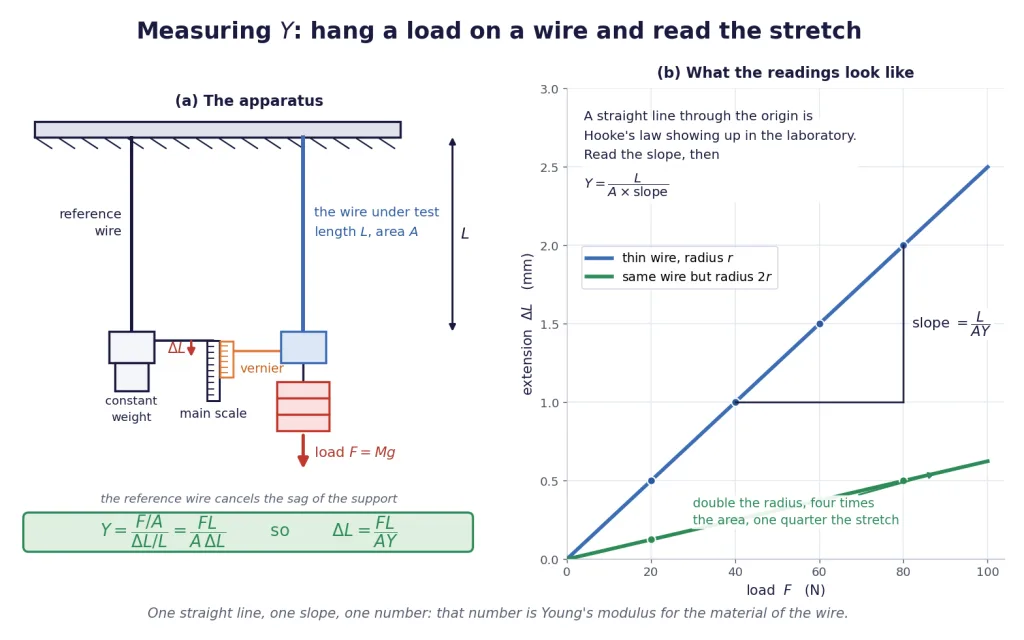
Two long wires of the same material hang from the same rigid support. One, the reference wire, carries a small constant weight and simply hangs there. The other, the experimental wire, carries the load that is being varied. A main scale is fixed to the frame hanging from the reference wire and a vernier to the frame hanging from the experimental wire, so what you read is the difference between the two.
That is the whole trick of the design, and it is worth a mark. If the support sags, both wires go down together and the difference does not change. If the room warms up, both wires expand and the difference does not change. Only a genuine stretch of the experimental wire moves the vernier.
The measurement, step by step
- Measure the original length of the experimental wire from the support to the vernier frame, with a metre scale.
- Measure the diameter at several places with a screw gauge and average, then .
- Add slotted weights in equal steps, recording the vernier reading each time.
- Remove the weights in the same steps, recording again, to check the wire has stayed elastic.
- Plot against and draw the best straight line through the origin.
The graph is a straight line through the origin — which is Hooke's law showing up in a laboratory — and its slope is
[Board Important] Two standard questions on this experiment. Why two wires? To cancel any sagging of the support and any change of temperature, since only the difference of the two is read. Why measure the diameter with a screw gauge and not a ruler? Because depends on , so a 2% error in the diameter becomes a 4% error in — the diameter is the most error-sensitive quantity in the whole experiment.
The formula everything else is built on
Rearranging the definition gives the workhorse of the chapter:
Key Point — the elongation formula: Read it as a set of instructions: elongation grows with the load and with the length, and shrinks with the area and with the stiffness of the material. For a wire hanging under a mass , put .
Two cautions that cost marks every year:
- is the area of cross-section, not the surface area, and not the diameter. If you are given a diameter, halve it first. Forgetting to halve puts your answer out by a factor of four.
- Work in SI throughout. Millimetres squared to metres squared is a factor of , not . Write m on your rough sheet before you start.
Why cranes and bridges are made of steel
The table in the previous block explains a lot of the built world at a glance. Take four wires of the same length and the same cross-section, and ask what force each needs to stretch it by the same 0.1%:
| Material | (Pa) | Force for 0.1% strain in a 1 mm wire |
|---|---|---|
| Steel | 200 N | |
| Copper | 120 N | |
| Brass | 91 N | |
| Aluminium | 70 N |
Steel needs nearly three times the force aluminium does to give the same stretch. Turn that round: under the same load, steel deforms least. A crane cable that stretched appreciably under load would be useless, and a bridge girder that sagged noticeably would be dangerous, so steel is the natural choice for both. Wood, bone, concrete and glass have small moduli by comparison and are used where stiffness is not the governing requirement.
Comparing Two Wires: the Question This Chapter Runs On
If you learn one skill from this section, learn this one. A very large fraction of every elasticity paper is a single question wearing different clothes: two wires, the same load, something different about them — which stretches more, and by what factor?
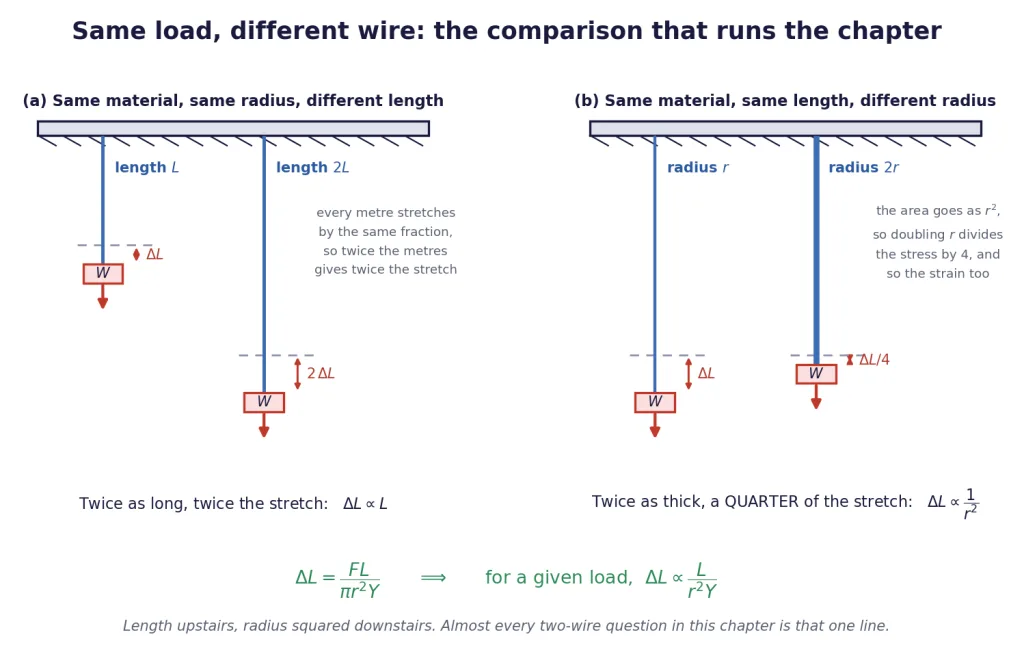
Start from the elongation formula and simply read off what depends on what:
Key Point — the comparison rule:
For a given load , Length upstairs. Radius squared downstairs. Modulus downstairs. Nothing else matters.
The three moves, one at a time
Change the length. Double the length, double the stretch. Each metre of wire stretches by the same fraction, so twice as many metres gives twice as much stretch. .
Change the radius. Double the radius and the area goes up by four, so the stress drops to a quarter, so the strain drops to a quarter, so the elongation drops to a quarter. . This is where most of the lost marks in this chapter live: people divide by 2 instead of by 4.
Change the material. Elongation is inversely proportional to . Copper stretches times as much as steel of the same shape under the same load.
Doing it as a ratio, which is always faster
Never compute two elongations and divide. Write the ratio directly and let everything common cancel:
Notice the two subscripts that flip over: and appear the other way up, because they sit in the denominator of the elongation formula. Getting that flip wrong is the second most common error here.
Here is the same rule as a drill table. In every row the load is the same and only the named quantity changes.
| The change | What happens to |
|---|---|
| length doubled | doubled |
| length halved | halved |
| radius doubled | one quarter |
| radius halved | four times |
| diameter tripled | one ninth |
| area doubled | halved |
| steel replaced by copper | |
| length doubled AND radius doubled | halved, since |
| both length and radius halved | doubled, since |
[JEE Tip] Watch for the trap where a question says "the wire is cut in half and one half is used". The load is unchanged and the area is unchanged, so the stress and the strain are unchanged. It is only the elongation that halves, because there is half as much wire to stretch. Stress, strain and do not care how long the wire is.
The same rule read the other way
Sometimes the question fixes the elongation and asks about the load, or fixes the stress. Then use the version you need:
- Stress depends on the load and the area only — never on the length.
- Strain equals — again, never on the length.
- Elongation is strain times length, so it is the only one of the three that cares about .
That three-line list settles a surprising number of otherwise confusing questions.
A Stretched Wire Is a Spring
This block develops material that sits outside the rationalised syllabus body text. JEE Main, JEE Advanced and NEET ask it every year, so it is built here from first principles.
Go back to the elongation formula and rearrange it so the extension is the subject on the right and the force is alone on the left:
Compare that with the spring law you have known since Class 11 mechanics, . They are the same equation. So:
Key Point — a wire is a spring: A stretched wire obeys Hooke's law with a force constant built out of the material through and the geometry through and . Short and fat means stiff; long and thin means floppy. Everything you know about springs — combinations, oscillations, energy stored — transfers over untouched.
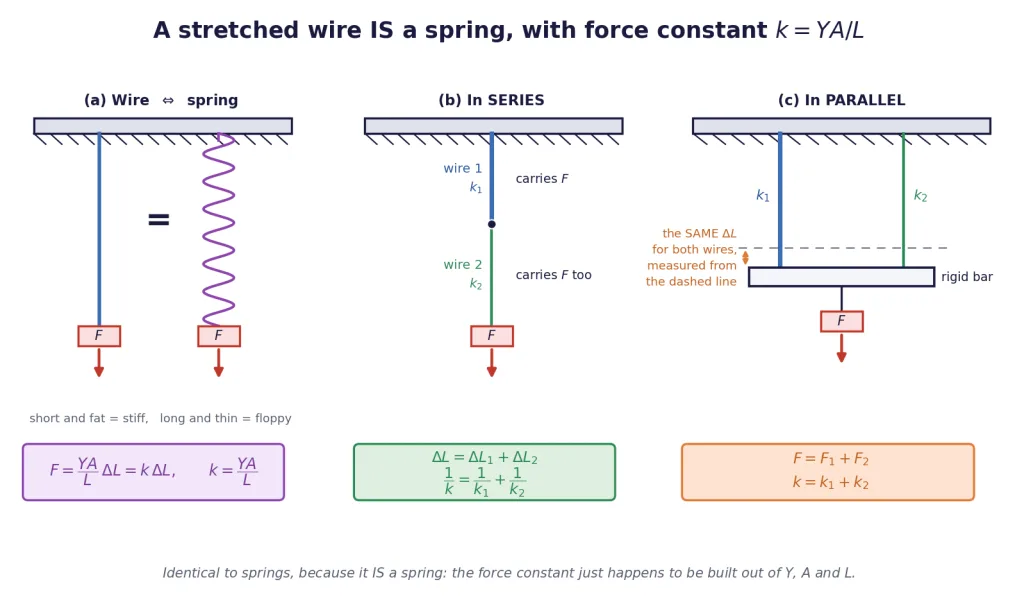
Note carefully what does and does not depend on. is a property of the material alone. is a property of this particular wire. Cut a wire in half and is unchanged while doubles. That distinction is the point of half the questions on this topic.
Wires in series
Join two wires end to end and hang a load from the bottom.
The force is the same in both. Cut the join in your imagination and draw a free-body diagram of the lower wire: it carries the full load , so the join must be pulling up on it with , so the upper wire carries too. (Strictly, that assumes the wires themselves are light — the last block of this section handles the case where they are not.)
The extensions add, because the bottom of the whole assembly moves down by however much the first wire stretched plus however much the second did.
Key Point: In series: same force, extensions add, and the reciprocals of the force constants add. The combination is floppier than either wire alone — which makes sense, since you have made the wire longer.
The individual extensions are not equal unless the two wires happen to have the same . The softer wire (smaller ) does more of the stretching.
Wires in parallel
Now hang two wires side by side from the ceiling, joined at the bottom to a rigid bar that carries the load.
The extensions are equal, because the bar is rigid and stays horizontal — both wires end at the same level, so both must have stretched by the same amount. This is called a compatibility condition, and it is the single most useful idea in this topic.
The forces add, because the bar is in equilibrium under the two upward pulls and the load.
Key Point: In parallel: same extension, forces add, and the force constants add. The combination is stiffer than either wire alone. The stiffer wire (larger ) takes the larger share of the load, in the ratio .
The extra equation the rigid bar hands you
There is one more condition hiding in the parallel case, and JEE loves it. If the bar is to stay horizontal, the load cannot hang just anywhere — it must hang at the point where the torques balance.
Take moments about the point where wire 1 meets the bar. If the wires are a distance apart and the load hangs a distance from wire 1:
So the load must hang closer to the stiffer wire. If the two wires are identical the load goes in the middle, as you would expect.
[JEE Tip] Every rigid-bar-on-wires problem is solved by writing down exactly three equations and no more: (i) forces balance, (ii) torques balance, (iii) the extensions are compatible with the bar staying straight. Write all three before substituting a single number.
And since it is a spring, it oscillates
Hang a mass from a wire of force constant , pull it down a little and release. As long as the wire stays inside its elastic region, the restoring force is proportional to the displacement, so the motion is simple harmonic with
The periods come out startlingly short — milliseconds, not seconds — because for a metal wire is huge. That is a nice reality check on the size of .
Breaking Stress, and the Longest Wire That Can Hang
This block also restores material outside the rationalised syllabus body text. It is asked every year in all three examinations, so it is developed here in full.
Breaking stress is a stress, not a force
Every material has a stress beyond which it cannot be loaded. Call it the breaking stress , and be clear about which convention that name is carrying.
Key Point — the convention: From here on, means the maximum stress the material can withstand — the ultimate tensile strength, the peak of its stress-strain curve. This is the meaning Board, JEE and NEET questions give the phrase, and it is the meaning of every tabulated value in this chapter.
Section 3 drew the curve properly and kept the peak apart from the fracture point , which for a ductile metal sits lower because the specimen necks. That distinction still matters whenever a question is about the shape of a curve. But when a problem hands you one number and calls it the breaking stress — as every problem in this section does — that number is the peak, and is what this chapter calls it.
Key Point:
Breaking stress is a property of the material, measured in pascal. The breaking force is not — it depends on how thick the wire is.
Now the fact that trips people up every single year:
Key Point: Breaking stress does not depend on the length of the wire. Cut a wire in half and each half breaks under exactly the same load as the whole did. Halve the radius, though, and the breaking load drops to a quarter, because the area went down by four.
Why is length irrelevant? Because breaking is decided by the stress across one cross-section, and every cross-section of a uniform wire carries the same load. Length changes how much the wire stretches; it does not change how hard any one cross-section is being pulled.
Practical consequence: engineers work to a factor of safety. If a cable must carry a load , they size it so that the working stress is divided by 4 or 5, and then
A wire hanging under its own weight
Everything so far has treated the wire as weightless, with a load at the bottom. Now let the wire itself be heavy. This is a rope hanging down a mine shaft, a cable dangling from a helicopter, a lift cable in a tall building.
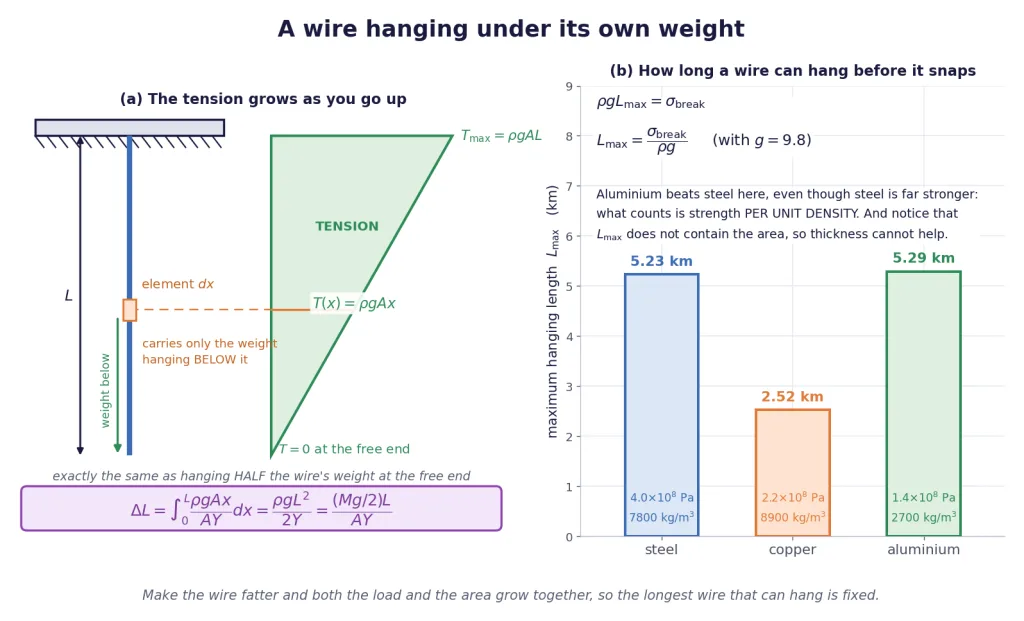
Take a wire of length , area , density , hanging from a support with nothing on the end. The key observation is that the tension is no longer the same everywhere. A cross-section a height above the free end has to hold up only the piece below it, whose mass is :
So the tension is zero at the bottom, rises linearly, and reaches — the full weight of the wire — at the top.
Where it breaks. The most heavily stressed section is the one at the top, where the stress is
The area has cancelled. Set that equal to the breaking stress and solve for :
Key Point — the maximum hanging length: There is no in that formula. Making the wire fatter does not help at all: it can carry more load, but it also weighs proportionally more, and the two effects cancel exactly. What decides the answer is the strength-to-density ratio of the material.
With m/s and the table from the first block, that gives steel km, copper 2.5 km and aluminium 5.3 km. Aluminium beats steel even though steel is nearly three times stronger, because aluminium is nearly three times lighter. That is exactly why aircraft are not made of steel.
How much does a heavy wire stretch?
Since the tension varies along the wire, you cannot use with a single . You have to add up the stretches of the individual pieces.
Take a small element of length at a height above the free end. It feels a tension , and being of length it stretches by
Add up every element from the bottom to the top:
Key Point — self-weight elongation: where is the mass of the wire. Read the second form carefully: a heavy wire stretches exactly as much as a weightless wire of the same size carrying HALF the wire's weight at its free end. The factor of one half comes from the tension rising linearly from zero to its maximum, so its average value is half the maximum. Note also the : double the length of a hanging wire and its self-stretch goes up by four.
And if there is also a load on the end, the two effects simply add, because both come from the same integral:
with the mass of the wire itself.
[JEE Tip] For ordinary laboratory wires the self-weight term is negligible — for a 20 m steel wire carrying 5 kg it contributes about 1.5% of the total. Do not put it in unless the question is clearly about a long, heavy, hanging wire, or unless it explicitly says "taking the weight of the wire into account".
Pulling It Together
The whole section on one page
| Quantity | Formula | Depends on |
|---|---|---|
| Young's modulus | the material only | |
| Elongation | load, length, area, material | |
| Comparison rule | for a fixed load | |
| Wire as a spring | material and geometry | |
| Series | same force, extensions add | |
| Parallel | same extension, forces add | |
| Breaking load | area, not length | |
| Longest hanging wire | material only, not area | |
| Self-weight stretch | length squared |
The five traps
Trap 1 — the diameter is used as the radius. Area is , and is half the diameter. Using instead of makes your area four times too big and your elongation four times too small. Halve it first, on the paper, before anything else.
Trap 2 — the radius dependence is taken as . It is . Doubling the thickness of a wire divides its extension by four, not by two.
Trap 3 — breaking load is confused with breaking stress. Breaking stress is a material constant and knows nothing about the wire. Breaking load is and doubles when the area doubles. Cutting a wire in half changes neither of them.
Trap 4 — the elongation formula is used on a heavy hanging wire. If the wire's own weight matters, the tension varies along it and the single- formula is simply wrong. Integrate, or use .
Trap 5 — series and parallel are swapped. Ask yourself which quantity is forced to be the same. End to end, the force is common. Side by side onto a rigid bar, the extension is common. Get that right and the rest follows in one line.
A checking habit
Before you write down a final answer in this section, run these three checks.
- Units. and stress in pascal. in N/m. Strain and with no units at all. in metres.
- Size. A metal wire in a laboratory stretches by fractions of a millimetre under a few kilograms. If your answer is in centimetres, you have almost certainly used mm as m.
- Direction of the effect. Longer wire, more stretch. Fatter wire, less stretch. Stiffer material, less stretch. If your answer moves the wrong way, you have inverted a ratio.
[Board Important] The most common three-mark question in this section is to state the definition of Young's modulus with its SI unit, and then apply to a numerical wire. Write the definition as a ratio of stress to strain in words, then the formula, then substitute — all three steps earn marks, and skipping straight to numbers loses two of them.
Solved Examples
Constants used throughout this section, unless a problem states otherwise: m/s, Pa, Pa, Pa, breaking stresses Pa for steel, Pa for copper and Pa for aluminium, and densities 7800, 8900 and 2700 kg/m respectively.
Example 1: The standard wire calculation, start to finish
A steel wire of length 2.0 m and diameter 1.0 mm hangs from a ceiling and a 10 kg mass is attached to its free end. Find (a) the stress, (b) the strain, and (c) the elongation of the wire.
Solution:
Area first, and halve the diameter before anything else. mm m.
The force is the weight of the load:
(a) Stress:
(b) Strain, from the definition of : that is, 0.0624%.
(c) Elongation:
Sanity check on the stress. The breaking stress of steel is Pa, and we are at Pa, comfortably under a third of it. The wire is safe.
Final Answer: Stress Pa; strain ; elongation 1.25 mm.
Takeaway: Always do it in this order: area, force, stress, strain, elongation. Each step is one line and each one is separately worth a mark, and the order makes it impossible to lose track of a factor.
Example 2: What does Pa actually mean?
If Hooke's law somehow continued to hold, what force would be needed to double the length of a steel wire of cross-section 1.0 mm? Express it as a hanging mass, and comment.
Solution:
Doubling the length means the strain is 1, since .
From the definition of , the stress required is
The force:
As a hanging mass: about 20 tonnes on a wire one millimetre square.
The comment matters as much as the number. The wire would in fact snap at a stress of Pa, which is a load of only 400 N or about 41 kg. So the calculation is entirely hypothetical — it is a way of feeling how big is, not a prediction.
Final Answer: N, about 20 tonnes; but the wire would break at 400 N, some 500 times sooner.
Takeaway: A huge means the material simply refuses to be strained. The gap between the hypothetical 400 kN and the real 400 N is also a reminder that stiffness and strength are separate properties.
Example 3: Two wires joined end to end
A copper wire 1.5 m long and a steel wire 2.5 m long, each of diameter 2.0 mm, are joined end to end and hung from a support. A load is attached at the bottom and the total extension is found to be 1.2 mm. Find the load, and the extension of each wire.
Solution:
Area, the same for both: m, so
The tension is the same in both wires, equal to the load , because the wires are light and each one carries the whole load below the join.
Write each extension in terms of :
Stop and look at that. The two coefficients came out identical, because . The longer steel wire and the shorter copper wire stretch by exactly the same amount here. So each takes half the total:
Now find the load from either equation: that is, a hanging mass of kg.
Final Answer: Load about 151 N (a mass of 15.4 kg); each wire stretches by 0.60 mm.
Takeaway: In series, write both extensions in terms of the one common force and add them. Do not compute anything numerical until the very last line — the algebra usually reveals a simplification like the one above.
Example 4: Copper against steel
(a) A copper wire and a steel wire have the same length and the same radius and carry the same load. Which stretches more, and by what factor? (b) Now let the copper wire be twice as long as the steel one and have half its radius. Find the new ratio.
Solution:
(a) Use the comparison rule. With , and all identical, only differs, and it sits in the denominator: The copper stretches 1.67 times as much.
(b) Now all three factors are in play. Write the ratio in full, remembering that and flip over:
Substitute , (since copper has half the radius, steel has twice it), and :
Final Answer: (a) copper stretches 1.67 times as much; (b) 13.3 times as much.
Takeaway: Build the ratio factor by factor and check the direction of each one. Longer means more stretch, so goes upstairs. Thinner means more stretch, so the radius ratio goes in upside down. Softer means more stretch, so goes in upside down as well.
Example 5: Longer and thicker at the same time
Two wires of the same material carry the same load. Wire 1 has length and radius ; wire 2 has length and radius . Which stretches more, and by how much?
Solution:
Use , since the material and the load are the same for both.
Form the ratio:
So wire 1 stretches twice as much, even though wire 2 is the longer of the two. Doubling the length would have doubled the stretch on its own, but doubling the radius divided it by four, and four beats two.
Final Answer: Wire 1 stretches twice as much as wire 2.
Takeaway: When two things change at once, do them one at a time and multiply. The almost always wins against a change in , because it is a squared dependence against a linear one.
Example 6: The wire as a spring, and how fast it bounces
A steel wire of length 1.0 m has a cross-sectional area of 0.50 mm. (a) Find its force constant. (b) By how much does it stretch when a 2.0 kg mass is hung from it? (c) If the mass is pulled down slightly and released, find the period of the resulting vertical oscillation.
Solution:
(a) The force constant of a wire:
(b) Treat it exactly as a spring, with N:
(c) The oscillation is simple harmonic as long as the wire stays elastic: about 28 milliseconds, which is a frequency of some 36 Hz — you would hear it rather than see it.
Final Answer: (a) N/m; (b) 0.196 mm; (c) 28 ms.
Takeaway: Once you have , every spring result you already know applies unchanged. Extension, oscillation period, energy stored — all of it transfers.
Example 7: Series and parallel, with the rigid bar
A steel wire and a copper wire each have length 1.0 m and cross-section 1.0 mm. A load of 100 N is applied. Find the total extension when (a) the two are joined end to end, and (b) the two hang side by side from a ceiling and support a light rigid horizontal bar from which the load hangs. In case (b), find the force in each wire and where the load must hang if the bar is to stay horizontal, given that the wires are 1.0 m apart.
Solution:
Force constants first:
(a) Series: the same 100 N runs through both, and the extensions add. Equivalently gives N/m, and mm. The softer copper does more of the stretching, as it must.
(b) Parallel: the extensions are equal because the bar is rigid. Adding the force constants,
The forces, each equal to its own times that common extension: and they add to 100 N, as they must. The stiffer steel takes the larger share, in the ratio .
Where the load hangs. Take moments about the steel wire, with the wires 1.0 m apart and the load a distance from the steel: so the load hangs 37.5 cm from the steel wire and 62.5 cm from the copper — closer to the stiffer wire.
Final Answer: (a) 1.33 mm; (b) 0.3125 mm, with 62.5 N in the steel and 37.5 N in the copper, and the load hanging 0.375 m from the steel wire.
Takeaway: Series shares the force, parallel shares the extension, and the rigid bar hands you a third equation for free. Notice that the parallel arrangement stretches four times less than the series one out of the same two wires.
Example 8: Breaking load, and what cutting the wire does to it
The breaking stress of steel is Pa. (a) What is the greatest mass a steel wire of diameter 1.0 mm can support? (b) The wire is cut in half and one half is used. What is the greatest mass now? (c) A wire of diameter 2.0 mm is used instead. What is the greatest mass?
Solution:
(a) Area, then force, then mass.
(b) Cutting the wire in half changes nothing. The breaking load depends on and , and neither of those changed. The answer is still 32.1 kg. What did change is the elongation before breaking, which is now half as much — but the question did not ask that.
(c) Doubling the diameter multiplies the area by four:
Final Answer: (a) 32.1 kg; (b) still 32.1 kg; (c) 128 kg.
Takeaway: Length never appears in a breaking-load calculation. Every cross-section of a uniform wire carries the same load, so it makes no difference how many of them there are in a row.
Example 9: How long a wire can hang before it snaps under its own weight
Find the greatest length of wire that can hang vertically from a support without breaking, for steel, copper and aluminium. Comment on the result. Take m/s.
Solution:
Locate the weakest section. The tension at a height above the free end is the weight of the wire below it, , so the tension is greatest at the top, where it equals .
The stress there is The area has cancelled completely, which is the whole story of this problem.
Set that equal to the breaking stress:
Put in the three sets of numbers.
Comment. Aluminium wins, very slightly, even though steel is nearly three times as strong. The reason is that aluminium is nearly three times lighter, and what the formula actually rewards is the ratio of strength to density. Notice too that the answer does not contain the area, so you cannot buy yourself extra length by using a thicker wire.
Final Answer: Steel 5.2 km, copper 2.5 km, aluminium 5.3 km.
Takeaway: Thickness cannot help a wire hold up its own weight. A fatter wire carries more, but it also weighs more, in exactly the same proportion.
Example 10: The stretch of a long hanging wire
A steel wire of length 100 m and cross-section 1.0 mm hangs vertically from a support with nothing attached to its lower end. Find (a) the stress at the top, (b) the elongation caused by its own weight, and (c) confirm that this is the same as hanging half its weight at the free end.
Solution:
(a) The stress at the top is the full weight of the wire divided by the area, which is with the area cancelling: That is only about 2% of the breaking stress, so the wire is nowhere near failing.
(b) Add up the stretch element by element. An element at a height above the free end feels a tension and therefore stretches by :
(c) The check. The mass of the wire is Hanging half of that at the free end of a weightless wire of the same size gives Identical, to every digit.
Final Answer: (a) Pa; (b) 1.91 mm; (c) confirmed, both give 1.911 mm.
Takeaway: The factor of one half is the average tension. The tension climbs linearly from zero at the bottom to its maximum at the top, so on average the wire is being pulled with half its weight — and the elongation only ever cares about the average.
Example 11: A load and the wire's own weight together
A steel wire 20 m long with a cross-section of 1.0 mm hangs from a support and carries a 5.0 kg mass at its lower end. Find the total elongation, and what fraction of it is due to the weight of the wire itself.
Solution:
The mass of the wire:
Use the combined formula, load plus half the wire's weight:
The two forces:
Substitute: so 4.98 mm in total.
Splitting it up: the load alone would give mm, and the self-weight contributes the remaining mm, which is
Final Answer: 4.98 mm in total, of which 1.5% comes from the weight of the wire.
Takeaway: Check whether the self-weight term is worth including before you include it. Here it moves the answer from 4.90 to 4.98 mm. For a laboratory wire a metre long it would be utterly negligible; for a kilometre of mine-shaft cable it would dominate.
Example 12: Sizing a lift cable
A lift cage of total mass 800 kg is to be raised with an upward acceleration of 1.5 m/s by a steel cable. The breaking stress of the steel is Pa and a factor of safety of 5 is required. Find the minimum radius of the cable. Take m/s and neglect the weight of the cable itself.
Solution:
Find the tension. The cage is accelerating upwards, so the tension exceeds the weight:
Apply the factor of safety to the stress, not to the load:
The area needed:
Turn area into radius: so a radius of 6.0 mm, or a diameter of 12 mm.
Check. With mm the actual stress is Pa, exactly the working stress, and one fifth of the breaking stress. Correct.
Final Answer: A minimum radius of about 6.0 mm, that is, a cable 12 mm in diameter.
Takeaway: Never use for the tension in an accelerating cable. The acceleration adds 15% to the tension here, and 15% is a great deal of the margin a safety factor is supposed to be providing.