
Where Does the Work Go?
Hang a load on a wire. The wire stretches. You have clearly done work on it — and the wire has clearly not gone anywhere, so that work has not become kinetic energy. It has been stored, in the stretched bonds between the atoms, and you get it back the instant you take the load off. That stored quantity is the elastic potential energy, and this section is about how to compute it.
Let us do it properly, because the obvious answer is wrong by a factor of two and that factor of two is the single most examined thing in this section.
The force is not constant
Section 4 established that a wire of length and cross-section behaves exactly like a spring of stiffness
So when the wire has already been stretched by an amount , the restoring force it is pulling back with is
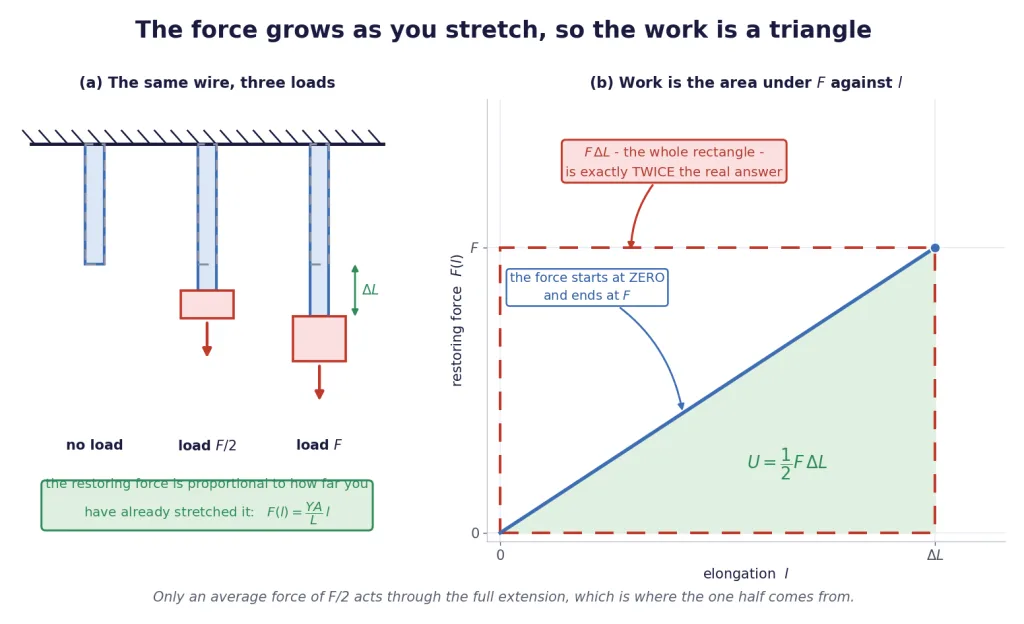
Read that again. At the very start, when , the restoring force is zero. At the end, when , it is . In between it grows steadily. There is no single moment at which the wire is pulling with the full force except the very last instant.
So the work is an integral, not a product
Because changes as you go, you cannot write . You have to add up over each tiny bit of the stretch:
And since , that same result can be written three equivalent ways:
Key Point — elastic potential energy of a stretched wire: and, if you know the load rather than the extension, .
SI unit: joule.
If you have met for a spring, you have already met this formula. A wire is a spring; nothing new has happened.
The factor of one half, and why it is a trap
Here is the picture that makes it obvious. Plot the restoring force against the elongation. It is a straight line from the origin up to the point . The work done is the area under that line, and the area under a straight line from the origin is a triangle:
The wrong answer, , is the area of the whole rectangle — and the triangle is exactly half of it.
Key Point: , never . The reason, in one sentence: the force grew from zero to , so its average value over the stretch was only , and it is the average force that does the work.
That "average force is " argument is worth keeping, because it works only because the graph is a straight line — that is, only inside the elastic region where Hooke's law holds. Outside it, you must go back to the area.
The question everybody asks next
If you simply hang a mass on an unstretched wire and let go, gravity does work times the distance the mass falls. Over the static extension that is — twice the energy stored. Where did the other half go?
It did not vanish. If you let the mass go suddenly it does not stop at ; it overshoots, oscillates, and the excess energy sits in that oscillation until damping turns it into heat. If instead you lower the mass gently, keeping it in equilibrium all the way down, your hand takes exactly half of gravity's work back out of the system, and the wire ends up with the other half.
The full dynamic treatment — how far a suddenly released or a dropped mass actually stretches the wire — is a JEE-level problem and is developed in the JEE Corner section. What matters here is the bookkeeping: the wire stores , and any extra work done on the system has gone somewhere else.
[Board Important] "Derive an expression for the elastic potential energy stored in a stretched wire" is a standard three-mark derivation. The marks are for (i) writing the restoring force as a function of the extension, (ii) integrating rather than multiplying, and (iii) the final . Writing the answer without the integral loses two of the three.
Energy Per Cubic Metre: the Strain Energy Density
The energy we just computed belongs to one particular wire. Double the wire's length and changes; double its thickness and changes again. That makes useless for comparing materials, for exactly the same reason that raw force was useless in Section 2.
The fix is the same fix: divide out the size of the object. Divide the energy by the volume of material storing it.
Doing the division
The wire has volume . So
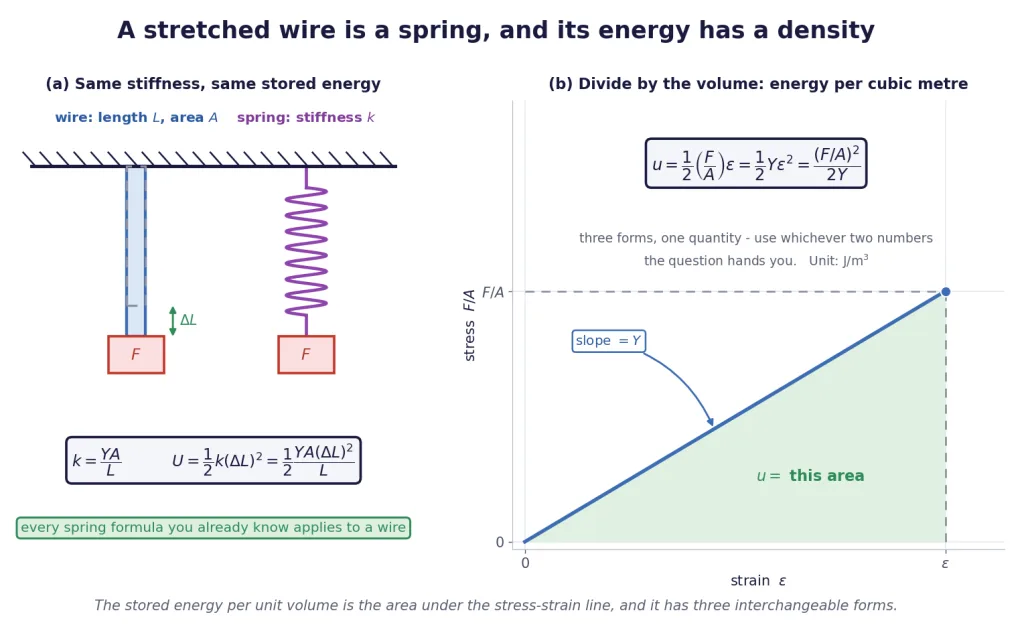
Look at what those two brackets are. The first is the stress. The second is the strain. So the energy per unit volume is just one half of stress times strain — a result far tidier than the thing we started with.
Key Point — strain energy density:
The elastic potential energy stored per unit volume of a strained body is SI unit: joule per cubic metre, J/m. Its dimensional formula is , the same as stress and as pressure — which makes sense, since energy per volume and force per area are the same combination of dimensions.
Why all three forms, and why you must know all three
The three expressions are the same quantity. Getting from one to the next takes one substitution of :
So why memorise three things instead of one? Because problems hand you different pairs of numbers, and the version that matches your data turns a three-line problem into a one-line one.
| What the question gives you | Use | Why |
|---|---|---|
| stress and strain | both numbers used directly | |
| Young's modulus and strain | no need to find the stress first | |
| Young's modulus and stress | no need to find the strain first | |
| load, length, area, modulus | this is times the volume, tidied | |
| extension and stiffness | the spring form |
Five ways of saying one thing. Pick the row whose right-hand column contains only quantities you were given.
Notice the two energy-density forms behave in opposite ways with , and this is not a contradiction:
- At a fixed strain, grows with . A stiff material bent to the same shape stores more.
- At a fixed stress, falls as grows. A stiff material carrying the same load barely deforms, so it stores less.
Both statements are true because they answer different questions. Read carefully which one a problem is asking, because examiners set this pair deliberately.
Total energy from the density
Going back the other way is trivial and worth stating, because it is how most numerical problems finish:
as long as the stress is the same everywhere in the body. For a uniform wire under a uniform load it is. For a hanging wire stretched by its own weight it is not, and then you must integrate over the volume — a JEE-level refinement.
[JEE Tip] A question that gives you a stress and a modulus but no dimensions at all is asking for the density , in J/m. A question that also gives a length and an area wants the total , in J. Check the units the options are written in before you start; they tell you which one is wanted.
Reading the Energy Straight Off the Curve
Section 3 made the point that the area under a stress-strain curve is an energy per unit volume. Now we can say exactly which energy, and use it.
The reason is the derivation we have just done, run in reverse. A thin vertical strip of the curve at strain , of width , has area — a stress times a strain, which is J/m. Adding all the strips gives
For a straight Hookean line that integral is the triangle , exactly as before. For a curve of any shape it is still the area — and that is the version that matters, because real materials stop being straight long before they break.
Two different areas, two different words
Which part of the area you take decides which property you have measured, and the two are constantly confused.
Key Point — resilience and toughness:
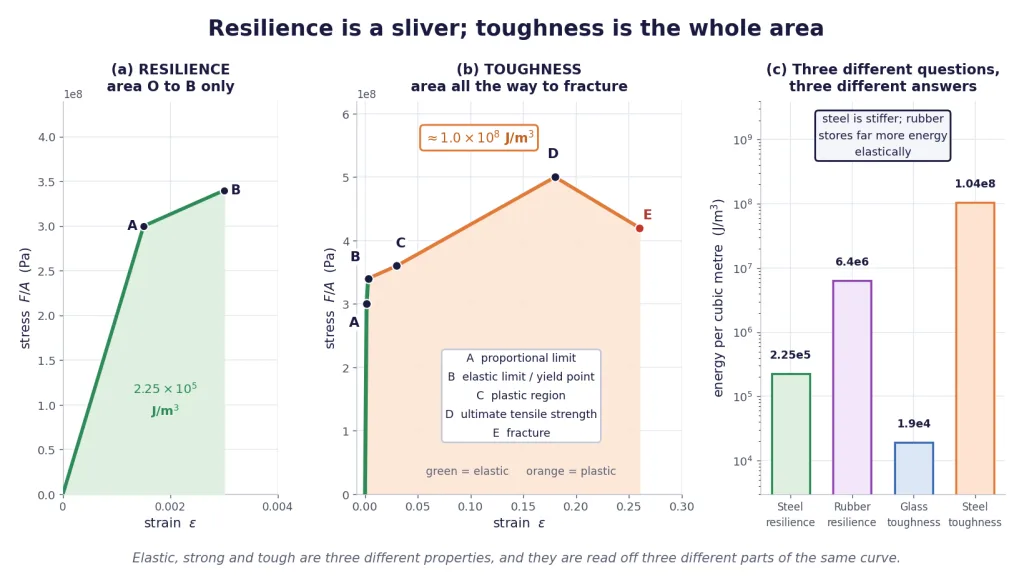
- Resilience is the area under the curve up to the elastic limit. It is the energy per unit volume a material can absorb and then give back completely. Its peak value is called the modulus of resilience, .
- Toughness is the area under the whole curve, right up to fracture. It is the total energy per unit volume the material absorbs before it breaks — most of it spent permanently deforming the material, and none of it recoverable.
For a ductile metal these two numbers are wildly different. Take the steel curve with an elastic limit at Pa and a fracture strain of about 0.26:
| Quantity | Value for this steel |
|---|---|
| Modulus of resilience (area O to the elastic limit) | J/m |
| Toughness (area to fracture) | about J/m |
| Resilience as a fraction of toughness | about |
Almost everything a metal absorbs before breaking, it absorbs plastically. The elastic sliver is a fifth of one per cent of the total.
Elastic, strong and tough are three different words
This is where the marks are, and where the intuition usually fails.
- Elastic (in the technical sense) means a large modulus — a steep curve. Steel wins easily.
- Strong means a high stress before failure — a tall curve. Steel wins again.
- Tough means a large area — and area needs both height and width.
A brittle material such as glass has a steep, tall, and extremely short curve. It is stiff and reasonably strong, and yet its area is minute: about J/m, some five thousand times less than steel's. That is precisely what "brittle" means in energy terms — it will not absorb a blow, it will simply crack.
Rubber is the mirror image. Its modulus is around Pa, five orders of magnitude below steel's, so it is nowhere near as elastic in the technical sense. But it stretches to several hundred per cent before it fails, and area needs width. Its recoverable energy per cubic metre works out at some J/m — about 28 times steel's modulus of resilience.
Key Point: "Which is more elastic, steel or rubber?" and "which stores more energy per unit volume, steel or rubber?" have opposite answers. Steel is more elastic; rubber stores far more. Both are correct; answer the question that was asked.
That is why catapults, bungee cords and the soles of running shoes are made of elastomers and not of spring steel: the job is to store and return energy, and for that you want area, not slope.
The warning that comes with a curved graph
is the area of a triangle, and a triangle is the right shape only if the graph is a straight line through the origin. For a rubber band, which is elastic but thoroughly non-linear, the formula is simply wrong — and it is wrong by a lot, not by a rounding error.
Take a rubber specimen whose loading curve rises to Pa at a strain of 3.0. The triangle formula would give J/m. Counting the actual area under the measured curve gives J/m. The shortcut is 41% too high, because a rubber curve sags well below the straight line for most of its length.
Key Point: Use only inside the linear region. Outside it, count the area — by the trapezium rule, by counting squares, or by integrating whatever function you are given.
[NEET Important] Two facts that get asked as one-liners: the area under a stress-strain curve is the energy absorbed per unit volume, in J/m; and toughness is the area up to fracture while resilience is the area up to the elastic limit. Mixing these two up is the standard distractor.
Three Places This Energy Shows Up
1. What is released when something snaps
A cable under tension is a charged spring. Cut it and every joule stored in it is released in a fraction of a second — which is why a snapping steel cable is genuinely dangerous, and why load-testing is done behind screens.
The calculation is short. Find the energy density from the stress, multiply by the volume of the cable:
The volume matters as much as the stress does. A short cable at high stress can hold less energy than a long one at moderate stress, and it is the long one that whips further when it goes.
2. Stretching in stages, and why the second stage costs more
Suppose you stretch a wire by 1 mm, and then stretch it by a further 1 mm. Same extra millimetre both times. Is the work the same?
No — and not even close.
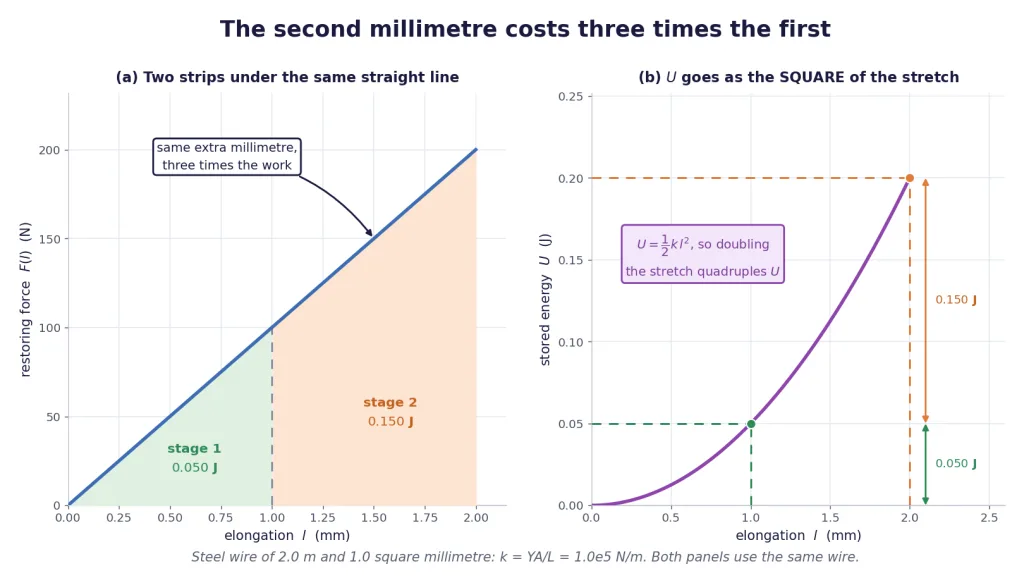
Key Point: The second identical increment of stretch takes three times the work of the first, because goes as the square of the extension. Doubling the stretch quadruples the stored energy, and the difference between and is .
The general rule, worth having ready: to go from extension to extension ,
It is a difference of squares, not . That second expression is a very popular wrong answer and it is never right unless .
3. If the energy turns into heat
When a wire is stretched and released repeatedly, or when a stored energy is dissipated inside the material rather than radiated away, the energy shows up as a temperature rise. The bookkeeping is straightforward: energy per unit volume divided by (density times specific heat capacity).
The numbers that come out are usually startlingly small, and knowing that is a useful reality check. For steel at a stress of Pa, with kg/m and J/(kg K), the entire elastic energy converted to heat would raise the temperature by about K — under three hundredths of a degree.
Key Point: Elastic energy densities are large compared with everyday energies but small compared with thermal energies. That is why you do not feel a stretched wire get warm, and why the elastic heating of structures is almost always negligible.
The comparison question that flips
One more thing to have ready, because it is set constantly. Compare a steel wire and a copper wire, Pa and Pa.
| Condition | Formula that applies | Which stores more per unit volume |
|---|---|---|
| Same stress in both | copper, by the factor | |
| Same strain in both | steel, by the same factor |
The same pair of wires, two conditions, opposite answers. The condition decides the formula, and the formula decides the answer.
[JEE Tip] Whenever a comparison question appears, your very first move is to identify what is being held equal — same load, same stress, same extension, same strain, same energy. Write that down before touching a formula. Half the marks in this topic are lost by answering the wrong version of the question.
Pulling the Section Together
The whole section on one page
| Quantity | Formula | When to use it |
|---|---|---|
| Wire as a spring | any elastic wire, inside Hooke's law | |
| Elastic PE | force and extension known | |
| Elastic PE | extension known, force not | |
| Elastic PE | load known, extension not | |
| Energy density | stress and strain known | |
| Energy density | modulus and strain known | |
| Energy density | modulus and stress known | |
| Total from density | stress uniform through the body | |
| Two-stage work | stretching further from an already stretched state | |
| Area interpretation | any curve, linear or not | |
| Modulus of resilience | recoverable energy per unit volume | |
| Toughness | area under the whole curve to fracture | total energy absorbed before breaking |
| Heating | if the stored energy becomes heat |
Everything in Section 8. The unit of is the joule; the unit of is J/m.
The six traps
- Writing . It is . The force grew from zero, so the average was .
- Confusing with . One is joules and belongs to an object; the other is J/m and belongs to a material. Check the units in the options.
- Using on a curved graph. The triangle is only the area if the graph is straight. For rubber it overestimates by tens of per cent.
- Writing for a two-stage stretch. It is , a difference of squares.
- Getting the steel-versus-copper comparison backwards. At the same stress the softer material stores more; at the same strain the stiffer one does.
- Calling a strong material tough. Strength is the height of the curve, toughness is its area. Glass is strong and not tough at all.
One habit that catches most errors
Before you finish, ask the two-part question: "Joules or joules per cubic metre?" and "Did I halve it?" Those two checks between them catch the great majority of the marks lost in this topic, and they take four seconds.
What comes next
The energy stored here came from a mechanical load. Section 9 looks at what happens when a body is prevented from expanding as its temperature changes — a thermal stress, which can be enormous — and at what real materials do when you cycle them around a loop of loading and unloading, which turns out not to be a perfectly reversible business at all.
Solved Examples
Values used throughout this section, unless a problem supplies its own: Pa, Pa, kg/m, J/(kg K), and m/s where a weight is needed.
Example 1: The standard calculation, three ways
A steel wire of length 2.0 m and cross-sectional area 1.0 mm is stretched by 1.0 mm. Find (a) the stretching force, (b) the elastic potential energy stored, and (c) the energy stored per unit volume.
Solution:
(a) The force. First the stiffness, with mm m:
(b) The energy.
(c) The energy density. The volume is m, so
Check it the other way. The strain is and the stress is Pa, so The two routes agree.
Final Answer: N, J, J/m.
Takeaway: Compute first and everything else falls out. With in hand, the wire is just a spring, and every spring formula you already know applies without modification.
Example 2: The factor of two, priced
For the wire in Example 1, a student writes J. Explain the error and say exactly where the missing energy went if the 100 N load had simply been hung on the wire.
Solution:
The error. assumes the wire pulls back with 100 N throughout the stretch. It does not. It pulls back with 0 N at the start and 100 N only at the very end.
The correct average. Since is linear in , its average over to is exactly N. So
What gravity did. If a load of 100 N descends by 1.0 mm, gravity does which is indeed twice the stored energy.
Where the other 0.050 J went. It did not disappear. Released suddenly, the load overshoots 1.0 mm, oscillates about it, and the surplus ends up as heat once the oscillation is damped out. Lowered gently, your hand does J of work and carries the surplus away.
Final Answer: The correct energy is 0.050 J. The other 0.050 J of gravity's work goes into oscillation and then heat, or is removed by whatever lowers the load gently.
Takeaway: is not a small error, it is exactly double. If your answer is precisely twice the option offered, you have forgotten the one half.
Example 3: Energy density from stress alone
A steel cable carries a working stress of Pa. Find the elastic energy stored per unit volume.
Solution:
Choose the form that matches the data. You have a stress and a modulus and nothing else, so use
Substitute.
A feel for the number. That is 25 kJ in every cubic metre. A cubic metre of steel has a mass of 7800 kg, so this is about 3.2 J per kilogram — tiny compared with, say, the 62 MJ per kilogram needed to escape the Earth's gravity, but quite enough to hurt somebody if it is released in a millisecond.
Final Answer: J/m.
Takeaway: No dimensions were given, and none were needed. A question that supplies only intensive quantities — stress, strain, modulus — can only be asking for the density , never the total .
Example 4: Energy density from stress and strain
A wire is under a stress of Pa and its measured strain is . Find the strain energy density, and deduce the Young's modulus of the material.
Solution:
The density, from the first form:
The modulus. Since the material is inside the Hookean region, which identifies it as steel.
Confirm with the second form. Same answer, as it must be.
Final Answer: J/m and Pa.
Takeaway: The three forms are a single formula wearing three hats. Whichever two of stress, strain and modulus you are handed, one of the three fits without any preliminary work.
Example 5: The second millimetre costs more than the first
The wire of Example 1 is stretched from 0 to 1.0 mm, and then from 1.0 mm to 2.0 mm. Find the work done in each stage and their ratio.
Solution:
Stage 1, with N/m:
Stage 2 is the difference of two stored energies, not a fresh :
The ratio.
Check the total. J, and directly J. It closes.
Final Answer: 0.050 J and 0.150 J; the second stage takes three times the work of the first.
Takeaway: Work between two extensions is a difference of squares. Writing would have given 0.050 J for the second stage, exactly the wrong answer, and it is always offered as an option.
Example 6: Hanging a mass, gently
A 5.0 kg mass is attached to a steel wire of length 2.0 m and cross-section 1.0 mm and lowered gently until the wire supports it in equilibrium. Take m/s. Find the extension, the energy stored in the wire, and the work done by gravity. Account for the difference.
Solution:
The force.
The extension, with N/m from Example 1:
The stored energy.
Gravity's work. The mass descends the full m, so
Account for the gap. Gravity supplied J and the wire kept J — exactly half. The other half, J, was taken out by the hand that lowered the mass gently; the hand's upward force does negative work all the way down.
Final Answer: mm, J, J, and the hand removes the missing J.
Takeaway: Gravity always does exactly twice the stored energy over a static extension, whatever the numbers are, because the load's weight is constant while the restoring force builds from zero. The factor is 2 every time.
Example 7: The energy in a cable that snaps
A steel cable of cross-section 2.0 cm and length 50 m is under a stress of Pa when it fails. How much elastic energy is released?
Solution:
Energy density from the stress.
Volume of the cable. With cm m,
Total energy.
A cross-check by the other route. The load is N, the extension is m, and J. Agrees.
Final Answer: J, that is 1.0 kJ.
Takeaway: A kilojoule released in milliseconds is roughly the kinetic energy of a 4 kg mass moving at 22 m/s. That is why a failed cable whips, and why the energy question is a safety question and not merely an academic one.
Example 8: Does the wire get warm?
If all the energy of Example 7 stayed inside the steel and became heat, what temperature rise would it produce? Take kg/m and J/(kg K).
Solution:
Work per unit volume, already found: J/m.
Heat capacity per unit volume.
The temperature rise.
Check it the long way. The cable's mass is kg, so K. Same.
Final Answer: About K, roughly three hundredths of a degree.
Takeaway: Elastic energy is negligible thermally. Even a cable stressed to half its breaking point holds barely enough energy to warm itself by a thirtieth of a degree — which is exactly why elastic heating is ignored in every problem in this chapter.
Example 9: Steel against copper, twice
A steel wire and a copper wire of identical dimensions are compared. Which stores more energy per unit volume (a) when both carry the same stress, and (b) when both have the same strain? Use Pa and Pa, with a stress of Pa in part (a) and a strain of in part (b).
Solution:
(a) Same stress. Use , in which sits in the denominator. Copper stores more, by the factor .
(b) Same strain. Now use , in which sits in the numerator. Steel stores more, by the same factor .
Why the flip. At equal stress the softer wire must stretch further to carry it, and it is the extra stretch that stores the energy. At equal strain both stretch the same amount, so the stiffer wire — which needed a bigger force to get there — stores more.
Final Answer: (a) copper, by a factor of 1.67; (b) steel, by a factor of 1.67.
Takeaway: The answer to "which stores more?" depends entirely on what is held equal. Underline the condition in the question before choosing a formula, because the same two wires give opposite answers under the two conditions.
Example 10: The modulus of resilience of steel
A steel with an elastic limit of Pa and Pa is loaded right up to that limit. Find the strain there and the maximum energy per unit volume it can store and give back.
Solution:
Strain at the elastic limit.
The modulus of resilience is the area of the triangle up to that point:
Put it in context. The same steel absorbs about J/m before it actually fractures. So the recoverable part is of the total.
Final Answer: and J/m, about 0.2% of the steel's toughness.
Takeaway: Resilience is what you get back; toughness is what it takes to break it. For a ductile metal these differ by a factor of several hundred, so never quote one when the question asked for the other.
Example 11: A rubber band, where the triangle fails
A rubber specimen is stretched and its loading curve recorded at seven points:
| Strain | 0 | 0.5 | 1.0 | 1.5 | 2.0 | 2.5 | 3.0 |
|---|---|---|---|---|---|---|---|
| Stress (MPa) | 0 | 0.9 | 1.4 | 1.8 | 2.3 | 3.4 | 6.0 |
Find the energy stored per unit volume at a strain of 3.0, and compare it with what would give.
Solution:
Count the area by the trapezium rule. Each strip contributes (the average of its two stresses) times the strip width, which is 0.5 here. The six averages, in MPa, are and they add to 12.8 MPa. Multiplying by the strip width, (Simpson's rule on the same points gives J/m, a difference of 1.6% — the honest uncertainty in reading a curve from seven points.)
What the triangle formula would say.
The error.
Why. The rubber curve sags well below the straight chord for almost its whole length, so the triangle drawn on that chord contains far more area than the curve does.
Final Answer: J/m. The triangle formula gives J/m, which is 41% too high.
Takeaway: stressstrain is the area of a triangle, and rubber's graph is not a triangle. For any non-linear material, count the area. Notice also that J/m is about 28 times steel's modulus of resilience — the elastomer wins the energy-storage contest comfortably, despite a modulus five orders of magnitude smaller.
Example 12: How the stored energy scales
A wire of length and radius stores energy under a fixed load . What happens to if, keeping the same load, (a) the length is doubled, (b) the radius is doubled, (c) the load is doubled? And what happens if instead the length is doubled at a fixed extension?
Solution:
Start from the right form. With the load fixed, the useful expression is
(a) Length doubled. , so doubles.
(b) Radius doubled. , so falls to one quarter.
(c) Load doubled. , so becomes four times as large.
The fixed-extension case is different. Now use , in which is in the denominator. Doubling at fixed halves .
Final Answer: At fixed load: doubled, quartered, quadrupled. At fixed extension, doubling the length halves .
Takeaway: The same wire, the same change, two opposite answers — because sits in the numerator of one form and the denominator of the other. Decide what is held fixed, choose the matching form, and only then read off the proportionality.