
Nobody Asked What Happens Sideways
Three sections in a row have been about one number changing. Section 4 stretched a wire and measured . Section 5 sheared a block and measured the angle. Section 6 squeezed a cube and measured .
Go back to the stretched wire for a moment. You pulled it, it got longer by , and you computed and moved on. But something else happened at the same instant, and we have been quietly ignoring it.
The wire also got thinner.
Of course it did. Stretch a rubber band between your fingers and watch it — it narrows visibly. A steel wire does exactly the same thing; the change is just far too small to see. That sideways shrinking is a real, measurable, material-specific effect, and this section is about the number that measures it.
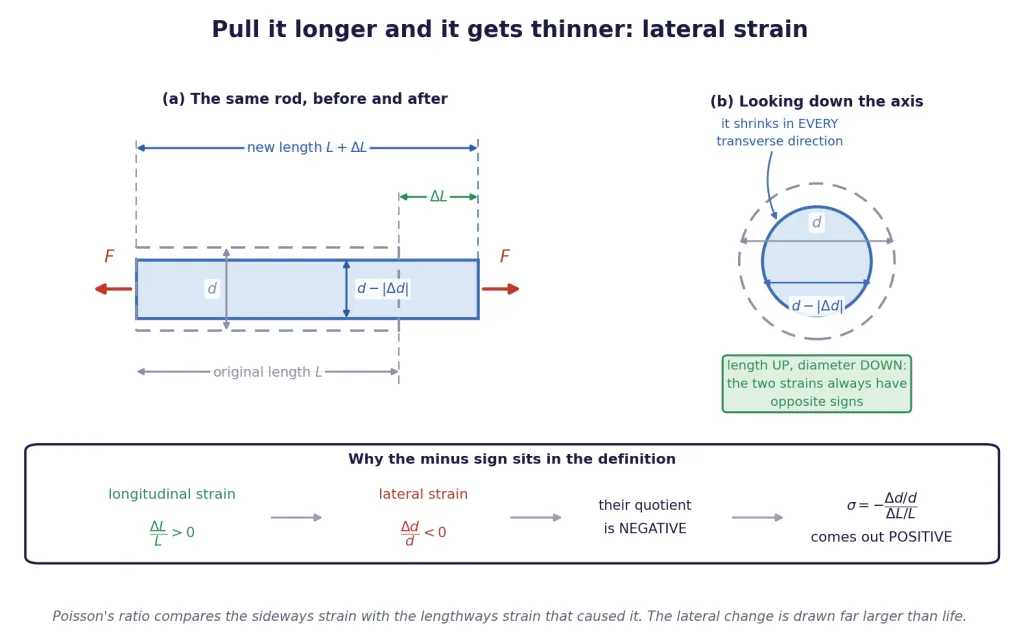
Lateral strain
The strain we have been using all along, , is the longitudinal strain — the fractional change along the direction you pulled. Now define its partner.
Key Point — lateral strain:
Lateral strain is the fractional change in a dimension measured at right angles to the applied force. For a wire of diameter that thins by , It is a strain like any other: a pure number, no unit, no dimensions. For a stretched wire it is negative, because is negative — the wire gets thinner while it gets longer.
Two details worth pinning down straight away.
- It does not matter which transverse direction you pick. For an isotropic material the wire shrinks by the same fraction in every direction perpendicular to the pull. Diameter, radius, width, breadth — the fractional change is the same number. That is why you may safely write and use whichever the question gives you.
- Compress instead of stretching and every sign flips. Squash a rod and it gets shorter and fatter: is negative and is positive. The two are still opposite in sign, which is the whole point.
Poisson's ratio
Experiment shows something rather beautiful: for a given material, over the range where Hooke's law holds, the two strains are in a fixed ratio. Double the load and both strains double; their quotient does not budge.
Key Point — Poisson's ratio:
Poisson's ratio is the negative of the ratio of lateral strain to longitudinal strain: It is dimensionless and has no unit, being a ratio of two pure numbers. It is a property of the material, not of the particular specimen — its length and thickness cancel out of the definition entirely.
Why the minus sign is there — say this, every time
This is the same kind of sign question as the one in the bulk modulus, and it has the same kind of answer.
For an ordinary material the two strains always have opposite signs: pull it and while . Their quotient is therefore a negative number. If we defined Poisson's ratio as that quotient, every ordinary material would have a negative , and we would spend the rest of our lives carrying a minus sign around for no reason.
Key Point: The minus sign in the definition exists so that comes out positive for ordinary materials. It is a bookkeeping choice, exactly like the minus sign in , and it earns a mark in a definition question. Write it, and say what it is for.
A useful rearrangement, which is what you actually use in problems:
So if you know and you know how much the wire stretched, you know exactly how much thinner it got.
The symbol, at last
means Poisson's ratio, and stress is written or , , when a symbol is genuinely needed. This is the section where that reservation finally pays for itself. Elsewhere often denotes stress, with (nu) or (mu) for Poisson's ratio — check the symbol list first and do not mix the two conventions inside a single solution.
[Board Important] "Define Poisson's ratio. Why is a negative sign used in its definition?" is a standard two-mark question. One mark for the ratio, one for the sentence about the sign. Adding "it is dimensionless and has no unit" costs you nothing and often picks up the third mark in a three-mark version.
What a Stretched Rod Does to Its Own Volume
Here is a question that sounds harmless and catches almost everybody: when you stretch a wire, does its volume go up, go down, or stay the same?
Think about the two competing effects. The wire gets longer, which increases the volume. It also gets thinner, which decreases it. Which wins?
Let us just do the sum. It takes two lines.
The two-line derivation
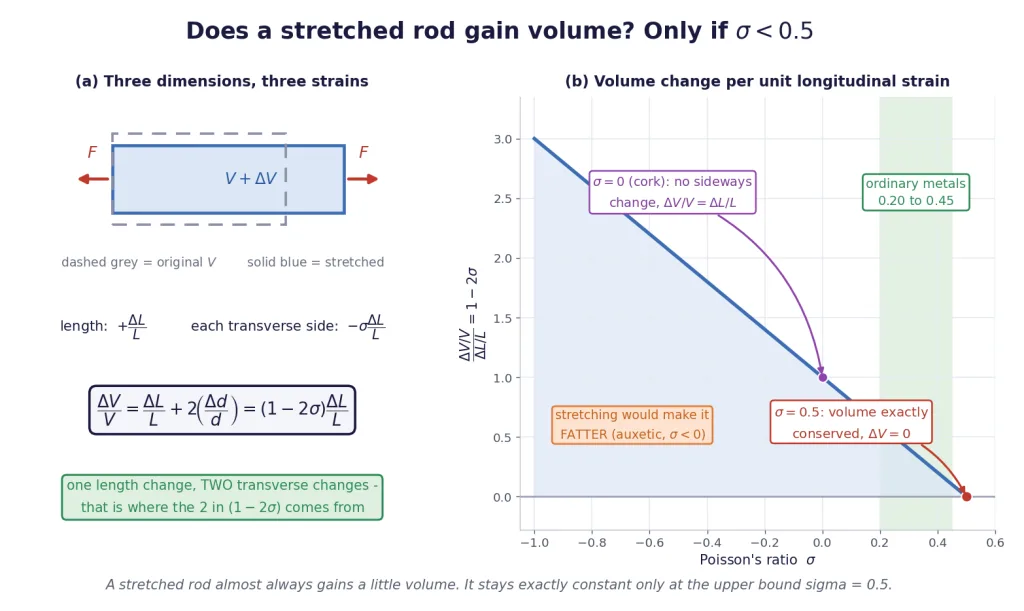
Take a rod of length and square cross-section of side , so that . (A circular wire gives exactly the same answer — try it as an exercise.) Stretch it. The length gains a fraction ; each of the two transverse sides loses a fraction .
For small changes, fractional changes simply add:
That factor of 2 is the whole trick and the whole trap. There is one length and there are two transverse dimensions, and both of them shrink. Now substitute :
Key Point — the volume change of a stretched rod: This holds for small strains and for an isotropic material. It works for a wire, a rod, a bar of any cross-section.
Reading the answer off
Everything now depends on the single factor :
- — then and the volume increases. Since every ordinary metal has between and , this is the normal case. Stretching a steel wire makes it very slightly bigger.
- — then and the volume does not change at all. The lengthening and the thinning cancel exactly. Such a material is called incompressible, and rubber comes extremely close to it.
- — the volume would decrease when you pulled it. No material does this, and the next block explains why it cannot.
Key Point: is precisely the value at which a stretched body conserves its volume. Not approximately — exactly, to first order. Whenever a question says "the material is incompressible" or "the volume remains constant on stretching", it has just handed you .
How good is "for small changes"? Let us check rather than assume
That phrase "fractional changes simply add" is an approximation, and this chapter does not let approximations pass unexamined. So compute the exact new volume by multiplying out the real deformed dimensions,
and compare it with the linear answer . Here is what comes out:
| Longitudinal strain | Exact | Linear | Error of the linear form | |
|---|---|---|---|---|
| 0.29 | 0.01% | |||
| 0.29 | 0.12% | |||
| 0.29 | 1.2% | |||
| 0.40 | 18.8% | |||
| 0.40 | 45.3% |
Exact deformed volume against the linearised formula. The exact column was obtained by multiplying the actual new dimensions together. As everywhere in this chapter, the error is measured against the exact value: .
Read that table honestly. At the strains a metal actually works at — a few parts in ten thousand — the linear formula is good to better than a tenth of a per cent, and you should use it without a second thought. At rubber strains, where is measured in tens of per cent, the linear formula is out by nearly a half and is simply the wrong tool. That is not a defect in the physics; it is the visible edge of the small-strain assumption that the whole chapter rests on.
[JEE Tip] The single most common slip here is dropping the 2. Students write because they counted one transverse direction instead of two. If you ever forget, rebuild it: one length, two widths, so one plus and two minuses.
How Big Is , and How Big Is It Allowed to Be?
Poisson's ratio is a pure number, so the question "how big is it?" has a clean answer. Here are real values.
| Material | Poisson's ratio |
|---|---|
| Cork | about 0.0 |
| Concrete | 0.15 to 0.20 |
| Glass | 0.22 |
| Cast iron | 0.25 |
| Steel | 0.28 to 0.30 |
| Iron | 0.29 |
| Aluminium | 0.33 |
| Copper | 0.34 |
| Brass | 0.35 |
| Titanium | 0.36 |
| Gold | 0.42 |
| Lead | 0.44 |
| Rubber | 0.4999, effectively 0.5 |
Poisson's ratio for common materials. This is our own reference list for the chapter; use these values whenever a problem does not supply its own.
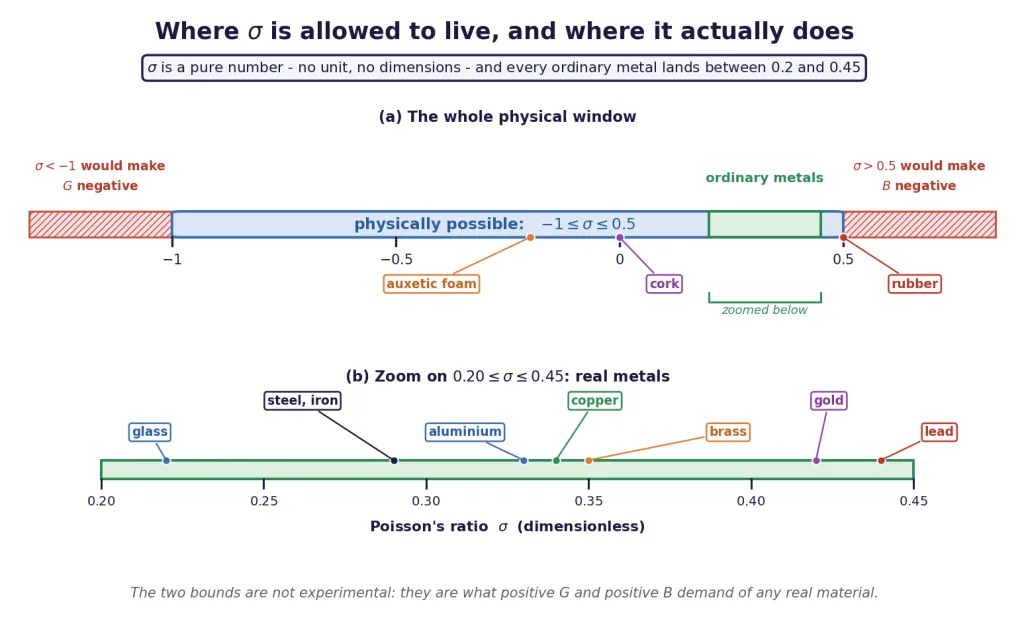
Key Point — the number to carry in your head: for ordinary metals, lies between about 0.2 and 0.45, and a typical value is around 0.3. If a calculation hands you or for a metal, you have made an arithmetic mistake, not a discovery.
The theoretical bounds
The measured values all sit inside a window, and the window is not an accident of which materials happen to exist. It is forced by physics.
Key Point — the bounds on Poisson's ratio: No isotropic material can have a value outside this range, whatever it is made of.
Where do the two ends come from? Each one is a modulus refusing to be negative. The relations that make this precise are set up in the next block, but the argument is short enough to give now.
- The upper bound, . The next block derives . Both and must be positive — a material with a negative bulk modulus would expand when you squeezed it, gaining energy from nothing. Positive and positive force , that is, . At exactly , becomes infinite: the material is perfectly incompressible.
- The lower bound, . The next block also gives . Positive and positive force , that is, . At exactly , becomes infinite: the material would resist shearing absolutely.
So the two bounds are simply the two moduli insisting on being positive. Nothing was measured to obtain them.
What the special values mean physically
- . Stretch it and it does not get thinner at all. Cork is very close to this, which is exactly why a cork goes into a bottleneck: push it in and it does not bulge sideways to jam. A rubber stopper of the same size would.
- . Volume exactly conserved, as the last block showed. Rubber, and most liquids-like solids and biological tissue, sit near here.
- . Stretch it and it gets fatter. Materials that do this are called auxetic. They are not found in ordinary metals; they are engineered — certain foams, folded structures and some crystals cut in particular directions. Their existence is why the lower bound is stated at rather than at .
One caution about "isotropic"
Every statement in this section — the bounds, the relations in the next block, the claim that the lateral shrinkage is the same in all transverse directions — assumes the material is isotropic: the same in every direction. Ordinary metals, glass and most engineering materials are close enough for our purposes. Wood is not, and neither is a single crystal, and neither is carbon fibre. Wood cut along the grain behaves completely differently from wood cut across it, and for such materials Poisson's ratio is not a single number at all. That is well past Class 11, but it is worth knowing the assumption is there.
[NEET Important] Three one-liners that get asked directly: is dimensionless; its practical range for metals is 0.2 to 0.45; its theoretical range is to . Options offering , or for a real material are always wrong.
Tying All Four Constants Together
This block sits outside the rationalised syllabus body text, but JEE Main, JEE Advanced and NEET use these relations freely every year, so they are developed here from first principles.
We now have four numbers that describe how an elastic solid responds: , , and . They arrived in four different sections from four different experiments, and so far nothing has connected them.
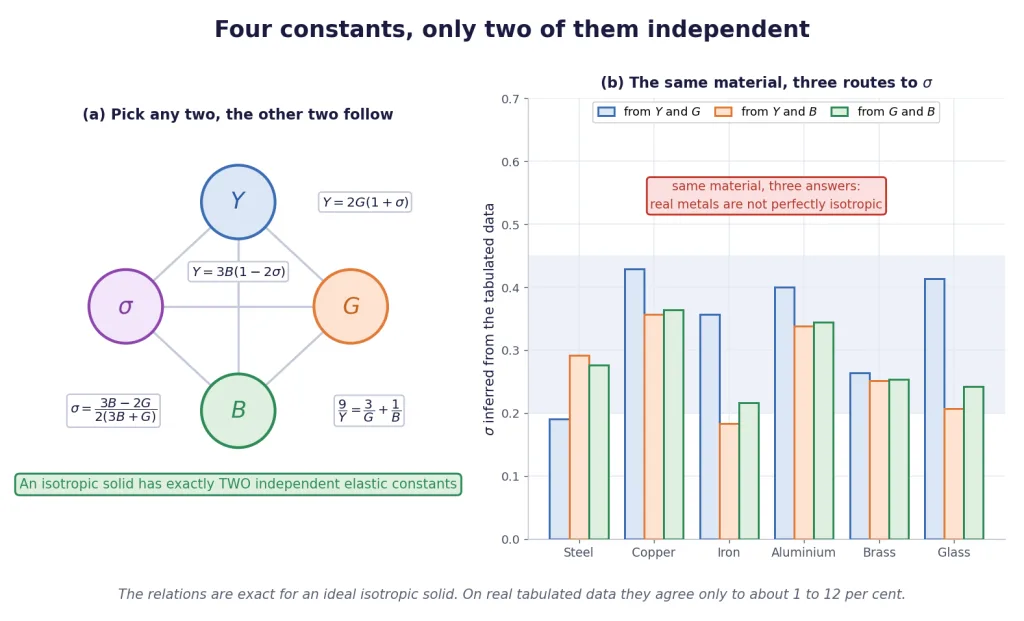
They are connected. In fact, for an isotropic solid, only two of the four are independent — fix any two and the other two are determined. Here is why.
Deriving
This one you can do yourself, and it uses only what is already on this page.
Take a cube and put it under a uniform pressure — a hydraulic stress. That is the same thing as applying a compressive stress of size along the axis, and along the axis, and along the axis, all at once. Strains from separate stresses simply add, so work out the strain along by counting three contributions:
- The compression along itself produces a strain .
- The compression along squeezes the cube in the direction, so by Poisson's effect the cube expands along by .
- The compression along does exactly the same: .
Add them:
By symmetry and are the same, and for small strains the volume strain is their sum:
Finally use the definition of the bulk modulus from Section 6, :
Notice that the minus signs have all cancelled and has come out positive, exactly as Section 6 promised.
The shear relation is proved the same way, but it needs one extra idea: a pure shear is the same stress state as a tension along one diagonal together with an equal compression along the other. Set that up, work out the strains of the two diagonals with the same superposition trick, and the shear strain drops out. The construction is a little beyond Class 11 geometry, so we state the result and use it:
The other two, by elimination
Now you have two equations in the four unknowns. Eliminate whichever quantity you do not want.
Eliminate by setting and solving for :
Eliminate instead. From the first relation ; from the second . Set them equal and tidy up:
That last form is worth memorising in the shape rather than the shape — it is far easier to remember, and it looks pleasingly like the formula for resistors in parallel.
Key Point — the four relations, all together: Any two of , , , determine the other two. An isotropic solid therefore has exactly two independent elastic constants, not four.
Which one to reach for
| You are given | You want | Use |
|---|---|---|
| and | ||
| and | ||
| and | ||
| and | ||
| and | ||
| and |
Six routes, two relations. Every row is one of the two boxed formulas, rearranged.
A promise from Section 5, finally kept
Section 5 noted that is empirically about to times for real metals, and said the reason would appear here. Now it can. Rearranged, the shear relation says
Put into that and you get . Put in and you get . So the observed band to is not an empirical curiosity at all — it is exactly what the metals' Poisson ratios of to force it to be. The rough rule "" corresponds to , which is why it always runs a little low for a real metal.
[JEE Tip] These relations turn a two-unknown problem into a one-unknown problem. "Given and , find the fractional volume change under a pressure " looks like it needs , which you were not given. It does not: compute from and in one line and carry on.
Do These Relations Actually Work? An Honest Test
The four relations are exact — for a perfectly isotropic, homogeneous, linearly elastic solid. Real metals are none of those things exactly. So before you trust the formulas on real data, let us test them on real data.
Here is the experiment. Take the chapter's own tabulated , and for six materials, all measured independently. Then compute Poisson's ratio three different ways — from and , from and , and from and . If the material were perfectly isotropic and the numbers were perfectly measured, all three would agree exactly.
| Material | (GPa) | (GPa) | (GPa) | from | from | from | predicted from | Error in |
|---|---|---|---|---|---|---|---|---|
| Steel | 200 | 84 | 160 | 0.190 | 0.292 | 0.277 | 215 | |
| Copper | 120 | 42 | 140 | 0.429 | 0.357 | 0.364 | 114 | |
| Iron | 190 | 70 | 100 | 0.357 | 0.183 | 0.216 | 170 | |
| Aluminium | 70 | 25 | 72 | 0.400 | 0.338 | 0.344 | 67 | |
| Brass | 91 | 36 | 61 | 0.264 | 0.251 | 0.253 | 90 | |
| Glass | 65 | 23 | 37 | 0.413 | 0.207 | 0.243 | 57 |
The relations tested against independently measured moduli. The last column compares with the measured .
The verdict, stated plainly
The agreement is good but not exact. Across these six materials, predicted from and lands within for brass, within about for copper and aluminium, about for steel, and around to for iron and glass. The average error in magnitude is about .
The three routes to scatter by a similar amount. For brass they agree beautifully — , , . For steel they range from to , and for glass from to .
Key Point: The inter-constant relations are exact for an ideal isotropic solid and good to roughly ten per cent on real tabulated data. Do not expect a handbook's , and for the same metal to satisfy them to three figures. They will not.
Why the disagreement, and why it does not matter for you
Four honest reasons:
- Real metals are polycrystalline, made of countless tiny crystals, each of which is anisotropic. The bulk material is only approximately isotropic, and how approximately depends on how it was rolled, drawn or cast.
- "Steel" is not one material. Nor is "brass" or "glass". Each is a family of alloys and compositions whose moduli differ by several per cent from one another. The in a table and the in a different table may not even be the same alloy.
- The three moduli are measured by three different experiments, each with its own systematic error, on three different specimens.
- The table values are rounded to two significant figures. Rounding from a true is already a change, and that alone moves from from to .
None of this makes the relations useless. It makes them what they are: exact statements about an idealised material, and good estimates for a real one.
For your exams the practical consequence is simple and worth stating clearly:
- Inside a problem, treat the relations as exact. If a question gives you and and asks for , there is one right answer and you compute it. Examiners construct such questions from consistent numbers.
- Comparing against a table, expect a ten per cent discrepancy and do not panic. If your computed for steel comes out as Pa while the table says Pa, nothing has gone wrong.
[Board Important] If a question asks you to "verify the relation" using tabulated data, the expected answer says the two sides agree to within experimental error, and names a reason — real materials are not perfectly isotropic. An answer claiming exact agreement to four figures is claiming something false.
Pulling the Section Together
The whole thing on one page
| Quantity | Formula | Notes |
|---|---|---|
| Lateral strain | negative when the body is stretched | |
| Poisson's ratio | dimensionless; the minus sign makes | |
| Lateral change | the working form | |
| Volume change | small strains, isotropic body | |
| Practical range | to for metals | typical value about |
| Theoretical bounds | from and | |
| Incompressible | volume exactly conserved | |
| Bulk relation | derive it by superposing three stresses | |
| Shear relation | equivalently | |
| from and | eliminate | |
| from and | remember it in this shape | |
| Independent constants | two | for any isotropic solid |
Everything in Section 7, in one table. The last five rows sit outside the rationalised syllabus body text and are asked every year.
The six traps
- Dropping the 2. , not . One length, two widths.
- Losing the minus sign in the definition, and then reporting a negative Poisson's ratio for steel.
- Using diameter where the problem gave radius, or the other way round. It does not matter — the fractional change is the same either way — but students often convert unnecessarily and slip.
- Mixing conventions between books. If a source writes for stress, its Poisson's ratio is or . Decide which convention the question uses before you substitute.
- Forgetting that has no units. It is a ratio of two dimensionless strains. Answers in pascal are wrong by construction.
- Quoting . If a calculation produces , the arithmetic is wrong. The bound is not a guideline.
A checking habit worth building
Whenever you compute one elastic constant from two others, check the answer against the plausible range before writing it down:
- between and for a metal.
- between about and .
- of the same order as for a metal — usually somewhat smaller for steel, somewhat larger for copper.
A of or a larger than tells you instantly that a substitution went in upside down, and it costs three seconds to look.
What comes next
You now have every static elastic constant this chapter defines. Section 8 asks the next obvious question: where does the work you did in stretching the wire actually go? The answer is a stored energy, and it comes with a factor of one half that catches more students than anything else in the chapter.
Solved Examples
Values used throughout this section, unless a problem supplies its own: Pa, Pa, Pa, , , .
Example 1: How much thinner does the wire get?
A copper wire of diameter 2.0 mm is stretched until its length increases by 0.10%. Taking for copper, find the change in its diameter.
Solution:
Write down the longitudinal strain. An increase of 0.10% means
Use the definition, rearranged.
Multiply by the actual diameter. With mm m,
Read the sign. The negative sign says the diameter decreased, which is what stretching does.
Final Answer: The diameter falls by m, that is 0.68 micrometre. The new diameter is 1.99932 mm.
Takeaway: The lateral change is tiny because the longitudinal change is tiny, and is less than one. A wire stretched by a tenth of a per cent thins by only three hundredths of a per cent — which is exactly why nobody noticed it in Sections 4 to 6.
Example 2: Reading Poisson's ratio off a measurement
A wire 2.50 m long and 1.20 mm in diameter is loaded. Its length increases by 1.50 mm and its diameter falls by 0.288 micrometre. Find Poisson's ratio for the material.
Solution:
Longitudinal strain.
Lateral strain, keeping the sign:
Take the ratio and put the minus sign in front.
Sanity check. sits comfortably inside the metal band of 0.2 to 0.45. Plausible.
Final Answer:
Takeaway: Neither the length nor the diameter of the wire appears in the answer. They cancelled when the strains were formed. That is the whole reason is a property of the material rather than of the specimen.
Example 3: The volume of a stretched steel rod
A steel rod of length 1.0 m and radius 5.0 mm is stretched with a force that produces a longitudinal strain of . Take Pa and . Find (a) the stretching force, (b) the fractional change in volume, and (c) the actual change in volume.
Solution:
(a) The force. The cross-section is and since ,
(b) Fractional volume change.
(c) Actual volume change. The original volume is
The exact check. Rebuilding the rod dimension by dimension gives a new radius and a new length , and multiplying those out gives m — the same to three figures, differing from the linear answer by 0.12%.
Final Answer: N, , m (0.033 cm).
Takeaway: The volume went UP. A stretched metal rod gains volume, because is less than 0.5. About 1.6 tonnes of force changes that rod's volume by three hundredths of a cubic centimetre.
Example 4: The incompressible material
A rubber cord is stretched. Assuming rubber has exactly, show that its volume does not change, and find what its diameter does when its length is increased by 20%.
Solution:
The volume. Straight from the formula, whatever the strain is. The lengthening and the thinning cancel exactly.
The diameter, using the linear formula. With , so the diameter falls by 10%.
Being honest about step 2. A strain of 20% is far outside the small-strain regime. Exactly conserving the volume requires to be constant, so — a fall of 8.7%, not 10%. The linear estimate is 15% out.
Final Answer: The volume is unchanged. The diameter falls by about 10% on the linear estimate, and by 8.7% on the exact constant-volume calculation.
Takeaway: is the definition of an incompressible material, and it is the only value for which stretching changes no volume. But at rubber-sized strains the linearised formulas are estimates, not answers — say so when you use them.
Example 5: From and to and
For steel, Pa and . Find the bulk modulus and the shear modulus.
Solution:
Bulk modulus, from :
Shear modulus, from :
Cross-check against the third relation. With these values, It closes exactly, as it must.
Final Answer: Pa and Pa.
Takeaway: The relations are self-consistent, so the third one is always a free check. Compute and from the first two, then verify with . If it does not close, you made an arithmetic slip. Note also that the tabulated values for real steel are Pa and Pa — close, but not identical, exactly as the honesty block warned.
Example 6: From and to and
A metal has Pa and Pa. Find and .
Solution:
Poisson's ratio, straight from the elimination formula: Compute the pieces: and , so the numerator is . The denominator is .
Young's modulus, from the reciprocal relation:
Check both against the originals. . Agrees.
Final Answer: Pa and .
Takeaway: This is real steel's and , and the predicted comes out 7% above the measured Pa. That is the honest size of the disagreement between an ideal isotropic relation and a real polycrystalline metal — not an error in your working.
Example 7: Aluminium, three ways
For aluminium, Pa and Pa. Find and , and compare with the tabulated Pa.
Solution:
Young's modulus.
Poisson's ratio. With and ,
Compare with the table. Predicted Pa against a tabulated Pa — low by 4.0%. Predicted against a handbook 0.33 — high by about 4%.
Final Answer: Pa and , both within about 4% of the tabulated values.
Takeaway: Four per cent is a good result, not a bad one. Aluminium is one of the more nearly isotropic common metals, which is exactly why the relations do better here than they do for iron or glass.
Example 8: The material with
A hypothetical solid has exactly. Express and as multiples of , and find .
Solution:
Shear modulus.
Bulk modulus.
Their ratio.
Check with the elimination formula. Put into : numerator , denominator , so . Consistent.
Final Answer: , , and .
Takeaway: is the classic examination value because every ratio comes out in round numbers. If a question gives you , expect and and save yourself the algebra.
Example 9: Why cannot exceed 0.5
Show, using the relations, that no isotropic material can have or . What happens to and at the two limits?
Solution:
The upper bound. From , rearranged as . Both and must be positive for a stable material. If then and would be negative — meaning the body would expand when you compressed it, releasing energy indefinitely. That is impossible, so .
At the limit itself. As , and . Infinite bulk modulus means zero compressibility: the material cannot be squeezed at all. This is exactly the incompressible case.
The lower bound. From . If then and would be negative, so .
At that limit. As , : the material would resist any shearing absolutely.
Final Answer: . At the bulk modulus becomes infinite; at the shear modulus becomes infinite.
Takeaway: The bounds are not measured, they are forced. They come from nothing more than the demand that and be positive, which in turn is the demand that a material not be a free source of energy.
Example 10: Three routes, three answers
For steel take GPa, GPa and GPa, all from measurement. Compute three ways and comment.
Solution:
From and :
From and :
From and :
Comment. The three answers are 0.190, 0.292 and 0.277 — a spread of about 0.10, or roughly 40% of the middle value. The accepted handbook figure for structural steel is about 0.29, so the and routes are good and the route is poor. The culprit is the rounded GPa; the value for common structural steel is nearer 79 GPa, and using that gives .
Final Answer: 0.190, 0.292 and 0.277 respectively. The true value is about 0.29.
Takeaway: A ten per cent error in one modulus becomes a much larger error in , because from and is a small difference between two numbers near 1. Never quote a Poisson's ratio obtained this way to more than two figures.
Example 11: Percentage volume change
A metal wire with is stretched by 0.20% of its length. By what percentage does its volume change, and in which direction?
Solution:
Substitute directly.
The direction. is positive, so the volume increases.
Exact check. Multiplying out the actual deformed dimensions gives — the linear answer is high by 0.26%, which is negligible at this strain.
Final Answer: The volume increases by 0.080%.
Takeaway: A 0.20% stretch produces only a 0.080% volume gain, because most of the lengthening is paid for by the sideways shrinking. The factor is exactly the fraction that survives.
Example 12: From volume change back to Poisson's ratio
A rod is stretched so that its length increases by 0.50%. Its volume is found to increase by 0.10%. Find Poisson's ratio for the material and identify a likely candidate from the reference list.
Solution:
Write the relation and solve for .
Substitute the two percentages — note that both are fractions, so the units cancel and you may divide the percentages directly:
Rearrange.
Identify it. From the reference list, sits between titanium (0.36) and gold (0.42) — a soft, dense metal. It is far too high for steel or glass.
Final Answer: .
Takeaway: The ratio of the two percentages is directly. You do not need the length, the diameter, the force or the modulus — this is a pure-ratio question, and recognising that turns a page of work into two lines.