
Close the Notes. Start the Clock.
Sections 1 to 12 taught you this chapter — stress and strain, Hooke's law and the whole stress-strain curve, the three moduli, Poisson's ratio and the relations between the constants, strain energy, thermal stress and fatigue, the engineering applications, forty-odd worked problems and a JEE toolkit on top. This section asks one different question: can you use any of it with a timer running?
There is no new theory below. There are 30 single-correct questions built to the exam pattern, and a marking scheme designed to punish the two habits this chapter rewards most cruelly — reaching for a formula before checking which modulus it belongs to, and reading a diameter as though it were a radius.
The rules of engagement
Key Point: This is not a reading exercise. Blank sheet, pen, timer. Attempt all 30 questions in one unbroken sitting, and do not open a single explanation until the last answer is written.
| The setup | What it is |
|---|---|
| Number of questions | 30, single correct option |
| Marking scheme | correct, incorrect, unattempted |
| Maximum score | marks |
| Minimum possible score | marks |
| Suggested time limit | 45 minutes (a shade under a minute and a half per question) |
| Take as | 9.8 m/s throughout. No question here uses 10 |
| Allowed | rough sheet, your own head |
| Not allowed | calculator, formula sheet, a glance back at the earlier sections |
The constants sheet
Every question that needs a number uses these and no others. Copy them to the top of your sheet before you start.
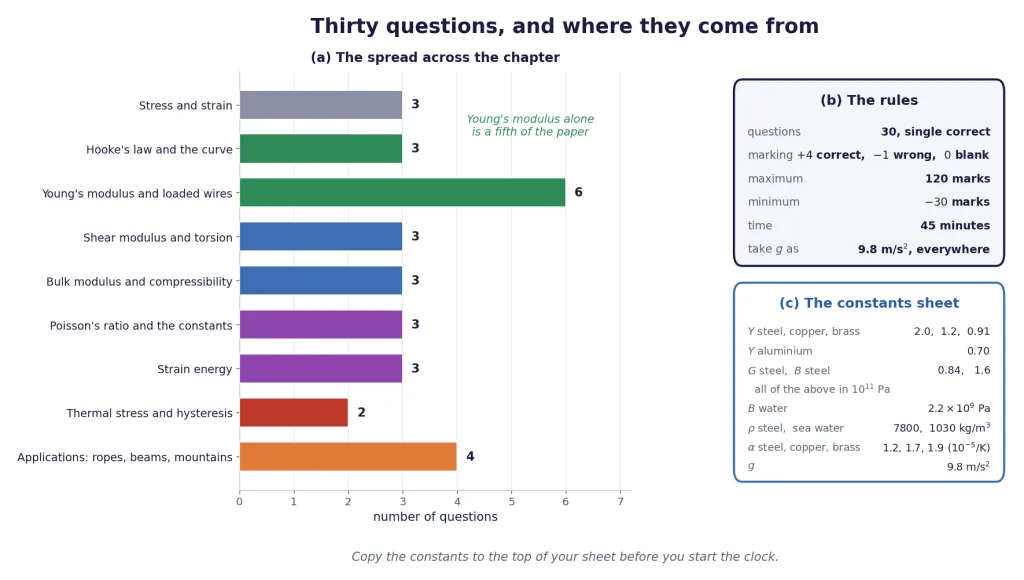
| Quantity | Value |
|---|---|
| Young's modulus of steel | Pa |
| Young's modulus of copper | Pa |
| Young's modulus of brass | Pa |
| Young's modulus of aluminium | Pa |
| Shear modulus of steel | Pa |
| Bulk modulus of steel | Pa |
| Bulk modulus of water | Pa |
| Density of steel | 7800 kg/m |
| Density of sea water | 1030 kg/m |
| for steel, copper, brass | , , , each per degree |
| Acceleration due to gravity | 9.8 m/s |
| One atmosphere | Pa |
| Useful values | , , |
The constants used throughout this drill. Nothing else is needed.
Symbols. means Poisson's ratio; stress is written and strain is . The moduli are , and . Compressibility is .
What this set covers
| Topic | Questions | How many |
|---|---|---|
| Stress, strain, units and the three pairs | Q1 to Q3 | 3 |
| Hooke's law and the stress-strain curve | Q4 to Q6 | 3 |
| Young's modulus, loaded wires, wires as springs | Q7 to Q12 | 6 |
| Shear modulus and torsion | Q13 to Q15 | 3 |
| Bulk modulus and compressibility | Q16 to Q18 | 3 |
| Poisson's ratio and the elastic constants | Q19 to Q21 | 3 |
| Strain energy and energy density | Q22 to Q24 | 3 |
| Thermal stress and hysteresis | Q25 to Q26 | 2 |
| Applications: ropes, beams, mountains | Q27 to Q30 | 4 |
That spread mirrors how the paper actually samples this chapter. Young's modulus alone is 6 of the 30, because the loaded wire is the single most-set situation in the whole topic, and it is where an SI slip on mm or a diameter read as a radius does the most damage.
The difficulty mix is roughly 25% easy, 45% medium and 30% hard. A handful will feel brutal. They are meant to.
[Exam Tip] That is not decoration. Four wild guesses that land one lucky hit earn mark for four minutes of work — a terrible trade. But a question narrowed to two options returns marks on average, which is a very good one. Narrow first, then commit. Leave blank only what you could not narrow at all.
[Exam Tip] Before you start, write five lines at the top of your sheet: which modulus — , or ?, which area?, is that a radius or a diameter?, did I remember the ?, are my units SI? Those five questions catch the overwhelming majority of the marks lost in this chapter.
Scoring Yourself Honestly
Mark your sheet with the real scheme — , , — and total it. No half marks for "I knew that one really". The number you get is the number that matters.
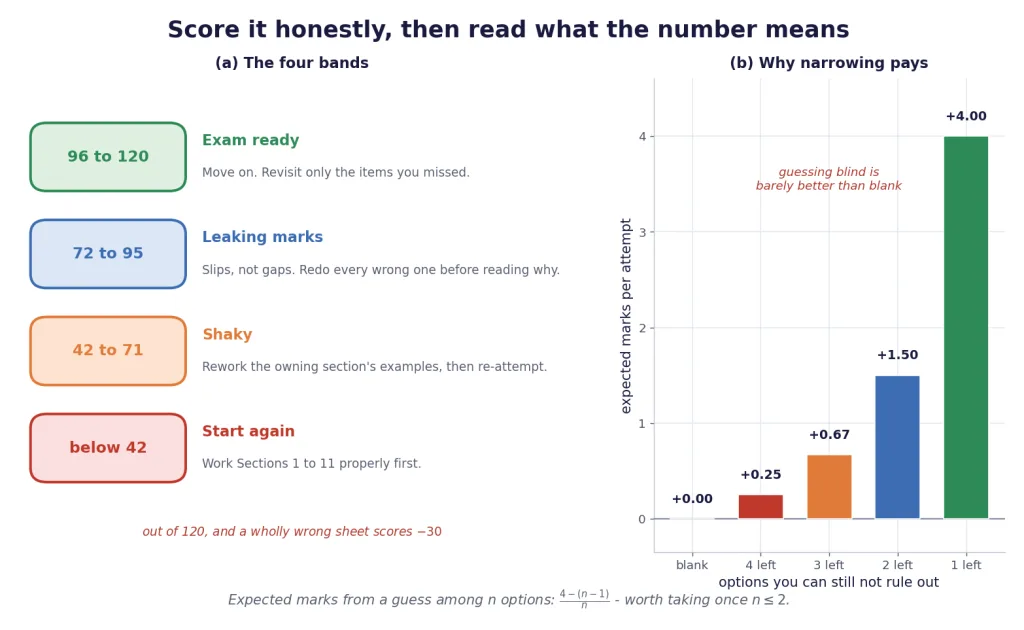
The bands
| Your score (out of 120) | Verdict | What to do next |
|---|---|---|
| 96 to 120 | Exam ready. 80% or more on a hard set, inside the time. | Move on. This chapter will not cost you marks. Revisit only the specific items you missed. |
| 72 to 95 | Solid, but leaking marks. | Almost always slips rather than gaps — a diameter used as a radius, a missing , mm converted as instead of . Redo every wrong question without the explanation first. |
| 42 to 71 | Shaky. The ideas are there; the execution is not. | For each wrong answer go back to the section that owns it (use the topic map above) and rework its solved examples before re-attempting. |
| Below 42 | Start again. | Work Sections 1 to 10 properly, then Section 11's worked problems, then Section 12. Re-attempting this set now teaches you nothing but the answer key. |
Read your own answer sheet
Before you touch a single explanation, sort your mistakes into three piles. This is the most valuable ten minutes in the whole section.
- Method errors — you reached for where the deformation was a shear, or for where the body was pulled in one direction only. You used the cross-section perpendicular to a tangential force. You applied to a wire whose tension varies along its length. These are the expensive ones, because the whole solution is wrong from line one.
- Execution errors — right method, wrong arithmetic. The classic four in this chapter: a diameter substituted where the formula wanted a radius; mm converted as m instead of m; the factor dropped from an energy; and forgotten, so a mass in kilograms was used as a force in newtons.
- Reading errors — the question asked for the stress, not the strain; for the energy per unit volume, not the total; for the increase in density, not the decrease in volume; for the load at which the wire breaks, not the load it safely carries.
Key Point: In this chapter pile 2 is unusually fat, and three of its four members are pure unit discipline. mm m. cm m. A radius is half a diameter. Write the SI conversion on its own line, every time, and a whole class of lost marks disappears.
The eight habits this set is drilling
- Name the deformation before you name the modulus. Pulled or pushed along one direction: . Slid or twisted: . Squeezed from every side: . There is no fourth case at this level.
- Name the area before you divide by it. For a longitudinal stress it is the section perpendicular to the force; for a shearing stress it is the face the force acts along.
- Strain has no unit, and stress has the unit of pressure. If your "strain" comes out with a pascal attached, you have divided by the wrong thing.
- Breaking stress belongs to the material, not to the object. Cutting a wire in half changes neither its breaking stress nor its breaking load. What it does change is the extension under a given load.
- A wire is a spring, . Wires end to end share the tension; wires side by side share the extension.
- Energy carries a , in all three of its forms: , per unit volume, , .
- Thermal stress is and contains neither nor . A short fat rod and a long thin one develop exactly the same stress.
- Check the size of the answer. Strains in metals under safe loads are around or smaller. An elongation of centimetres in a steel wire, or a Poisson's ratio above , means you have made an error, not a discovery.
[Exam Tip] Every explanation below is a full step-by-step solution, so this set doubles as revision. Read the explanation even for the questions you got right — several of these have a two-line route and a two-page route, and it is the two-line route you will need in the hall.