
When One Spring Is Not Enough
The previous section settled the single spring completely: a restoring force , an angular frequency , and a period that gravity cannot touch. Almost every spring question you will actually be set, though, has more than one spring in it — two side by side, two joined end to end, one above and one below, a spring cut in half, a spring with a block at each end.
None of that needs new physics. The whole job is to replace the collection of springs by one imaginary spring that would push the block exactly as hard, for exactly the same displacement. That imaginary spring's constant is written , the equivalent spring constant, and once you have it, everything from the previous section applies unchanged with replaced by .
The series combination and the general equivalent-stiffness rules sit outside the rationalised syllabus, and Boards, JEE and NEET ask them every year, so both are built here from first principles.
The one question that decides everything
There are exactly two ways two springs can be attached, and you tell them apart by asking a physical question — never by looking at the picture and guessing.
Key Point — the question to ask:
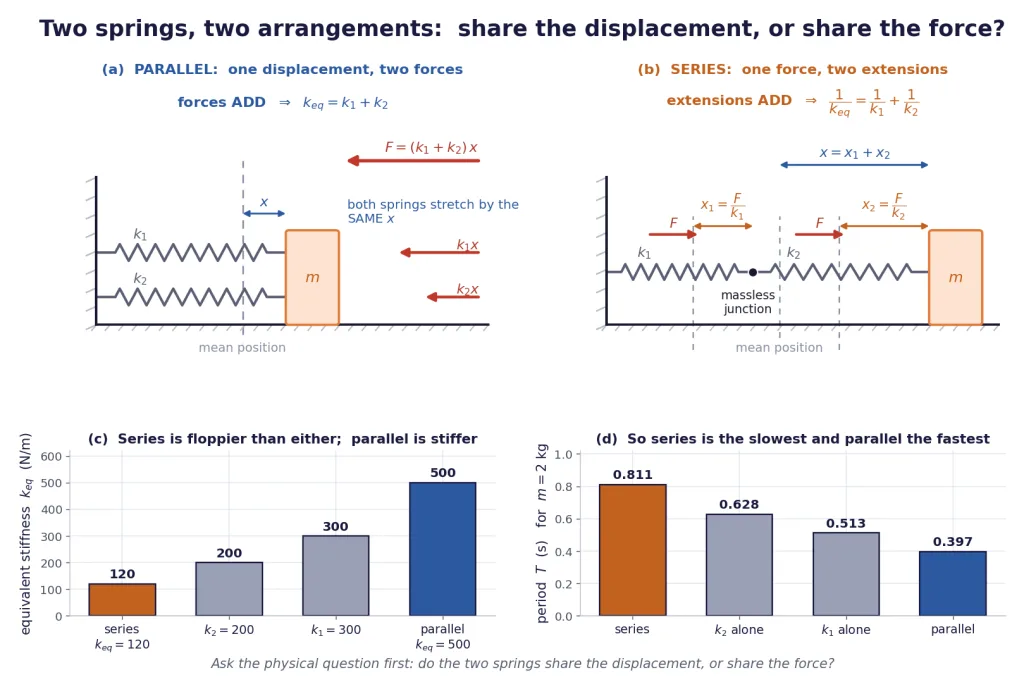
Do the two springs share the displacement, or share the force?
- If moving the block changes both springs' lengths by the same amount, they are in parallel. Their forces add.
- If the same tension runs through both, and their extensions add up to the block's displacement, they are in series. Their extensions add.
Everything in this section follows from that one distinction.
Parallel: the springs share the displacement
Take a block of mass on a frictionless horizontal surface. Two light springs, of spring constants and , run from the same rigid wall to the block. Both are at their natural length when the block sits at rest, so that resting point is the mean position.
Step 1 — displace and find each force. Pull the block a distance away from the wall. Both springs are anchored at one end and attached to the block at the other, so both stretch by the same . By Hooke's law each pulls back:
Step 2 — add them, because they act on the same body in the same direction.
Step 3 — compare with the test. This is , so the motion is simple harmonic, and the constant in the bracket is the equivalent spring constant.
Key Point — springs in parallel: For springs sharing the displacement, .
What that does to the motion
Adding a spring in parallel can only make the system stiffer, because you are adding a positive number:
A stiffer system oscillates faster, since . Two identical springs of constant in parallel give , so the period drops by a factor of — not by a factor of 2. The square root is where marks are lost.
Here is the arithmetic for a 2 kg block with springs of 300 N/m and 200 N/m, so you can see the sizes involved.
| Arrangement | (N/m) | (rad/s) | (s) | (Hz) |
|---|---|---|---|---|
| the 200 N/m spring alone | 200 | 10.0000 | 0.6283 | 1.5915 |
| the 300 N/m spring alone | 300 | 12.2474 | 0.5130 | 1.9492 |
| both in parallel | 500 | 15.8114 | 0.3974 | 2.5165 |
Notice that is in radians per second and in hertz, and that they differ by the factor . A question asking for "the frequency" wants ; one asking for "the angular frequency" wants .
[JEE Tip] Get in newtons per metre before you touch anything else. The moment you have it, the problem has collapsed into the single-spring problem you already know, and finishes it in one line.
Series: the Springs Share the Force
Now join the two springs end to end. One end of spring 1 is fixed to the wall; its other end is tied to one end of spring 2; the free end of spring 2 carries the block. The point where the two springs meet is called the junction.
The fact that does all the work
The junction is a knot of wire with essentially no mass. Apply Newton's second law to it:
A massless object cannot carry a net force — it would have infinite acceleration. So the pull of spring 1 on the junction must exactly balance the pull of spring 2 on it.
Key Point: In a chain of springs joined end to end, the same tension runs through every spring, exactly as the same current runs through every element of a series circuit. This is the defining feature of a series arrangement, and it is what makes the extensions add.
The derivation
Let the tension in the chain be when the block has been pulled out a distance .
Step 1 — each spring stretches by whatever that tension demands. Applying Hooke's law separately to each,
Step 2 — the block's displacement is the total stretch. The block sits at the far end of the chain, so it moves out by however much the chain as a whole has lengthened:
Step 3 — define the equivalent spring. The imaginary single spring that would produce the same force at the same displacement satisfies , that is, . Comparing the two expressions for :
Key Point — springs in series: For springs in a chain, . For identical springs of constant , .
[NEET Important] The tidy form — "product over sum" — is only valid for two springs. With three or more, go back to the reciprocals: add for each spring and invert at the end.
A series chain is floppier than any spring in it
Look at the reciprocal form. Since is a positive number,
and by the same argument . So a series pair is softer than either spring on its own — which makes sense, because when you pull the block, both springs stretch, and the total give is the sum of two gives. Softer means slower, so the period rises.
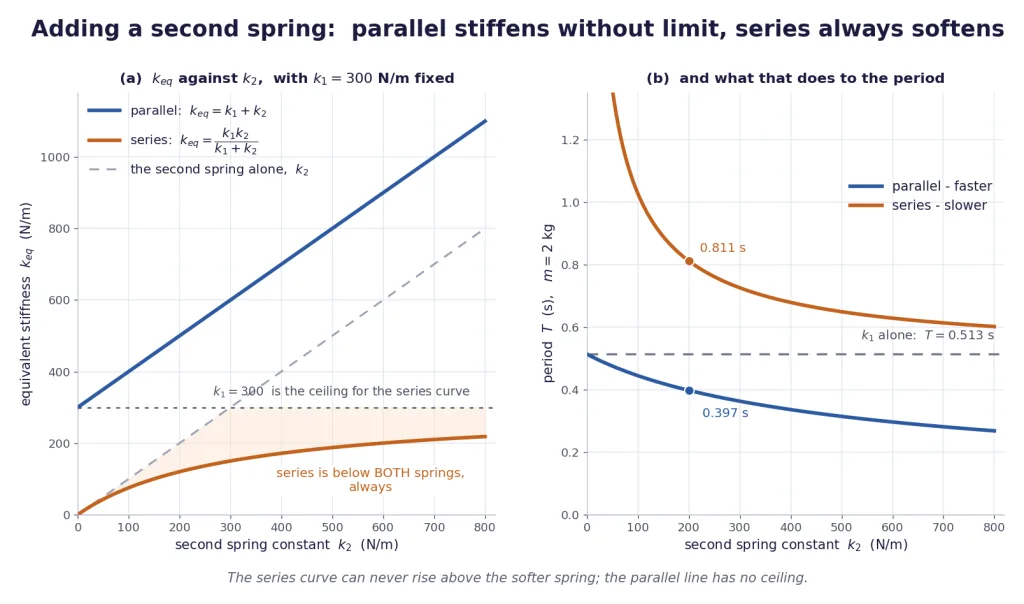
The same 2 kg block and the same two springs, now joined end to end:
| Arrangement | (N/m) | (rad/s) | (s) | (Hz) |
|---|---|---|---|---|
| both in series | 120 | 7.7460 | 0.8112 | 1.2328 |
| the 200 N/m spring alone | 200 | 10.0000 | 0.6283 | 1.5915 |
| the 300 N/m spring alone | 300 | 12.2474 | 0.5130 | 1.9492 |
| both in parallel | 500 | 15.8114 | 0.3974 | 2.5165 |
Read that table downwards and the whole section is in it: series is the floppiest and slowest, parallel is the stiffest and fastest, and the two single springs sit in between. The series period here is times the parallel period, since .
The soft spring wins a series pair
If one spring in a chain is far softer than the other, it decides the answer almost by itself. Put N/m in series with N/m:
barely different from 10 N/m. A stiff spring in series with a soft one is nearly a rigid rod — it hardly stretches, so it hardly contributes to the give. That is why the series curve in the figure flattens off: past a point, making the second spring stiffer changes nothing.
[Board Important] "Derive an expression for the equivalent spring constant of two springs joined in series" is a standard three-marker. The marks are for saying why the tension is the same in both (the junction is massless), then , then the reciprocal result. Skipping the first step loses the reasoning mark even if the answer is right.
Which Is It? — and Why the Rules Look Backwards
You now have both results. The only thing that can go wrong is picking the wrong one, and that happens for two reasons: the picture is misleading, or the rules get muddled with the ones from current electricity.
The resistor trap
Set the rules side by side and the problem is obvious.
| Arrangement | Springs | Resistors | Capacitors |
|---|---|---|---|
| series | |||
| parallel |
Springs are the exact opposite of resistors and the exact same as capacitors. Copy the resistor rule across and every combination question in the chapter comes out inverted.
The reason is not a coincidence. A resistance measures how much an element resists — how much voltage you need per unit of current. A spring constant measures the opposite kind of thing: how much force the spring delivers per unit of stretch. In that sense is like a conductance, not a resistance. The genuine spring analogue of resistance is , the compliance — how much the spring gives per unit of force — and compliances do add in series, just as resistances do.
Key Point — do not memorise, re-derive:
When you are unsure, spend ten seconds on the physics instead of hunting for the formula.
- Both springs change length by the same amount as the block moves? The forces add: .
- The same tension runs through both, and their stretches add up to the block's displacement? The compliances add: .
A ten-second re-derivation beats a half-remembered formula every time.
The case that catches everyone: a spring on each side
A block of mass rests on a frictionless surface between two walls. A spring of constant joins it to the left wall and a spring of constant joins it to the right wall. Both are at their natural length when the block is at rest.
The springs are on opposite sides and clearly not joined end to end, so a great many students call this "series". It is parallel, and here is the argument.
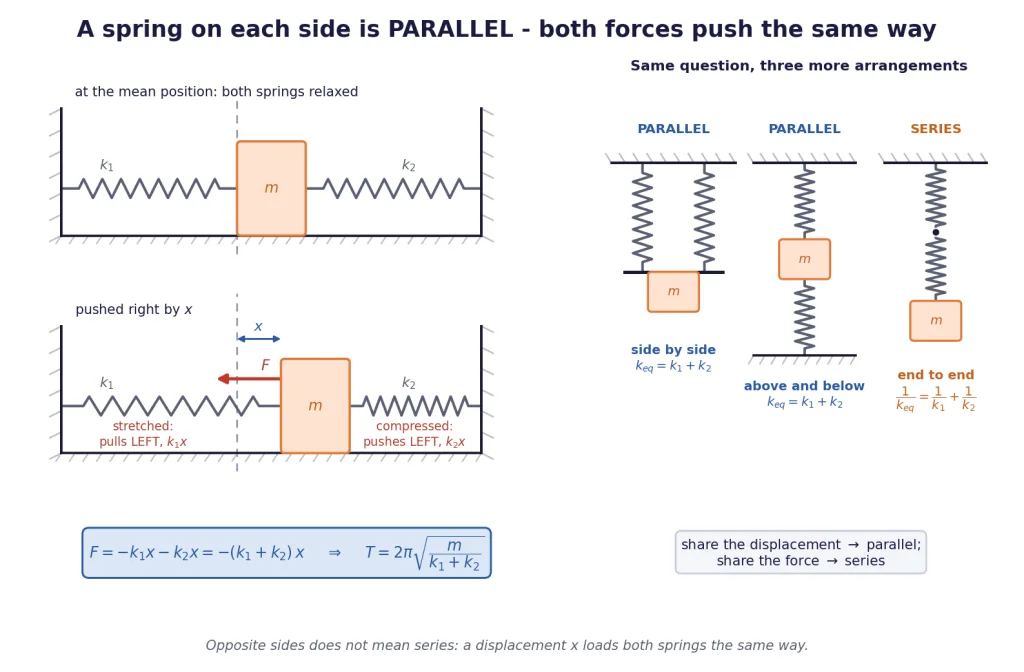
Push the block a distance to the right.
- The left spring is now stretched by . A stretched spring pulls its ends together, so it pulls the block back to the left, with force .
- The right spring is now compressed by . A compressed spring pushes its ends apart, so it pushes the block to the left as well, with force .
Both forces point the same way — back towards the mean position. Taking rightwards as positive,
Key Point: A mass between two walls with a spring on each side is a parallel combination, . Being on opposite sides makes no difference: a single displacement changes both springs' lengths by , and both resulting forces push the block back the same way. With two identical springs of constant , .
And it does not matter whether the springs were slack, relaxed or already squeezed at the start. If both springs were pre-compressed at the equilibrium position, those two pre-load forces were already balancing each other there — that is what made it the equilibrium — so they cancel out of the change in force and only the survives. Find the change in the force, never the total.
The gallery of look-alikes
Run each of these through the one question and the answers come out immediately.
| Arrangement | What is shared? | |
|---|---|---|
| two springs from one wall to the block, side by side | the displacement | |
| two springs from the ceiling to the same hanging block | the displacement | |
| one spring above the block to the ceiling, one below it to the floor | the displacement | |
| block between two walls, one spring each side | the displacement | |
| two springs joined end to end, block on the far end | the force | |
| block hanging from a spring that hangs from another spring | the force |
The third row is worth a moment. Push the block down by : the spring above it stretches by and pulls up with ; the spring below it compresses by and pushes up with . Both push it back up. Same story as the two walls, turned through a right angle.
[NEET Important] "One spring on each side" and "one spring above and one below" are parallel. Only springs strung end to end, so that the whole tension passes through both, are in series. If you can trace a single continuous line of tension running through both springs, it is series; if the springs branch off from the block in different directions, it is parallel.
Cutting a Spring, and a Spring with a Mass at Each End
Cutting a spring makes it stiffer
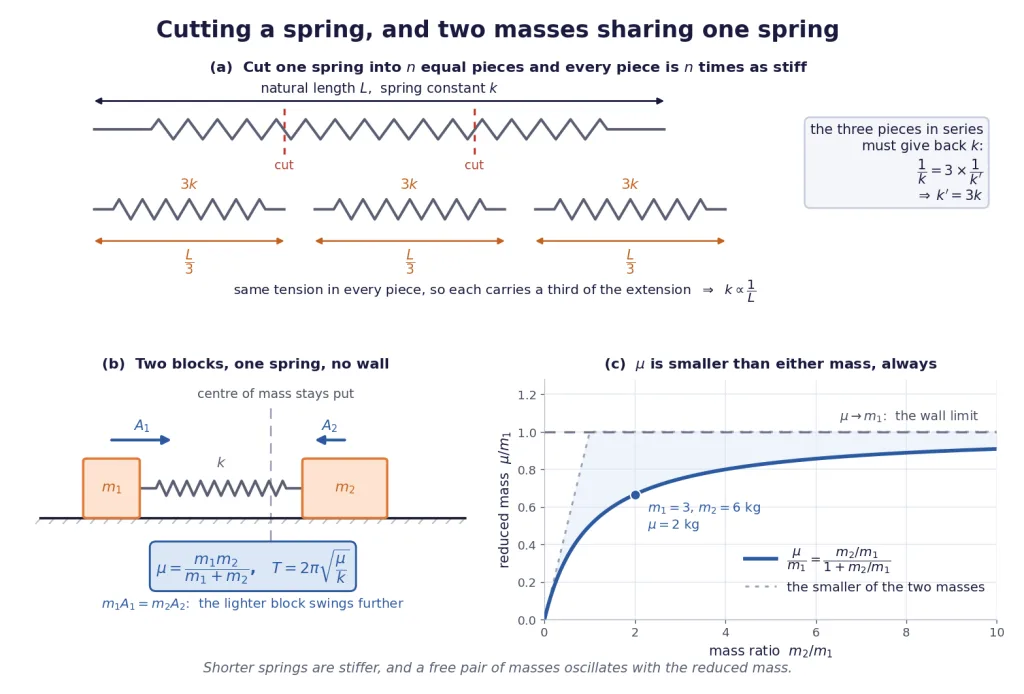
Take a spring of natural length and spring constant , and cut it into equal pieces. What is the spring constant of one piece?
The answer surprises people the first time: each piece is times as stiff, not times as floppy.
The direct argument. Hang a weight on the whole spring and it stretches by . Now look at the spring one piece at a time. Every piece carries the same tension — it is a chain of coils, and the tension is the same all the way along. The pieces are identical, so each contributes an equal share of the stretch, namely . Therefore, for one piece,
The series argument, which is the same thing said faster. The original spring is identical pieces joined end to end — a series chain. So
Key Point — cut springs: Cut a spring of constant into equal pieces and each piece has constant . Cut it into unequal pieces, and a piece of length has constant .
Half a spring is twice as stiff. A third of a spring is three times as stiff.
A worked check on the unequal case. Cut a spring of constant into two pieces whose lengths are in the ratio 1 : 2. The pieces have lengths and , so
Put them back in series and you must recover the original:
Any time you split a spring, do that check — it costs one line and catches a wrong ratio instantly.
| What you do to the spring | New constant | New period, same mass |
|---|---|---|
| cut in half, use one half | ||
| cut in half, use both halves in parallel | ||
| cut into equal pieces, use one | ||
| cut into equal pieces, use all in parallel | ||
| join two identical springs end to end |
[JEE Tip] Halving a spring halves the period? No. It multiplies by 2, and , so the period falls only by , to about 71 per cent. To genuinely halve the period you need four times the stiffness — which is exactly what the second row of that table gives you.
Two blocks, one spring, no wall
Every system so far has had one end of the spring bolted to something immovable. Take that away: two blocks of masses and lie on a frictionless horizontal surface, joined by a single light spring of constant . Pull them apart and let go.
There is no external horizontal force, so the centre of mass stays where it is (or drifts at constant velocity). The blocks must therefore always move in opposite directions, and neither of them is the "fixed end".
Working in the extension
Let the blocks be at positions and , and let the spring's natural length be . The quantity that matters is the extension,
When the spring is stretched by it pulls the blocks towards each other with a force each. Newton's second law for the two blocks:
The acceleration of the extension is :
Define by , and the equation becomes
which is all over again, with standing in for the mass.
Key Point — the reduced mass: Two masses joined by one spring, with nothing fixed, oscillate as though a single body of mass were on a spring with one end held still. Note the shape of the formula: reciprocals add, exactly as they do for springs in series. That is the memory hook.
Three properties worth knowing:
- is smaller than either mass. Since , we get , and likewise . A free pair therefore oscillates faster than the same spring with either block bolted to a wall.
- Equal masses give . Two blocks of 4 kg each on a spring behave like a single 2 kg block.
- A wall is the limit . Then , and the formula collapses back to . A wall is just a partner so heavy it does not budge.
How the two blocks share the amplitude
The centre of mass does not move, so at every instant . Taking the extremes,
The lighter block swings further, in inverse proportion to its mass, and the two amplitudes add up to the amplitude of the extension: .
[JEE Tip] Whenever a spring problem has no wall, no ceiling and no fixed point, reach for . Using instead of is the standard wrong answer, and for it is wrong by a factor of 2 in the mass and in the period.
Inclines, Pulleys, and the Whole Toolkit
Two more arrangements appear constantly, and both are settled by principles you already have.
A spring on a frictionless incline
A block of mass rests on a smooth incline that makes an angle with the horizontal. A spring of constant runs along the incline, its upper end fixed.
The block first slides down until the spring's pull balances the component of gravity along the slope. That gives the equilibrium stretch:
Now displace the block a further distance from that equilibrium and release. Taking down-the-slope as positive, the forces along the incline are down and up:
because exactly. The gravity term has cancelled, the same way it cancelled for the vertical spring, and
with no , no in it.
Key Point: A spring-block system on a smooth incline has the same period as on a horizontal table. The angle only decides where the block sits at rest, not how fast it oscillates. This is the general rule at work: any constant force along the line of motion shifts the mean position and leaves the period alone. If the incline carries a combination of springs, replace by and nothing else changes.
The one thing the angle does change is the sag. On a incline, — exactly half the sag the same spring would show hanging vertically.
Springs through a pulley
The light fixed pulley changes nothing. A block hangs from a light inextensible string that passes over a smooth fixed pulley; the other end of the string is tied to a spring fixed to the ceiling. Move the block down by and the string on the other side must come down by too, so the spring stretches by exactly . The tension in a light string over a smooth pulley is the same throughout, so the force on the block equals the force in the spring. Same displacement, same force: and , unchanged.
A movable pulley does change things — and by a factor of 4. Now hang the block from the axle of a light movable pulley. A string runs over that pulley; one end is tied to the ceiling and the other to a spring of constant , whose upper end is also fixed to the ceiling.
Work through it one step at a time.
- Let the block, and with it the pulley, descend by . Both string segments over the pulley get longer by , so the string needs an extra length .
- The string is inextensible and one end is tied to the ceiling, so that extra length can only come from the spring end: the spring stretches by .
- The tension in the string therefore equals the spring's force, .
- The pulley is held up by two segments of that string, so the upward force on the pulley and block is .
Key Point — the mechanical-advantage rule:
If a mechanism makes the spring stretch times as far as the block moves, then the force fed back to the block is times the spring's tension, so The factor appears twice — once in the stretch and once in the force — which is why it squares. The movable pulley has , giving .
The whole toolkit on one page
| Arrangement | Period | |
|---|---|---|
| single spring, constant | ||
| , in parallel (same displacement) | ||
| , in series (same tension) | ||
| identical springs in parallel | ||
| identical springs in series | ||
| mass between two walls, one spring each side | ||
| one spring above, one below | ||
| one piece of a spring cut into equal parts | ||
| spring on a smooth incline, angle | ||
| spring through a light fixed pulley | ||
| spring through a light movable pulley | ||
| two masses , on one spring | , with for the mass | , |
The five mistakes that cost the marks
- Calling the two-walls arrangement series. It is parallel. One displacement loads both springs.
- Importing the resistor rule. Springs go the other way; they follow the capacitor pattern.
- Using product-over-sum for three springs. With three or more, add the reciprocals.
- Thinking a cut spring gets floppier. Shorter is stiffer: .
- Using for a two-mass oscillator. It is the reduced mass , which is smaller than either.
[Board Important] In any derivation, say which quantity is shared before you write a formula — "both springs undergo the same extension ", or "the same tension acts in both springs". That single sentence is where the reasoning marks live.
Solved Examples
Conventions used throughout: m/s²; every spring is light and obeys Hooke's law; every surface, pulley and string is smooth and light unless stated. is the angular frequency in radians per second and the frequency in hertz — they differ by a factor of and both are quoted with their units. Displacement is always measured from the mean position. .
Example 1: Two springs pulling together
A block of mass 2 kg rests on a frictionless horizontal table. Two light springs, of spring constants 300 N/m and 200 N/m, both run from the same wall to the block, and both are at their natural length when the block is at rest. The block is displaced and released. Find the equivalent spring constant, the angular frequency, the period and the frequency, and compare the period with what the 300 N/m spring alone would give.
Solution:
Identify the arrangement. Both springs are anchored to the wall at one end and to the block at the other, so when the block moves a distance , both change length by . They share the displacement, so they are in parallel.
Add the forces. Displacing the block by , so
Angular frequency.
Period and frequency — keep them apart. Check: rad/s, which is again.
Compare with one spring alone. With only the 300 N/m spring, Adding the second spring made the system stiffer and the oscillation faster, by a factor .
Final Answer: N/m; rad/s, s, Hz. The 300 N/m spring alone would give s.
Takeaway: Parallel springs share the displacement, so their forces add and the stiffnesses add. Adding a spring in parallel always speeds the oscillation up.
Example 2: The same two springs, joined end to end
The same 2 kg block is now attached to the same two springs, but this time the 300 N/m spring runs from the wall to a junction, and the 200 N/m spring runs from that junction to the block. Find , , and , and the ratio of this period to the one in Example 1. Which spring stretches more?
Solution:
Identify the arrangement. The springs are joined end to end at a massless junction, so the same tension runs through both. They share the force: this is a series combination.
Add the compliances. Or by product over sum: N/m. Note that 120 is less than both 200 and 300, as a series pair must be.
Angular frequency, period, frequency.
The ratio of periods. The same two springs, rearranged, change the period by a factor of more than 2.
Which stretches more? Under a common tension , and , so The softer 200 N/m spring stretches 1.5 times as much. In a series chain the soft spring does most of the giving.
Final Answer: N/m; rad/s, s, Hz. The series period is times the parallel one, and the extensions are in the ratio 2 : 3.
Takeaway: Series springs share the tension, so their extensions add and their reciprocals add. The result is always softer, and therefore slower, than either spring alone.
Example 3: A block between two walls
A block of mass 2 kg lies on a frictionless floor between two walls. A spring of constant 300 N/m joins it to the left wall and a spring of constant 500 N/m joins it to the right wall; both are relaxed when the block is at rest. Show that a small displacement produces simple harmonic motion and find and .
Solution:
- Displace and look at each spring separately. Push the block a distance to the right.
- The left spring is stretched by , so it pulls the block left with force .
- The right spring is compressed by , so it pushes the block left with force .
Both forces point the same way. That is the whole point of the problem. Taking rightwards as positive, This is , so the motion is simple harmonic, with The arrangement is parallel, even though the springs sit on opposite sides.
The constants.
What the wrong route would have given. Treating this as series would give N/m and s — more than twice too long.
Final Answer: simple harmonic with N/m; rad/s, s, Hz.
Takeaway: A spring on each side is parallel. One displacement stretches one spring and compresses the other, and both then push the block back the same way, so the two stiffnesses add.
Example 4: Cutting a spring into three
A spring of spring constant 300 N/m is cut into three equal pieces. A 1 kg block is attached to one of the pieces. Find the piece's spring constant and the period of the block's oscillation, and compare with the period on the uncut spring.
Solution:
Find the constant of one piece. The uncut spring is three identical pieces in series, so if each piece has constant , Shorter means stiffer: .
The oscillation on one piece.
The oscillation on the uncut spring.
The ratio. exactly as with tripled demands.
Final Answer: each piece has N/m; s and Hz on one piece, against s on the whole spring — shorter by a factor of .
Takeaway: Cutting a spring into equal pieces makes each piece times as stiff, and the period on one piece times shorter. Never times shorter — the square root is the trap.
Example 5: An unequal cut, then reassembled side by side
A spring of spring constant 400 N/m is cut into two pieces whose lengths are in the ratio 1 : 3. Both pieces are then attached side by side between a wall and a 2 kg block, so that both stretch by the same amount. Find the constants of the two pieces and the period of the resulting oscillation.
Solution:
The two lengths. In the ratio 1 : 3 the pieces are and .
Their constants, from . A piece of length has constant :
Check by putting them back in series. so they do recombine to the original 400 N/m.
Side by side means parallel.
The oscillation.
Final Answer: N/m and N/m; in parallel N/m, giving s and Hz.
Takeaway: A piece of length has constant , and the pieces always recombine to when put back in series. Doing that one-line check before going on is the cheapest insurance in this topic.
Example 6: Three unequal springs in a chain
Three springs of spring constants 110 N/m, 220 N/m and 330 N/m are joined end to end, and a 1.5 kg block hangs from the free end of the chain. Find the equivalent spring constant and the period of small oscillations.
Solution:
Three springs — reciprocals, not product over sum. The chain is a series arrangement, so Take a common denominator of 660: Less than the softest spring in the chain, 110 N/m, as it must be.
The oscillation.
A note on the hanging. The spring is vertical, so the chain sags by m before the oscillation starts. That only moves the mean position — no appears in the period.
Final Answer: N/m; rad/s, s, Hz.
Takeaway: With three or more springs in series, add the reciprocals. Product over sum is a two-spring shortcut only, and applying it to three springs gives nonsense.
Example 7: A hanging chain of two springs
Two light springs, of spring constants 100 N/m and 150 N/m, are joined end to end and hung from the ceiling. A 3 kg block is attached gently to the lower end. Find (a) the extension of each spring at equilibrium and the total sag, and (b) the period and frequency of small vertical oscillations.
Solution:
(a) The tension in a hanging chain is the weight. Each spring carries the whole weight of the block, N. So The softer spring stretches more, as always in a chain.
The equivalent constant, as a cross-check.
(b) The period. Displacement is measured from the hanging equilibrium, and about that point the weight cancels exactly against , leaving :
The same answer from the sag alone. Since ,
Final Answer: extensions of m and m, total sag m; s and Hz.
Takeaway: In a hanging chain every spring carries the full weight, so the extensions divide in the ratio and add to . The period still has no in it; appears only because the sag was measured under gravity.
Example 8: A block on a smooth incline
A block of mass 2 kg is held on a frictionless incline of angle by a spring of constant 200 N/m lying along the incline, its upper end fixed. Find (a) the extension of the spring at equilibrium, and (b) the period of small oscillations along the incline. (c) The single spring is then replaced by two springs of 200 N/m and 300 N/m attached side by side, both along the incline. Find the new extension and period.
Solution:
(a) The equilibrium stretch. Along the incline the spring's pull balances the component of gravity: That is 4.9 cm.
(b) Displace by from that point. The forces along the incline are down the slope and up it, so since the first two terms cancel. There is no and no left: The same block on a horizontal table with the same spring would give exactly this.
(c) Two springs side by side share the displacement, so they are parallel.
Final Answer: (a) m; (b) s, Hz; (c) m, s, Hz.
Takeaway: The incline angle sets the sag and nothing else. Any constant force along the line of motion shifts the mean position and leaves untouched.
Example 9: A spring through a pulley
A 2 kg block is to be hung from a spring of constant 200 N/m in two different ways.
(a) The block hangs from a light string that passes over a smooth fixed pulley; the other end of the string is tied to the spring, whose upper end is fixed to the ceiling.
(b) The block hangs from the axle of a light movable pulley. A light string passes over that pulley; one end is tied to the ceiling and the other to the spring, whose upper end is also fixed to the ceiling.
Find the period in each case.
Solution:
(a) The fixed pulley. Move the block down by . The string is inextensible and the pulley cannot move, so the string on the far side comes down by as well and the spring stretches by exactly . A light string over a smooth pulley has the same tension throughout, so the force on the block equals the spring's force. Same displacement, same force: The pulley has done nothing except change the direction.
(b) The movable pulley — the displacement doubles. Let the block and the pulley descend by . Both string segments over the pulley lengthen by , so the string needs an extra . One end is tied to the ceiling, so all of it must come from the spring:
The force also doubles. The spring's force, and therefore the string's tension, is The pulley hangs from two segments of that string, so the upward force on the block-and-pulley is
Read off . Exactly half the period of case (a), because was multiplied by 4 and .
Final Answer: (a) s; (b) N/m and s, half as long.
Takeaway: A light fixed pulley changes nothing; a movable pulley multiplies by 4. In general, if the spring stretches times as far as the block moves, — the factor enters once through the stretch and once through the force.
Example 10: Two blocks sharing one spring
Two blocks, of masses 3 kg and 6 kg, lie on a frictionless horizontal surface and are joined by a light spring of constant 200 N/m. The spring is stretched by 9 cm and both blocks are released from rest. Find (a) the period and frequency of the oscillation, (b) the amplitude of each block, and (c) how the period would differ if the 6 kg block were bolted to a wall instead.
Solution:
(a) Nothing is fixed, so use the reduced mass. Note that is smaller than both masses, as it must be.
The oscillation of the extension.
(b) Split the amplitude. There is no external horizontal force, so the centre of mass stays put and From the first, , so . Substituting into the second, : The lighter block swings twice as far.
(c) If the 6 kg block were a wall. Then only the 3 kg block would move, and which is longer than s. A free partner lets the system oscillate faster, because kg is less than 3 kg. As the partner is made heavier and heavier, kg and the two answers converge.
Final Answer: kg; s and Hz; amplitudes cm and cm; with the 6 kg block fixed the period would be s.
Takeaway: No wall means reduced mass: with , and the blocks split the amplitude in inverse proportion to their masses. Using is the standard wrong answer.
Example 11: Working backwards from two periods
A block oscillating on a light spring has a period of 0.6 second. A second spring is then attached alongside the first, so that both stretch by the same amount as the block moves, and the period falls to 0.4 second. Find (a) the ratio , and (b) the period that the same block would have if the two springs were instead joined end to end.
Solution:
(a) Use the proportionality, not the numbers. At fixed mass, , so . The second arrangement is parallel, with : The second spring is 1.25 times as stiff as the first.
(b) Now put them in series. Writing ,
Convert the stiffness ratio into a period ratio.
Sanity check on the ordering. s in parallel, s on the first spring alone, s in series — series slowest, parallel fastest, single spring in between. Exactly the expected order.
Final Answer: ; in series the period would be s.
Takeaway: Ratio problems never need the actual values of and . Use , form the ratio, and the unknowns cancel.
Example 12: A mixed network
Three identical springs, each of constant 200 N/m, are arranged like this: two of them are attached side by side between a wall and a junction, so that both stretch by the same amount; the third runs from that junction to a 1.2 kg block. Find the equivalent spring constant and the period.
Solution:
Work from the inside out. The two springs between the wall and the junction share the same displacement of the junction, so they are in parallel:
Now combine with the third. That 400 N/m combination and the third spring are joined end to end at the junction, so the same tension runs through both: they are in series. Softer than either the pair (400) or the single spring (200), as any series result must be.
The oscillation.
Final Answer: N/m; rad/s, s, Hz.
Takeaway: Reduce a network one junction at a time, innermost first, asking the same question at each step — do these springs share the displacement, or share the force? Never try to see the whole network at once.