
Free Oscillations, and What Happens When Something Keeps Pushing
Pull a block on a spring aside and release it. Nobody touches it again. It goes back and forth at one particular rate, and that rate is not up for negotiation — it is fixed by the spring and the mass and nothing else:
That is a free oscillation, and is the natural angular frequency of the system. Give the block a bigger pull and the amplitude changes, but does not. Every oscillator has one: a pendulum's is , a floating block's is , and a bridge, a wine glass and a building each have theirs.
Key Point — free oscillation:
A system displaced and then left alone oscillates at its own natural angular frequency , in rad/s. The corresponding natural frequency in hertz is and the natural period is . The amplitude is set by how hard you started it; the frequency is not.
Forced oscillations and resonance sit outside the rationalised syllabus body text, and the topic is asked every year in all three examinations, so it is developed here from first principles.
Left alone, it dies
Damping takes care of the rest. A real free oscillation decays inside the envelope and is gone after a few times . So if you want an oscillation that keeps going at a useful size, you have to keep feeding energy in — and the way to do that is to push it periodically.
The driving force
Apply an external periodic force
where is the amplitude of the driving force, in newtons, and is the driving angular frequency, in rad/s. This is now a forced or driven oscillation. Someone is choosing — the motor's speed, the marcher's step, the singer's note — and it has nothing whatever to do with .
Newton's second law now carries three forces on the right: the spring's , the damping , and the driver:
Key Point — the equation of a driven oscillator: Everything on the left belongs to the oscillator; everything on the right is being done to it from outside. Setting gives back the damped oscillator, and setting as well gives back plain simple harmonic motion.
Three angular frequencies, and they are all different
| Symbol | Name | Value | Fixed by |
|---|---|---|---|
| natural | the oscillator | ||
| damped free | the oscillator | ||
| driving | whatever the driver is doing | the outside world |
All three are angular frequencies in rad/s; divide any of them by to get a frequency in hertz. Mixing them up is the whole difficulty of this topic and most of its wrong answers.
What the motion actually looks like: two pieces
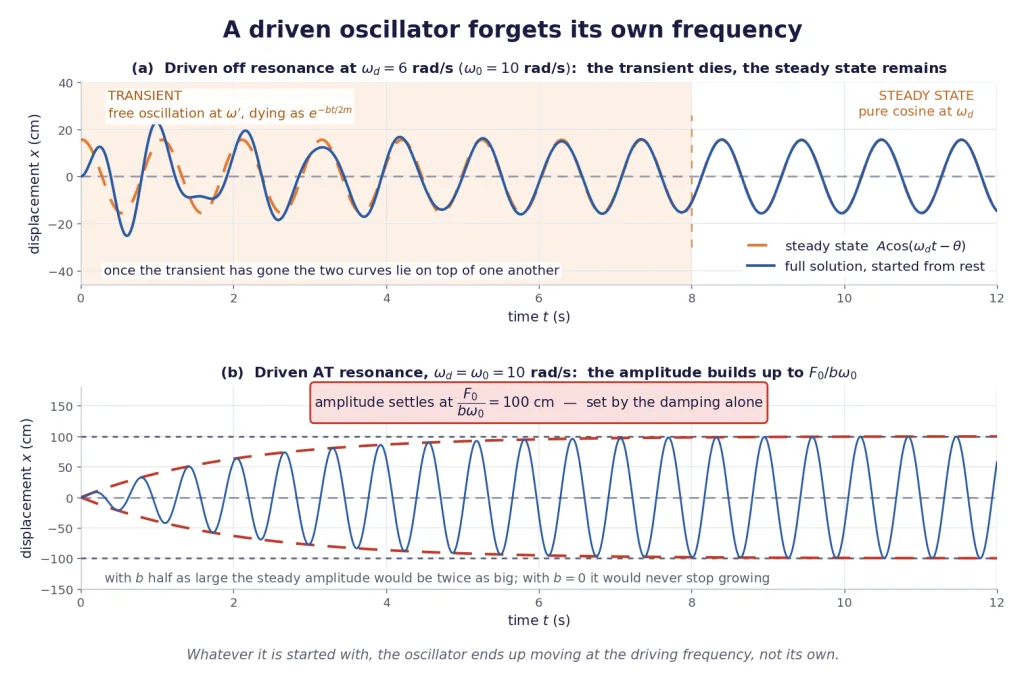
Start the driven oscillator from rest and watch it. For a while the motion looks messy — two rhythms fighting each other. Then it cleans itself up into a perfect cosine. That is because the full solution is a sum of two parts:
The transient is just the free damped oscillation from the last section, at the system's own . It carries the memory of how the motion was started, and it dies exponentially — after four or five times there is nothing left of it.
The steady state does not decay. It has no exponential in front, it goes on for as long as the driver runs, and it oscillates at .
Key Point — the result that surprises everybody:
Once the transient has died, a driven oscillator oscillates at the driving frequency , not at its own and not at . The driver dictates the rhythm; the oscillator only gets to decide how big the response is.
That is worth pausing on, because the instinct is the opposite. Drive a block whose natural frequency is 3.18 Hz at 5 Hz, and after a second or two it is moving at exactly 5 Hz — never 3.18, never anything in between. The oscillator's own frequency has not disappeared; it has moved into deciding the amplitude, which is the subject of the next block.
[Board Important] "What is the frequency of a forced oscillation in the steady state?" — the driving frequency. One line, one mark, and a very common slip.
[JEE Tip] "After a long time", "in the steady state" and "once transients have died" all mean the same thing: throw the exponential term away and use only .
The Steady-State Amplitude
Substituting into the driven equation and matching the cosine and sine parts fixes both unknowns. The amplitude is the one that matters:
Key Point — the steady-state amplitude: with . Every symbol in it is something you already know: and come from the driver, , and from the oscillator.
An equivalent form, got by multiplying top and bottom by , is sometimes quicker to substitute into:
The body also lags behind the force by a phase lag , given by , with taken between and — so a negative tangent, which happens whenever , means a lag past . The push and the response are not in step, and how far out of step they are turns out to be the cleanest signature of resonance.
Read the formula before you use it
Look only at the denominator. sits on top, so doubling the force doubles the amplitude and nothing else changes — the response is proportional to the push. Everything interesting is underneath, in a sum of two squares:
- — the detuning term. It measures how far the driver is from the oscillator's own frequency, and it vanishes when .
- — the damping term. It is never zero while there is any damping at all.
A small denominator means a big amplitude. So the amplitude is large when the driver is tuned close to and the damping is weak, and small otherwise. That single sentence is the whole of the next two blocks.
Three zones
Push the driving frequency to each extreme and the formula collapses into something recognisable.
1. Very slow driving, . Then is negligible beside and the damping term is tiny too, so
which is exactly the static stretch the force would produce if you simply held it there. The body follows the driver lazily, in step with it, and the spring constant decides the amplitude.
2. Very fast driving, . Now swamps everything:
which falls away to nothing as grows. The force reverses before the body has time to get moving, so the mass decides the amplitude. This is why a heavy machine on soft mounts barely shakes its floor.
3. Driving at the natural frequency, . The detuning term is exactly zero and only the damping is left:
Nothing but the damping is holding the amplitude down. That is resonance, and it gets the next block to itself.
| Zone | Condition | Amplitude | Decided by | Phase lag |
|---|---|---|---|---|
| slow | spring constant | near | ||
| resonant | damping constant | |||
| fast | mass | near |
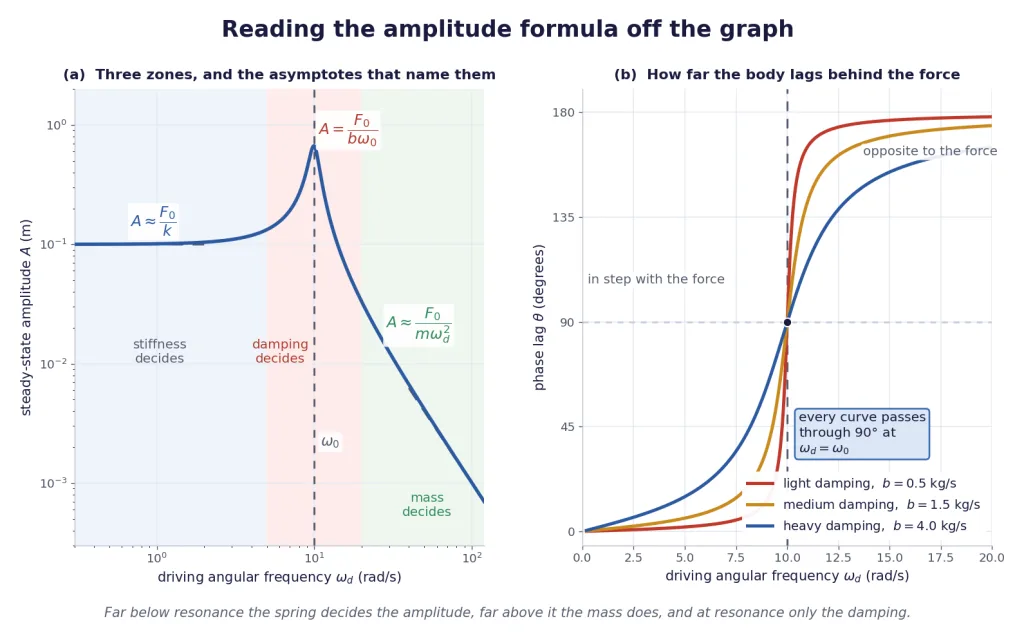
The phase column is worth memorising on its own. Far below resonance the body moves with the force; far above it moves against the force; and exactly at it lags by a quarter of a cycle, whatever the damping is. Every curve in the phase graph passes through that same point, which makes the sharpest experimental test of resonance there is.
[NEET Important] At very low driving frequency the amplitude is — no , no , no . At very high driving frequency it is — no and no . Recognising which limit a question is in usually removes the need to touch the full formula.
Resonance
Key Point — resonance:
Resonance is the condition — the driving frequency matched to the system's own natural frequency. There the amplitude of the forced oscillation is a maximum, and it is limited only by the damping:
Read that boxed result carefully, because it says something quite unusual. The spring constant has gone. The mass has gone. A quantity that started out looking like a minor correction — the damping constant , which for most of the previous section only nibbled slowly at an amplitude — has become the single thing standing between a modest push and an enormous motion.
The divergence, and what it is telling you
Put into the amplitude formula and drive at :
The expression blows up. Now, no real amplitude is infinite, so this is not a prediction — it is a warning. What the mathematics is saying is that an undamped oscillator driven exactly at its natural frequency takes in energy on every single cycle and has no way of getting rid of any of it, so the amplitude grows without limit. In practice the growth stops for one of two reasons: either the damping catches up, or the system breaks. A real undamped system would tear itself apart, and the infinity in the formula is the algebra saying exactly that.
You can see the same thing in the time domain. Drive a lightly damped oscillator at resonance from rest, and the amplitude climbs steadily and then flattens off at ; the flattening is entirely the damping's doing. Halve and the final amplitude doubles and takes twice as long to get there. Let go to zero and the climb never stops.
Why the energy argument is the real explanation
At resonance, the phase lag is , which means the velocity is exactly in step with the driving force. The power delivered is , and if and have the same sign at every instant, the driver does positive work throughout the whole cycle — it never once has to fight the motion.
Away from resonance the force and the velocity fall out of step, so during part of each cycle the driver is pushing against a body that is already moving the other way, and it takes energy back out. Resonance is simply the condition under which the pushing is perfectly timed.
That is exactly what a child on a swing is doing. The pushes are small; what makes them work is that every one of them arrives when the swing is already moving away.
How big is "big"?
Compare the resonant amplitude with the static one, , that the same force would produce if it just leaned on the body:
Key Point — the amplification at resonance: This dimensionless number is the quality factor of the oscillator. A lightly damped system has a large and turns a small periodic force into a very large motion; a heavily damped one has of order 1 and barely amplifies anything.
A tuning fork has in the thousands. A wine glass, several hundred to a thousand. A car body on its shock absorbers, only about 2 — which is exactly the point of shock absorbers.
[JEE Tip] The three resonance results are worth carrying together: the amplitude at resonance is , the amplification over static is , and the phase lag is . Most resonance numericals are one of these three in disguise.
[NEET Important] "At resonance the amplitude of a forced oscillation is limited by" — the answer is the damping, every time. Not the mass, not the spring constant, not the driving frequency.
The Shape of the Resonance Curve
Plot the steady-state amplitude against the driving frequency, holding , , and fixed, and you get a resonance curve: flat and low at small , rising to a peak near , falling away to nothing at large . Then draw the same curve again for a smaller , and again for a smaller one still.
Key Point — what damping does to the curve:
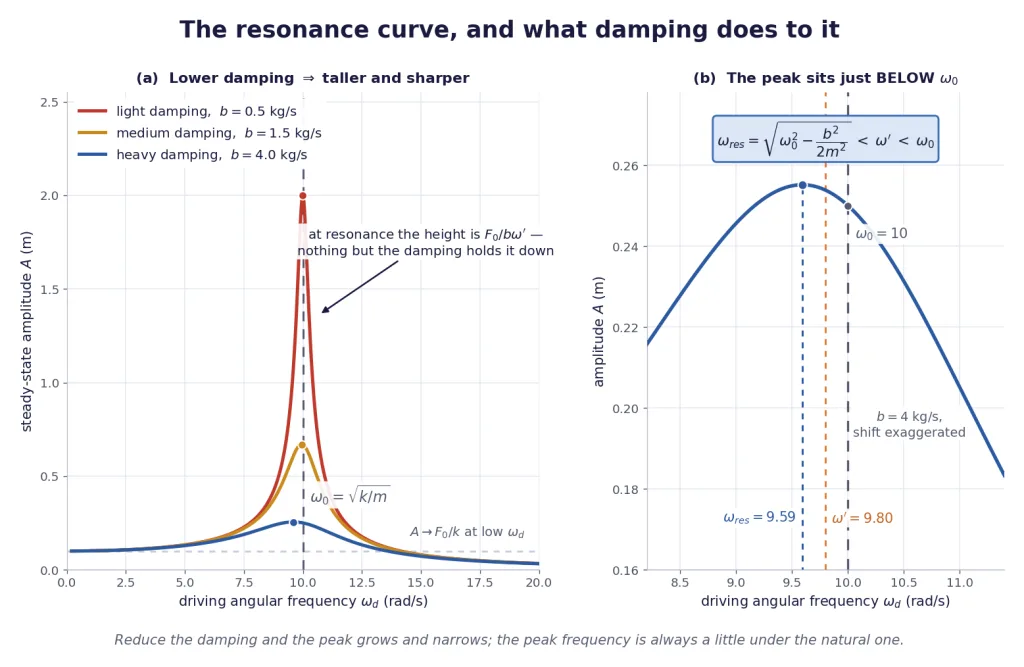
Less damping makes the peak taller and narrower. More damping makes it shorter and broader. The height at the peak goes as , so halving the damping doubles the peak.
Both halves of that statement matter, and they matter in different places.
- A tall, narrow peak means a system that responds enormously — but only to a driving frequency within a whisker of . That is what you want in a tuner: it must pick out one station and ignore the others.
- A short, broad peak means a system that never responds very much to anything. That is what you want in a bridge, a building or a car: no driving frequency should be able to do very much to it.
The peak is not quite at
Here is the detail that separates a careful answer from a rough one. The amplitude formula does not peak exactly at . Its denominator is smallest when
is smallest, and differentiating that with respect to and setting the result to zero gives
Key Point — the true peak of the resonance curve: and therefore The resonance peak sits below the damped free frequency, which itself sits below the natural frequency. Damping lowers all three, and it lowers the resonance peak the most, because is twice the that appears in .
The maximum amplitude, worked out at that frequency, is neat:
which is a shade larger than the you get by driving at itself, since .
How much does the shift matter? For light damping, almost nothing. With kg, N/m and kg/s the peak sits at 19.9875 rad/s against a natural 20 rad/s, and driving at instead of at the exact peak costs you of the amplitude. For heavy damping it is visible: with kg, N/m and kg/s the peak is at 9.06 rad/s, well below the natural 10 rad/s.
| peak height static | |||
|---|---|---|---|
| — no peak at all |
Here is the critical damping constant and the damping ratio. Past the quantity under the root in goes negative: the curve has no hump left at all, and the amplitude just falls steadily from as the driving frequency is raised. A system that heavily damped cannot be made to resonate.
The same formula, in ratios
Dividing the numerator and denominator of the amplitude formula by , and writing for the frequency ratio and for the damping ratio, gives a form that carries no units at all:
The fraction in front is the static amplitude, and everything after it is the amplification factor — how many times bigger the real motion is than a static push would give. At it is , which is the of the previous block. This is the form engineers actually use, because "how far off resonance am I, and how well damped am I" is the only thing that matters and both are pure numbers.
[JEE Tip] If a problem gives you a damping ratio or a rather than a in kg/s, switch to the ratio form immediately: and are all you need, and scales the answer at the end.
Resonance in the World
Resonance is not a laboratory curiosity. It is the reason some things work and the reason others fall down.
Where it is wanted
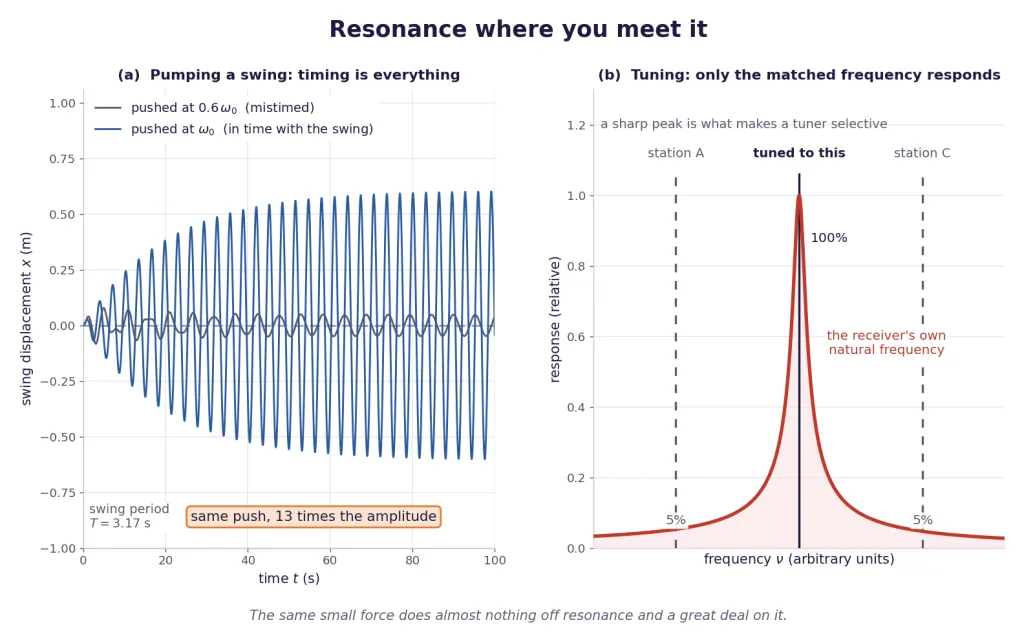
A child pumping a swing. A swing is a pendulum with a period of about 3 seconds. The child leans back and forward once per swing — driving at — and each small effort arrives exactly when it helps. A few dozen tiny pushes produce a very large amplitude. Get the timing wrong, even a little, and nothing happens at all; anybody who has tried to push a swing out of time knows this by feel long before they meet the formula.
Tuning a radio. The circuit inside a receiver has its own natural frequency, and the tuning knob changes it. When it is made equal to the frequency of one station's carrier wave, that station drives the circuit at resonance and produces a large current, while every other station in the air drives it far off resonance and produces almost nothing. Tuning is nothing but matching a natural frequency to a driving one. The peak has to be narrow, too, or you would hear two stations at once — which is exactly the "tall and narrow means selective" point of the previous block.
Musical instruments. The body of a sitar or a guitar is built so that its natural frequencies lie in the range the strings produce. The string alone moves very little air; driven at resonance the body moves a great deal, and that is what you hear. An air column in a flute is the same idea.
Magnetic resonance imaging. The nuclei of hydrogen atoms in the body precess at a natural frequency set by the magnetic field, and a radio wave tuned to it drives them resonantly. Nothing else in the body responds, which is what makes the picture.
Where it is a nuisance, or worse
A wine glass shattered by a voice. A wine glass rings at a definite frequency — tap one and listen. A singer holding exactly that note drives the rim at resonance, and because the glass is only lightly damped, its runs into the hundreds. The rim's vibration builds up until the glass cannot take the strain, and it breaks. Two things are essential: the note must be exact, since the peak is very narrow, and it must be held, because the amplitude needs time to build.
Soldiers breaking step on a bridge. Marching feet are a periodic force, typically about 2 pushes per second. If that happens to match a natural frequency of the bridge, the deck is being driven at resonance, and a force that would do nothing at all in one step accumulates over hundreds. Soldiers are ordered to break step for exactly this reason: an irregular crowd of footfalls has no single dominant frequency, so nothing gets driven resonantly.
The Tacoma Narrows bridge. In 1940 a suspension bridge in Washington State twisted itself apart in a moderate wind. The wind was not gusting at any particular rate; the airflow past the deck shed vortices, and the deck's own twisting motion fed the process, so that energy went in at a frequency matched to a natural torsional mode of the structure. The amplitude built up over hours until the deck failed. Every bridge design since has had to answer for its natural frequencies.
Earthquakes and buildings. The ground in an earthquake shakes with a characteristic frequency, typically a few hertz. A building is an oscillator with natural frequencies of its own, and a rough rule is that an -storey building has a natural period of about seconds — so a ten-storey block sits near 1 second, or 1 Hz, uncomfortably close to the ground's. If the two match, the building is driven at resonance and the swaying is amplified many times over.
Key Point — designing against resonance:
Structures in earthquake zones are designed so that their natural frequencies avoid the frequencies the ground is likely to shake at. There are only three things you can do to an oscillator, and all three are used: change (stiffen or soften the structure), change , or increase (add dampers that turn the motion into heat). Getting away from resonance is always cheaper than surviving it.
Why a singer can break a glass but not a wall
Two reasons, and they are the two features of the resonance curve.
- Matching. The glass has a clean natural frequency in the range a human voice can produce. A wall's natural frequencies are nothing like a singable note, so nothing is ever driven at resonance.
- Damping. The glass is lightly damped: its is in the hundreds, so a small force produces a motion hundreds of times bigger than it deserves. A brick wall is enormously damped — its is of order 1 — so even a perfectly matched force would produce nothing more than the static deflection, which for a wall is nothing at all.
Resonance needs both. Match the frequency to something with almost no damping and a whisper can wreck it; miss the frequency, or aim it at something well damped, and you can shout all day.
[Board Important] "Give two examples of resonance and explain one" is standard. Take the swing or the radio for the useful side and the marching soldiers or the wine glass for the destructive side, and in the explanation say the two things that earn the marks: the driving frequency equals the natural frequency, and the amplitude then becomes large because only the damping limits it.
Solved Examples
Conventions used throughout: displacement is measured from the mean position; is the natural angular frequency, the damped one and the driving one, all in rad/s, while is a frequency in hertz — angular frequencies and frequencies differ by a factor of . is in kg/s and in newtons. Steady state means the transient has been dropped. m/s², , .
Example 1: Which frequency does it end up at?
A block of mass 0.5 kg on a spring of spring constant 200 N/m is damped with kg/s. An external force newtons drives it at a frequency of 5 Hz. Find (a) the natural angular frequency, natural frequency and natural period, (b) the driving angular frequency, (c) the frequency of the steady-state motion, and (d) the steady-state amplitude.
Solution:
(a) The oscillator's own numbers.
(b) The driver's number. The driving frequency is given in hertz, so multiply by :
(c) The steady-state frequency. This is the whole point of the section: it is the driving frequency, 5 Hz, not the natural 3.1831 Hz. The transient at rad/s dies away with time constant s, and after about 8 seconds nothing of it is left.
(d) The amplitude. Put the numbers into the formula, keeping the two frequencies straight: about 0.68 cm — small, because at 5 Hz the driver is well above resonance.
Final Answer: rad/s, Hz, s; rad/s; the steady state is at 5 Hz; the amplitude is 0.68 cm.
Takeaway: The driver sets the frequency, the oscillator sets the size. And read the question's units: "5 Hz" is a and must be multiplied by before it goes anywhere near the amplitude formula.
Example 2: The same oscillator at three very different driving frequencies
For the block of Example 1 ( kg, N/m, kg/s, N), find the steady-state amplitude when is (a) 2 rad/s, (b) 20 rad/s, (c) 200 rad/s, and compare each with the appropriate limiting formula.
Solution:
(a) Slow driving, rad/s. Here is a tenth of : The low-frequency limit predicts m, that is 1.00 cm. Agreement to .
(b) At resonance, rad/s. The detuning term vanishes:
(c) Fast driving, rad/s. The high-frequency limit predicts m. Again within .
Put the three side by side. The same force, on the same oscillator, gives 1.01 cm, 20 cm and 0.0101 cm. The resonant response is about 20 times the static one and about 2000 times the high-frequency one. That factor of 20 is no accident:
Final Answer: 1.01 cm, 20 cm and 0.0101 cm respectively; the limiting formulas give 1.00 cm and 0.0100 cm for the two extremes, and the amplification at resonance is 20.
Takeaway: One oscillator, one force, three completely different answers — the driving frequency is doing all the work. Check which zone you are in before reaching for the full formula; two of the three cases need only one term.
Example 3: Only the damping is holding it down
For the same block ( kg, N/m, N) driven exactly at , find the amplitude when (a) kg/s, (b) kg/s, (c) kg/s, and (d) say what happens as . (e) Also find the true maximum of the resonance curve for kg/s.
Solution:
(a), (b), (c). At the amplitude is , and rad/s throughout: Each halving of doubles the amplitude, because .
(d) As . The amplitude grows without limit. There is no other term in the denominator to stop it: with no damping the driver does positive work on every cycle and nothing removes any of it. A real system reaches its breaking strain first — which is what "resonance can destroy a structure" means, stated as algebra.
(e) The true peak, for kg/s. The maximum is not quite at : So driving at rather than at the exact peak costs of the amplitude. At this damping the distinction is academic.
Final Answer: 0.20 m, 0.40 m and 0.80 m; as the amplitude diverges; the true peak is at 19.9875 rad/s with m.
Takeaway: At resonance — halve the damping and you double the motion. And the ordering always holds, even when, as here, all three agree to three figures.
Example 4: A heavily damped oscillator, where the shift is visible
A 1.0 kg mass on a spring of spring constant 100 N/m has kg/s and is driven by a force of amplitude 10 N. Find (a) , and , (b) the amplitude at , (c) the true maximum amplitude, and (d) the static amplitude, and comment on the amplification.
Solution:
(a) The three frequencies. First check the regime: kg/s, so and the free motion is under-damped. The ordering is the general result, made visible by the heavy damping.
(b) At .
(c) The true maximum. which is larger. With this much damping the difference is real, and a question asking for "the maximum amplitude" wants this one.
(d) The static amplitude and the amplification. The resonance is barely a resonance: the peak is only about times the static value, and the curve is a gentle hump rather than a spike.
Final Answer: rad/s, rad/s, rad/s; m; m; m, an amplification of only 1.67.
Takeaway: Heavy damping does three things at once — it lowers the peak, broadens it, and drags it further below . All three come from the same , and all three are visible in this one oscillator.
Example 5: How long before the transient is gone?
A 1.0 kg mass on a spring of spring constant 100 N/m with kg/s is driven from rest by newtons. Find (a) the three angular frequencies in play, (b) the steady-state amplitude and phase lag, (c) the time for the transient to fall to of its initial size, and (d) the period of the motion long after the start.
Solution:
(a) The three frequencies.
(b) Amplitude and phase lag. The lag is small because the driver is well below resonance — the block is very nearly moving in step with the force.
(c) When is the transient gone? It decays as , with s. For it to fall to : about four time constants, which is the usual rule of thumb.
(d) The long-time period. The transient's period would be s, but the transient is gone. What survives has period Note that this is not the natural period s either. The motion has settled into the driver's rhythm completely.
Final Answer: rad/s, rad/s, rad/s; cm with a lag of ; the transient is of its start after 7.82 s; the long-time period is 1.0472 s.
Takeaway: Write all three angular frequencies down before you calculate anything. The transient carries , the steady state carries , and appears only inside the amplitude formula.
Example 6: Pumping a swing
A child sits on a swing whose ropes are 2.5 m long. (a) Find its natural period and natural frequency. (b) How often should the child be pushed for the largest swing? (c) If instead the pushes come every 2.0 seconds, by what factor is the amplitude reduced? Take the swing and child as kg with kg/s and a push of amplitude 3.0 N.
Solution:
(a) The swing's own numbers. A swing is a pendulum:
(b) The best pushing rate. Resonance means , so the pushes must come once every 3.17 seconds — that is, once per swing, about 19 pushes a minute. This is exactly what a child does instinctively by leaning back at the same point in every cycle.
(c) Pushing every 2.0 seconds instead. Now rad/s, and with N/m: Whereas at resonance,
The comparison. . Mistiming the pushes by about a second in three has cut the swing by a factor of 30, using exactly the same effort.
Final Answer: s and Hz; push once every 3.17 s; pushing every 2.0 s instead reduces the amplitude from 60.6 cm to 2.01 cm, a factor of about 30.
Takeaway: Resonance is about timing, not strength. The same 3 N push produces either 60 cm or 2 cm depending entirely on when it arrives.
Example 7: A row of pendulums on one support
Four pendulums of lengths 0.25 m, 0.64 m, 1.00 m and 1.44 m hang from the same flexible horizontal string. A fifth pendulum, of length 1.00 m, is set swinging. Find each pendulum's natural frequency and say which of the four responds most strongly, and which responds next.
Solution:
The driver. The swinging pendulum shakes the string, so it drives all four at its own frequency:
The four natural frequencies. Each obeys :
| (m) | (rad/s) | (Hz) | (s) | |
|---|---|---|---|---|
Which responds? The amplitude goes as , so the smaller the detuning , the larger the response. The 1.00 m pendulum has zero detuning: it is at resonance and swings strongly, building up over many cycles. Next comes the 1.44 m one, whose detuning of 2.99 is the smallest of the rest. The 0.25 m pendulum, detuned by 29.4, barely moves at all.
A point worth noticing. The 1.44 m pendulum beats the 0.64 m one even though 0.64 is "closer to 1.00" in length. Length is not what matters — is, and changes much faster for short pendulums than for long ones.
Final Answer: the natural frequencies are 0.9965, 0.6228, 0.4982 and 0.4152 Hz; the 1.00 m pendulum resonates and swings most, followed by the 1.44 m one, then the 0.64 m one, and the 0.25 m one least.
Takeaway: Compare with , not lengths with lengths. Detuning is measured in the square of the angular frequency, which is what the amplitude formula actually contains.
Example 8: Mounting a motor so it does not shake the floor
A 20 kg motor runs at 1500 rpm. Its rotor is slightly unbalanced and produces a periodic force of amplitude 50 N. It is bolted to mounts of total stiffness N/m with kg/s. Find (a) the driving frequency, (b) the stiffness that would put the mounting exactly at resonance, (c) the natural frequency of the mounting as built, (d) the running amplitude, and (e) the amplitude if the mounting had been built to resonate.
Solution:
(a) The driving frequency. Convert the rotation rate:
(b) The stiffness to avoid. Resonance would need , i.e. Any mounting near half a meganewton per metre is exactly the wrong choice.
(c) What was actually built. The motor runs at 25 Hz, well above the mounting's 10.07 Hz, so it sits in the mass-controlled zone — which is where you want it.
(d) The running amplitude.
(e) If it had resonated. which is 33 times larger. One warning, though: as the motor speeds up from rest it must pass through 10.07 Hz on the way to 25 Hz, and for those few seconds it is at resonance. Machines are run up quickly through such a speed for exactly that reason.
Final Answer: Hz and rad/s; resonance would need N/m; as built Hz; the running amplitude is 0.12 mm against 3.95 mm at resonance, a factor of 33.
Takeaway: Mount a machine so that its running speed is far ABOVE the mounting's natural frequency. Soft mounts, not stiff ones — the amplitude then falls as and the floor stays quiet.
Example 9: Designing a building away from the ground's frequency
A building has a natural period of 0.50 s and a damping ratio of . The ground in an earthquake shakes it at 2.0 Hz. (a) Show that this is resonance and find the amplification. (b) The building is stiffened until its natural frequency is 5.0 Hz. Find the new amplification and the factor gained.
Solution:
(a) The original building. which is exactly the shaking frequency, so and the building is being driven at resonance. Using the ratio form of the amplitude, The building sways ten times as far as the same push would move it if applied steadily.
(b) After stiffening. Now Hz while the ground still shakes at 2.0 Hz, so
The factor gained. . Moving the natural frequency away from the ground's has cut the sway by a factor of more than eight — and it did not require making the building eight times stronger, only stiff enough to move well clear.
Which knob was turned? , so raising from 2.0 Hz to 5.0 Hz at fixed mass needs . The alternative — leaving alone and raising with dampers — would also work: at the amplification is , so would bring it down to 1.25.
Final Answer: the original building is at resonance with an amplification of 10; stiffened to 5.0 Hz the amplification is 1.19, a gain of a factor 8.4.
Takeaway: Get off resonance first, add damping second. Detuning by a factor of two and a half did more here than an eightfold increase in damping would have.
Example 10: Finding the damping from a measured resonance
An oscillator of mass 0.20 kg has a natural angular frequency of 50 rad/s. Driven by a force of amplitude 0.50 N it is found to have an amplitude of 2.5 cm at resonance. Find (a) the spring constant, (b) the damping constant, (c) the quality factor and the damping ratio, and (d) the amplitude when the same force drives it at 25 rad/s.
Solution:
(a) The spring constant.
(b) The damping constant. At resonance , so rearranging,
(c) Quality factor and damping ratio. Check the pair against each other: . And the static amplitude is m cm, so cm, which is the measurement we started from.
(d) At half the natural frequency. With rad/s, Nineteen times smaller than at resonance, for a driver only a factor of two away in frequency.
Final Answer: N/m; kg/s; and ; at 25 rad/s the amplitude is 0.133 cm.
Takeaway: A measured resonance peak is the easiest way to get . One reading of the amplitude at gives , and everything else about the oscillator follows.
Example 11: Why the singer has to hit the note exactly
A wine glass rings at 660 Hz with a quality factor of 1000. A singer holds a steady note. Find (a) the amplification when the note is exactly 660 Hz, (b) the amplification when the note is 700 Hz instead, and (c) the ratio between them. (d) Say why the same voice does nothing to a brick wall.
Solution:
The glass's own numbers.
(a) On the note. At , The rim moves a thousand times further than the sound pressure could push it steadily. That is how a voice breaks glass.
(b) Forty hertz sharp.
(c) The ratio. . A mistuning of has cut the response by a factor of 125. This is the "tall and narrow" peak in action: the higher the , the more violently the response falls away on either side of .
(d) The wall. Two reasons, and both are needed. Its natural frequencies are nowhere near any note a voice can produce, so is never close to 1; and it is enormously damped, with of order 1, so even a matched note would give an amplification of about 1 — that is, the static deflection, which for a brick wall is immeasurably small.
Final Answer: the amplification is 1000 on the note and 8.0 at 700 Hz, a ratio of 125; a wall is neither tuned to the voice nor lightly damped, so nothing is amplified.
Takeaway: A high is a double-edged thing: enormous response exactly on resonance, almost none a few per cent away. Sharpness and height always come together, because both are .
Example 12: Soldiers on a footbridge
A footbridge has a natural frequency of 2.0 Hz and a quality factor of 20. A column of soldiers marches across at 120 steps per minute. (a) Show that this is resonance and find the amplification. (b) They break step, and the dominant footfall rate drops to about 1.5 Hz. Find the new amplification and the improvement.
Solution:
(a) In step. The marching rate is which equals the bridge's natural frequency, so and the deck is driven at resonance. With , the damping ratio is , and The deflection is twenty times what the soldiers' weight would produce if they simply stood still.
(b) Out of step. Now :
The improvement. , so the sway is cut by nearly a factor of nine.
What really happens when they break step. In practice it is better than this calculation suggests, because breaking step does not simply move the driving frequency — it destroys the idea of a single driving frequency altogether. Hundreds of uncorrelated footfalls spread the force over many frequencies, and no one of them is large enough to drive the bridge hard at any of them.
Final Answer: at 120 steps per minute the bridge is at resonance with an amplification of 20; at 1.5 Hz it is 2.28, an improvement of about nine times.
Takeaway: Marching is a periodic force, and any periodic force can find a resonance. The order to break step is not tradition for its own sake — it is this formula, and it was written into military practice after more than one bridge came down under marching feet.