
How to Use This Problem Bank
Ten sections of theory, and now the part that actually earns marks. What follows is 44 worked problems covering the whole chapter — identifying which motions oscillate, reading a motion off a graph or an equation, reference circles, velocity and acceleration, springs alone and in combination, energy, the pendulum and its variants, damping, and driven oscillators at and away from resonance.
They are arranged easy first, hard last, in four parts that follow the order the chapter was taught in. Work them with a pen: cover the solution, try it, then compare — and read the takeaway at the end of each one, because that is where the marks usually leak away.
Notation for This Chapter
Key Point — THE THREE THAT GET CONFUSED:
- is the period, in seconds — the time for one complete oscillation.
- is the frequency, in hertz — oscillations per second, .
- is the angular frequency, in radians per second. It is times the frequency, and it is not interchangeable with it.
A question that says "the frequency" wants . A question that says "the angular frequency" wants . Quoting one where the other was asked for is the single commonest wrong answer in this chapter, and it is worth zero marks even though the arithmetic was right.
Two more symbols that must not blur into each other. is the Greek letter nu, used only for frequency; is the italic vee of speed. And always means the spring constant in newtons per metre — never a wave number, never a Boltzmann constant.
| Symbol | Meaning | Unit |
|---|---|---|
| displacement from the mean position | m | |
| amplitude, the greatest value of | m | |
| period | s | |
| frequency | Hz | |
| angular frequency | rad/s | |
| phase at time | rad | |
| phase constant | rad | |
| spring constant | N/m | |
| pendulum length, support to centre of bob | m | |
| damping constant | kg/s | |
| natural angular frequency | rad/s | |
| damped angular frequency | rad/s | |
| driving angular frequency | rad/s |
Two Conventions
- Displacement is measured from the mean position. For a hanging mass on a vertical spring the mean position is the stretched equilibrium, a distance below the natural length. Measure from the natural length instead and every energy and every force comes out wrong. The gravity term cancels exactly about that new equilibrium, so a vertical spring has with no in it at all.
- The standard form is the cosine one, , with the whole bracket called the phase and alone the phase constant. A sine start and the two-term form describe the same motion — absorbs the entire difference — and the conversions appear in Examples 8, 9 and 14. Angles inside and are in radians; a phase quoted as a bare number is in radians.
Key Point — every formula this section uses, in one place:
The series spring rule, the second's pendulum with its lift, car and liquid variants, damped oscillations and forced oscillations at resonance all sit outside the rationalised syllabus body text, yet a large fraction of the problems below cannot be done without them, and Boards, JEE and NEET ask about them every year. They are used freely here.
The constants used throughout
| Quantity | Value |
|---|---|
| on the Earth | 9.8 m/s² |
| on the Moon | 1.7 m/s² |
| Density of water | 1000 kg/m³ |
| 3.1416 |
Every solution also restates the constants it uses inside itself, so you never have to scroll back. Where a problem states a different value of , that value is used and no other.
[Board Important] Every solution below writes the formula on its own line before any number goes into it, converts centimetres to metres on a line of its own, and names whether it is quoting or . Do all three in the exam. A correct formula with an arithmetic slip still earns most of the marks; a dropped between and loses them all.
Solved Examples
Part 1: Recognising the Motion, and Reading It Off
Eleven warm-ups. No springs and no pendulums yet — just the vocabulary, the three frequency-like quantities, and the business of turning a description, a graph or an equation into .
Constants for this part: none needed beyond .
Example 1: Four motions, sorted into periodic and not
Which of these are periodic?
(a) A swimmer who crosses a river and comes back to the bank she started from, once. (b) A bar magnet hanging freely, turned away from the north-south line and released. (c) A hydrogen molecule spinning about its centre of mass. (d) An arrow shot from a bow.
Solution:
The test is the definition: periodic motion repeats itself at equal intervals of time, and it must keep doing so.
- (a) Not periodic. One return trip is one event. Nothing repeats. If the swimmer kept going back and forth at a steady rate it would become periodic, but a single trip is not.
- (b) Periodic — and oscillatory. The Earth's magnetic field supplies a restoring torque that always turns the magnet back towards the north-south line, so it swings to and fro about that line. Every oscillation is periodic.
- (c) Periodic, not oscillatory. The molecule turns through the same angle in equal times and returns to the same configuration once per revolution, so the motion repeats. But it does not go to and fro about a mean position — it keeps going round the same way. Rotation is periodic without being an oscillation.
- (d) Not periodic. The arrow flies once and stops in the target. There is no repetition at all.
Final Answer: (b) and (c) are periodic; (b) is also oscillatory. (a) and (d) are neither.
Takeaway: Every oscillation is periodic, but not every periodic motion is an oscillation. Rotation is the standard counterexample: it repeats without ever reversing. Ask two questions — does it repeat, and does it reverse about a mean position?
Example 2: Which of these are (nearly) simple harmonic?
For each of the following, say whether it is (nearly) simple harmonic or periodic but not simple harmonic.
(a) The Earth turning on its axis. (b) Mercury sloshing up and down in a U-tube. (c) A ball bearing released a little above the lowest point of a smooth curved bowl. (d) The general vibration of a polyatomic molecule about its equilibrium shape.
Solution:
The test for simple harmonic motion is a single sinusoid, equivalently a restoring force proportional to the displacement, equivalently .
- (a) Periodic, not simple harmonic. The Earth spins steadily; nothing pulls it back towards a mean orientation. There is no restoring torque and no to-and-fro at all, so it cannot be SHM.
- (b) Nearly simple harmonic. Push the mercury down on one side by and the level on the other side rises by , so a column of excess height is left unbalanced. The restoring force is proportional to , which is exactly the condition for SHM. This one is worked in full in Example 30.
- (c) Nearly simple harmonic. For a small displacement, the tangential restoring force on the bearing is proportional to the arc it has moved from the lowest point, again giving . Release it from far up the side of the bowl and the linearity fails, which is why the answer says "nearly".
- (d) Periodic, not simple harmonic. A polyatomic molecule has several normal modes with different frequencies. A general vibration is a superposition of them, so it is periodic (if the frequencies are commensurate) but its displacement is a sum of sinusoids, not one.
Final Answer: (b) and (c) are nearly simple harmonic; (a) and (d) are periodic but not simple harmonic.
Takeaway: "Nearly" is doing real work in these answers. A U-tube and a bowl are simple harmonic only for small displacements; a superposition of several sinusoids is periodic but never simple harmonic, however many terms you add.
Example 3: Six functions of time, classified
For each function, say whether it represents simple harmonic motion, periodic motion that is not simple harmonic, or non-periodic motion. Give the period wherever there is one. Here is a positive constant.
(a) (b) (c) (d) (e) (f)
Solution:
The test: a motion is simple harmonic only if it can be written as one term of the form .
(a) Take out : One sinusoid, so simple harmonic, with period .
(b) Use : Two sinusoids of different frequencies, so periodic but not simple harmonic. The longer of the two periods is , and the other, , divides into it exactly three times, so the sum repeats after .
(c) Cosine is even, so : One sinusoid, so simple harmonic — with angular frequency , and therefore period .
(d) Three sinusoids, so periodic but not simple harmonic. The individual periods are , and ; the smallest time containing a whole number of all three is .
(e) is a bell shape: it rises to 1 at and dies away on both sides, never returning to a value it has already left. Non-periodic, and it is not even an oscillation.
(f) grows without limit. Non-periodic.
Final Answer: SHM: (a) with , and (c) with . Periodic but not SHM: (b) and (d), both with . Non-periodic: (e) and (f).
Takeaway: Count the sinusoids. One means simple harmonic; two or more of different frequencies means periodic but not simple harmonic; a growing or decaying function means neither. And watch the angular frequency inside the bracket in (c) — it is , so the period is half of what a careless reading gives.
Example 4: One measurement, three quantities
A metal strip clamped at one end is twanged and completes 40 full oscillations in 25 seconds. Find its period, its frequency and its angular frequency.
Solution:
Period is time per oscillation:
Frequency is the reciprocal, in hertz:
Angular frequency is times that, in radians per second:
Check the two routes agree. Straight from the period,
Final Answer: s, Hz, rad/s.
Takeaway: Write the unit next to every one of the three. Hertz for , radians per second for , seconds for . A bare number with no unit is where the goes missing.
Example 5: Going both ways between and
(a) A loudspeaker cone vibrates at 440 Hz. Find its angular frequency and its period. (b) A different body oscillates with an angular frequency of 31.4 rad/s. Find its frequency and its period.
Solution:
(a) Frequency to angular frequency — multiply by :
(b) Angular frequency to frequency — divide by :
Sense check on (b). rad/s is very nearly , and means Hz exactly. That is the standard way this number is dressed up in a question.
Final Answer: (a) rad/s, ms. (b) Hz, s.
Takeaway: Going from to you multiply by ; going the other way you divide. Say which direction you are travelling out loud before you touch the calculator, and a factor of will never land upside down.
Example 6: Everything from one line of algebra
A particle moves as with in centimetres and in seconds. Find the amplitude, the angular frequency, the frequency, the period and the phase constant. Then find the displacement, the velocity and the acceleration at .
Solution:
Convention: the motion is already in the standard form , with measured from the mean position, so the constants can be read straight off.
Read off the constants.
Frequency and period, kept firmly apart from :
Displacement at . The phase at that instant is just :
Velocity at , by differentiating: The minus sign says the particle is heading back towards the mean position.
Acceleration at , fastest from :
Final Answer: cm, rad/s, Hz, s, ; at , cm, cm/s, m/s².
Takeaway: Use rather than differentiating twice. Once you have at that instant, the acceleration is one multiplication away — and the minus sign is automatic.
Example 7: Everything a displacement-time graph will tell you
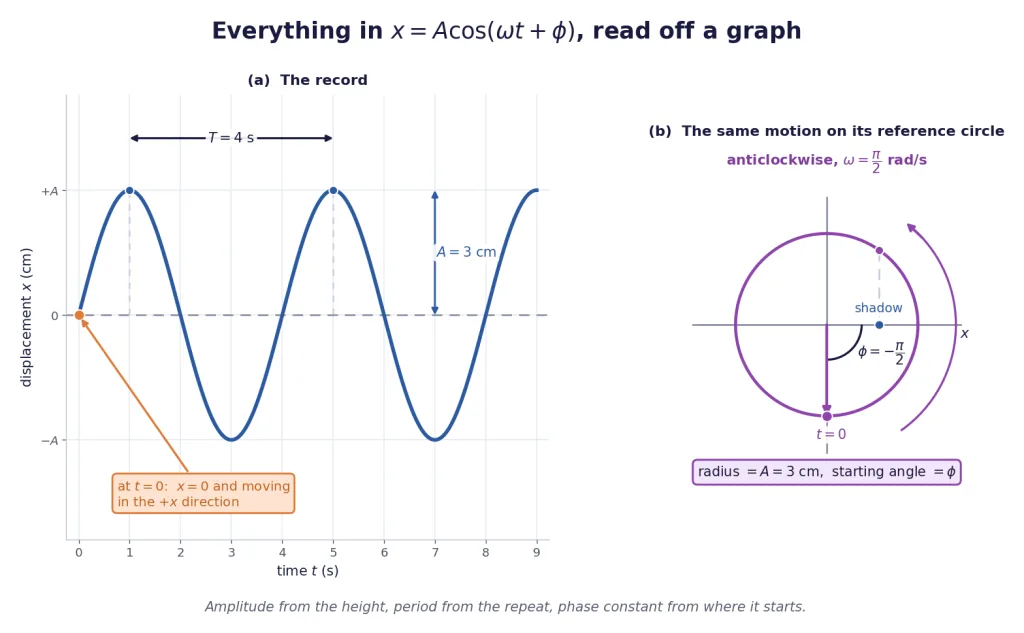
The graph below is the record of a particle in simple harmonic motion. Its peaks reach 3 cm, the first at s and the next at s, and at the particle is at the mean position and moving in the positive direction. Find , , , and , and write the equation of the motion.
Solution:
Convention: the standard form , with measured from the mean position.
Amplitude — the height of a peak above the mean line.
Period — the gap between two successive maxima.
Frequency and angular frequency.
Phase constant. Two facts fix it. At the displacement is zero: and the particle is moving in the direction, so :
The equation.
Check against the graph. Put : cm, the first maximum. Put : cm, the trough shown at .
Final Answer: cm, s, Hz, rad/s, , and cm.
Takeaway: A displacement value at leaves two candidates for ; the direction of motion picks one. Never stop at — go on and check the sign of the velocity.
Example 8: A sine start rewritten in the standard form
A particle moves as cm. Write the same motion in the form , and state , , , and .
Solution:
The one identity that does the whole job.
Apply it with :
Read off the constants.
Check at . From the sine form, cm. From the cosine form, cm. The same motion, two spellings.
Final Answer: cm, with cm, rad/s, Hz, s, .
Takeaway: Converting a sine to a cosine changes only the phase constant — it subtracts . The amplitude, the angular frequency and the period are untouched, because it is the same motion timed from the same instant.
Example 9: A cosine and a sine added together
A particle moves as centimetres. Find its amplitude and its phase constant, and write the motion in the standard form.
Solution:
The general result. Any sum with the same in both terms is a single simple harmonic motion:
Amplitude. Here cm and cm:
Phase constant. Take the value in the fourth quadrant, because and together need and .
The motion.
Check at . The original gives cm; the standard form gives cm. Check the velocity too: the original gives cm/s, and the standard form gives cm/s.
Final Answer: cm, rad, and cm.
Takeaway: Adding a cosine and a sine of the same frequency never makes a new kind of motion. It makes another simple harmonic motion, with amplitude — bigger than either term but not their sum.
Example 10: Amplitude and phase constant from a position and a velocity
A particle in simple harmonic motion is described by with rad/s. At it is at cm and moving with velocity cm/s in the positive direction. Find and . Then find the amplitude and phase constant if the same motion is written as .
Solution:
Convention: displacement measured from the mean position, in centimetres, and all phases in radians.
Write down both conditions in the cosine form.
Divide to get , add squares to get .
Choose the right root for . allows and . We need , which only gives:
Now the sine form. With , :
The two answers agree, as they must. .
Final Answer: cm with ; in the sine form, cm with .
Takeaway: The amplitude never depends on which form you choose — only the phase constant does, and it shifts by exactly . Getting and different is a sure sign of an algebra slip.
Example 11: Does starting it harder change anything?
A block on a spring is set going with an amplitude of 2 cm and found to have a period of 0.40 second. It is stopped and restarted, this time with an amplitude of 4 cm. What happens to the period, the frequency, the maximum speed and the maximum acceleration?
Solution:
Angular frequency first, since everything hangs off it:
Period and frequency: unchanged. contains only the spring constant and the mass. The amplitude is set by how far you pulled the block, and does not appear. So stays at 0.40 second and stays at 2.5 Hz.
Maximum speed: doubled. is proportional to :
Maximum acceleration: doubled. is also proportional to :
Why the period can stay put while the speed doubles. The block has twice as far to travel in each quarter cycle, but it travels the whole way twice as fast. The two changes cancel exactly, and only a linear restoring force makes them cancel exactly.
Final Answer: and unchanged at 0.40 s and 2.5 Hz; doubles from 0.314 to 0.628 m/s; doubles from 4.93 to 9.87 m/s².
Takeaway: The period of a simple harmonic oscillator is a property of the system, not of the start. Change the amplitude and the period will not move — which is exactly why a pendulum can keep time.
Part 2: The Reference Circle, Velocity and Acceleration
Eleven problems on the two tools that turn timing questions into geometry and position questions into one line of algebra: the reference circle, and .
Constants for this part: .
Key Point: On the reference circle, a particle goes round a circle of radius with angular speed , and its shadow on a diameter performs the SHM. Equal angles are swept in equal times, so a time interval is just . That is the whole method.
Example 12: How long does it take to get from here to there?
A particle executes simple harmonic motion of amplitude 6 cm with a period of 1.2 seconds. Find the time it takes to go (a) from cm to the extreme at cm, and (b) straight from cm to cm.
Solution:
Convention: measured from the mean position; on the reference circle the phase angle is measured from the positive -axis.
Turn each displacement into an angle on the circle using :
(a) From to is a sweep from to , an angle of :
(b) From to is a sweep from to , again :
Why the two are equal, and why that is surprising. The second journey covers 6 cm of ground, the first only 3 cm — but the second is made through the middle, where the particle is moving fastest, and the first near the extreme, where it is barely moving at all. The circle knows this automatically; a straight "distance over average speed" does not.
Final Answer: 0.20 second in both cases.
Takeaway: Convert displacements to angles, subtract, and scale by . No integration, no calculator gymnastics — and it never breaks for a displacement that is not a neat fraction of .
Example 13: Two revolving particles, and the shadows they cast
Two particles move in uniform circular motion.
- Particle P moves on a circle of radius 3 cm with a period of 2 seconds. At it is at the far left of the circle, on the negative -axis, and it goes round anticlockwise.
- Particle Q moves on a circle of radius 2 m with a period of 4 seconds. At it is at the top of the circle, on the positive -axis, and it goes round clockwise.
Write the simple harmonic motion performed by the -projection of each.
Solution:
Convention: angles measured anticlockwise from the positive -axis; the projection is .
Particle P. Angular speed: It starts at and the angle increases (anticlockwise), so :
Particle Q. Angular speed: It starts at and the angle decreases (clockwise), so :
Check both at . P: cm, which is the far left of its circle. Q: , which is directly below the top of the circle. Both correct.
Check the direction of travel just after . P is at the leftmost point and moving anticlockwise, so it is heading downwards and its shadow starts moving in the direction: , which is positive for small . Q is at the top moving clockwise, so it heads to the right: , positive at .
Final Answer: P: cm. Q: m.
Takeaway: The only thing the sense of rotation changes is the sign in front of . Anticlockwise gives , clockwise gives . Everything else follows from .
Example 14: Turning three equations into circle diagrams
For each motion below ( in centimetres, in seconds), find the radius of the reference circle, the angular speed of the reference particle, and the angle at which it starts, taking the rotation to be anticlockwise throughout.
(a) (b) (c)
Solution:
Convention: get every motion into with ; then the radius is , the angular speed is , and the starting angle is .
(a) Use : Radius 2 cm, angular speed 3 rad/s, starting angle . The period is s, and at the particle sits at cm.
(b) Cosine is even, so the minus sign inside can be flipped: Radius 1 cm, angular speed 1 rad/s, starting angle . Period s, and cm.
(c) Use : Radius 3 cm, angular speed rad/s, starting angle . Here Hz and s, and cm.
Final Answer: (a) radius 2 cm, rad/s, start at . (b) radius 1 cm, rad/s, start at . (c) radius 3 cm, rad/s, start at .
Takeaway: A minus sign in front of the amplitude is not a negative amplitude — it is a phase shift of . Absorb every sign and every sine into before you draw anything, and the diagram comes out right first time.
Example 15: Position, velocity and acceleration at a stated instant
A particle moves as centimetres. Find its displacement, velocity and acceleration at s, and say which way it is moving and which way it is being pushed.
Solution:
Read off the constants.
The phase at that instant, in radians:
Displacement.
Velocity.
Acceleration, straight from :
Read the signs. The particle is on the negative side, still travelling further negative (), and the acceleration points back towards the mean position () and is slowing it down. It is on its way to the extreme at cm.
Final Answer: cm, cm/s, cm/s².
Takeaway: The acceleration always points back towards the mean position, so its sign is always opposite to . If your and your come out with the same sign, you have made an arithmetic error, not discovered a new kind of motion.
Example 16: Speed at three displacements, without touching the clock
A particle executes simple harmonic motion of amplitude 5 cm with a period of 0.40 second. Find its speed at the mean position, at cm and at cm.
Solution:
Angular frequency.
The relation that skips the time entirely.
At the mean position, : which is also , as it must be.
At cm:
At cm:
Notice the pattern. The particle is 60% of the way out at cm but still moving at 80% of top speed; at 80% of the way out it is still at 60%. Speed falls off slowly at first and then collapses near the ends.
Final Answer: 78.5 cm/s, 62.8 cm/s and 47.1 cm/s respectively.
Takeaway: answers "how fast is it moving when it is here?" in one line. The sign is the only thing it cannot tell you — that depends on which way the particle happens to be going.
Example 17: Where is the speed half its maximum, and where is the acceleration?
A particle executes simple harmonic motion of amplitude 8 cm. Find the displacements at which (a) its speed is half its maximum speed, and (b) the magnitude of its acceleration is half its maximum.
Solution:
(a) Speed. Set in :
(b) Acceleration. Here is directly proportional to the displacement, so half the maximum acceleration means half the amplitude:
Why the two answers are so different. Acceleration is linear in , so halving it halves the displacement. Speed depends on , so halving it barely moves the particle in from the extreme — it is already at of the amplitude.
Final Answer: (a) cm. (b) cm.
Takeaway: "Half the maximum" means two completely different places for and for . scales with ; scales with . Never carry an answer from one to the other.
Example 18: The piston in a locomotive cylinder
The piston in the cylinder head of a locomotive has a stroke — that is, twice the amplitude — of 1.0 m, and it moves in simple harmonic motion with an angular frequency of 200 rad/min. Find its maximum speed, and also its frequency, its period and its maximum acceleration.
Solution:
Amplitude from the stroke. The stroke is the full travel from one extreme to the other, which is :
Convert the angular frequency to SI. It was given per minute, and every formula below wants per second:
Maximum speed.
Frequency and period, keeping them distinct from :
Maximum acceleration.
Final Answer: m/s, with Hz, s and m/s².
Takeaway: The stroke is , and radians per minute are not radians per second. Two unit traps in one short question, and each of them alone is enough to lose the mark.
Example 19: The signs of velocity, acceleration and force, point by point
A particle is in linear simple harmonic motion between two points and which are 10 cm apart. Take the direction from to as positive. Give the signs of the velocity, the acceleration and the force on the particle when it is:
(a) at the end ; (b) at the end ; (c) at the mid-point of , going towards ; (d) 2 cm from , going towards ; (e) 3 cm from , going towards ; (f) 4 cm from , going towards .
Solution:
Convention: the mean position is the mid-point of , and displacement is measured from there. With cm, the amplitude is 5 cm, so sits at cm and at cm.
The two rules that decide everything. The velocity sign is simply the direction of travel: towards is positive, towards is negative. The acceleration is and the force is , so both always have the sign opposite to — and both are zero at the mean position.
Locate each case on the -axis, then apply the rules.
| Case | Position | Moving | |||
|---|---|---|---|---|---|
| (a) at | cm | at rest, turning | |||
| (b) at | cm | at rest, turning | |||
| (c) mid-point, towards | towards | ||||
| (d) 2 cm from , towards | cm | towards | |||
| (e) 3 cm from , towards | cm | towards | |||
| (f) 4 cm from , towards | cm | towards |
- Reading the table. In cases (d), (e) and (f) the velocity and the force come out with the same sign. That is no accident: in each of those three the particle is heading towards the mean position, so the restoring force pulls it the way it is already going and the speed is rising. Whenever a particle is heading away from the mean position instead, the two signs disagree and it is slowing down.
Final Answer: as tabulated: (a) ; (b) ; (c) ; (d) ; (e) ; (f) .
Takeaway: Force and acceleration never depend on which way the particle is going — only on where it is. Fix the origin at the mean position, read the sign of , and flip it. The velocity is the only entry that needs the direction of travel.
Example 20: Which acceleration laws give simple harmonic motion?
Which of these relations between acceleration and displacement (SI units throughout) describe simple harmonic motion? For any that do, find , and .
(a) (b) (c) (d)
Solution:
The test. Simple harmonic motion means : proportional to , with a minus sign, and positive.
(a) . Proportional, but the sign is wrong. The acceleration points away from the mean position, so any small displacement grows. This is unstable equilibrium — a ball balanced on top of a dome — not oscillation.
(b) . The sign in front is negative, but is never negative, so is negative on both sides of the origin. That is not a restoring acceleration, and in any case it is not proportional to . Not SHM.
(c) . Proportional and restoring. Simple harmonic, with
(d) . Not proportional to , and the sign is wrong as well. Not SHM.
Final Answer: only (c), with rad/s, s and Hz.
Takeaway: Two conditions, both compulsory: first power of , and a minus sign. Fail either and it is not simple harmonic — and comes from the magnitude of the coefficient, with .
Example 21: A spring on a table, from equation to graphs
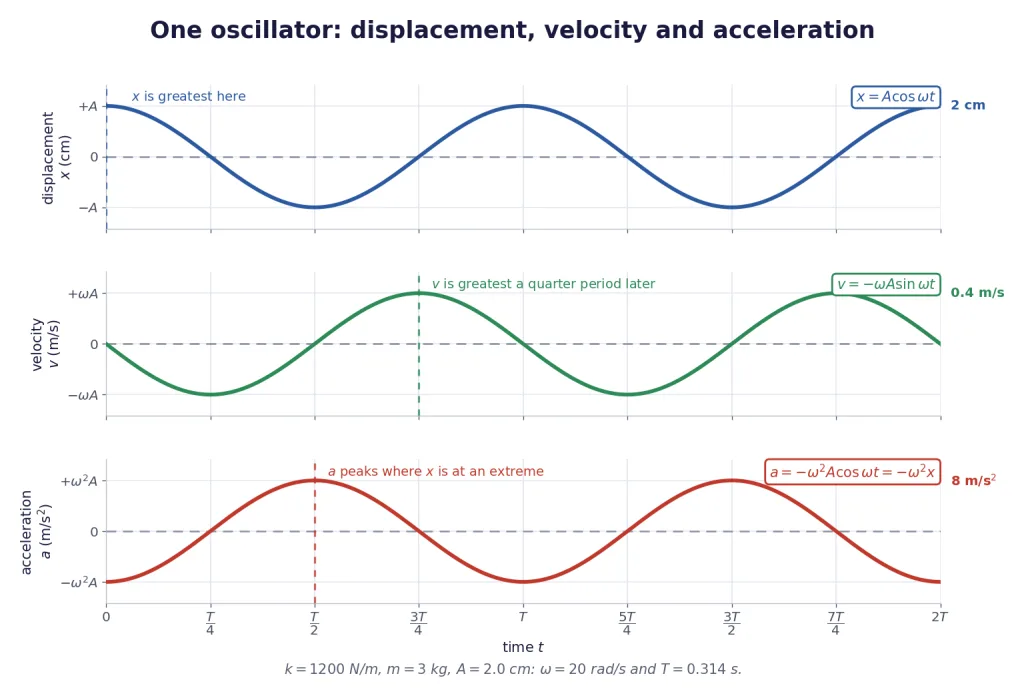
A spring of spring constant 1200 N/m is clamped at one end on a horizontal table, and a 3 kg block on a frictionless surface is attached to its free end. The block is pulled sideways 2.0 cm and released. Find (i) the frequency of the oscillation, (ii) the maximum acceleration of the block and (iii) its maximum speed.
Solution:
Angular frequency from the spring and the mass.
(i) Frequency — the question asked for , not :
Amplitude. The block was released from rest 2.0 cm from the mean position, so that is the amplitude:
(ii) Maximum acceleration, which happens at the extremes:
(iii) Maximum speed, which happens at the mean position:
The three curves together. Displacement peaks at the extremes, velocity a quarter of a period later at the mean position, and acceleration back in step with displacement but reversed in sign — the figure at the top of this section is drawn for exactly this oscillator.
Final Answer: Hz, m/s², m/s.
Takeaway: Release from rest means the release point is the amplitude. And when a question says "frequency", divide by before you write the answer down — quoting 20 here instead of 3.18 is the standard way to lose this mark.
Example 22: The same oscillator, three different stopwatch starts
Take the oscillator of the previous example — 1200 N/m, 3 kg, amplitude 2.0 cm — and measure from the mean position, with the positive direction to the right. Write as a function of time if, at the instant the stopwatch is started, the block is (a) at the mean position and moving to the right, (b) at its right-hand extreme, and (c) at its left-hand extreme. In what respect do the three answers differ?
Solution:
Convention: the standard form , with measured from the mean position. From the previous example, cm and rad/s.
(a) Starting at the mean position, moving right. We need with :
(b) Starting at the right-hand extreme, :
(c) Starting at the left-hand extreme, :
Compare the three. All three have amplitude 2.0 cm and angular frequency 20 rad/s, hence the same frequency 3.18 Hz and the same period 0.314 s. The only difference is the phase constant — , and respectively. Starting the stopwatch at a different moment cannot change how stiff the spring is or how heavy the block is.
Final Answer: (a) cm; (b) cm; (c) cm. They differ only in the phase constant, not in amplitude or frequency.
Takeaway: The phase constant carries all the information about when you started watching. It is set by the initial conditions and by nothing else — which is why changing it never changes the period, and why an exam answer that also changes or has gone wrong somewhere.
Part 3: Springs, "Show It Is Simple Harmonic", and Energy
Eleven problems on where the restoring force actually comes from. Springs on their own and in combination, three systems that turn out to be simple harmonic once you find the restoring force, and the energy book-keeping that finishes most of them off.
Constants for this part: m/s²; density of water 1000 kg/m³; .
Key Point — the recipe for "show that this is simple harmonic":
- Displace the system by a small from its equilibrium position.
- Find the net restoring force (or torque), keeping only the terms first order in .
- Show it equals .
- Read off as , and write .
Example 23: A spring balance used as a clock
A spring balance has a scale reading from 0 to 50 kg, and the scale is 20 cm long. A body hung from this balance is displaced and released, and oscillates with a period of 0.6 second. Find the weight of the body.
Solution:
Constants: m/s².
Get the spring constant from the scale. A load of 50 kg stretches the spring by the full 20 cm:
Get the mass from the period. For a vertical spring, displacement measured from the stretched equilibrium gives
Weight is the force, not the mass.
Sense check. 22.3 kg is comfortably inside the 0 to 50 kg range of the instrument, so the spring is still in its linear region and Hooke's law was safe to use.
Final Answer: kg, so the weight is about 219 N.
Takeaway: enters through the spring constant, never through the period. It was needed to convert the 50 kg reading into a force, and then it vanished — has no in it, vertical spring or not.
Example 24: A hanging block, and where zero is
A light spring hangs from a ceiling. A block hung on its lower end stretches it by 4.0 cm and comes to rest. The block is then pulled down a little further and released. Find the period and the frequency of the oscillation.
Solution:
Constants: m/s².
The equilibrium condition gives without needing either separately. At rest, the spring force balances the weight:
Period.
Frequency.
Where the mean position is, and why the answer has no in it. The block oscillates about the stretched equilibrium, 4.0 cm below the natural length. Measure from there and the net force is because the bracket is exactly zero. Gravity has cancelled itself out of the oscillation entirely — it only decided where the mean position is.
Final Answer: s and Hz.
Takeaway: A static extension is a disguised way of handing you . Whenever a problem says "the spring stretched by when loaded", you can write immediately, without knowing or at all.
Example 25: Both springs stretching together
A 5 kg block on a frictionless horizontal table is attached to two light springs of spring constants 400 N/m and 600 N/m. Both springs run from the same wall to the block, so that when the block moves, both change length by the same amount. Find the equivalent spring constant, the angular frequency, the frequency and the period.
Solution:
Decide which combination it is by asking the physical question: do the springs share the displacement or the force? Here both stretch by the same , so they share the displacement — this is the parallel case.
Add the forces.
Angular frequency.
Frequency and period.
Sense check. The combination is stiffer than either spring alone (1000 N/m beats both 400 and 600), so the period must be shorter than for either spring by itself. With the 400 N/m spring alone, s — and 0.444 s is indeed shorter.
Final Answer: N/m, rad/s, Hz, s.
Takeaway: Same displacement means add the stiffnesses. Parallel springs are always stiffer than either one, so the period always falls — a fast sanity check that costs no time.
Example 26: The same pair, joined end to end
The same two springs, 400 N/m and 600 N/m, are now joined end to end to make one long chain running from the wall to the same 5 kg block. Find the equivalent spring constant and the period.
Solution:
Which combination? The same tension runs right through the chain, so the springs share the force, and their extensions add. That is the series case.
Add the compliances. With a common tension , the total extension is so which is also N/m.
Angular frequency and period.
Compare with the parallel case. Same two springs, same block: parallel gave 0.444 s, series gives 0.907 s — slower by a factor of just over two, because 240 N/m is floppier than either spring on its own.
Final Answer: N/m, s, Hz.
Takeaway: A series combination is always floppier than the floppiest spring in it. If your comes out bigger than the smaller spring constant, you have added the wrong things — check before going on.
Example 27: Cut into three, then two of the pieces side by side
A light spring of spring constant 720 N/m is cut into three equal pieces. Two of those pieces are then attached side by side between a wall and a 4.8 kg block on a frictionless table, so that both stretch by the same amount. Find the period of the oscillation.
Solution:
What cutting does. Think of the original spring as three equal pieces joined end to end — a series combination of three identical springs of stiffness each: A short spring is a stiff spring: the same pull produces only a third of the extension in a third of the length.
Now put two of those pieces in parallel, since both stretch by the same amount:
Angular frequency and period.
Sense check on the size of the effect. The uncut spring with the same block would give rad/s and s. Cutting and doubling up has made the system six times stiffer and the period times shorter.
Final Answer: N/m, s.
Takeaway: Cut a spring into equal pieces and each piece has stiffness . Shorter is stiffer, always — and the general rule for an unequal cut is that stiffness is inversely proportional to length.
Example 28: Springs on opposite sides that still add
A 1.5 kg block lies on a frictionless floor between two walls. A spring of spring constant 500 N/m joins it to the left wall and one of 300 N/m joins it to the right wall, and both are relaxed when the block is at rest. Find the period of small oscillations.
Solution:
Displace the block to the right by and look at each spring separately. The left spring is now stretched by , so it pulls the block back to the left with force . The right spring is now compressed by , so it pushes the block back to the left with force .
Both forces point the same way — back towards the mean position. So they add: Even though the springs are on opposite sides of the block, this is the parallel rule, because both change length by the same .
Angular frequency and period.
The trap. "On opposite sides" tempts people into the series formula, which would give N/m and s — more than twice as long, and wrong. The springs never share a tension here; they share a displacement.
Final Answer: N/m and s.
Takeaway: Geometry does not decide series or parallel — the question "same or same ?" does. Two walls, one on each side, is a parallel combination every time.
Example 29: A cork bobbing in a liquid, from scratch
A cylindrical piece of cork of base area , height and density floats upright in a liquid of density . It is pushed down slightly and released. Show that it oscillates simple harmonically, and that the period is Then evaluate it for a cork of height 6.0 cm and density 240 kg/m³ floating in water.
Solution:
Constants: m/s²; density of water 1000 kg/m³.
The equilibrium. Floating means the weight equals the buoyant force. If a depth is submerged at equilibrium,
Push it down a further . The submerged depth becomes , so the extra liquid displaced is a slab of volume , and the extra upward force is its weight: The minus sign says the extra push is upward while the displacement is downward — a restoring force. The weight and the equilibrium part of the buoyancy have already cancelled.
It is proportional to , so this is simple harmonic. Comparing with : and the oscillating mass is the whole cork, .
Read off the period. The base area has cancelled, so a fat cork and a thin one of the same height bob at the same rate.
Put the numbers in.
Read the formula. Since , the period is also — the period of a simple pendulum whose length equals the submerged depth. A cork floating with 1.44 cm under water bobs like a 1.44 cm pendulum.
Final Answer: , which for this cork is 0.241 s ( Hz).
Takeaway: The buoyant force on the extra slab is what makes this simple harmonic, and it is proportional to the extra depth. The base area always cancels, so the answer depends only on the height, the two densities and .
Example 30: Mercury in a U-tube after the pump is switched off
One arm of a U-tube of uniform bore is connected to a suction pump and the other is open, so that a small pressure difference holds the mercury levels apart. Show that when the pump is switched off the mercury column executes simple harmonic motion, and find the period for a total mercury column of length 40 cm.
Solution:
Constants: m/s².
Set up the displacement. Let the tube have cross-sectional area , the mercury have density , and the total length of the mercury column be . Suppose the level in the left arm is below its equilibrium level. Since the mercury is incompressible and the bore is uniform, the level in the right arm is then above its equilibrium level.
Find the restoring force. The two levels now differ by , so the unbalanced weight is that of a mercury column of height and area : restoring, because it always pushes the high side down.
Proportional to , so this is simple harmonic. Comparing with : and the mass being moved is the whole column, .
The period. Both the area and the density cancel: mercury, water and oil in the same tube would all oscillate at the same rate.
Put the numbers in.
Final Answer: s, with Hz.
Takeaway: The factor of 2 comes from the level difference being , not . Miss it and the period comes out times too long — the single most common error in this problem, and it survives every other check you might do.
Example 31: A smooth bowl and a small ball
A small ball is placed inside a smooth spherical bowl of radius 1.25 m, slightly above the lowest point, and released. Show that it oscillates simple harmonically and find the period. Treat the ball as a point mass sliding without friction.
Solution:
Constants: m/s².
Set up the geometry. Let be the radius of the bowl and the angle the ball's radius makes with the vertical. The ball's displacement along the surface, measured from the lowest point, is the arc .
Resolve gravity. The normal reaction is along the radius and does no tangential work. The tangential component of the weight is , directed back towards the lowest point:
Small displacement. For a small angle, in radians, and : which is exactly , so the motion is simple harmonic with
The period.
What the answer looks like. is exactly the simple pendulum formula with the bowl radius in place of the string length — and for good reason: the ball moves along a circular arc of radius under gravity, which is what a pendulum bob does.
Final Answer: s.
Takeaway: A ball in a shallow bowl is a pendulum whose string is the bowl's radius. The mass drops out, and so does the amplitude, exactly as for a pendulum — and for the same reason, both only while the displacement stays small.
Example 32: The full energy account of one oscillator
A block of mass 0.4 kg oscillates on a spring of spring constant 250 N/m with an amplitude of 6.0 cm. Find (a) the total mechanical energy, (b) the kinetic and potential energies at cm, (c) the speed there, (d) the position at which the two energies are equal, and (e) the position at which the kinetic energy is three times the potential.
Solution:
Angular frequency first, since it links everything:
(a) Total energy. Convert the amplitude first:
(b) The split at cm m. So at half the amplitude, exactly a quarter of the energy is potential and three quarters is kinetic — because goes as .
(c) The speed there, two ways that must agree:
(d) Where . Each must then be :
(e) Where . Then : which is the position part (b) already worked out, and the two agree.
Final Answer: J; at cm, J and J with m/s; at cm; at cm.
Takeaway: Both standard positions come straight from and : . Equal energies need , giving ; kinetic three times potential needs , giving . Memorise the ratio, not the two answers.
Example 33: When, not where — the energy split against the clock
A particle executes simple harmonic motion with a period of 0.40 second, starting from an extreme position. Find (a) the fraction of the total energy that is kinetic at , (b) all the instants in the first period at which the kinetic and potential energies are equal, and (c) the period with which each energy varies.
Solution:
Convention: starting from an extreme position means , with and measured from the mean position.
Angular frequency.
(a) At . The phase is So three quarters of the energy is kinetic, one quarter potential. Notice this is the same split as at , because puts the particle exactly there.
(b) When . Each is then half the total, so Since , these are Four instants in one period, spaced apart.
(c) The period of the energies. Write them out: Each depends on time only through , whose angular frequency is . So each energy has against Hz for the displacement.
And their sum is still constant. Adding the two boxed expressions, the terms cancel and at every instant.
Final Answer: (a) ; (b) at , , and s; (c) each energy has period 0.20 s, that is , and frequency 5.0 Hz.
Takeaway: The energies run at twice the frequency of the motion. A particle oscillating at 2.5 Hz has a kinetic energy that peaks 5 times a second, because and each complete two cycles for every one of and . Quoting the energy frequency as instead of is a standard one-mark loss.
Part 4: Pendulums, Damping, Resonance — and the Long Ones
The last eleven, and the hardest. Pendulums where is not , oscillators that lose energy, oscillators that are being driven, and two multi-step problems of the kind that decide ranks.
Constants for this part: m/s² on the Earth and m/s² on the Moon; .
Example 34: The same pendulum taken to the Moon
A simple pendulum has a period of 3.5 seconds on the Earth, where m/s². What is its period on the surface of the Moon, where the acceleration due to gravity is 1.7 m/s²?
Solution:
Constants: m/s², m/s².
Nothing about the pendulum itself changes. The string is the same length and the bob has the same mass — and the mass never entered the formula anyway:
So take the ratio and let cancel.
The new period.
Optional cross-check through the length.
Final Answer: about 8.4 seconds.
Takeaway: A pendulum clock runs slow where gravity is weak. Since , the Moon's gravity — about a sixth of the Earth's — makes every swing take about times as long. Notice the ratio route never needed the length.
Example 35: The pendulum that ticks the seconds
A second's pendulum is one whose period is exactly 2 seconds, so that each half-swing takes one second. (a) Find its length where m/s². (b) Find it where m/s². (c) What length of second's pendulum would be needed on the Moon, and what period would the Earth version have if taken there?
Solution:
Constants: m/s² unless stated; m/s².
Rearrange the pendulum formula for .
(a) At m/s², with s: Just under a metre — which is why a metre of string is the standard laboratory guess.
(b) At m/s², nearer the equator: A change of 0.2% in moves the required length by 0.2%, about 2 mm. A clock built for one place and carried to the other runs measurably wrong.
(c) On the Moon. For a 2-second period there, only 17 cm. And the Earth pendulum of 0.993 m, taken to the Moon unchanged, would have
Frequency and angular frequency of a second's pendulum, for completeness:
Final Answer: (a) 0.993 m; (b) 0.991 m; (c) 0.172 m on the Moon, and the Earth pendulum would take 4.80 s per swing there.
Takeaway: A second's pendulum has a period of 2 seconds, not 1. The name refers to the one-second half-swing — the tick — and reading it as a one-second period quarters the length to 0.248 m, which is the classic wrong answer here.
Example 36: A pendulum in a lift, going up, going down, and falling
A simple pendulum of length 1.0 m hangs from the ceiling of a lift. Find its period (a) when the lift is at rest or moving at constant speed, (b) when the lift accelerates upwards at 2.0 m/s², (c) when it accelerates downwards at 2.0 m/s², and (d) when the cable snaps and the lift falls freely.
Solution:
Constants: m/s².
The idea. In the accelerating lift, work in the lift's frame and add a pseudo-force. The bob then behaves as though gravity had a different strength — an effective :
(a) At rest or at constant velocity, :
(b) Accelerating upwards at m/s². The pseudo-force on the bob points downwards, adding to gravity: The pendulum runs fast — everything feels heavier, including the restoring force.
(c) Accelerating downwards at m/s²: The pendulum runs slow.
(d) Free fall. Now , so The bob is weightless relative to the lift. There is no restoring force at all, so it simply stays wherever it is put: the pendulum stops oscillating, and its period is infinite rather than zero.
Final Answer: (a) 2.01 s; (b) 1.83 s; (c) 2.25 s; (d) it does not oscillate — the period is infinite.
Takeaway: Up means , down means , free fall means no oscillation. And the free-fall case is not "period zero" — a longer, weaker restoring force means a longer period, and no restoring force at all means no period.
Example 37: A pendulum in a car going round a bend
A simple pendulum of length with a bob of mass hangs inside a car that is going round a circular track of radius at a steady speed . The pendulum makes small oscillations in the radial direction about its equilibrium position. Find its period, and evaluate it for m, m/s and m.
Solution:
Constants: m/s².
What the car's motion does. Going round a bend at a steady speed, the car has a centripetal acceleration directed horizontally, towards the centre of the track. In the car's frame the bob feels an outward pseudo-force as well as its weight .
Combine the two. They are at right angles — one vertical, one horizontal — so the effective gravity is their resultant: and the string hangs along that resultant, tilted outwards from the vertical by .
The period, with the pendulum swinging about that tilted equilibrium: The bob's mass does not appear, exactly as for an ordinary pendulum.
Put the numbers in.
How far the string tilts. from the vertical, leaning away from the centre of the bend — which is what a hanging air freshener does in a fast turn.
Final Answer: , which is 1.89 s here, with the equilibrium string tilted from the vertical.
Takeaway: Two perpendicular accelerations combine by Pythagoras, not by adding. Any horizontal acceleration — a car braking, a train cornering, a trolley being pushed — makes , which is always larger than , so the pendulum always speeds up.
Example 38: A steel bob swinging under water
A simple pendulum of length 1.0 m has a bob whose density is 8 times that of water. It is set swinging with the bob completely immersed in water. Find its period in water and compare it with its period in air. Neglect viscous drag.
Solution:
Constants: m/s²; density of water 1000 kg/m³.
What the liquid does. The upthrust on the bob is the weight of the water it displaces. If the bob has volume and density , and the liquid has density : The net downward force is the difference, so the bob behaves as though gravity were
Put the density ratio in. Here :
The two periods.
The ratio, done directly. so the pendulum runs about 6.9% slow — a clock like this would lose about 100 minutes a day.
Why "neglect viscous drag" matters. Buoyancy changes the period; viscosity would damp the amplitude, which is a separate effect and is the subject of the next three examples. A real bob in water loses its swing in a few oscillations.
Final Answer: m/s², s against s — longer by a factor .
Takeaway: Buoyancy weakens gravity by the factor and nothing else. If the bob's density were equal to the liquid's, would be zero and the bob would float in place, exactly like the pendulum in the falling lift.
Example 39: A stopwatch, twenty-five swings and the value of
In a laboratory, a pendulum whose length from the support to the centre of the bob is 0.900 m is timed over 25 complete oscillations, which take 47.6 seconds. Find at that place. If the student had instead timed a single oscillation and got 1.9 s, how much would the answer have changed?
Solution:
Period from the timing. Timing many swings and dividing is the whole point of the technique:
Rearrange the pendulum formula for .
Substitute.
What a single-swing timing would have cost. With s, Because , a fractional error in is doubled in : the timing was 0.2% low and the answer came out 0.4% high. Timing 25 swings divides the stopwatch's reaction-time error by 25, which is why it is done that way.
Final Answer: m/s²; timing one swing instead would have given 9.84 m/s².
Takeaway: , and the square means every timing error counts double. Measure to the centre of the bob, and time as many swings as your patience allows.
Example 40: A dashpot, a half-life and a count of cycles
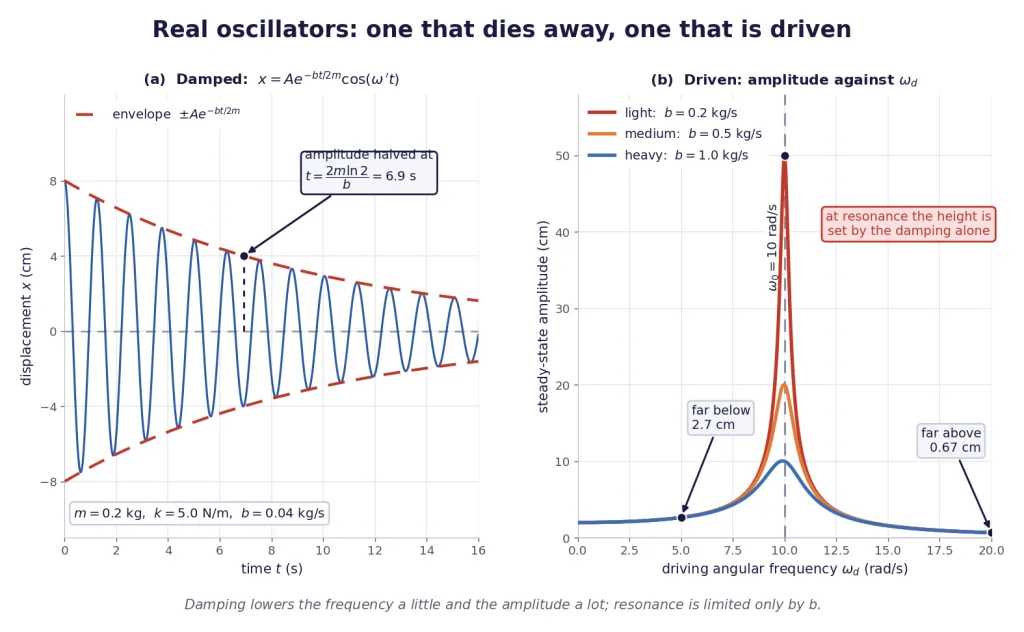
A block of mass 0.2 kg oscillates on a spring of spring constant 5.0 N/m, with a damping force where kg/s. The initial amplitude is 8.0 cm. Find (a) the natural angular frequency, (b) the damped angular frequency and the damped period, (c) the time for the amplitude to fall to half its initial value, (d) the time for the mechanical energy to fall to half, and (e) how many oscillations the block completes before the amplitude has halved.
Solution:
(a) Natural angular frequency, the value with no damping at all:
(b) Damped angular frequency. against s undamped — longer, but by only 0.02%. Damping always makes an oscillator slower; here it is a tiny effect because the damping is light. How light? The critical value is and kg/s is just 2% of it.
(c) Amplitude half-life. The amplitude at time is :
(d) Energy half-life. Energy goes as the square of the amplitude, , so its exponent is twice as fast: exactly half the amplitude half-life, as it must be.
(e) Number of oscillations. Divide the time by the damped period: so the block completes about five and a half oscillations before its swing is halved.
The two time constants, for reference. s is the time for the amplitude to fall to of its value, and s is the same thing for the energy.
Final Answer: rad/s; rad/s with s; amplitude halves in 6.93 s; energy halves in 3.47 s; about 5.5 oscillations.
Takeaway: The energy dies at exactly twice the rate of the amplitude, so its half-life is exactly half. Every time-constant question in this topic is really that one sentence — check which of the two the question asked for before you write down a number.
Example 41: Five per cent off the amplitude, and what that costs in energy
A 2.0 kg block oscillating on a spring loses 5.0% of its amplitude in 10 seconds because of a damping force . Find (a) the damping constant, (b) the percentage of its mechanical energy lost in the same 10 seconds, (c) the amplitude time constant and (d) the time for the amplitude to fall to half.
Solution:
(a) Damping constant from the amplitude decay. Losing 5.0% leaves 95%:
(b) Energy lost. Energy is proportional to the square of the amplitude, so The block has lost 9.75% of its energy — just about twice the 5% the amplitude lost, which is what squaring a number close to 1 does.
(c) Amplitude time constant. and the energy time constant is half of that, s.
(d) Time to half amplitude. So the swing that lost only 5% in the first 10 seconds takes over two minutes to lose half — the decay is exponential, so the fraction lost per 10 seconds stays the same while the amount keeps shrinking.
Final Answer: (a) kg/s; (b) 9.75% of the energy; (c) s; (d) 135 s.
Takeaway: A small fractional loss of amplitude means roughly twice that fractional loss of energy. For losses of a few per cent, , and the exam answer is almost always that factor of two.
Example 42: Far below, dead on, and far above resonance
A block of mass 0.5 kg on a spring of spring constant 50 N/m has a damping constant kg/s. It is driven by a periodic force of amplitude 1.0 N. Find the steady-state amplitude when the driving angular frequency is (a) 5.0 rad/s, (b) 10.0 rad/s and (c) 20.0 rad/s. Compare with the displacement the same force would produce if it simply held the block still.
Solution:
Natural angular frequency. so case (b) is exactly at resonance, (a) is half that frequency and (c) is double.
The steady-state amplitude formula.
(a) At rad/s, far below resonance:
(b) At rad/s, exactly at resonance, the first bracket vanishes and only the damping term survives:
(c) At rad/s, far above resonance:
The static comparison. A steady 1.0 N force applied to this spring would displace the block by So driving at resonance gives 25 times the static displacement, driving at half the natural frequency gives only a little more than static, and driving at twice it gives less than a third of static.
Final Answer: (a) 2.7 cm; (b) 50 cm; (c) 0.67 cm — against a static displacement of 2.0 cm.
Takeaway: Resonance is a narrow window, and outside it the driver barely does anything. Halving or doubling the driving frequency here drops the response by a factor of about 20 and 75 respectively. And at resonance the amplitude is set by alone: halve the damping and the 50 cm becomes a metre.
Example 43: One spring and one mass, then one spring and two masses
A light spring of spring constant is clamped at one end, with a mass attached to its free end, and a force applied to the free end stretches it. A second, identical spring has no clamp: instead a mass is attached to each end, and each end is pulled outwards by the same force .
(a) What is the maximum extension of the spring in each case? (b) If the masses are then released, what is the period of oscillation in each case? Take kg, N/m and N.
Solution:
(a) Extension in the clamped case. At the greatest extension the spring force balances the applied force:
(a) Extension in the free case. This is the one that looks as if it should be double, and is not. A spring is in equilibrium only if the forces on its two ends are equal and opposite — which is exactly what the clamp was providing in the first case. Pulling both ends with produces the same tension throughout the spring, so the same as before. The wall was never doing anything the second mass is not doing.
(b) Period in the clamped case. One mass, one spring:
(b) Period in the free case. Both masses move, so the effective mass is the reduced mass:
Why the free system is faster. The centre of mass of the two-block system stays put, so the mid-point of the spring never moves — each block is effectively attached to a half spring, of stiffness , and , which is the same answer. Either route gives .
Final Answer: (a) 10 cm in both cases. (b) 0.628 s clamped, 0.444 s free — shorter by a factor .
Takeaway: A wall is just a partner that never moves. The extension depends on the tension, which is either way; the period depends on how much mass has to be shifted, and two free masses of move like one mass of .
Example 44: A hanging block, end to end
A 2.0 kg block hangs at rest from a light vertical spring, which it has stretched by 5.0 cm. The block is then pulled down a further 3.0 cm and released. Find (a) the spring constant, (b) the angular frequency, the frequency and the period, (c) the maximum speed and maximum acceleration, (d) the total energy of the oscillation, (e) the speed and the energy split when the block is 1.5 cm from the mean position, and (f) the greatest and least forces the spring exerts during the motion. Does the spring ever go slack?
Solution:
Constants: m/s².
(a) Spring constant from the static stretch. At rest the spring force balances the weight:
(b) The three frequency-like quantities. No appears in the period: gravity fixed the mean position 5.0 cm below the natural length and then dropped out of the problem.
Amplitude. The block was released from rest 3.0 cm below the mean position, so
(c) Maxima.
(d) Total energy.
(e) At cm from the mean position, that is at half the amplitude: using . Check: J.
(f) The forces the spring exerts. The spring's extension is measured from its natural length, not from the mean position, and it ranges from to :
Does it go slack? The spring would go slack only if the block rose all the way to the natural length, that is if . Here cm is less than cm, so it never does — equivalently, m/s² is less than m/s², so the block is never in free fall at the top.
Final Answer: N/m; rad/s, Hz, s; m/s, m/s²; J; at 1.5 cm, m/s with J and J; spring force runs from 7.84 N to 31.4 N and it never goes slack.
Takeaway: Two different origins live in one problem, and you must keep them apart. The oscillation is measured from the mean position — that is where , , and come from. The spring force is measured from the natural length. Mixing the two is the single most expensive mistake in this chapter, and it is why part (f) is worth more marks than it looks.