
What JEE Adds to This Chapter
Sections 1 to 11 built this chapter properly. , the reference circle, , and , spring combinations, the energy account, the pendulum, damping, resonance — all of it is in place, and for the Board paper that build is complete.
What JEE adds is almost no new physics. It is still one restoring force proportional to one displacement. What changes is that the restoring force is no longer handed to you. The spring is replaced by gravity acting on a rod, by buoyancy on a floating block, by a magnetic torque, by the field inside the Earth. The wall the spring is tied to gets up and walks away. The mass that appears under the square root is not the mass of the block. And very often the whole problem is a potential energy function with no force written anywhere.
The one idea that organises this whole section
Here it is, up front, because everything below is a variation on it.
Key Point — every oscillator is the same oscillator. Find a coordinate measured from the equilibrium value, get the equation of motion into the shape and you are finished, because then need not be a length — it can be an angle, a volume, a charge. is whatever multiplies and is whatever multiplies . Getting the equation into that shape is the entire problem; reading off it takes one second.
There are exactly two reliable ways to reach that shape, and both are worked below: the force-and-torque route (displace by , find the net restoring force or torque, show it is ) and the energy route (write the total energy, differentiate it with respect to time, set the derivative to zero). The energy route is usually faster and never drops a term.
Notation for This Section
| Symbol | Meaning | Unit |
|---|---|---|
| angular frequency | rad/s | |
| frequency (Greek nu, not the italic vee of speed) | Hz | |
| period | s | |
| natural angular frequency, | rad/s | |
| damped angular frequency, | rad/s | |
| driving angular frequency | rad/s | |
| phase difference between two superposed SHMs | rad | |
| phase constant of the resultant SHM | rad | |
| reduced mass, | kg | |
| moment of inertia about the pivot | kg m | |
| damping constant | kg/s | |
| quality factor | dimensionless | |
| half-power bandwidth of the resonance curve | rad/s | |
| , | effective stiffness and effective mass | N/m, kg |
Speed is and frequency is ; both appear in this section and they are different letters.
The twelve things this section teaches
| # | Skill | Why it earns marks |
|---|---|---|
| 1 | Phasor addition of two SHMs along one line | The cosine rule replaces a page of trigonometry |
| 2 | Perpendicular SHMs and the phase difference | One equation covers lines, ellipses and circles |
| 3 | The physical pendulum, | A rod or a disc is not a simple pendulum |
| 4 | Rolling without slipping in a curved track | The moment of inertia slows the oscillation down |
| 5 | Deriving the restoring force before writing a period | Floating bodies, liquid columns, magnets |
| 6 | The energy method, | One differentiation gives the whole equation of motion |
| 7 | Effective mass — a heavy spring, a loaded pulley | The mass under the root is rarely the block's mass |
| 8 | Reduced mass when both bodies are free | Nothing is bolted to a wall, so becomes |
| 9 | Oscillators in accelerating frames | The equilibrium moves; the period does not |
| 10 | Small oscillations about a minimum of | turns any well into a spring |
| 11 | Damped oscillators counted in cycles, not seconds | The answer wanted is a number of swings |
| 12 | and the half-power bandwidth | Sharpness of resonance compressed into one number |
Constants and standard results, fixed now
| Quantity | Value |
|---|---|
| m/s | |
| Radius of the Earth | m |
| N m/C | |
| Rod of mass , length , about one end | |
| Rod about its centre | |
| Disc or solid cylinder about its axis | |
| Solid sphere about a diameter | |
| Ring or hollow cylinder about its axis |
Superposition of perpendicular simple harmonic motions, the energy method, small oscillations about a potential minimum and the sharpness of resonance sit outside the rationalised syllabus body text, and JEE Main and JEE Advanced set them every year, so each is developed here from first principles rather than quoted.
[Exam Tip] Four questions, asked before any algebra, choose the method for almost every problem below. Where is the equilibrium — and am I measuring my displacement from it, or from some natural length? Is anything in this system free to move that I have quietly assumed was fixed? Is my coordinate a length or an angle, and if it is an angle, is it in radians? Does the question want , or , or ? Answer those four and the algebra is usually three lines.
Superposing Two SHMs of the Same Frequency
Two oscillations act on the same particle. What does it do? The answer splits cleanly into two cases, and JEE asks both.
Case 1: both along the same line — add them as phasors
Let so is the phase difference between them. The particle's displacement is . You could expand both cosines and collect terms, and it works, but there is a picture that does it in one line.
Recall from the reference circle that is the -projection of a vector of length turning at , starting at angle . Such a vector is called a phasor. Projections add, so the two phasors add as vectors — and because both turn at the same rate , the triangle they make never changes shape. Freeze it at and the answer is a piece of geometry:
Key Point — phasor addition. For two SHMs of the same along the same line, with That is the cosine rule for a triangle with sides and and included angle . The resultant has the same frequency as its parts — only the amplitude and the phase constant change.
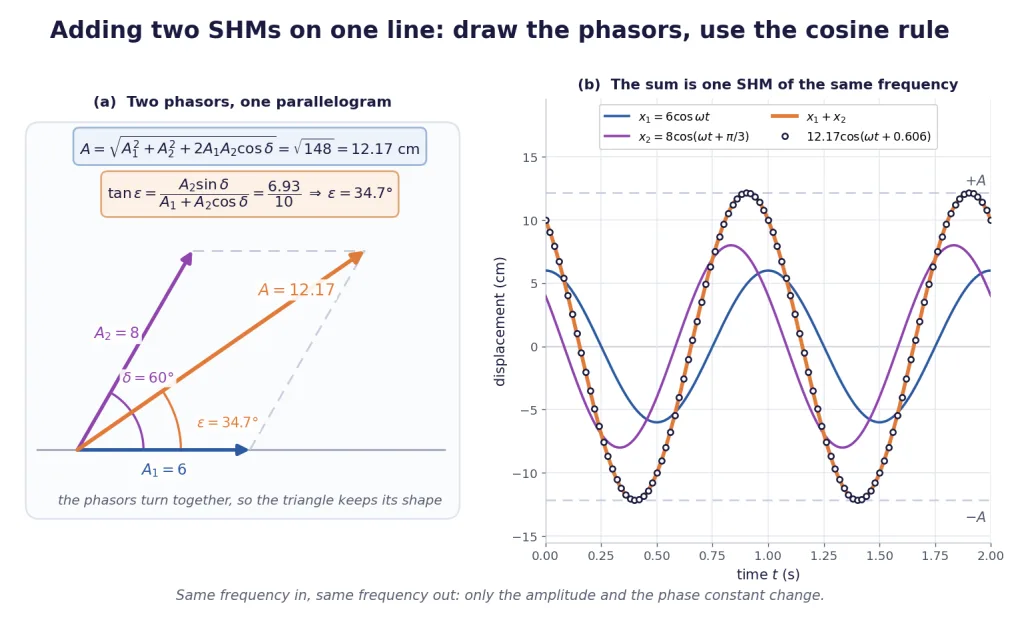
Three consequences worth memorising:
- gives , the largest possible. Constructive.
- gives , the smallest possible. Destructive, and exactly zero if the amplitudes are equal.
- gives — the plain Pythagorean sum, which is why has amplitude .
For more than two, add the phasors head to tail, or resolve each into components and add those. Three equal amplitudes with phase constants , and close into an equilateral triangle and give exactly zero — a favourite one-line question.
Case 2: along perpendicular lines — the path is a conic
Now the two motions are along and : Here the question is not "what is the amplitude" but "what curve does the particle trace?" Eliminate . From the first, and . Expanding the second and substituting gives, after squaring,
Key Point — the general path. This one equation covers every case. It is an ellipse in general, inscribed in the rectangle , , and it degenerates into a straight line when .
Read off the standard cases:
| Equation becomes | Path | |
|---|---|---|
| straight line | ||
| full equation, | ellipse tilted towards | |
| ellipse with axes along and | ||
| and | circle | |
| full equation again | ellipse tilted the other way | |
| straight line |
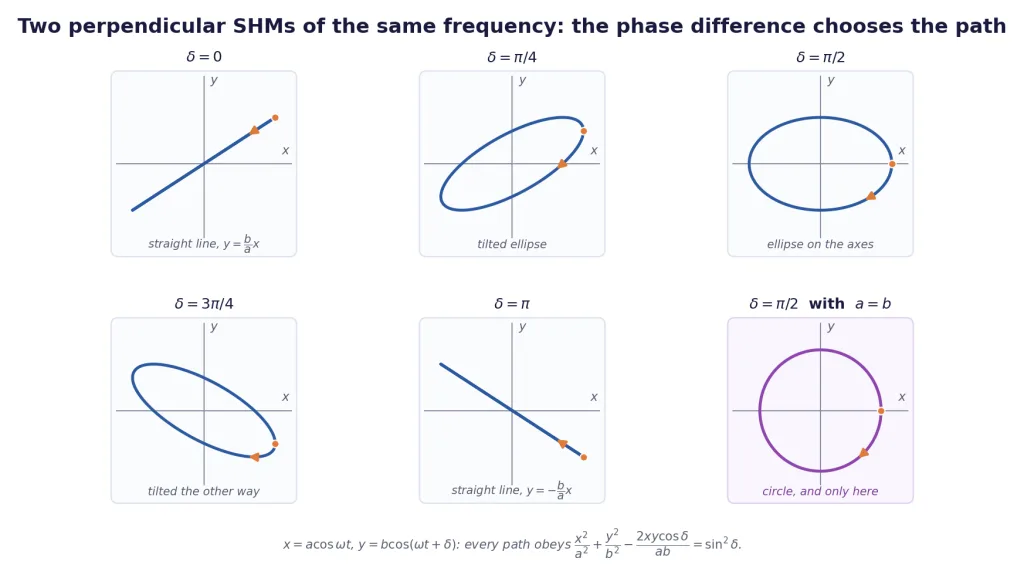
Two details that separate a full-marks answer from a half-marks one.
The circle needs both conditions. alone gives an ellipse; equal amplitudes alone give a tilted ellipse. Only and together give a circle. This is exactly the reference circle of Section 3 read backwards: uniform circular motion is two perpendicular SHMs of equal amplitude a quarter cycle apart.
The area of the traced ellipse is . It is largest at and collapses to zero at or , which is another way of saying the ellipse has flattened into a line. And the sense of travel — clockwise or anticlockwise — is fixed by the sign of : with the particle starts at and moves so that is decreasing, that is, clockwise.
[Exam Tip] If a question gives you and as sines rather than cosines, do not convert anything. The identity above only needs the two motions written with the same trigonometric function; is then the difference of the two arguments, whatever function you are using.
Oscillators Whose Restoring Force You Have to Find First
In Sections 5 and 6 the spring handed you and the rest was arithmetic. Here nothing hands you anything. The recipe never changes:
Key Point — the four-step derivation.
- Locate the equilibrium and choose a coordinate measured from it.
- Displace by a small and write the net restoring force, or the net restoring torque if is an angle.
- Linearise: keep only the term proportional to . This is where and live, and where every angle must be in radians.
- Compare with and read straight off.
The physical pendulum — the workhorse
Any rigid body free to swing about a horizontal axis is a physical pendulum. Let be its moment of inertia about the pivot, its mass, and the distance from the pivot to the centre of mass. Displace it by and gravity supplies a restoring torque , so
Compare with and you get the equivalent simple pendulum length which is the single most useful line in this whole topic: any rigid swinging body behaves exactly like a simple pendulum of that length.
For a uniform rod of length pivoted at one end, and , so A metre stick swung from its end has a period like a m simple pendulum, not a m one — a shorter period than the careless answer.
Rolling without slipping in a curved track
A cylinder or a sphere of radius rolls inside a fixed circular track of radius . Its centre moves on a circle of radius , so the centre's speed is , and rolling ties the spin to that: . The kinetic energy therefore carries two terms: The bracket is a pure number: for a solid cylinder, for a solid sphere, for a ring. Calling it , the result is So a solid cylinder oscillates times more slowly than a block sliding on the same frictionless track. Rolling always lengthens the period, because part of every joule goes into spin.
The standard derived oscillators, in one table
is m/s throughout, and every angle is in radians.
| System | Restoring law | Period | |
|---|---|---|---|
| Rigid body, pivot at distance from the centre of mass | torque | ||
| Uniform rod, length , pivoted at one end | torque | ||
| Solid cylinder rolling in a track of radius | |||
| Solid sphere rolling in the same track | |||
| Body floating, cross-section , liquid density | |||
| Liquid column of length , arms inclined at and | |||
| Bar magnet, moment , in a field | torque | ||
| Charge on the axis of a ring of charge , radius | |||
| Particle in a tunnel through the Earth |
Two of those rows deserve a sentence each.
The U-tube with inclined arms. For arms making angles and with the horizontal, push the liquid a distance along the tube. One arm rises by , the other falls by , so the unbalanced height is and the restoring force is acting on a mass . Set both arms vertical, , and it collapses to the familiar . A tube with one arm vertical and the other at , holding a cm column, gives rad/s and s.
The magnet. A magnetic moment in a field feels a torque , which is identical in form to gravity on a pendulum. That is why a vibration magnetometer is a pendulum in disguise, and why doubling divides the period by .
Key Point — the check that catches most errors. Whatever you derive, put it through a dimension check and a limiting check. has units of time; does too. And every rolling result must reduce to the sliding one when the moment of inertia is set to zero.
The Energy Method, Effective Mass and Frames That Accelerate
Differentiate the energy: one line, no free-body diagram
For any conservative oscillator the total mechanical energy is constant. Write it in terms of one coordinate and its rate : Differentiate with respect to time and use : Cancel the common (legitimate everywhere except at the two instants when the body is momentarily at rest) and you have the equation of motion:
Key Point — the energy method. Everything that multiplies is the effective mass; everything that multiplies is the effective stiffness. No forces, no torques, no signs to lose.
This is worth doing even when the force method would work, because it automatically collects contributions you might forget — the rotational kinetic energy of a pulley, the kinetic energy of the spring itself, the kinetic energy of a liquid in the arms of a tube.
Effective mass: the mass under the square root is not the block's mass
A spring that is not light. A uniform spring of mass and natural length , fixed at one end, carries a block at the other. When the block moves at speed , the element at distance from the fixed end moves at . Its kinetic energy is So the spring behaves as though one third of it were stuck to the block:
A pulley in the loop. A block hangs from a string that runs over a pulley of moment of inertia and radius ; the other end of the string is tied to a spring of constant . With ,
Reduced mass: when nothing is bolted to a wall
Two blocks and on a frictionless surface, joined by a spring of constant . There is no wall. Write Newton's law for each, using the extension : Subtract, after dividing each by its own mass:
Key Point — the two-body oscillator. The extension of the spring performs SHM with Both blocks oscillate at that same about the centre of mass, which never moves. Their amplitudes divide in the inverse ratio of their masses: and their momenta are always equal and opposite, so at every instant.
The same appears whenever the "wall" is really a body free to recoil — a spring between a block and a plank that can slide, a spring between two carts, a diatomic molecule. Set and , recovering the fixed-wall answer, which is the check to run every time.
Oscillators in an accelerating frame
Put the whole apparatus on a trolley with constant acceleration . Work in the trolley's frame and add a pseudo-force on every mass. A constant force does exactly one thing to a spring oscillator: it moves the equilibrium and leaves the period alone.
For a block on a horizontal spring on such a trolley, And if the block happens to be sitting at the old (natural-length) position when the trolley starts, then it is away from its new equilibrium with zero velocity — so the amplitude is exactly .
This is the same argument as the vertical spring in Section 5, where gravity shifts the equilibrium down by and cancels out of the equation of motion entirely. In a lift accelerating upward at the extension at equilibrium becomes and the period is still , with no and no in it.
Key Point — the rule for any constant extra force. Add a constant force to a spring oscillator and the equilibrium moves by ; , and do not change at all. Measure your displacement from the new equilibrium and the constant force disappears from the algebra. This is not true for a pendulum, where a constant sideways force changes the effective gravity and therefore does change the period.
Why SHM Is Universal: Small Oscillations About Any Minimum
This is the deepest idea in the chapter, it is absent from the rationalised syllabus, and it is asked at JEE almost every year — usually as a problem that gives you a potential energy function and nothing else.
The argument
Let a particle of mass move in a potential energy with a minimum at . Expand in a Taylor series about that point:
The first term is a constant and does nothing. The second term vanishes, because is a minimum and the slope there is zero — that is exactly what "equilibrium" means. So the first surviving term is the quadratic one. Write for the displacement from equilibrium and it reads which is precisely the potential energy of a spring. The force follows:
Key Point — every smooth minimum is a spring. A positive second derivative means a minimum and a genuine oscillation; a negative one means a maximum, an unstable equilibrium and no oscillation at all. This is why simple harmonic motion is everywhere in physics — atoms in a crystal, the two atoms of a molecule, a satellite nudged off a stable orbit, a ball in a valley. Zoom in far enough on any smooth minimum and it is a parabola.
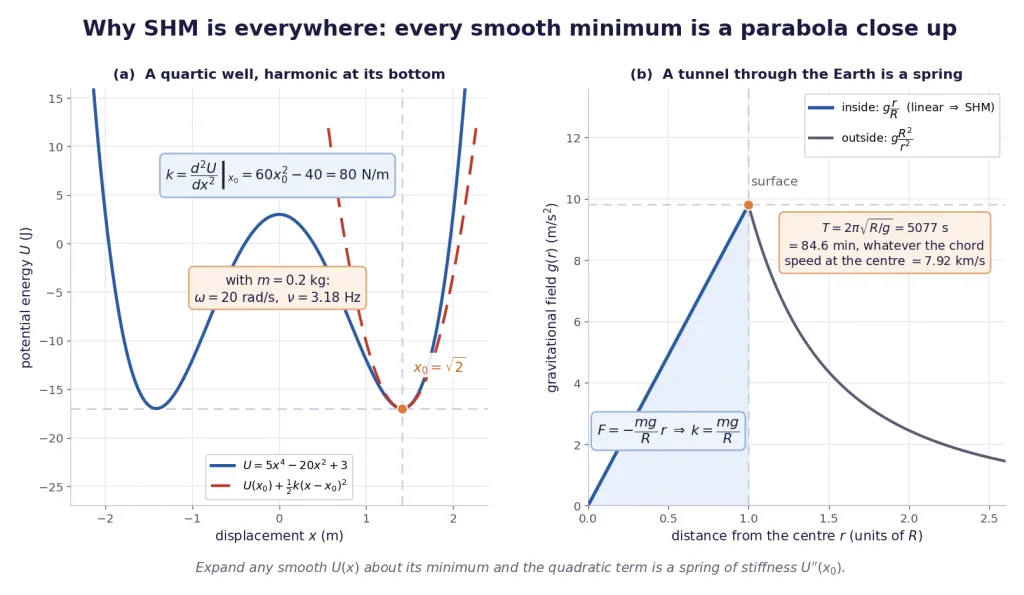
The approximation is good only while the cubic term is small compared with the quadratic one, which is what "small oscillations" means. Push the amplitude up and the period starts to drift — exactly as the simple pendulum's period drifts once the swing is no longer small.
The recipe, in three lines
Given and a mass :
- Solve for . Discard any root where is negative.
- Evaluate in N/m.
- , then and .
Two families come up so often they are worth knowing:
| Potential | Minimum at | |
|---|---|---|
The tunnel through the Earth
Treat the Earth as a uniform sphere of radius and surface gravity . Only the mass inside your radius pulls you, and that mass grows as while the inverse-square law divides by , so the field inside is linear: Bore a tunnel straight through the centre and drop a ball in. The force on it is Notice that the mass cancels — a marble and a truck take the same time. Putting in m and m/s gives s, that is minutes for the round trip and minutes to fall to the other side of the planet.
Now the part that surprises everybody. Bore the tunnel along a chord instead, at perpendicular distance from the centre. When the ball is at distance from the centre and from the tunnel's midpoint, the pull is towards the centre, and the component along the tunnel is The cancels. The period is for every chord, no matter how short — minutes from Delhi to Mumbai or from pole to pole. Only the amplitude changes, and with it the maximum speed, . For the diametric tunnel that is km/s, which is the orbital speed at the Earth's surface — not a coincidence, but that is a story for gravitation.
A charged bead on the axis of a ring
A ring of radius carries a total charge , spread uniformly. On its axis, at distance from the centre, the field is For the denominator is just , so is linear in . A bead of mass carrying an opposite charge is therefore pulled back towards the centre with , giving With C, C, kg and m this comes to rad/s, so Hz. The whole problem is the linearisation of one denominator.
[Exam Tip] Whenever a problem gives you , a field, or a force that is not obviously linear, your first move is to expand about the equilibrium and keep the linear term. Every one of these problems is the same problem.
Counting Cycles, and the Sharpness of Resonance
From "how long" to "how many"
Section 9 gave the damped amplitude . JEE rarely asks for the time; it asks for the number of complete oscillations before the amplitude falls to some fraction. That is a two-step calculation and both steps are easy to fumble.
Key Point — cycles to a given amplitude fraction. To fall from to , Divide by the damped period , not by . For light damping the two are nearly equal, and for heavy damping they are not.
Useful fractions, all from the same logarithm: for half, for a quarter, for a tenth, and for the point. And since the energy goes as the square of the amplitude, , the energy reaches half in exactly half the time the amplitude does.
The quality factor
One number measures how good an oscillator is at oscillating:
Key Point — the quality factor. is dimensionless. A high means light damping: the free oscillation rings for a long time, and the resonance peak is tall and narrow. A car suspension has ; a tuning fork about ; a quartz crystal or more.
The number of cycles before the amplitude drops to follows immediately: the amplitude time constant is , and dividing by the period gives So "" already tells you the thing will manage about swings before it has faded to .
The sharpness of resonance: half-power bandwidth
Section 10 drew the resonance curve and showed that lower damping makes it taller and sharper. How much sharper is what measures. Start from the steady-state amplitude, Near resonance write with small. Then , and the peak value is . The amplitude falls to — the half-power points, so called because the energy stored goes as and has halved there — when the two terms under the root are equal:
Key Point — bandwidth and . The full width of the resonance curve between the half-power points is A high- oscillator responds to a narrow band of driving frequencies and ignores everything else. That is what makes a radio tuner select one station out of hundreds.
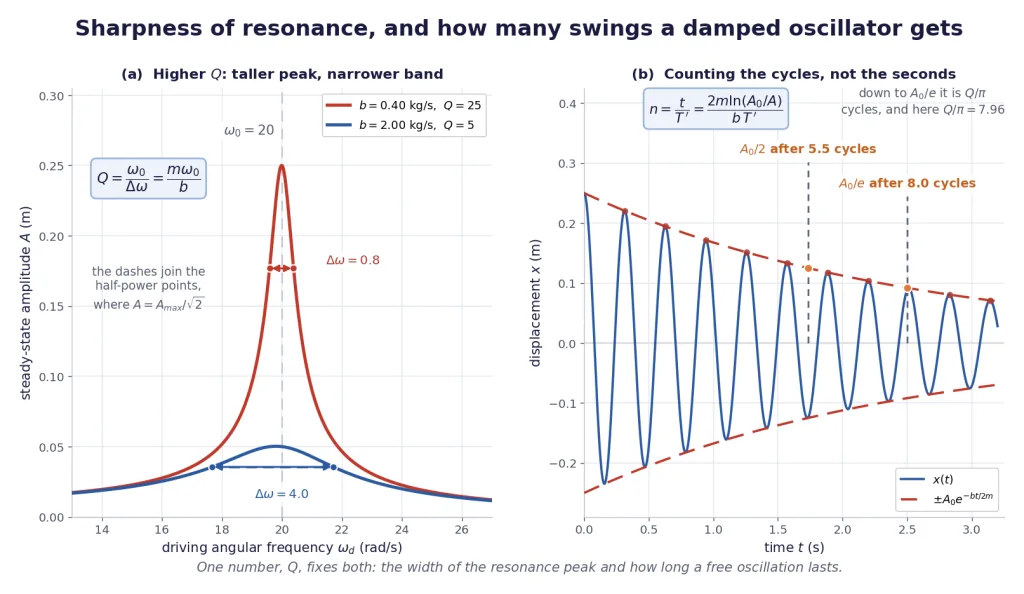
One more identity worth carrying: at resonance the amplitude is times the amplitude the same force would produce if applied statically. So is simultaneously the resonant amplification, the reciprocal of the fractional bandwidth, and times the number of free cycles to . Three questions, one number.
The four traps this chapter sets, every single year
1. Measuring displacement from the natural length instead of the equilibrium. For a hanging spring the mean position is the stretched equilibrium, below the natural length. Release a block from the natural length of an unstretched vertical spring and its amplitude is , so it falls a total of before coming back up — not , and not "it just hangs there". The gravity term cancels exactly once you measure from the right place, which is why has no in it at all. The same applies to the trolley, the lift and the incline: find the shifted equilibrium first, then start the clock.
2. Degrees where the small-angle approximation needs radians. is true for in radians and nowhere else. At the sine is and the radian measure is , agreeing to two parts in a thousand; the number agrees with nothing. Every inside a , every angular amplitude, every phase constant you substitute — radians. A phase quoted with no unit is in radians.
3. Forgetting that the energy varies at twice the frequency. With , both and contain . Their angular frequency is and their period is . Their sum is flat. If a question mentions kinetic or potential energy and a frequency in the same breath, the factor of is the whole question.
4. Quoting when the question asked for . They differ by , and the wrong one is always on the option list. "Frequency" means in hertz. "Angular frequency" means in radians per second. Combine this trap with the previous one and a block with rad/s has a potential energy that varies at rad/s and Hz — and the answers , and are all wrong for different reasons.
Key Point — the last line of every solution. Write the unit. is rad/s, is Hz, is s, is N/m, is kg/s, is a pure number. If the unit does not match what the question asked for, the answer is wrong however good the algebra was.
Solved Examples, Part 1: Superposing Oscillations
Values used throughout, unless a problem says otherwise: m/s, m, N m/C. Every angle inside a sine or cosine is in radians. The standard form is .
Example 1: Two oscillations on one line, added the fast way
A particle is acted on by two simple harmonic motions along the same straight line: (a) Write the resultant in the form . (b) Keeping both amplitudes fixed, what are the largest and smallest resultant amplitudes obtainable by changing ? (c) For what phase difference would the resultant amplitude be exactly cm?
Solution:
Draw the phasors and use the cosine rule. With , and , so :
The phase constant of the resultant. So cm, and it is one SHM of the same angular frequency .
Sanity check on the phase constant. must lie between and , because the resultant phasor lies inside the angle between the two. It does: . And it is nearer the larger amplitude's phasor than the smaller one's, as the parallelogram demands.
(b) The extremes. can only run from to : Every possible resultant lies between cm and cm.
(c) Work backwards for . Set : Which is the Pythagorean case, , as it had to be.
Final Answer: (a) cm, that is amplitude cm with phase constant rad or . (b) Between cm and cm. (c) .
Takeaway: Two SHMs of the same frequency on the same line always give a third SHM of that same frequency. Only the amplitude and the phase constant are new, and one triangle delivers both.
Example 2: Three phasors, and one that vanishes
(a) Three SHMs act along the same line on one particle: all in centimetres. Find the resultant. (b) Three SHMs of equal amplitude have phase constants , and . Find their resultant.
Solution:
- (a) With more than two phasors, resolve into components. Take the -axis along the first phasor:
| Phasor | Amplitude | Phase | Along axis | Perpendicular |
|---|---|---|---|---|
| Sum |
Recombine. The signs matter: the along-axis component is negative and the perpendicular one positive, so is in the second quadrant. A calculator's is the wrong branch.
(b) Three equal phasors at to each other. Resolve: The resultant is exactly zero. The three phasors form a closed equilateral triangle, so the particle does not move at all.
Final Answer: (a) cm. (b) Zero — the particle stays at rest.
Takeaway: Beyond two phasors, always go to components; the cosine rule only handles a pair. And any set of equal phasors spread evenly around the circle sums to zero, which is why three-phase electricity has no return current.
Example 3: One pair of perpendicular equations, four different paths
A particle's coordinates are cm and cm. Find the path, and the area it encloses, for , , and .
Solution:
Write the master equation once, with and :
. The right side is zero and the left is a perfect square: A straight line through the origin, travelled back and forth between and . The motion along that line is itself SHM of amplitude cm. Enclosed area zero.
. Now and : An ellipse with semi-axes cm and cm lying along the coordinate axes. It is not a circle, because . Area cm.
. Right side zero again, cross term flips sign: The same line reflected — the other diagonal of the rectangle. Area zero.
. With : A tilted ellipse, still inscribed in the rectangle , , touching its sides. Its area is cm.
The pattern. As runs from to the path opens from a line, fattens to the upright ellipse at , and closes back to the opposite line. The area tracks it exactly.
Final Answer: : line ; : ellipse of area cm; : line ; : tilted ellipse of area cm.
Takeaway: Learn one equation, not four cases. And note that none of these is a circle: with and no choice of can make one, because a circle needs equal amplitudes and a quarter-cycle lag.
Example 4: How far from the origin does a tilted ellipse reach?
A particle moves with (a) Find the equation of its path. (b) Find its greatest and least distances from the origin. (c) A student answers (b) with m. What went wrong?
Solution:
(a) The master equation works with sines too, since both motions use the same function and . With and , : Multiply through by :
Recognise the shape. The cross term means it is tilted. Because the and coefficients are equal, the symmetry axes are the lines and .
(b) Look along each axis of symmetry. On , substitute: That point is , at distance m. On : That point is , at distance m.
So the semi-major axis is m along , and the semi-minor axis is m along . The greatest distance from the origin is m and the least is m.
(c) Where comes from. It is — the corner of the bounding square, obtained by assuming and reach their maxima at the same instant. They do not: they are out of step, so when the value of is , giving only m. The true maximum, m, occurs at neither extreme.
Final Answer: (a) . (b) Greatest m, least m. (c) assumes both coordinates peak together, which a phase difference forbids.
Takeaway: With perpendicular SHMs, the maximum of the distance is not the combination of the two separate maxima. Get the path equation, then look along its symmetry axes.
Solved Examples, Part 2: Deriving the Oscillator
Example 5: A swinging rod, and the best place to hang it
A uniform rod of length m swings in a vertical plane about a horizontal axis. (a) Find its period, frequency and angular frequency when the axis is at one end, and the length of the simple pendulum that would match it. (b) The axis is now moved to a distance from the rod's centre. For what is the period least, and what is that least period?
Solution:
(a) Set up the physical pendulum. For a uniform rod of mass pivoted at one end, and the centre of mass is at : The mass cancels, as it always does for a pendulum.
Put the numbers in. With m and m/s:
Now all three quantities, each with its unit. Check: rad/s. Agrees.
The equivalent simple pendulum. and indeed s. A m rod ticks like a m simple pendulum, not like a m one.
(b) Move the pivot. By the parallel-axis theorem, , so Only the bracket depends on , so minimise . Setting :
Evaluate. m from the centre, and then , so the numerator is :
A pleasing feature. At the optimum, m. Hang the rod anywhere else — including from its end — and the period is longer.
Final Answer: (a) s, Hz, rad/s, equivalent length m. (b) Least period s, with the axis m from the centre.
Takeaway: with the parallel-axis theorem handles every "rod / disc / ring swung from a point" question there is. And note the shape of : it blows up both as and as grows, so a minimum in between is guaranteed.
Example 6: A cylinder rolling in a groove, by the energy method
A solid cylinder of radius cm rolls without slipping inside a fixed cylindrical groove of radius cm, oscillating about the lowest point. (a) Derive its period using the energy method and evaluate it. (b) Compare with a block sliding on the same frictionless groove, and with a solid sphere rolling in it.
Solution:
(a) Set up the coordinate. Let be the angle of the line joining the groove's centre to the cylinder's centre, measured from the vertical. The cylinder's centre moves on a circle of radius m, so its speed is
Write both kinetic energies. Rolling without slipping means the spin rate is , and a solid cylinder has :
The potential energy. The centre rises by , and for small in radians, :
Differentiate the total energy and set it to zero. Cancel :
Read off, then the period.
(b) The sliding block. No spin term, so and the result is the simple pendulum of length : The rolling cylinder is slower by exactly as the factor predicts.
The solid sphere. Its , so Between the block and the cylinder, because a sphere carries less of its mass far from the axis.
Final Answer: (a) rad/s, s, Hz. (b) Sliding block s, solid sphere s — rolling always lengthens the period, by the factor .
Takeaway: The energy method turned a nasty rolling-constraint problem into three lines. Notice the small radius never appeared on its own — only through and through , which is a pure number.
Example 7: Two hidden masses — a heavy spring and a loaded pulley
(a) A block of mass kg hangs from a spring of spring constant N/m whose own mass is kg. Find the period, and the percentage error made by ignoring the spring's mass. (b) A block of mass kg hangs from a light string that passes over a pulley of moment of inertia kg m and radius m; the other end of the string is attached to a spring of constant N/m fixed to the floor. Find the frequency of small vertical oscillations of the block.
Solution:
(a) The spring's kinetic energy. Each element of the spring moves at a fraction of the block's speed, from zero at the fixed end to at the block. Integrating gives , so
The period follows at once.
The careless answer. Ignoring the spring's mass gives an under-estimate of Not small. Gravity, incidentally, does nothing here except shift the equilibrium down by ; it does not appear in .
(b) The pulley stores kinetic energy too. If the block moves at then the string, and so the rim of the pulley, also moves at , and the pulley spins at . Write the energy with measured from the equilibrium position:
Evaluate the effective mass.
Then the three quantities. The pulley has doubled the effective mass and so multiplied the period by .
Final Answer: (a) s; ignoring the spring's mass under-estimates it by . (b) Hz, with rad/s and s.
Takeaway: Anything that moves when the block moves contributes to . Write the total kinetic energy in terms of one speed and the coefficient of hands you the effective mass with nothing left out.
Example 8: Nine centimetres of stretch, shared between two free blocks
Blocks of mass kg and kg lie on frictionless ice, joined by a light spring of spring constant N/m. They are pulled apart until the spring is stretched by cm and released from rest. (a) Find the angular frequency, frequency and period of the resulting oscillation. (b) Find the amplitude of each block's motion. (c) Find the maximum speed of each block, and verify with momentum and with energy.
Solution:
(a) There is no wall, so use the reduced mass.
The extension of the spring performs SHM about zero extension. Notice the trap: using the total mass kg instead of would have given rad/s, more than twice too slow.
(b) The centre of mass never moves, because no external horizontal force acts. So each block oscillates about its own fixed distance from the centre of mass, and the cm of stretch divides in the inverse ratio of the masses: The lighter block swings twice as far, and cm, as it must.
(c) Maximum speeds, from for each block.
Momentum check. With the centre of mass at rest the momenta must cancel at every instant: Equal and opposite. Agrees.
Energy check. All the stored energy becomes kinetic when the spring reaches its natural length: Agrees to the last digit.
Final Answer: (a) rad/s, Hz, s. (b) cm and cm. (c) m/s and m/s, consistent with both momentum and energy.
Takeaway: The moment a problem says "on a frictionless surface" and does not attach anything to a wall, reach for . And check the limit: make the kg block enormously heavy and kg, recovering the fixed-wall answer.
Example 9: The trolley pulls away, and the lift goes up
(a) A block of mass kg rests on the frictionless floor of a trolley and is joined to the trolley's front wall by a spring of constant N/m. The trolley accelerates forward at a steady m/s, starting at the instant the block is at rest at the spring's natural length. Describe the block's motion in the trolley's frame: its equilibrium, amplitude, period and maximum speed. (b) The same block and spring now hang vertically inside a lift that accelerates upward at m/s. Find the extension at equilibrium and the period.
Solution:
(a) Work in the trolley's frame and add the pseudo-force. Every mass feels an extra backwards:
Find the new equilibrium. The spring must supply that N, so it stretches by The block's mean position has moved cm back from the natural length.
The period is untouched. Measuring from the new equilibrium, the constant pseudo-force cancels exactly:
The amplitude. At the starting instant the block is at the natural length with zero velocity in the trolley's frame — that is cm from its new equilibrium, at rest. A body released at rest is at an extreme, so
Maximum speed (in the trolley's frame, at the new equilibrium): Energy check: J, and J. Agrees.
(b) The lift is the same argument with . The equilibrium extension is and the period is still with no and no in it.
Final Answer: (a) Mean position cm behind the natural length, amplitude cm, s, Hz, m/s. (b) Extension m at equilibrium, period unchanged at s.
Takeaway: Constant forces move the mean position and nothing else. This is the single most useful fact about spring oscillators, and it is exactly why the answer to "what happens to a spring-block clock in a lift" is nothing — while the same question about a pendulum has a completely different answer.
Solved Examples, Part 3: Potentials, the Earth, and Sharpness
Example 10: Three potential wells, three oscillators
(a) A particle of mass kg moves along the -axis with potential energy joules, in metres. Find its stable equilibrium positions and the angular frequency, frequency and period of small oscillations about one of them. How much energy above the minimum may the particle have and still stay in one well? (b) A particle of mass kg has with J m and J m. Find and , and give the general formulas. (c) For , find and the effective spring constant in two equivalent forms.
Solution:
(a) Equilibrium first: set the slope to zero.
Sort them with the second derivative. At this is , negative: a maximum, unstable, no oscillation. At it is , positive: two stable minima.
Read the spring constant straight off.
Then the three quantities, each with its unit.
How deep is the well? J, and the barrier at the origin is J. So the particle stays in one well as long as its total energy is less than above the minimum. Beyond that it crosses the hump and visits both wells, and the motion is periodic but no longer simple harmonic.
(b) Same three steps. gives Numerically N/m, so The depth of this well is J.
(c) The same machinery, higher powers. gives , that is Substituting collapses it: and . This is the potential between two atoms in a molecule, and this is why molecules absorb infrared light.
Final Answer: (a) Stable minima at m; N/m, rad/s, Hz, s; up to J above the minimum keeps it in one well. (b) m, N/m, rad/s. (c) , .
Takeaway: Differentiate once for where, twice for how stiff. That is the whole method, and it works on any you are handed — polynomial, inverse power, or something with no name at all.
Example 11: Falling through the Earth
Take the Earth as a uniform sphere of radius m with m/s at the surface, and neglect all friction and rotation. (a) A ball is dropped into a tunnel bored straight through the centre. Show that it performs SHM, and find , , , the one-way travel time and the maximum speed. (b) A second tunnel is bored along a chord whose perpendicular distance from the centre is . Find its period and the maximum speed in it.
Solution:
(a) The field inside a uniform sphere. At distance from the centre, only the mass within pulls you, and it grows as while the inverse-square law divides by : so the force on a ball of mass is directed towards the centre. That is exactly with , so the motion is simple harmonic.
The mass cancels.
Then the period and the frequency, each labelled. The one-way trip, surface to surface, is half a period:
Maximum speed, at the centre, where the amplitude is the full radius :
(b) The chord tunnel. Let be the distance along the tunnel from its midpoint, and the distance from the Earth's centre. The pull is towards the centre; its component along the tunnel is that times : The cancels completely. So is the same, and
Only the amplitude changes. For a chord at perpendicular distance , half its length is
Final Answer: (a) rad/s, Hz, s min, one-way time min, km/s. (b) The same period, min; maximum speed km/s.
Takeaway: The chord result is the memorable one — every straight tunnel through the Earth takes minutes end to end, whether it is a thousand kilometres long or twelve thousand. And the answer contains no mass and no length of tunnel, only and .
Example 12: One damped oscillator, answered five ways
A block of mass kg on a spring of constant N/m is damped with kg/s, and is driven by a periodic force of amplitude N. (a) Find , and . (b) Left free with an initial amplitude of m, how many complete oscillations does it make before the amplitude falls to half? To ? (c) Find its quality factor. (d) Find the half-power bandwidth in rad/s and in Hz. (e) Find the steady-state amplitude at resonance, and compare it with the deflection the same force would produce applied steadily.
Solution:
(a) The three frequencies, kept apart. Light damping indeed: is smaller than by , but it is smaller, and it is that sets the period of the free motion:
(b) Time first, then divide by the damped period. So it manages about five and a half complete swings before the amplitude has halved. For the point the logarithm is :
(c) The quality factor. Cross-check with . Agrees. And the shortcut reproduces step 2 exactly.
(d) Bandwidth. Check against : , and . Both give . Agrees.
(e) At resonance the damping alone limits the amplitude. Applied steadily, the same N would simply stretch the spring by The ratio is
Read the whole system off one number. says: the peak is times the static deflection; the peak is of wide; and the free motion lasts cycles before fading to .
Final Answer: (a) rad/s, Hz, rad/s. (b) cycles to half amplitude, to . (c) . (d) rad/s, Hz. (e) m, which is times the static m.
Takeaway: Everything in parts (b) to (e) is the same number wearing different clothes. Compute first and the rest of the question answers itself — and note that the cycle count needed , not , even though here the difference is invisible at three figures.