
Motion That Repeats Itself
Most of the motion you have studied so far happens once and is over. A ball thrown across a field traces its parabola and lands; a car pulls away from a traffic light and keeps going. Nothing comes back.
This chapter is about the other kind — motion that does the same thing again, and again, and again.
Key Point — periodic motion:
A motion that repeats itself at regular intervals of time is called periodic motion.
"Repeats itself" is meant literally: after a fixed interval the body is back where it was, moving the way it was moving, and the whole history starts over.
The world is full of it. The Earth goes round the Sun and is back at the same point in its orbit every year. The minute hand of a clock returns to the twelve every hour. A heart beats. A ball bouncing between your palm and the floor rises to the same height each time. In every one of these, some interval of time keeps repeating.
Now narrow it down
Look more carefully at two of those examples.
The Earth goes round the Sun and comes back — but it comes back by going all the way round. It never turns and retraces its path. The same is true of the second hand of a clock and of any wheel spinning at a steady rate.
A pendulum is different. It swings out to the right, stops, swings back through the middle, out to the left, stops, and returns. It moves to and fro about a point in the middle of its path — and it passes through that middle point twice in every repetition.
Key Point — oscillatory motion:
Oscillatory motion is to-and-fro motion about a fixed mean position. The mean position is the equilibrium point that sits somewhere inside the path, and the body swings first one side of it, then the other.
The mean position is also called the equilibrium position, and the two names mean exactly the same thing throughout this chapter.
The sentence that gets examined every year
Key Point: Every oscillatory motion is periodic, but every periodic motion need not be oscillatory.
The standard counter-example is uniform circular motion: it repeats perfectly, so it is periodic, but the body never reverses and there is no mean position anywhere on its path. It is periodic and not oscillatory.
Think of it as one set sitting inside another. All oscillations live inside the larger family of periodic motions, and the outer part of that family — orbits, spinning wheels, clock hands — contains motions that repeat without ever turning back.
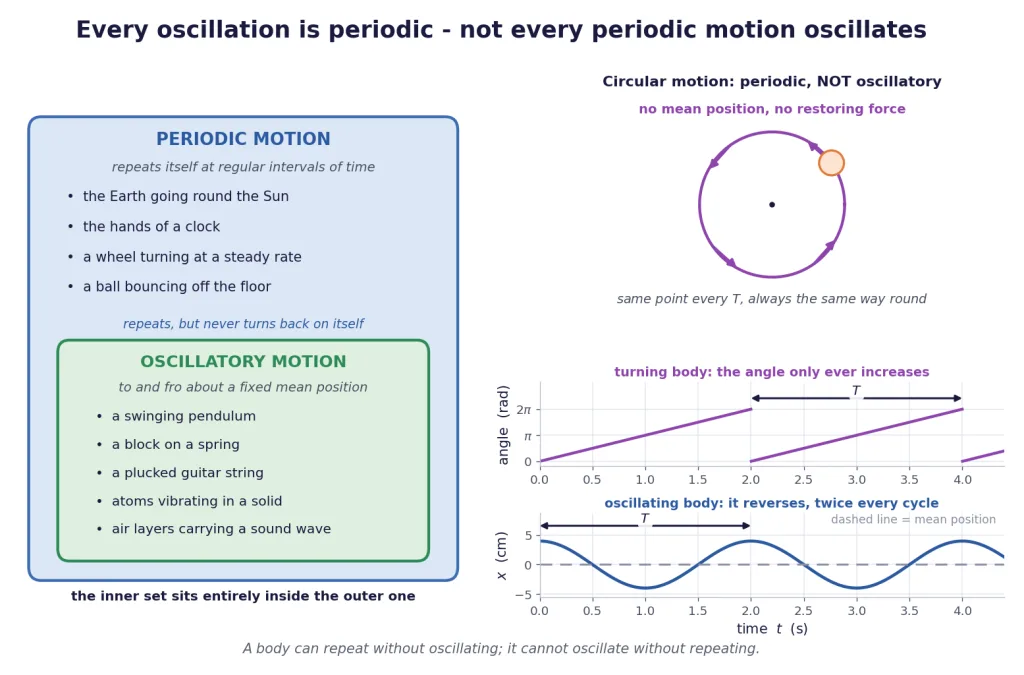
[Board Important] "Distinguish between periodic and oscillatory motion, with one example of each" is a two-mark question that appears constantly. The answer is three lines: periodic means it repeats at regular intervals; oscillatory means it repeats by moving to and fro about a mean position; circular motion is periodic but not oscillatory, a pendulum is both.
Oscillation, vibration — is there a difference?
Not a real one. Both words describe the same to-and-fro motion. In practice we tend to say oscillation when the repetition is slow enough to watch — a tree branch swaying, a pendulum, a swing — and vibration when it is too fast to follow, such as a guitar string or the prongs of a tuning fork. Use whichever word fits; no formula in this chapter cares which one you chose.
Why this is worth a whole chapter
Oscillations are not a curiosity. In a solid, every atom vibrates about its own place in the lattice, and the average energy of that vibration is what a thermometer reads as temperature. Sound reaches you because layers of air oscillate back and forth. The strings of a sitar, the membrane of a drum, the diaphragm in a loudspeaker — all oscillators. An AC supply drives a voltage that swings above and below zero many times a second. And when a huge number of oscillators are coupled together, their collective motion travels, which is what a wave is — the subject of the next chapter.
What Makes a Body Oscillate: the Restoring Force
Why does the pendulum come back? Nothing forces the Earth to reverse in its orbit, so what is different about the swing?
The answer is a force, and it is the single most important idea in this chapter.
Start at the equilibrium position
A body in periodic motion very often has an equilibrium position somewhere inside its path. At that position the net external force on it is zero. Put it there at rest and it stays there — forever, if nothing disturbs it.
Now displace it a little. A force appears. And the crucial fact is which way that force points:
Key Point — the restoring force:
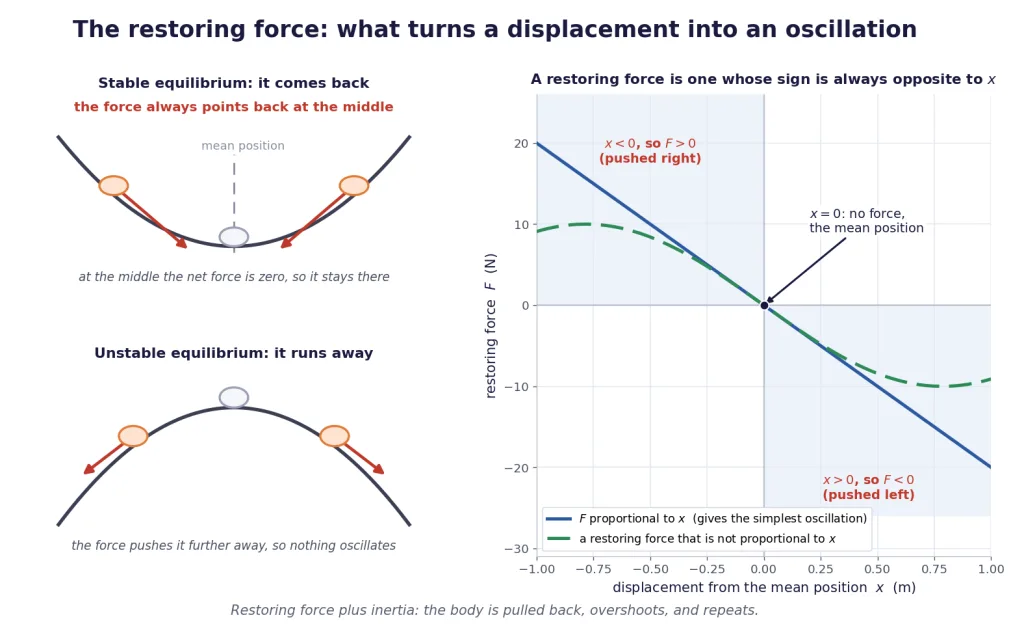
A restoring force is a force that always pushes or pulls the body back towards its mean position, and grows in strength the further away the body is taken. Its direction is always opposite to the displacement, and it is zero at the mean position itself.
A ball resting at the bottom of a bowl is the picture to keep. Push it a little up one side and gravity, acting along the curved surface, pulls it back down towards the bottom. Push it up the other side and the pull is the other way — still towards the bottom. Whichever side you choose, the force says come back.
The restoring force alone is not enough — inertia does the rest
If a restoring force were the whole story, the ball would simply slide back to the bottom of the bowl and stop. It does not, and the reason is inertia.
Follow one full trip:
- Released from the right-hand side, the ball is pulled towards the middle and speeds up on the way.
- It arrives at the middle moving fast. At that instant the restoring force is zero — but the ball's velocity is not, so it does not stop.
- It overshoots into the left-hand side. Now the restoring force points right, opposing the motion, and the ball slows down.
- It stops somewhere up the left side, is pulled back, and the whole thing runs again in reverse.
Key Point: Oscillation needs two ingredients: a restoring force to bring the body back, and inertia to carry it past. Take away the restoring force and the body never returns. Take away the inertia and it settles at the middle and stays. Together they produce a motion that repeats.
Stable and unstable equilibrium
Not every equilibrium position produces oscillation. Balance a ball exactly on top of a smooth dome and the net force on it is zero — it is in equilibrium. But nudge it, and gravity now pulls it further from the top. The force is not restoring; it is the opposite. The ball rolls away and never comes back.
| At the equilibrium point | Displace the body a little and the force | Result |
|---|---|---|
| Stable (bottom of a bowl) | points back towards the equilibrium | it oscillates |
| Unstable (top of a dome) | points further away from it | it runs away |
Only a stable equilibrium can be the mean position of an oscillation. That is the whole content of the distinction.
Where the rest of the chapter goes from here
The restoring force can depend on the displacement in all sorts of ways. There is one case that is simpler and far more important than the others: the case in which the restoring force is directly proportional to the displacement from the mean position, and directed towards it. That case is called simple harmonic motion, and the whole of the rest of this chapter is built on it.
When the restoring force is not proportional to the displacement, the motion is generally still oscillatory — the body still goes to and fro — but its period then depends on how far you pulled it in the first place. In the simple harmonic case it does not, which is a large part of why that case is so useful.
[JEE Tip] In real life friction and air resistance drain energy out of an oscillator and it eventually stops at its mean position. It can be kept going indefinitely by an external periodic push. These two effects — damping and forced oscillation — get their own sections later in this chapter, and both are heavily examined.
Period, Frequency and Angular Frequency
Three numbers describe how fast a periodic motion repeats. They carry the same information, they are trivially converted into one another — and mixing them up costs more marks in this chapter than anything else.
The period
Key Point — period:
The period is the smallest interval of time after which the motion repeats itself. Its SI unit is the second.
The word smallest is doing real work there. A pendulum that repeats every 2 seconds also repeats every 4 seconds and every 6 seconds, but its period is 2 seconds. When you read a period off a graph, you want the shortest gap that returns the curve to the same state.
Periods in nature run over an absurd range, so convenient sub-units and multiples are used:
| Oscillator | Period | Written as |
|---|---|---|
| Quartz crystal in a wristwatch | about 30.5 microseconds | 30.5 s |
| Tuning fork | about 1.95 milliseconds | 1.95 ms |
| Mains AC supply in India | 0.02 second | 20 ms |
| Human heart at rest | 0.8 second | 0.8 s |
| Earth's spin | 24 hours | 86400 s |
| Mercury's orbit | 88 Earth days | — |
| Halley's comet | 76 years | — |
The frequency
Turn the period upside down and you get the number of repetitions per second.
Key Point — frequency: The frequency is the number of complete oscillations per unit time. Its SI unit is the hertz, and
Two things to notice. First, is the Greek letter nu, not an italic — in this chapter always means frequency and always means speed. Second, a frequency need not be a whole number. A heart beating 75 times a minute has Hz, and there is nothing wrong with 1.25 of anything per second; it simply means 75 in sixty seconds.
The angular frequency — and the chapter's biggest trap
Here is the third number, and the one that causes the trouble.
Key Point — angular frequency: The angular frequency is measured in radians per second, and it is times the frequency.
Why ? Because one complete oscillation carries the motion through a full cycle, and a full cycle is radians of phase. Hertz counts whole oscillations per second; radians per second counts the phase swept out per second. Since every oscillation is worth radians, the two counts differ by exactly that factor.
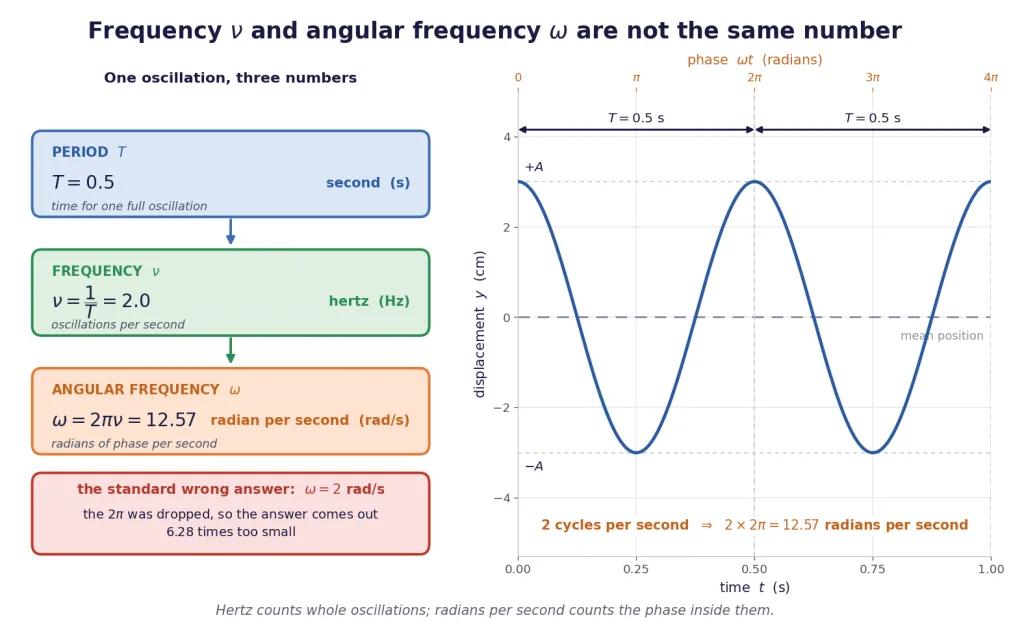
Key Point — say the unit out loud every single time:
- is in seconds.
- is in hertz, and hertz means oscillations per second.
- is in radians per second. It is never in hertz.
A question that asks for "the frequency" wants . A question that asks for "the angular frequency" wants . They differ by a factor of , and quoting one when the other was asked for is the commonest wrong answer in the whole chapter.
Work an example in both directions and the habit sticks.
Given the period, going down the chain. A body completes one oscillation in 0.5 second.
Given the angular frequency, going back up. A body oscillates with rad/s.
Three numbers for the same motions
| Motion | (Hz) | (rad/s) | |
|---|---|---|---|
| Human heart, 75 beats/min | 0.8 s | 1.25 | 7.854 |
| Swing, one full to-and-fro | 4 s | 0.25 | 1.571 |
| Mains AC supply | 0.02 s | 50 | 314.2 |
| Tuning fork | 1.953 ms | 512 | 3217 |
| Watch quartz | 30.52 s | 32768 | |
| Minute hand of a clock | 3600 s | ||
| Earth's spin | 86400 s |
Notice the last two rows. A clock hand and a spinning Earth are periodic without being oscillatory, and applies to them just the same. The relation belongs to periodic motion in general, not only to oscillations.
Notation for This Chapter
| Symbol | Meaning | Unit |
|---|---|---|
| period, time for one complete oscillation | s | |
| frequency, oscillations per second | Hz | |
| angular frequency, | rad/s | |
| displacement from the mean position | m (or the relevant unit) | |
| amplitude, the largest magnitude of | same as | |
| speed | m/s |
[JEE Tip] When a problem hands you a number and calls it , check the unit before you do anything else. "A particle oscillates with " and "a particle oscillates at 50 Hz" describe two completely different motions — the second one is times faster, with rad/s.
Displacement and Amplitude
Displacement is measured from the mean position
You met displacement earlier as the change in a body's position vector. In this chapter the word is used in a wider sense, and with one rigid rule attached to it.
Key Point: Displacement in an oscillation is always measured from the mean position. Not from the wall the spring is fixed to, not from the corner of the bench, not from where the body happened to be when you started the stopwatch. From the mean position, and from nowhere else.
That is why displacement in an oscillation takes both positive and negative values. On one side of the mean position it is positive, on the other side negative, and at the mean position it is exactly zero. Choose which side you call positive at the start and then stay with it.
This rule is not decoration. A block on a spring might oscillate between 12 cm and 28 cm from a wall. Its mean position is at 20 cm; its displacement runs from cm to cm; and the number 28 is not a displacement at all, it is a distance from a wall that has nothing to do with the physics.
Key Point — the case that catches everybody: for a mass hanging on a vertical spring, the mean position is the stretched equilibrium position, where the spring is already pulling up hard enough to balance the weight. It is not the spring's natural length. Measure displacement from the stretched position and the gravity term looks after itself.
Displacement need not be a length
Here is where the word does more work than usual. Displacement in this chapter means the change with time of whatever physical quantity is doing the oscillating. Sometimes that is a distance. Very often it is not.
| Oscillating system | The displacement variable is | Its unit |
|---|---|---|
| Block on a spring | distance from the equilibrium position | m |
| Simple pendulum | angle of the string from the vertical | rad (or degrees) |
| AC circuit | voltage across a capacitor, measured from its mean value | V |
| Sound wave in air | pressure change, measured from atmospheric pressure | Pa |
| Light wave | the electric and magnetic field strengths | V/m and T |
Why does this matter so much? Because the same mathematics then covers all of them. Once you can solve one oscillation, you have solved every system in that table — a spring, a swinging bob, a circuit and a sound wave are the same problem wearing different units. That single fact is why oscillations are worth studying so carefully.
[NEET Important] An angle can be a displacement, a pressure can be a displacement, a voltage can be a displacement. What cannot be one is a quantity that does not vary — the mass of the bob, the length of the string, the value of . If it is a fixed property of the apparatus, it is not a displacement variable.
Amplitude
Key Point — amplitude:
The amplitude is the maximum magnitude of the displacement from the mean position. It is taken as a positive number, and it carries the same unit as the displacement itself — metres, radians, volts, pascals.
The displacement therefore ranges over , and the body turns around at each end.
Three consequences that show up constantly:
- The full width of the motion is , not . The distance from one extreme to the other — sometimes called the peak-to-peak value — is twice the amplitude. If a graph swings between and , the amplitude is 8, not 16.
- In one complete oscillation the body covers a path length of . It travels out, back to the middle, out the other side and back again. Its displacement over that trip is zero; its path length is . The two questions are asked deliberately close together.
- The amplitude tells you nothing about the period. Two identical pendulums swinging through different angles can share a period exactly. Amplitude is about how far, period is about how long.
[Board Important] Write the amplitude with its unit, and state the mean position you measured from. A bare "8" answers nothing; "the amplitude is 8 cm about a mean position 20 cm from the wall" answers everything.
Reading a Periodic Graph, and Why Sines Run the Chapter
Taking the period off a graph
A displacement-time graph shows the whole history at once, and the period can be read straight off it — provided you read it correctly.
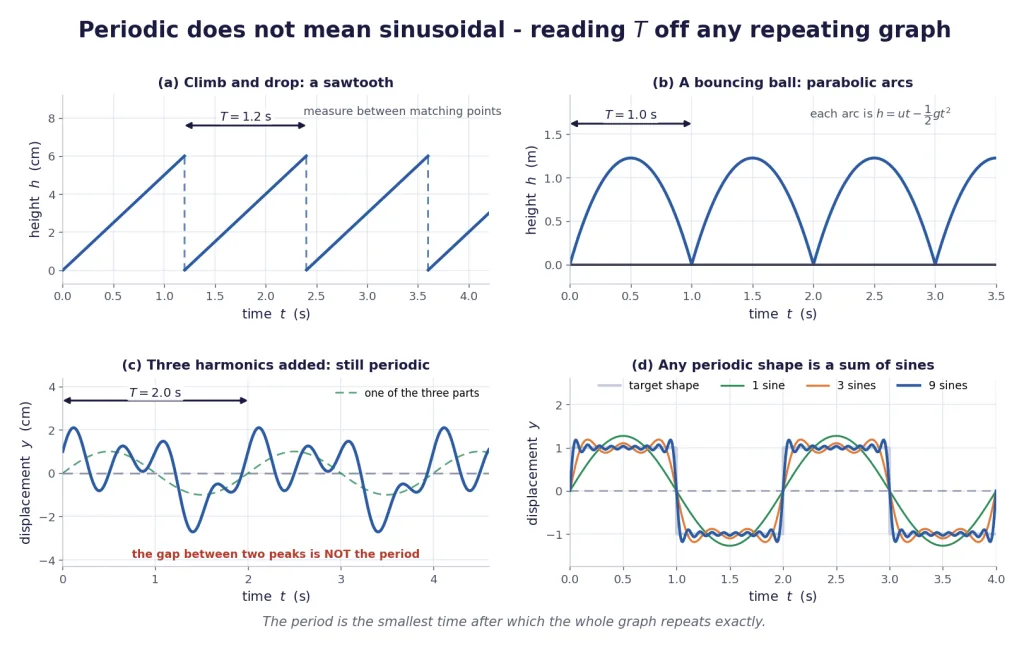
Key Point — how to read : find two points where the graph is doing exactly the same thing (same displacement and heading the same way), with the pattern in between repeated in full. The time between them is the period. Then take the smallest such gap.
The trap is to grab the wrong pair of points.
- Do not measure from a peak to the next trough. That is half a period at best, and on a lopsided curve it is not even that.
- Do not assume every peak is a period apart. A repeating pattern may contain a tall peak and a short one; the period is the gap between two tall peaks, because only then has the whole pattern repeated.
- Do check the direction of travel. The curve passes through zero twice in every cycle — once going up, once coming down — so "same displacement" alone is not enough.
Periodic does not mean sine-shaped
Nothing in the definition of periodic motion mentions a sine curve. An insect that climbs a ramp and drops off the end gives a sawtooth: a straight climb, an abrupt fall, repeat. A ball bouncing on the floor gives a chain of parabolic arcs, each one a piece of ordinary projectile motion, going up and coming down with the appropriate . Both graphs repeat perfectly, and neither is a sine curve anywhere.
So when you meet a graph made of straight lines, or arcs, or an odd wobbling shape, do not hesitate. If the pattern repeats, it has a period, and you read it off exactly the same way.
Testing a function for periodicity
Sometimes the motion is handed to you as a formula rather than a graph. The test is:
Key Point: A function is periodic if there is a positive number for which and the period is the smallest such .
Applied to the standard cases:
- and repeat when their argument grows by , so and .
- can be written as . The cosine inside has angular frequency , so the period is — half what you might have guessed.
- falls steadily and never returns to a value it has already had. Not periodic.
- climbs forever and likewise never repeats. Not periodic — and since it runs off to infinity, it cannot represent any physical displacement at all.
Adding periodic functions. If you add several periodic terms, the sum repeats at the smallest time that is a whole number of periods of every term at once. Take . With , the three terms have periods , and . After a time , the first term has completed 1 cycle, the second 2 and the third 4 — all whole numbers — so the sum repeats, and is the smallest time for which that is true. The period of the sum is .
The result that makes the whole chapter worthwhile
Look again at that sum. Three sines and cosines were added and out came a lumpy, distinctly non-sinusoidal curve — but still a perfectly periodic one. Push that idea to its limit and you get one of the great results of mathematics, proved by Jean Baptiste Joseph Fourier:
Key Point: Any periodic function whatever can be expressed as a superposition of sine and cosine functions of suitable amplitudes and frequencies.
A sawtooth, a square pulse, the pressure trace of a sitar note, the ragged repeating signal from a heart monitor — every one of them is a sum of sines and cosines, and nothing else is needed.
That is why the next several sections put so much effort into one single case: the motion whose displacement is a pure sine or cosine of time. It is not that nature only makes sine curves. It is that every periodic motion is built out of them, so understanding the sinusoidal case thoroughly means understanding all of them. The simplest oscillation turns out to be the building block of every oscillation there is.
Solved Examples
Conventions used throughout: is the frequency in hertz and the angular frequency in radians per second; ; m/s² where it is needed. Every answer states which of , and is being quoted, and in which unit.
Example 1: The beating heart
On average a human heart beats 75 times in a minute. Find its frequency, its period, and its angular frequency. How many beats is that in an hour?
Solution:
Frequency first — count the beats, divide by the time. The time must be in seconds: A frequency of 1.25 Hz is perfectly respectable; frequencies do not have to be whole numbers.
Period is the reciprocal: Sanity check: 0.8 second per beat, and seconds for 75 beats. Correct.
Angular frequency — multiply by , and change the unit:
Beats in an hour. At 1.25 per second for 3600 seconds:
Final Answer: Hz, s, rad/s, and 4500 beats in an hour.
Takeaway: Frequency is a count divided by a time, and the time goes in seconds before anything else happens. Then and follow mechanically — but write the unit on each of the three, because they are three different numbers.
Example 2: A tuning fork
A tuning fork is stamped 512 Hz. Find its period in milliseconds and its angular frequency. How many complete vibrations does it make in 2 minutes?
Solution:
Period: About two milliseconds per vibration — far too fast to see, which is why we call it a vibration rather than an oscillation.
Angular frequency: Note how much bigger this number is than 512. If you ever quote 512 rad/s you have dropped the .
Vibrations in 2 minutes. That is 120 seconds:
Final Answer: ms, rad/s, and 61440 complete vibrations.
Takeaway: The stamp on a tuning fork is a frequency in hertz, never an angular frequency. Anything labelled Hz needs multiplying by before it can go anywhere near a formula that wants .
Example 3: Working backwards from
A physical quantity varies periodically with angular frequency rad/s. Find the frequency and the period of the variation.
Solution:
Divide by to get the frequency: The cancels, which is why angular frequencies are so often quoted as a multiple of — it makes this step exact.
Reciprocate to get the period:
Check the whole chain the other way. From s, Hz and rad/s. Back where we started.
Final Answer: Hz and s.
Takeaway: Going down the chain you multiply by ; coming back up you divide by it. When is given as a multiple of , the division is exact and the answer is a clean number — a hint that the problem wanted all along.
Example 4: The mains supply, and the answer that is times wrong
The AC mains supply in India has a frequency of 50 Hz. Find its period and its angular frequency. A student writes " rad/s". By what factor is that wrong, and what is the correct value?
Solution:
Period: The voltage completes a full swing — positive, back through zero, negative, back again — fifty times a second.
Angular frequency: which is often written exactly as rad/s.
The student's error. Writing rad/s copies the number 50 across and keeps the wrong unit on it. The factor lost is exactly : So the quoted value is 6.283 times too small.
How to catch it every time. Ask what unit the number carries. 50 came with "Hz" attached, and hertz is not radians per second. Any number in hertz must be multiplied by before it can be called .
Final Answer: s and rad/s. The student's answer is too small by a factor of .
Takeaway: A number does not become an angular frequency by being called one. and are different physical quantities in different units; the bridge between them is and it is never optional.
Example 5: The quartz crystal in a wristwatch
The quartz crystal in a quartz watch is cut to vibrate at 32768 Hz. Find its period in microseconds and its angular frequency. Why is that particular frequency chosen?
Solution:
Period: Thirty microseconds — which is why quartz periods are quoted in microseconds rather than seconds.
Angular frequency:
Why 32768? Because . A simple electronic circuit can halve a frequency; do it fifteen times in a row and 32768 Hz becomes exactly 1 Hz, which is one tick of the second hand. No division by an awkward number is ever needed, so the watch keeps time to the accuracy of the crystal itself.
Final Answer: s and rad/s.
Takeaway: Very fast oscillators are quoted by frequency, very slow ones by period — nobody says a comet has a frequency of Hz, and nobody says a watch crystal has a period. Convert to whichever end of the chain the question is asking about.
Example 6: A block, a wall, and where the origin belongs
A block attached to a spring slides back and forth on a smooth horizontal surface. Measurements show that its distance from the wall varies between 12 cm and 28 cm, and it takes 0.4 second to travel from one extreme to the other. Find (a) the mean position, (b) the amplitude, (c) the range of the displacement, (d) the period, frequency and angular frequency, and (e) the path length covered in one complete oscillation.
Solution:
(a) The mean position is the midpoint of the two extremes: This is where the block would sit at rest, with the spring neither stretched nor compressed.
(b) The amplitude is the half-width, not the full width:
(c) The displacement runs from cm to cm, because displacement is measured from the mean position at 20 cm. The number 28 is a distance from a wall, and it never enters a formula.
(d) Timing. Going from one extreme to the other is half an oscillation, because a full oscillation is out and back again. So
(e) Path length in one oscillation. From the middle out to , back to the middle, out to , back to the middle: while the displacement over that same complete oscillation is zero, since the block ends where it began.
Final Answer: mean position 20 cm from the wall; cm; displacement from cm to cm; s, Hz, rad/s; path length 32 cm per oscillation.
Takeaway: Find the mean position first, then measure everything from it. Extreme-to-extreme is and takes half a period; one full oscillation covers a path of and a displacement of zero.
Example 7: Counting oscillations on a swing
A child on a swing goes from the highest point on one side, through the bottom, to the highest point on the other side, and back again — the whole trip taking 4 seconds. Find the frequency and the angular frequency. A classmate argues that since the swing passes the lowest point twice in 4 seconds, the frequency must be Hz. What has gone wrong?
Solution:
Identify one complete oscillation. The trip described — out, back, and out to the original side again — is exactly one full to-and-fro. So
Frequency and angular frequency:
What the classmate counted. Frequency counts complete oscillations per second, not passages through the mean position. A body crosses the mean position twice in every cycle — once going each way — so counting crossings gives exactly double the frequency. The answer 0.5 Hz is , not .
The same trap in other clothes. "The body is at its extreme position twice per cycle", "the speed is maximum twice per cycle", "the displacement is zero twice per cycle" — all true, and none of them is a frequency. One cycle means back to the start, moving the same way.
Final Answer: Hz and rad/s. The classmate counted mean-position crossings, which happen twice per cycle.
Takeaway: A cycle ends only when the body is back at the same point moving in the same direction. Anything that happens twice per cycle — zero displacement, maximum speed, reaching an extreme — will hand you double the frequency if you count it instead.
Example 8: Which of these functions are periodic?
Decide whether each of the following functions of time is periodic, and give the period where it is. Here is a positive constant. (i) (ii) (iii) (iv)
Solution:
(i) . Both terms repeat when their argument increases by , that is, after a time . Since they repeat together, so does the sum. Its graph is a wave swinging between and , so the amplitude of the combination is , not 1 and not 2.
(ii) . Take the terms one at a time. With , the first has period , the second has period , and the third has period . After a time the three terms have completed 1, 2 and 4 cycles — every one of them a whole number — so all three are back where they started and the sum repeats. No shorter time works, because the first term alone needs the full . This is periodic but not sinusoidal: the graph is a repeating lumpy shape with several bumps inside one period.
(iii) . This decreases steadily towards zero as grows and never returns to any value it has already taken. Not periodic.
(iv) . This increases without limit as grows, so it too never repeats. Not periodic — and because it runs away to infinity it could not represent a physical displacement even in principle.
Final Answer: (i) periodic, ; (ii) periodic, ; (iii) not periodic; (iv) not periodic.
Takeaway: A sum of sinusoids is periodic at the longest of the individual periods, provided the shorter ones fit a whole number of times inside it. A function that only ever rises, or only ever falls, cannot be periodic at all.
Example 9: The period of
Find the period of , and of . Are they the same?
Solution:
Rewrite the square using the double-angle identity. Since ,
Read off the angular frequency. The only time-dependent piece is , whose angular frequency is , not . Therefore Half the period of itself. Squaring doubled the frequency.
The constant matters too. The function oscillates about the value , not about zero, swinging between 0 and 1. Its mean position sits at and its amplitude is .
Now . Taking the modulus flips every negative hump up above the axis, so the pattern of one hump repeats after the time one hump takes, which is again The two functions have the same period, though they are not the same function — the modulus has sharp corners where it touches zero, and is smooth there.
Final Answer: Both have period .
Takeaway: Squaring a sinusoid, or taking its modulus, halves the period. Any time a question shows you a sine or cosine that has been squared, expect a factor of 2 in the angular frequency and check it with the double-angle identity before answering.
Example 10: Reading the period off a lumpy record
A recording of a body's displacement shows tall peaks at s, 1.2 s, 2.2 s and 3.2 s, and shorter peaks at s, 1.6 s, 2.6 s and 3.6 s. Between consecutive peaks the curve dips below the mean position by the same amount each time. Find the period, the frequency and the angular frequency of the motion.
Solution:
Ask what has to match. The period is the smallest time after which the whole pattern repeats — not just some feature of it. Here the pattern is "tall peak, then short peak".
Test the gap between neighbouring peaks, 0.4 s. Shift the record forward by 0.4 s and every tall peak lands where a short peak used to be. The curve does not map onto itself, so 0.4 s is not the period.
Test the gap between consecutive tall peaks, 1.0 s. Shift forward by 1.0 s: tall peaks land on tall peaks, short peaks on short peaks, dips on dips. Everything matches.
The other two numbers:
Final Answer: s, Hz, rad/s.
Takeaway: The period is the smallest shift that maps the graph exactly onto itself. On a curve with more than one kind of peak, the gap between neighbouring peaks is a fraction of the period, and quoting it is the standard mistake.
Example 11: Three displacements that are not lengths
Identify the mean position and the amplitude in each case, with units. (a) A pendulum bob swings so that the string reaches 15° either side of the vertical. (b) An AC voltage rises to V and falls to V about a mean value of zero, fifty times a second. (c) As a sound wave passes, the air pressure at a point varies between 101320 Pa and 101340 Pa.
Solution:
(a) The displacement is an angle. The mean position is the vertical, , because that is where the bob hangs at rest. The angular displacement ranges over , so the amplitude is Both forms are correct, but any calculation involving or must use the radian value.
(b) The displacement is a voltage. The mean value is zero, so the amplitude is and the period follows from the 50 in the question: s, with rad/s.
(c) The displacement is a pressure change. Here the mean position is not zero — it is atmospheric pressure, the midpoint of the two extremes: Ten pascals on top of a hundred kilopascals — sound is a very small ripple on a very large steady pressure, which is exactly why we measure the displacement from the mean.
Final Answer: (a) mean at the vertical, amplitude rad; (b) mean at zero, amplitude 325 V; (c) mean at 101330 Pa, amplitude 10 Pa.
Takeaway: Whatever the oscillating quantity is, the recipe is identical: find the middle value, and the amplitude is half the full swing. The unit of the amplitude is simply the unit of the thing that is oscillating.
Example 12: Is this force a restoring force?
A body moving along a straight line experiences a force newtons, where is its displacement from the origin in metres, and the origin is the body's equilibrium position. Find the force when the body is at cm, at cm, and at . Explain in each case which way the force points, and say whether the body will oscillate.
Solution:
Convert to SI before substituting. cm m.
At cm: The minus sign is not a "negative force" — it is a direction. The displacement was in the direction, so a negative points in the direction: back towards the origin.
At cm: Now the displacement is to the left and the force is to the right — again, back towards the origin. Same magnitude, opposite direction.
At : No force at the mean position, which is exactly what makes it the equilibrium position: left there at rest, the body stays.
Does it oscillate? Yes. The force is zero at the origin, is directed towards the origin on both sides, and grows with distance — the definition of a restoring force. Displace the body and it is pulled back; its inertia carries it through the middle; it overshoots to the other side and is pulled back again.
Final Answer: N at cm and N at cm, both directed towards the origin; at . The body oscillates about the origin.
Takeaway: The minus sign in a restoring force is the whole physics of it. It says the force and the displacement always point opposite ways, which is what guarantees a return, and it is why and can never carry the same sign in an oscillation.