
Multiply the Acceleration by the Mass
The previous section ended with the one relation that defines simple harmonic motion:
That is a statement about kinematics — about how the motion looks. To turn it into physics, ask what has to be pushing the particle around to make it move like that. Newton's second law answers it in one step. Multiply both sides by the mass :
The combination is made of two constants, so it is itself a constant. Call it :
Key Point — the force law of SHM: The force on a particle in simple harmonic motion is proportional to the displacement from the mean position and directed opposite to it. Since it always drives the particle back towards the centre, it is called the restoring force.
This is Hooke's law — the same law you meet for a stretched spring, where is the spring constant measured in newtons per metre. A spring with N/m pulls back with 200 N for every metre you stretch it, so 4 cm of stretch gives 8 N.
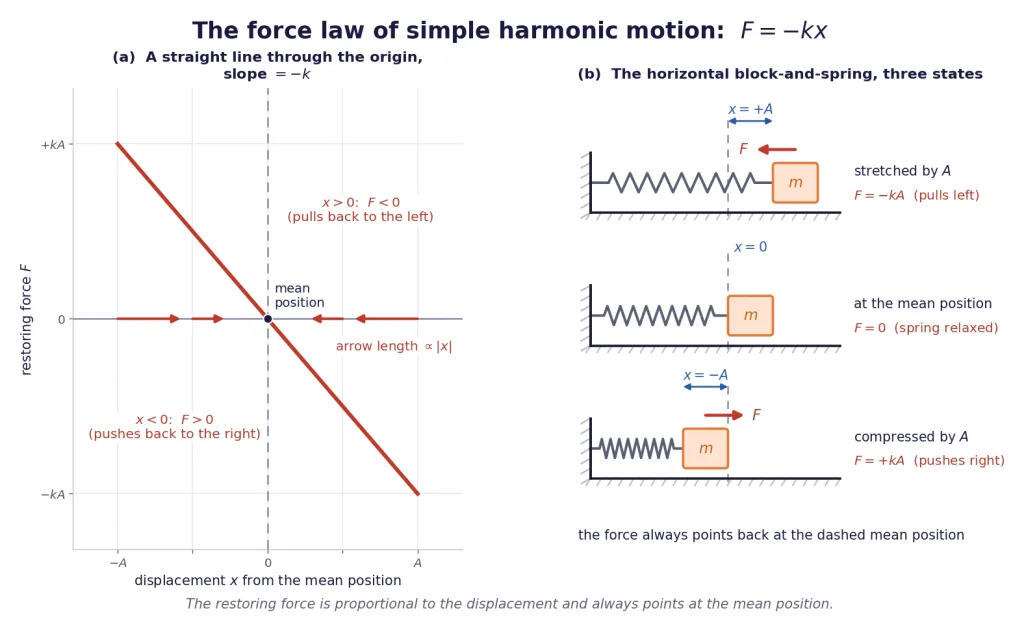
Reading the constant both ways
The relation can be turned round, and the turned-round version is the one you will use in almost every problem:
Key Point — the two workhorse formulas: Here is the angular frequency in radians per second and is the frequency in hertz. They differ by a factor of and are never interchangeable.
Check the units once and you will never doubt the formula again. is in N/m, which is ; dividing by a mass in kg leaves ; the square root is , which is what rad/s means, because a radian is a pure number. Turn the fraction upside down and comes out in seconds, exactly as a period should.
The converse — and this is the useful half
So far is a consequence of the motion being simple harmonic. The statement that earns its keep runs the other way.
Key Point — the test:
If the net force on a body of mass is with measured from the equilibrium position, then the body executes simple harmonic motion, with that constant playing the role of : Nothing else has to be true. The body need not be on a spring, and there need not be a spring anywhere in the problem.
A body oscillating under a force that is linear in the displacement is called a linear harmonic oscillator. That word "linear" is doing real work: it means the graph of against is a straight line through the origin. If the force also contains terms in or , the system is a non-linear oscillator, it is not simple harmonic, and none of the formulas above apply to it.
| If the net force is | The motion is | Period |
|---|---|---|
| simple harmonic | ||
| periodic but not SHM | depends on the amplitude | |
| not oscillatory at all — it runs away | none | |
| uniform acceleration | none |
[Board Important] "State and explain the force law for simple harmonic motion" is a standard three-marker. Start from , multiply by , define , and finish with and , naming as the spring constant in N/m.
The Block and Spring, Worked in Full
Here is the system the whole chapter keeps coming back to. A block of mass rests on a frictionless horizontal surface. One end of a light spring of spring constant is fixed to a rigid wall; the other end is attached to the block.
Setting it up
Leave the block alone and it settles at the position where the spring is neither stretched nor compressed — its natural length. That resting position is the mean position, and we measure the displacement from there, taking the direction away from the wall as positive.
Now pull the block a distance to the right and let go.
Find the force. The spring is stretched by , so by Hooke's law it pulls the block back towards the wall with a force of magnitude . Since that force points in the direction while the displacement is in the direction, Push the block to the left instead and the spring is compressed by , so it pushes the block back to the right. The displacement is now negative and the force positive — and describes that case too, with no change of sign needed. One equation covers both sides, which is exactly why the minus sign is written into the law.
Apply Newton's second law.
Compare with the test. This is , with the constant equal to . So the block executes simple harmonic motion, and
That is the whole derivation. Three lines, and it is worth being able to write them from memory.
What the period is made of
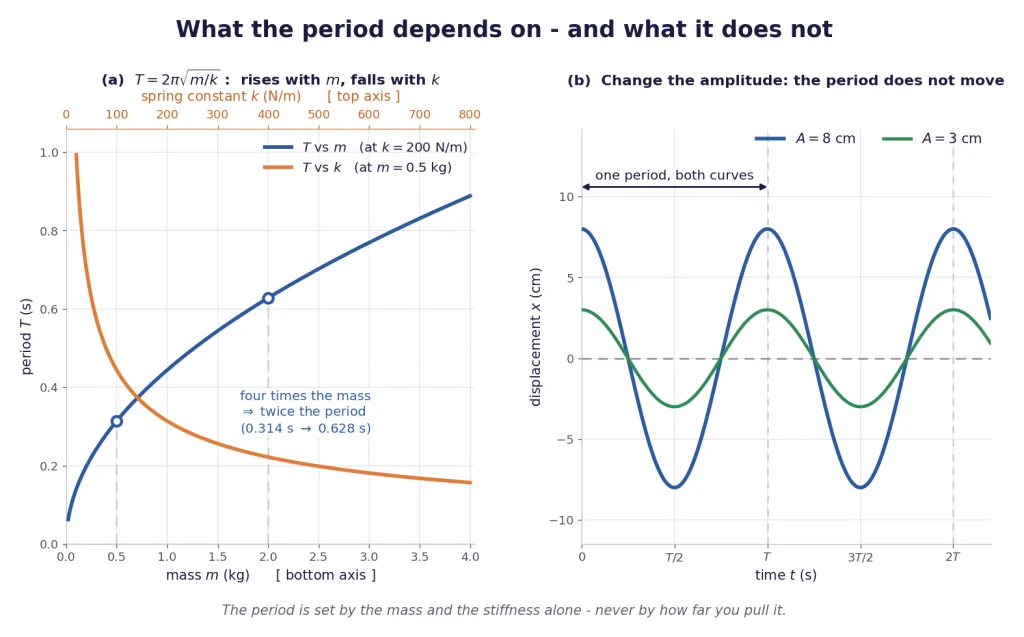
Only two quantities appear, and they pull in opposite directions.
| Change | Effect on | Reason |
|---|---|---|
| heavier block ( up) | period rises as | more inertia, so the same force produces less acceleration |
| stiffer spring ( up) | period falls as | a bigger restoring force for the same displacement |
| bigger amplitude | no change | does not appear in the formula at all |
| stronger gravity | no change | does not appear either |
Because of the square roots, the responses are gentler than students expect. Quadrupling the mass only doubles the period; to halve the period you must make the spring four times as stiff.
Everything else follows from
Once is known, the results of the previous section give the rest of the motion immediately. For a block released from rest at ,
The last one is worth a second look: is just Hooke's law evaluated at the largest displacement, and it must equal . It does — .
[JEE Tip] A great many spring problems are solved the moment you write . Get first, in rad/s, before touching anything else; then convert to or only if the question actually asks for them.
The Vertical Spring, and Where the Goes
Hang the same spring from the ceiling and attach the same block to its lower end. Now gravity is pulling on the block the whole time. Surely the period must change?
It does not. Here is why, and this argument is worth learning properly, because misreading it is one of the two commonest sources of wrong answers in this chapter.
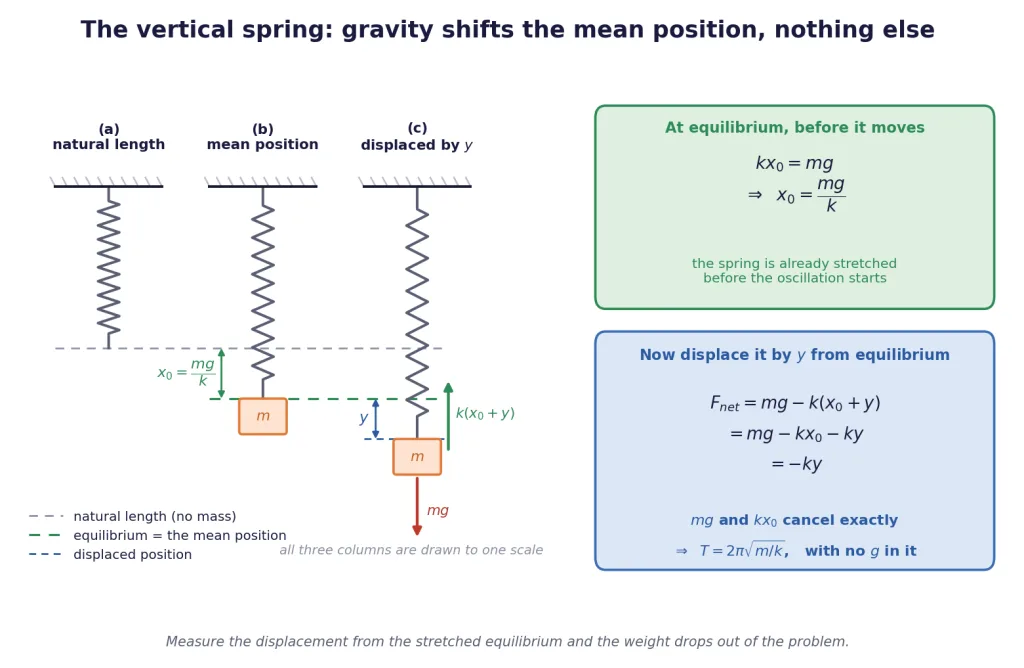
Step 1: find the new equilibrium
Attach the block gently and let it settle. The spring stretches until its upward pull balances the weight. Call that stretch :
The block now hangs at rest a distance below the natural length of the spring. That resting point — not the natural length — is the mean position of the oscillation that follows.
Key Point: Displacement in simple harmonic motion is always measured from the mean position. For a hanging mass the mean position is the stretched equilibrium, a distance below the spring's natural length.
Step 2: displace it and watch the weight cancel
Pull the block down a further distance from that equilibrium and release it. Two forces act:
- gravity, , downwards, unchanged;
- the spring, now stretched by a total of , pulling up with .
Take downwards as positive and add them:
But from Step 1, so those first two terms are equal and opposite and destroy each other:
There is no left anywhere. The equation is identical to the horizontal case with in place of , so
exactly as before.
Key Point — the vertical spring: with no in it.
Gravity does not change the period of a spring-mass oscillator. All it does is shift the mean position downwards by . Measure the displacement from that shifted position and gravity drops out of the problem completely.
Measuring from the natural length instead leaves a stray in the force expression, the force is no longer of the form , and every number after that point is wrong. When a hanging mass appears in a question, the first thing to write down is where the equilibrium is.
The useful by-product
Because gives , the period can be written in a second form:
Key Point: where is the static stretch — how far the spring sagged when the mass was hung on it.
This is a small gift. Measure how much a spring stretches under a load with a ruler, and you can predict the period of the oscillation without ever knowing the mass or the spring constant separately. A spring that sags 5 cm under its load will oscillate with a period of about 0.45 second, whatever the load is.
[NEET Important] Two spring-mass systems that sag by the same amount under their own loads have the same period, even if one carries a 100 g mass and the other 10 kg. The heavier mass needs the stiffer spring to sag equally, and the extra and the extra cancel in .
[JEE Tip] The same cancellation happens in a lift accelerating upwards with acceleration , or anywhere else a constant extra force acts. The equilibrium shifts to , but the restoring force about that point is still , so is unchanged. Any constant force shifts the mean position and leaves the period alone.
The Recipe: How to Show Anything Is Simple Harmonic
Most oscillating systems you will be asked about have no spring in them at all — a floating block bobbing in water, mercury sloshing in a bent tube, a marble rolling in a bowl. They are all handled by the same four steps, and once the steps are habitual these problems take about three lines each.
Key Point — the four-step recipe:
- Locate the equilibrium and measure the displacement from there.
- Displace the system by a small and find the net force that appears — the force that was not there before you moved it.
- Show that force is , with a positive constant. If it is, the motion is simple harmonic.
- Read off the constant: , then and .
Step 3 is the whole test. If the net force comes out proportional to , or to with not small, the motion is not simple harmonic and there is no to be had.
The mass to use in step 4 is the mass of everything that is moving, which is not always the obvious thing — in the U-tube below it is the whole liquid column, not the bit that sticks up.
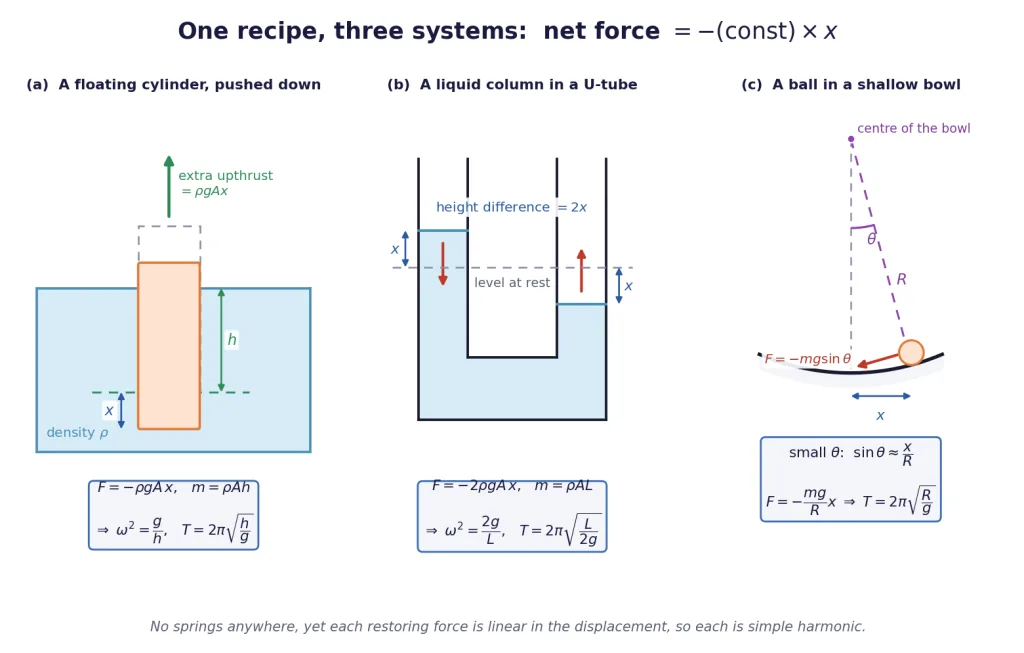
A floating cylinder pushed down
A cylinder of cross-sectional area floats upright in a liquid of density , sunk to a depth . Floating means the upthrust already balances the weight, so is the equilibrium.
Push it down a further distance . The extra submerged volume is , so the extra upthrust is the weight of that extra liquid:
Linear in , so this is simple harmonic. The moving mass is the cylinder's own mass, and since it floats, that equals the mass of liquid it displaced at equilibrium: . Therefore
Both and cancelled. The period depends only on how deep the thing floats — a fact worth remembering, because it makes the answer independent of how wide the cylinder is.
A liquid column in a U-tube
A U-tube of uniform cross-section holds a liquid of density ; the total length of the liquid column is . At rest the two surfaces are level.
Push the liquid so that one surface falls by and the other rises by . The height difference between the two surfaces is now , and the unbalanced weight is that of a column of height :
Linear again. The moving mass is the entire column, , so
The density cancels: mercury and water in identical tubes oscillate with identical periods. The factor of 2 is the whole question. It appears because the level difference is when each surface moves by , and dropping it is the standard mistake here.
A ball in a shallow bowl
A small ball rests at the bottom of a bowl whose inner surface is part of a sphere of radius . Displace it so that the radius to the ball makes an angle with the vertical. The component of gravity along the surface is , directed back towards the bottom:
That is not linear in the displacement — until is small. For small (in radians), , and the arc length from the bottom is , so and
The mass cancels, so a marble and a cannonball roll in the same bowl with the same period. (If the ball is large enough that its own rolling matters, some of the energy goes into spinning it and the period comes out a little longer; for a small ball, or one sliding on a smooth surface, the result above is the one to use.)
The three results together
| System | Restoring force | Period | |
|---|---|---|---|
| block on a spring, | |||
| cylinder floating at depth | |||
| liquid column of length in a U-tube | |||
| ball in a bowl of radius |
Notice the shape they share. Each period is times the square root of "something that measures the inertia" divided by "something that measures the stiffness of the restoring pull". The spring case has and ; the other three have a length and .
[JEE Tip] In step 2, find the change in the force, not the total. At equilibrium the forces already balance, so the balanced parts are guaranteed to cancel — exactly as cancelled against for the vertical spring. Writing only the new, unbalanced part is faster and much harder to get wrong.
Why the Period Ignores the Amplitude
Look once more at
The amplitude is simply not in it. Pull the block out 1 cm or 10 cm and it takes exactly the same time to come back. This property has a name — isochronism — and it is what makes oscillators useful as clocks.
Why it works out that way
At first hearing it sounds impossible: surely a bigger swing takes longer, because there is further to travel? There is, but two effects arrive together and cancel exactly.
- Double the amplitude and the path length doubles.
- Double the amplitude and the restoring force at every corresponding point also doubles, because is linear. Double the force means double the acceleration, which means the block is moving twice as fast at every corresponding point ().
Twice the distance covered at twice the speed takes the same time. The cancellation is exact only because the force is exactly proportional to . That is the deep reason the linearity matters: it is what buys isochronism.
Key Point:
For a linear harmonic oscillator the period is independent of the amplitude. It depends only on the inertia () and the stiffness () — and, in the systems above, on nothing else at all.
The small print: "for small displacements"
Every result in this section rests on the restoring force being linear, and in the real world that is an approximation which holds only over a limited range.
| System | The linear law holds while | It fails when |
|---|---|---|
| a real spring | the deformation stays within the elastic limit | it is stretched so far that it deforms permanently, or coil-bound |
| ball in a bowl | is small enough that | the ball is released near the rim |
| floating cylinder | it stays upright and partly submerged throughout | it is pushed under, or lifts clear of the liquid |
| U-tube | the surfaces stay in the straight arms | the liquid spills, or one surface enters the bend |
Stretch a spring too far and the force picks up extra terms, something like
The motion is still periodic and still symmetric, but it is no longer simple harmonic, and its period now does depend on the amplitude. For a stiffening spring like the one above, the period gets shorter as the amplitude grows.
Key Point — the assumption behind the whole chapter:
"Simple harmonic" almost always means "for small displacements about equilibrium". Small enough that the restoring force has not yet started to curve away from a straight line. Whenever a problem says "small oscillations", it is telling you that you are allowed to use and everything that follows from it.
Why is that assumption so often good? Because almost any restoring force, however complicated, looks like a straight line if you zoom in close enough to the equilibrium point — the same way any smooth curve looks straight over a short enough stretch. That is the real reason simple harmonic motion turns up in so many unrelated corners of physics: not because nature is fond of springs, but because near a stable equilibrium, nearly everything behaves like one.
[Board Important] A one-mark favourite: does the period of a spring-mass system depend on the amplitude? No — provided the spring stays within its elastic limit. Both halves of that answer are wanted.
Solved Examples
Conventions used throughout: m/s²; springs are light and obey Hooke's law; surfaces are frictionless unless stated. is the angular frequency in radians per second and the frequency in hertz — the two differ by a factor of , and both are quoted with their units. Displacement is measured from the mean position in every case. .
Example 1: A spring constant straight off a ruler
A light spring hangs from a hook. When a 2 kg block is attached, the spring stretches by 5 cm and the block hangs at rest. Find (a) the spring constant, (b) the angular frequency, period and frequency of the vertical oscillations the block performs if it is now pulled down a little and released.
Solution:
(a) The static stretch gives . At rest the spring's pull balances the weight: Note the conversion: cm m. Leaving it in centimetres would make a hundred times too small.
(b) Angular frequency.
Period and frequency — keep them apart. Check: rad/s, which is again.
A second route to the same period. Since , Same answer, and it never needed or at all.
Final Answer: N/m; rad/s, s, Hz.
Takeaway: A hanging mass measures its own spring constant: . And the period follows from the sag alone, through .
Example 2: The horizontal oscillator, end to end
A block of mass 0.5 kg on a frictionless horizontal table is attached to a spring of spring constant 200 N/m whose other end is fixed to a wall. The block is pulled 4 cm from its equilibrium position and released from rest at . Find (a) , and , (b) the displacement as a function of time, (c) the maximum speed, the maximum acceleration and the maximum force on the block, and (d) the speed when the block is 2 cm from the mean position.
Solution:
(a) The constants.
(b) The motion. Released from rest at the extreme means m and phase constant zero in the cosine form:
(c) The three maxima. Cross-check the last two against each other: N. They agree, as they must.
(d) Speed at cm. No need to find the time — use the relation from the previous section: That is , which is sensible: halfway out, the block has lost only about 13 per cent of its top speed.
Final Answer: rad/s, s, Hz; m; m/s, m/s², N; and m/s at cm.
Takeaway: Compute first and everything else is a substitution. And should always match — a free check on your arithmetic.
Example 3: The vertical spring with no numbers to spare
A block hangs at rest from a light vertical spring, which it has stretched by 4 cm. The block is pulled down slightly and released. Find the period and the frequency of the resulting oscillation. Neither the mass nor the spring constant is given.
Solution:
Recognise that you do not need them. At the hanging equilibrium , so The mass and spring constant only ever enter the period as this ratio, and the ratio is fixed by the sag.
Substitute. With cm m,
The other two quantities. Check by a second route: rad/s. Agreed.
Convince yourself the mass really is irrelevant. A 0.25 kg block sagging 4 cm needs N/m, giving s. A 7.5 kg block sagging 4 cm needs N/m, giving s. Identical.
Final Answer: s, Hz, rad/s.
Takeaway: A hanging spring's period is fixed by its sag: . No appears in ; it appears here only because was measured under gravity in the first place.
Example 4: Working backwards to a mass
In a laboratory a 300 g mass on a spring oscillates with a period of 0.6 second. Find (a) the spring constant, and (b) the mass that would have to be used, on the same spring, to make the period 0.9 second.
Solution:
(a) Invert the period formula. Square both sides of : With kg and s, Sanity check: rad/s, and N/m. Agreed, since .
(b) Use the proportionality instead of starting again. At fixed , , so :
Check the long way. kg. Agreed.
Frequencies, for completeness. Hz and Hz — slower, as a heavier mass must be.
Final Answer: N/m; the required mass is kg, that is 675 g.
Takeaway: Ratios beat re-derivation. at fixed , so the mass scales as the square of the period — 1.5 times the period needs 2.25 times the mass.
Example 5: A wooden cylinder bobbing in water
A cylindrical wooden block of length 20 cm and density 800 kg/m³ floats upright in water of density 1000 kg/m³. It is pushed down slightly and released. Find the period and the frequency of the vertical oscillations.
Solution:
How deep does it float? Floating means the weight of the block equals the weight of liquid displaced. With cross-sectional area and submerged depth , So 16 cm of the 20 cm is under water.
Push it down by and find the extra force. The extra volume submerged is , so the extra upthrust is , upwards: Linear in , so the motion is simple harmonic.
Read off . The moving mass is , so The area and the density both cancelled.
Period and frequency. Or directly, s.
Final Answer: s and Hz (with rad/s).
Takeaway: For a floating body, with the submerged depth. The cross-sectional area never matters, and the densities enter only through .
Example 6: Mercury sloshing in a U-tube
A U-tube of uniform bore contains mercury. The total length of the mercury column is 30 cm. The mercury is displaced slightly and released. Find the period of the oscillation, and state what would change if water were used instead.
Solution:
Displace and find the unbalanced force. If one surface falls by , the other rises by , so the height difference is . The unbalanced weight is that of a mercury column of height and cross-section :
Identify the moving mass. The whole column moves, not just the raised part: This is the step that decides the answer, and the one most often got wrong.
Read off .
Period and frequency.
Water instead of mercury? Nothing changes. The density cancelled at step 3 and never reappears, so a 30 cm column of water in the same tube oscillates with the same period of 0.7773 second.
Final Answer: s ( Hz), and the answer is identical for any liquid.
Takeaway: for a U-tube, with the total column length. Forget the factor of 2 and you get 1.0993 s — the commonest wrong answer to this question.
Example 7: A marble in a bowl
A small marble is placed at the bottom of a large bowl whose inner surface is spherical with radius 50 cm. It is displaced a small distance along the surface and released. Find the period of the resulting oscillation.
Solution:
Displace by an angle . The forces on the marble are its weight and the normal reaction from the bowl. The reaction is along the radius, so the only force along the surface is the tangential component of the weight, , pointing back towards the lowest point:
Make it linear. For a small displacement, (in radians) is small and . The distance along the surface from the lowest point is , so and The constant in the brackets plays the part of .
Read off . The mass cancels immediately:
Period and frequency.
How small is "small"? Released at the true period is about 0.05 per cent longer than this; at about 0.19 per cent longer. Both are well inside the precision of any answer you would quote, which is what makes the approximation safe.
Final Answer: s, Hz.
Takeaway: A ball in a bowl of radius has , independent of its mass. The small-angle step is where "simple harmonic" enters; without it the motion is periodic but not simple harmonic.
Example 8: A bare force law
A body of mass 0.2 kg moves along the -axis under a force newtons, where is its displacement from the origin in metres. Show that the motion is simple harmonic and find its period. If the amplitude is 6 cm, find the maximum speed, the maximum acceleration and the maximum force.
Solution:
Apply the test. The force is , with the constant N/m. That is exactly the form , so the motion is simple harmonic with N/m.
Angular frequency.
Period and frequency. Do not confuse the two: rad/s and Hz describe the same motion.
The three maxima with m. Consistency check: N. Agreed.
Final Answer: SHM with N/m; rad/s, s, Hz; m/s, m/s², N.
Takeaway: When a force law is handed to you in the form , the constant is , in N/m. Check the units of before using it — if they are not N/m, the quantity in the bracket is not a displacement.
Example 9: The oscillator in a lift
A block of mass 1 kg hangs from a light spring of spring constant 100 N/m inside a lift. Find (a) the extension of the spring when the lift is at rest, (b) the extension when the lift accelerates upwards at 2 m/s², and (c) the period of small vertical oscillations of the block in each case.
Solution:
(a) Lift at rest. The spring's pull balances the weight:
(b) Lift accelerating upwards at m/s². Now the net upward force on the block must be , so the spring must pull harder: The equilibrium has moved down by 2 cm.
(c) The period, in both cases. Measure the displacement from whichever equilibrium applies. In the lift at rest the balanced pair is against ; in the accelerating lift it is against . Either way the balanced parts cancel and what is left is so in both cases
Final Answer: extensions of 9.8 cm and 11.8 cm respectively; the period is s in both cases.
Takeaway: A constant extra force moves the mean position and leaves the period alone. Gravity, a lift's acceleration, a steady electric force — each shifts the equilibrium and none of them changes .
Example 10: Reading a force-displacement graph
The restoring force on a 0.4 kg body is measured at several displacements and plotted against displacement. The points lie on a straight line through the origin with slope N/m. Find the angular frequency, period and frequency of the body's oscillation.
Solution:
What the graph is telling you. A straight line through the origin means . Comparing with : The negative slope is what makes it a restoring force; a positive slope would describe a system that flies apart.
Angular frequency.
Period and frequency.
Final Answer: rad/s, s, Hz.
Takeaway: The magnitude of the slope of an - graph is ; the fact that it is negative and passes through the origin is what certifies simple harmonic motion. A line that misses the origin usually just means was measured from the wrong place.
Example 11: A bobbing cylinder as a measuring instrument
A uniform cylinder of length 25 cm floats upright in an unknown liquid. Pushed down slightly and released, it bobs with a period of 0.9 second. Find (a) the depth to which it is submerged, and (b) the ratio of the cylinder's density to the liquid's.
Solution:
(a) Invert the floating-body formula. From , So it floats 20.11 cm deep. Check by substituting back: s.
(b) The density ratio. Floating requires the weight of the cylinder to equal the weight of liquid displaced, which for a uniform cylinder of length submerged to depth gives
Is that sensible? The ratio is less than 1, as it must be for anything that floats, and about 80 per cent of the cylinder is below the surface — which matches the picture.
Final Answer: submerged depth m (about 20.1 cm); density ratio .
Takeaway: Timing the bob measures the submerged depth, and the submerged depth measures the density ratio. Both directions of are examinable.
Example 12: Where the linear law runs out
A body of mass 0.1 kg is acted on by a restoring force newtons, with in metres. (a) Find the period of very small oscillations. (b) Find the amplitude at which the cubic term reaches 1 per cent of the linear term. (c) Comment on what happens to the period at large amplitude.
Solution:
(a) For small , drop the cube. When is small, is very much smaller than , so
(b) When does the cube start to matter? Set the cubic term equal to 1 per cent of the linear term: So for amplitudes below about 28 cm, treating the force as is good to better than 1 per cent — which is why a small-amplitude answer of s is trustworthy at, say, 5 cm.
(c) At large amplitude. The extra always adds to the restoring force, so far out the body is pulled back harder than Hooke's law alone would manage. A stronger pull means a quicker return, so the period shortens as the amplitude grows. The motion stays periodic, but it is no longer simple harmonic, and it is no longer isochronous — the period now depends on the amplitude, which for a genuine linear oscillator it never does.
Final Answer: s ( rad/s, Hz) for small oscillations; the cubic term reaches 1 per cent of the linear one at an amplitude of about 0.283 m; beyond that the period shortens with increasing amplitude.
Takeaway: "Simple harmonic" is a small-amplitude statement. Keep only the term linear in , read off it, and be honest about the range over which that is allowed.