
A Ball on a String, Seen Edge-On
You already have the equation of simple harmonic motion, . This section gives you a picture of it — and the picture is worth having, because a whole family of questions that are ugly with a calculator become one line of geometry once you can draw it.
Here is the experiment. Tie a small ball to a string and whirl it in a horizontal circle at a steady rate, so it is in uniform circular motion. Now crouch down until your eye is level with the plane of the circle, and look at the ball edge-on. You no longer see a circle at all: you see the ball sliding to and fro along a straight line, fastest in the middle, slowing to a stop at each end, then coming back. Shine a light on it from the side instead and its shadow on the wall does exactly the same thing.
What you are watching is the ball's projection onto one diameter of the circle. And that projection is not merely "something like" an oscillation. It is simple harmonic motion, exactly.
The mathematics behind the shadow
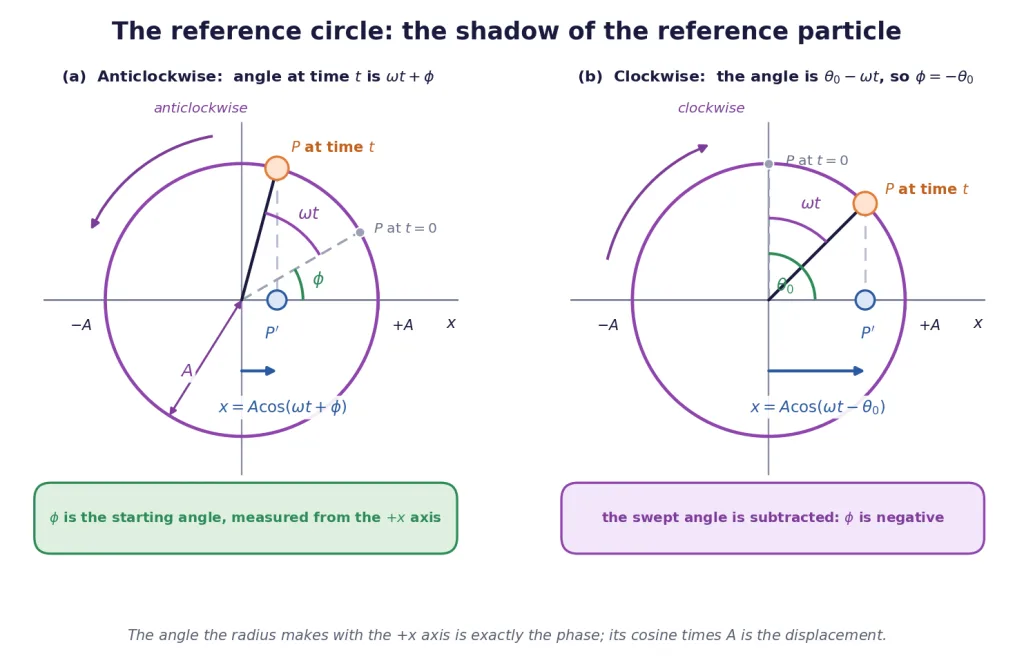
Let a particle move anticlockwise round a circle of radius centred at the origin, with a constant angular speed . At let the radius make an angle with the positive -axis.
In a time the radius sweeps through a further angle , because the angular speed is constant. So at time the radius makes an angle with the positive -axis. Drop a perpendicular from onto the -axis and call its foot . Straight from the definition of the cosine, the -coordinate of — which is the position of — is
That is the defining equation of SHM, arrived at with no calculus and no dynamics, purely by dropping a perpendicular.
Key Point — the reference circle:
If a particle moves uniformly on a circle of radius with angular speed , then its projection on any diameter of that circle performs simple harmonic motion of amplitude and angular frequency .
is called the reference particle and its circular path the reference circle.
The other diameter gives a sine
Nothing forced us to project onto the -axis. Project the same motion onto the -axis and the -coordinate of is which is simple harmonic too, with the same amplitude and the same angular frequency, differing from the first only by a phase of . One circular motion therefore contains two simple harmonic motions at right angles, a quarter cycle apart — a fact this section returns to at the end.
One warning, and it is examined
Key Point: Uniform circular motion is not simple harmonic motion. SHM is a to-and-fro motion along a straight line; the reference particle goes round and round and never reverses. What is simple harmonic is the projection, the shadow, not the particle itself.
The forces are different too. Keeping on the circle needs a centripetal force of constant magnitude, always pointing at the centre. Driving along the diameter needs a force that reverses direction every half cycle and vanishes at the middle. Two very different physical situations that share one piece of geometry.
[Board Important] "Show that the projection of a uniform circular motion on a diameter is simple harmonic" is a standard three-marker. The full answer is the four lines above: draw the circle, state that the angle at time is , project, and quote as the definition of SHM.
Everything Read Off the Picture
The reference circle is useful because every symbol in is something you can point at on the diagram. Learn this dictionary and half the section is done.
| In the equation | On the reference circle |
|---|---|
| amplitude | the radius of the circle |
| angular frequency | the angular speed of the reference particle, in rad/s |
| phase | the angle the radius makes with the axis at time |
| phase constant | the starting angle, the angle made at |
| displacement | the foot of the perpendicular from to the -axis |
| period | the time for one complete revolution |
| one full oscillation | one full trip round the circle, worth of angle |
The third row is the one to hold on to.
Key Point: The angle swept is the phase. Not something proportional to it, not something like it — the angle the radius vector makes with the axis, measured in radians, is the phase . The starting angle is the phase constant .
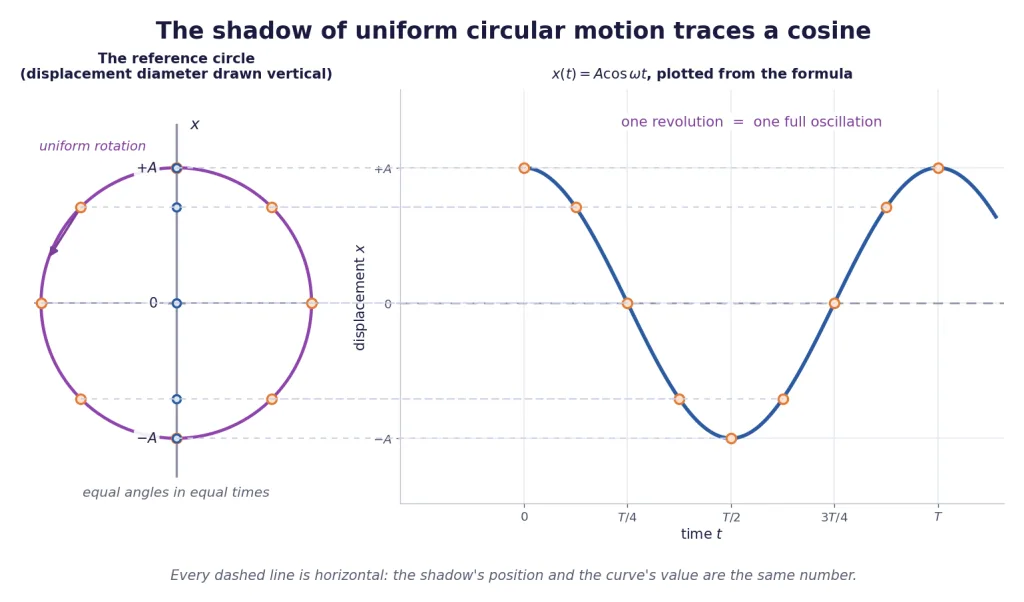
Because one revolution is one oscillation, the circle and the oscillation share their timing exactly: with in radians per second and the frequency in hertz. The reference particle goes round times a second, and the shadow completes oscillations a second — the same number.
Steady round the circle, anything but steady along the line
Look at the picture again. The reference particle covers equal angles in equal times — it never speeds up or slows down. Its shadow does nothing of the sort. Near the middle of the diameter the shadow races across; near either end it barely moves, stops, and turns.
The reason is pure geometry: when is near the top or bottom of the circle it is moving almost horizontally, so its shadow moves fast; when is near the left or right edge it is moving almost vertically, so the shadow hardly moves at all. That single observation is the engine behind everything in the rest of this section.
Two visits per revolution
Every value of strictly between and corresponds to two points on the circle — one above the -axis, one below, at angles and . So the shadow passes through each displacement twice per cycle, and the two visits are distinguished by the direction of travel:
- in the upper half of the circle is moving leftwards the shadow is moving in the direction
- in the lower half the shadow is moving in the direction
(with the anticlockwise sense assumed throughout). Only and are visited once, at the two ends of the horizontal diameter, and those are precisely the instants when the shadow is momentarily at rest.
Where the velocity and acceleration come from
The reference particle has a speed along the tangent and a centripetal acceleration pointing at the centre. Project each of those two vectors on the -axis and you get exactly the velocity and the acceleration of the shadow — the same and that the next section obtains by differentiating twice. It is worth knowing that the two routes agree; the differentiation itself, and everything that follows from it, belongs to that section.
[NEET Important] A question that says "a particle moves on a circle of radius with angular speed ; find the amplitude and period of the motion of its projection" is asking for nothing more than and . Read the radius, read the angular speed, and you are finished.
Drawing the Circle Both Ways
Two skills, and exam questions come in both directions.
Given the SHM, draw the circle
You are handed and asked to draw its reference circle.
- Draw a circle of radius centred on the mean position, with the -axis along the direction of the actual oscillation.
- Mark the starting radius at the angle , measured anticlockwise from the axis. (A negative therefore lands below the axis.)
- Put an anticlockwise arrow on the circle, with the particle going round at radians per second.
- Drop the perpendicular from the starting point to the -axis. Where it lands is , the displacement at the moment the clock started.
For centimetres, that is a circle of radius 4 cm, the reference particle starting at above the axis and going anticlockwise at 2 rad/s, with the shadow starting at cm.
Given the circle, write the SHM
Now the reverse. You are shown a circle with a radius, a period, a starting position and — crucially — an arrow showing the sense of rotation. Four steps:
- Amplitude: is the radius.
- Angular frequency: , in rad/s, from the period marked on the figure.
- Starting angle: measure the angle that the initial radius makes with the axis, taking anticlockwise as positive.
- Sense of rotation: this fixes the sign, and it is where marks are lost.
Key Point — the sign of from the sense of rotation:
- Anticlockwise: the angle increases, so at time it is , and
- Clockwise: the angle decreases, so at time it is , and The second step uses , which is why a clockwise diagram can still be written in the standard form with nothing worse than a sign change.
The four starting positions everybody should recognise instantly, all anticlockwise:
| Reference particle starts at | The SHM | ||
|---|---|---|---|
| the axis | |||
| the axis (top) | |||
| the axis | |||
| the axis (bottom) |
The direction check, done on the picture
The circle also settles the sign of when you are told where the particle is and which way it is going, rather than being shown a diagram:
- shadow starting at the mean position and heading towards the reference particle starts at the bottom of the circle
- shadow starting at the mean position and heading towards it starts at the top
- shadow starting at , momentarily at rest it starts on the axis
[JEE Tip] A clockwise figure is not a different kind of problem. Read off exactly as you would for an anticlockwise one, then write and carry on. Every other quantity — amplitude, period, frequency, the displacement at any instant — is unaffected by the sense of rotation.
The Time Between Two Displacements
This is what the reference circle is really for.
The question. A particle in SHM of amplitude and period moves from displacement to displacement . How long does it take?
The algebraic route is to solve and , worry about which of the two solutions of each inverse cosine you want, and subtract. It is slow and it invites sign errors.
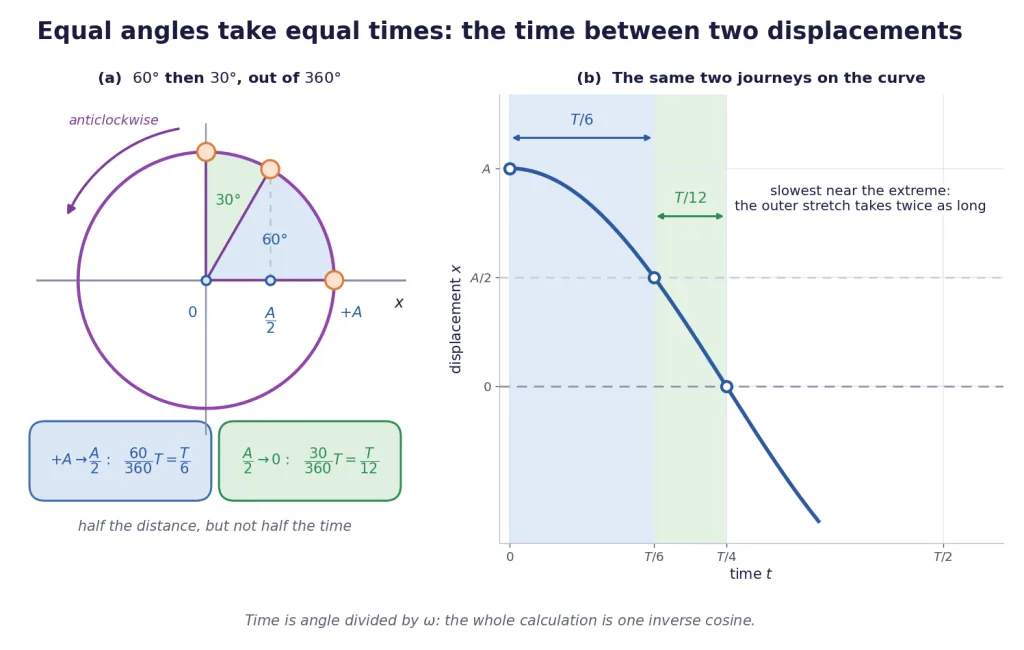
The circle route is one line, because of a single fact: the reference particle covers equal angles in equal times. So the time taken is just the fraction of a revolution that the radius vector turns through.
Key Point — time from angle: and the angle belonging to a displacement is the angle its radius makes with the axis, measured from at , through at the mean position, to at .
The method, in four steps
- Draw the circle of radius and mark the two displacements and on the horizontal diameter.
- Draw the vertical lines through them; where each cuts the circle is the reference particle's position.
- Find the angle between the two radii, using for each.
- Divide by , or take that fraction of and multiply by .
The standard results, worth memorising
Every one of these is for a particle moving directly between the two displacements, with no reversal in between.
| Journey | Angles swept | Time |
|---|---|---|
| , i.e. | ||
| , i.e. | ||
| , i.e. | ||
| , i.e. | ||
| , i.e. | ||
| , i.e. | ||
| mean position either extreme | ||
| extreme extreme |
Two consistency checks you can do in your head: , which is the mean position to the extreme; and as well, going by way of .
The trap this table exists to defeat
Key Point: Equal distances are not equal times. The inner half of the journey, from the mean position out to , takes . The outer half, from to , takes — twice as long, over exactly the same distance. The particle is slowing down as it approaches the extreme.
Anyone who answers "half the distance, so half the time" gets these questions wrong every time. Time is proportional to the angle, never to the displacement.
Where the particle spends its time
The same idea answers a favourite question: what fraction of each cycle does the particle spend within of the centre?
On the circle, means the radius lies between and , or between and — two arcs of each, out of . So the particle is in the middle half of its range for only of every period, and in the two outer quarters for . Equal lengths, twice the time.
[JEE Tip] The answer is the angle actually swept, so the direction of travel matters as much as the two displacements. A particle at that is heading towards the mean position reaches only after going all the way out to and back — of arc, or — while one already heading outwards gets there in . Same two displacements, five times the wait.
Two Perpendicular Simple Harmonic Motions
We finish by running the whole argument backwards. If a circular motion contains two perpendicular simple harmonic motions, what happens if you start with two perpendicular SHMs and combine them?
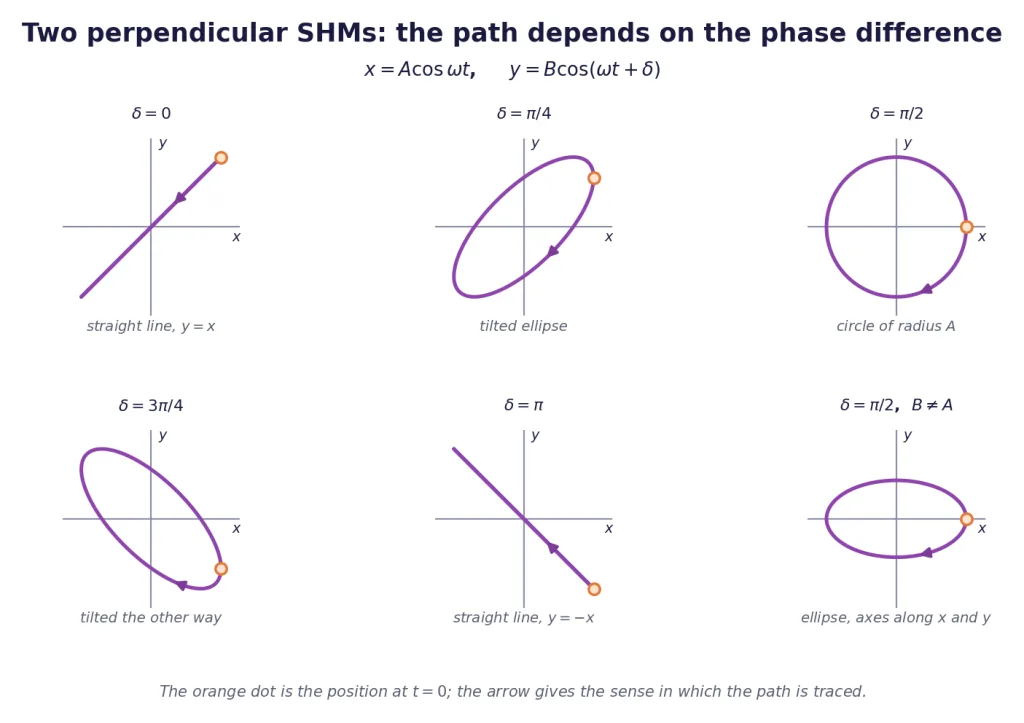
Let a particle be given one simple harmonic motion along and another along , of the same angular frequency: where is the constant phase difference between them. Both motions have the same period, so the particle retraces its path once every . What that path is depends on and on the ratio of the amplitudes — and on nothing else.
The three cases that matter
— a straight line. With no phase difference, at every instant. The particle moves back and forth along a straight line through the origin of slope , and that motion is itself simple harmonic, of amplitude .
— the other straight line. Now : the same thing with the line sloping the other way.
with — a circle. Here and , so a circle of radius , traced at constant angular speed . This is the reference circle again, built rather than dismantled.
Key Point: Two perpendicular simple harmonic motions of equal amplitude and the same angular frequency, a quarter cycle out of step, add up to uniform circular motion. With the circle is traced clockwise, with anticlockwise.
Everything in between
For any other the path is an ellipse. Eliminating from the two equations gives the general result which contains all the cases at once. Put or and the right-hand side vanishes, leaving a perfect square — the two straight lines. Put and the cross term vanishes, leaving an ellipse with its axes along the coordinate axes, which becomes a circle when . Any other keeps the term, and the ellipse is tilted.
| Phase difference | Path |
|---|---|
| straight line, slope | |
| between and | tilted ellipse |
| ellipse with axes along and ; a circle if | |
| between and | tilted ellipse, leaning the other way |
| straight line, slope |
[JEE Tip] For this whole family the angular frequency of the two motions must be the same. Two perpendicular SHMs with different angular frequencies produce the much more elaborate Lissajous figures, which close into a repeating pattern only when the ratio of the frequencies is a ratio of whole numbers. Check that the two values match before reaching for the table above.
Solved Examples
Conventions used throughout: the standard form is , angles are in radians with the degree equivalent given alongside where it helps, and the reference circle is drawn anticlockwise unless a question says otherwise. is the angular frequency in rad/s and the frequency in hertz. .
Example 1: Drawing the reference circle for a given SHM
A particle moves as , with in centimetres and in seconds. Describe its reference circle completely, and state where the shadow is at .
Solution:
Read the three constants. Comparing with : cm, rad/s, rad .
The circle. Radius cm, centred on the mean position.
The reference particle. It goes round anticlockwise at 2 rad/s, starting at above the axis.
The timing. Note the units: 2 rad/s is the angular frequency, and the frequency is 0.318 Hz — one is not the other.
The shadow at . Drop the perpendicular from the starting point: and since the reference particle starts in the upper half of the circle and is heading anticlockwise, the shadow is moving in the direction.
Takeaway: the equation and the circle carry identical information — amplitude to radius, angular frequency to angular speed, phase constant to starting angle.
Example 2: Reading an SHM off an anticlockwise circle
A reference particle moves anticlockwise on a circle of radius 3 cm with a period of 4 s. At the radius makes an angle of with the positive -axis. Obtain the SHM performed by the -projection.
Solution:
Amplitude: cm, the radius.
Angular frequency: rad/s, and Hz.
Starting angle: rad.
Sense: anticlockwise, so the angle increases and . At time the radius makes an angle , and the projection is
Check at : cm, which is indeed where the perpendicular from a starting point lands.
Takeaway: anticlockwise means the starting angle goes straight into the equation as , sign unchanged.
Example 3: Reading an SHM off a clockwise circle
A reference particle starts on the positive -axis of a circle of radius 5 cm and moves clockwise with a period of 30 s. Find the SHM of its -projection, and state the phase constant.
Solution:
Amplitude and angular frequency: cm; rad/s, so Hz.
Starting angle: on the axis, so .
Sense: clockwise, so the angle decreases. After a time the radius makes an angle with the axis, and
In standard form. Using , The phase constant is negative, exactly as the clockwise rule promises: .
Sanity check: and the shadow immediately moves towards — correct, because the reference particle starts at the top and swings clockwise towards the axis.
Takeaway: clockwise costs you nothing but a minus sign on the starting angle. The amplitude and the period do not care which way the particle goes round.
Example 4: From the mean position to half the amplitude
A particle performs SHM with amplitude 6 cm and period 2.4 s. How long does it take to travel from the mean position to a displacement of 3 cm?
Solution:
Set up the circle. Radius 6 cm. The mean position is the top of the circle, at ; the displacement 3 cm sits at
Angle swept: from to , that is .
Time:
Takeaway: mean position to half the amplitude is , whatever the amplitude — the cancels, because only the ratio sets the angle.
Example 5: The two halves of the same journey
A particle in SHM of period 1.2 s starts from rest at . Find (a) the time to reach , (b) the further time to reach the mean position, and (c) comment on the two answers.
Solution:
(a) The particle starts at the axis, . It reaches at . So
(b) From to the mean position at is a further :
(c) The two legs cover the same distance, each, but The outer leg takes twice as long, because the particle is barely moving near the extreme and fastest near the centre. As a check, s , which is the quarter period from an extreme to the mean position.
Takeaway: never split a time in proportion to distance in SHM. Split the angle.
Example 6: Across the middle
A particle in SHM has a period of 0.6 s. Find the shortest time it takes to go from to .
Solution:
The two angles. is at , and is at .
Angle swept, going directly: .
Time:
Notice that this is the same as the time from to — a journey covering only half the distance. The middle stretch is crossed quickly.
Why "shortest"? Because a particle sitting at might instead be heading outwards, towards . It would then reach only after turning round at the far extreme — on the circle that is a sweep from to , or , taking s. The circle handles both routes without ambiguity; the direction of motion decides which one the question means.
Takeaway: the answer is the angle actually swept, divided by . Decide the route first, then read the angle.
Example 7: Two displacements that are not standard fractions
A particle in SHM has amplitude 5 cm and period 2 s. It is at cm and moving towards the negative side. How long does it take to reach cm?
Solution:
First angle. .
Second angle. .
Angle swept. The particle is heading towards , so on the circle it is climbing through the upper half and the angle increases:
Time.
The two awkward numbers 3 and 4 with a 5 cm amplitude were never awkward at all: they form a 3-4-5 right triangle, and the two radii turn out to be exactly perpendicular.
Takeaway: the method does not need round numbers. Two inverse cosines, one subtraction, one division by .
Example 8: Working backwards from a measured time
A particle in SHM takes 0.1 s to travel from one extreme position to the point where its displacement is half the amplitude. Find the period, the frequency and the angular frequency.
Solution:
Identify the angle. Extreme to half amplitude is to , so is swept.
Set up the equation.
The other two quantities, with their units.
Quote the one the question asked for: 1.67 Hz is the frequency, 10.47 rad/s is the angular frequency, and they differ by the factor .
Takeaway: any single time interval between two known displacements fixes the whole timing of the motion.
Example 9: Where does the particle spend its time?
A particle executes SHM of amplitude . What fraction of each period does it spend at displacements whose magnitude is less than ?
Solution:
Translate to angles. means .
Find the arcs. In one revolution, lies between and for between and , and again between and .
Add them up. Two arcs of each, so out of :
So the particle spends inside the middle half of its range and in the two outer quarters — even though those regions are the same total length. That is exactly why a pendulum bob photographed at equal intervals appears bunched up near the ends of its swing.
Takeaway: "what fraction of the time" questions become "what fraction of the circle" questions, and those are just arcs.
Example 10: Two perpendicular SHMs — the circular case
A particle has and , both in centimetres with in seconds. Identify the path, its size, the sense in which it is traced and the speed of the particle.
Solution:
Eliminate the time. so the path is a circle of radius 4 cm centred on the origin.
Why: the two motions have equal amplitude and the same rad/s, and writing shows the phase difference between them is exactly .
The sense. At the particle is at , the top. An instant later has become positive while has fallen slightly, so it moves to the right and down: clockwise.
The speed. The angle increases at a steady 2 rad/s, so the motion is uniform circular motion and constant in magnitude, with period s.
Takeaway: equal amplitudes plus a quarter-cycle phase difference plus one common equals uniform circular motion — the reference circle, assembled from its two shadows.
Example 11: Two perpendicular SHMs — the straight-line case
A particle has and centimetres. Find the path and the amplitude of the resulting motion.
Solution:
The phase difference is zero, so divide one equation by the other: a straight line through the origin of slope .
The motion along that line is simple harmonic, since the distance from the origin is
Amplitude: the particle runs from one end of the line at cm through the origin to the other end, so the amplitude is
Takeaway: in-phase perpendicular SHMs give SHM along a slanted line, with amplitudes adding like perpendicular vectors — , never .
Example 12: Two perpendicular SHMs — the elliptical case
A particle has and metres. Find the path and describe it.
Solution:
Simplify the second equation. , so .
Eliminate the time.
Describe it. An ellipse with its axes along the coordinate axes, semi-axis 2 m along and 3 m along . It is not a circle because the two amplitudes differ; had they been equal it would have been.
The sense. At the particle is at and is about to go negative, so it is traced clockwise, and it completes one circuit every .
Takeaway: a phase difference of always gives an ellipse aligned with the axes; equal amplitudes make that ellipse a circle, and any other phase difference tilts it.