
How to Use These Cards
This is the last section of the chapter, and it has one job: to be read the night before the paper, and again in the queue outside the hall.
Nothing new is taught here. Every card below compresses something an earlier section built properly, in the same notation and with the same numbers. So if a line here surprises you, that is not a line to memorise — it is a signal to go back and reread the section that owns it.
Six cards, two figures, the table of standard oscillators, a decision chart, the mistake checklist, a 60-second list and a fast self-test. Photograph the oscillator table and the mistake checklist.
Damped oscillations, forced oscillations and resonance, the series spring rule and the equivalent stiffness, the second's pendulum and the effective-gravity variants of the pendulum all sit outside the body text of the rationalised syllabus, and Boards, JEE and NEET ask about them every single year — so they are on these cards in full.
Notation for This Chapter
Two symbols decide more marks in this chapter than everything else on this page put together.
Key Point — against .
- is the angular frequency, in radians per second.
- is the frequency, in hertz — oscillations per second.
They differ by a factor of and they are never interchangeable. A question asking for "the frequency" wants ; one asking for "the angular frequency" wants . Write the unit on every answer and the mistake cannot happen.
Key Point — displacement is measured from the MEAN POSITION.
Always, in every formula on every card below. For a block hanging on a spring the mean position is the stretched equilibrium, a distance below the spring's natural length — not the natural length itself.
| Symbol | Meaning | Unit |
|---|---|---|
| displacement from the mean position | m | |
| amplitude, the largest value of | m | |
| angular frequency | rad/s | |
| frequency (Greek nu, never the italic vee of speed) | Hz | |
| period | s | |
| phase constant; the phase is the whole bracket | rad | |
| speed | m/s | |
| spring constant | N/m | |
| equivalent spring constant of a combination | N/m | |
| mass; the reduced mass of a two-body oscillator | kg | |
| length of a pendulum | m | |
| effective gravity for a pendulum in an accelerated frame or a liquid | m/s² | |
| damping constant, from | kg/s | |
| natural angular frequency, | rad/s | |
| damped angular frequency | rad/s | |
| driving angular frequency | rad/s |
Three habits protect all of it. State the unit on every frequency you write down. Mark the mean position on your diagram before you write a single equation. Convert every angle to radians before it goes anywhere near a sine.
The constants sheet
| Quantity | Value |
|---|---|
| acceleration due to gravity on the Earth, | 9.8 m/s² |
| acceleration due to gravity on the Moon | 1.7 m/s² |
| , , | , , |
| , , | , , |
| one degree, in radians | |
| one radian, in degrees | |
| length of a second's pendulum | 0.993 m, so about 1 metre |
Take m/s² everywhere unless a problem states otherwise, and never mix with inside one problem.
Card 1 — The Motion: , and
Key Point — the three equations, in the chapter's standard form: All three are sinusoids of the same and the same period . One factor of arrives with every differentiation.
and describe exactly the same family of motions; the phase constant absorbs the difference, and the second has amplitude . Here and are just those two coefficients — not the acceleration above, and not the damping constant of Card 5.
Key Point — the defining property: The acceleration is proportional to the displacement from the mean position and directed opposite to it. Any motion obeying this is simple harmonic, whatever the system.
The maxima, and reading a motion off them
Key Point: Give a question's maximum speed and maximum acceleration, and it has handed you , , and in one line each.
Key Point — speed at a stated displacement, with no clock involved: No time in it, no phase constant in it. This one line answers most "how fast is it when it is here" questions.
| At the | Energy | |||
|---|---|---|---|---|
| mean position | , largest | all kinetic | ||
| extreme position | , largest | , largest | all potential |
The phase relations, and the three stacked curves
- leads by — a quarter of a period.
- leads by , and therefore leads by : acceleration and displacement are exactly out of phase, which is said in the language of phase.
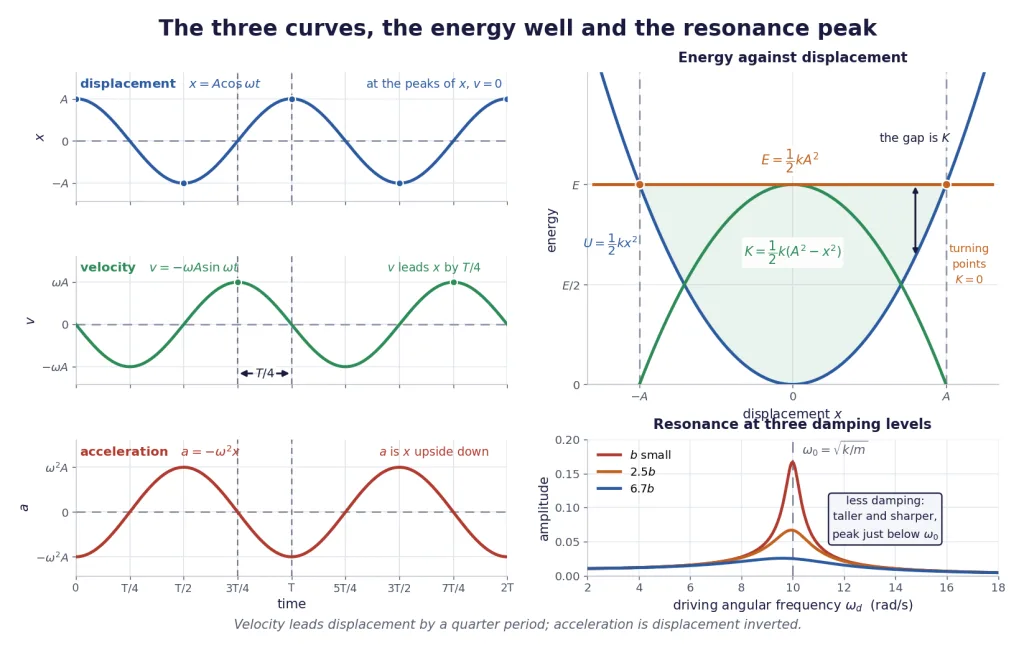
Read the left column downwards. Where is at a peak, is zero and is at its most negative. Where crosses zero, is at a peak and is zero. The acceleration curve is the displacement curve turned upside down and stretched by .
[Board Important] Two graphs settle an "is this SHM" question instantly. against is a straight line through the origin of slope . against is an ellipse with semi-axes and .
Timing, straight off the reference circle
A particle in SHM is the shadow of a particle going round a circle of radius at angular speed . Every "how long does it take" question becomes an angle.
| From to | Angle turned | Time from the extreme | Time from the mean position |
|---|---|---|---|
[JEE Tip] Over one complete oscillation the path length is and the net displacement is zero, so the average speed is and the average velocity is zero. The two questions look identical and have different answers.
Card 2 — Force, Springs and the Standard Oscillators
Key Point — the force law: The period depends on the inertia and the stiffness, and on nothing else — not on the amplitude, not on , not on how the oscillation was started.
Key Point — the vertical spring: Hanging the mass shifts the mean position down by the static stretch and changes nothing else. Measure from that shifted position and gravity leaves the problem entirely.
The four-step recipe, for a system with no spring in sight
- Locate the equilibrium, and measure from there.
- Displace by a small and find the net force that appears.
- Show it is , with a positive constant. That is the whole test.
- Read off: , then and .
Combinations of springs
Key Point:
Parallel — both springs change length by the same amount as the block moves, so their forces add: Series — the same tension runs through both and their extensions add, so their compliances add: Ask one question and you never need to remember which is which: do the two springs share the displacement, or share the force?
- Springs end to end combine like resistors in parallel; springs side by side combine like resistors in series. The wiring analogy is upside down, so lean on the physics instead.
- A block between two walls with a spring on each side is a parallel pair, . Being on opposite sides changes nothing: one displacement changes both lengths by , and both forces push back the same way.
- Cut springs: . Cut a spring into equal pieces and each piece has stiffness . A piece of length has stiffness .
- Two free masses on one spring: replace by the reduced mass , so . Reciprocals add, exactly as for springs in series.
- A mechanism that makes the spring stretch times as far as the block moves gives ; the factor appears once in the stretch and once in the force. The movable pulley is the case, .
- A spring-block system on a smooth incline has the same period as on a table. A constant force along the line of motion shifts the mean position and leaves the period alone.
The standard oscillators, with their effective stiffness
Every row is the same physics: a restoring force acting on an inertia, giving .
| System | Effective | Period | Watch for |
|---|---|---|---|
| block of mass on a spring | no , horizontal or hanging | ||
| the same block hanging, static stretch | same period, written with what you measured | ||
| two springs side by side, or one each side of a block | stiffer, so faster | ||
| two springs end to end | floppier, so slower | ||
| one of equal pieces cut from a spring | shorter is stiffer | ||
| two free masses , on a spring | , with inertia | ||
| simple pendulum of length | no mass, no amplitude | ||
| small ball in a bowl of radius | a pendulum of length | ||
| cylinder of base area floating in a liquid of density | is the submerged depth, not the height | ||
| liquid column of total length in a U-tube, density , bore | the factor : both arms push |
[NEET Important] Three of those periods are in disguise — the hanging spring written with , the floating cylinder and the ball in the bowl. Spot the length and you have the period.
Card 3 — Energy in Simple Harmonic Motion
Key Point — the two energies and their sum: is measured with at the mean position. The total energy is a constant: it depends on neither the time nor the position.
All the energy is kinetic at the mean position and all of it potential at the extremes; averaged over a full cycle the two split it exactly evenly, because .
Key Point — the trap that is set every year:
The displacement has period . The kinetic energy and the potential energy each have period
Each completes two cycles while the displacement completes one, so their frequency is . The total energy has no period at all — it never changes.
Scaling
Double the amplitude and the energy is four times as large; halve it and a quarter is left. Double the frequency without changing how far it swings and the energy is again four times as large.
The ratio positions — one-mark staples
Key Point: So at , and at . Both carry a : each condition is met once on each side of the mean position.
Everything in that box depends only on the ratio — not on the mass, not on , not on the frequency. Questions of this kind never need a unit conversion. Starting from an extreme, the block reaches after and the mean position after .
Reading the energy-against-displacement diagram
The right-hand panel of the figure in Card 1 is the whole story:
- the upward parabola is ;
- the horizontal line is the total energy ;
- the vertical gap between them is the kinetic energy at that displacement;
- where the line meets the parabola the gap is zero, so — those are the turning points, at ;
- the parabola and the inverted parabola of cross at , each at height .
Raise the horizontal line and you have raised , which widens the well: a larger amplitude, since .
Key Point — why simple harmonic motion is everywhere:
Near a stable equilibrium almost every potential-energy curve is approximately a parabola, and the effective stiffness is its curvature there, A parabolic potential means a linear restoring force, and a linear restoring force means simple harmonic motion. That is why one chapter's formulas describe a molecule, a bridge deck and a swinging bob alike.
[JEE Tip] For a damped oscillator the same still holds at each instant with the current amplitude — which is why the energy falls twice as fast as the amplitude does.
Card 4 — The Simple Pendulum
Key Point: The mass cancels before any approximation is made. is in radians — always.
- The period does not depend on the mass of the bob, or on the amplitude (within the small-angle approximation), or on the material.
- runs from the point of suspension to the centre of mass of the bob: add the bob's radius to the string's length.
- The true period is always a little longer than , and the excess grows with amplitude: about at , about at .
- Second's pendulum: seconds exactly, so Hz, rad/s and m. It ticks once per one-way swing.
- A pendulum clock runs on , so a longer pendulum ticks more slowly and the clock loses time. With a temperature rise, , and the time lost per day is that fraction times 86400 seconds.
The variants — one master rule
Key Point: is the magnitude of the net non-string force per unit mass on the bob, in the frame in which the support is at rest. The string hangs along , and the swing is about that direction. Only ever changes.
| Situation | Effect on | |
|---|---|---|
| lift accelerating up at | shorter period, the clock gains | |
| lift accelerating down at | longer period, the clock loses | |
| lift in free fall | no oscillation at all, infinite | |
| lift moving with constant velocity | no change whatsoever | |
| car accelerating horizontally at | , string tilted at | shorter period |
| bob of density swinging in a liquid of density | longer period, always | |
| a place where changes (the Moon, ) | the local | , so times longer on the Moon |
[NEET Important] A spring-block oscillator in a lift has unchanged, because there is no in it. Only the pendulum feels the lift. Mixing the two rules is a standard trap.
Card 5 — Damping and Resonance
Key Point — the damped oscillator: A damped oscillator always swings more slowly than the same oscillator undamped. Damping never speeds anything up.
Key Point — the two decays: The energy decays at twice the rate of the amplitude, because energy goes as the square of the amplitude. Time constants: and , in the ratio . The amplitude halves after , with .
- Critical damping is , in kg/s. Below it the system is under-damped and oscillates; at it, critically damped — the fastest return to equilibrium with no overshoot, which is what a car's shock absorber and a dead-beat galvanometer are built for; above it, over-damped and sluggish.
- A damped oscillation is only approximately simple harmonic: it never exactly repeats, because each swing is smaller than the last.
Key Point — the driven oscillator: Once the transient has died, the oscillator moves at the driving frequency — not at and not at . The driver sets the rhythm; the oscillator only decides how big the response is.
Key Point — resonance:
Resonance is the condition . There the amplitude is largest and is held down only by the damping: With no damping at all the formula blows up — which is why an undamped resonance is a broken bridge, not a large number.
The bottom-right panel of the figure in Card 1 shows the amplitude against at three damping levels. Less damping gives a taller, sharper peak, of height proportional to ; more damping gives a shorter, broader one. The exact peak sits just below :
[Board Important] Everyday resonance: pushing a swing once per swing, a radio tuned so that its circuit's natural frequency matches the station, soldiers breaking step on a bridge, a wine glass shattered by a held note, and buildings designed so that their natural frequencies avoid the frequencies at which the ground shakes.
Card 6 — Is It Simple Harmonic At All?
One test decides it, and it is worth thirty seconds before you reach for any formula.
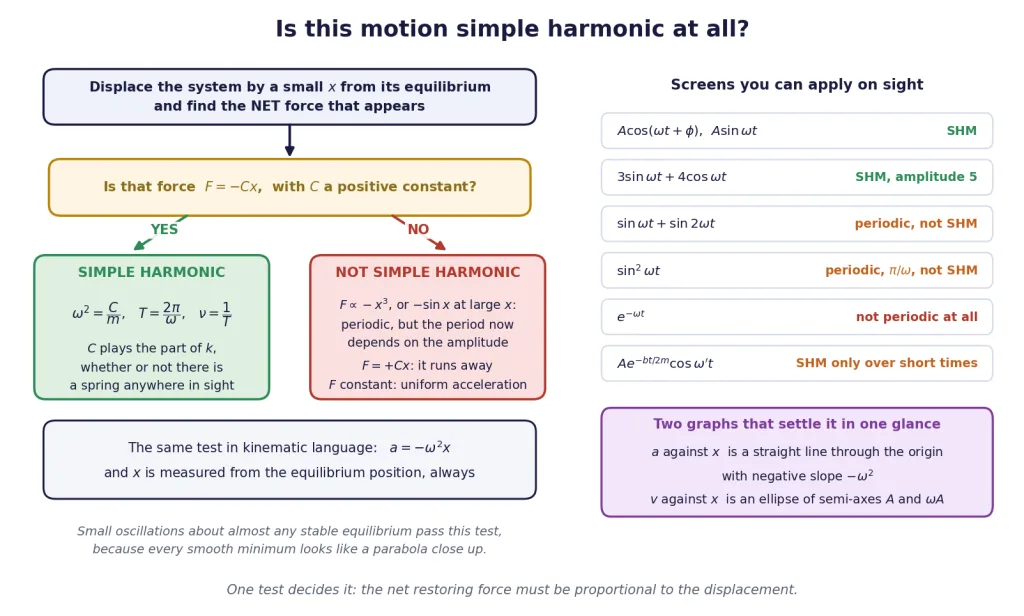
Key Point: Displace the system by a small from its equilibrium, find the net force that appears, and ask whether it is with a positive constant and to the first power. If it is, the motion is simple harmonic with . If it is not, no period formula in this chapter applies.
| What you find | The verdict |
|---|---|
| simple harmonic, | |
| , or with not small | periodic, but not simple harmonic; the period depends on the amplitude |
| not oscillatory — the body runs away from the equilibrium | |
| constant | uniform acceleration, no oscillation |
| Function of time | Verdict |
|---|---|
| , | simple harmonic |
| simple harmonic, amplitude 5 | |
| periodic with period , not simple harmonic | |
| periodic with period , not simple harmonic | |
| not periodic at all | |
| simple harmonic only over times short compared with |
And keep the two families apart: every oscillatory motion is periodic, but not every periodic motion is oscillatory. A fan blade and an orbiting planet repeat without ever going back and forth about a mean position.
The Mistakes That Cost the Most Marks
Ordered by how often they turn up in answer scripts. The first four are worth more than the rest of the list put together.
1. Measuring the displacement from the spring's natural length instead of from the mean position. For a hanging block the mean position is the stretched equilibrium, below the natural length. The period survives this error, because never asked where the origin was. The amplitude, every energy and every value of and do not. Mark the mean position on the diagram first, then measure everything from it.
2. Quoting where was asked, or the reverse. They differ by . "Frequency" means in hertz; "angular frequency" means in radians per second. Writing the unit next to the number is the whole cure.
3. Leaving an angle in degrees inside a small-angle step. holds for in radians. An amplitude of enters as , not as — a factor of between a right answer and a nonsense one. The same applies to every phase: a phase quoted as a bare number is in radians.
4. Believing the energies repeat once per cycle. The kinetic and potential energies each have period and frequency — twice per oscillation. Meanwhile the total energy does not vary at all. A question asking for "the frequency of the potential energy" is asking for .
5. Putting a into a spring's period. contains no , hanging or horizontal, in a lift or on the Moon. Only the pendulum's period contains . The reverse slip is just as costly: a pendulum's period contains no and no .
6. Getting the series and parallel spring rules the wrong way round. Side by side, sharing the displacement: , stiffer and faster. End to end, sharing the tension: , floppier and slower. A block between two walls is the parallel case, not the series one. When in doubt, ask which quantity the two springs share and re-derive in ten seconds.
7. Forgetting that cutting a spring stiffens it. : half a spring is twice as stiff, a third of a spring three times as stiff.
8. Confusing , and . Natural, damped and driving. always. A driven oscillator finally moves at , whatever its own frequency may be.
9. Using the amplitude's decay rate for the energy. Amplitude , energy . The energy time constant is half the amplitude time constant. When the amplitude has fallen to half, the energy is at a quarter.
10. Taking the amplitude to affect the period. It does not, for any linear oscillator in this chapter — spring, pendulum at small angles, floating cylinder, U-tube, bowl. Amplitude decides the energy, never the timing.
11. Reading with the wrong quantity squared. It is under the root, not , and the whole thing carries in front. At the speed is , not .
12. Calling "the phase". The phase is the whole bracket ; alone is the phase constant, fixed by where the particle was and which way it was moving at .
13. Treating a second's pendulum as having a period of one second. Its period is 2 seconds. It ticks once per one-way swing, and its length is 0.993 m.
14. Using for a pendulum at a large angle. The formula is a small-angle result. At large amplitudes the true period is longer and depends on the amplitude.
15. Forgetting that a damped oscillation is not strictly periodic. It never returns to the same displacement with the same speed, so it is only approximately simple harmonic — over times short compared with .
Key Point: Three that cost single marks each — dropping the from , leaving a length in centimetres inside a period formula, and reporting an angular frequency with "Hz" written after it.
The 60-Second Revision
You are in the queue outside the hall. This is the irreducible minimum.
Notation. in rad/s, in Hz, . Displacement always from the mean position. The phase is ; alone is the phase constant.
The motion. , , . Maxima and , so and .
Speed anywhere. .
Phases. leads by ; leads by . At the mean position is largest and is zero; at an extreme, the reverse.
Force. , , , — no , and no amplitude.
Springs. Parallel ; series ; a piece has stiffness ; two free masses use .
Energy. , , . . and each have period ; the total energy is constant. at , at , and generally at .
Pendulum. — no mass, no amplitude, radians only. Second's pendulum: seconds, m. Variants: replace by , which is , , , , and zero in free fall.
Other oscillators. Floating cylinder ; U-tube ; bowl .
Damping. , , , .
Resonance. Steady state at ; largest amplitude when , where ; less damping means a taller, sharper peak, sitting just below .
Habits. Mark the mean position first. Write the unit on every frequency. Convert every angle to radians. Check whether a belongs in the formula before you write one.
The Fast Self-Test
Cover the answers. Fifteen questions, five minutes. Anything you miss tells you which card to reopen tonight.
- What are the units of and of , and what joins them?
- Write , and for simple harmonic motion, and state the two phase relations.
- What single equation defines simple harmonic motion?
- Write the speed at a displacement , without using the time.
- Where is a hanging block's mean position, and does appear in its period?
- State the parallel and series rules for two springs, and say which arrangement is stiffer.
- A spring of constant is cut into three equal pieces. What is the constant of each?
- Write the three expressions for the total energy of an oscillator.
- With what period do and vary, and with what period does vary?
- At what displacements is , and at what displacement is ?
- Write the period of a simple pendulum, and list three things it does not depend on.
- What is a second's pendulum, and how long is it?
- Give for a lift accelerating up, a lift in free fall and a car accelerating horizontally.
- Write the damped displacement, , and the two decay rates.
- What is resonance, at what frequency does a driven oscillator finally move, and what limits the amplitude at resonance?
Answers. 1. is in radians per second, in hertz; . 2. , , ; leads by and leads by . 3. , with measured from the mean position. 4. . 5. At the stretched equilibrium, below the natural length; no, the period is with no in it. 6. Parallel (same displacement) ; series (same tension) ; the parallel pair is stiffer, so it oscillates faster. 7. Each piece has constant . 8. . 9. and each have period ; is constant and has no period. 10. at ; at . 11. ; it does not depend on the mass of the bob, on the amplitude (for small angles) or on the material of the bob. 12. One whose period is exactly 2 seconds; m. 13. ; zero, so it does not oscillate; , with the string tilted at . 14. with ; the amplitude falls as and the energy as . 15. Resonance is ; the oscillator moves at the driving frequency ; at resonance the amplitude is limited only by the damping, .
That is the whole chapter. Go and get the marks.