
Same Chapter, Half the Clock
Sections 1 to 11 took oscillations apart slowly and worked forty-odd problems through it. If you did that work, you already know more than this section will ever ask of you.
So why a separate corner? Because the skill being tested here is different. This paper does not want a derivation. It wants a sentence you can quote, a formula you can recognise, one substitution you can do without a calculator, and a proportionality you can read off in five seconds.
Physics is 45 questions, and inside a 180-minute paper shared with Chemistry and Biology those 45 deserve about 45 minutes. One minute each. Oscillations reliably supplies two to four of them, and every one has to be finished in well under a minute, correctly, so that the time is banked for the questions that genuinely need it.
One syllabus note. Damped oscillations, forced oscillations and resonance, the series combination of springs, the second's pendulum and the effective-gravity variants of the pendulum — the lift, the accelerating car, the bob in a liquid — all sit outside the body text of the rationalised syllabus, yet NEET has asked about every one of them, so every one appears in the tables and the practice below.
The five types, and what each should cost you
| Type | What it looks like | Your budget | The right instinct |
|---|---|---|---|
| 1. Direct recall | "Define simple harmonic motion." "What is resonance?" "Why is a damped oscillation only approximately simple harmonic?" | 15-20 s | You either know the sentence or you do not. Never derive a definition. |
| 2. One-step plug-in | , , , , | 25-35 s | Name the card, substitute once. |
| 3. Proportionality | "The mass is quadrupled. What happens to the period?" "The length is halved." "The spring is cut in two." | 15-25 s | Cancel everything common. Never substitute numbers. |
| 4. Graph reading | The stacked , , curves; the energy curves; against ; against | 20-30 s | Read the axes, find the zeros and the peaks, count the humps. |
| 5. Assertion-Reason / Column matching | Two special formats, both drilled below | 35-45 s | Judge each statement alone, then judge the link. |
[Important] A diagnostic worth internalising: if an oscillations question needs a fifth line of working, you have misread it. You are given a mass and a spring constant and asked for a period, or an amplitude and an angular frequency and asked for a maximum speed. If your page is filling up, stop and reread the stem.
The two mistakes that cost more marks than everything else combined
Neither is a concept. Both are bookkeeping.
Key Point — THE / / RULE, and it never bends:
- is the angular frequency, in radians per second.
- is the frequency, in hertz — oscillations per second. It is the Greek letter nu, not the italic vee of speed .
- is the period, in seconds, and .
They differ by a factor of and are not interchangeable. A stem asking for "the frequency" wants ; one asking for "the angular frequency" wants . Losing the is the commonest wrong answer in this chapter, and the -times-wrong value is always printed on the option list.
Here is what ignoring it costs. A body oscillates with rad/s. What is its frequency?
- Right: Hz, so second.
- Wrong: " Hz", which is times too large.
Write the unit next to every frequency you compute — rad/s or Hz — before you look at the options.
Key Point — DISPLACEMENT IS MEASURED FROM THE MEAN POSITION. Always, everywhere. For a vertical spring the mean position is the stretched equilibrium, a distance below the natural length, not the natural length itself. Measuring from the natural length is the second commonest error in this chapter. When you work from the correct origin the gravity term cancels exactly, which is why for a hanging spring exactly as for one lying on a table. Gravity moves the mean position and changes nothing else.
Constants for this section
Every solution below states the constants it uses inside the solution. A question that supplies its own number always wins.
| Quantity | Value |
|---|---|
| acceleration due to gravity on the Earth, | m/s² |
| acceleration due to gravity on the Moon | m/s² |
| , near enough to that | |
| length of a second's pendulum | m, so about metre |
Working values for this section. Angles inside and are in radians; a phase quoted as a bare number is in radians.
What this section does, and what it does not repeat
We will not rebuild periodic and oscillatory motion (Section 1), rederive (Section 2), reconstruct the reference circle from scratch (Section 3), redifferentiate for and (Section 4), rederive (Section 5), reprove the spring-combination rules (Section 6), rebuild the energy account (Section 7), rederive the pendulum (Section 8), resolve the damped equation (Section 9) or reconstruct the resonance curve (Section 10). What you get instead is the same material reorganised for recognition speed:
- The sentences that come back almost verbatim.
- Every formula in the chapter as a recognition table, with a hook for each.
- The reference circle drilled as a twenty-second stopwatch, and the period lookup.
- The proportionality grid, which is the highest-yield page in this section, and graph reading.
- The biology-adjacent physics this paper reaches for every year.
- The two special formats, and the habits that finish a question in under 45 seconds.
The / arithmetic
Four marks right, minus one wrong, zero for a blank. On a doubtful item the real question is not "can I get this?" but "can I get this in 40 seconds?" A blind guess among four is worth , essentially nothing. Eliminate two options first and a guess between the survivors is worth marks on average. Eliminate, then commit.
The Sentences That Come Back Almost Verbatim
Read this block as flashcards, not as prose. Every item here has appeared as a complete question by itself.
What simple harmonic motion is
Key Point — the definition, in the form that earns the mark:
A particle executes simple harmonic motion if its acceleration is directed towards a fixed mean position and is proportional to its displacement from that position: The minus sign is not decoration. It says the acceleration always points back towards the mean position while the displacement points away from it, which is the whole reason the motion turns round instead of running away.
Three equivalent ways of saying the same thing, any of which may be the correct option:
- the acceleration is proportional to the displacement and oppositely directed;
- the restoring force is proportional to the displacement, ;
- the displacement is a sinusoidal function of time, .
[Important] Two traps live inside that definition. "Acceleration proportional to displacement" is not enough — without the minus sign you have , which flies apart exponentially and is not oscillation at all. And "the motion repeats" is not enough either; that is periodicity, which is a far weaker condition.
Periodic, oscillatory, simple harmonic — three nested boxes
Key Point: Every oscillatory motion is periodic, but not every periodic motion is oscillatory. An oscillation is a to-and-fro motion about a mean position; if it repeats in equal intervals it is periodic as well. But a motion can repeat perfectly without ever going to and fro about anything.
- Periodic but not oscillatory: the Earth going round the Sun, a fan blade, a point on a rotating wheel, the hands of a clock. Each returns to the same state at equal intervals; none reverses about a mean position.
- Oscillatory but not simple harmonic: a ball bouncing between two walls, a body in a -shaped valley, a pendulum swung through . All go to and fro; none has a restoring force proportional to the displacement.
- Simple harmonic: the small subset in which the restoring force is exactly .
So the boxes nest: simple harmonic oscillatory periodic. Read a stem for which box it is asking about.
The phase relations between , and
Asked every year, in words or as a graph.
Key Point: Differentiating twice, and writing each as a cosine,
- leads by , a quarter of a period.
- leads by , another quarter.
- is out of phase with — exactly opposite, which is just said in the language of phase.
And the consequence, which is what the question usually wants:
| At the | Force | Energy | |||
|---|---|---|---|---|---|
| mean position | , largest | zero | all kinetic | ||
| extreme position | , largest | , largest | largest | all potential |
Speed largest where the acceleration is zero, and zero where the acceleration is largest. Students who try to remember that as two separate facts get it backwards under pressure; remember instead that the particle is slowing down the whole way out and speeding up the whole way back, so it must be fastest in the middle.
Why a pendulum's period does not care about the mass or the amplitude
Key Point — the mass. The restoring force on the bob is the tangential component of its weight, , and the mass being accelerated is the same . Writing , the mass cancels from both sides, leaving with no anywhere. Gravity supplies both the push and the inertia, so a heavy bob and a light bob keep identical time.
Key Point — the amplitude. For small angles in radians, so , which is simple harmonic with and neither nor the amplitude appears in it. A wider swing covers more distance but does so proportionately faster, and the two effects cancel exactly — that is the property Galileo noticed, and it is what makes a pendulum a clock.
[Important] The independence of amplitude is an approximation, and only a good one for small angles. At an amplitude of the true period is about longer than ; at it is longer. The correct answer to "does the period depend on the amplitude?" is no, for small oscillations — and if a stem hands you a large angle it is usually asking you to notice exactly that.
Two more sentences from the same family. Does the period depend on ? Yes, as — that is the whole basis of the laboratory measurement of , and of why a pendulum runs slow on the Moon. Does a block on a spring depend on ? No. contains no at all, so a spring oscillator keeps the same period on the Moon while a pendulum there slows to times its Earth period. That pair, side by side, is a favourite.
Resonance, in one sentence and one example
Key Point: A system driven by an external periodic force of angular frequency settles down to oscillate at the driving frequency , not at its own natural frequency . Resonance is the large response that occurs when the driving frequency is made equal to the natural frequency of the system, . At that point the driving force is always pushing in the direction the body is already moving, so it feeds in energy every single cycle, and the amplitude is held down by nothing but the damping. Make small and the response becomes enormous.
The example to write, and it takes one line: a child on a swing. The swing has its own natural frequency, fixed by the length of the ropes. Push at exactly that rate and the amplitude builds swing after swing; push at any other rate and half your pushes fight the motion. Equally acceptable: soldiers break step on a bridge so that their marching frequency cannot match the bridge's natural frequency; a radio is tuned by matching a circuit's natural frequency to the station's; a wine glass shatters when a singer holds exactly its natural note.
Why a damped oscillation is only approximately simple harmonic
Key Point: With a damping force added, the motion becomes Simple harmonic motion requires a constant amplitude, and here the amplitude shrinks continuously. So the motion never repeats itself exactly, and strictly it is not periodic at all. It is called approximately simple harmonic because over a few cycles the exponential factor has barely changed, so within any short window the motion looks like an ordinary sinusoid of nearly constant amplitude. The approximation is good for small and for short time intervals; it fails over long times.
Two facts from the same box, both asked directly. The damped angular frequency is always smaller than the natural , so damping always makes the oscillation slower, never faster. And the mechanical energy falls as — twice as fast as the amplitude, because energy goes as the square of the amplitude.
The always-true / never-true table
Speed comes from knowing which sentences are safe.
| Statement | Verdict |
|---|---|
| Every oscillatory motion is periodic | Always |
| Every periodic motion is oscillatory | Never — a fan blade, an orbit |
| In SHM the acceleration is proportional to the displacement | Always, and oppositely directed |
| The period of a spring-block oscillator depends on the amplitude | Never |
| The period of a simple pendulum depends on the mass of the bob | Never |
| The period of a simple pendulum depends on the amplitude | Never, for small oscillations only |
| The velocity leads the displacement by a quarter period | Always |
| The acceleration and the displacement are exactly out of phase | Always |
| At the mean position the acceleration is zero and the speed is largest | Always |
| At an extreme position the velocity is zero and the acceleration is largest | Always |
| contains for a hanging spring | Never — only shifts the mean position |
| The kinetic and potential energies each vary with period | Always |
| The total mechanical energy varies with period | Never — it is constant |
| The total energy is proportional to the square of the amplitude | Always |
| A driven system finally oscillates at its own natural frequency | Never — at the driving frequency |
| At resonance the amplitude is limited only by the damping | Always |
| The damped frequency exceeds the natural frequency | Never — |
| A damped oscillation is strictly periodic | Never — the amplitude decays |
| and describe motions of the same period | Always — only the phase constant differs |
| is simple harmonic | Never — it is periodic, with period |
[Important] The four most reused distractors in this chapter are the -times-wrong frequency, "the period depends on the amplitude", "a driven system ends up at its natural frequency" and "the total energy also oscillates with period ". Each turns up somewhere almost every year, and each is worth four marks in fifteen seconds.
The Recognition Table, With a Hook for Each
Sections 1 to 11 derived all of these. Your job here is different: see the situation, name the formula, substitute. No derivation, ever.
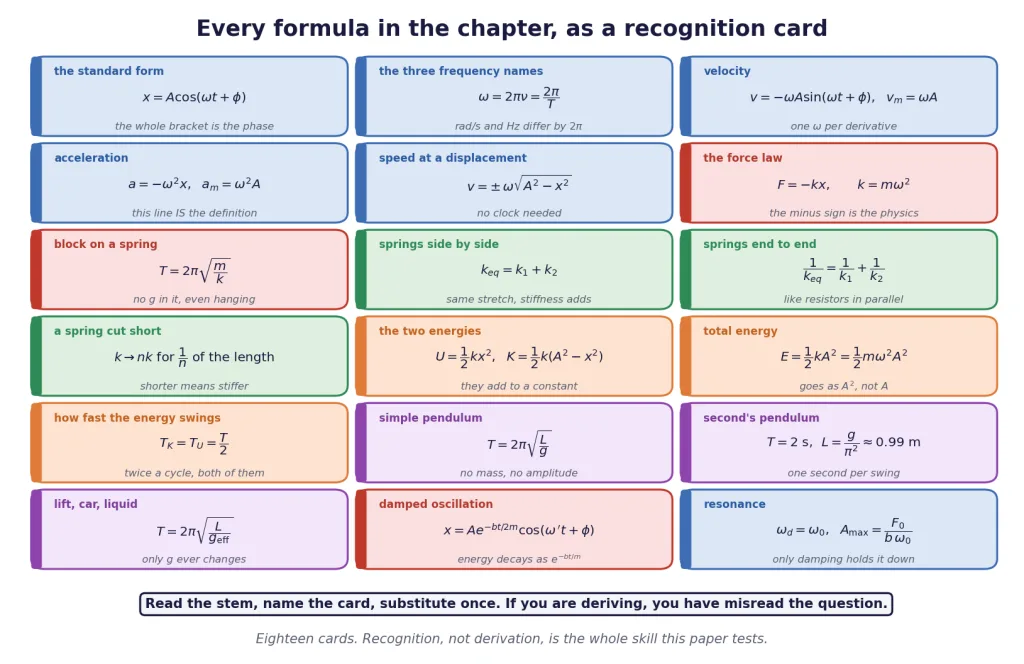
The eighteen you must know cold
| # | Situation | Formula | Memory hook |
|---|---|---|---|
| 1 | the standard form | the whole bracket is the phase; alone is the phase constant | |
| 2 | the three frequency names | rad/s and Hz differ by | |
| 3 | velocity | , | one per derivative |
| 4 | acceleration | , | this line is the definition |
| 5 | speed at a stated displacement | answers it with no clock at all | |
| 6 | the force law | , | the minus sign is the physics |
| 7 | block on a spring | no in it, even hanging | |
| 8 | springs side by side (parallel) | same stretch, so stiffnesses add | |
| 9 | springs end to end (series) | combines like resistors in parallel | |
| 10 | a spring cut short | a piece has stiffness | shorter means stiffer |
| 11 | the two energies | , | they add to a constant |
| 12 | total energy | goes as , not as | |
| 13 | how fast the energy swings | and each have period | twice a cycle, both of them |
| 14 | simple pendulum | no mass, no amplitude | |
| 15 | second's pendulum | seconds, m | one second per one-way swing |
| 16 | pendulum in a lift, a car, a liquid | only ever changes | |
| 17 | damped oscillation | , | the energy decays twice as fast |
| 18 | resonance | , | only the damping holds it down |
And two more that finish the chapter:
| # | Situation | Formula | Memory hook |
|---|---|---|---|
| 19 | the damped angular frequency | always less than | |
| 20 | critical damping | the fastest return with no overshoot |
The four traps hiding inside that table
Trap 1 — series and parallel springs are the reverse of what the words suggest. Two springs side by side carrying the same block both stretch by the same amount, so their forces add and : the combination is stiffer than either. Two springs end to end share the same tension and their extensions add, so is smaller than either. If you know the electrical rules, springs joined end to end combine like resistors in parallel — the opposite word from the one you would expect, which is exactly why it is examined.
Trap 2 — , not . Doubling the amplitude quadruples the total energy, doubles the maximum speed and doubles the maximum acceleration, and leaves the period completely alone. Four different answers to four nearly identical stems.
Trap 3 — and swing at twice the frequency of , but does not swing at all. In one full cycle of the displacement the particle passes the mean position twice and reaches an extreme twice, so each energy completes two full cycles. Their sum, , is a flat horizontal line. "The total energy varies with period " is printed as an option every time this idea appears.
Trap 4 — for a hanging spring, measure from the stretched equilibrium. The block hangs at rest a distance below the natural length; that is the mean position, and the amplitude is measured from there. Do this and cancels out of the whole problem.
[Exam Tip] Three unit checks are free marks. is in newtons per metre and has units of seconds, so a period that comes out in the tens for a laboratory spring means you inverted the fraction. is in rad/s and in Hz — write the unit and the trap disappears. And is in kilograms per second, so is a rate, per second, and is the time in which the amplitude falls by a factor of .
The Reference Circle in Twenty Seconds, and the Period Lookup
Lookup one: the reference circle as a stopwatch
Half of the timing questions on this chapter take the form "how long does the particle take to go from here to there?" Nobody has time to solve under exam pressure. The reference circle turns every one of them into a fraction of a circle.
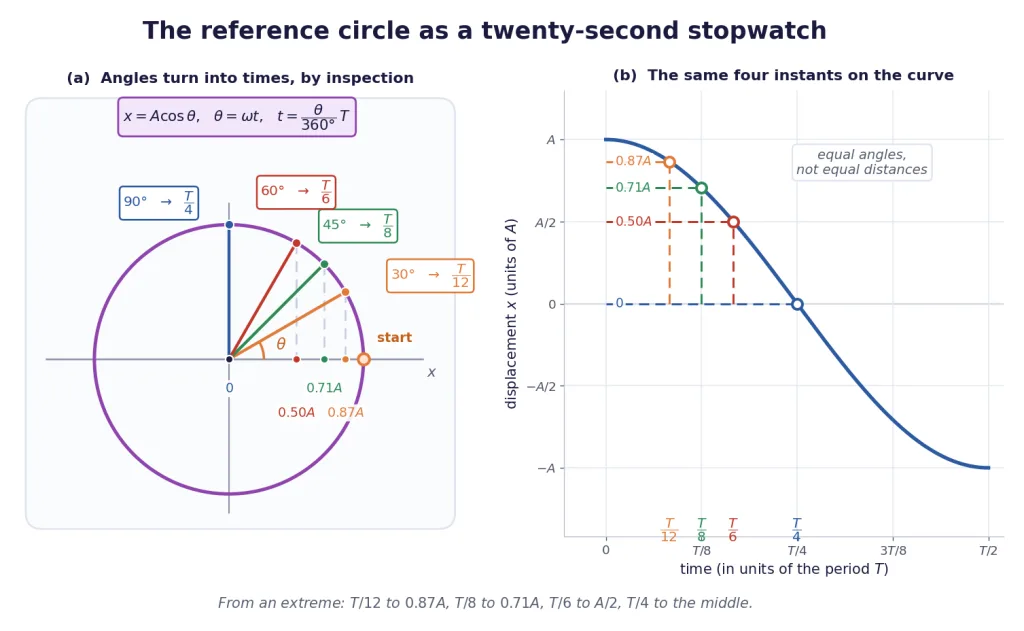
Key Point — the method, in three steps.
- Draw a circle of radius . The particle's displacement is the projection of a point moving round it at angular speed .
- Start the angle from the extreme position, , so that with .
- Find the angle turned through, then The whole method is: convert the displacements to angles, subtract the angles, convert the difference to a fraction of .
Four angles cover almost everything, because their cosines are the four numbers a question ever asks for.
| From to | Angle turned | Time from the extreme | Time from the mean position |
|---|---|---|---|
| , that is | |||
| , that is | |||
| , that is | |||
| , the mean position |
Read the last two columns as a pair. The two halves of the quarter-period always add to : , and .
Three results worth holding as sentences.
Mean position to half the amplitude takes ; half the amplitude to the extreme takes . Twice as long for the second half of the journey, even though it is a shorter distance — because the particle is slowing down all the way out.
Straight across the middle, from to , takes , by symmetry: two lots of .
The particle spends a third of every cycle inside , and two thirds outside it, which is why a long-exposure photograph of an oscillator is brightest at the ends.
[Exam Tip] If the stem starts the particle at the mean position instead, use and measure the angle from there — or, easier, keep the cosine and read the last column of the table. Whichever you choose, do not mix them inside one question.
Lookup two: the standard periods
Every period in this chapter is . Learn the row, do not rebuild it.
| System | Period | The one thing to notice |
|---|---|---|
| block of mass on a spring of constant | no , horizontal or hanging | |
| the same block hanging, stretching the spring by at rest | since — identical in form to a pendulum | |
| two springs side by side, same block | stiffer, so faster | |
| two springs end to end, same block | floppier, so slower | |
| block between two walls, one spring each side | both springs push the same way: parallel, not series | |
| equal pieces cut from one spring of constant | each piece has | shorter is stiffer |
| simple pendulum of length | no mass, no amplitude | |
| second's pendulum | seconds exactly, so m | it ticks once per one-way swing |
| pendulum in a lift accelerating up at | heavier feeling, faster ticking | |
| pendulum in a lift accelerating down at | lighter feeling, slower ticking | |
| pendulum in a freely falling lift | infinite — it does not oscillate at all | , so there is no restoring force |
| pendulum in a car accelerating horizontally at | , string tilted at | the two accelerations add as vectors |
| bob of density swinging fully immersed in a liquid of density | buoyancy cancels part of gravity | |
| floating cylinder of height and density , submerged depth | a pendulum in disguise | |
| liquid column of total length in a U-tube | note the — the level difference is when each surface moves by | |
| small ball in a bowl of radius | a pendulum of length |
Key Point — the one idea behind every row. Whatever the system, put its equation of motion into the shape where is measured from the equilibrium value, and read off. Then . Every entry above is that one line with a different in it.
[Important] The freely falling lift is the one row people get wrong, and it is the most-asked of them all. In free fall, the bob and its support fall together, so the string goes slack and there is no restoring force whatsoever. The bob does not oscillate: , so and the frequency is zero. "The pendulum oscillates faster" is on every option list; the answer is that it stops oscillating.
The Proportionality Grid, and Reading the Curves
Change one thing, read the factor off the square root
This is the highest-yield page in the section. Most oscillations questions on this paper do not ask for a number at all — they ask what happens to the period when the mass is quadrupled or the length is halved. Substituting numbers into those is a waste of forty seconds.
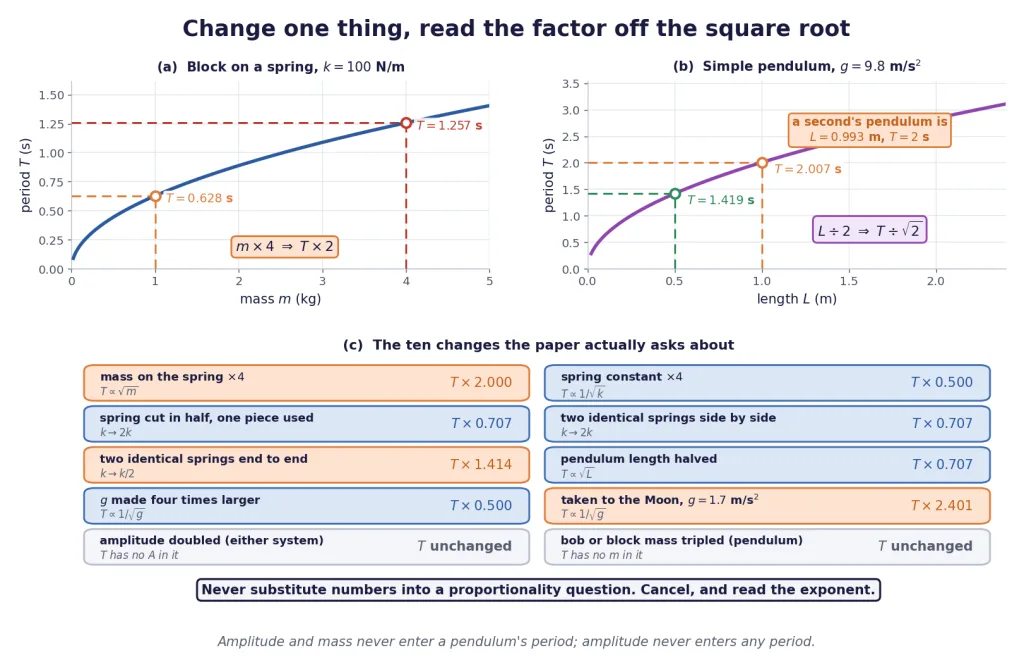
Key Point — the master line, from which every entry follows: Everything is a square root, so every factor applied to , , or reaches the period halved in the exponent. Multiply the mass by 4 and the period doubles; multiply it by 9 and the period triples.
| Change made | What it does | Factor on |
|---|---|---|
| mass on the spring | ||
| mass on the spring | ||
| spring constant | ||
| spring cut in half, one piece used | , that is | |
| two identical springs side by side | ||
| two identical springs end to end | ||
| pendulum length halved | ||
| pendulum length | ||
| made four times larger | ||
| taken to the Moon, m/s² | ||
| amplitude doubled, either system | has no in it | unchanged |
| bob mass tripled, pendulum | has no in it | unchanged |
And the quantities that are not the period: doubling the amplitude leaves and alone, doubles and , and multiplies the total energy by 4.
Three cells worth memorising as sentences.
To double the period of a spring oscillator you must quadruple the mass. Speeds and periods live under square roots; only energies are linear in the thing they depend on. Confusing with is the commonest arithmetic slip in this chapter.
Cutting a spring makes it stiffer, so the period falls. A half-length piece stretches half as much under the same pull, so its spring constant is and the period drops by . The instinct that "a smaller spring must be weaker" is exactly wrong.
Amplitude never appears in any period in this chapter. Not for the spring, not for the pendulum, not for the U-tube, not for the bowl. If an option offers an amplitude-dependent period, it is wrong before you read the rest of it.
[Exam Tip] Do these as ratios, never as substitutions: No , no calculator, no risk of a unit slip. If you find yourself typing into a proportionality question, you have chosen the ninety-second route to a ten-second answer.
Reading the curves
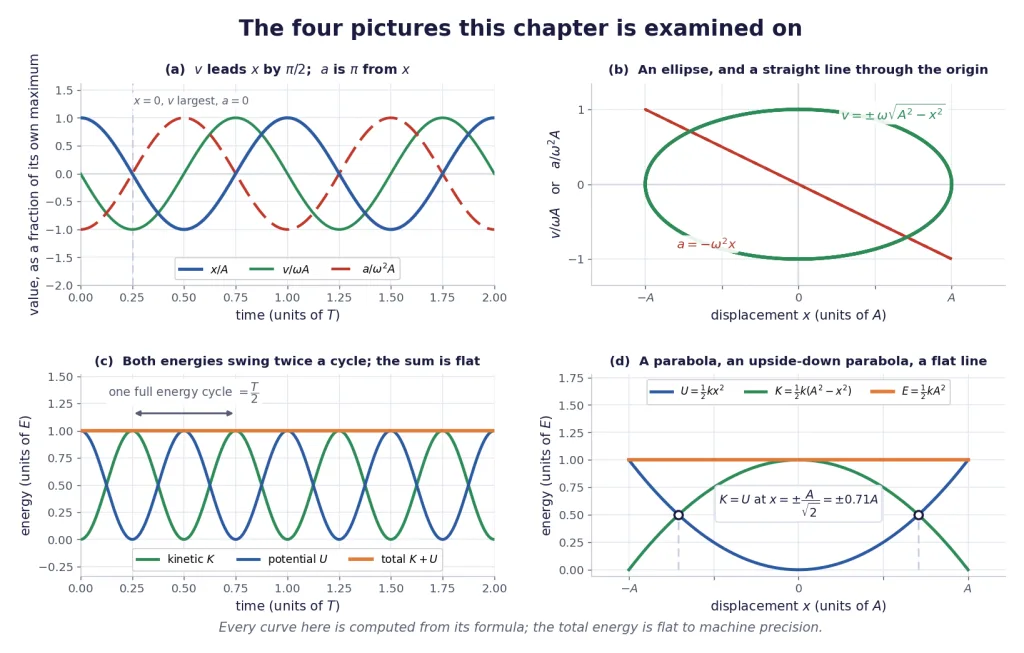
Four pictures cover every graph question this chapter can produce.
1. The stacked , , curves against time. All three are sinusoids of the same period, shifted by a quarter period each. Read them by their zeros: where crosses zero, is at a peak; where is at a peak, crosses zero and is at a peak. The acceleration curve is the displacement curve turned upside down and stretched by — a straight consequence of .
2. against is an ellipse. Squaring and adding and gives an ellipse with semi-axes and , traced clockwise. It is a circle only if in the units used.
3. against is a straight line through the origin with a negative slope. The slope is , so a graph of this kind hands you for free: read the slope, take the square root of its magnitude. A curve here, rather than a line, means the motion is not simple harmonic.
4. The energy curves. Against time, and are each raised sinusoids of period , running exactly out of step, and their sum is a flat horizontal line. Against displacement, is an upward parabola with its minimum at the mean position, is the same parabola turned over, and is again a flat line. The two parabolas cross at , which happens at .
| What you are shown | What to say |
|---|---|
| a sinusoid, and a second one a quarter period ahead | displacement and velocity |
| a sinusoid and its exact mirror image | displacement and acceleration |
| an ellipse in a against plot | ordinary SHM; semi-axes and |
| a straight line of negative slope in an against plot | SHM, and the slope is |
| two humped curves per cycle of , adding to a flat line | the kinetic and potential energies |
| an upward parabola in an energy against plot | the potential energy |
| a horizontal line in an energy against plot | the total energy |
| a sinusoid whose peaks shrink along a smooth envelope | a damped oscillation |
| a peaked curve of amplitude against driving frequency | a resonance curve |
[Important] Two habits make graph questions fast. Count the humps per cycle: one hump per cycle means it is , or ; two humps per cycle of means it is an energy. And check the value at and at the extremes — that alone separates from from without any algebra, because at a cosine starts at its maximum, a sine starts at zero, and the acceleration starts at its most negative.
Oscillations Wearing a Lab Coat
Two thirds of this paper is about living things, and oscillation is the physics idea that reaches furthest into them. A heartbeat is a period. Breathing is a frequency. The eardrum is a driven oscillator and the cochlea is a bank of resonators. Expect at least one of your oscillations questions to arrive wearing biological clothes, and be pleased when it does, because the physics inside them is always the easy kind: a period, a frequency, and the between them.
The heartbeat and the breath, as periodic motion
Neither is simple harmonic — a heartbeat is a sharp pulse, not a sinusoid — but both are periodic, and everything in Section 1 applies to them unchanged.
| Quantity | Resting adult | Period | Frequency |
|---|---|---|---|
| heart rate | beats per minute | second | Hz |
| heart rate, athlete at rest | beats per minute | seconds | Hz |
| heart rate, hard exercise | beats per minute | second | Hz |
| breathing | breaths per minute | seconds | Hz |
| a hummingbird's wingbeat | about per minute | second | Hz |
Key Point — the conversion, done once and never thought about again. A rate quoted per minute becomes a frequency in hertz on dividing by 60, and the period is the reciprocal: For beats per minute: Hz and second. And if the stem asks for the angular frequency, it is rad/s — not .
[Important] A heartbeat is periodic but not oscillatory in the strict sense, and certainly not simple harmonic. If a stem asks "which of these is an example of simple harmonic motion?" and offers a heartbeat, that is the wrong answer. If it asks "which is periodic?", it is right. Read which of the three nested boxes the question is standing in.
The eardrum and the cochlea, as driven oscillators
This is the richest biological application of the chapter, and it is entirely Section 10 in disguise.
Key Point: A sound wave arriving at the ear is a periodic driving force. The eardrum is a light stretched membrane with its own natural frequency and a good deal of damping, and it does exactly what any driven oscillator does: after the transient dies away it vibrates at the frequency of the sound, not at its own. That is why the ear reproduces the pitch it is given rather than one pitch of its own — a heavily damped driven oscillator is a faithful follower.
And then the cochlea does the opposite job, on purpose.
Key Point: The basilar membrane inside the cochlea is stiff and narrow at one end and floppy and wide at the other, so its natural frequency varies continuously along its length. An incoming tone sets the region whose natural frequency matches it into resonance, while the rest of the membrane barely moves. The hair cells at that place fire, and the brain reads the position of the response as the pitch. The cochlea is a row of tuned oscillators, and hearing pitch is resonance used as a measuring instrument.
Three consequences the paper likes.
- High frequencies are detected at the stiff base, low frequencies at the floppy apex — exactly as predicts: stiffer means a higher natural frequency.
- Prolonged loud noise damages the base first, which is why noise-induced hearing loss takes the high frequencies first.
- The audible range, about Hz to Hz, is the range of natural frequencies the membrane provides. Nothing outside it can find a resonator to excite.
The rest of the biology-adjacent list, one line each
| Observation | The physics |
|---|---|
| A hummingbird hovers, a housefly buzzes, a mosquito whines | wingbeat frequency; the pitch you hear is |
| A child pumps a swing by leaning at the right moment | resonance — energy fed in at , once every cycle |
| A tall person walks with a slower stride than a short one | the leg swings as a pendulum, and |
| A doctor's stethoscope, and why the chest wall booms | a driven membrane responding to a periodic pressure |
| A vocal fold vibrating at Hz for a low male voice, Hz for a female | a driven elastic oscillator; tension sets , so tightening raises the pitch |
| The circadian rhythm, roughly a -hour period | a biological oscillator, entrained — driven — by the daily light cycle |
| An insect's flight muscle vibrating far faster than its nerve fires | the thorax is an elastic system driven at its own natural frequency |
| A shivering muscle, roughly Hz | periodic, not simple harmonic |
| Sea-sickness, and why about Hz is the worst frequency | resonance of the body's own low-frequency mechanical response |
| A tuning fork held to the skull in a hearing test | forced oscillation transmitted through bone rather than air |
[Exam Tip] In every one of these, the physics you are being asked for is one of exactly three things: a period-to-frequency conversion, the word "resonance" with its condition , or the classification periodic / oscillatory / simple harmonic. Decide which of the three it is before you read the options, and the biology stops mattering.
The Two Special Formats, and the Speed Habits
Assertion-Reason: the four codes
You are given an Assertion (A) and a Reason (R) and asked to choose:
| Code | Meaning |
|---|---|
| (a) | Both A and R are true, and R is the correct explanation of A |
| (b) | Both A and R are true, but R is not the correct explanation of A |
| (c) | A is true but R is false |
| (d) | A is false but R is true |
Read the option list before you start — the order of these four is not fixed between papers, and choosing "option (a)" from memory when the paper has shuffled them is a self-inflicted wound.
Key Point: Three separate judgements, in this order, and never let one influence the next:
- Cover R. Is A true, on its own?
- Cover A. Is R true, on its own?
- Only if both are true: does R actually explain A, or is it merely another true statement about the same topic?
Step 3 is where the marks are. Ask: if R were false, would A stop being true? If yes, R explains A. If A would survive without R, the answer is (b).
Worked, four times.
Item 1. A: The period of a block on a spring is the same on the Moon as on the Earth. R: The period of a spring oscillator is , which contains no . A alone: true. R alone: true. Does R explain A? Yes — the absence of from the formula is precisely why the location makes no difference. Both true, R explains A.
Item 2. A: The period of a block on a spring is the same on the Moon as on the Earth. R: The mass of the block is the same on the Moon as on the Earth. A alone: true. R alone: true — mass is not weight, and it does not change with location. But does R explain A? No. The mass being unchanged is necessary but nothing like sufficient; a pendulum's bob mass is also unchanged on the Moon and its period changes by a factor of . The explanation is the absence of from the formula, not the constancy of . Both true, R does not explain A. Items 1 and 2 have the same assertion and completely different answers, and that is exactly how this format is built.
Item 3. A: In simple harmonic motion the speed is greatest at the mean position. R: The acceleration is zero at the mean position, so the particle has stopped speeding up. A alone: true. R alone: true, and it is the reason: the particle accelerates all the way in and decelerates all the way out, so the turning point of the speed is exactly where the acceleration changes sign. Both true, R explains A.
Item 4. A: The kinetic energy, the potential energy and the total energy of a particle in SHM all vary with period . R: The kinetic and potential energies each depend on the square of a sinusoid, and squaring a sinusoid halves its period. A alone: false — and do have period , but the total energy is constant and has no period at all. R alone: true, and it is exactly why the first two behave as they do. A is false but R is true. Notice how the assertion has been written to look like the standard sentence with one extra word slipped in.
Column matching: anchor, do not solve
You are given four items in Column I, four in Column II, and four codes. Never work out all four pairings. Find the one or two that are unmistakable and use them to kill codes.
Key Point: Anchor on whatever is structurally unique in Column II — the only entry containing , the only one that is zero, the only sum , the only . Two anchors almost always leave exactly one surviving code.
Worked. Column I: (A) mean position (B) extreme position (C) a quarter of a period after the mean position (D) the position where . Column II: (i) speed is zero (ii) (iii) acceleration is zero (iv) the particle is at an extreme.
Anchor 1: "acceleration is zero" happens at exactly one place, the mean position, so A-iii. Anchor 2: is the only algebraic entry, and it is the equal-energy position, so D-ii. Two anchors, and any code disagreeing with either is dead. The remaining two fall out with no work: at an extreme the speed is zero, so B-i; and a quarter period after the mean position the particle has reached an extreme, so C-iv.
[Exam Tip] In this chapter one anchor is nearly always free. Zero acceleration can only be the mean position; zero speed can only be an extreme; can only be the equal-energy position; can only be an energy; anything with in it is a pendulum, and anything without is a spring. Find whichever of those appears and you have your first pairing before you have read the rest of the question.
The six habits that finish a question in under 45 seconds
1. Read the last line of the stem first. It tells you which card you need and, half the time, which trap is set. The words "frequency", "angular frequency", "period", "maximum speed", "maximum acceleration", "total energy" and "kinetic energy" all change the answer without changing the topic.
2. Write the unit on every frequency, at once. rad/s or Hz, decided before you substitute anything. That single habit removes the chapter's commonest wrong answer, and it costs two seconds.
3. Ask whether the question is a ratio. If two situations are being compared, cancel everything common and read the exponent off the master line. No , no , no calculator. Every proportionality in this chapter is a square root.
4. Locate the mean position before anything else. For a hanging spring it is the stretched equilibrium; for a pendulum it is the lowest point; for a floating body it is the normal floating level. Displacement, amplitude and energy are all measured from there.
5. Sanity-check the size before you look at the options. A laboratory spring oscillator has a period of a fraction of a second. A metre-long pendulum takes about two seconds. An audible frequency is hundreds or thousands of hertz. A heartbeat is around one hertz. If your answer is a decade away from those, you have dropped a or inverted a fraction.
6. Read what each wrong option encodes. In this chapter the distractors are almost never a few per cent out. They are the -times-wrong answer, the square-root-forgotten answer ( where belongs), the amplitude-dependent period, the energy that went as instead of , the series-for-parallel spring answer and the natural-for-driving frequency answer. Identify which trap each option encodes and you can often eliminate two of them without computing anything at all.
[Important] One last habit, and it is about the clock rather than the physics. If forty seconds have gone and you are still on line two, mark it and move. Oscillations questions on this paper are worth exactly as much as the easier ones elsewhere in it, and the four marks you lose by running out of time at the end are worth the same as the four you were fighting for here.
Solved Examples
Twelve problems at exam level and exam pace. Give yourself 45 seconds on each before reading the solution. Throughout, m/s², and ; other constants are stated where they are used. Angles inside and are in radians. Every solution that produces a frequency states its unit, rad/s or Hz, on the line where it appears.
Example 1: Twenty statements, no arithmetic
Answer each in a single sentence, with no calculation.
(a) Define simple harmonic motion. (b) Why is every oscillatory motion periodic, while the converse fails? (c) Give one motion that is periodic but not oscillatory. (d) Give one motion that is oscillatory but not simple harmonic. (e) In , what is the phase and what is the phase constant? (f) By what angle does the velocity lead the displacement? (g) What is the phase relation between the acceleration and the displacement? (h) Where in the motion is the speed largest, and where is the acceleration largest? (i) Why does the period of a simple pendulum not depend on the mass of the bob? (j) Why does it not depend on the amplitude? (k) Under what condition is that amplitude statement true? (l) Does the period of a block on a spring depend on ? (m) What is a second's pendulum? (n) What happens to a pendulum in a freely falling lift? (o) With what period do the kinetic and potential energies vary? (p) With what period does the total energy vary? (q) How does the total energy depend on the amplitude? (r) What is resonance, and give one example. (s) At what frequency does a driven oscillator finally settle? (t) Why is a damped oscillation only approximately simple harmonic?
Solution:
(a) A motion in which the acceleration is proportional to the displacement from a fixed mean position and directed towards it: , equivalently .
(b) An oscillation is a to-and-fro motion about a mean position, and a motion that goes to and fro necessarily returns to where it started, so it repeats. A periodic motion need only repeat — it need not reverse about anything.
(c) The Earth's orbit round the Sun, or a fan blade, or the hands of a clock.
(d) A ball bouncing between two walls, or a pendulum swung through — to and fro, but the restoring force is not proportional to the displacement.
(e) The phase is the whole bracket ; the phase constant is alone, its value at .
(f) By , a quarter of a period.
(g) They are out of phase — exactly opposite, which is in the language of phase.
(h) Speed largest at the mean position, acceleration largest at the extremes. Each is zero where the other is largest.
(i) Because the restoring force is a component of the bob's own weight, so appears on both sides of and cancels. Gravity supplies both the push and the inertia.
(j) Because for small angles , giving , in which no amplitude appears. A wider swing travels further but proportionately faster.
(k) Only for small angular amplitudes. At the true period is about longer, and at about longer.
(l) No. contains no . For a hanging spring, gravity shifts the mean position down by and then cancels out of the equation of motion.
(m) A pendulum whose period is exactly 2 seconds, so that each one-way swing takes one second. Its length on the Earth is m, near enough to a metre.
(n) It stops oscillating. Bob and support fall together, so , there is no restoring force, and the period becomes infinite.
(o) Each with period , that is at twice the frequency of the displacement.
(p) It does not vary at all. The total mechanical energy is constant, .
(q) As the square of it: . Doubling the amplitude quadruples the energy.
(r) The large response of a driven system when the driving frequency is made equal to its natural frequency, ; the amplitude is then limited only by the damping. Example: a child on a swing pushed once per swing.
(s) At the driving frequency , never at its own natural frequency, once the transient has died away.
(t) Because its amplitude decreases with time, so the motion never repeats exactly. Over a few cycles the decay is negligible and the motion looks sinusoidal, which is all the approximation claims.
Takeaway: Twenty questions, no arithmetic, and about five minutes of your life. Every one of them has been the whole of somebody's four marks.
Example 2: Name the card, substitute once
A block of mass kg oscillates on a light horizontal spring of spring constant N/m with an amplitude of cm. Find (a) the angular frequency, (b) the frequency and the period, (c) the maximum speed, (d) the maximum acceleration, (e) the total energy, and (f) the speed when the block is cm from the mean position.
Solution:
(a) Card 6 and card 7, in one step:
(b) Now card 2, and write both units: The answer " Hz" is on the option list. It is the same number as with the wrong unit stuck to it.
(c) Card 3, with m:
(d) Card 4:
(e) Card 12: Check it the other way: J. Same.
(f) Card 5 — and notice that no time is needed: The , , triangle does the work. And the answer is of the maximum speed, which is worth remembering: at three fifths of the amplitude the speed is four fifths of its maximum.
Takeaway: Six answers, six single lines, no derivation anywhere. The only place a mark can be lost is the unit on part (b).
Example 3: The that decides the mark
(a) A particle oscillates at Hz. What is its angular frequency? (b) Another has rad/s. What are its frequency and period? (c) The mains supply in India alternates at Hz. What is the corresponding angular frequency? (d) A student writes "the angular frequency of a second's pendulum is rad/s". What went wrong?
Solution:
One relation does all four, read in whichever direction the stem wants:
(a) rad/s. Given hertz, multiply by .
(b) Hz, and second. Given rad/s, divide by . The trap answer " Hz" is times too large.
(c) rad/s. This one is worth memorising outright, because it turns up in three different chapters.
(d) The student computed the frequency, not the angular frequency. A second's pendulum has seconds, so is right, with the wrong name and the wrong unit on it. That is the entire mistake, and it is worth four marks every time it is made.
Takeaway: Decide which of the three the stem wants before you compute anything, and write its unit on the same line. Hertz means cycles per second; rad/s means radians per second; the factor between them is and it never goes away.
Solved Examples (continued)
Example 4: Six proportionality questions in ninety seconds
For each change, state the factor by which the period changes, with no calculator.
(a) The mass on a spring is quadrupled. (b) The spring is replaced by one four times as stiff. (c) A spring is cut into two equal halves and the block is hung from one half. (d) The length of a pendulum is halved. (e) The same pendulum is taken to the Moon, m/s². (f) The amplitude of either oscillator is doubled.
Solution:
Everything comes off two lines, and neither needs a number substituted into it:
(a) , so . The period doubles. Quadrupling the mass to double the period is the whole content of the square root, and "the period quadruples" is always on the option list.
(b) , so . The period halves.
(c) A half-length spring stretches half as much under the same force, so its spring constant is . Then . The period falls by — cutting a spring makes it stiffer, not weaker.
(d) , so again.
(e) , so A second's pendulum taken to the Moon has a period of seconds — a clock driven by it loses more than half its time.
(f) Unchanged. No period in this chapter contains the amplitude. What does change: the maximum speed and the maximum acceleration both double, and the total energy is multiplied by 4, since .
Takeaway: Six answers, no arithmetic beyond one square root of . Cancel first, and only then look for a calculator — you will find you do not need one.
Example 5: The reference circle answers four timing questions
A particle executes SHM of amplitude with a period of seconds. Find the time it takes to travel (a) from an extreme position to , (b) from the mean position to , (c) from straight across to , and (d) from an extreme position to .
Solution:
Set up the circle once, measuring the angle from the extreme so that , and then with seconds.
(a) gives , so :
(b) The mean position is at and is at , so the particle turns through :
(c) By symmetry this is two lots of part (b):
(d) gives :
Now read (a) and (b) side by side, because that comparison is the question underneath the question. The outer half of the journey, from to the extreme, takes second; the inner half, from the mean position to , takes only second. Half the distance, twice the time — because the particle is slowing down all the way out. And the two must add to a quarter period: . That sum is a free check on every answer of this kind.
Takeaway: Convert displacements to angles, subtract the angles, and turn the difference into a fraction of . Four timing questions, four fractions, and the only trigonometry needed is , and .
Example 6: The period lookup, used five times
Take m/s² throughout. Find the period of (a) a kg block on a spring of spring constant N/m; (b) a simple pendulum of length m; (c) a kg block carried by two springs of N/m and N/m side by side; (d) the same block on the same two springs joined end to end; and (e) state the length of a second's pendulum.
Solution:
(a) Card 7:
(b) Card 14:
(c) Side by side is the parallel case. Both springs change length by the same amount as the block moves, so their restoring forces add:
(d) End to end is the series case. The same tension runs through both springs and their extensions add:
(e) A second's pendulum has seconds by definition, so
The check that catches a series-for-parallel slip instantly. Compare (c) and (d): the same two springs give N/m one way and N/m the other, a ratio of , so the periods must be in the ratio . And indeed . The parallel combination is always stiffer than either spring alone; the series combination is always floppier than either. If your "parallel" answer came out smaller than N/m, you have used the wrong rule.
Takeaway: Five systems, five rows of the lookup table, no derivations. The only judgement anywhere is deciding whether the springs share a stretch (parallel) or share a tension (series).
Solved Examples (continued)
Example 7: A lift, a car and a liquid
A pendulum has a period of exactly seconds when it hangs at rest. Take m/s². Find its new period when (a) it is in a lift descending with acceleration ; (b) it hangs from the roof of a car accelerating horizontally at , and also find the angle its string makes with the vertical; (c) its bob, of density times that of the liquid, swings fully immersed in that liquid; (d) the lift's cable snaps and it falls freely.
Solution:
One card covers all four. Only ever changes, so Work with that ratio and never has to be found.
(a) Lift descending at . The lift accelerates downwards, so the bob feels lighter: Descending means a longer period, so a pendulum clock in a descending lift runs slow. Going up, it would be and the clock would run fast.
(b) Car accelerating horizontally at . Gravity acts downwards and the pseudo-acceleration backwards; they are perpendicular, so they combine as vectors: and the string hangs along the direction of , tilted backwards from the vertical by The , , triangle again: , so . Any horizontal acceleration increases , whichever way the car is going, because the two vectors are perpendicular and the magnitude of the sum can only grow.
(c) Bob immersed, . Buoyancy is an upward force of of the weight, so Slower, as it must be: part of gravity has been cancelled. (Viscous drag would damp the swing as well, but it does not enter this formula.)
(d) Free fall. The lift and everything in it accelerate downwards at together, so . There is no restoring force at all: the string goes slack, the bob does not swing, and . The frequency is zero, not infinite — that pair is deliberately offered together.
Takeaway: Replace by and use the ratio form. Up means , down means , horizontal means , a liquid means , and free fall means no oscillation at all.
Example 8: Reading four curves off one motion
A particle moves as , with in centimetres and in seconds. (a) Read off , , and . (b) Sketch, in words, the shapes of , and against time, and say where each is zero and where each peaks. (c) What shape is the against graph, and what are its intercepts? (d) What shape is the against graph, and what does its slope give you? (e) How many humps does the kinetic-energy-against-time graph show in one cycle of ?
Solution:
(a) Compare with , term by term: The phase constant is zero, so the particle starts at the positive extreme.
(b) All three are sinusoids of period seconds, each a quarter period ahead of the last.
- starts at cm, is zero at s and s, and reaches cm at s.
- starts at zero, reaches its largest magnitude cm/s at s — exactly where crosses zero — and is zero again at s.
- starts at its most negative, cm/s², is zero at s, and is most positive at s.
The reading rule in one line: where is at a peak, is zero and is at a peak; where is zero, is at a peak and is zero.
(c) An ellipse, from It cuts the -axis at cm (where , the extremes) and the -axis at cm/s (where , the mean position). Those two intercepts are and , so the ellipse hands you both amplitudes at a glance.
(d) A straight line through the origin with negative slope, because . The slope is per second squared, so which recovers part (a). A straight line here is the signature of SHM; any curvature means the motion is not simple harmonic.
(e) Two. The kinetic energy is largest every time the particle passes the mean position, and that happens twice per cycle — so has period second and shows two humps in every cycle of . So does , out of step with it, and their sum is a flat line at .
Takeaway: Four graphs, four signatures: a quarter-period shift between the three time curves, an ellipse for against , a straight line of slope for against , and two humps per cycle for either energy.
Example 9: Where the energy is, at a glance
A block of mass kg oscillates on a spring of spring constant N/m with an amplitude of cm. Find (a) the total energy and the period; (b) the displacement at which the kinetic and potential energies are equal; (c) the displacement at which the kinetic energy is three times the potential energy; (d) the kinetic and potential energies when the block is cm from the mean position; (e) the period with which the kinetic energy varies; (f) the average kinetic energy over one full cycle.
Solution:
Set up once. rad/s, so second, and
(b) means each is , so , giving Not at half the amplitude — that is the trap, and cm is always an option. Because the potential energy goes as , you have to get of the way out before half the energy is potential.
(c) means , so and So is the place where the energy splits three to one, not one to one. Learn the pair together: gives , and gives .
(d) At cm, use and : Check with the fraction rule: , and J. The fraction of the energy that is potential is exactly , which turns most of these into mental arithmetic.
(e) second, so the kinetic energy varies at Hz while the block itself oscillates at Hz. Twice the frequency, half the period — and the total energy stays flat at J throughout.
(f) Over a complete cycle the kinetic and potential energies share the total equally, so
Takeaway: Three positions do most of the work — where , where they are equal, and where the energy is all potential. And the fraction that is potential is always .
Solved Examples (continued)
Example 10: Four assertion-reason items, judged three times each
For each pair choose: (a) both true and R explains A; (b) both true but R does not explain A; (c) A true, R false; (d) A false, R true.
(i) A: A simple pendulum will not oscillate inside a freely falling lift. R: In free fall the bob and the support have the same acceleration, so the effective gravity is zero.
(ii) A: The total mechanical energy of a particle in SHM varies with period . R: The kinetic and potential energies each vary with period .
(iii) A: A driven oscillator finally oscillates at the frequency of the driving force. R: At resonance the amplitude of a driven oscillator is limited only by the damping.
(iv) A: The damped angular frequency is smaller than the natural angular frequency . R: , and the subtracted term is positive.
Solution:
(i) A alone: true — with nothing to restore it, the bob simply floats beside its support. R alone: true. Does R explain A? Yes, precisely: kills the restoring force, so . Answer (a).
(ii) A alone: false. The total energy is constant; it is and separately that have period . R alone: true. Answer (d). Notice the construction: the true sentence about and has been stretched to include , and one extra word turns a correct statement into a wrong one. Read assertions for the words that were added, not just for the topic.
(iii) A alone: true — after the transient dies away, the steady state is at . R alone: true, that is exactly what happens at . Does R explain A? No. R is a statement about how large the response is at one particular driving frequency; A is a statement about what frequency the response happens at, and it holds at every driving frequency, resonant or not. Two true sentences about the same topic, no explanatory link. Answer (b). This is the hardest of the four, and it is the pattern the format exists to test.
(iv) A alone: true. R alone: true, and for any real damping. Does R explain A? Yes — subtracting a positive quantity from can only reduce it. Answer (a).
Takeaway: Cover R and judge A. Cover A and judge R. Only then ask whether R explains A rather than merely sitting next to it. Item (ii) shows why step one must come first: had you read R and agreed with it, you might have let it carry a false assertion through.
Example 11: Two column-matching sets, anchored not solved
Set 1. Column I: (A) (B) (C) (D) . Column II: (i) liquid column in a U-tube (ii) simple pendulum (iii) one block on one spring (iv) two springs side by side.
Set 2. Column I: (A) maximum speed (B) maximum acceleration (C) total energy (D) period. Column II: (i) (ii) independent of (iii) and equal to (iv) and equal to .
Solution:
Set 1 — find the structurally unique entries first.
Anchor 1: only one formula in Column I contains a in the denominator under the root, and only one system in Column II is a U-tube. D-i. Anchor 2: only one formula contains with a length that is not a liquid column. B-ii. Two anchors, and the rest is forced: is the side-by-side (parallel) combination, so C-iv, and the bare is the single spring, A-iii.
Final: A-iii, B-ii, C-iv, D-i. Total working: about fifteen seconds, and two of the four pairings were never computed at all.
Set 2 — anchor on the odd one out.
Anchor 1: exactly one entry in Column II says "independent of ", and exactly one quantity in this chapter does not depend on the amplitude. D-ii. Anchor 2: exactly one entry goes as , and only the energy does. C-i. The last two are separated by their : one power of belongs to the speed and two to the acceleration, so A-iii and B-iv.
Final: A-iii, B-iv, C-i, D-ii.
[Exam Tip] In both sets the anchors were found by looking for structural oddities — the only , the only , the only "independent of" — and never by working out a pairing. Once two pairings are fixed, a four-item code list almost always has a single survivor. Match two, eliminate, and move.
Takeaway: Column matching is an elimination exercise wearing the costume of a calculation. Find the entry that could only be one thing, and let it kill three of the four options.
Example 12: The heartbeat, the eardrum and the cochlea
(a) A resting adult's heart beats times a minute. Find the period, the frequency and the angular frequency of the beat. (b) Is a heartbeat periodic? Oscillatory? Simple harmonic? (c) A sound of frequency Hz enters the ear. At what frequency does the eardrum finally vibrate, and why? (d) How does the cochlea tell one pitch from another? (e) Why does prolonged loud noise damage high-frequency hearing first?
Solution:
(a) A rate per minute becomes a frequency on dividing by 60: Three different numbers with three different units, and the stem's exact wording decides which one is wanted.
(b) Periodic: yes — it repeats at equal intervals. Oscillatory: not in the strict sense — the heart is not going to and fro about a mean position. Simple harmonic: definitely not — the trace is a sharp spiked pulse, nothing like a sinusoid, so there is no anywhere in it. Periodic is the only one of the three you may claim.
(c) At Hz, the frequency of the driving force. A driven oscillator settles into the steady state at the driving frequency, never at its own natural frequency; only the amplitude of the response depends on how near the drive is to . If the eardrum vibrated at its own natural frequency, every sound would come out at the same pitch and hearing would be useless.
(d) By resonance, read as position. The basilar membrane inside the cochlea is stiff and narrow at one end and floppy and wide at the other, so its natural frequency varies continuously along its length. An arriving tone drives the whole membrane, but only the region whose natural frequency matches it responds strongly. The hair cells at that place fire, and the brain reads where the response happened as which pitch it was. A row of tuned oscillators, used as a measuring instrument.
(e) Because rises with stiffness, the high frequencies resonate at the stiff base of the cochlea — the end every sound must pass on its way in. That region takes the largest cumulative amplitude, so it wears out first, and high-frequency hearing is what is lost.
Takeaway: Every biological oscillation question in this chapter reduces to one of three things — a per-minute to hertz conversion, the resonance condition , or the classification periodic / oscillatory / simple harmonic. Decide which before reading the options, and the biology stops mattering.