
Two Energies, One Block
A block on a spring never stops swapping. At the extremes it is motionless but the spring is fully stretched; at the centre the spring is relaxed but the block is flying. Something is clearly being handed back and forth, and this section works out exactly what, exactly how much, and exactly how fast.
Two results are already in hand and will not be re-derived here:
Everything below is those two, squared.
The kinetic energy
Kinetic energy is , so substitute the velocity:
and since is exactly the spring constant , the same thing can be written
Note what the squaring did to the minus sign: it destroyed it. Kinetic energy does not care which way the block is going, and that single fact is behind the most examined result in this section.
The potential energy
The spring force is a conservative force, so a potential energy belongs to it. To find it, ask how much work you must do to stretch the spring from its natural length out to a displacement , pulling gently. At an intermediate displacement you must pull with , so
That work is not lost; it is stored in the spring, ready to be handed back. So
Key Point — the elastic potential energy: measured with at the mean position, which is the standard choice throughout this chapter. is the displacement from the mean position — for a hanging mass that means from the stretched equilibrium, not from the natural length of the spring.
Now put in the displacement of the actual motion, :
The pair, side by side
Key Point — the two energies of a linear harmonic oscillator: One carries a , the other a , and they share the identical prefactor . That is the whole structure of this section.
Three things follow at once, and none of them needs any algebra.
1. Both are always positive or zero. A square cannot be negative. Kinetic energy is and potential energy is , and both squares see to it that neither curve ever dips below the axis.
2. They peak at opposite moments. is largest exactly where is smallest. When one is at the top of its range the other is at the bottom — never both at once.
3. Each has the same ceiling, . Because and both run between 0 and 1, each energy runs between and , and each reaches both ends of that range in every cycle.
| Where the block is | Speed | |||
|---|---|---|---|---|
| mean position, | maximum, | maximum, | ||
| extremes, | maximum, | |||
| a general |
That last row is worth staring at. Substituting into gives
so the kinetic energy is written in terms of position rather than time — no phase, no clock, no inverse cosine. Most energy questions in an exam are answered from that line and the line above it.
[Board Important] "Derive expressions for the kinetic and potential energy of a particle executing SHM and show that the total energy is constant" is a standard four- or five-mark question. The derivation above is the first half of it; the next block is the second half.
Add Them Up, and Watch the Time Disappear
Take the two expressions and add them.
The prefactor is common, so pull it out:
The bracket is the oldest identity in trigonometry, and it equals 1 for every angle. So the bracket collapses, and with it the entire time dependence.
Key Point — the total mechanical energy of a linear harmonic oscillator: A constant. It does not depend on the time, and it does not depend on the position. Whatever the oscillator is doing at this instant, has the same value it had at every other instant.
That is not a coincidence of the algebra; it is conservation of mechanical energy doing its job. The spring force is conservative and there is no friction in the ideal problem, so nothing can drain the total.
Three ways to write the same constant
All three faces of get asked, and each is convenient with different data.
| You are given | Use | Because |
|---|---|---|
| the spring constant and the amplitude | no mass needed at all | |
| the mass, and the amplitude | no spring constant needed | |
| the mass, the frequency and the amplitude | substitute and square |
The third one exists purely because questions so often quote a frequency in hertz. Note where the went: . [JEE Tip] If you would rather not carry a fourth formula, convert to first and use the second form. What you must never do is put a frequency in hertz into a formula that wants — that loses a factor of in an energy.
Reading the maxima off it
Since the total is constant and each energy in turn takes the whole of it:
Key Point: All the energy is kinetic at the mean position, all of it is potential at the extremes, and at every point in between the two share it out.
Two useful rearrangements come free:
The first says that the speed at the mean position is fixed entirely by the energy and the mass; the second lets you find the amplitude from an energy without knowing anything about the timing.
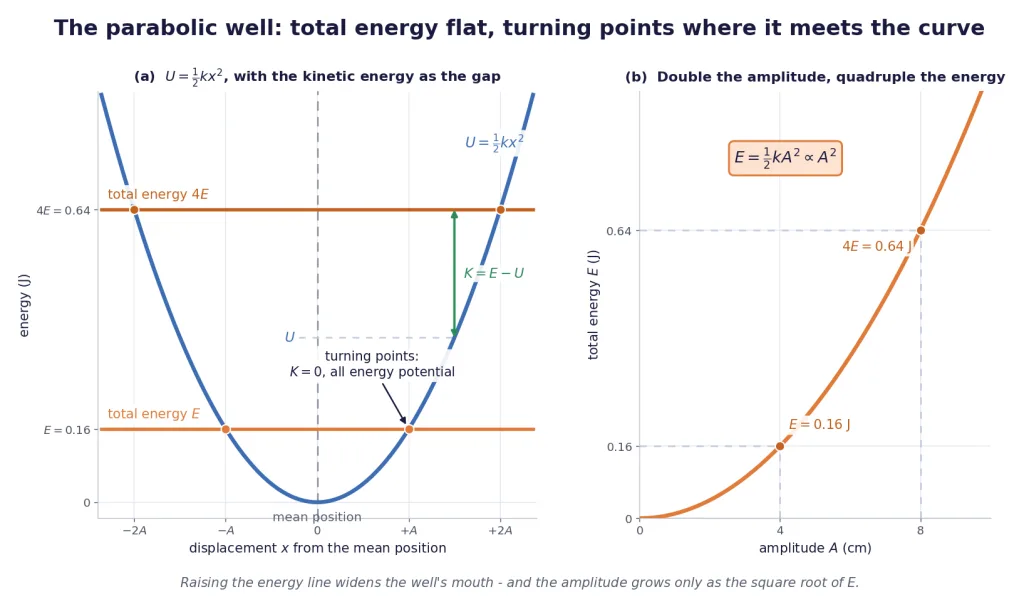
The headline: energy goes as the square of the amplitude
contains , not . That single exponent is worth more marks in this chapter than any other detail.
Key Point — energy and amplitude: Double the amplitude and the energy becomes four times as large. Triple it and the energy becomes nine times as large. Halve it and only a quarter of the energy is left.
Run it backwards and the square root appears: to double the energy you must increase the amplitude by only , not by 2. Pumping a swing twice as hard does not make it swing twice as high.
And as the square of the frequency
Look at with the amplitude held fixed. The frequency also enters squared.
Key Point — energy and frequency:
At a fixed amplitude, (equivalently , and equivalently , since ). Double the frequency of an oscillation without changing how far it swings and you have quadrupled its energy.
That is why a high-frequency vibration of even a tiny amplitude can carry serious energy, and it is the reason a stiffer spring stores more energy for the same pull.
| Change made, everything else fixed | and | |
|---|---|---|
| amplitude | unchanged | |
| amplitude | unchanged | |
| (or ) | halved | |
| spring constant , same | halved | |
| mass on the same spring, same | doubled | unchanged, since has no |
That last row catches people. With the amplitude held fixed, changing the mass on a given spring does not change the stored energy at all — it changes only how long the block takes to go round. Look at whichever form of contains the quantities the question actually fixed, and the answer is immediate.
The Energies Run at Twice the Frequency
Here is the result that catches more students than anything else in this section. It is short, it is easy to prove, and it is asked constantly.
Key Point — the periods do not match:
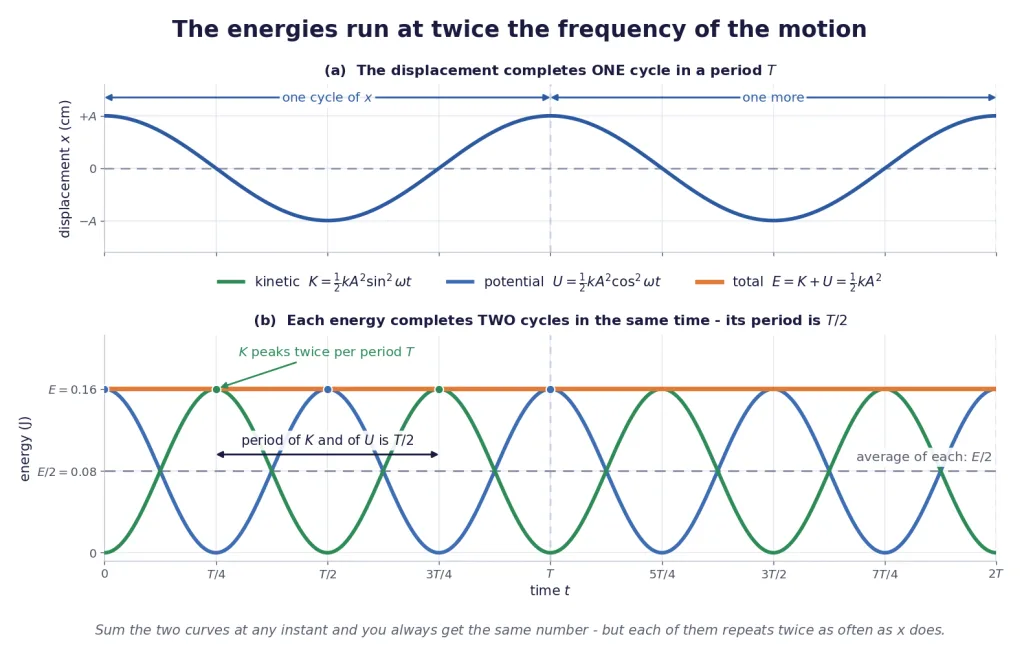
The displacement has period . The kinetic energy and the potential energy each have period
Each of them completes two full cycles in the time the displacement takes to complete one. Their frequency is , twice the frequency of the motion.
Why, in one line
Because both energies depend on the square of a sinusoid, and squaring a sinusoid doubles its frequency. The two double-angle identities say it exactly:
Apply them to the two energies, writing and remembering that :
Read the angular frequency straight off those brackets: it is , not . And the period that goes with is
Why, without any algebra at all
The physical argument is even shorter, and it is the one to give in an exam if the marks are for reasoning. Watch the kinetic energy through one full cycle, starting at the right extreme:
- at it is zero;
- at the centre it is maximum;
- at it is zero again;
- at the centre again it is maximum again;
- back at it is zero.
The block passes the mean position twice in every cycle, once going left and once going right, and peaks at both. Since depends on the square of the velocity, it does not notice that the block is travelling the opposite way the second time. Two peaks per period means a period of . The same count works for , which reaches its maximum at and again at .
The averages, which fall straight out
The forms above are written as "a constant plus a cosine", and the average of a cosine over a whole number of its own cycles is exactly zero. So the average of each energy is simply the constant left behind.
Key Point — cycle averages: Averaged over a complete cycle, the energy is split exactly evenly between the two forms. Equivalently, .
[JEE Tip] The average of or over a full cycle being is worth memorising on its own. It reappears in alternating current, in wave energy and in kinetic theory, always for the same reason.
One thing and are not
They oscillate, and they oscillate sinusoidally, but neither of them is simple harmonic. Simple harmonic motion swings symmetrically about zero and takes negative values half the time; and oscillate about and never go below zero. They are sinusoids sitting on a pedestal, which is a different thing. If a question asks whether the kinetic energy of a particle in SHM is itself simple harmonic, the answer is no — it is periodic, with period .
The four traps this result creates
| A question asks for… | The answer is | Not |
|---|---|---|
| the period of the displacement | ||
| the period of the kinetic energy | ||
| the frequency of the potential energy | ||
| the period of the total energy | undefined, it never changes | or |
That last row deserves a sentence. The total energy is a straight horizontal line; a constant has no period, and describing it as "varying with period " is wrong. Only the two parts oscillate.
[NEET Important] "The kinetic energy of a particle in SHM of period varies with a period of _" is close to an annual question. The answer is . The same goes for potential energy. If the question gives a frequency instead, the answer is twice it.
Where the Two Are Equal, and Every Other Ratio
Almost every one-mark energy question in this chapter is a version of the same problem: at what displacement is the kinetic energy some stated multiple of the potential energy? One formula answers all of them.
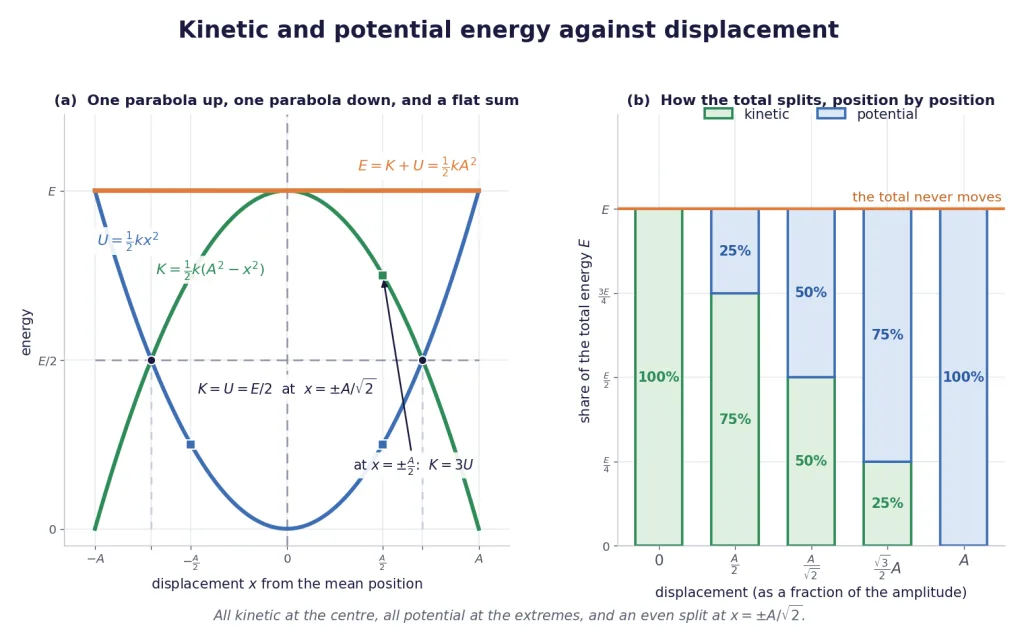
The two fractions
Divide each energy by the total. Since and , the cancels:
Key Point — the energy fractions at displacement : Both depend only on the ratio — not on the mass, not on the spring constant, not on the frequency. So questions of this kind never need a single unit conversion.
Set and the potential fraction is zero; set and it is one. Everything in between follows.
The two standard positions
Where the two energies are equal. Set , that is :
and at that point each energy is exactly half the total, .
Where the kinetic is three times the potential. Set , that is :
and there while .
Key Point — the two one-mark staples: Both have a , because each condition is met once on each side of the mean position.
The general rule, which makes all of them one question
Ask for for any positive number . Then , so and
Key Point — the master formula: Check it on the two you know: gives , and gives . Both agree.
The mirror question, "where is the potential energy times the kinetic?", is the same formula with replaced by — or, more simply, use directly.
| Condition | Displacement | ||
|---|---|---|---|
| all kinetic | |||
| all potential |
The same conditions, in time
Now the other half of the question: when does each of these happen? Take the standard start, released from rest at , so that with . Then a condition on becomes a condition on .
For at :
using in the last step. The same working for the other two standard positions gives:
| Condition | First time reached | ||
|---|---|---|---|
| , at | |||
| , at | |||
| , at | |||
| all kinetic, at |
Key Point: starting from an extreme, the block reaches the point where after , and the mean position after .
[JEE Tip] Count the instants, not just the first one. A condition on the displacement such as is met twice per period. A condition on the energies such as involves only, so it is met at four instants per period: , , and — which is the periodicity of the energies showing itself again, since those four times are two per half-period.
A trap worth naming
At the kinetic energy is of the total, so the speed there is of the maximum — not of it. Energies go with the square of the speed, so a "half" in one language is never a "half" in the other.
Key Point: the position where the energy is half kinetic is ; the position where the speed is half its maximum is . Two different questions, two different answers, and swapping them is the standard error here.
The Parabolic Well, and Why This Motion Is Everywhere
Plot the potential energy against the displacement rather than against time, and the whole oscillation becomes one picture.
The three elements of the diagram
is a parabola with its vertex at the mean position, opening upwards. Its steepness is set by : a stiff spring gives a narrow, sharp-sided well, a floppy one gives a wide shallow dish.
The total energy does not change, so on the same axes it is a horizontal straight line.
And the kinetic energy is whatever is left over:
so at any displacement is simply the vertical gap between the flat line and the curve.
Key Point — how to read the energy diagram:
- the parabola is the potential energy ;
- the horizontal line is the total energy ;
- the gap between them is the kinetic energy at that displacement;
- where the line meets the parabola the gap is zero, so — these are the turning points, at .
The turning points are the whole reason the motion stays bounded. The block cannot go further out, because doing so would need a negative kinetic energy, and cannot be negative. It arrives at with nothing left, stops for an instant, and is thrown back.
What the picture tells you at a glance
- Raise the energy line and it meets the parabola further out, so the amplitude grows — but only as , because the walls of a parabola get steeper the further out you go.
- Narrow the well (a stiffer spring, larger ) and the same energy line meets it closer in, so the amplitude is smaller and the oscillation faster.
- The deepest point of the well is the mean position, where and the whole of is kinetic. That is why the block is fastest there.
- The curve is symmetric, so the motion is symmetric: the block goes exactly as far to the left as to the right.
Now the part that matters far beyond this chapter
A spring is a very special thing. A parabolic potential energy is not.
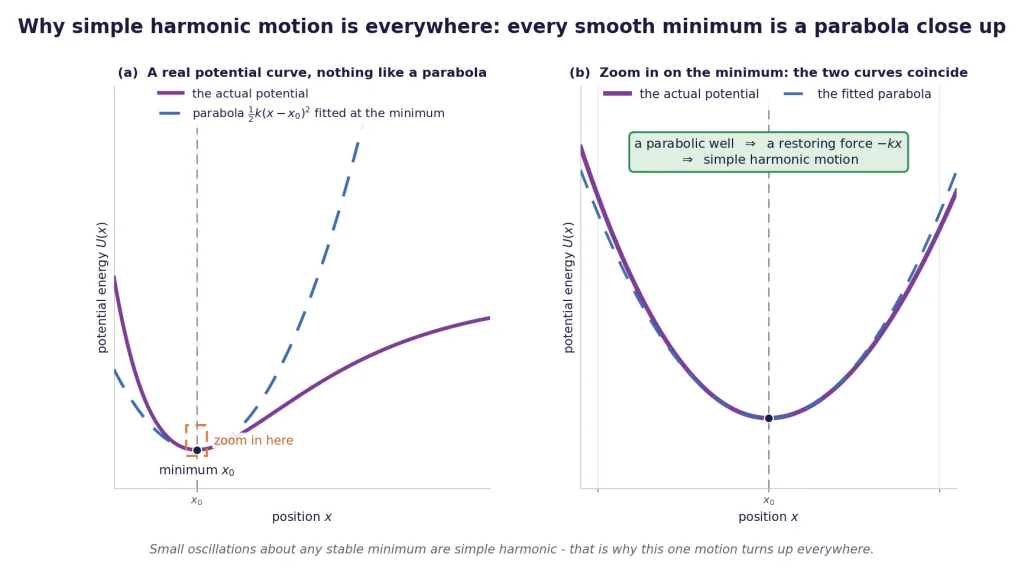
Take any system with a stable equilibrium and draw its potential energy against position. The curve can be any shape at all — the potential between two atoms in a molecule, the energy of a bent girder, the energy of a pendulum bob, the potential of a charge near a ring. Whatever it looks like far away, one thing is guaranteed about a stable equilibrium: it sits at a minimum of that curve.
And near a minimum every smooth curve looks the same. It is flat at the bottom — that is what a minimum means, the slope is zero — so the first thing that varies as you move away is the curvature, and a curve with a fixed curvature and zero slope is a parabola. Zoom in far enough on the bottom of any smooth well and you cannot tell it from .
Key Point — why simple harmonic motion is universal:
Near a stable equilibrium, almost every potential energy curve is approximately a parabola. A parabolic potential energy means a restoring force linear in the displacement. A linear restoring force means simple harmonic motion. So small oscillations about almost any stable equilibrium, in almost any system, are simple harmonic — and they all obey the formulas in this chapter.
That is the answer to the question a student is entitled to ask at the start of this chapter: why spend a whole chapter on one very artificial-looking motion? Because it is not artificial. It is the small-amplitude behaviour of nearly everything that sits still and can be nudged: atoms in a crystal vibrating about their lattice sites, a molecule's bond stretching, a bridge deck flexing, a guitar string, air in an organ pipe, the charge sloshing in a tuned circuit. The parabola is why they all sound the same mathematically.
The word "small" is carrying real weight there. Go far enough from the minimum and the true curve peels away from the parabola — in the figure above, the real potential is much softer on one side than the parabola predicts — and once that happens the force is no longer linear, the motion is no longer simple harmonic, and the period starts to depend on the amplitude. Everything in this chapter is the small-oscillation limit, and it is an excellent approximation precisely because most oscillations in the world are small compared with the size of the system doing them.
The section in one box
Key Point — everything above, condensed:
Solved Examples
Conventions used throughout: displacement is measured from the mean position; the standard form is , so a block released from rest at has . is the angular frequency in radians per second and the frequency in hertz — they differ by a factor of and both are quoted with their units. Potential energy is measured with at the mean position. .
Example 1: The complete energy account of one block
A block of mass 1 kg is fastened to a spring of spring constant 50 N/m on a frictionless horizontal surface. It is pulled 10 cm from its equilibrium position and released from rest at . Find (a) the angular frequency, period and frequency, (b) the total energy, (c) the kinetic and potential energies when the block is 5 cm from the mean position, and (d) the speed there.
Solution:
(a) The timing constants first. Check the pair: rad/s, which is again.
(b) The total energy. With m, Convert the amplitude to metres before squaring it. Leaving it as 10 would inflate the answer by a factor of .
(c) At cm m, the potential energy is a direct substitution: The kinetic energy is then whatever is left of the total:
Cross-check without using the total. Directly, The same number by a different road.
(d) The speed. From , And from the kinematic relation, which must agree: m/s. It does.
A sanity check on the split. The block is halfway out, , so the potential fraction should be of the total. Indeed , and the kinetic share is the remaining . So here, exactly as the general rule predicts at .
Final Answer: rad/s, s, Hz; J; at cm, J and J; the speed is 0.6124 m/s.
Takeaway: Find first, then get by substitution and by subtraction. It is faster than computing the speed and squaring it, and the subtraction cannot go wrong.
Example 2: Energies at a given instant
A particle of mass 0.2 kg moves as with in metres and in seconds. Find (a) the force constant and the total energy, and (b) the kinetic and potential energies at s.
Solution:
(a) Read the motion off the equation. Keep the two frequencies apart: rad/s and Hz are the same motion described two ways.
The force constant. From ,
The total energy. Or straight from the other form: J. Same.
(b) Evaluate the phase once. At s,
Now both energies, using the and forms.
Check the sum and the ratio. J, which is to the last digit carried. And — which it must be, because m is exactly .
Final Answer: N/m and J; at s, J and J.
Takeaway: Once is known, the energies at any instant are just and . Evaluate the phase once, square the sine and the cosine, and both energies drop out with no force or velocity calculation at all.
Example 3: Every ratio position for one amplitude
A particle executes SHM of amplitude 8 cm. Find the displacements at which (a) the kinetic and potential energies are equal, (b) the kinetic energy is three times the potential, (c) the potential energy is three times the kinetic, and (d) the kinetic energy is nine times the potential.
Solution:
Use the master formula. For , with cm throughout. Because the answer depends only on the ratio , there is no need to convert to metres for this question.
(a) , so :
(b) , so : which is , as expected.
(c) . Now it is the potential that is the larger, so use with : (The master formula gives the same thing with : .)
(d) , so :
Look at the pattern. The more kinetic the energy is, the closer to the centre you must be — and the positions crowd towards the middle only slowly, because of the square root. Going from to moves the point from only in to .
Final Answer: (a) cm; (b) cm; (c) cm; (d) cm.
Takeaway: for answers this entire family in one line. Always attach the : each condition is satisfied on both sides of the mean position.
Example 4: What doubling does to the energy
A block of mass 0.5 kg oscillates on a spring of spring constant 200 N/m with an amplitude of 4 cm. Find (a) the angular frequency, frequency and total energy. Then find the new total energy if (b) the amplitude alone is doubled, and (c) the amplitude is kept at 4 cm but the spring is replaced by one four times as stiff.
Solution:
(a) The base case.
(b) Amplitude doubled to 8 cm, same spring. That is four times 0.16 J, exactly as demands. The period and frequency are unchanged — the amplitude has never appeared in .
(c) Same amplitude, raised to 800 N/m. Also four times the original. Here the timing did change: The frequency doubled, and since at fixed amplitude, the energy quadrupled again.
The two routes compared.
| Change | ||
|---|---|---|
| base: N/m, cm | 3.1831 Hz | 0.16 J |
| amplitude doubled | 3.1831 Hz | 0.64 J |
| stiffness quadrupled | 6.3662 Hz | 0.64 J |
Two completely different changes, the same fourfold rise in energy — but only one of them touched the frequency.
Final Answer: (a) rad/s, Hz, J; (b) 0.64 J; (c) 0.64 J, with the frequency now 6.3662 Hz.
Takeaway: at fixed stiffness, and at fixed amplitude. Decide which quantities the question is holding fixed before you decide which form of to use.
Example 5: Averages, and the frequency of the energy
A particle of mass 0.2 kg executes SHM of amplitude 3 cm at a frequency of 5 Hz. Find (a) the angular frequency and the total energy, (b) the average kinetic energy and the average potential energy over one complete cycle, and (c) the period and the frequency with which the kinetic energy itself varies.
Solution:
(a) Convert the frequency before doing anything else. This is the step that decides the answer. Using 5 in place of 31.416 would make the energy times too small.
The total energy, using the form built for a mass, an and an amplitude: Check against the hertz form: J. Agreed.
(b) The averages. Over a complete cycle the two energies share the total evenly: This is not an approximation — it follows exactly from over a whole number of cycles.
(c) How fast the energy oscillates. The energies run at twice the frequency of the motion: So while the particle makes 5 round trips per second, its kinetic energy rises and falls 10 times per second.
The total, for contrast. J at every instant. It has no period at all, because it never changes.
Final Answer: rad/s and J; J; the kinetic energy varies with period 0.1 second, that is at 10 Hz.
Takeaway: The cycle average of each energy is exactly half the total, and each varies at twice the frequency of the motion. Two separate facts about the same , and both are asked.
Example 6: Working backwards from the energy
A particle of mass 2 kg executes SHM with amplitude 0.20 m, and its total mechanical energy is 8 J. Find the force constant, the angular frequency, the period, the frequency and the maximum speed.
Solution:
Get from the energy and the amplitude. Rearranging ,
Then the angular frequency, in the usual way.
Period and frequency — keep them apart. Check: rad/s, matching .
The maximum speed, straight from the energy. At the mean position all the energy is kinetic:
Verify it kinematically. m/s. The two routes agree, which confirms both and .
Final Answer: N/m, rad/s, s, Hz, m/s.
Takeaway: An energy and an amplitude between them fix the spring constant, and a mass then fixes everything else. and are two roads to the same number — using both is a free check.
Example 7: The energy split at a stated position
A block of mass 0.4 kg on a spring of spring constant 100 N/m oscillates with an amplitude of 5 cm. Find (a) the total energy, (b) the kinetic and potential energies when the block is 3 cm from the mean position, (c) the speed there, and (d) the maximum speed.
Solution:
(a) Total energy.
(b) At cm m.
(c) The speed there.
Check kinematically. With rad/s, The 3-4-5 triangle does the arithmetic in centimetres, and the two answers agree.
(d) Maximum speed. or equivalently m/s.
The split, as fractions. and . Those are and , exactly as says, and no unit conversion was needed to see it.
Final Answer: J; at cm, J and J; the speed there is 0.6325 m/s, and the maximum speed is 0.7906 m/s.
Takeaway: turns the energy split into a one-line ratio. At of the amplitude the energy is potential and kinetic, whatever the mass and the spring constant happen to be.
Example 8: Reading the energy-displacement diagram
The potential energy of a particle of mass 0.5 kg executing SHM is plotted against its displacement. The graph is a parabola through the origin passing through the point where the displacement is 0.1 m and the potential energy is 2 J. A horizontal line at 8 J marks the total energy. From the graph find (a) the force constant, (b) the amplitude, (c) the angular frequency, period and frequency, (d) the maximum speed, and (e) the kinetic energy at a displacement of 0.1 m.
Solution:
(a) The parabola gives . The curve is , so one point on it is enough:
(b) The amplitude is where the line meets the curve. The turning points are the displacements at which all the energy is potential, so set : The block turns round at m and can never be found outside that range, because beyond it the kinetic energy would have to be negative.
(c) The timing.
(d) Maximum speed, at the bottom of the well where the whole 8 J is kinetic: Cross-check: m/s.
(e) At m the kinetic energy is the gap between the line and the curve: Note that m is exactly , and — the familiar at half the amplitude.
Final Answer: N/m, m, rad/s, s, Hz, m/s, and J at m.
Takeaway: On an energy diagram, one point on the parabola gives , the height of the flat line gives , their intersection gives , and the vertical gap gives . Four readings, and the whole oscillation is determined.
Example 9: When, not where
A particle executes SHM with period 0.8 second, starting from rest at at . Find (a) the first instant at which the kinetic and potential energies are equal, (b) the first instant at which the kinetic energy is three times the potential, (c) the first instant at which the kinetic energy is maximum, (d) all the instants in the first complete period at which , and (e) the period with which the kinetic energy varies.
Solution:
Set up the motion. Released from rest at the positive extreme means , so
(a) happens at . Translate that into a phase:
(b) happens at .
(c) The kinetic energy is greatest at the mean position, reached a quarter of a period after release:
(d) All the instants with in one period. The condition involves only, so it is met whenever , that is at : Four instants per period, evenly spaced by — two of them in each half-period, which is the periodicity of the energies showing through.
(e) The period of the kinetic energy. so it peaks at s and again at s, twice in each 0.8-second cycle of the motion.
Final Answer: (a) 0.1 s; (b) 0.13333 s; (c) 0.2 s; (d) at 0.1, 0.3, 0.5 and 0.7 s; (e) 0.4 s.
Takeaway: Convert an energy condition into a displacement, then the displacement into a phase. And remember that an energy condition depends on , so it is met four times per period, not twice.
Example 10: Two oscillators that turn out to be equal
Two particles of the same mass 0.1 kg execute simple harmonic motion. Particle P has amplitude 2 cm and frequency 4 Hz; particle Q has amplitude 4 cm and frequency 2 Hz. Compare their total energies.
Solution:
Use the form built out of and , since those are what the question gives:
Particle P.
Particle Q.
The ratio, seen without arithmetic. Since at fixed mass, P has twice the frequency and half the amplitude of Q, and the two effects cancel exactly, because both enter squared.
Cross-check through the spring constants. For P, N/m and J. For Q, N/m and J. Both agree.
Final Answer: J; the ratio is .
Takeaway: At fixed mass, the energy depends on the product — that is, on the maximum speed — and on nothing else. Since , two oscillators with equal maximum speeds have equal energies however different their amplitudes look.
Example 11: The whole energy table for one oscillator
A block of mass 2 kg oscillates on a spring of spring constant 200 N/m with an amplitude of 10 cm. Build a table of the potential energy, the kinetic energy and the speed at the displacements , , , and .
Solution:
The constants. A total of exactly 1 J makes every entry below readable as a fraction as well as a number.
The three formulas to apply at each position.
Work through the five positions. At m, for instance,
The completed table.
| Displacement | (m) | (J) | (J) | Speed (m/s) | |
|---|---|---|---|---|---|
Two patterns worth reading off it. The potential column is the square of the displacement fraction: , , , , for fractions , , , , . And the speed column is not the kinetic column — at the block still has of the energy but of the top speed, because .
Check the maximum speed. m/s, matching the first row, and m/s as well.
Final Answer: as tabulated: in joules is , , , , at the five displacements, with speeds , , , and m/s.
Takeaway: Energy fractions go as ; speed fractions go as . Write both columns out once and the ratio questions in this section stop being calculations at all.