
Why Every Real Oscillation Dies Away
Everything so far has described an oscillator that never stops. Pull the block out to , let go, and says it will still be swinging between and next Tuesday.
No real oscillator does that. A pendulum bob loses half its swing in a few minutes. A guitar string goes quiet. A car that hits a speed-breaker bounces once or twice and settles. Something is removing energy, and the ideal equation has no room for it.
Damped oscillations sit outside the rationalised syllabus body text, which still refers forward to them, and Boards, JEE and NEET all set questions on the topic, so it is developed here from first principles.
The extra force
The energy leaves through a damping force — air resistance on the bob, viscosity of the liquid a body is bobbing in, friction at a pivot, currents induced in a metal vane. All of these share one feature: they act against the velocity. Nothing is dragging a stationary body.
For a body moving slowly through a fluid, the drag is proportional to the speed, and we take that as our model:
Key Point — the damping force: is the damping constant. The minus sign says the force always points opposite to the velocity, so the damping force is a retarding force, never a restoring one.
The unit of follows from the definition — a force divided by a speed:
so is quoted in kilograms per second. A drag of 0.8 N on a body moving at 2 m/s means kg/s.
[NEET Important] in kg/s and in N/m are different animals, and swapping them wrecks every formula in this section. multiplies a displacement; multiplies a velocity.
The equation of motion
Now put both forces on the block and use Newton's second law. The spring supplies and the fluid supplies :
Move everything to one side:
Key Point — the equation of a damped oscillator: Three terms, in order: inertia, damping, restoring force. Setting gives back the undamped oscillator of the earlier sections.
Read the three terms one at a time and the whole section becomes predictable.
| Term | What it is | What it does |
|---|---|---|
| inertia | resists any change of velocity | |
| damping | opposes the motion; drains energy as heat | |
| restoring force | pulls the body back to the mean position |
The damping term is the one new thing, and notice what makes it new: it involves the first derivative. The undamped equation only ever contained and , which is why its solution was a pure cosine. A first-derivative term is exactly what a decaying exponential produces, and that is the shape the answer is about to take.
One consequence you can state before solving anything
Mechanical energy is no longer conserved. The rate at which the damping force does work on the body is
which is negative at every instant the body is moving, and zero only at the turning points where . So the total energy falls, it never rises, and it falls fastest near the mean position where the body is moving quickest. That energy is not destroyed — it ends up as heat in the surrounding fluid.
[Board Important] "Write the differential equation of a damped harmonic oscillator and name each term" is a standard two-marker. Write , and say inertia, damping, restoring — in that order.
The Solution: A Cosine Inside a Shrinking Envelope
The equation has a clean solution whenever the damping is light, which for now means "the body still manages to oscillate". Substitute the following back into the equation and it satisfies it exactly:
Key Point — the light-damping solution: Here is the natural angular frequency the oscillator would have with no damping, and is the damped angular frequency, both in rad/s. is the amplitude at and the phase constant.
Set and every piece collapses to what you already know: , , and .
Read it in three pieces
1. — it still oscillates. The body still goes back and forth through the mean position, still crosses twice in every cycle.
2. — the amplitude shrinks, exponentially. This factor is not a constant any more. Call it
and it is the amplitude at time — the largest displacement the body will manage on that particular swing. It falls by the same fraction in every equal interval, which is what "exponential" means.
3. — the oscillation is slightly slower than it would be undamped. That is the subject of the next block.
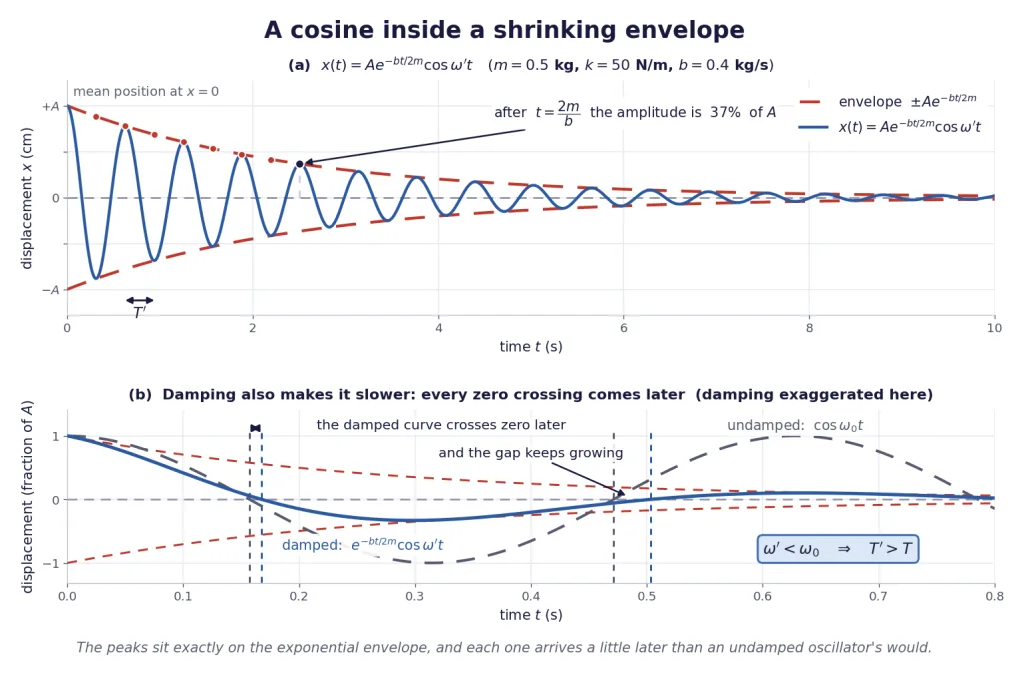
The envelope
The pair of curves and is called the envelope of the motion. The oscillation is trapped between them, and it touches them once per swing, at each peak. Draw the envelope first and the damped curve almost draws itself: it is just a cosine squeezed into that shrinking gap.
The time constant, and how fast "fast" is
Put into the exponential and you get .
Key Point — the amplitude time constant: After a time the amplitude has fallen to of its starting value. After it is of that, and so on.
Half-lives are asked more often than time constants, because they are easier to read off a graph. Setting :
Key Point: The time for the amplitude to fall to half is , with . It depends on and only — the spring constant does not appear.
Every cycle loses the same fraction
Compare the amplitude one full period later:
The has vanished. Successive peaks are in a constant ratio, whatever part of the motion you look at. If the first peak is 8.0 cm and the next is 7.6 cm, the ratio is , and the peak after that will be cm, and the twentieth will be .
[JEE Tip] The exponent in the amplitude carries underneath: . The exponent in the energy, coming next, carries only . Writing for an amplitude is the single most common slip in this topic, and it makes the answer wrong by a square.
Damping Makes It Slower as Well as Weaker
Look again at
Something is being subtracted under the root. So
Key Point: A damped oscillator swings more slowly than the same oscillator would with no damping. Damping never speeds anything up.
Three angular frequencies now live in this chapter, and they must be kept apart:
| Symbol | Meaning | Value |
|---|---|---|
| natural angular frequency, undamped | ||
| damped angular frequency | ||
| driving angular frequency of an applied force | set by whatever is driving it |
The third belongs to the next section and is listed here only so that the symbols do not collide. Every one of them is an angular frequency in rad/s; divide by to get a frequency in hertz.
How much slower, in numbers
It is neater in terms of the critical damping constant , which the last block of this section explains. Dividing inside the root by ,
| no oscillation at all |
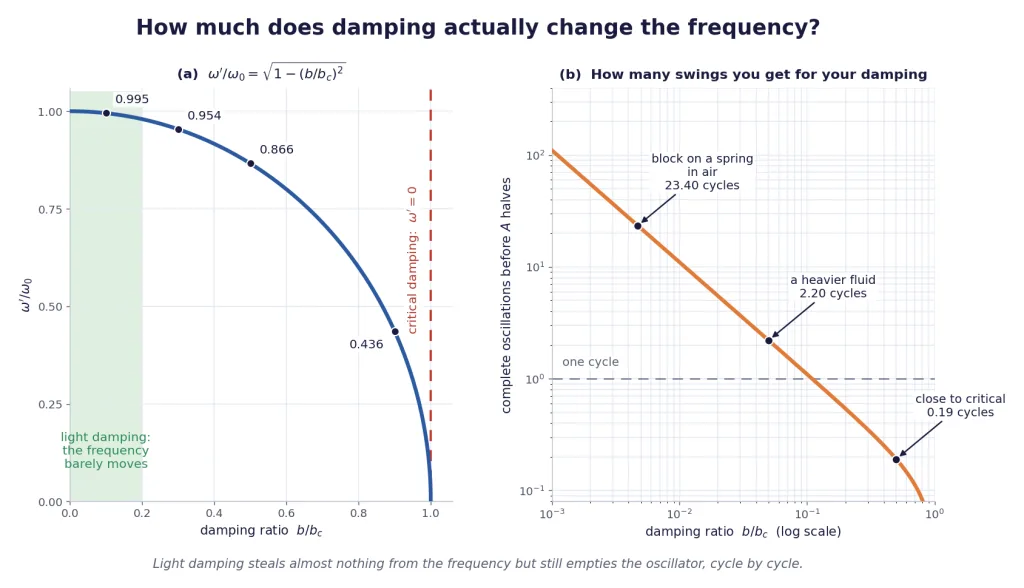
Read the top of that table carefully, because it is where most real problems live. At one tenth of critical damping the frequency has dropped by only half a per cent, while the amplitude is dying visibly from swing to swing. The amplitude notices the damping long before the frequency does, because enters the amplitude to the first power and the frequency only through .
[JEE Tip] In a numerical problem, always compute and compare it with before doing anything else. If it is a thousand times smaller, and agree to three or four figures and you may use either; if it is comparable, you must use .
Why this is only approximately simple harmonic
Simple harmonic motion has two requirements: the acceleration obeys , and the motion repeats. Damped motion fails both, strictly.
- The acceleration now has a velocity term in it, so it is not proportional to alone.
- The body never returns to a state it has been in before, because the amplitude is smaller every time. Strictly, the motion is not even periodic.
What is still true is that the zero crossings are evenly spaced: they come every , exactly. So the motion has a well-defined period even though it is not periodic — which is why one speaks of the damped period at all.
Key Point — the interval over which the approximation holds:
If the amplitude changes very little during one cycle, the motion over a few cycles is simple harmonic to an excellent approximation. That requires Over times short compared with , treat it as SHM of angular frequency . Over times comparable with , the decay is the whole story.
The Energy Falls Twice as Fast
An undamped oscillator has total mechanical energy , fixed for all time. For a damped one, the amplitude is no longer fixed — but if the damping is light, the amplitude barely changes during any one cycle, so the same formula can be used with replaced by the amplitude at that moment, :
Squaring the exponential doubles the exponent — — and that one algebraic step is the whole result:
Key Point — the energy of a damped oscillator: where is the energy it started with. Compare the two exponents: The energy decays at twice the rate, because energy goes as the square of the amplitude.
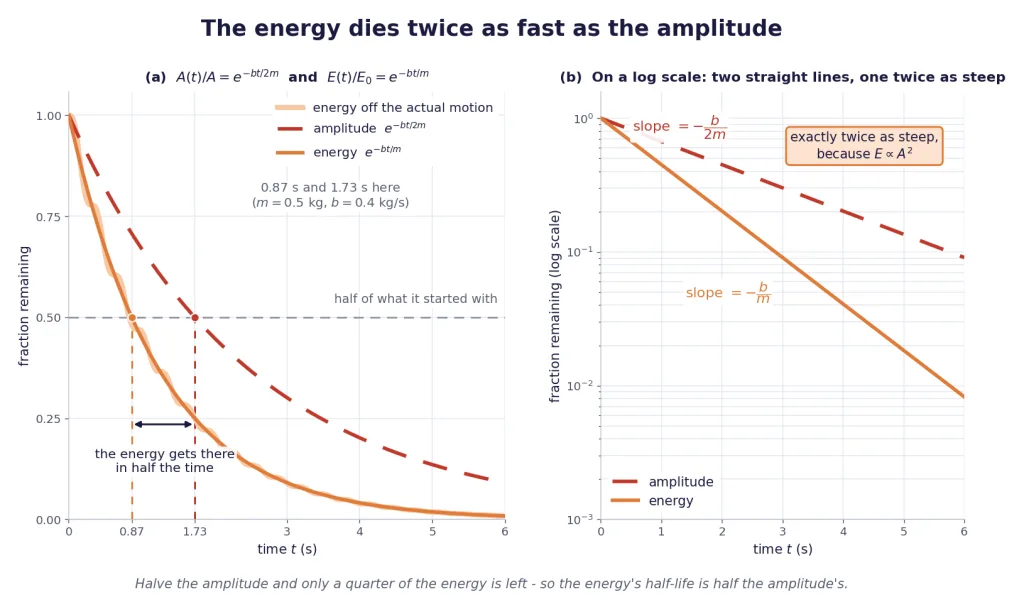
Two time constants, and the factor of two everywhere
| Quantity | Decay law | Time constant | Half-life |
|---|---|---|---|
| amplitude | |||
| energy |
Every energy interval is half the corresponding amplitude interval. Three consequences get asked constantly:
- When the amplitude has halved, the energy is of what it was.
- When the energy has halved, the amplitude is of what it was — it has only fallen by about .
- After amplitude half-lives, the amplitude is and the energy of the original.
[NEET Important] "The amplitude falls to half in 20 s; what fraction of the energy is left?" The answer is one quarter, and it takes no calculation at all. Do not reach for the exponential.
Loss per cycle
Set in the energy law and the fraction surviving one complete oscillation is
a constant, independent of where in the motion you start. For light damping the exponent is small, and , so the fractional energy lost per cycle is roughly — and the fractional amplitude loss per cycle is half of that. An oscillator that loses of its energy each swing is losing about of its amplitude.
Where the energy goes
Back in the first block, . Two things follow.
- The loss is fastest at the mean position, where the body is moving fastest, and momentarily zero at the extremes.
- The energy becomes heat in the surrounding fluid. Total energy is conserved; mechanical energy is not.
[JEE Tip] Questions like "how many complete oscillations before the amplitude halves?" are two lines. Find , find , divide. Do not confuse this with the energy half-life, which gives half as many oscillations.
Under-damped, Critically Damped, Over-damped
Everything so far assumed the body oscillates. Turn the damping up far enough and it stops doing that, and the switch happens at a sharp, calculable value of .
The quantity under the root sign decides it:
That is a real number only while , i.e. while . The boundary is
Key Point — the critical damping constant: measured, like , in kg/s. The ratio is called the damping ratio, and it alone decides which of the three regimes you are in.
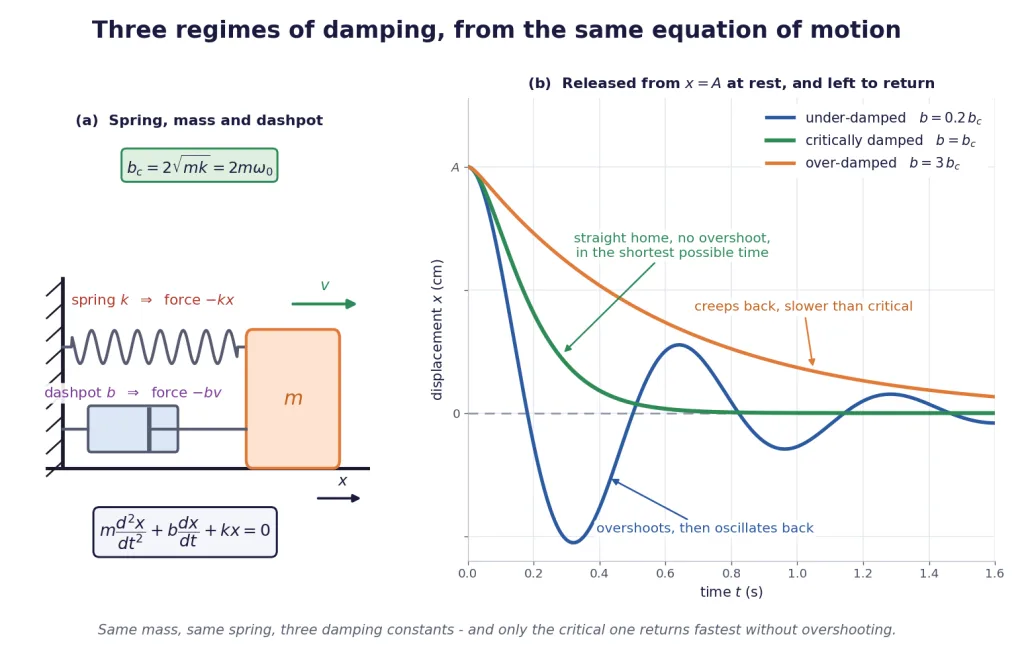
The three cases
1. Under-damped, . is real and the body oscillates, with the amplitude dying inside the envelope . Everything in the previous three blocks describes this case. A pendulum in air, a plucked string, a car with worn shock absorbers.
2. Critically damped, . : there is no oscillation left. Released from , the body slides back to the mean position and stops there, without ever crossing it. The displacement follows
and among all possible values of this one returns the body to equilibrium in the shortest time.
3. Over-damped, . The motion is a sum of two decaying exponentials with no oscillation at all, and the body creeps back. It is tempting to think that more damping must mean a quicker stop; it does not. The slower of the two exponentials dominates and the return takes longer than critical damping. Think of a spoon settling through honey.
| Regime | Condition | What it does | Where you meet it |
|---|---|---|---|
| under-damped | , i.e. | oscillates, amplitude decaying | pendulum in air, guitar string, worn suspension |
| critically damped | , i.e. | returns fastest, no overshoot | dead-beat galvanometer, door closer |
| over-damped | , i.e. | creeps back slowly, no overshoot | body settling in a thick liquid |
Key Point: Critical damping is the fastest possible return to equilibrium without overshooting. An under-damped system reaches the mean position sooner, but it does not stop there — it shoots past and has to come back several times.
Where each one is wanted
Engineers pick deliberately, and the choice is nearly always "at or a little under critical".
- Car suspension. The spring absorbs the bump; the shock absorber is the dashpot that supplies . Set too low and the car keeps bouncing after every pothole; set too high and the suspension is stiff and slow to recover. Real cars are designed slightly under-damped — typically around to of critical — so the body settles after about one small bounce. Worn shock absorbers reduce , which is why an old car keeps rocking after a speed-breaker.
- A door closer. The cylinder at the top of a swing door is a dashpot, tuned close to critical: the door must shut quickly and firmly, but must not slam, and must not bounce back off the frame.
- A moving-coil galvanometer. A needle that oscillates about the reading is useless, and one that crawls is worse. Instruments are critically damped so the pointer travels straight to the reading and stops. Such an instrument is called dead-beat. The damping comes from eddy currents induced in the metal former the coil is wound on.
- Deliberately light damping. A child's swing, a pendulum clock and a guitar string all want as little damping as possible, so the oscillation survives many cycles.
[Board Important] "Distinguish between under-damped, critically damped and over-damped motion, with one application of each" is a full three-marker. The application marks are given for naming a device, so name it: shock absorber, door closer, dead-beat galvanometer.
A separate question — what happens when an external periodic force keeps driving the oscillator at some angular frequency of its own, instead of leaving it to die — is taken up in the next section.
Solved Examples
Conventions used throughout: displacement is measured from the mean position; is the natural angular frequency and the damped one, both in rad/s, while is a frequency in hertz — they differ by a factor of . is in kg/s. , , , and m/s² where it is needed.
Example 1: The block, the spring and the dashpot
A block of mass 200 g is attached to a spring of spring constant 90 N/m and oscillates on a horizontal surface. A damping force acts on it with kg/s. Find (a) the natural angular frequency and period, (b) the damped angular frequency and period, (c) the time in which the amplitude falls to half its initial value, and (d) how many complete oscillations that takes.
Solution:
(a) The undamped quantities. With kg and N/m,
(b) Now the damping. First the combination that appears in every formula: The damped period is longer than the undamped one, as it must be — but only by about . Here kg/s, so : this is very light damping indeed, and to four figures and are the same number.
(c) The amplitude half-life. Set the envelope equal to half:
(d) Number of oscillations. Each takes s, so about 23 complete swings before the amplitude is down to half.
Final Answer: rad/s, s; rad/s, s; the amplitude halves in 6.93 s, after about 23 complete oscillations.
Takeaway: Compute first. It is the decay rate of the amplitude, it is what goes inside , and with it the whole problem is two substitutions.
Example 2: The same oscillator, now the energy
For the block of Example 1 ( kg, N/m, kg/s), find (a) the time in which the mechanical energy falls to half, (b) the time constants of the amplitude and of the energy, and (c) what fraction of the initial amplitude is left when the energy has halved.
Solution:
(a) The energy half-life. The energy obeys , with s:
Check it against Example 1. The amplitude took 6.93 s to halve; the energy takes 3.47 s, exactly half as long. That is the factor of two, showing up as it always does.
(b) The time constants. After 10 s the amplitude is of its start; after 5 s the energy is of its start.
(c) The amplitude at the energy half-life. At s, Which is just , read backwards. The energy is down by half while the amplitude is down by only .
Final Answer: the energy halves in 3.47 s; s and s; when the energy has halved the amplitude is of its initial value.
Takeaway: Halve the energy, and the amplitude is of what it was; halve the amplitude, and the energy is . Learn the pair together and this whole family of questions is instant.
Example 3: Reading the damping constant off an experiment
A 0.5 kg body oscillating in a liquid is seen to have its amplitude fall from 10 cm to 5 cm in 20 s. Find (a) the damping constant, (b) the amplitude after 60 s from the start, and (c) the fraction of the initial energy left at that moment.
Solution:
(a) Use the half-life directly. The amplitude halved, so s and The decay rate is s, and the time constants are s and s.
(b) The amplitude at 60 s. Sixty seconds is exactly three half-lives, so no exponential is needed:
(c) The energy fraction. Energy goes as amplitude squared, so The same answer follows from the energy half-life, which is 10 s here: sixty seconds is six energy half-lives, and . The two routes agree, as they must.
Final Answer: kg/s; the amplitude is 1.25 cm at 60 s; of the energy remains.
Takeaway: When the times given are whole multiples of a half-life, count half-lives instead of using the exponential. Three amplitude half-lives is six energy half-lives — never the same number.
Example 4: Successive peaks
An under-damped oscillator of period s has a first peak of 8.0 cm and the next peak, one period later, of 7.6 cm. Find (a) the decay rate , (b) the amplitude 10 s after the first peak, and (c) the fraction of the energy left then.
Solution:
(a) The ratio of successive peaks. Take logarithms: so s.
(b) The amplitude at 10 s. Two routes, and they must agree. Or count cycles: 10 s is complete periods, and each multiplies the amplitude by , so
(c) The energy fraction. about of the original energy, after of it has gone to heat.
A bonus. The amplitude half-life here is s, which is oscillations.
Final Answer: s; the amplitude at 10 s is 2.87 cm; about of the energy is left.
Takeaway: The ratio of successive peaks is the same everywhere in the motion. That turns "amplitude after cycles" into a simple power, , with no exponential in sight.
Example 5: How much slower does damping make it?
A body of mass 0.25 kg on a spring of spring constant 100 N/m experiences a damping force with kg/s. Find (a) the natural and damped angular frequencies, (b) both periods and both frequencies in hertz, and (c) the percentage by which damping lengthens the period.
Solution:
(a) The two angular frequencies. Check the regime first: kg/s, so and the motion is under-damped.
(b) Periods and frequencies. Keep the two kinds of frequency separate and label every unit. Confirm the pairing: rad/s, which is again.
(c) The percentage change. Or straight from the ratio: , and .
Final Answer: rad/s and rad/s; s and s; Hz and Hz; the period is longer.
Takeaway: Even at a fifth of critical damping the frequency changes by only about two per cent. The frequency shift is a second-order effect in ; the amplitude decay is first order, and always the bigger story.
Example 6: Designing for critical damping
A 2.0 kg mass hangs on a spring of spring constant 50 N/m in a machine that must not oscillate. Find (a) the damping constant that makes it critically damped, and (b) state and justify what happens if the damping constant is set to 25 kg/s instead.
Solution:
(a) The critical value. The other form gives the same thing: kg/s.
(b) With kg/s. Since , the system is over-damped: it returns to equilibrium without oscillating, but more slowly than at . To see how much more slowly, look at the decay rates. Substituting into gives , whose roots are The motion is a mixture of and ; the second dies almost at once and the slower one, , controls the tail. Critical damping would have given a decay governed by , which is twice as fast.
Final Answer: kg/s; at kg/s the system is over-damped and settles roughly twice as slowly, its return governed by rather than .
Takeaway: More damping is not faster settling. Past , extra damping slows the return down, because the system's slowest exponential gets slower still.
Example 7: Comparing all three regimes on one system
For kg and N/m, classify the motion for , and kg/s, and say which of the three brings the body to rest at the mean position soonest.
Solution:
The boundary. kg/s, and rad/s.
Classify.
- kg/s: , under-damped. Here s and rad/s, so it oscillates with s while the envelope decays as .
- kg/s: , critically damped, .
- kg/s: , over-damped. The roots of are and s, so the tail behaves as .
- Which settles soonest? Compare the slowest exponential in each case, since that is what survives longest: under-damped, critical, over-damped. Critical damping has by far the fastest one. Taking "settled" to mean the displacement has dropped below of and stays there, the three take about 8.6 s, 3.3 s and 4.9 s respectively.
Final Answer: under-damped, critically damped and over-damped respectively; the critically damped case settles soonest, in roughly 3.3 s against 4.9 s and 8.6 s.
Takeaway: Critical damping wins, and the loser is not always the one you expect. Under-damped is worst here, not because it decays slowly in amplitude, but because it keeps crossing the mean position instead of stopping there.
Example 8: The loss per cycle
A 0.5 kg block on a spring of spring constant 200 N/m is damped with kg/s. Find (a) the percentage of its energy lost in one oscillation, and (b) the percentage of its amplitude lost in the same oscillation.
Solution:
Timing first. The damping is so light that and agree to six figures.
(a) Energy over one period. With s, so the loss is , that is per oscillation.
(b) Amplitude over the same period. a loss of , almost exactly half the energy percentage.
Why "almost exactly half"? Because for a small exponent, , so the fractional losses are close to and . The ratio here is , not quite 2 — the small difference is the part of the exponential the approximation drops.
Final Answer: about of the energy and of the amplitude are lost in each oscillation.
Takeaway: Fractional energy loss per cycle , and the amplitude loss is half of it. For light damping you can quote both in one line without touching a calculator's exponential key.
Example 9: One spring, three damping constants
A 0.1 kg mass is attached to a spring of spring constant 10 N/m. For , and kg/s, state the regime, and for the under-damped case find , and the frequency in hertz.
Solution:
The critical value.
Classify by comparing with kg/s.
- kg/s: , under-damped.
- kg/s: exactly , critically damped.
- kg/s: , over-damped.
The under-damped case in detail. s, so Note the size of the effect: at a quarter of critical damping the angular frequency has fallen by , from 10 to 9.68 rad/s. Compare that with the amplitude, which in one period drops by a factor — to a fifth. The amplitude is being demolished while the frequency is barely touched.
The over-damped case, for completeness. The roots of are and s; the return is controlled by the slow one, so it takes of order 1 s to creep home.
Final Answer: under-damped, critically damped and over-damped; for kg/s, rad/s, s, Hz.
Takeaway: Compute before anything else, and compare. Every classification question in this topic is that one comparison.
Example 10: A pendulum losing its swing
A simple pendulum of length 1.0 m carries a bob of mass 0.1 kg. Its angular amplitude falls from to in 8 minutes. Taking the damping to obey , find (a) the period, (b) the damping constant, (c) the number of oscillations in those 8 minutes, and (d) whether the damping changes the period noticeably.
Solution:
(a) The period. Small angular amplitude, so the usual result applies: with rad/s and Hz.
(b) The damping constant. The amplitude halved in s, so that is the amplitude half-life: a tiny number, as it should be for a bob swinging in still air. The decay rate is s.
(c) The count.
(d) Does the period change? Compare the two terms under the root: The second is smaller by a factor of about five million, so differs from by roughly one part in ten million — utterly unmeasurable. Note also that the angular amplitude here is rad, small enough for : the true period exceeds by only about , which is still far larger than the damping's effect.
Final Answer: s; kg/s; 239 oscillations; the damping changes the period by about one part in , which is negligible.
Takeaway: Light damping empties an oscillator without slowing it down. After 239 swings this pendulum has lost half its amplitude and three quarters of its energy, while its period is unchanged to seven figures.
Example 11: Working backwards from time constants
An oscillator of mass 0.4 kg has damping constant kg/s. Find (a) the two time constants, (b) the time for the amplitude to fall to a quarter of its initial value, and (c) the time for the energy to fall to of its initial value.
Solution:
(a) The time constants.
(b) Amplitude to a quarter. A quarter is two halvings, so Or in one step, s.
(c) Energy to .
A consistency check. At s the amplitude is , so the energy should be . From the energy law directly, . Agreed.
Final Answer: s and s; the amplitude quarters in 13.86 s; the energy falls to in 23.03 s.
Takeaway: Use for anything about amplitude and for anything about energy, then multiply by . One line each, and no chance of using the wrong exponent.
Example 12: Writing down the whole motion
A 0.5 kg block on a spring of spring constant 50 N/m is pulled 5.0 cm from the mean position and released from rest at . The damping constant is kg/s. Write , and find the amplitude and the energy at s.
Solution:
The constants. Check the regime: kg/s, so and the motion is very lightly under-damped.
The phase constant. Released from rest at the extreme, so to an excellent approximation, and with m, Strictly, "released from rest" fixes a hair away from zero, because at the envelope is already falling. The correction is of order , which changes the amplitude by — invisible at this level of damping, and always ignored for light damping.
The amplitude at 2 s.
The energy at 2 s. Start with the initial energy: Cross-check from the amplitude just found: J. The two agree, which is the whole content of "energy decays twice as fast".
How many swings has it managed? The amplitude half-life is s, and — under three oscillations to lose half its amplitude. This one is dying fast.
Final Answer: m; at s the amplitude is 2.25 cm and the energy 0.0126 J.
Takeaway: Write the three constants — , and — and the equation of motion assembles itself. Then every later question is a substitution into it.