
One Oscillation Out of All of Them
You now have the vocabulary: a body swings to and fro about a mean position, it takes a time to complete one full trip, it repeats times a second, and its displacement never exceeds the amplitude on either side. All of that is true of a pendulum, a bouncing ball, a swinging gate and a wobbling ruler clamped to a desk.
But those four motions do not have the same shape. Plot displacement against time for each and you get four different repeating curves. This section picks out one of those shapes and gives it a name — and then spends the rest of the chapter on it, because it is the one that nature keeps producing and the one that mathematics can handle exactly.
The definition
Take a particle moving back and forth along the -axis about the origin, between the limits and . The motion is simple harmonic if the displacement varies with time in one very specific way.
Key Point — simple harmonic motion:
A particle is in simple harmonic motion (SHM) if its displacement from the mean position varies with time as where , and are constants of the motion — they do not change as the oscillation runs.
Read the definition twice, because there is a word in it doing enormous work: constants. The amplitude does not drift, the angular frequency does not drift, and the phase constant is fixed at the outset by how the motion was started. Only changes.
Key Point: SHM is not just any periodic motion. It is the special case in which the displacement is a sinusoidal function of time — a single cosine (or, equally, a single sine) and nothing else added on.
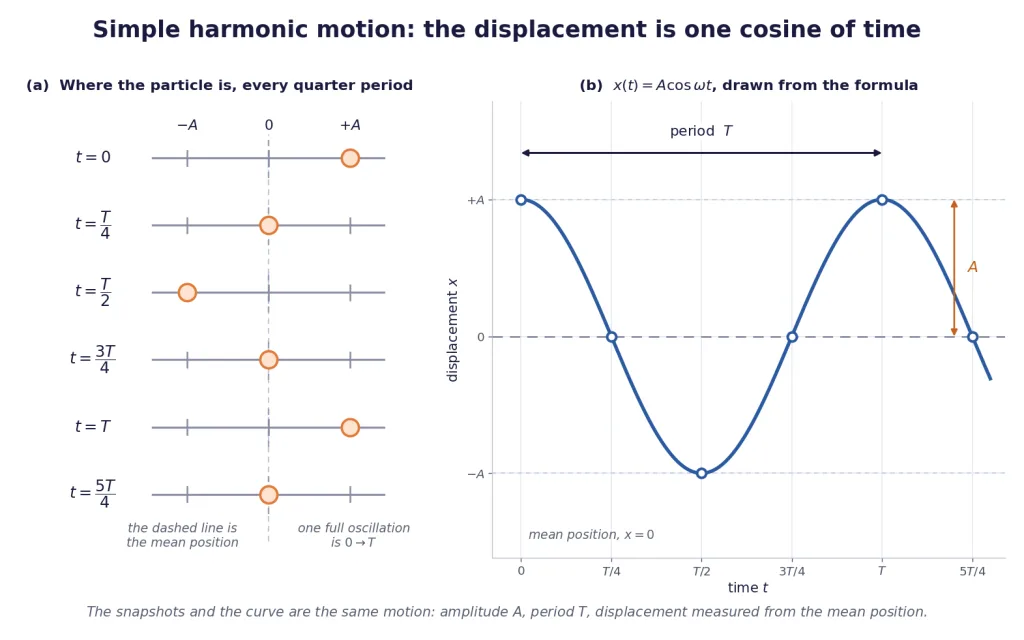
Walk one cycle, a quarter at a time
Set for a moment, so that , and follow the particle. Since for one complete cycle, a quarter of a period advances by exactly .
| Time | Where the particle is | ||
|---|---|---|---|
| at , the right-hand extreme | |||
| at the mean position, | |||
| at , the left-hand extreme | |||
| back at the mean position | |||
| back at — one full oscillation done |
After the whole table repeats, which is exactly what "period " means. And notice the two facts that fall straight out of the cosine: since runs between and , the displacement runs between and , and it passes through the mean position twice per cycle.
Why the angle inside the cosine is not an angle you can see
There is no physical angle anywhere in a block sliding on a table, yet is measured in radians and fed to a cosine. It is a bookkeeping angle: it counts how far through the cycle the motion has got, in the units a cosine understands. One complete oscillation is worth radians of it, which is exactly why .
[Board Important] "Define simple harmonic motion" is a standard two-marker. The answer is one sentence plus one equation: SHM is periodic motion in which the displacement from the mean position varies sinusoidally with time, as , with , and constant. Do not answer it with the force law — that is a consequence, and it comes later in this chapter.
Amplitude, Phase and Phase Constant
The equation has exactly three constants in it, and every question in this chapter is ultimately about finding them or using them. Here is what each one is, with the naming rule that examiners test relentlessly.
The amplitude
is the magnitude of the maximum displacement from the mean position. Because the cosine swings between and , the displacement swings between and , and the amplitude is the height of the curve above the mean line.
is always taken positive — nothing is lost by doing so, because a minus sign in front of the amplitude can always be absorbed into the phase constant instead. (If you ever produce , rewrite it as : same motion, positive amplitude.)
Two simple harmonic motions can share and and still have different amplitudes; the curves then have the same shape and the same timing, one simply taller than the other.
The phase
Now the part that gets misnamed more often than anything else in the chapter.
Key Point — the naming rule:
- The whole bracket is the phase of the motion at time . It changes as time runs on.
- The constant alone is the phase constant (also called the phase angle or the initial phase). It is the value of the phase at .
is not "the phase". Calling it that loses marks and, worse, loses the distinction between something that changes with time and something that does not.
Both are measured in radians. A phase quoted as a bare number — "the phase is " — is in radians.
What does the phase actually tell you? Everything about the state of the motion, once the amplitude is known. Feed the phase to a cosine, multiply by , and you have the position:
| Phase | of it | Displacement | The particle is |
|---|---|---|---|
| at the positive extreme | |||
| crossing the mean position, heading to | |||
| at the negative extreme | |||
| crossing the mean position, heading to | |||
| back at the positive extreme |
So the phase is a single number that says where in the cycle the particle currently is. It increases steadily, at radians every second, and it gains a full in every period — which is why the motion repeats.
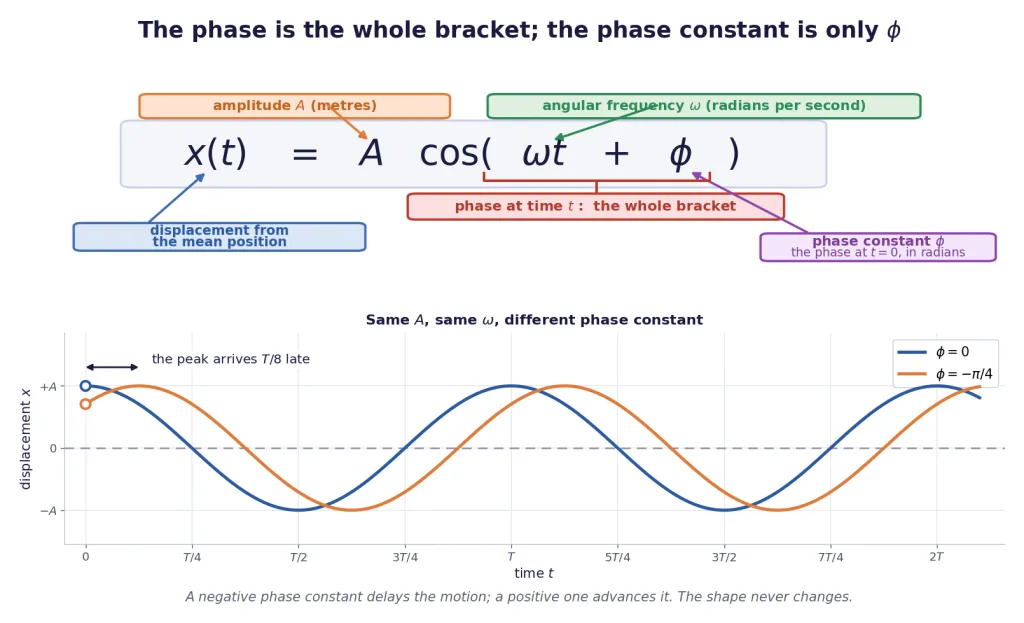
The phase constant
is fixed by where the particle was, and which way it was going, at the instant you started the clock. Nothing else. Start the stopwatch at a different moment and you get a different for the very same physical motion.
Because repeats every , the phase constant is only defined up to a multiple of : and describe identical motion. It is normal to quote the value lying between and , and both forms are acceptable in an answer as long as you are consistent.
Two simple harmonic motions with the same and but different have identical curves, one slid sideways relative to the other. A negative phase constant slides the curve to the right — everything happens later. A positive one slides it left — everything happens earlier.
[JEE Tip] When a question says "the phase difference between the two motions is ", it means the difference of the two whole brackets. If the two motions have the same , that difference is just and stays constant for ever. If they have different , the phase difference grows with time and the phrase means nothing on its own — check the two angular frequencies before you answer.
Reading , , and Off an Equation or a Graph
This is the bread-and-butter skill of the section. Two versions of it: one when you are handed a formula, one when you are handed a curve.
From an equation: match it term by term
Line the given equation up against the standard form and read straight across. For with in centimetres and in seconds, you get cm, rad/s and rad. Then everything else follows from :
Key Point: the number multiplying inside the cosine is in radians per second — never a frequency in hertz. In the equation above the frequency is 3.18 Hz, not 20 Hz. Quoting the coefficient of as "the frequency" is the single commonest error on this type of question.
The displacement at is not the amplitude unless happens to be zero. Here cm — half the amplitude, because the motion did not start at an extreme.
From a graph: four steps in order
Step 1 — amplitude. Read the height of a peak above the mean line, or take half the peak-to-peak swing. If the curve runs between and , then , not 8.
Step 2 — period. Find the shortest time in which the whole curve repeats: peak to next peak, or an upward zero-crossing to the next upward zero-crossing. That is .
Step 3 — the two rates. in radians per second and in hertz. Write the unit on each; they are not the same number.
Step 4 — the phase constant. Put into the standard form: That equation always has two solutions in one cycle, and , and the graph alone at that one instant cannot tell them apart. The direction of motion can.
Key Point — getting the sign of right:
As time runs on, the phase increases from its starting value . A cosine is rising while its argument lies between and , and falling while it lies between and . Therefore, at :
- the particle is moving in the positive direction is negative,
- the particle is moving in the negative direction is positive,
- the particle is at rest at
- the particle is at rest at
The four cases everybody is expected to know by heart:
| At the particle is | The equation becomes | |
|---|---|---|
| at (an extreme) | ||
| at the mean position, heading towards | ||
| at (the other extreme) | ||
| at the mean position, heading towards |
A shortcut worth having. The phase is zero at a maximum. So if the curve reaches its first maximum at time , then , giving (add if you would rather quote a positive value). A peak sitting a quarter of a period after the origin therefore means , every time.
[Board Important] Quote in radians unless the question asks otherwise, and say which convention you used — a solution written from and one written from give phase constants that differ by , and both are right.
Three Spellings of the Same Motion
The same simple harmonic motion can be written down in three ways: All three describe exactly the same physical motion — same amplitude, same period, same everything — with the phase constant absorbing the whole difference between them. In this chapter the standard form is , and an answer in any of the three forms is correct provided the constants are consistent.
Sine to cosine, and back
The only fact needed is so
The amplitude and the angular frequency are untouched; only the phase constant moves, and it moves by exactly a quarter cycle. Going the other way, .
| Given | In the standard cosine form |
|---|---|
A sine plus a cosine is still one sinusoid
This is the conversion that turns up in half the problems. Expand the standard form: and compare it with . Matching the terms and the terms separately, Square and add — the collapses to 1 — and then divide:
Key Point — combining a sine and a cosine of the same : Fix the quadrant of from the signs of and , not from the arctangent alone.
Two things to hold on to. First, the resultant amplitude is , not — combining a 3 and a 4 gives 5, not 7. Second, is unchanged: adding two sinusoids of the same angular frequency can only ever produce another sinusoid of that same angular frequency. It changes the amplitude and shifts the phase; it cannot change the period.
That last sentence is the reason this form counts as SHM at all, and it is worth stating as a rule.
Key Point: A sum of any number of sines and cosines of one common angular frequency is simple harmonic, with that same . A sum containing two or more different angular frequencies is not.
[JEE Tip] When a problem gives you and asks for the amplitude, you do not need at all — answers it in one line. Only compute if the question actually asks for the phase constant or for the displacement at a stated time.
Changing One Constant at a Time
Three constants, three completely separate effects. Change one and the other two do not care.
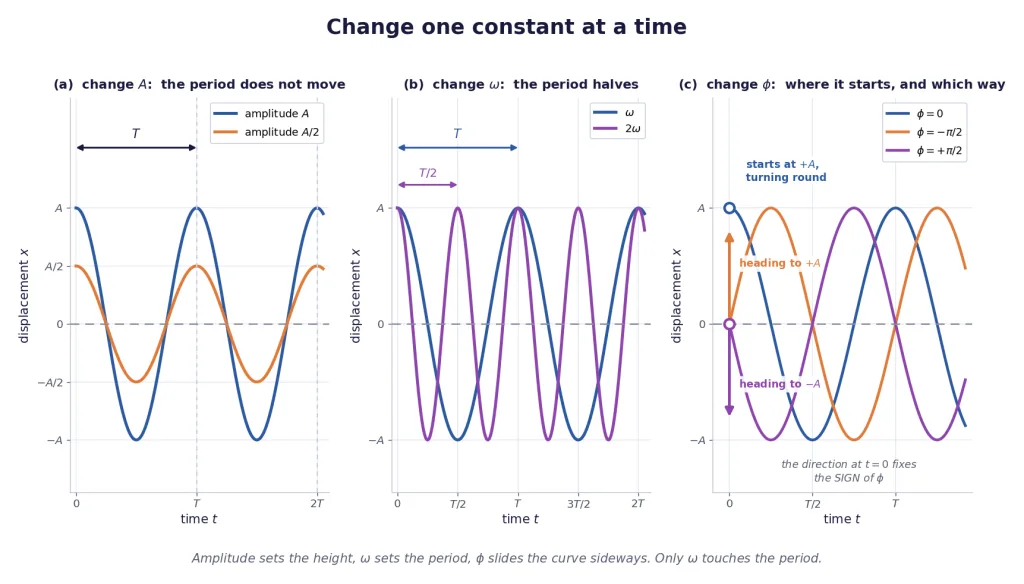
Change : the curve gets taller, and nothing else happens
Double the amplitude and every displacement doubles. The peaks reach instead of , the troughs reach , the particle covers twice the path in a cycle. But the peaks arrive at exactly the same instants as before. The curve is stretched vertically, never horizontally.
Key Point — the fact that matters most in this chapter:
The period of simple harmonic motion does not depend on the amplitude. is fixed by , and is fixed by the physical system — how stiff it is and how heavy it is — not by how hard you started it off.Pull the oscillator twice as far and release it: it travels twice as far, but it takes exactly as long. Motion with this property is called isochronous.
This is not a small technical point; it is why oscillators are useful. A timekeeper built on a simple harmonic oscillator keeps the same time as its swing slowly dies away, because a shrinking amplitude does not change the beat. An oscillator whose restoring force were not proportional to displacement would lose that property immediately — its period would depend on how far it was pulled, and it would be useless as a clock.
Change : the curve is squeezed along the time axis
Double and the period halves, the frequency doubles, and twice as many complete oscillations fit in the same stretch of the graph. The height is untouched. Since and , this is the only one of the three constants that has anything to do with timing.
Change : the curve slides sideways
The shape and the height stay exactly as they were; the whole curve shifts along the time axis. A change of phase constant shifts the curve by a time so a phase constant of delays everything by , and delays it by a quarter period. Negative delays, positive advances.
The summary table
| Change | Amplitude | Period and frequency | Position of the curve on the time axis |
|---|---|---|---|
| increase | taller | unchanged | unchanged |
| increase | unchanged | smaller, larger | (peaks come faster) |
| increase | unchanged | unchanged | slides earlier by |
[NEET Important] "The time period of a particle in SHM depends on…" is a recall question that appears every year. The period depends on the system's own properties through . It does not depend on the amplitude, on the displacement at any instant, or on the phase constant.
Is It Simple Harmonic? The Test
You are handed a function of time and asked to classify it. There are exactly three possible verdicts, and one test that separates them.
Key Point — the test:
A motion is simple harmonic if and only if its displacement can be written as a single sinusoid of one angular frequency about the mean position — that is, in the form , or equivalently or .If it repeats but cannot be squeezed into that form, it is periodic but not simple harmonic. If it does not repeat at all, it is neither.
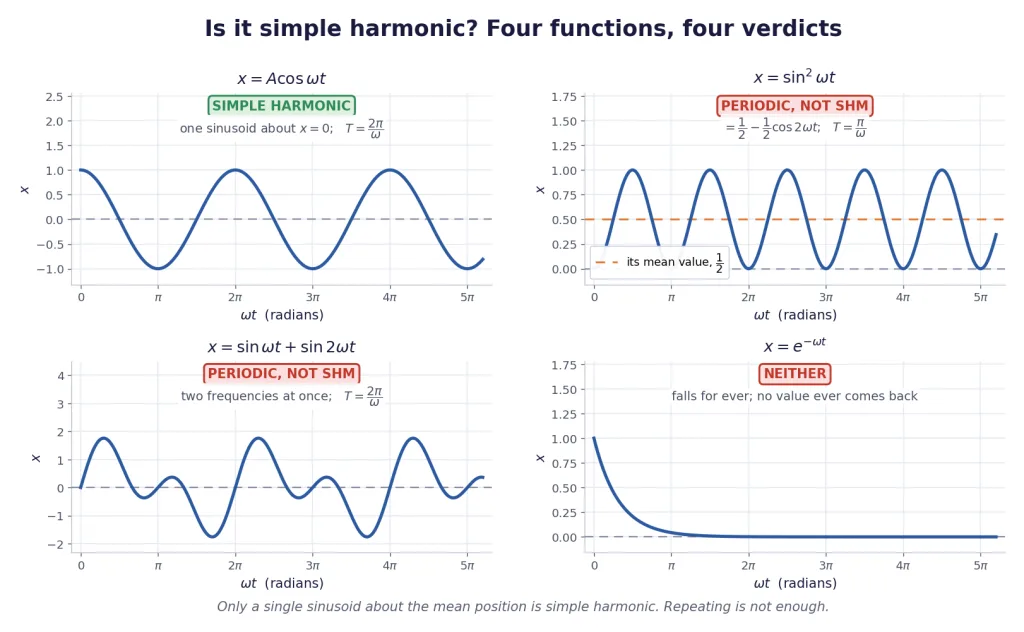
How to run the test in practice
- Try to reduce the function to one sinusoid. Trigonometric identities are the whole game here: the double-angle formula for a square, the compound-angle formula for a sum, for a mismatch of sine and cosine.
- Count the angular frequencies that survive. One surviving frequency and no leftover constant term means SHM. Two or more different frequencies means periodic but not SHM.
- If nothing repeats, say so. A function that only ever rises, or only ever falls, cannot be periodic — and therefore cannot be simple harmonic either.
The standard traps
| Function | Verdict | Why, and its period |
|---|---|---|
| SHM | one frequency; equals , | |
| SHM | cosine is even, so it equals ; | |
| periodic, not SHM | ; the leftover means it never goes negative. | |
| periodic, not SHM | two different angular frequencies; | |
| periodic, not SHM | : frequencies and ; | |
| periodic, not SHM | three frequencies; | |
| periodic, not SHM | corners where it touches zero; | |
| neither | falls for ever, never returns to a value it has had | |
| neither | a single hump, then decay; no repetition | |
| neither | grows without limit; cannot even be a physical displacement |
The trap inside the trap:
This one is worth its own paragraph because it is asked so often and it is easy to answer half-right.
Write it out: . Now look at what is there.
- It is periodic, with period — half the period of itself, because squaring doubled the frequency.
- As a displacement measured from the origin it is not simple harmonic: it never becomes negative, it swings between 0 and 1, and it is not of the form because of the constant sitting in front.
- Measured from its own mean value of , however, it is harmonic — amplitude , angular frequency . Shifting the origin to the mean position is exactly what the rest of this chapter always does.
The expected answer to "is simple harmonic?" is periodic but not simple harmonic, and the reason to give is the constant term, which puts the equilibrium at rather than at zero.
A constant added on is a shifted mean position, not a new motion
The same idea in general: something like is simple harmonic. The mean position is at , the amplitude is 3, and the motion runs between 5 and . Measure the displacement from — as the rule of this chapter requires — and the constant vanishes, leaving a pure cosine of amplitude 3.
[JEE Tip] Three quick reflexes that settle most of these on sight. A square or a modulus of a sinusoid halves the period and is not SHM. A sum of sinusoids with different is periodic but not SHM. An exponential, a logarithm or a polynomial in is not periodic at all.
Solved Examples
Conventions used throughout: the standard form is ; is the angular frequency in radians per second and the frequency in hertz; every phase constant is quoted in radians, with the degree equivalent alongside where it helps. .
Example 1: Reading everything off an equation
A particle moves along the -axis with where is in centimetres and in seconds. Find (a) the amplitude, (b) the angular frequency, period and frequency, (c) the phase constant, (d) the phase at s, and (e) the displacement at and at s.
Solution:
(a) Amplitude. Match against : the multiplier in front of the cosine is
(b) The three rates. The coefficient of inside the bracket is : Here and happen to be numerically different by exactly , as always — 6.2832 rad/s and 1 Hz are the same motion described two ways.
(c) Phase constant. The constant left over inside the bracket: which is 45°. Note carefully: is the phase constant, not "the phase".
(d) Phase at s. The phase is the whole bracket evaluated at that instant:
(e) Displacements. Half a period apart, so the particle is the same distance out on the opposite side. That is a useful sanity check: always.
Final Answer: cm; rad/s, s, Hz; rad; phase at 0.5 s is rad; cm and cm.
Takeaway: Match the given equation against symbol by symbol before doing anything else. The coefficient of is in rad/s; the leftover constant is ; and equals only when happens to be zero.
Example 2: Writing the equation from a description
A particle performs SHM of amplitude 2 cm with a period of 0.5 second. Write if (a) at the particle is at the positive extreme, and (b) at it is at the mean position, moving in the positive direction.
Solution:
The constants that do not depend on the starting condition. Amplitude cm, and from the period, Both parts share these; only will differ.
(a) Starting at the positive extreme. At , , so and :
(b) Starting at the mean position, heading towards . At , , so , which gives or . The direction decides. The particle is moving in the direction, so the phase constant must be negative:
The same answer in sine form. Since , which is the form most students would have written straight down — and it is exactly the same motion.
Final Answer: (a) cm; (b) cm.
Takeaway: The amplitude and come from the apparatus; only comes from where you started the clock. "Starts at an extreme" means ; "starts at the mean position going the positive way" means , which is the sine form in disguise.
Example 3: Two candidate phase constants, and how to choose
A particle in SHM has amplitude 4 cm and angular frequency 5 rad/s. At its displacement is cm. Find the phase constant if the particle at that instant is (a) moving towards , and (b) moving towards . Write in each case.
Solution:
Use .
Two candidates. In one full cycle, at that is, at and . The displacement alone cannot distinguish them, because the particle passes cm twice per cycle — once going out, once coming back.
(a) Moving towards means moving in the positive direction, so is negative:
(b) Moving towards means moving in the negative direction, so is positive:
Check by looking at the graph in your head. With the peak has not happened yet — it arrives at s, when the phase reaches zero — so the particle must still be on its way out to . With the peak is already behind it and the particle is on its way back. Consistent.
Final Answer: (a) rad, cm; (b) rad, cm.
Takeaway: gives two answers; the direction of motion at picks one. Moving in the direction makes negative, moving in the direction makes it positive. Answering without checking the direction is a half-solved problem.
Example 4: Taking all four constants off a graph
The displacement-time graph of a particle in SHM is a smooth curve whose highest points are cm and whose lowest are cm. The first maximum after the origin occurs at s, and the next maximum at s. Find , , , and , and write .
Solution:
Amplitude. The curve runs from to cm, so the half-width is (The full swing, 8 cm, is — it is not the amplitude.)
Period. Successive maxima are one full period apart:
Frequency and angular frequency.
Phase constant. The phase is zero at a maximum, and the first maximum is at s: which is .
Assemble, then check. At this gives , and the negative phase constant says the particle is moving in the direction — so it climbs from the mean position and reaches cm a quarter period later, at s. That is precisely the graph described.
Final Answer: cm, s, Hz, rad/s, rad, and cm.
Takeaway: A peak at time gives immediately. Read the height for , the peak-to-peak spacing for , convert to and with their units, and take the phase constant from the position of the first peak.
Example 5: Sine form into the standard cosine form
A particle's displacement is centimetres, with in seconds. Rewrite it as and state , , , and .
Solution:
Use the quarter-cycle identity. , with :
Collect the constants inside the bracket.
Read off the constants.
Period and frequency. Note that rad/s and Hz are the same motion; the frequency is not 4.
Sanity check at one instant. At the original gives cm, and the rewritten form gives cm. They agree, as they must.
Final Answer: cm, with cm, rad/s, s, Hz and rad.
Takeaway: Converting a sine to a cosine costs exactly off the phase constant, and touches nothing else. The amplitude, the angular frequency, the period and the frequency all survive the conversion unchanged.
Example 6: A cosine plus a sine
A particle moves as centimetres. Show that this is SHM, and find its amplitude, period and phase constant.
Solution:
Check the frequencies first. Both terms have the same angular frequency, rad/s. A sum of sinusoids sharing one angular frequency is another sinusoid of that same angular frequency — so this is SHM, before any arithmetic.
Expand the standard form and match. Comparing coefficients with :
Square and add for the amplitude. Not 7. The two amplitudes combine like the sides of a right triangle, because the two terms peak at different instants.
Divide for the phase constant, then fix the quadrant. The quadrant check: and , so lies in the fourth quadrant — negative, between and 0. That is the value above.
Period.
Check at . The original gives cm. The rewritten form gives cm. Agreed.
Final Answer: SHM with cm, s ( Hz) and rad, so cm.
Takeaway: is SHM of amplitude and the same . The amplitudes add in quadrature, never straight; and the sign of comes from the signs of and , not from the calculator's arctangent.
Example 7: The classic
Show that represents simple harmonic motion, and find its amplitude, period and phase constant.
Solution:
One angular frequency, so it is SHM. Both terms carry the same ; only the amplitude and the phase can come out of the combination.
Factor out the resultant amplitude. Here (the coefficient of ) and (the coefficient of ), so Take that out in front:
Recognise the compound angle. Since , the bracket is , which is . So
Convert to the standard cosine form. Subtract another :
The constants. Adding gives the equivalent positive value rad; both describe the same motion. In the sine form the phase constant is — a reminder to say which form your phase constant belongs to.
Final Answer: SHM with , , and rad in the cosine form (equivalently in the sine form).
Takeaway: A phase constant means nothing until you say which form it belongs to. The same motion has written as a cosine and written as a sine, and the two differ by exactly .
Example 8: Three functions, three verdicts
For each of the following, state whether the motion is (a) simple harmonic, (b) periodic but not simple harmonic, or (c) neither. Give the period where there is one. Here is a positive constant. (i) (ii) (iii)
Solution:
(i) — reduce it with the double-angle identity. From , The only time-dependent piece is , whose angular frequency is , so the function repeats after It is therefore periodic. But it is not SHM, because of the constant : the function swings between 0 and 1 and never becomes negative, so it is not of the form about the origin. (Measured from its own mean value of it is harmonic, with amplitude and angular frequency — but that is a shifted origin, not the function as written.)
(ii) — count the frequencies. Two terms, with angular frequencies and . They are different, so no identity can collapse the sum into a single sinusoid: not SHM. It is still periodic. The first term needs a time to come back; the second needs . After a time the first has completed 1 cycle and the second 2 — both whole numbers — so the sum repeats, and nothing shorter works because of the first term.
(iii) — check whether it ever returns. It decreases steadily towards zero and never takes any value twice. There is no with , so it is not periodic, and hence not SHM either. Neither.
Final Answer: (i) periodic but not SHM, ; (ii) periodic but not SHM, ; (iii) neither.
Takeaway: Reduce, then count. One angular frequency with nothing left over means SHM; two or more different angular frequencies means periodic but not SHM; a function that only rises or only falls is neither.
Example 9: A longer classification set
Classify each of the following as simple harmonic, periodic but not simple harmonic, or non-periodic. Give the period where there is one. is a positive constant. (a) (b) (c) (d) (e)
Solution:
(a) . Use , rearranged: Two different angular frequencies, and : periodic but not SHM. The slower term sets the repeat time, and fits three whole cycles into it, so
(b) . The variable has a minus sign in front, which looks wrong — until you remember the cosine is an even function, : That is exactly the standard form. SHM, with amplitude 3, angular frequency and phase constant rad:
(c) . Three different angular frequencies: periodic but not SHM. After a time the three terms have completed 1, 3 and 5 cycles — all whole numbers — so
(d) . A polynomial in ; it increases without limit and never returns to a previous value. Non-periodic — and as it runs off to infinity it could not represent a physical displacement in any case.
(e) . A single hump that peaks at and dies away on both sides. It never repeats. Non-periodic.
Final Answer: (a) periodic, not SHM, ; (b) SHM, ; (c) periodic, not SHM, ; (d) non-periodic; (e) non-periodic.
Takeaway: A minus sign in front of inside a cosine is harmless — the cosine is even. A power of a sinusoid, or a sum of sinusoids with different , is periodic but not SHM; anything exponential or polynomial in does not repeat at all.
Example 10: Does the amplitude change the period?
A particle executes SHM with rad/s. In one experiment it is displaced 3 cm from the mean position and released from rest; in a second experiment the same particle is displaced 9 cm and released from rest. For each, find the period, the frequency, the time taken to travel from the extreme to the mean position, and the displacement one sixth of a period after release.
Solution:
The period comes from alone. In both experiments The amplitude appears nowhere in either formula, so the two experiments have the same period and the same frequency.
Extreme to mean position is a quarter of a cycle. Released from rest at an extreme means , and the particle reaches when the phase first equals : Again the same in both experiments — the 9 cm particle covers three times the distance in the same time.
Displacement at . With , the phase at that instant is
What did and did not change. Every time in this problem was identical in the two experiments. Every distance scaled with the amplitude. That is the whole content of isochronism.
Final Answer: s and Hz in both cases; extreme to mean takes 0.3927 s in both; at s the displacements are 1.5 cm and 4.5 cm respectively.
Takeaway: Amplitude scales the distances and leaves the times alone. Any question of the form "if the amplitude is doubled, what happens to the period / frequency / the time to reach the mean position?" has the answer "nothing".
Example 11: Starting somewhere awkward
A particle in SHM has amplitude 2 cm and period 4 s. At it is at cm and moving towards the mean position. Write , and find the displacement at s and at s.
Solution:
Angular frequency.
Two candidate phase constants.
Which sign? The particle is at cm, on the negative side, and it is moving towards the mean position at — that is, in the positive direction. Moving in the positive direction at makes the phase constant negative:
The equation. Check at : cm. Correct.
At s. The phase is
At s. The phase is The particle has crossed the mean position, gone out towards , turned, and is on its way back — which is consistent with the peak occurring when the phase hits zero, at s.
Final Answer: cm, with cm and cm.
Takeaway: "Moving towards the mean position" has to be turned into a direction along the axis before it means anything. From the negative side, towards the mean is the direction, so is negative; from the positive side, towards the mean is the direction, so is positive.
Example 12: Half a period given the hard way
A particle in SHM of amplitude 6 cm takes 0.2 second to travel from one extreme position to the other. At it is at the mean position, moving in the negative direction. Find , and , write , and find the displacement at s. What path length does it cover in one complete oscillation?
Solution:
Extreme to extreme is half an oscillation, not a whole one — out and back is what makes a full cycle. So
The other two rates.
Phase constant. At the displacement is zero, so and . The particle is moving in the negative direction, so is positive:
The equation. The second form makes the direction obvious: just after the sine is positive, so is negative — the particle has indeed set off the negative way.
Displacement at s. The phase is That instant is one eighth of a period after the start, and the particle is already most of the way out towards cm.
Path length in one oscillation. Out to one extreme, back through the middle, out to the other, back again: The net displacement over that same complete oscillation is zero.
Final Answer: s, Hz, rad/s; cm; cm; path length 24 cm per oscillation.
Takeaway: Convert the timing statement into a full period before you touch . Extreme to extreme is , extreme to the mean position is , and only a complete out-and-back trip is .