
Differentiate Once, Then Again
The previous section handed you the whole motion in one line:
Everything else about the particle is already decided by that. Velocity is the rate of change of displacement, and acceleration is the rate of change of velocity, so there is no new physics to put in here — only two derivatives to take.
The velocity
Differentiate the displacement with respect to time. The derivative of is multiplied by , and here , so :
Two things arrived with that derivative. A factor of came down in front, and the cosine turned into a minus sine. Both matter, and both are examined.
The acceleration
Differentiate again. The derivative of is times , so another comes down:
Key Point — the three equations of SHM: All three are sinusoids of the same angular frequency and the same period . Only their sizes and their timings differ.
The two amplitudes
A sine and a cosine can never be larger than 1 in magnitude, so each of the three quantities has a fixed ceiling.
Key Point — velocity amplitude and acceleration amplitude: Each is a positive number. The velocity itself runs from to , and the acceleration from to .
The units come out right because a radian is a pure number: in rad/s times in metres gives in m/s, and in times in metres gives in m/s².
| Quantity | As a function of time | Amplitude | SI unit |
|---|---|---|---|
| displacement | m | ||
| velocity | m/s | ||
| acceleration | m/s² |
Three quick consequences worth memorising
Divide the two amplitudes and the amplitude cancels; multiply and divide the other way and cancels.
Key Point: So if a question gives you the maximum speed and the maximum acceleration, it has given you the whole motion: , , and all follow in one line each.
[Board Important] "Derive expressions for the velocity and the acceleration of a particle executing SHM" is a standard three-marker. Start from , differentiate once, differentiate again, and finish by stating and with their units. The geometric route through uniform circular motion arrives at exactly the same two results.
: The Property That Defines SHM
Put the acceleration next to the displacement and look at the brackets.
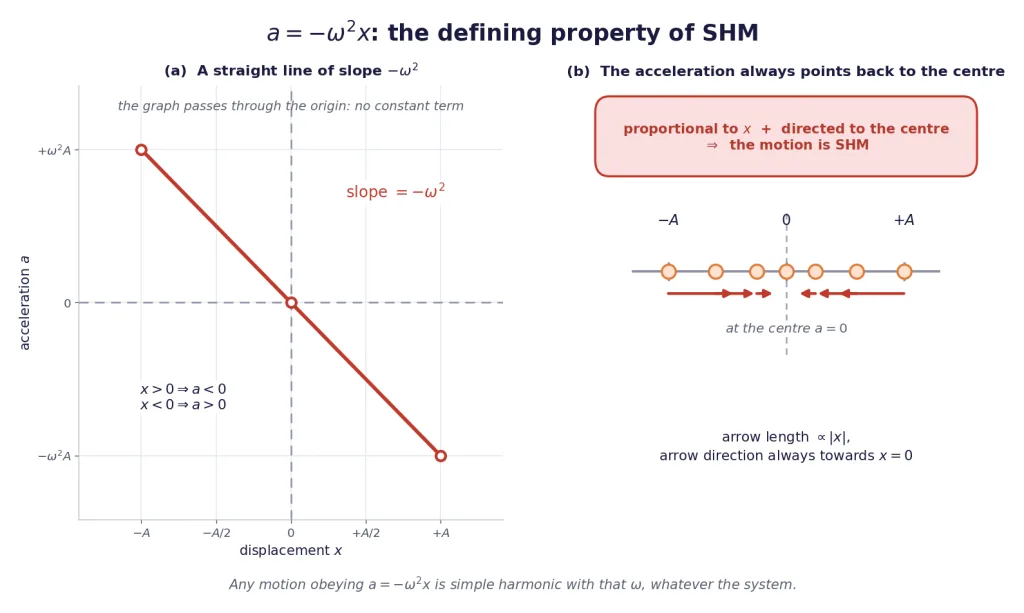
The bracket is identical. The whole of on the right is just , so the second equation collapses to something with no time in it at all:
Key Point — the single most important equation in this chapter: The acceleration of a particle in SHM is proportional to its displacement from the mean position and directed opposite to it — that is, always back towards the mean position.
Read the sign carefully, because it carries half the meaning. When the acceleration is negative, pulling the particle back towards the left; when the acceleration is positive, pushing it back towards the right. Whatever the value of between and , the acceleration points at the centre. That is why the particle keeps turning round instead of escaping.
The converse, which is what makes this a definition
So far this is a consequence of . The powerful statement runs the other way.
Key Point — the test that decides everything later in this chapter:
If the acceleration of any body, in any system, satisfies with measured from the equilibrium position, then that body is executing simple harmonic motion, with No further work is needed. It does not matter whether the body is a block on a spring, a swinging bob, a floating cylinder or a column of liquid in a bent tube.
That is a remarkable licence, and it is why the same three formulas describe systems that look nothing like one another. The recipe is short enough to memorise:
- Measure the displacement from the equilibrium position, not from anywhere else.
- Find the acceleration and show it can be written as with a positive constant.
- Read off , then and .
For example, a particle whose acceleration obeys in SI units has , so
and you know the period of the motion without having solved a single differential equation.
The - graph
Since , a graph of acceleration against displacement is a straight line through the origin with a negative slope, and
That gives you a free way of testing a graph. A straight line through the origin sloping downwards means SHM. A curve, or a straight line that misses the origin, means something else — although a line that misses the origin usually just means the displacement was measured from the wrong place, and shifting the origin to the true mean position repairs it.
The sign is not optional
If the relation were , the "restoring" influence would push the particle further out the moment it moved, and the displacement would run away exponentially instead of oscillating. Nothing about that motion would repeat. The minus sign is the entire difference between an oscillation and a runaway.
[JEE Tip] Whenever a problem hands you an acceleration in the form — however disguised, and in whatever variable — write immediately and check the units of : they must be . If they are not, you have compared the wrong quantities somewhere.
The Phase Relations, and Where Everything Peaks
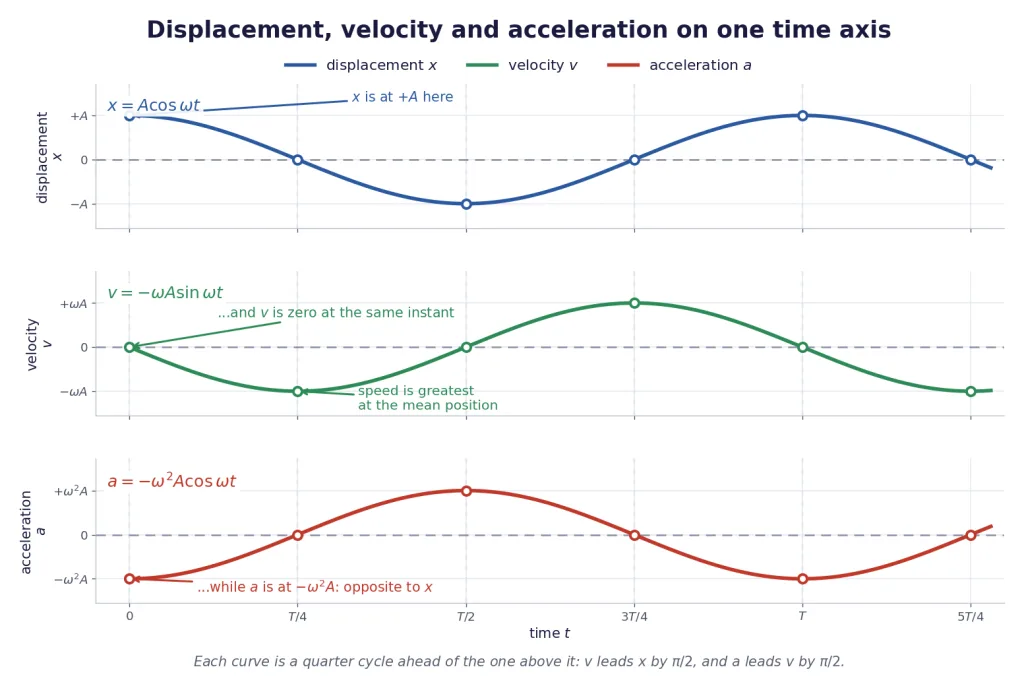
The three curves are sinusoids of the same , so they have the same period. What separates them is timing, and the timings are fixed and simple.
All three written as cosines
The phases are easiest to compare once everything is a cosine. Using and :
Now the phase of each is written out, and the differences can be read straight off.
Key Point — the phase relations:
- The velocity leads the displacement by (a quarter of a period).
- The acceleration leads the velocity by (another quarter period).
- The acceleration leads the displacement by — it is exactly out of phase with the displacement, which is just said in the language of phase.
"Leads by a quarter period" has a plain meaning on a graph: whatever the velocity curve is doing now, the displacement curve will do a quarter of a period later. The velocity peaks first, then the displacement, then the velocity again.
One cycle, quarter by quarter
Take so the particle starts at rest at , and walk round once.
| Time | Phase | What the particle is doing | |||
|---|---|---|---|---|---|
| momentarily at rest at the right extreme, pulled hard left | |||||
| flying through the centre at top speed, no acceleration | |||||
| at rest at the left extreme, pushed hard right | |||||
| through the centre again, top speed the other way | |||||
| back where it started |
Notice that no two of the three peak at the same instant. That is the whole content of the phase relations.
Where each quantity is largest and where it vanishes
Key Point: speed is greatest where the acceleration vanishes, and the acceleration is greatest where the speed vanishes.
| At the… | Speed | ||
|---|---|---|---|
| mean position, | maximum, | ||
| extreme positions, | maximum, | ||
| general position |
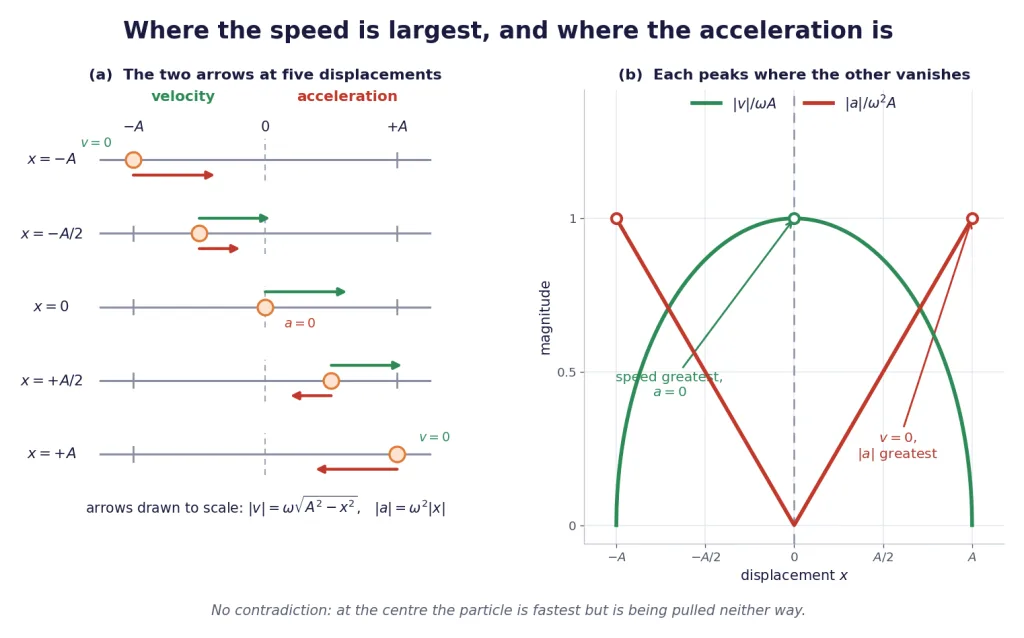
"Fastest where the acceleration is zero" — why that is not a contradiction
Students trip over this every year, so it is worth a paragraph. The objection goes: if the acceleration is zero at the middle, how can the particle be moving fastest there?
The answer is that acceleration is not speed. Acceleration is the rate at which the velocity is changing. Any quantity is at a maximum exactly where its rate of change is zero — that is what a peak on a graph means. So a velocity that is momentarily as large as it will ever get must, at that instant, be changing at zero rate. Maximum speed and zero acceleration are not in conflict; they are two descriptions of the same instant.
The mirror image says the rest of it. At the extreme position the particle is momentarily stationary, but its velocity is changing as fast as it ever does — it is about to reverse — so the acceleration is at its largest there. A ball thrown straight up makes the same point: at the top of its flight its speed is zero, and yet gravity is pulling on it exactly as hard as ever.
[NEET Important] "At which position is the acceleration of a particle in SHM maximum / zero?" and "at which position is the velocity maximum / zero?" are single-mark recall questions that appear almost every year. Acceleration is greatest at the extremes and zero at the mean position; speed is greatest at the mean position and zero at the extremes. Never the other way round.
Getting the Speed Without the Time
The three formulas so far all have in them. But a very large fraction of the questions you will be set never mention time at all: how fast is it going when it is 3 cm from the mean position? Answering that with the time formulas means finding the instant at which cm, which needs an inverse cosine, and then substituting into — two steps of unpleasant work for a one-line answer.
There is a much better route: eliminate between the displacement and the velocity.
The elimination
Write for the phase, so that
Rearrange each to isolate the trigonometric function:
Now use the one identity that holds for every angle, :
Multiply through by :
and solve for .
Key Point — speed at a given displacement: Equivalently . There is no time in it, no phase constant in it, and it works whatever the starting conditions were.
Two immediate checks
Put : , the velocity amplitude. Put : . Both are exactly what the quarter-by-quarter table says, which is a good sign that the elimination was done correctly.
Why the is there, and what to do with it
The particle passes through every displacement twice in each cycle — once travelling outwards and once travelling back. At those two instants the speeds are equal and the directions are opposite, and that is precisely what the two signs record. So:
- if the question asks for the speed, quote the positive root and stop;
- if it asks for the velocity, you must decide the direction from the physical description, and attach the sign yourself.
The same relation, turned round
Solving for the displacement instead:
which answers "where is it when it is moving at this speed?" just as directly.
The standard displacements, worth knowing on sight
| Displacement | Speed | As a fraction of |
|---|---|---|
Read the table both ways. The particle is at half its top speed when it is at — not at , which is the trap. And it is still moving at of its top speed when it is halfway out.
The velocity-displacement graph is an ellipse
Go back a step, to the form before the square root:
That is the equation of an ellipse in the - plane, with semi-axis along the displacement direction and semi-axis along the velocity direction. The particle runs once round this ellipse in every period.
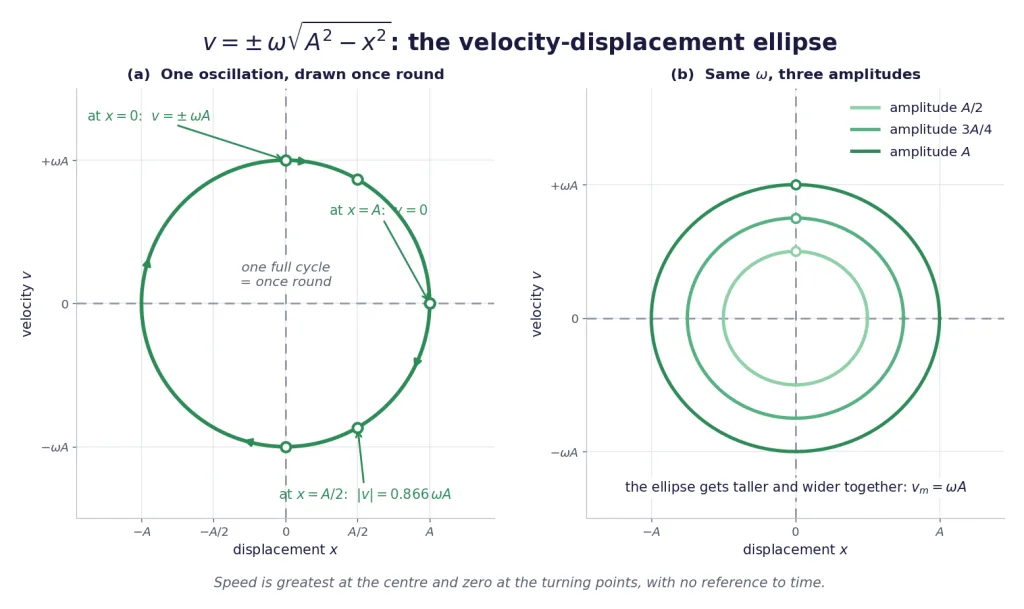
So the three graph shapes that this section produces are all different, and questions test whether you can tell them apart:
| Graph | Shape |
|---|---|
| against | straight line through the origin, negative slope |
| against | ellipse, semi-axes and |
| against | straight line, slope , intercept on the axis |
[JEE Tip] Two speeds at two known displacements determine the whole motion. From and , subtracting kills and dividing kills : Both are worth carrying into the exam; they turn a two-unknown problem into two substitutions.
Reading the Three Graphs, and the Traps
How to read the stacked plots
When the three curves are drawn one above the other on a shared time axis, four rules get you through any question asked about them.
- The vertical scales are different, and deliberately so. The displacement panel is scaled to , the velocity panel to and the acceleration panel to . Comparing the heights of curves in different panels means nothing. Comparing their timings means everything.
- The velocity crosses zero exactly where the displacement peaks or troughs. The particle is momentarily at rest at each turning point.
- The acceleration curve is an upside-down copy of the displacement curve, magnified by . Wherever has a peak, has a trough of the same shape, and both cross zero at the same instants.
- Each curve is a quarter period ahead of the one above it. If a figure shows the velocity peaking at the same instant as the displacement, the figure is wrong.
The reference card
| Quantity | In time | Amplitude | At the mean position | At the extremes |
|---|---|---|---|---|
The in the last cell is not a typo: at the acceleration is , and at it is . The acceleration always carries the sign opposite to the displacement.
The traps
1. The amplitude of the velocity is not the velocity. This is the single commonest error on this material. is the speed at one place only — the mean position. Asked for the speed at , a student who writes has quoted the ceiling instead of the value; the answer is . The same warning applies to , which is the acceleration only at the extremes.
2. is not . needs the angular frequency in radians per second. If a question gives the frequency in hertz, then and . Dropping the is the commonest arithmetic slip in the chapter, and it is worth writing the conversion line out every time.
3. Maximum speed is not average speed. Over one complete oscillation the particle covers a path length in a time , so its average speed is and its average velocity over that same complete cycle is exactly zero, because the net displacement is zero. Three different numbers, three different questions.
4. Zero acceleration does not mean at rest. At the mean position the acceleration vanishes and the speed is at its greatest. Zero acceleration means the velocity is not changing at that instant, nothing more.
5. must be measured from the mean position. and are both written for a displacement measured from the equilibrium position. If a problem quotes a distance from an extreme, or from some other reference point, convert it before substituting.
6. Amplitude changes the sizes but never the timings. Double and both and double, while , and do not move at all. Double instead and doubles while goes up four times, because carries .
Key Point: scales with the first power of and with the second, which is what makes ratio questions on this material separable.
| Change made | and | ||
|---|---|---|---|
| amplitude , same | unchanged | ||
| , same amplitude | halved, doubled | ||
| both doubled | halved, doubled |
[JEE Tip] When a numerical question mixes displacement, speed and acceleration at the same instant, resist the urge to find . Use for anything involving the acceleration and for anything involving the speed. Between them they answer almost every such question without a single trigonometric evaluation.
Solved Examples
Conventions used throughout: the standard form is ; is the angular frequency in radians per second and the frequency in hertz; is a speed or a velocity and phases are quoted in radians, with the degree equivalent where it helps. . Where a question asks for a speed, the positive root is quoted.
Example 1: Everything from one equation
A particle moves along the -axis with where is in metres and in seconds. Find (a) the amplitude, angular frequency, period and frequency, (b) the maximum speed and the maximum acceleration, and (c) the displacement, velocity and acceleration at s.
Solution:
(a) Match against the standard form. Note the pair: rad/s and Hz describe the same motion, and they differ by the factor .
(b) The two amplitudes.
(c) Find the phase first, then substitute once. At s,
Now all three quantities.
Check the last one two ways. Using the time formula instead, m/s². Agreed. And the speed can be checked without the phase at all: m/s. Agreed again.
Final Answer: m, rad/s, s, Hz; m/s and m/s²; at s, m, m/s and m/s².
Takeaway: Evaluate the phase once, then substitute it into all three formulas. And use for the acceleration rather than the time formula — it is shorter and it cannot go wrong once is known.
Example 2: The two amplitudes fix the whole motion
A particle in SHM has a maximum speed of 0.6 m/s and a maximum acceleration of 3.6 m/s². Find its angular frequency, amplitude, period and frequency.
Solution:
Write down what each maximum means. Two equations, two unknowns.
Divide to remove the amplitude. The units confirm it: divided by gives , which is what rad/s is.
Substitute back for the amplitude. Or in one step, m.
Period and frequency. Note again that rad/s and Hz are not the same number.
Final Answer: rad/s, m, s and Hz.
Takeaway: and turn a pair of maxima into the whole motion. Dividing the two amplitudes removes ; that is always the first move when both maxima are given.
Example 3: Speed at a given displacement
A particle executes SHM of amplitude 5 cm with a period of 0.4 second. Find (a) its maximum speed, (b) its speed when it is 3 cm from the mean position, (c) its speed when it is 4 cm from the mean position, and (d) the displacement at which the speed is half its maximum value.
Solution:
Angular frequency first — everything needs it.
(a) Maximum speed.
(b) At cm. Use with everything in metres: The 3-4-5 triangle does the arithmetic: in centimetres.
(c) At cm. Further out, slower — as it must be.
(d) Where is the speed half of ? Set . The cancels:
Sanity check on (d). The answer is not . At cm the speed would be cm/s, which is of the maximum, not half of it.
Final Answer: m/s; m/s at 3 cm; m/s at 4 cm; the speed is half its maximum at cm.
Takeaway: answers every "speed at this displacement" question in one line. And the displacement at which the speed is half the maximum is , not — the square root does not distribute over the subtraction.
Example 4: Two speeds, two displacements, two unknowns
A particle in SHM has a speed of 8 cm/s when it is 3 cm from the mean position, and a speed of 6 cm/s when it is 4 cm from the mean position. Find its angular frequency, amplitude, period and frequency, and its maximum speed.
Solution:
Write the relation twice. With cm/s at cm and cm/s at cm,
Subtract, and the amplitude disappears. The centimetres cancel on both sides, so there was no need to convert units for this step.
Put back into either equation for the amplitude.
Check with the other pair, which was not used in step 3. That is exactly , so the pair is consistent with both measurements.
The rest follows.
Final Answer: rad/s, cm, s, Hz, and cm/s.
Takeaway: Two (speed, displacement) pairs determine and completely. Subtract the two squared relations to kill and find ; substitute back for ; then verify with the pair you did not use.
Example 5: A full quarter-by-quarter account
A particle of amplitude 4 cm executes SHM with a period of 2 seconds. It is released from rest at cm at . Find (a) , and , (b) the first instant at which its speed is maximum and the value of that speed, (c) , and at , and (d) at .
Solution:
The constants. Released from rest at the positive extreme means .
(a) The three functions. With m,
(b) When is the speed greatest? At the mean position, which the particle first reaches a quarter period after release: The acceleration is zero at that same instant.
(c) At s. The phase is The particle is halfway out on the positive side, moving in the negative direction (back towards the centre), and being pulled the same way.
(d) At s. The phase is
Read the pattern in the two answers. The displacement changed sign between and , and so did the acceleration — always opposite to . The velocity did not change sign: the particle is still travelling the same way, having simply crossed the middle at .
Final Answer: m, m/s, m/s²; maximum speed 12.57 cm/s first reached at s; at , ; at , .
Takeaway: The velocity keeps its sign right through the mean position; the displacement and the acceleration flip there together. Checking those signs against the physical picture catches errors that the arithmetic alone will not.
Example 6: The amplitude of the velocity is not the velocity
A particle executes SHM of amplitude 2 cm at a frequency of 5 Hz. A student writes "the velocity of the particle is 0.628 m/s". Explain what is wrong with that sentence, and find the actual speed when the particle is 1 cm from the mean position. Find also the average speed over one complete oscillation.
Solution:
Where the number came from. Convert the frequency to an angular frequency first: So 0.628 m/s is the velocity amplitude — the maximum speed, reached only as the particle sweeps through the mean position. It is not the speed at any other point, and it is certainly not "the velocity", which changes continuously and is negative for half of every cycle.
The actual speed at cm. which is of the maximum, not of it.
The maximum acceleration, for contrast. and at cm the acceleration is m/s², exactly half of the maximum — because acceleration is proportional to , while speed is not.
The average speed over a full cycle. In one period the particle covers a path length of : which is of the maximum speed. The average velocity over that cycle is zero, since the net displacement is zero.
Final Answer: 0.628 m/s is the velocity amplitude, not the velocity; the speed at cm is 0.5441 m/s; the average speed over a full oscillation is 0.4 m/s and the average velocity is zero.
Takeaway: Three different numbers hide behind the word "velocity" here: the maximum 0.628 m/s, the instantaneous value 0.544 m/s, and the cycle average 0.4 m/s. Read the question carefully enough to know which one it wants.
Example 7: Recognising SHM from the acceleration alone
A particle moves along the -axis such that its acceleration is always given by , with in metres and in m/s². (a) Show that the motion is simple harmonic and find its period and frequency. (b) If the particle's speed as it passes the mean position is 8 m/s, find its amplitude and its maximum acceleration. (c) Find its speed at m.
Solution:
(a) Apply the test. The acceleration is a negative constant times the displacement, with the displacement measured from . That is exactly , so the motion is simple harmonic, and comparing term by term, The unit check matters: the coefficient 16 has units , which is what must have.
(b) The speed at the mean position is the maximum speed. Check the second one directly against the given rule: at m, m/s², magnitude 32 m/s². Consistent.
(c) Speed at m. That is of the maximum, as it must be at half the amplitude.
Final Answer: SHM with rad/s, s and Hz; m and m/s²; the speed at m is 6.928 m/s.
Takeaway: A statement of the form is a complete description of an oscillation's timing. Read off it at once, check that has units of , and the period follows without any further physics.
Example 8: Working backwards from the acceleration
The acceleration of a particle in SHM varies with time as a cosine of period 0.5 second, with maximum magnitude 8 m/s². At the acceleration has its maximum positive value. Find the angular frequency, the amplitude, the maximum speed, the phase constant, and where the particle is at .
Solution:
Angular frequency from the period. The acceleration has the same period as the displacement, so
Amplitude from the acceleration amplitude.
Maximum speed. This could also be had directly as m/s.
Phase constant, from the condition at . The acceleration is , and it is at its maximum positive value at , so
Where the particle is. With , The particle is at the negative extreme. That is exactly what a maximum positive acceleration should mean: the acceleration is largest when the displacement is largest, and it points the opposite way, so a maximum positive acceleration goes with the most negative displacement.
Write the motion out.
Final Answer: rad/s ( Hz), cm, m/s, rad, and at the particle is at rest at .
Takeaway: The acceleration graph is the displacement graph turned upside down. A maximum of therefore corresponds to a minimum of , so "acceleration maximum positive at " means the particle starts at , not at .
Example 9: What doubling does
A particle executes SHM of amplitude 3 cm at a frequency of 2 Hz. Find its maximum speed and maximum acceleration. Then find what each becomes if (a) the amplitude alone is doubled, and (b) the frequency alone is doubled.
Solution:
The base case. Convert to angular frequency first, every time:
(a) Double the amplitude, leave the frequency alone. m, unchanged: Both doubled, because both and are directly proportional to . The period and frequency did not move at all.
(b) Double the frequency, leave the amplitude alone. Hz, so rad/s and m: The maximum speed doubled, but the maximum acceleration went up by a factor of four, because carries .
Collect it.
| Quantity | Base | Double | Double |
|---|---|---|---|
| 0.5 s | 0.5 s | 0.25 s | |
| 0.3770 m/s | 0.7540 m/s | 0.7540 m/s | |
| 4.737 m/s² | 9.475 m/s² | 18.950 m/s² |
Final Answer: base case m/s and m/s²; doubling gives 0.7540 m/s and 9.475 m/s²; doubling gives 0.7540 m/s and 18.950 m/s².
Takeaway: is proportional to and to ; is proportional to and to . So the maximum speed cannot tell the two changes apart, but the maximum acceleration can — and the period only ever responds to .
Example 10: When is the speed half its maximum?
A particle executes SHM as . Find all the instants in the first complete period at which its speed is half its maximum value, and the displacement at each of them.
Solution:
Write the speed as a function of time.
Set the condition.
Solve over one full period, that is for running from 0 to . The sine has magnitude at four angles:
Convert to times using , so : Four instants per cycle, as expected: the particle passes through each speed value four times in a period, twice on each side of the centre.
The displacement at each. At those angles , so with positive at and , and negative at and .
Cross-check without time. From we get directly, which agrees.
Final Answer: at , at which the displacements are respectively.
Takeaway: A speed condition gives four instants per period, and a displacement condition gives two. Solve the trigonometric equation over the full rather than quoting the first solution only.
Example 11: Given the velocity, find the displacement
The velocity of a particle executing SHM is , with in m/s and in seconds. Find the amplitude, the angular frequency, the period, the maximum acceleration, and the displacement as a function of time.
Solution:
Read and off the given expression. A velocity of the form has
Amplitude from the velocity amplitude.
Maximum acceleration. or equally m/s².
Displacement, by integrating — or by recognising the pattern. Since , and the constant is zero because is measured from the mean position. So which is the standard cosine form with rad — the particle starts at the mean position moving in the positive direction.
Check by differentiating back. which is the given velocity. And m/s², whose maximum magnitude is 8 m/s², matching step 3. It also equals , as it must.
Final Answer: m, rad/s, s, m/s², and metres.
Takeaway: A velocity written as a cosine means a displacement written as a sine, one quarter cycle behind. Read and straight off the velocity expression, get , and always differentiate your answer back to check.