
A Bob, a String, and One Honest Equation
Tie a small stone to a metre of thread, hang it from a hook, pull it a little to one side and let go. It swings back and forth with a beat so steady that for three hundred years it was the best clock the world had. Galileo is said to have timed a swinging chandelier against his own pulse and noticed that the beat did not change as the swing died away — and that single observation is what this section is about.
Key Point — what "simple pendulum" means:
A simple pendulum is a point mass (the bob) suspended from a light, inextensible string of length whose upper end is fixed to a rigid support, free to swing in a vertical plane.
Four idealisations are packed into that sentence, and every one of them earns its place:
| Idealisation | What it buys us |
|---|---|
| the string is massless | all the moving mass sits at one point, a distance from the pivot |
| the string is inextensible | stays fixed, so the bob moves on a circular arc |
| the bob is a point | there is one distance , not a range of them |
| the support is rigid | the pivot does not recoil, so no energy leaks away through it |
Setting up the problem
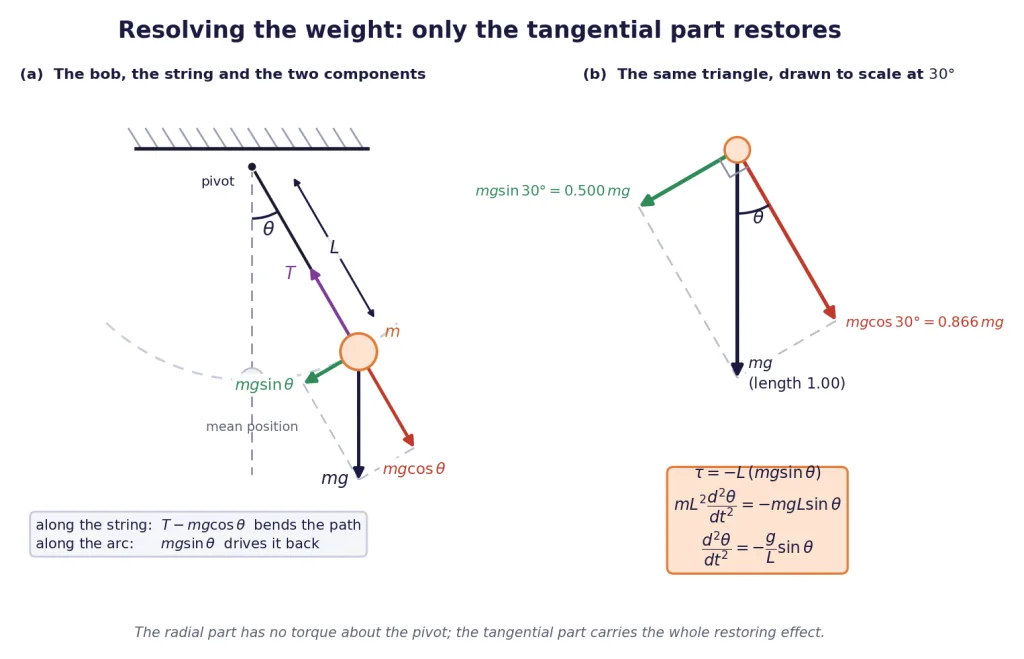
Let be the angle the string makes with the vertical. At the mean position . Two forces act on the bob:
- the tension along the string, pointing towards the pivot (in this one derivation is a force in newtons; from the next block onward it returns to meaning the period, in seconds);
- the weight , straight down.
The weight is the interesting one, and the whole derivation turns on splitting it into two pieces — one along the string and one perpendicular to it:
Why we take torques about the pivot
The bob is not moving in a straight line — it is moving along a circular arc of radius . That makes the rotational form of Newton's law the natural tool, and it comes with a gift.
The two radial forces, and , both lie along the line joining the bob to the pivot. A force whose line of action passes through the pivot has zero moment arm about it, and therefore exerts no torque. So the entire torque about the support comes from the tangential piece:
The minus sign is the physics: whichever way you displace the bob, this torque pushes back towards zero. It is a restoring torque.
(That does not make and useless — their difference, , supplies the centripetal force that bends the bob's path into an arc. They just have nothing to say about how fast it swings.)
The equation of motion
Newton's second law for rotation is , where is the moment of inertia about the pivot and is the angular acceleration. For a point mass at a distance from the pivot, . So
Cancel one and one from both sides:
Key Point — the exact equation of a simple pendulum: The mass has vanished already, at this early stage — before any approximation has been made.
Read that equation carefully, because it is not simple harmonic
Simple harmonic motion requires the acceleration to be proportional to the displacement:
What we actually have is . And is not proportional to — it is a curve that bends away from the straight line as grows. So as it stands, a simple pendulum is not a simple harmonic oscillator. It is periodic; it is not simple harmonic.
That is an honest and slightly awkward place to be, and the next block is entirely about the one step that rescues it.
[Board Important] "Derive the expression for the time period of a simple pendulum" is a standard four- or five-marker. The marks sit at: resolving into and ; saying the radial forces give no torque; writing and ; and only then making the small-angle approximation.
The Small-Angle Approximation, and Exactly How Good It Is
Everything now depends on one fact about the sine function. Its series expansion is
and — this is not optional — must be in radians for that series to be true. If is small, is very much smaller, smaller still, and the first term carries almost the whole value.
Key Point — the small-angle approximation: Not degrees. Ever. The number is meaningless here; the number is the one that works.
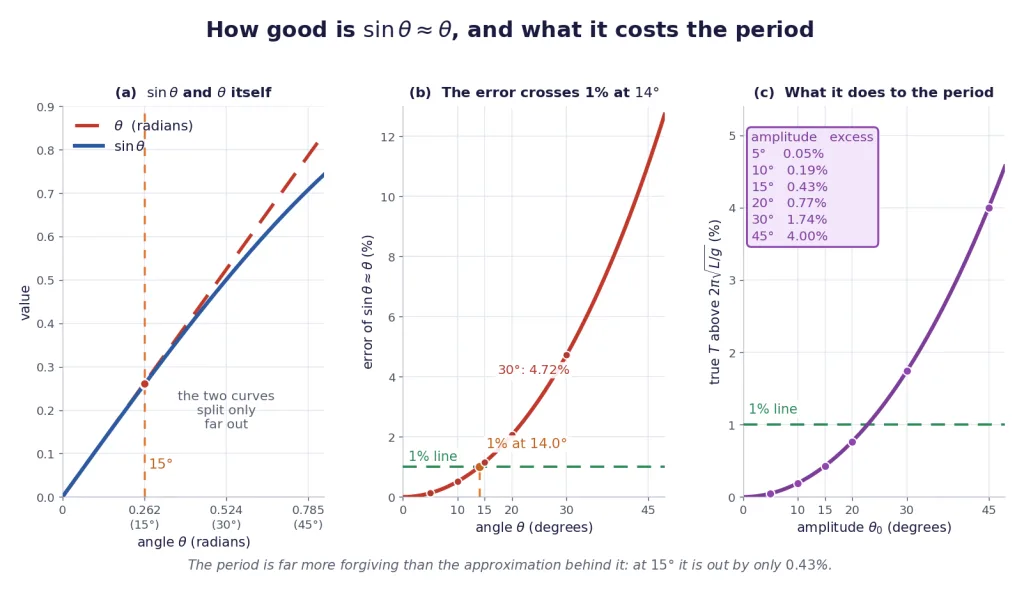
How small is "small"? Put numbers on it
| (degrees) | (radians) | error of | |
|---|---|---|---|
| % | |||
| % | |||
| % | |||
| % | |||
| % | |||
| % | |||
| % | |||
| % |
Read the fourth row: the approximation is good to exactly 1 per cent at about , and it is still inside about 1 per cent at — where it is out by per cent. Beyond it starts to hurt, and by it is hopeless.
What the approximation does to the equation
Put into the exact equation:
Now compare with the defining relation for simple harmonic motion, . The two match, with
This is exactly the four-step test from the force-law section, run in angle instead of distance: displace the system, find the restoring effect that appears, check that it is the displacement, and read straight off that constant. Here the constant is , and it arrived only after the small-angle step — which is precisely why the approximation is not a detail.
Key Point — the formula the whole section exists for: Here is the angular frequency in radians per second and is the frequency in hertz. They differ by a factor of and are never interchangeable.
Check the units once. is in m/s² and in metres, so has units of s², its square root is in seconds, and comes out in seconds. It could not have been otherwise.
So the angular displacement is simple harmonic:
with the angular amplitude and the phase constant. The bob's displacement along the arc is , so that is simple harmonic too, with linear amplitude .
Being honest about what the approximation costs
Since we threw away the term, cannot be exactly right for any real swing. So how wrong is it? Solve the exact equation instead and compare.
| Angular amplitude | True period exceeds by |
|---|---|
| % | |
| % | |
| % | |
| % | |
| % | |
| % | |
| % |
Look at how forgiving that is. At the sine approximation itself is off by per cent, but the period it predicts is off by only per cent — about a third as much. Errors in do not pass straight through into the period; the swing spends most of its time near the middle, where the approximation is at its best.
The leading correction, for those who like a formula for it, is
At that gives per cent against a true per cent — close enough to be useful, and a reminder that the true period does creep up with amplitude.
Key Point: A simple pendulum is isochronous — same period whatever the amplitude — only within the small-angle approximation. Swing it far enough and the period grows. That is the small print on Galileo's chandelier.
[JEE Tip] When a question says "small oscillations", it is granting you permission to write and use . When it gives you an amplitude of , it is telling you the opposite, and the expected answer is usually the qualitative one: the period is longer than .
What the Period Depends On — and What It Does Not
Two symbols. That is the whole content of the formula, and the things it leaves out are as examinable as the things it contains.
The three things that do not matter
1. The mass of the bob. A lead bob and a cork bob on strings of the same length swing in step. It cancelled right at the start: the restoring torque carries a factor , and so does the moment of inertia . More mass means a bigger pull and more inertia to move, in exactly the same proportion.
2. The amplitude — within the small-angle approximation, as the previous block quantified.
3. The material of the bob. Brass, wood, glass, ice: irrelevant. Density enters only if the bob is swinging in something denser than air, which is a different problem and is handled later in this section.
The one thing that does matter: the ratio
| Change | Effect on | Because |
|---|---|---|
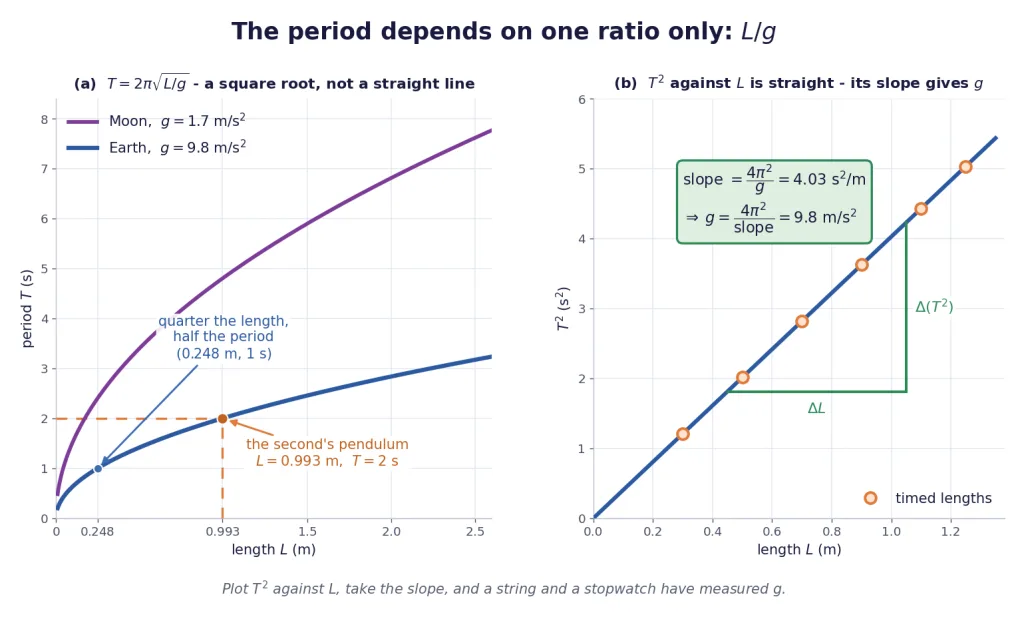
| length made four times bigger | period doubles | |
| length made a quarter | period halves | same square root |
| taken to the Moon, where is about | period about times longer | , and |
| moved from the equator to a pole, where is larger | period slightly shorter | a pendulum clock runs fast at the poles |
| bob made heavier | no change | cancelled |
| amplitude increased from to | no measurable change | still inside the approximation |
Because of the square roots the responses are gentle. To halve the period you must quarter the length; a 2 per cent error in shifts by only about 1 per cent.
Where exactly is measured to?
To the centre of the bob — not to the top of it, and not to the knot.
The derivation treated the bob as a point mass sitting a distance from the pivot, and the point that stands in for a solid sphere is its centre. So in the laboratory,
and if the bob hangs from a hook, the hook counts too. This sounds fussy, but with a 1 cm bob on a 1 m string, forgetting the radius shifts by about 1 per cent and by about 1 per cent — which is far bigger than the error in a well-timed experiment.
Key Point: is the distance from the point of suspension to the centre of mass of the bob. Add the radius of the bob to the length of the string.
Measuring with a string and a stopwatch
Turn the formula inside out:
That is a genuine laboratory measurement of good to three figures, from equipment that costs nothing. Two habits make it work:
- Time many oscillations, not one. Time 20 or 50 swings and divide. Your reaction time enters the total once, so dividing by 50 divides that error by 50 as well.
- Start and stop the watch as the bob passes through the mean position, where it is moving fastest and the instant is sharpest — not at the turning points, where it dawdles.
Better still, repeat for several lengths and plot against . The graph is a straight line through the origin of slope , so
and a line through many points beats any single reading.
[JEE Tip] appears squared in the expression for , so a 1 per cent error in the period produces about a 2 per cent error in . Timing is where this experiment is won or lost.
When the string expands
Strings and rods get longer when they are heated. If the pendulum's length changes by a small fraction , then since ,
For thermal expansion, with the coefficient of linear expansion and the temperature rise, so
Key Point: A pendulum clock in a warm room has a longer pendulum, therefore a longer period, therefore it ticks too slowly and loses time. Time lost per day seconds.
Cool the room instead and the pendulum shortens, the period shortens, and the clock gains. Good pendulum clocks were built with compensating rods of two metals precisely to kill this effect.
[NEET Important] The half in is the whole question. It comes from the square root, and leaving it out doubles every answer.
The Second's Pendulum
The second's pendulum and the effective-gravity variants that follow sit outside the rationalised syllabus body text, and Boards, JEE and NEET ask them every year, so they are developed here.
Key Point — the definition:
A second's pendulum is a simple pendulum whose time period is exactly 2 seconds.
Why 2 and not 1? Because a full period is a round trip — over and back. A pendulum with a 2-second period takes 1 second to swing from one extreme to the other, so it ticks once every second, which is exactly what a clock needs. The pendulum in a grandfather clock is a second's pendulum, and its tick-tock is one full period.
That single sentence contains the trap. For a second's pendulum:
The frequency is half a hertz, not one hertz. Every year somebody writes second because "it ticks every second".
How long is it?
Rearrange for the length:
With seconds the is , so
which is a pleasant thing to remember on its own: the length of a second's pendulum is divided by . With m/s²,
Just under a metre. That near-coincidence is not a coincidence at all — one early proposal for defining the metre was "the length of a pendulum that beats seconds", and although the definition that won was a different one, the two lengths stayed within a per cent of each other.
| Where | (m/s²) | Length of a second's pendulum |
|---|---|---|
| Earth, standard | m | |
| Earth, at a pole | m | |
| Earth, at the equator | m | |
| the Moon | m |
Take it to the Moon and it stops keeping time
Keep the same pendulum — the same m — and carry it to the Moon, where m/s². Its period becomes
It is no longer a second's pendulum; a clock driven by it would run at about per cent of the correct rate. To get a genuine second's pendulum on the Moon you must shorten it to m, about 17.2 cm, because at fixed period.
[NEET Important] Three facts to have on instant recall: a second's pendulum has s, Hz, and m on the Earth. Questions are often built out of nothing else.
[JEE Tip] "A second's pendulum is taken into a lift accelerating upwards" is a favourite construction. Nothing new is needed — it just means m and , which is the subject of the next block.
When Gravity Is Not Just : Effective Gravity
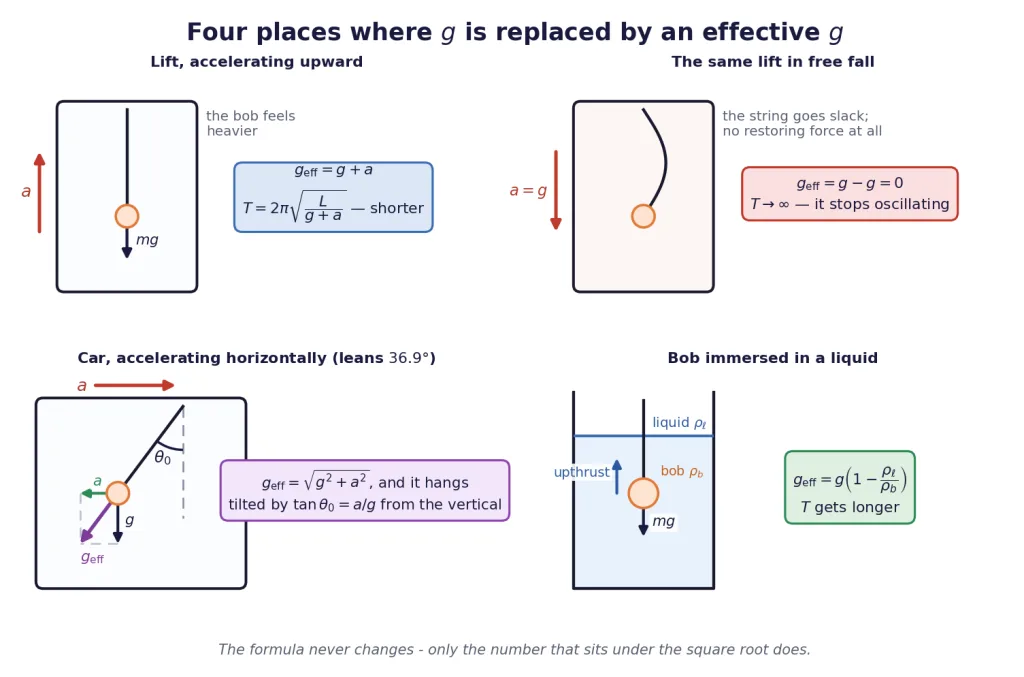
Put the pendulum in a lift, in a car, in a tank of water or in an electric field, and the formula does not change shape at all. Only the number under the square root does.
Key Point — the master rule: where is the magnitude of the net non-string force per unit mass on the bob, as seen from the frame in which the support is at rest. The bob's equilibrium position — where the string hangs when nothing is swinging — points along , and the oscillation is about that direction.
Everything below is one application of that rule.
1. In a lift
Work in the lift's frame and add the pseudo-force on the bob.
- Lift accelerating upwards with acceleration : the pseudo-force points down, adding to the weight.
The period is shorter, so the clock gains.
- Lift accelerating downwards with acceleration (this includes a lift moving up but slowing down):
The period is longer, so the clock loses.
Lift in free fall, : then . There is no restoring force at all, the string goes slack, and . The pendulum does not oscillate. Displace the bob and it simply stays where it is put, drifting alongside the lift.
Lift moving with constant velocity, up or down, fast or slow: , so and nothing changes. Only acceleration matters, never velocity.
2. In a car accelerating horizontally
Now the pseudo-force is horizontal, pointing backwards, while gravity still points down. They are perpendicular, so they add by Pythagoras:
and the resultant is tilted from the vertical. The string hangs along it, leaning backwards, at an angle given by
The bob then oscillates about that tilted line, not about the vertical, with
Since always, a pendulum in an accelerating car always runs faster than one at rest, whichever way the car accelerates.
3. Bob immersed in a liquid
Let the bob have density and volume , and let it swing in a liquid of density (with , or it would float). The upthrust is constant and vertical, so it simply cancels part of the weight:
The mass being accelerated is still the bob's own, , so the effective gravity is that force divided by that mass:
Key Point: Buoyancy always reduces , so the period in a liquid is always longer.
(The liquid also resists the bob's motion and slowly shrinks the swing; that is a separate effect and it does not alter the period result above.)
4. A charged bob in an electric field
A bob of mass carrying charge in a uniform field feels a constant extra force . A constant force is exactly what is, so it just adds vectorially:
| Direction of the electric force | Effect on | |
|---|---|---|
| vertically down | shorter | |
| vertically up | longer | |
| horizontal | , tilted by | shorter |
If the upward electric force grows until , then and the pendulum stops oscillating, exactly as in free fall. Push past that and the bob hangs upside down, above the pivot, oscillating about the upward vertical with .
The whole table in one place
| Situation | Period compared with rest | |
|---|---|---|
| at rest, or constant velocity | unchanged | |
| lift accelerating up with | shorter | |
| lift accelerating down with | longer | |
| lift in free fall | no oscillation | |
| horizontal acceleration | , tilted by | shorter |
| bob in a liquid | longer | |
| charge , field force down | shorter | |
| charge , field force up | longer |
[JEE Tip] One habit solves every problem in this table. Draw the bob, mark every constant force on it except the string's tension, add them as vectors, divide by : that resultant is , and its direction is where the string hangs. Then write and stop.
[Board Important] The free-fall case is a two-mark favourite. The answer is "the pendulum does not oscillate, because the effective gravity is zero and there is no restoring force" — not "the period becomes zero".
Solved Examples
Conventions used throughout: m/s² on the Earth and m/s² on the Moon; . Strings are light and inextensible, bobs are treated as point masses at the centre, and always runs from the point of suspension to the centre of the bob. Every angle inside a sine or a small-angle step is in radians. is the angular frequency in rad/s, the frequency in Hz.
Example 1: The metre-long pendulum, end to end
A simple pendulum of length 1.00 m hangs from a rigid support and is set swinging through a small angle of about . Find (a) its angular frequency, (b) its period, (c) its frequency, and (d) how many complete oscillations it makes in one minute.
Solution:
(a) Angular frequency.
(b) Period. Or straight from the formula: s. Same number.
(c) Frequency — and keep it apart from . Check: rad/s, which is again. The two differ by the factor and describe the same swing.
(d) Oscillations in a minute. so 29 complete oscillations, with the thirtieth about nine-tenths finished.
Is the amplitude safe? Yes — at the true period exceeds by about per cent, far below the precision of any quoted answer.
Final Answer: rad/s, s, Hz, and 29 complete oscillations in a minute.
Takeaway: A one-metre pendulum has a period of very nearly 2 seconds — worth memorising as a sanity check on every other pendulum answer you produce.
Example 2: The second's pendulum, here and on the Moon
Find (a) the length of a second's pendulum on the Earth, (b) its length on the Moon, and (c) the period the Earth pendulum would have if it were carried, unchanged, to the Moon.
Solution:
(a) On the Earth. A second's pendulum has s exactly, so That is cm — just under a metre.
(b) On the Moon. Same , but m/s²: Notice . At fixed period, exactly.
(c) The Earth pendulum taken to the Moon. Now is fixed at m and drops: Or by ratio, which is faster: , and s.
Final Answer: m on the Earth; m on the Moon; and the Earth pendulum would take s per swing on the Moon.
Takeaway: A second's pendulum has s and . On the Earth that is about a metre; anywhere else, recompute it, because .
Example 3: Measuring in the laboratory
A student suspends a bob so that the distance from the support to the centre of the bob is 0.850 m. Timing from the mean position, 20 complete oscillations take 37.0 seconds. Find (a) the period, (b) the value of , and (c) what would happen to the answer if the total time had been misread as 1 per cent too long.
Solution:
(a) The period. Divide the total by the number of oscillations: Timing 20 swings rather than one divides the reaction-time error by 20 as well — that is the entire reason for doing it.
(b) The value of . From , square and rearrange: Three figures, from string and a stopwatch.
(c) A 1 per cent timing error. Since , a period 1 per cent too large gives so comes out per cent low, about m/s². The error in is roughly twice the error in .
Frequency, for completeness. Hz, and rad/s.
Final Answer: s and m/s²; a 1 per cent error in produces about a 2 per cent error in .
Takeaway: , and is squared. Time many oscillations, start and stop at the mean position, and the experiment gives three good figures.
Example 4: Forgetting the radius of the bob
A pendulum is made from a string 98.0 cm long attached to a metal sphere of radius 1.5 cm. A student takes to be just the length of the string. Find (a) the period the student predicts, (b) the correct period, and (c) the value of the student would deduce from the correct period using the wrong length.
Solution:
(a) The student's prediction. With m,
(b) The correct period. The bob is a sphere, so its centre lies a further cm down: The difference is s — small in absolute terms, but per cent, which the ruler-and-stopwatch method can easily resolve.
(c) The value of that mistake produces. The pendulum really does take s. Feeding that measured period in with the wrong length: which is per cent below the true — and it is low by very nearly the same 1.5 per cent by which the length was short. That is no accident: at fixed .
Final Answer: predicted s, actual s; the omission makes come out as m/s², about per cent low.
Takeaway: runs to the centre of the bob. A 1.5 cm radius on a 1 m string is a 1.5 per cent error in and a 1.5 per cent error in — bigger than anything your stopwatch will contribute.
Example 5: How much the amplitude really costs
A pendulum of length 1.00 m is pulled aside to and released. Find (a) the period predicted by , (b) the true period, (c) how much a clock regulated on the small-angle formula would lose in an hour if it were swung at , and (d) the same for a swing.
Solution:
(a) The small-angle prediction.
(b) The true period. Solving the exact equation for a release at gives which is per cent longer than . The leading correction predicts it well: with rad, within per cent of the true value.
(c) The clock error at . The clock believes each swing takes but each really takes , so in seconds of real time it counts It loses about 61.6 seconds an hour — a minute an hour, which no clockmaker would tolerate.
(d) The same at . Here the true period is s, an excess of only per cent, and the hourly loss is
Final Answer: s and the true period is s at ; a clock loses about s per hour at but only about s per hour at .
Takeaway: The formula is a small-amplitude result, and it always underestimates the period. Keep the swing under about and the error stays below half a per cent; open it to and it becomes visible in an hour.
Example 6: The pendulum in a lift
A simple pendulum of length 1.00 m hangs inside a lift. Find its period when the lift is (a) at rest or moving with constant velocity, (b) accelerating upwards at 2.0 m/s², (c) accelerating downwards at 2.0 m/s², and (d) in free fall.
Solution:
(a) At rest, or at constant velocity. Acceleration zero means : Constant velocity changes nothing whatever — only acceleration enters.
(b) Accelerating upwards. In the lift's frame a downward pseudo-force adds to the weight: Shorter, as it must be — the ratio is .
(c) Accelerating downwards. Longer, by the factor .
(d) Free fall. Now , so . There is no restoring force at all: the string goes slack, and The pendulum does not oscillate. Displace the bob and it stays displaced, falling alongside the lift.
Final Answer: s at rest, s accelerating up, s accelerating down, and no oscillation at all in free fall.
Takeaway: In a lift, becomes — plus for upward acceleration, minus for downward. In free fall it becomes zero and the pendulum stops being a pendulum.
Example 7: The pendulum in an accelerating car
A simple pendulum of length 1.00 m hangs from the roof of a car that accelerates horizontally at 7.35 m/s². Find (a) the angle the string makes with the vertical when the bob has settled, (b) the effective gravity, and (c) the period of small oscillations about that settled position.
Solution:
(a) The tilt. In the car's frame a backward pseudo-force acts on the bob, perpendicular to the weight. The string settles along the resultant, so The string leans backwards, away from the direction of the acceleration.
(b) The effective gravity. The two are perpendicular, so they combine by Pythagoras: (This is the familiar -- triangle scaled up: , and are in the ratio .)
(c) The period. Oscillations are about the tilted equilibrium line, and Against s at rest, that is a factor — the pendulum runs faster.
Final Answer: the string hangs at to the vertical; m/s²; and s.
Takeaway: A horizontal acceleration tilts the equilibrium and always shortens the period, because is bigger than no matter which way the car accelerates.
Example 8: A brass bob swinging in water
A brass bob of density 8000 kg/m³ hangs on a 1.00 m string and is set swinging entirely under water, of density 1000 kg/m³. Find the new period and compare it with the period in air.
Solution:
Find the effective gravity. The upthrust is constant and vertically upward, so it removes part of the weight:
The period.
Compare with air. In air the period is s, so the ratio is The period is per cent longer.
A quick sanity check. Buoyancy opposes gravity, so the restoring pull is weaker, so the swing is lazier. A longer period is the only possible answer.
Final Answer: s in water against s in air — longer by per cent, in the ratio .
Takeaway: Immersion multiplies the period by . A denser bob is affected less; a bob only slightly denser than the liquid is affected enormously.
Example 9: A charged bob in an electric field
A pendulum bob of mass 50 g carries a charge of C and hangs on a 1.00 m string in a uniform electric field of magnitude N/C. Find the period when the electric force on the bob is (a) vertically downwards, (b) vertically upwards, and (c) horizontal.
Solution:
First, the electric acceleration. The force is , so the extra acceleration it can produce is Conveniently, exactly half of .
(a) Force downwards. It adds to gravity:
(b) Force upwards. It subtracts: Halving the effective gravity multiplies the period by , which is exactly what happened.
(c) Force horizontal. Perpendicular vectors again:
Final Answer: s with the force down, s with it up, and s with it horizontal (the string then hanging at to the vertical).
Takeaway: A constant electric force behaves exactly like extra or reduced gravity. Add to as a vector, and read the tilt of the string off the same vector.
Example 10: A pendulum clock in a hot room
A pendulum clock keeps perfect time at 20°C. Its pendulum rod is steel, with a coefficient of linear expansion per °C. The room warms to 40°C. Does the clock gain or lose, and by how much per day?
Solution:
How much longer does the rod get? With a temperature rise degrees, That is per cent — a fifth of a millimetre on a metre.
How much longer does the period get? Since , a small fractional change in produces half as big a fractional change in :
Gain or lose? A longer pendulum means a longer period, so each tick takes slightly too long and the clock falls behind. It loses.
How much per day? There are seconds in a day, and the clock is slow by the fraction of them:
Check it the long way. A second's pendulum of m becomes m, giving s instead of s — and s. Agreed.
Final Answer: the clock loses about seconds per day.
Takeaway: , and time lost per day is that fraction of 86400 seconds. Warmer means longer means slower; the factor of one half comes from the square root.
Example 11: A second's pendulum in a lift
A second's pendulum is carried into a lift that accelerates upwards at 2.0 m/s². Find (a) its new period, (b) how many complete oscillations it now makes in one hour compared with 1800 at rest, and (c) the length it would have to be given to remain a second's pendulum inside that lift.
Solution:
(a) The new period. A second's pendulum has m, and in the lift m/s²: Faster, as an upward acceleration must make it. By ratio: s.
(b) Oscillations in an hour. against at rest — about 175 extra oscillations in the hour. A clock driven by it would gain badly.
(c) The length that restores s. Keep s and use the lift's : It must be lengthened from m to about m, in the ratio — because at fixed period .
Final Answer: s; about oscillations an hour instead of ; and it would need to be lengthened to m.
Takeaway: "Second's pendulum" fixes , and then any change of is an ordinary calculation. The two ideas combine in almost every year's paper.