
Close the Notes. Start the Clock.
Sections 1 to 12 taught you this chapter: periodic and oscillatory motion, the standard equation with its amplitude, phase and phase constant, the reference circle, velocity and acceleration by differentiation, the force law , springs in parallel and in series, energy in SHM, the simple pendulum and its variants, damping, resonance, and an advanced toolkit on top of all of it.
This section asks one different question: can you use any of it with a timer running?
There is no new theory below. There are 30 single-correct questions built to the exam pattern, and a marking scheme designed to punish the four habits this chapter rewards most cruelly: quoting when the question asked for , measuring a hanging block's displacement from the spring's natural length instead of from its equilibrium position, leaving an angle in degrees inside a small-angle formula, and forgetting that the kinetic and potential energies repeat twice in every cycle of the motion.
The rules of engagement
Key Point: This is not a reading exercise. Blank sheet, pen, timer. Attempt all 30 questions in one unbroken sitting, and do not open a single explanation until the last answer is written.
| The setup | What it is |
|---|---|
| Number of questions | 30, single correct option |
| Marking scheme | correct, incorrect, unattempted |
| Maximum score | marks |
| Minimum possible score | marks |
| Suggested time limit | 50 minutes (a shade over a minute and a half per question) |
| Take as | 9.8 m/s² everywhere, unless a question says otherwise |
| Allowed | rough sheet, your own head |
| Not allowed | calculator, formula sheet, a glance back at the earlier sections |
Everything in this drill sits inside the JEE Main syllabus for oscillations; the four items marked Advanced in their tags go a step past it and are there to stretch you, not to scare you.
Notation
Half the traps below turn on it.
Key Point: is the angular frequency in radians per second and is the frequency in hertz, oscillations per second. They are linked by and they are not interchangeable. A question that asks for "the frequency" wants ; one that asks for "the angular frequency" wants . Read the last four words of the question before you circle anything.
The rest of the alphabet, fixed for all 30 questions:
| Symbol | Meaning | Unit |
|---|---|---|
| displacement from the mean position | m | |
| amplitude | m | |
| angular frequency | rad/s | |
| frequency | Hz | |
| period | s | |
| phase constant; the phase is the whole bracket | rad | |
| spring constant | N/m | |
| length of a pendulum | m | |
| damping constant | kg/s | |
| , , | natural, damped and driving angular frequency | rad/s |
| speed (never the frequency) | m/s |
Key Point: Displacement is measured from the mean position, always. For a block hanging on a spring the mean position is the stretched equilibrium, a distance below the natural length. The gravity term cancels exactly there, so with no in it - and the amplitude is measured from that equilibrium, not from where the spring would sit unloaded.
Every angle inside a or a is in radians, and a phase quoted as a bare number is in radians.
The formulas that decide the most marks
Useful numbers
| Quantity | Value |
|---|---|
| on the Earth | 9.8 m/s² |
| on the Moon | 1.7 m/s² |
| , , | , , |
| , , | , , |
| One degree in radians | |
| Length of a second's pendulum | 0.993 m |
These are all the numbers this drill needs. Copy them to the top of your sheet before you start.
What this set covers
| Topic | Questions | How many |
|---|---|---|
| The SHM equation, phase and phase constant | Q1 to Q4 | 4 |
| The reference circle and timing questions | Q5 to Q7 | 3 |
| Velocity and acceleration | Q8 to Q11, Q16 | 5 |
| Springs, spring combinations, the vertical spring | Q12 to Q15 | 4 |
| Energy in SHM | Q17 to Q20 | 4 |
| The simple pendulum and its variants | Q21 to Q25 | 5 |
| Damped oscillations | Q26 to Q28 | 3 |
| Forced oscillations and resonance | Q29 to Q30 | 2 |
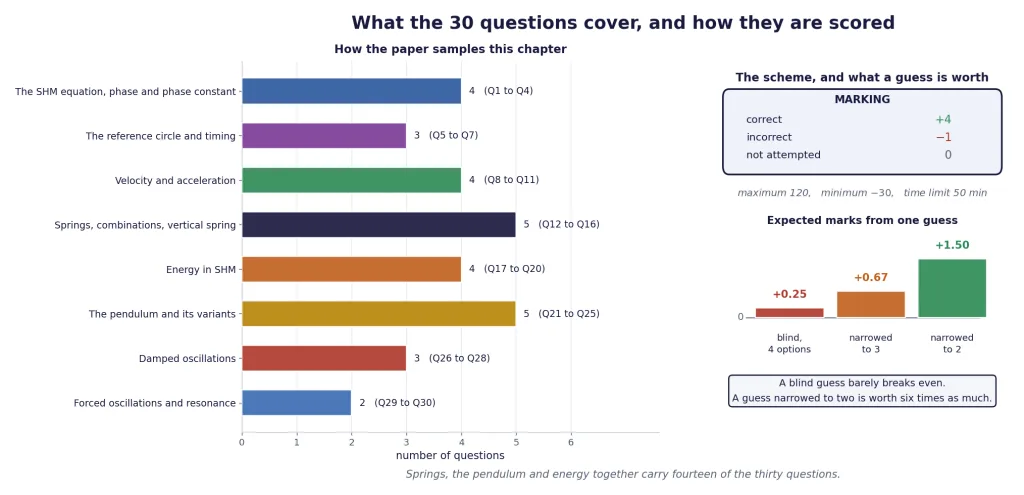
That spread mirrors how the paper actually samples this chapter. Springs, the pendulum and energy together carry 13 of the 30, because those are the blocks that carry the multi-step questions, and therefore the marks.
The difficulty mix is roughly 25% easy, 45% medium and 30% hard. A handful will feel brutal. They are meant to.
[Exam Tip] That changes the arithmetic of guessing. A blind guess among four options returns marks on average, barely worth the minute it costs. A question narrowed to two options returns marks on average, six times as much. Narrow first, then commit. Leave blank only what you could not narrow at all.
[Exam Tip] Before you start, write five lines at the top of your sheet: is it asking for or for ?, where is the mean position?, is that angle in radians?, is this the energy's period or the motion's?, does belong in this formula at all? Those five questions catch the overwhelming majority of the marks lost in this chapter.
Scoring Yourself Honestly
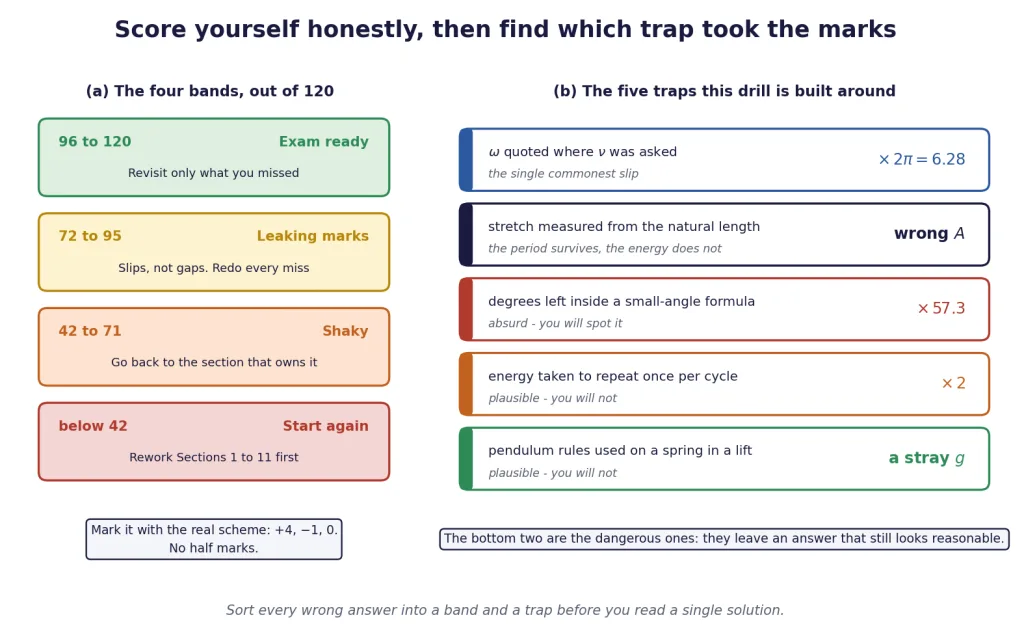
Mark your sheet with the real scheme, and and , and total it. No half marks for "I knew that one really". The number you get is the number that matters.
The bands
| Your score (out of 120) | Verdict | What to do next |
|---|---|---|
| 96 to 120 | Exam ready. 80% or more on a hard set, inside the time. | Move on. This chapter will not cost you marks. Revisit only the specific items you missed. |
| 72 to 95 | Solid, but leaking marks. | Almost always slips rather than gaps: a dropped, an amplitude measured from the wrong place, an angle left in degrees. Redo every wrong question without the explanation first. |
| 42 to 71 | Shaky. The ideas are there; the execution is not. | For each wrong answer go back to the section that owns it (use the topic table above) and rework its solved examples before re-attempting. |
| Below 42 | Start again. | Work Sections 1 to 10 properly, then Section 11's worked problems, then Section 12. Re-attempting this set now teaches you nothing but the answer key. |
Read your own answer sheet
Before you touch a single explanation, sort your mistakes into three piles. This is the most valuable ten minutes in the whole section.
- Method errors. You put into a spring period, or left it out of a pendulum period. You treated as measured from the natural length of a hanging spring. You added two springs in series as though they were in parallel. You used the small-angle result at an angle where it does not hold. These are the expensive ones, because the whole solution is wrong from line one.
- Execution errors. Right method, wrong arithmetic. The classic four here: written down where was wanted; an angle in degrees fed straight into ; centimetres left unconverted inside an energy; a square root taken of instead of .
- Reading errors. The question asked for the angular frequency, not the frequency. For the period of the energy, not the period of the motion. For the time to reach a displacement, not the time to complete a quarter cycle. For the damped angular frequency, not the natural one. For the amplitude, not the total distance between the turning points.
Key Point: In this chapter pile 2 is unusually fat, because three of the chapter's four standing traps are pure execution: the missing , the degree left in a radian formula, and the energy's doubled frequency. Two of them wreck the answer so badly you would notice; two of them leave a number that still looks perfectly reasonable. Those two are the ones that cost marks.
How badly each trap hurts
| The slip | What it does to your answer |
|---|---|
| quoted where was asked | out by a factor of |
| An angle left in degrees inside | out by a factor of |
| The energies taken to repeat once per cycle | the energy's frequency out by a factor of 2 |
| The stretch measured from the natural length | the period survives; the amplitude and every energy do not |
| A pendulum rule applied to a spring in a lift | a spurious in a period that never had one |
The last three are the dangerous ones. Nobody ships an answer that is 57 times too big; everybody ships one that is a factor of 2 out.
The eight habits this set is drilling
- Circle the words "frequency" or "angular frequency" in the question before you compute anything. Then write the unit next to your answer, Hz or rad/s. If your answer is times somebody else's, one of you has answered a different question.
- Draw the mean position before you draw anything else. For a hanging spring that is the equilibrium point, below the natural length. Every , every amplitude and every energy in the problem is measured from there.
- Convert every angle to radians on its own line. rad. The small-angle approximation is a statement about radians and about nothing else.
- Say which period you have been asked for. The motion repeats with period ; the kinetic and potential energies repeat with period , so their frequency is . Write "energy: " in the margin the moment a question mentions energy and time together.
- belongs in a pendulum period and nowhere near a spring period. contains no , so a lift, an incline or a trip to the Moon leaves it untouched. contains no mass, so the bob can be lead or cork.
- Reach for before you reach for the clock. Almost every "speed at this displacement" question is one line long, and almost every wrong answer to one comes from going back through .
- Scale rather than recompute. , , , , , . Most of the multi-step questions in this set fall in one line to a proportionality and in five lines to brute force.
- Sanity-check every period. A metre-long pendulum takes about 2 seconds. A block on a stiff laboratory spring takes a few tenths of a second. An answer of 20 seconds or of 0.002 seconds is a units error, not a discovery.
[Exam Tip] Every explanation below is a full step-by-step solution, so this set doubles as revision. Read the explanation even for the questions you got right - several of these have a two-line route and a two-page route, and it is the two-line route you will need in the hall.