
Reading the Chapter Backwards
Nothing in this section is new. Every fact here was taught earlier in the chapter, gland by gland, and this section only gathers it up and turns it round. That is the whole point. The chapter walks through the endocrine system one gland at a time - hypothalamus, pituitary, pineal, thyroid, parathyroid, thymus, adrenal, pancreas, testis, ovary, then the heart, kidney and gut - and it never once reads the list in the other direction. The exam does. It hands you a hormone and asks for the gland. It hands you a disorder and asks for the hormone. So here is the index the chapter never builds: three grids, and a short note on who commands whom.
Who controls whom - the chain of command
Most of this chapter is a flat list, but a part of it is a chain, and the chain runs hypothalamus to pituitary to peripheral gland. The hypothalamus never touches the thyroid or the adrenal itself; it acts on the anterior pituitary through a portal circulatory system, and the pituitary acts on the gland in the field.
The chapter names three chains in full:
- GnRH (hypothalamus) to LH and FSH (anterior pituitary) to the GONADS. GnRH stimulates the pituitary synthesis and release of the gonadotrophins; LH and FSH stimulate gonadal activity and are hence called gonadotrophins.
- TSH (anterior pituitary) to the THYROID. TSH stimulates the synthesis and secretion of thyroid hormones from the thyroid gland.
- ACTH (anterior pituitary) to the ADRENAL CORTEX. ACTH stimulates the synthesis and secretion of the steroid hormones called glucocorticoids from the adrenal cortex.
Two more pituitary targets are worth adding to that list even though they are not glands: MSH acts on the melanocytes and PRL acts on the mammary glands. And one route is not a chain at all - the posterior pituitary is under the DIRECT NEURAL regulation of the hypothalamus, and the two hormones released from it, oxytocin and vasopressin, are actually synthesised by the hypothalamus.
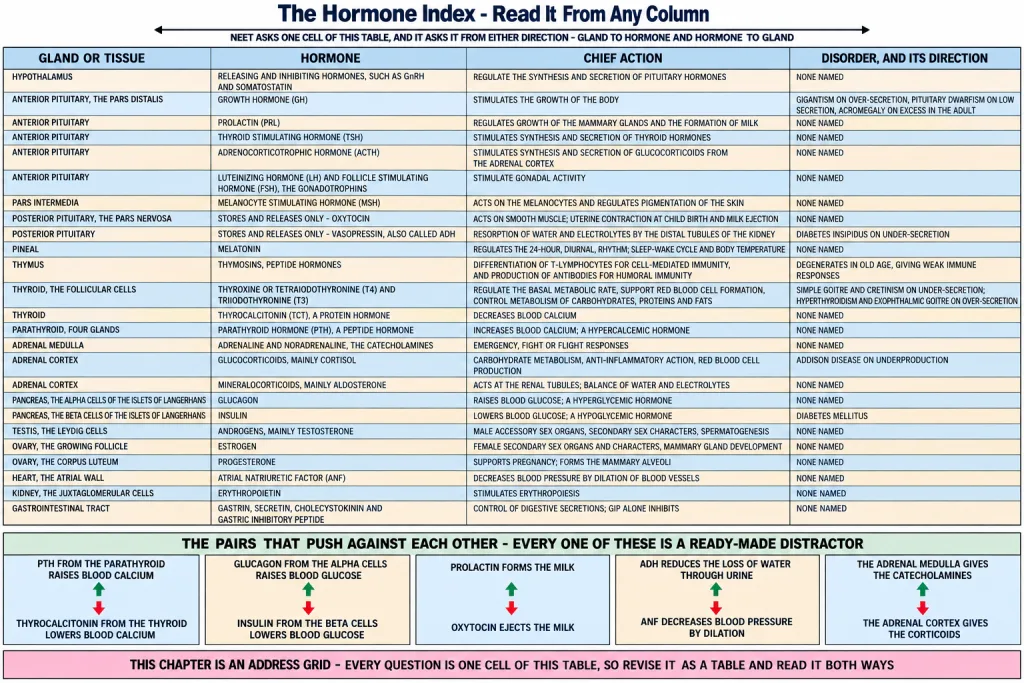
[NEET Important] The chain is asked as a fill-in-the-blank: hormone against target gland. Hypothalamic hormones target the pituitary, TSH targets the thyroid, ACTH targets the adrenal cortex, LH and FSH target the gonads, and MSH targets the melanocytes of the skin. The trap in every one of those rows is the name: a hormone is named for what it acts on, not for where it is made - so thyroid stimulating hormone comes from the pituitary, and gonadotrophin releasing hormone comes from the hypothalamus.
Grid 1 - Every Hormone, Its Gland, Its Chief Action and Its Disorder
One row per hormone, in gland order, top of the body downward. Where the chapter names no disorder for a hormone, the last column is left empty - that is information too, and inventing an entry there is how marks get lost.
| Hormone | Gland or tissue | Chief action | Disorder, and its direction |
|---|---|---|---|
| Releasing hormones, e.g. GnRH | Hypothalamus | Stimulate secretion of pituitary hormones; GnRH stimulates pituitary synthesis and release of the gonadotrophins | - |
| Inhibiting hormones, e.g. somatostatin | Hypothalamus | Inhibit secretions of pituitary hormones; somatostatin inhibits the release of growth hormone | - |
| Growth hormone (GH) | Pars distalis, anterior pituitary | Growth and development of the somatic tissues | Gigantism - OVER, in childhood; acromegaly - OVER, in adults especially middle age; pituitary dwarfism - UNDER |
| Prolactin (PRL) | Anterior pituitary | Regulates the growth of the mammary glands and the formation of milk in them | - |
| Thyroid stimulating hormone (TSH) | Anterior pituitary | Stimulates the synthesis and secretion of thyroid hormones from the thyroid gland | - |
| Adrenocorticotrophic hormone (ACTH) | Anterior pituitary | Stimulates the synthesis and secretion of glucocorticoids from the adrenal cortex | - |
| Luteinizing hormone (LH) | Anterior pituitary | Males: stimulates synthesis and secretion of androgens from the testis. Females: induces ovulation of the fully mature graafian follicles and maintains the corpus luteum | - |
| Follicle stimulating hormone (FSH) | Anterior pituitary | Males: with androgens, regulates spermatogenesis. Females: stimulates growth and development of the ovarian follicles | - |
| Melanocyte stimulating hormone (MSH) | Pars intermedia | Acts on the melanocytes and regulates pigmentation of the skin | - |
| Oxytocin | Synthesised by the hypothalamus; stored and released by the posterior pituitary | Acts on the smooth muscles and stimulates their contraction - vigorous contraction of the uterus at childbirth and milk ejection from the mammary gland | - |
| Vasopressin (ADH) | Synthesised by the hypothalamus; stored and released by the posterior pituitary | Acts at the kidney and stimulates resorption of water and electrolytes by the DISTAL TUBULES, reducing loss of water through urine | Diabetes insipidus - UNDER, from impaired synthesis or release of ADH |
| Melatonin | Pineal | Regulates the 24-hour (diurnal) rhythm - sleep-wake cycle and body temperature; also influences metabolism, pigmentation, the menstrual cycle and our defense capability | - |
| Thyroxine () and triiodothyronine () | Thyroid, follicular cells | Regulate the basal metabolic rate; support the process of red blood cell formation; control the metabolism of carbohydrates, proteins and fats; maintain water and electrolyte balance | Goitre - UNDER, from iodine deficiency; cretinism - UNDER, hypothyroidism during pregnancy; hyperthyroidism and exophthalmic goitre (Graves' disease) - OVER |
| Thyrocalcitonin (TCT) | Thyroid | A protein hormone which regulates the blood calcium level by DECREASING it | - |
| Parathyroid hormone (PTH) | Parathyroid, four glands | HYPERCALCEMIC - increases the level of the blood by bone resorption, reabsorption of by the renal tubules and absorption from digested food | - |
| Thymosins | Thymus | Differentiation of T-lymphocytes, giving cell-mediated immunity; also promote the production of antibodies for humoral immunity | Thymus is degenerated in old individuals - thymosin production falls and immune responses become weak |
| Adrenaline (epinephrine) | Adrenal medulla | Emergency hormone of Fight or Flight - alertness, pupilary dilation, piloerection, sweating, increased heart beat, strength of heart contraction and rate of respiration, breakdown of glycogen giving increased blood glucose, breakdown of lipids and proteins | - |
| Noradrenaline (norepinephrine) | Adrenal medulla | The same catecholamine actions, secreted with adrenaline in response to stress and emergency | - |
| Glucocorticoids, chiefly cortisol | Adrenal cortex | Gluconeogenesis, lipolysis and proteolysis; inhibit cellular uptake and utilisation of amino acids; cortisol maintains the cardio-vascular system and kidney functions, produces anti-inflammatory reactions, suppresses the immune response and stimulates RBC production | Addison's disease - UNDER-production by the adrenal cortex, giving acute weakness and fatigue |
| Mineralocorticoids, chiefly aldosterone | Adrenal cortex | Act at the renal tubules: reabsorption of and water, excretion of and phosphate ions; maintain electrolytes, body fluid volume, osmotic pressure and blood pressure | - |
| Androgenic steroids, small amounts | Adrenal cortex | Growth of axial hair, pubic hair and facial hair during puberty | - |
| Glucagon | -cells of the Islets of Langerhans, pancreas | HYPERGLYCEMIC - acts on hepatocytes, stimulates glycogenolysis and gluconeogenesis, reduces cellular glucose uptake and utilisation | - |
| Insulin | -cells of the Islets of Langerhans, pancreas | HYPOGLYCEMIC - acts on hepatocytes and adipocytes, enhances cellular glucose uptake and utilisation, stimulates glycogenesis | Diabetes mellitus - from prolonged hyperglycemia, with loss of glucose through urine and formation of ketone bodies |
| Androgens, mainly testosterone | Leydig (interstitial) cells of the testis | Development, maturation and functions of the male accessory sex organs; muscular growth, facial and axillary hair, aggressiveness, low pitch of voice; major stimulatory role in spermatogenesis; male sexual behaviour (libido); anabolic effects on protein and carbohydrate metabolism | - |
| Estrogen | Growing ovarian follicles, ovary | Growth and activities of the female secondary sex organs; development of the growing ovarian follicles; female secondary sex characters such as high pitch of voice; mammary gland development; regulation of female sexual behaviour | - |
| Progesterone | Corpus luteum, ovary | Supports pregnancy; acts on the mammary glands, stimulating the formation of alveoli and milk secretion | - |
| Atrial natriuretic factor (ANF) | Atrial wall of the heart | Decreases blood pressure by causing dilation of the blood vessels | - |
| Erythropoietin | Juxtaglomerular cells of the kidney | Stimulates erythropoiesis - the formation of RBC | - |
| Gastrin | Endocrine cells of the gastro-intestinal tract | Acts on the gastric glands; stimulates the secretion of hydrochloric acid and pepsinogen | - |
| Secretin | Endocrine cells of the gastro-intestinal tract | Acts on the exocrine pancreas; stimulates secretion of water and bicarbonate ions | - |
| Cholecystokinin (CCK) | Endocrine cells of the gastro-intestinal tract | Acts on both the pancreas and the gall bladder; stimulates the secretion of pancreatic enzymes and bile juice respectively | - |
| Gastric inhibitory peptide (GIP) | Endocrine cells of the gastro-intestinal tract | INHIBITS gastric secretion and motility | - |
[NEET Important] Two whole classes of question live in that grid. "Which gland secretes X" is the second column, and the distractors will be other real glands of this chapter. "What does X do" is the third. Watch the rows where the source is not where you would guess: oxytocin and vasopressin are SYNTHESISED BY THE HYPOTHALAMUS and only stored and released by the posterior pituitary, and thyrocalcitonin comes from the THYROID, not the parathyroid, even though it is a calcium hormone.
Grid 2 - The Disorder Index, Read Backwards
Ten disorders are named in this chapter. Here they are the other way round - disorder first, because that is how a question hands them to you.
| Disorder | Hormone at fault | Gland | Direction of the fault |
|---|---|---|---|
| Gigantism | Growth hormone (GH) | Pituitary - pars distalis | OVER-secretion, during the growing years |
| Pituitary dwarfism | Growth hormone (GH) | Pituitary - pars distalis | LOW secretion, during the growing years |
| Acromegaly | Growth hormone (GH) | Pituitary - pars distalis | EXCESS secretion in adults, especially in middle age |
| Diabetes insipidus | Vasopressin (ADH) | Posterior pituitary, the hormone being made by the hypothalamus | Impaired synthesis or release - UNDER |
| Goitre (simple) | Thyroid hormones, and | Thyroid | UNDER - hypothyroidism from iodine deficiency in the diet |
| Cretinism | Thyroid hormones | Thyroid | UNDER - hypothyroidism during pregnancy, affecting the growing baby |
| Hyperthyroidism | Thyroid hormones | Thyroid | OVER - from cancer of the thyroid or development of nodules |
| Exophthalmic goitre (Graves' disease) | Thyroid hormones | Thyroid | OVER - a form of hyperthyroidism |
| Addison's disease | The hormones of the adrenal cortex | Adrenal cortex | UNDER-production, altering carbohydrate metabolism |
| Diabetes mellitus | Insulin | -cells of the Islets of Langerhans, pancreas | UNDER - prolonged hyperglycemia |
Three pairs are confused more than anything else in this chapter. Separate them now.
Diabetes insipidus against diabetes mellitus. They share a word and nothing else. Diabetes insipidus is an ADH fault, so the kidney cannot conserve water - the loss is water, and the result is dehydration. Diabetes mellitus is an INSULIN fault, so blood glucose stays high - the loss is glucose through the urine, along with the formation of ketone bodies. Different hormone, different gland, different substance lost.
Simple goitre against exophthalmic goitre. Both enlarge the thyroid, and the directions are opposite. Simple goitre is UNDER-secretion - hypothyroidism caused by iodine deficiency in the diet. Exophthalmic goitre is OVER-secretion - a form of hyperthyroidism, with protrusion of the eyeballs, increased basal metabolic rate and weight loss on top of the enlargement. The protruding eyeballs are what tell them apart in a question.
Gigantism against acromegaly. Same hormone, same direction, different age. Both are excess GH. Gigantism happens while the person is still growing, so the whole body overshoots and the person is abnormally tall. Acromegaly is excess GH in adults, especially in middle age, when the long bones can no longer lengthen - so instead there is severe disfigurement, especially of the face. It is hard to diagnose in the early stages and may lead to serious complications and premature death if unchecked.
[NEET Important] Every disorder item in this chapter is really asking for a triple: the hormone, the gland, and the direction. Get all three and no distractor can reach you. The single most common error is answering diabetes insipidus for a question about diabetes mellitus or the other way round - read which word follows "diabetes" before anything else.
Grid 3 - The Pairs That Push Against Each Other
The chapter demonstrates this idea six times and never names it. Hormones very often work in pairs, and a pair is either antagonistic - the two pull the same variable in opposite directions - or cooperating - the two do different steps of one job. Once you see the pairs, half the chapter organises itself.
| Pair | What they act on | How they oppose or cooperate |
|---|---|---|
| Insulin against glucagon | Blood glucose | Insulin is HYPOGLYCEMIC - it enhances cellular glucose uptake and utilisation and stimulates glycogenesis, so blood glucose falls. Glucagon is HYPERGLYCEMIC - it stimulates glycogenolysis and gluconeogenesis, so blood glucose rises. Glucose homeostasis is maintained JOINTLY by insulin and glucagon, and they come from two different cell types of the same gland - -cells and -cells |
| PTH against thyrocalcitonin (TCT) | Blood calcium | PTH is HYPERCALCEMIC - it increases the level of the blood. TCT regulates the blood calcium level by DECREASING it. Along with TCT, PTH plays a significant role in calcium balance - and note that they come from two different glands, the parathyroid and the thyroid |
| Releasing against inhibiting hormones | The pituitary | Releasing hormones stimulate the secretion of pituitary hormones; inhibiting hormones inhibit the secretions of pituitary hormones. Both come from the hypothalamus. GnRH releases the gonadotrophins; somatostatin inhibits growth hormone |
| Aldosterone against ANF | Blood pressure and body fluid | Aldosterone acts at the renal tubules, causing reabsorption of and water, which helps maintain body fluid volume, osmotic pressure and blood pressure. ANF DECREASES blood pressure by dilation of the blood vessels. One holds fluid in, the other lets pressure down |
| Adrenaline with the sympathetic neural system | The emergency response | Not an opposition but a doubling up - the same response by two routes. Adrenaline and noradrenaline are rapidly secreted in response to stress of any kind and during emergency situations, and their effects - increased alertness, pupilary dilation, piloerection, sweating, increased heart beat and rate of respiration - are exactly what the sympathetic nerves produce. One route is fast but short-lived, the other is slower but sustained |
| Prolactin with oxytocin | Milk | Cooperating, not opposing. PRL regulates the growth of the mammary glands and the formation of milk in them - it MAKES the milk. Oxytocin stimulates milk ejection from the mammary gland - it MOVES the milk. Add estrogen, which gives mammary gland development, and progesterone, which forms the alveoli and stimulates milk secretion, and all four steps are covered |
[NEET Important] Insulin against glucagon and PTH against thyrocalcitonin are the two antagonistic pairs asked most often, and both have a trap in the source. For the first, both hormones come from the same gland but different cells - so "which two hormones from different glands regulate blood glucose" is false. For the second, the two hormones come from different glands - PTH from the parathyroid, TCT from the thyroid - so an option putting both in the parathyroid is wrong. And prolactin with oxytocin cooperate; an item calling them antagonistic is wrong.
Quick Recap
- The chain of command is hypothalamus to pituitary to peripheral gland: GnRH to LH and FSH to the gonads, TSH to the thyroid, ACTH to the adrenal cortex.
- The posterior pituitary is under the direct NEURAL regulation of the hypothalamus, and oxytocin and vasopressin are actually synthesised by the hypothalamus.
- Hypothalamus: releasing hormones such as GnRH, and inhibiting hormones such as somatostatin.
- Anterior pituitary (pars distalis): GH, PRL, TSH, ACTH, LH, FSH. Pars intermedia: MSH. Posterior pituitary stores and releases oxytocin and vasopressin.
- Pineal: melatonin. Thyroid: , and thyrocalcitonin. Parathyroid: PTH. Thymus: thymosins.
- Adrenal medulla: adrenaline (epinephrine) and noradrenaline (norepinephrine). Adrenal cortex: glucocorticoids (cortisol), mineralocorticoids (aldosterone) and small amounts of androgenic steroids.
- Pancreas: glucagon from the -cells and insulin from the -cells.
- Testis: androgens, mainly testosterone, from the Leydig cells. Ovary: estrogen from the growing follicles and progesterone from the corpus luteum.
- Heart: ANF. Kidney: erythropoietin. Gastro-intestinal tract: gastrin, secretin, CCK and GIP.
- GH disorders: gigantism (over, in childhood), acromegaly (excess in adults) and pituitary dwarfism (under).
- ADH under: diabetes insipidus. Insulin under: diabetes mellitus.
- Thyroid under: goitre and cretinism. Thyroid over: hyperthyroidism and exophthalmic goitre (Graves' disease). Adrenal cortex under: Addison's disease.
- Antagonistic pairs: insulin against glucagon on blood glucose; PTH against thyrocalcitonin on blood calcium; releasing against inhibiting hormones on the pituitary; aldosterone against ANF on blood pressure and body fluid.
- Adrenaline reproduces the sympathetic response by a chemical route, and prolactin and oxytocin cooperate on milk - one makes it, the other ejects it.
Solved Examples
Question 1
Q. Give example(s) of androgens and estrogens. This is one of the chapter-end exercises.
Answer. This part spans both gonads and the adrenal, so all three sources are needed.
Androgens. The chief example is TESTOSTERONE, produced by the Leydig cells, also called the interstitial cells, which lie in the intertubular spaces of the testis. The chapter says these cells produce a group of hormones called androgens, mainly testosterone. Testosterone regulates the development, maturation and functions of the male accessory sex organs, plays a major stimulatory role in spermatogenesis, brings out the male secondary sex characters such as facial and axillary hair and a low pitch of voice, and influences male sexual behaviour.
Estrogens. The chief example is ESTROGEN itself, synthesised and secreted mainly by the GROWING OVARIAN FOLLICLES of the ovary. Estradiol is the estrogen named in the list of steroid hormones. Estrogens stimulate the growth and activities of the female secondary sex organs, drive development of the growing ovarian follicles, produce the female secondary sex characters such as a high pitch of voice, cause mammary gland development and regulate female sexual behaviour.
And one source that is neither gonad. Small amounts of androgenic steroids are also secreted by the adrenal cortex. They play a role in the growth of axial hair, pubic hair and facial hair during puberty. So androgens are not exclusively testicular, and that is exactly the point a question on this part is testing.
Question 2
Q. Which hormones does the hypothalamus use to control the anterior pituitary, and which pituitary hormones control which peripheral glands?
Answer. The hypothalamus uses releasing hormones, which stimulate secretion of pituitary hormones, and inhibiting hormones, which inhibit secretions of pituitary hormones. They reach the anterior pituitary through a portal circulatory system.
| Pituitary hormone | Target |
|---|---|
| TSH | The thyroid gland |
| ACTH | The adrenal cortex |
| LH and FSH (the gonadotrophins) | The gonads - testis and ovary |
| MSH | The melanocytes of the skin |
| PRL | The mammary glands |
Question 3
Q. Name the disorders caused by growth hormone and give the direction of each.
Answer. All three are growth hormone faults of the pituitary.
- Gigantism - OVER-secretion of GH during the growing years, giving abnormal growth of the body.
- Pituitary dwarfism - LOW secretion of GH during the growing years, giving stunted growth.
- Acromegaly - EXCESS GH in adults, especially in middle age, giving severe disfigurement especially of the face. It is hard to diagnose in the early stages and may lead to serious complications and premature death if unchecked.
Gigantism and acromegaly are the same excess at two different ages.
Question 4
Q. Distinguish between diabetes insipidus and diabetes mellitus.
Answer.
| Feature | Diabetes insipidus | Diabetes mellitus |
|---|---|---|
| Hormone at fault | Vasopressin (ADH) | Insulin |
| Where it comes from | Synthesised by the hypothalamus, released by the posterior pituitary | -cells of the Islets of Langerhans, pancreas |
| Direction | Impaired synthesis or release - UNDER | UNDER, following prolonged hyperglycemia |
| What goes wrong | The kidney has a diminished ability to conserve water, giving water loss and dehydration | Loss of glucose through urine and formation of harmful compounds known as ketone bodies |
| Treatment named | Not named in the chapter | Insulin therapy |
The word they share is the only thing they share.
Question 5
Q. Which two hormones regulate blood calcium, where does each come from, and in which direction does each act?
Answer. Parathyroid hormone (PTH) comes from the parathyroid glands and is a HYPERCALCEMIC hormone - it increases the levels in the blood by stimulating bone resorption, stimulating reabsorption of by the renal tubules and increasing absorption from the digested food. Thyrocalcitonin (TCT) comes from the THYROID gland and regulates the blood calcium levels by DECREASING it. Along with TCT, PTH plays a significant role in calcium balance. The trap is the source: the calcium-lowering hormone is thyroid, not parathyroid.
Question 6
Q. Which two hormones jointly maintain glucose homeostasis, and from which cells does each come?
Answer. Insulin and glucagon, and glucose homeostasis is maintained JOINTLY by them. Glucagon comes from the -cells of the Islets of Langerhans and is a HYPERGLYCEMIC hormone - it stimulates glycogenolysis and gluconeogenesis and reduces cellular glucose uptake and utilisation. Insulin comes from the -cells and is HYPOGLYCEMIC - it enhances cellular glucose uptake and utilisation in hepatocytes and adipocytes and stimulates glycogenesis. Both come from the same gland, from different cells.
Question 7
Q. Simple goitre and exophthalmic goitre both enlarge the thyroid. How do you tell them apart?
Answer. By the direction of the fault and by one visible sign. Simple goitre is UNDER-secretion - deficiency of iodine in our diet causes hypothyroidism and enlargement of the thyroid gland. Exophthalmic goitre is OVER-secretion - it is a form of hyperthyroidism, also called Graves' disease, and besides the enlargement of the thyroid gland it shows protrusion of the eyeballs, increased basal metabolic rate and weight loss. The protruding eyeballs mark the over-secreting one.
Question 8
Q. Which two hormones released by the posterior pituitary are not made there, and where are they made?
Answer. Oxytocin and vasopressin. The neurohypophysis, or posterior pituitary, STORES AND RELEASES them, but they are actually synthesised by the HYPOTHALAMUS and transported axonally to the neurohypophysis. This is why the posterior pituitary is under the direct NEURAL regulation of the hypothalamus rather than under hormonal control through a portal system.
Question 9
Q. Name the four hormones of the gastro-intestinal tract and the hormones of the heart and the kidney.
Answer. From the gastro-intestinal tract: gastrin, which stimulates secretion of hydrochloric acid and pepsinogen from the gastric glands; secretin, which stimulates secretion of water and bicarbonate ions from the exocrine pancreas; cholecystokinin (CCK), which acts on both the pancreas and the gall bladder to stimulate pancreatic enzymes and bile juice respectively; and gastric inhibitory peptide (GIP), which inhibits gastric secretion and motility. From the heart: atrial natriuretic factor (ANF) from the atrial wall, which decreases blood pressure. From the kidney: erythropoietin from the juxtaglomerular cells, which stimulates erythropoiesis.
Question 10
Q. Name four pairs of hormones that act against each other, and say what each pair controls.
Answer.
| Pair | Variable | Directions |
|---|---|---|
| Insulin and glucagon | Blood glucose | Insulin lowers it (hypoglycemic), glucagon raises it (hyperglycemic) |
| PTH and thyrocalcitonin | Blood calcium | PTH raises it (hypercalcemic), TCT decreases it |
| Releasing and inhibiting hormones | Pituitary secretion | Releasing hormones stimulate, inhibiting hormones inhibit |
| Aldosterone and ANF | Blood pressure and body fluid | Aldosterone reabsorbs and water and helps maintain blood pressure; ANF decreases blood pressure by dilation of the blood vessels |
Question 11
Q. Which hormone would you name for each of the following: a hypoglycemic hormone, a hyperglycemic hormone, a hypercalcemic hormone, the gonadotrophins, a progestational hormone, and a blood pressure lowering hormone?
Answer.
| Category | Hormone | Why it fits |
|---|---|---|
| Hypoglycemic hormone | Insulin | It enhances cellular glucose uptake and utilisation, giving decreased blood glucose |
| Hyperglycemic hormone | Glucagon | It stimulates glycogenolysis, giving increased blood sugar |
| Hypercalcemic hormone | Parathyroid hormone (PTH) | It increases the levels in the blood |
| Gonadotrophic hormones | LH and FSH | They stimulate gonadal activity and are hence called gonadotrophins |
| Progestational hormone | Progesterone | It supports pregnancy |
| Blood pressure lowering hormone | Atrial natriuretic factor (ANF) | It decreases blood pressure by dilation of the blood vessels |
Question 12
Q. Match each disorder with the gland at fault and the direction of the fault: acromegaly, diabetes insipidus, cretinism, exophthalmic goitre, Addison's disease, diabetes mellitus.
Answer.
| Disorder | Gland at fault | Direction of the fault |
|---|---|---|
| Acromegaly | Pituitary, pars distalis | Over-secretion of growth hormone, in an adult |
| Diabetes insipidus | Posterior pituitary, storing a hormone made in the hypothalamus | Under-secretion or impaired release of ADH |
| Cretinism | Thyroid | Under-secretion, occurring during pregnancy |
| Exophthalmic goitre | Thyroid | Over-secretion |
| Addison's disease | Adrenal cortex | Under-production of corticoids |
| Diabetes mellitus | Pancreas, the -cells of the Islets of Langerhans | Under-secretion of insulin, giving prolonged hyperglycemia |
The column that decides the mark is the last one. Four of these six are under-secretions, and the two over-secretions - acromegaly and exophthalmic goitre - are the ones most often mis-assigned.
Question 13
Q. Which hormones of this chapter have no disorder attached to them, and why does that matter?
Answer. Most of them. The chapter names a disorder only for growth hormone (gigantism, acromegaly, pituitary dwarfism), for vasopressin (diabetes insipidus), for the thyroid hormones (goitre, cretinism, hyperthyroidism, exophthalmic goitre), for the adrenal cortex hormones (Addison's disease) and for insulin (diabetes mellitus). It matters because a question that asks for the disorder of a hormone with none - oxytocin, MSH, melatonin, gastrin - is testing whether you will invent one. The correct response is that the chapter names none.
Question 14
Q. Two hormones both act on the mammary gland but do opposite halves of one job. Name them and say what each does.
Answer. Prolactin (PRL) and oxytocin, and they cooperate rather than oppose. PRL, from the anterior pituitary, regulates the growth of the mammary glands and the formation of milk in them - it makes the milk. Oxytocin, released from the posterior pituitary, stimulates milk ejection from the mammary gland - it moves the milk out. Two more hormones prepare the gland before either acts: estrogen gives mammary gland development, and progesterone stimulates the formation of alveoli and milk secretion.