
Four Small Glands on the Back of the Thyroid
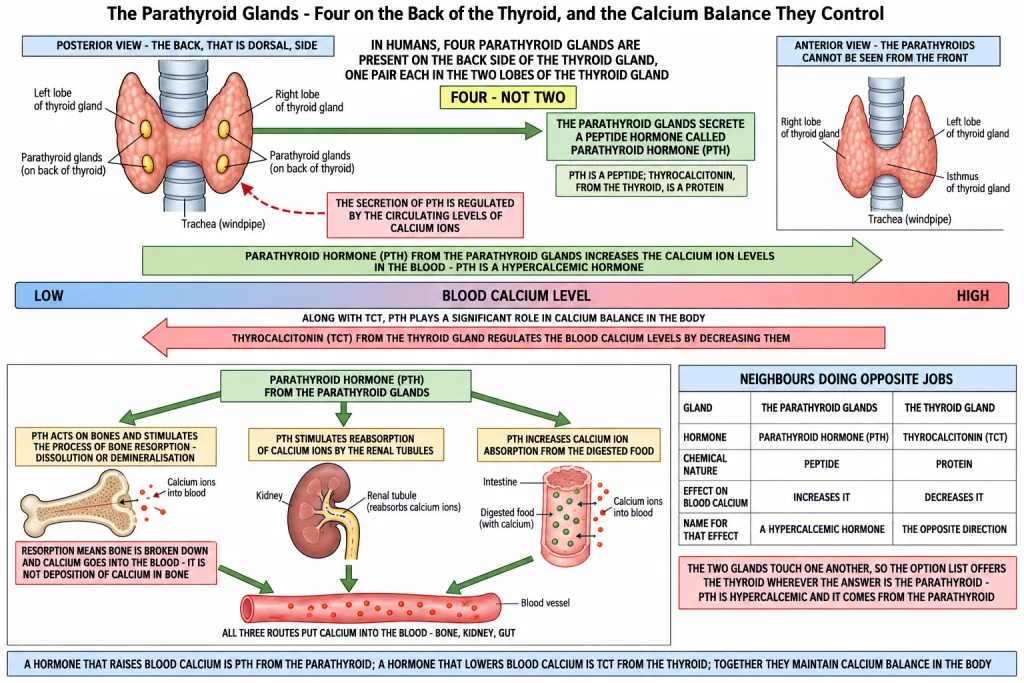
In humans, FOUR parathyroid glands are present on the BACK side of the thyroid gland, one pair each in the two lobes of the thyroid gland. Every part of that sentence is examinable: the number is four, the side is the back (dorsal) side, and they are arranged as one pair per thyroid lobe. This is why the textbook figure of the thyroid needs two views - a ventral view to show the thyroid lobes and the isthmus, and a dorsal view to show the four parathyroids behind them.
The parathyroid glands secrete a PEPTIDE hormone called parathyroid hormone (PTH). Compare that with the thyroid sitting directly in front of them, whose calcium hormone TCT is a PROTEIN, and whose and are iodothyronines. Three glands' worth of chemistry in one small region of the neck.
The secretion of PTH is regulated by the circulating levels of CALCIUM IONS. So this hormone is not driven by a pituitary trophic hormone at all - there is no "parathyroid stimulating hormone". The gland senses the in the blood flowing past it and secretes accordingly. When calcium falls, PTH rises.
[NEET Important] "Four", "back side of the thyroid", "one pair in each lobe" and "peptide hormone" are all quoted directly. The commonest distractor puts the parathyroids on the front of the thyroid, or makes them two in number. A second item asks what controls PTH secretion, and the answer is the circulating levels of calcium ions, not a pituitary hormone.
What PTH Does - One Job, Three Routes
Parathyroid hormone (PTH) increases the levels in the blood. That is the one job, and it reaches it by three separate routes, which the chapter lists and which are asked as a set:
- PTH acts on BONES and stimulates the process of BONE RESORPTION - dissolution or demineralisation. Bone is the body's calcium store, and PTH withdraws from it, dissolving the mineral out of bone and into the blood.
- PTH stimulates REABSORPTION of by the RENAL TUBULES. Calcium that would otherwise have been lost in the urine is pulled back into the blood.
- PTH increases ABSORPTION from the digested food. More of the calcium eaten is taken up from the gut.
Three routes, and every one of them moves calcium into the blood - out of bone, back from the kidney filtrate, and in from the food. Learn them as bone, kidney, gut, which is also the order the chapter gives.
It is thus clear that PTH is a HYPERCALCEMIC hormone, that is, it increases the blood levels. Note the shape of the word: hyper-calc-emic means "high calcium in the blood", and the chapter builds two more names on the same pattern later - hyperglycemic for glucagon and hypoglycemic for insulin.
[NEET Important] The three routes are asked as a "which of the following is NOT an action of PTH" item, and the false option is usually "stimulates deposition of calcium in bone" - PTH does the opposite, it stimulates bone resorption. Also fix the word resorption: it means dissolution or demineralisation, that is, taking bone apart, not building it.
PTH Against TCT - Neighbours Doing Opposite Jobs
Along with TCT, PTH plays a significant role in CALCIUM BALANCE in the body. The two hormones are the chapter's cleanest opposing pair, and the reason they are so often confused is anatomical: the parathyroid glands are embedded on the back of the thyroid gland, so the two sources are physically stacked on each other while doing exactly opposite things.
| Parathyroid hormone (PTH) | Thyrocalcitonin (TCT) | |
|---|---|---|
| Which gland secretes it | The PARATHYROID glands - four of them, on the back of the thyroid | The THYROID gland |
| Chemical nature | A peptide hormone | A protein hormone |
| Effect on blood calcium | INCREASES the level | DECREASES the blood calcium level |
| The label | A HYPERCALCEMIC hormone | The calcium-lowering hormone of the thyroid |
| How it works | Bone resorption, reabsorption of by the renal tubules, and increased absorption from digested food | Regulates the blood calcium levels by lowering them |
| What controls its secretion | The circulating levels of calcium ions | The blood calcium level |
Between them the two hormones hold the blood calcium steady - one pushes it up, the other pulls it down, and calcium balance in the body is the result of the pair working against each other. Neither of them is under pituitary control.
Reading it backwards, which is how it gets asked: a hormone that raises blood calcium is PTH, from the parathyroid. A hormone that lowers blood calcium is TCT, from the thyroid. A gland sitting on the back of the thyroid is the parathyroid. A hormone whose secretion is regulated by the circulating levels of calcium ions is PTH.
[NEET Important] The single most reliable trap in this part of the chapter is to offer "thyroid" as the source of PTH, because of where the parathyroids sit, or to swap the two directions. Anchor it with the name: PTH is HYPERCALCEMIC, and it comes from the PARATHYROID.
Quick Recap
- In humans, four parathyroid glands are present on the back side of the thyroid gland, one pair each in the two lobes of the thyroid gland.
- The parathyroid glands secrete a peptide hormone called parathyroid hormone (PTH).
- The secretion of PTH is regulated by the circulating levels of calcium ions.
- PTH increases the levels in the blood, by three routes:
- it acts on bones and stimulates the process of bone resorption - dissolution or demineralisation;
- it stimulates reabsorption of by the renal tubules;
- it increases absorption from the digested food.
- PTH is thus a HYPERCALCEMIC hormone, that is, it increases the blood levels.
- Along with TCT, PTH plays a significant role in calcium balance in the body.
- PTH raises blood calcium and comes from the parathyroid; TCT lowers blood calcium and comes from the thyroid. The two glands sit on top of each other and do opposite jobs.
Solved Examples
Question 1
Q. List the hormones secreted by the parathyroid. This is one of the chapter-end exercises.
Answer. The parathyroid glands secrete one hormone:
- Parathyroid hormone (PTH) - a peptide hormone which increases the levels in the blood, and is therefore called a hypercalcemic hormone. Its secretion is regulated by the circulating levels of calcium ions, and along with TCT it plays a significant role in calcium balance in the body.
Question 2
Q. Write short notes on the functions of parathyroid hormone (PTH). This is one of the chapter-end exercises.
Answer. PTH is a peptide hormone secreted by the four parathyroid glands, which sit on the back side of the thyroid gland, and its secretion is regulated by the circulating levels of calcium ions - when blood calcium falls, PTH is released. Its function is a single one stated three ways: PTH increases the levels in the blood. First, it acts on bones and stimulates the process of bone resorption - dissolution or demineralisation - so calcium stored in the skeleton is released into the blood. Second, it stimulates reabsorption of by the renal tubules, so calcium that would have gone out in the urine is saved. Third, it increases absorption from the digested food, so more of what is eaten is taken in. Because all three routes push calcium into the blood, PTH is a hypercalcemic hormone, and along with TCT it plays a significant role in calcium balance in the body - PTH raising the level and TCT lowering it.
Question 3
Q. Give example(s) of a hypercalcemic hormone. This is one of the chapter-end exercises.
Answer. Parathyroid hormone (PTH), from the parathyroid glands - it fits the category because it increases the levels in the blood, which is exactly what hypercalcemic means.
Question 4
Q. How many parathyroid glands are there in humans, and where exactly are they placed?
Answer. Four. They are present on the BACK side of the thyroid gland, one pair each in the two lobes of the thyroid gland. Because they lie behind the thyroid, they are shown on the dorsal view of the gland, not the ventral one.
Question 5
Q. What regulates the secretion of PTH?
Answer. The circulating levels of calcium ions. The gland responds directly to the in the blood passing through it - there is no pituitary trophic hormone for the parathyroid. When the calcium level falls, PTH secretion rises.
Question 6
Q. What is bone resorption, and what does PTH have to do with it?
Answer. Bone resorption is the dissolution or demineralisation of bone - the mineral is taken out of the bone and released into the blood. PTH acts on bones and stimulates the process of bone resorption, and this is the first of the three ways it raises the blood level. Bone is being used as a calcium store, and PTH makes a withdrawal from it.
Question 7
Q. Name the three ways in which PTH raises the blood calcium level.
Answer. Remember them as bone, kidney, gut:
- It acts on bones and stimulates the process of bone resorption - dissolution or demineralisation.
- It stimulates reabsorption of by the renal tubules.
- It increases absorption from the digested food.
Question 8
Q. Why is PTH described as a hypercalcemic hormone?
Answer. Because it increases the blood levels. The word breaks into hyper (high), calc (calcium) and emic (in the blood), so a hypercalcemic hormone is one that raises blood calcium. The chapter uses the same word pattern again for the pancreas - glucagon is hyperglycemic and insulin is hypoglycemic.
Question 9
Q. Compare PTH with thyrocalcitonin.
Answer.
| Feature | PTH | TCT |
|---|---|---|
| Source gland | The parathyroid glands | The thyroid gland |
| Chemical nature | A peptide hormone | A protein hormone |
| Effect on blood calcium | Increases it | Decreases it |
| Category | Hypercalcemic | Calcium-lowering |
The one line that gets the mark: the two hormones together maintain calcium balance in the body, working in opposite directions from two glands that are physically stacked on each other.
Question 10
Q. A question offers "the thyroid gland" as the source of parathyroid hormone. Why is that wrong, and why is it tempting?
Answer. It is wrong because PTH is secreted by the parathyroid glands, not the thyroid. It is tempting because the four parathyroid glands are embedded on the back side of the thyroid gland, so the two are found together in the same place in the neck. The safe anchor is the direction of the effect: the thyroid's calcium hormone is TCT and it LOWERS calcium; the parathyroid's hormone is PTH and it RAISES calcium.
Question 11
Q. If all four parathyroid glands were removed, what would happen to the blood calcium level, and why?
Answer. It would fall. With no PTH, the three routes that push calcium into the blood are lost: bone resorption is no longer stimulated, reabsorption of by the renal tubules drops so more calcium is lost in the urine, and absorption from the digested food decreases. Meanwhile TCT from the thyroid continues to lower blood calcium, with nothing opposing it.
Question 12
Q. Which hormone is a peptide - PTH or TCT - and what is the other one?
Answer. PTH is the PEPTIDE hormone, secreted by the parathyroid. TCT is a PROTEIN hormone, secreted by the thyroid. Both act on calcium, and both are named in the chapter with their chemical nature attached, so the pair is easy to ask about.
Question 13
Q. Fill in the blanks: in humans, _ parathyroid glands lie on the side of the thyroid, one pair in each lobe; they secrete the hormone , which _ the blood calcium level.
Answer. In humans, four parathyroid glands lie on the back side of the thyroid, one pair in each lobe; they secrete the peptide hormone parathyroid hormone (PTH), which increases the blood calcium level.