
The Pineal Gland - and Why It Shares a Section with the Thymus
The pineal gland and the thymus are not related to each other. They sit in different parts of the body, they belong to different systems, and the chapter deals with them under two separate headings some pages apart. They share this section for one reason only: each of them has a single hormone and a short list of jobs, so neither fills a section on its own. Learn them as two separate entries, not as a pair. This block takes the pineal; the next takes the thymus.
The pineal gland is located on the DORSAL side of the forebrain. That is its whole anatomy in this chapter - a small gland sitting on the back of the forebrain. Compare it with the pituitary, which hangs from the base of the brain in the sella tursica: pineal on top and behind, pituitary below and in front.
The pineal secretes a hormone called MELATONIN. One gland, one hormone.
Melatonin plays a very important role in the regulation of a 24-HOUR (DIURNAL) RHYTHM of our body. That is its headline job, and the chapter gives two examples of what that rhythm covers:
- It helps in maintaining the normal rhythms of the SLEEP-WAKE CYCLE.
- It helps in maintaining the normal rhythm of BODY TEMPERATURE.
In addition, melatonin also influences metabolism, pigmentation, the menstrual cycle and our defense capability. Those four are a separate list and are worth memorising as a set, because an item asking which of the following melatonin does NOT influence has to be answered from it.
This is the hormone the previous chapter was missing. When the neural chapter listed what the brain controls, it named the regulation of circadian, that is 24-hour, rhythms among them but named no chemical. Melatonin is that chemical, and the pineal gland is where it comes from.
| Pineal gland | |
|---|---|
| Where it is | On the dorsal side of the forebrain |
| Hormone | Melatonin |
| Main job | Regulates the 24-hour (diurnal) rhythm of the body |
| Examples of that rhythm | The sleep-wake cycle and body temperature |
| Also influences | Metabolism, pigmentation, the menstrual cycle and defense capability |
[NEET Important] Dorsal side of the forebrain is the position asked, and the distractor puts the pineal at the base of the brain, which is where the pituitary is. The function item quotes "24-hour (diurnal) rhythm" and expects sleep-wake cycle and body temperature as the examples; pigmentation appears in the second list and is a genuine melatonin effect, so do not reject it just because MSH also regulates pigmentation.
The Thymus, the Thymosins and Two Kinds of Immunity
The thymus gland is a LOBULAR structure located BETWEEN THE LUNGS, BEHIND THE STERNUM, on the VENTRAL SIDE OF THE AORTA. All four parts of that description get quoted, so learn the position as a whole phrase rather than as a rough idea of "in the chest".
The thymus plays a major role in the development of the IMMUNE SYSTEM, and this gland secretes the PEPTIDE hormones called THYMOSINS. Note the plural and note the chemical class: thymosins are peptide hormones, and there is more than one of them.
What the thymosins do is the whole of the thymus question, and it comes in two halves:
| Cell-mediated immunity | Humoral immunity | |
|---|---|---|
| What the thymosins do | Play a major role in the DIFFERENTIATION of T-LYMPHOCYTES | Promote the PRODUCTION OF ANTIBODIES |
| Who does the defending | The T-lymphocytes themselves - cells | The antibodies - molecules dissolved in the body fluids |
| The chapter's wording | T-lymphocytes provide cell-mediated immunity | Antibodies provide humoral immunity |
Keep the two columns firmly apart. T-lymphocytes go with CELL-mediated immunity - the defence is carried out by a cell. Antibodies go with HUMORAL immunity - "humoral" comes from the old word for a body fluid, and antibodies are molecules floating in that fluid. An option pairing T-lymphocytes with humoral immunity is the standard wrong answer.
What happens in old age. The thymus is DEGENERATED in old individuals, resulting in a decreased production of thymosins. As a result, the immune responses of old persons become weak. That is a three-step chain and a question can enter it at any point: the gland shrinks, the hormone falls, the immunity weakens.
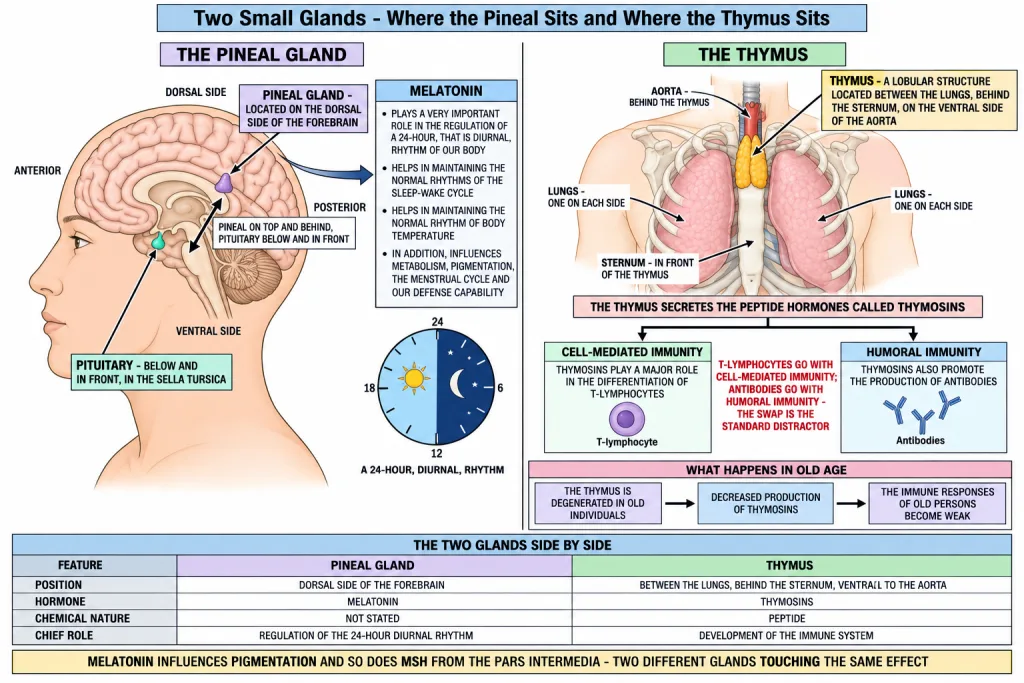
[NEET Important] The most asked line is thymosins - differentiation of T-lymphocytes - cell-mediated immunity, with antibodies - humoral immunity as the second half that candidates forget. The position item wants behind the sternum, between the lungs, on the ventral side of the aorta, and the old-age item wants the full chain: degeneration of the thymus, less thymosin, weaker immune response.
The Two Glands Side by Side
Because they share a section, the two are easy to confuse in a hurry. Put them in one grid and the confusion disappears - nothing in either column resembles anything in the other.
| Pineal gland | Thymus | |
|---|---|---|
| Where it is | On the dorsal side of the forebrain | A lobular structure between the lungs, behind the sternum, on the ventral side of the aorta |
| Hormone | Melatonin | Thymosins - peptide hormones |
| Chief role | Regulates the 24-hour (diurnal) rhythm of the body | Development of the immune system |
| Named actions | Sleep-wake cycle, body temperature; also metabolism, pigmentation, the menstrual cycle, defense capability | Differentiation of T-lymphocytes giving cell-mediated immunity; production of antibodies giving humoral immunity |
| What changes with age | Not stated in this chapter | Degenerates in old individuals, so thymosin production falls and immune responses become weak |
Read the grid backwards too, because that is how the reverse question is set:
- A hormone regulating the sleep-wake cycle and body temperature points back to melatonin, and therefore to the pineal gland.
- A hormone causing the differentiation of T-lymphocytes points back to thymosins, and therefore to the thymus.
- Cell-mediated immunity points back to T-lymphocytes; humoral immunity points back to antibodies. Both come under the thymus.
- Weak immunity in an old person points back to a degenerated thymus and decreased thymosins.
One overlap is worth naming so it does not trip you: melatonin influences pigmentation, and so does MSH from the pars intermedia. Both statements are in the chapter and both are correct - the question will ask which gland a named hormone belongs to, not which hormone owns pigmentation outright.
[NEET Important] The single trap that catches people here is defense capability. It appears in the melatonin list, and the thymus is the gland of immunity - so an item that offers "influences our defense capability" among melatonin's actions is testing whether you will reject a correct statement because it sounds like the thymus. It is a genuine melatonin action.
Quick Recap
- The pineal gland is located on the dorsal side of the forebrain.
- The pineal secretes a hormone called melatonin.
- Melatonin plays a very important role in the regulation of a 24-hour (diurnal) rhythm of our body.
- For example, it helps in maintaining the normal rhythms of the sleep-wake cycle and body temperature.
- In addition, melatonin also influences metabolism, pigmentation, the menstrual cycle as well as our defense capability.
- The thymus gland is a lobular structure located between the lungs, behind the sternum, on the ventral side of the aorta.
- The thymus plays a major role in the development of the immune system.
- The thymus secretes the peptide hormones called thymosins.
- Thymosins play a major role in the differentiation of T-lymphocytes, which provide CELL-MEDIATED IMMUNITY.
- In addition, thymosins also promote the production of antibodies to provide HUMORAL IMMUNITY.
- The thymus is degenerated in old individuals, resulting in a decreased production of thymosins, and as a result the immune responses of old persons become weak.
Solved Examples
Question 1
Q. List the hormones secreted by the thymus. This is one of the chapter-end exercises.
Answer. The thymus secretes one group of hormones:
- Thymosins - peptide hormones which play a major role in the differentiation of T-lymphocytes, the cells that provide CELL-MEDIATED IMMUNITY, and which also promote the production of antibodies to provide HUMORAL IMMUNITY.
There is no second hormone from the thymus. The plural in thymosins is a group of related peptide hormones, not two separate named hormones.
Question 2
Q. Write short notes on the functions of thymosins. This is one of the chapter-end exercises.
Answer. Thymosins are peptide hormones secreted by the thymus gland, a lobular structure lying between the lungs, behind the sternum, on the ventral side of the aorta. Their work is the development of the immune system, and it has two halves. First, thymosins play a major role in the differentiation of T-lymphocytes - the thymus is where these lymphocytes are matured into working defence cells - and T-lymphocytes provide CELL-MEDIATED IMMUNITY, in which the defending agent is the cell itself. Second, thymosins also promote the production of antibodies, and antibodies provide HUMORAL IMMUNITY, in which the defending agents are molecules dissolved in the body fluids. So a single group of hormones supports both arms of immunity. The importance of this shows up with age: the thymus is degenerated in old individuals, which results in a decreased production of thymosins, and as a result the immune responses of old persons become weak.
Question 3
Q. Where is the pineal gland located?
Answer. On the dorsal side of the forebrain.
Question 4
Q. Which hormone does the pineal gland secrete, and what is its chief role?
Answer. The pineal secretes melatonin. Melatonin plays a very important role in the regulation of a 24-hour (diurnal) rhythm of our body.
Question 5
Q. Give two examples of the 24-hour rhythms that melatonin helps maintain.
Answer. It helps in maintaining the normal rhythms of the SLEEP-WAKE CYCLE and of BODY TEMPERATURE.
Question 6
Q. Apart from the diurnal rhythm, what else does melatonin influence?
Answer. Metabolism, pigmentation, the menstrual cycle and our defense capability.
Question 7
Q. Where is the thymus gland situated, and what does it look like?
Answer. It is a LOBULAR structure located between the lungs, behind the sternum, on the ventral side of the aorta.
Question 8
Q. What is the chief role of the thymus gland?
Answer. It plays a major role in the development of the immune system. It does this through the peptide hormones called thymosins that it secretes.
Question 9
Q. Which cells do the thymosins act on, and what kind of immunity do those cells provide?
Answer. Thymosins play a major role in the differentiation of T-LYMPHOCYTES, and T-lymphocytes provide CELL-MEDIATED IMMUNITY.
Question 10
Q. How do the thymosins contribute to humoral immunity?
Answer. Thymosins also promote the production of ANTIBODIES, and antibodies provide HUMORAL IMMUNITY. So the thymosins support both arms of the immune response - the cellular one through T-lymphocytes and the fluid-borne one through antibodies.
Question 11
Q. Distinguish between cell-mediated immunity and humoral immunity as this chapter presents them.
Answer.
| Cell-mediated immunity | Humoral immunity | |
|---|---|---|
| Provided by | T-lymphocytes | Antibodies |
| How the thymosins help | By playing a major role in the differentiation of T-lymphocytes | By promoting the production of antibodies |
| The defending agent | A cell | A molecule carried in the body fluids |
The one line that gets the mark: T-lymphocytes give CELL-mediated immunity; antibodies give HUMORAL immunity.
Question 12
Q. Why do old people have weaker immune responses?
Answer. Because the thymus is degenerated in old individuals. A degenerated thymus gives a decreased production of thymosins, and since thymosins drive the differentiation of T-lymphocytes and the production of antibodies, the immune responses of old persons become weak.
Question 13
Q. Two hormones in this chapter influence pigmentation. Name them and their glands.
Answer. Melatonin, from the pineal gland, influences pigmentation as one of its additional effects. MSH, melanocyte stimulating hormone, from the pars intermedia of the pituitary, acts on the melanocytes and regulates the pigmentation of the skin. Both statements are correct, so an item on pigmentation has to be read carefully to see which gland is being asked for.
Question 14
Q. Fill in the blanks: the _ gland lies on the dorsal side of the forebrain and secretes , while the lies behind the sternum and secretes _.
Answer. The pineal gland lies on the dorsal side of the forebrain and secretes melatonin, while the thymus lies behind the sternum and secretes thymosins.