
The Adrenal Gland - Two Tissues, One Capsule
Our body has one pair of adrenal glands, one above each kidney. They sit like caps on the top of the kidneys, which is where the name comes from - ad-renal, "next to the kidney".
Cut one open and it is not one gland but two, packed inside the same capsule. The gland is composed of two types of tissue: the centrally located tissue is called the adrenal MEDULLA, and outside this lies the adrenal CORTEX.
- The MEDULLA is the INNER tissue - centrally located, the core.
- The CORTEX is the OUTER tissue - lying outside the medulla, the rind.
Say those two out loud, because they are routinely inverted in exam options, and every hormone question about the adrenal depends on getting them the right way round. The word cortex means bark or rind in the anatomy of every organ that has one - the kidney, the brain, the adrenal - and it is always the outside. Medulla always means the middle.
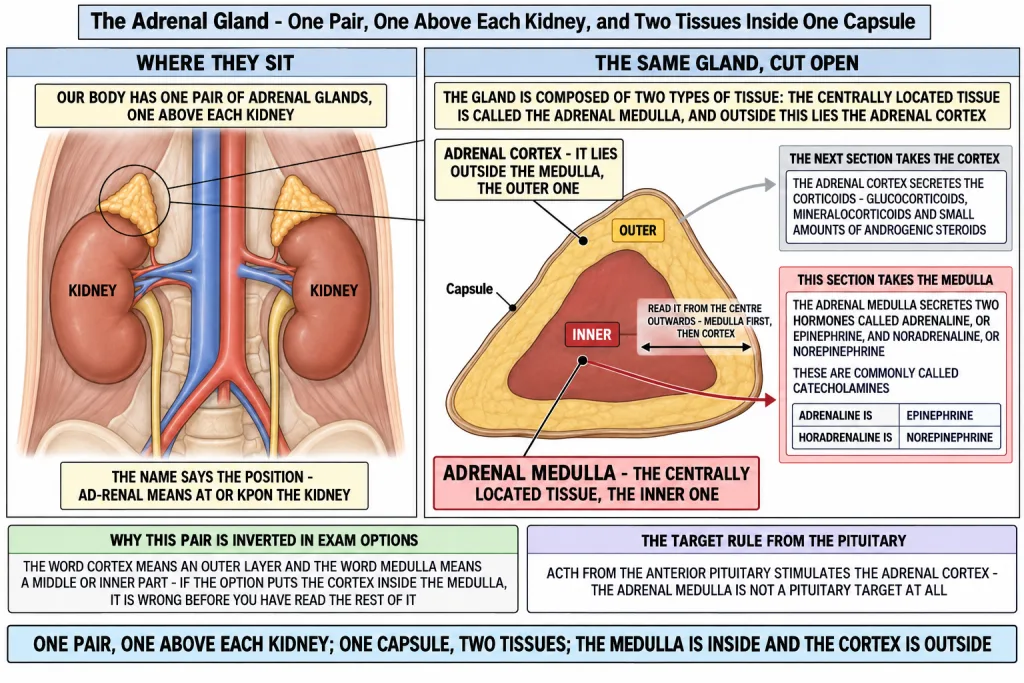
The two tissues make completely different hormones and cause completely different disorders, so the chapter treats them separately, and so does this book. This section takes the MEDULLA. The next section takes the CORTEX, with its three layers, its corticoids, and the disease that follows from its under-secretion.
[NEET Important] "One pair, one above each kidney" is asked as a location item, and "centrally located medulla, cortex outside it" is asked as a structure item. The inversion - cortex inside, medulla outside - is the single commonest wrong option in this whole part of the chapter.
The Two Hormones of the Medulla
The adrenal medulla secretes TWO hormones called ADRENALINE or EPINEPHRINE and NORADRENALINE or NOREPINEPHRINE. Both hormones have two names, both names are in use, and the exam uses either freely - so learn them in pairs from the start:
| The hormone | Its other name |
|---|---|
| Adrenaline | Epinephrine |
| Noradrenaline | Norepinephrine |
These are commonly called CATECHOLAMINES. That is the group name for the pair, and an option asking "adrenaline and noradrenaline are commonly called" wants exactly that word.
Adrenaline and noradrenaline are rapidly secreted in response to STRESS OF ANY KIND and during EMERGENCY SITUATIONS, and for that reason they are called EMERGENCY HORMONES or HORMONES OF FIGHT OR FLIGHT. Both of those labels are used in the chapter and both are asked.
Two points on the wording that questions turn on. "Rapidly secreted" - the medulla is the fast end of the endocrine system, which fits its job. And "stress of any kind" - not one particular stress, any of them: fright, cold, injury, exertion.
[NEET Important] Catecholamines, emergency hormones and hormones of Fight or Flight are three names for the same two molecules, and all three appear as answers. Do not let the nor- prefix mislead you: noradrenaline is norepinephrine, and both come from the adrenal medulla, not the cortex.
What Fight or Flight Actually Does to the Body
The effects are listed by the chapter as a set, and a question typically hands you four of them and asks which one does not belong. Learn the whole set:
- They increase ALERTNESS.
- They cause PUPILARY DILATION - the pupils widen.
- They cause PILOERECTION - the raising of hairs.
- They cause SWEATING.
- Both the hormones increase the HEART BEAT, the STRENGTH OF HEART CONTRACTION and the RATE OF RESPIRATION. Three separate effects in one sentence, and all three are examinable.
- Catecholamines stimulate the breakdown of GLYCOGEN, resulting in an increased concentration of GLUCOSE in the blood.
- In addition, they also stimulate the breakdown of LIPIDS AND PROTEINS.
Read the list as one story and it stops being a list. The body is preparing to fight or to run. Alertness and dilated pupils are the senses opening up. Faster, stronger heart beats and faster breathing push more oxygen to the muscles. Glycogen breakdown floods the blood with glucose so the muscles have fuel, and lipid and protein breakdown brings up the reserves behind it. Sweating disposes of the heat this is about to generate, and piloerection is the leftover of an animal making itself look bigger.
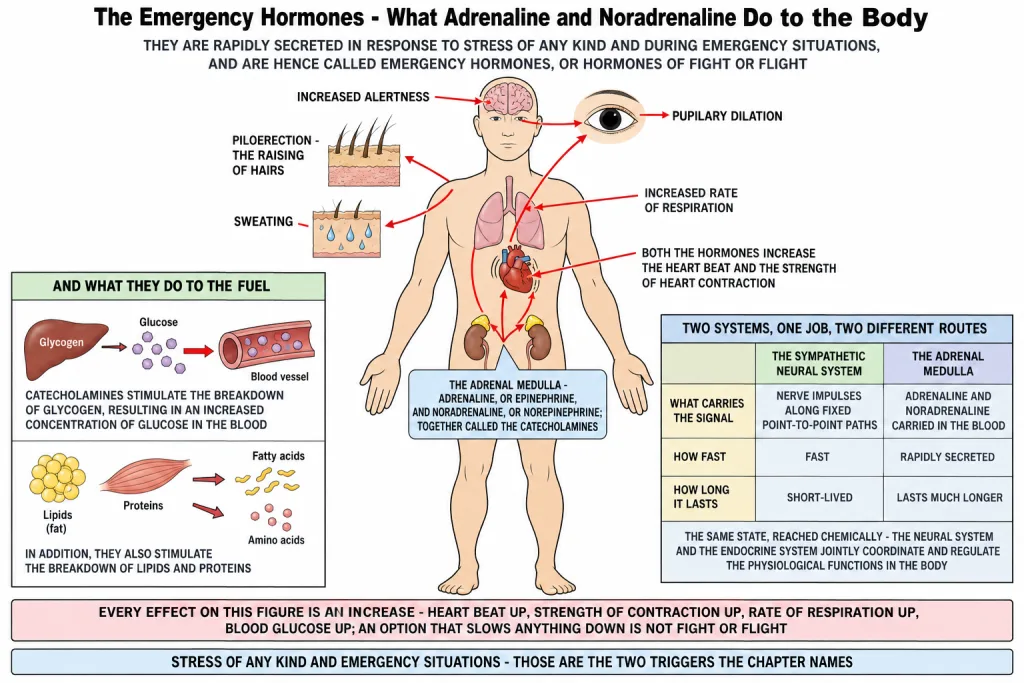
The link back to the previous chapter is the point of the whole thing. The neural chapter described the sympathetic neural system producing precisely this state - dilated pupils, faster heart, wider airways, glucose released - by sending nerve impulses down its fibres. Here the same state is produced chemically, by two hormones travelling in the blood. The sympathetic route is fast but short-lived; the hormonal route takes a moment longer to arrive but lasts much longer, because the hormone stays in circulation. Two systems, one job, two different routes - which is exactly the point the chapter opened with when it said that the neural system and the endocrine system jointly coordinate and regulate the physiological functions in the body.
[NEET Important] The list gets asked as a negative item, and the false option is always a slowing - "decreases the heart rate", "reduces the rate of respiration", "lowers blood glucose". Everything the catecholamines do goes up. The other favourite is the wording of the glucose effect: catecholamines stimulate the breakdown of GLYCOGEN, which is what raises blood glucose - they do not make glucose out of nothing.
Quick Recap
- Our body has one pair of adrenal glands, one above each kidney.
- The gland is composed of two types of tissue: the centrally located tissue is called the adrenal MEDULLA, and outside this lies the adrenal CORTEX. The medulla is inner, the cortex is outer.
- The adrenal medulla secretes two hormones called adrenaline or epinephrine and noradrenaline or norepinephrine.
- These are commonly called CATECHOLAMINES.
- Adrenaline and noradrenaline are rapidly secreted in response to stress of any kind and during emergency situations, and are called emergency hormones or hormones of Fight or Flight.
- These hormones increase alertness, pupilary dilation, piloerection (raising of hairs) and sweating.
- Both the hormones increase the heart beat, the strength of heart contraction and the rate of respiration.
- Catecholamines stimulate the breakdown of glycogen, resulting in an increased concentration of glucose in the blood.
- In addition, they also stimulate the breakdown of lipids and proteins.
- The sympathetic neural system produces the same fight-or-flight state by nerve impulses; the catecholamines produce it chemically, and the chemical version lasts longer.
- The adrenal cortex and its hormones are taken up in the next section.
Solved Examples
Question 1
Q. Describe the position and structure of the adrenal glands.
Answer. Our body has one pair of adrenal glands, one above each kidney. The gland is composed of two types of tissue. The centrally located tissue is called the adrenal MEDULLA, and outside this lies the adrenal CORTEX. So a section through the gland shows the medulla in the middle and the cortex as an outer shell around it.
Question 2
Q. Which part of the adrenal gland is the inner one, and which is the outer?
Answer. The MEDULLA is the inner, centrally located tissue. The CORTEX lies outside it. The general rule holds here as in the kidney and the brain: a cortex is always the outer layer and a medulla is always the inner one.
Question 3
Q. Name the two hormones secreted by the adrenal medulla, giving both names of each.
Answer. Adrenaline, also called epinephrine, and noradrenaline, also called norepinephrine. These are commonly called catecholamines.
Question 4
Q. Why are adrenaline and noradrenaline called emergency hormones?
Answer. Because they are rapidly secreted in response to stress of any kind and during emergency situations. For the same reason they are also called the hormones of Fight or Flight - they put the body into the state it needs to either fight the threat or run from it.
Question 5
Q. List the effects of the catecholamines on the body.
Answer.
- They increase alertness.
- They cause pupilary dilation.
- They cause piloerection - the raising of hairs.
- They cause sweating.
- Both the hormones increase the heart beat, the strength of heart contraction and the rate of respiration.
- They stimulate the breakdown of glycogen, resulting in an increased concentration of glucose in the blood.
- They also stimulate the breakdown of lipids and proteins.
Every one of these effects is an increase. Nothing in the fight-or-flight response slows down.
Question 6
Q. How do the catecholamines raise the blood glucose level?
Answer. They stimulate the breakdown of glycogen, which results in an increased concentration of glucose in the blood. Glycogen is the body's stored form of glucose; breaking it down releases glucose into the blood, where the working muscles can use it. In addition, they also stimulate the breakdown of lipids and proteins, bringing up the reserve fuels behind the glucose.
Question 7
Q. What does piloerection mean?
Answer. The raising of hairs. It is one of the effects of adrenaline and noradrenaline, and it is the reason the hairs stand up on the arms and neck when a person is frightened.
Question 8
Q. What effects do adrenaline and noradrenaline have on the heart and on breathing?
Answer. Both the hormones increase the heart beat, the strength of heart contraction and the rate of respiration. Three effects, and all three raise the rate at which oxygen reaches the muscles.
Question 9
Q. How is the action of the catecholamines related to the sympathetic neural system studied in the previous chapter?
Answer. They produce the same state by a different route. The sympathetic neural system prepares the body for an emergency by nerve impulses running down its fibres - the pupils dilate, the heart beats faster and harder, breathing quickens, and glucose is released. The adrenal medulla brings about exactly the same set of changes chemically, by pouring adrenaline and noradrenaline into the blood.
The difference is in the timing. Neural coordination is fast but short-lived; the hormonal version takes a little longer to arrive but lasts much longer, because the hormone stays in circulation until it is cleared. This is the chapter's opening claim in action - the neural system and the endocrine system jointly coordinate and regulate the physiological functions in the body.
Question 10
Q. An option states that adrenaline decreases the rate of respiration. Is that correct?
Answer. No. Both the hormones increase the heart beat, the strength of heart contraction and the rate of respiration. Every catecholamine effect in the chapter is an increase - in alertness, in pupil size, in heart rate, in breathing, in blood glucose. An option describing any of them going down is wrong.
Question 11
Q. A hormone raises the blood glucose level by breaking down glycogen. Two hormones in this chapter do that. Name them and say where each comes from.
Answer. Adrenaline and noradrenaline, from the adrenal medulla, stimulate the breakdown of glycogen resulting in an increased concentration of glucose in the blood. Glucagon, from the pancreas, does the same thing on the liver cells and is called a hyperglycemic hormone. The difference is the occasion: the catecholamines act in an emergency, while glucagon is part of the routine control of glucose homeostasis.
Question 12
Q. Fill in the blanks: the adrenal gland has a centrally located _ and an outer ; the inner tissue secretes and , which are together called _.
Answer. The adrenal gland has a centrally located medulla and an outer cortex; the inner tissue secretes adrenaline (epinephrine) and noradrenaline (norepinephrine), which are together called catecholamines.
Question 13
Q. Why is it useful that the fight-or-flight response is produced by hormones as well as by nerves?
Answer. Because the two routes have different strengths. The nerve impulse arrives at once but its effect is short-lived, and the nerve fibres do not innervate all the cells of the body. The hormones travel in the blood, so they reach every cell that carries the right receptor, including cells no sympathetic fibre reaches, and the effect continues for as long as the hormone remains in circulation. Together they give an emergency response that is both immediate and sustained.