
The Hypothalamus - A Piece of Brain That Behaves Like a Gland
The hypothalamus is the basal part of the diencephalon, forebrain, and the previous chapter already met it as the part that controls body temperature and the urge for eating and drinking. Here it comes back wearing its other hat: it regulates a wide spectrum of body functions, and it does so by producing hormones.
It contains several groups of neurosecretory cells called NUCLEI which produce hormones. The word nuclei here does not mean the nucleus of a cell - it means a cluster of neuron cell bodies sitting together inside the brain, and each cluster makes its own hormone. A neurosecretory cell is exactly what its name says: a neuron that secretes. It has an axon like any other neuron, but what travels down that axon and comes out at the end is a hormone, not just an impulse.
What those hormones do is regulate the synthesis and secretion of PITUITARY hormones. That is the whole job. The hypothalamus does not act on the thyroid or the adrenal directly - it acts on the pituitary, and the pituitary acts on them. It is the top of a chain of command, not a worker in the field.
[NEET Important] Two phrases get quoted. "Basal part of the diencephalon, forebrain" is the position, and an option placing the hypothalamus in the midbrain or the hindbrain is wrong. "Groups of neurosecretory cells called nuclei" is the structure, and the distractor swaps nuclei for follicles or islets - both of which are real words in this chapter, but they belong to the thyroid and the pancreas respectively.
Releasing Hormones and Inhibiting Hormones
The hormones produced by the hypothalamus are of TWO types, and the pair is a clean two-row table that gets asked directly:
| Type | What it does | Named example |
|---|---|---|
| Releasing hormones | Stimulate secretion of pituitary hormones | Gonadotrophin releasing hormone (GnRH) stimulates the pituitary synthesis and release of gonadotrophins |
| Inhibiting hormones | Inhibit secretions of pituitary hormones | Somatostatin inhibits the release of growth hormone from the pituitary |
Learn the two examples exactly as they are paired, because they are the only two the chapter names and they always appear together in a question:
- GnRH is a RELEASING hormone. Its target is the pituitary, and what it releases is the gonadotrophins - which the next section will identify as LH and FSH.
- Somatostatin is an INHIBITING hormone. Its target is also the pituitary, and what it holds back is growth hormone.
Notice that both of them are named after what they act on, not where they come from. GnRH is not made by the gonads and somatostatin is not made by the pituitary - both are hypothalamic. That naming pattern runs through the whole chapter and is worth fixing now, because the pituitary hormones are named the same way: thyroid stimulating hormone comes from the pituitary, not the thyroid.
[NEET Important] The commonest error is direction. A releasing hormone stimulates; an inhibiting hormone inhibits - and the trap item gives you somatostatin and asks what it does to growth hormone, offering "stimulates its release" as the first option. It inhibits.
How the Hypothalamus Reaches the Pituitary - Two Different Routes
This is the part of the section that carries the most marks, because the two lobes of the pituitary are reached in two completely different ways, and the chapter states both.
The hormones originate in the hypothalamic neurons, pass through axons, and are released from their nerve endings. Where those nerve endings are is what decides the route.
Route 1 - to the ANTERIOR pituitary, through a portal circulatory system. The releasing and inhibiting hormones are released from nerve endings at the base of the hypothalamus, and from there they reach the pituitary gland through a PORTAL CIRCULATORY SYSTEM and regulate the functions of the anterior pituitary. A portal system is a set of blood vessels running directly from one organ to another without going back through the general circulation first, so the hormone arrives concentrated and arrives only where it is wanted. The anterior pituitary is therefore under HORMONAL control.
Route 2 - to the POSTERIOR pituitary, by direct neural regulation. The posterior pituitary is under the DIRECT NEURAL regulation of the hypothalamus. There is no portal system here and no releasing hormone. The neurosecretory axons themselves run down into the posterior pituitary, and the next section will show that the two hormones stored there are actually synthesised by the hypothalamus and merely transported axonally to be stored and released.
| Anterior pituitary | Posterior pituitary | |
|---|---|---|
| How the hypothalamus controls it | Through releasing and inhibiting hormones | By direct neural regulation |
| The route those signals take | A portal circulatory system | Axons running down from the hypothalamus |
| Who makes the hormones released there | The anterior pituitary itself | The hypothalamus |
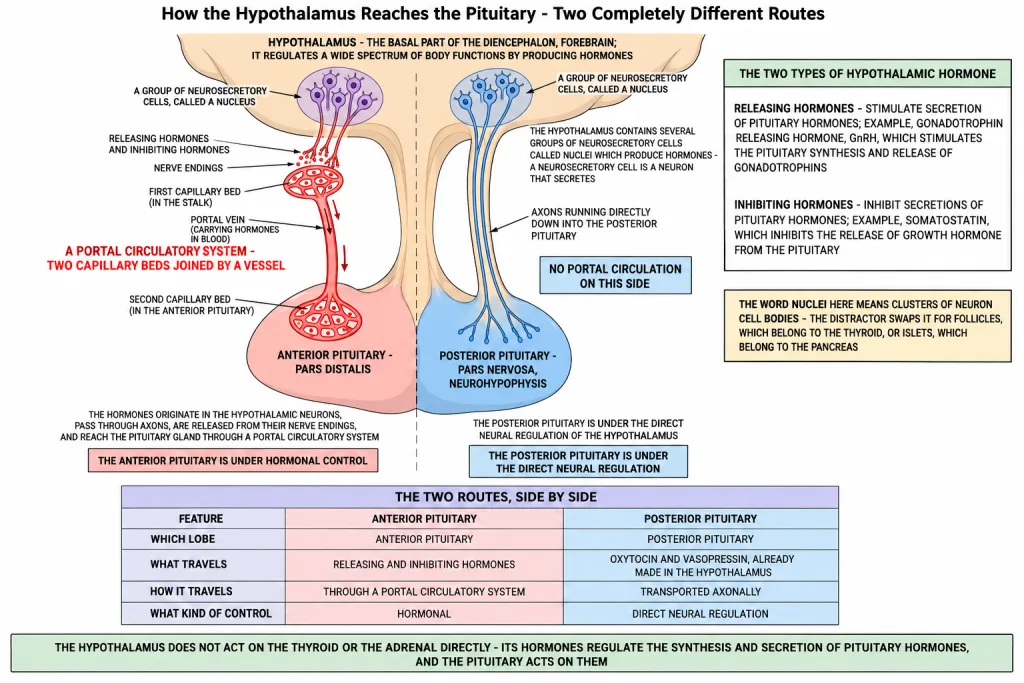
[NEET Important] Portal circulation for the anterior, direct neural regulation for the posterior - swapping those two is the single commonest error in this part of the chapter. A second item hides in the same fact: the posterior pituitary does not synthesise its own hormones, so an option calling it the site of oxytocin synthesis is wrong even though oxytocin is released from there.
Quick Recap
- The hypothalamus is the basal part of the diencephalon, forebrain, and it regulates a wide spectrum of body functions.
- It contains several groups of neurosecretory cells called nuclei which produce hormones.
- These hormones regulate the synthesis and secretion of pituitary hormones.
- The hypothalamic hormones are of two types: releasing hormones, which stimulate secretion of pituitary hormones, and inhibiting hormones, which inhibit secretions of pituitary hormones.
- Gonadotrophin releasing hormone (GnRH) stimulates the pituitary synthesis and release of gonadotrophins.
- Somatostatin from the hypothalamus inhibits the release of growth hormone from the pituitary.
- These hormones originate in the hypothalamic neurons, pass through axons and are released from their nerve endings.
- They reach the pituitary gland through a portal circulatory system and regulate the functions of the ANTERIOR pituitary.
- The POSTERIOR pituitary is under the direct NEURAL regulation of the hypothalamus.
Solved Examples
Question 1
Q. List the hormones secreted by the hypothalamus. This is one of the chapter-end exercises.
Answer. The hypothalamus secretes hypothalamic hormones, and they come in two types, both of which act on the pituitary:
- Releasing hormones - they stimulate the secretion of pituitary hormones. The named example is gonadotrophin releasing hormone (GnRH), which stimulates the pituitary synthesis and release of the gonadotrophins, LH and FSH.
- Inhibiting hormones - they inhibit the secretion of pituitary hormones. The named example is somatostatin, which inhibits the release of growth hormone from the pituitary.
Two more hormones are worth naming here even though they are usually credited to the pituitary: oxytocin and vasopressin are actually SYNTHESISED BY THE HYPOTHALAMUS and only transported axonally to the posterior pituitary, which stores and releases them.
Question 2
Q. Where exactly is the hypothalamus situated?
Answer. It is the basal part of the diencephalon, which is a region of the forebrain. It sits at the floor of the brain, just above the pituitary, to which it is joined by a stalk.
Question 3
Q. What are the nuclei of the hypothalamus?
Answer. They are groups of neurosecretory cells inside the hypothalamus that produce hormones. The word nuclei here means clusters of neuron cell bodies, not the nucleus of a cell. A neurosecretory cell is a neuron that secretes a hormone rather than only conducting an impulse.
Question 4
Q. Distinguish between releasing hormones and inhibiting hormones, and give one example of each.
Answer.
| Feature | Releasing hormones | Inhibiting hormones |
|---|---|---|
| What they do | Stimulate secretion of pituitary hormones | Inhibit secretion of pituitary hormones |
| Where they act | The pituitary gland | The pituitary gland |
| Named example | Gonadotrophin releasing hormone (GnRH) | Somatostatin |
| What that example controls | The release of gonadotrophins | The release of growth hormone |
The one line that gets the mark: both types act on the pituitary, and they differ only in direction - one switches a pituitary hormone on, the other switches it off.
Question 5
Q. What does gonadotrophin releasing hormone do, and where is it made?
Answer. GnRH is made in the hypothalamus, not in the gonads, despite the name. It stimulates the pituitary synthesis and release of the gonadotrophins - the hormones LH and FSH, which then go on to act on the testis and the ovary.
Question 6
Q. Which hypothalamic hormone stops growth hormone from being released, and from where is that growth hormone released?
Answer. Somatostatin, which is a hypothalamic inhibiting hormone. It inhibits the release of growth hormone from the pituitary.
Question 7
Q. By what route do the hypothalamic hormones reach the anterior pituitary?
Answer. They originate in the hypothalamic neurons, pass through axons and are released from their nerve endings, and from there they reach the pituitary gland through a PORTAL CIRCULATORY SYSTEM. A portal system carries blood directly from one organ to another, so the hormone arrives at the anterior pituitary without being diluted through the general circulation.
Question 8
Q. How is the posterior pituitary controlled by the hypothalamus, and how does that differ from the control of the anterior pituitary?
Answer. The posterior pituitary is under the DIRECT NEURAL regulation of the hypothalamus - the neurosecretory axons run into it, and there is no releasing hormone and no portal system involved. The anterior pituitary, by contrast, is controlled hormonally, by the releasing and inhibiting hormones that arrive through the portal circulatory system.
The one line that gets the mark: anterior - portal blood and hormones; posterior - axons and direct neural regulation.
Question 9
Q. In what sense is the hypothalamus the meeting point of the neural and the endocrine systems?
Answer. Because its neurosecretory cells are neurons that make hormones. They receive and carry impulses like any other neuron, but what they release at their nerve endings is a hormone, which then travels in the blood. So a neural signal arriving at the hypothalamus can be turned into a chemical signal leaving it, and that is the point at which the two coordinating systems of the body join up.
Question 10
Q. A statement reads: "The hypothalamus regulates the thyroid gland directly." Is that correct?
Answer. No. The hypothalamic hormones regulate the synthesis and secretion of PITUITARY hormones, and it is the pituitary that then acts on the thyroid, through thyroid stimulating hormone (TSH). The hypothalamus sits one step further back in the chain.
Question 11
Q. Why is a portal circulatory system useful here rather than the ordinary circulation?
Answer. A portal system runs directly from one organ to the next without returning through the general circulation first. The releasing and inhibiting hormones are produced in trace amounts, so if they were poured into the general circulation they would be diluted through the whole body before reaching their target. The portal route delivers them straight to the anterior pituitary, concentrated and undiluted.
Question 12
Q. Fill in the blanks: the hypothalamus contains groups of _ cells called , and the hormones they produce regulate the synthesis and secretion of _ hormones.
Answer. The hypothalamus contains groups of neurosecretory cells called nuclei, and the hormones they produce regulate the synthesis and secretion of pituitary hormones.