
Hormone Receptors - Why a Hormone in the Blood Reaches Only Some Cells
Every hormone in this chapter travels in the blood, and the blood goes everywhere. So why does thyroid stimulating hormone act on the thyroid and nowhere else? The answer is the whole of this section, and it is not about the hormone at all - it is about the cell that receives it.
Hormones produce their effects on target tissues by binding to specific proteins called HORMONE RECEPTORS located in the target tissues ONLY. The word only is doing all the work. A cell without the receptor is bathed in the hormone and ignores it completely. A target tissue is therefore simply a tissue that carries the receptor.
Receptors come in two positions, and where a receptor sits decides everything that follows.
| Membrane-bound receptors | Intracellular receptors | |
|---|---|---|
| Where they are | On the cell membrane of the target cells | Inside the target cell - mostly NUCLEAR RECEPTORS, present in the nucleus |
| Does the hormone enter the cell? | No - it normally does not enter the target cell | Yes |
| What it produces | SECOND MESSENGERS | A complex that acts on the genome |
Binding of a hormone to its receptor leads to the formation of a HORMONE-RECEPTOR COMPLEX. That complex is the working unit; nothing happens until it exists.
Each receptor is specific to ONE hormone only, and hence receptors are specific. One receptor, one hormone - not one class of hormones, not one gland's output. That single sentence is the reason a hormone circulating everywhere produces an effect in one place.
Hormone-receptor complex formation leads to certain biochemical changes in the target tissue, and target tissue metabolism, and hence physiological functions, are regulated by hormones. Read that as the chain the whole section is building: hormone, receptor, complex, biochemical change, metabolism, physiological function.
[NEET Important] Three sentences get quoted almost word for word. Receptors are located in
the target tissues ONLY - an option saying every cell of the body has receptors for every hormone
is wrong. Each receptor is specific to one hormone only. And the hormone-receptor complex
is the name of what forms on binding; the distractor calls it a second messenger, which is a
different thing generated later and only on one of the two routes.
The Four Chemical Groups of Hormones
On the basis of their chemical nature, hormones can be divided into groups. There are four, and the chapter gives named examples for each. Memorise the examples with the group, because the group is what decides which of the two mechanisms a hormone will use.
| Group | Examples the chapter gives |
|---|---|
| (i) Peptide, polypeptide, protein hormones | Insulin, glucagon, pituitary hormones, hypothalamic hormones |
| (ii) Steroids | Cortisol, testosterone, estradiol, progesterone |
| (iii) Iodothyronines | Thyroid hormones |
| (iv) Amino-acid derivatives | Epinephrine |
A few things about that table are worth saying out loud.
- Group (i) is enormous. Every pituitary hormone - GH, PRL, TSH, ACTH, LH, FSH - and every hypothalamic hormone - the releasing and inhibiting hormones - sits in it, along with both pancreatic hormones.
- Group (ii), the steroids, collects the adrenal cortex hormones and the gonadal hormones. Estradiol is an estrogen; progesterone is the ovarian hormone you have already met; cortisol is the main glucocorticoid; testosterone is the main androgen.
- Group (iii) has one member only - the thyroid hormones, meaning and . Iodothyronine is just a chemical name for them.
- Group (iv) is named for epinephrine, which is adrenaline from the adrenal medulla.
[NEET Important] The one that catches people is iodothyronines being their own group, not a
sub-heading under steroids - and yet, as the next part shows, they behave like steroids in the
mechanism. Group membership and mechanism are two different questions with two different answers
here. The other easy mark is epinephrine as an amino-acid derivative; an option calling it a
peptide is wrong.
Route 1 - Membrane-Bound Receptors and Second Messengers
Hormones which interact with membrane-bound receptors normally DO NOT ENTER the target cell, but generate SECOND MESSENGERS - cyclic AMP, , - which in turn regulate cellular metabolism.
The hormone stays outside. Something else carries the message the rest of the way. Follow it in order:
- The hormone arrives at the target cell in the blood. It does not go in.
- It binds a MEMBRANE-BOUND RECEPTOR on the cell membrane of the target cell.
- A HORMONE-RECEPTOR COMPLEX is formed - at the membrane, on the outside face.
- A SECOND MESSENGER is generated inside the cell. The three the chapter names are cyclic AMP, and .
- The second messenger regulates cellular metabolism.
- The biochemical changes in the target tissue give the physiological effect.
The name second messenger is a description of the relay. The hormone is the first messenger - it carries the message from the gland to the target cell surface. The second messenger carries it from the cell surface to the machinery inside. The hormone itself never crosses the membrane.
Which hormones go this way? The peptide, polypeptide and protein hormones, and the amino-acid derivatives - so insulin, glucagon, every pituitary hormone, every hypothalamic hormone, and epinephrine.
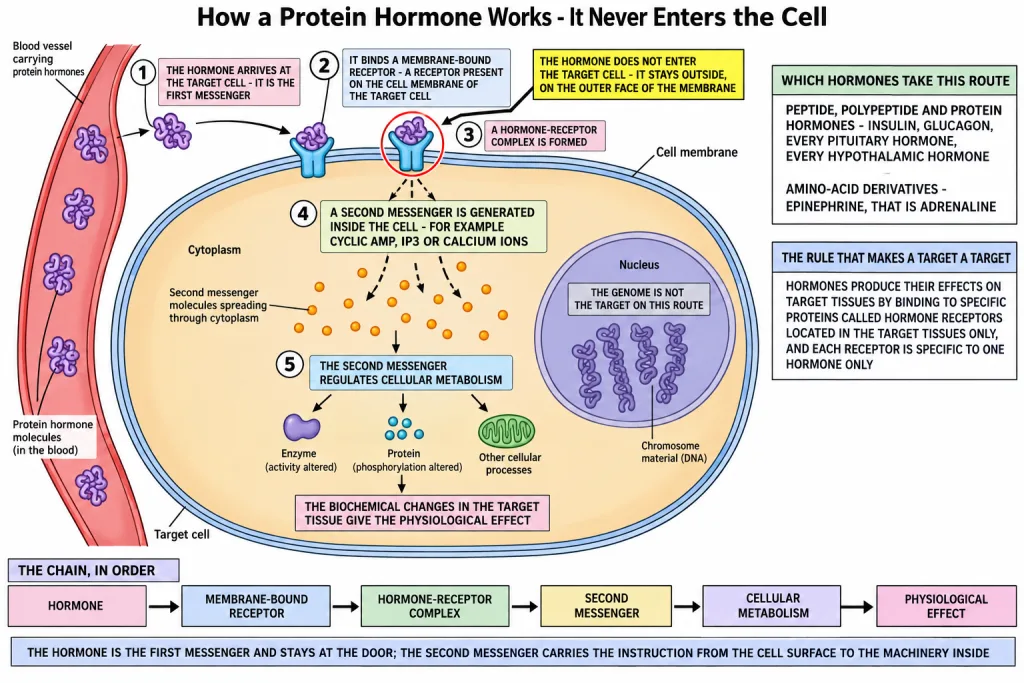
[NEET Important] Do not enter the target cell is the marked phrase, and the distractor has
the protein hormone walking into the cytoplasm. The named second messengers are cyclic AMP,
IP3 and calcium ions - an option adding a fourth, or naming the hormone-receptor
complex as a second messenger, is wrong.
Route 2 - Intracellular Receptors and the Genome, and the Rule That Chooses
Hormones which interact with intracellular receptors - steroid hormones, iodothyronines - mostly regulate GENE EXPRESSION or CHROMOSOME FUNCTION by the interaction of the hormone-receptor complex with the genome. Cumulative biochemical actions result in physiological and developmental effects.
Here the hormone goes in. Follow it in order again, and notice that the two sequences differ from step 1:
- The hormone ENTERS the target cell, crossing the cell membrane.
- It binds an INTRACELLULAR RECEPTOR - mostly a NUCLEAR RECEPTOR, present in the nucleus.
- A HORMONE-RECEPTOR COMPLEX is formed - inside the cell, not at the membrane.
- The complex INTERACTS WITH THE GENOME.
- GENE EXPRESSION or CHROMOSOME FUNCTION is regulated.
- Cumulative biochemical actions result in physiological AND DEVELOPMENTAL effects.
There is no second messenger on this route. There does not need to be one - the hormone itself got in, so nothing has to relay the message across the membrane.
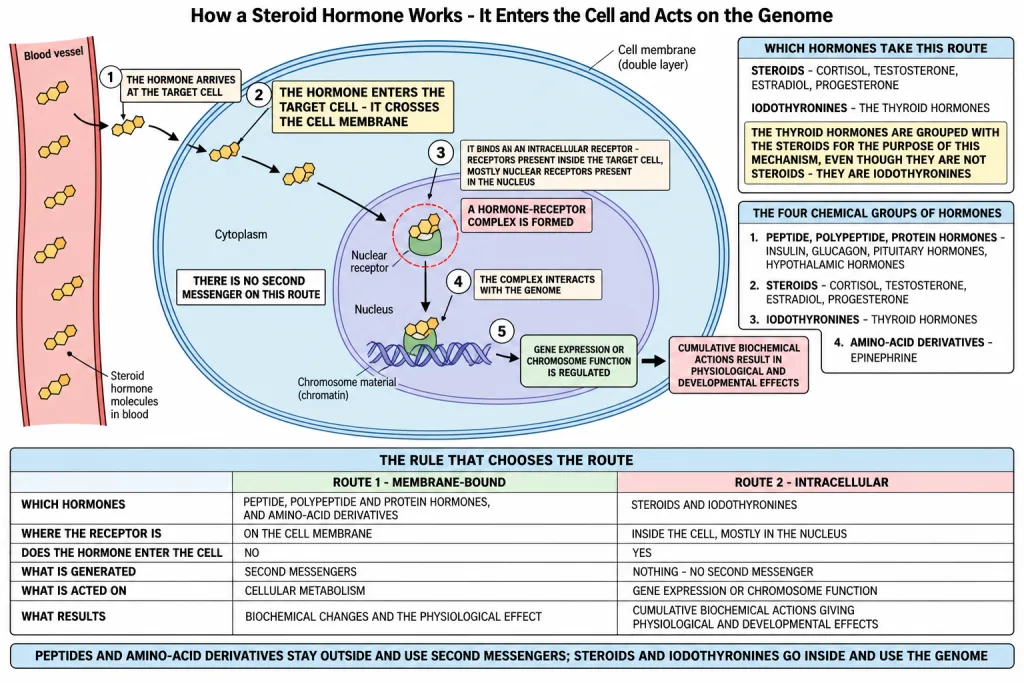
The rule that decides which route a hormone takes
| Route 1 - membrane-bound | Route 2 - intracellular | |
|---|---|---|
| Chemical groups that go this way | Peptide, polypeptide and protein hormones; amino-acid derivatives | Steroids; iodothyronines |
| Named examples | Insulin, glucagon, pituitary hormones, hypothalamic hormones, epinephrine | Cortisol, testosterone, estradiol, progesterone, thyroid hormones |
| Where the receptor is | On the cell membrane | Inside the cell, mostly in the nucleus |
| Does the hormone enter the cell? | No | Yes |
| What carries the message onward | Second messengers - cyclic AMP, , | The hormone-receptor complex itself, acting on the genome |
| What is regulated | Cellular metabolism | Gene expression or chromosome function |
| The result | Biochemical changes and the physiological effect | Cumulative biochemical actions giving physiological and developmental effects |
One subtlety that the chapter states but never flags. The thyroid hormones are grouped with the steroids for the purpose of this mechanism, even though they are NOT steroids. Chemically they are iodothyronines - their own group, group (iii). But when the chapter lists the hormones that interact with intracellular receptors, it names steroid hormones and iodothyronines together. So and enter the cell and act on the genome like a steroid, without being one.
[NEET Important] The whole section reduces to one dividing line: peptides and amino-acid
derivatives stay outside and use second messengers; steroids and iodothyronines go inside and use
the genome. Two traps sit on it. The first is insulin - it is a peptide, so it works
through a membrane-bound receptor, and an option that has insulin acting on the genome is
wrong. The second is thyroid hormone - it is not a steroid, but it uses the intracellular
route, so an option that sends it to a membrane receptor because it is not a steroid is also
wrong.
Quick Recap
- Hormones produce their effects on target tissues by binding to specific proteins called hormone receptors located in the target tissues ONLY.
- Receptors present on the cell membrane of the target cells are called membrane-bound receptors.
- Receptors present inside the target cell are called intracellular receptors, mostly nuclear receptors present in the nucleus.
- Binding of a hormone to its receptor leads to the formation of a hormone-receptor complex.
- Each receptor is specific to one hormone only, and hence receptors are specific.
- Hormone-receptor complex formation leads to certain biochemical changes in the target tissue, and target tissue metabolism, and hence physiological functions, are regulated by hormones.
- The four chemical groups of hormones are (i) peptide, polypeptide, protein hormones - insulin, glucagon, pituitary hormones, hypothalamic hormones; (ii) steroids - cortisol, testosterone, estradiol, progesterone; (iii) iodothyronines - thyroid hormones; and (iv) amino-acid derivatives - epinephrine.
- Hormones which interact with membrane-bound receptors normally do not enter the target cell, but generate second messengers - cyclic AMP, , - which in turn regulate cellular metabolism.
- Hormones which interact with intracellular receptors - steroid hormones and iodothyronines - mostly regulate gene expression or chromosome function by the interaction of the hormone-receptor complex with the genome.
- Cumulative biochemical actions result in physiological and developmental effects.
- Thyroid hormones use the intracellular route with the steroids even though they are iodothyronines and not steroids.
Solved Examples
Question 1
Q. Briefly mention the mechanism of action of FSH. This is one of the chapter-end exercises.
Answer. Work it out from what FSH is. FSH is a pituitary hormone, and pituitary hormones belong to the group of peptide, polypeptide and protein hormones. That fixes the route.
- FSH is carried in the blood to its target cells - the cells of the ovary in females and of the testis in males, which are its targets because they carry the receptor for it.
- It binds a MEMBRANE-BOUND RECEPTOR on the cell membrane of those target cells.
- FSH does NOT enter the target cell. Protein hormones normally do not.
- A HORMONE-RECEPTOR COMPLEX is formed at the membrane.
- SECOND MESSENGERS are generated inside the cell - cyclic AMP is the standard example, and the chapter also names and .
- The second messengers regulate cellular metabolism, and the biochemical changes in the target tissue produce the physiological effect.
The physiological effect itself: in females, FSH stimulates the growth and development of the ovarian follicles; in males, FSH along with androgens regulates spermatogenesis.
Since each receptor is specific to one hormone only, only cells carrying the FSH receptor respond, even though the hormone reaches every tissue in the body.
Question 2
Q. What is a hormone receptor, and where is it found?
Answer. A hormone receptor is a specific protein that a hormone binds to in order to produce its effect. Receptors are located in the target tissues ONLY - that is what makes a tissue a target. A cell without the receptor for a hormone does not respond to it, no matter how much of the hormone reaches it.
Question 3
Q. Distinguish between membrane-bound receptors and intracellular receptors.
Answer.
| Feature | Membrane-bound receptors | Intracellular receptors |
|---|---|---|
| Position | On the cell membrane of the target cell | Inside the target cell, mostly nuclear receptors present in the nucleus |
| Does the hormone enter the cell? | No | Yes |
| Hormones that use them | Peptide, polypeptide and protein hormones, and amino-acid derivatives | Steroid hormones and iodothyronines |
| How the message travels on | Through second messengers - cyclic AMP, , | The hormone-receptor complex acts on the genome |
| What is regulated | Cellular metabolism | Gene expression or chromosome function |
Question 4
Q. What is a hormone-receptor complex, and what happens once it forms?
Answer. Binding of a hormone to its receptor leads to the formation of a hormone-receptor complex. Once it exists, hormone-receptor complex formation leads to certain biochemical changes in the target tissue, and through those, target tissue metabolism, and hence physiological functions, are regulated by hormones.
Question 5
Q. What is meant by the statement that receptors are specific?
Answer. It means that each receptor is specific to ONE hormone only. A receptor will bind its own hormone and no other. This is the reason a hormone that circulates through the whole body produces an effect in just a few places - only the cells carrying that one receptor can read the message.
Question 6
Q. Name the four chemical groups of hormones with one example of each.
Answer.
| Group | Example |
|---|---|
| (i) Peptide, polypeptide, protein hormones | Insulin (also glucagon, pituitary hormones, hypothalamic hormones) |
| (ii) Steroids | Cortisol (also testosterone, estradiol, progesterone) |
| (iii) Iodothyronines | Thyroid hormones |
| (iv) Amino-acid derivatives | Epinephrine |
Question 7
Q. What are second messengers, which ones does the chapter name, and why are they needed?
Answer. Second messengers are molecules generated inside the target cell when a hormone binds a membrane-bound receptor. The three named are cyclic AMP, and . They are needed because those hormones normally do not enter the target cell - the message has to be carried from the membrane to the inside of the cell by something else, and these do it. They in turn regulate cellular metabolism.
Question 8
Q. Give the sequence of steps by which a steroid hormone acts on its target cell.
Answer.
- The hormone enters the target cell, crossing the cell membrane.
- It binds an intracellular receptor - mostly a nuclear receptor in the nucleus.
- A hormone-receptor complex is formed.
- The complex interacts with the genome.
- Gene expression or chromosome function is regulated.
- Cumulative biochemical actions result in physiological and developmental effects.
Question 9
Q. Thyroid hormones are not steroids. Why are they described alongside the steroids in this section?
Answer. Because the mechanism, not the chemistry, is what is being grouped here. Chemically, thyroid hormones are iodothyronines, which the chapter lists as their own group (iii), separate from the steroids. But when it comes to how they act, the chapter names steroid hormones and iodothyronines together as the hormones that interact with intracellular receptors. So and enter the target cell and regulate gene expression or chromosome function by the interaction of the hormone-receptor complex with the genome, exactly as a steroid does, without being steroids.
Question 10
Q. Insulin and cortisol both act on liver cells. Do they act by the same mechanism?
Answer. No. Insulin is a peptide hormone, so it binds a membrane-bound receptor, does not enter the cell, and generates second messengers such as cyclic AMP, which regulate cellular metabolism. Cortisol is a steroid, so it enters the cell, binds an intracellular receptor, and the hormone-receptor complex interacts with the genome to regulate gene expression or chromosome function. Same target organ, two different routes, decided by the chemical nature of the hormone.
Question 11
Q. Which route would epinephrine take, and why?
Answer. The membrane-bound receptor route. Epinephrine is an amino-acid derivative, not a steroid and not an iodothyronine, so it behaves like the peptide hormones: it does not enter the target cell, it binds a membrane-bound receptor, and it generates second messengers which regulate cellular metabolism. This fits what epinephrine is for - it is an emergency hormone, and a route that works through existing enzymes acts far faster than one that has to change gene expression.
Question 12
Q. Why does the intracellular route produce developmental effects while the membrane-bound route is described only in terms of metabolism?
Answer. Because of what each route regulates. The membrane-bound route ends with second messengers that regulate cellular metabolism - the chemistry the cell is already doing. The intracellular route ends with the hormone-receptor complex acting on the genome to regulate gene expression or chromosome function, which changes which proteins the cell makes at all. That is why the chapter says of this route that cumulative biochemical actions result in physiological AND DEVELOPMENTAL effects.
Question 13
Q. A student writes that a protein hormone enters the target cell, binds a nuclear receptor and switches genes on. Correct every error.
Answer. Every step belongs to the other route.
- A protein hormone normally does NOT enter the target cell.
- It binds a membrane-bound receptor on the cell membrane, not a nuclear receptor.
- It does not act on genes; it generates second messengers - cyclic AMP, , - which in turn regulate cellular metabolism.
The description the student gave is that of a steroid hormone or an iodothyronine, which does enter the cell and does regulate gene expression or chromosome function.