
Tissues That Are Not Glands, But Secrete Hormones Anyway
This section exists because of a decision made at the very start of the chapter. The classical definition called a hormone a chemical produced by endocrine glands, released into the blood and carried to a distant target. Under that wording, a chemical made by the wall of the heart was not a hormone at all, because the heart is not a gland.
So the definition was widened. Hormones are non-nutrient chemicals which act as intercellular messengers and are produced in trace amounts - and that version says nothing about which organ made them. The chapter told you why it was widened: the new definition covers a number of new molecules in addition to the hormones secreted by the organised endocrine glands. This section is those molecules. Everything in it is secreted by a tissue which is not an endocrine gland, and every one of them is a peptide hormone.
The heart - atrial natriuretic factor (ANF)
The atrial wall of our heart secretes a very important peptide hormone called atrial natriuretic factor (ANF), which DECREASES blood pressure. The chapter then spells out the loop, and it is worth learning as three linked steps because that is how it is asked:
- Blood pressure is increased.
- ANF is secreted.
- ANF causes DILATION of the blood vessels. This reduces the blood pressure.
Note the direction twice over. The stimulus is a rise in blood pressure, and the response is a fall. And the mechanism is dilation - the vessels widen, so the same blood pushes less hard against their walls. Atrial is the other marked word: it is the atrial wall, not the ventricle.
[NEET Important] ANF DECREASES blood pressure by DILATION of the blood vessels. Two distractors are built from the same sentence - one says ANF raises blood pressure, the other says it works by constriction. Both are inverted. The reverse-direction item is "which hormone lowers blood pressure", and the wrong options will be aldosterone, which acts the other way by holding on to sodium and water, and vasopressin (ADH), which conserves water.
The Kidney - Erythropoietin, and the Growth Factors
The juxtaglomerular cells of the kidney produce a peptide hormone called ERYTHROPOIETIN, which stimulates ERYTHROPOIESIS (formation of RBC).
Three parts of that sentence are separately examinable:
- The cell - the juxtaglomerular cells, not the kidney tubule, not the glomerulus.
- The hormone - erythropoietin, a peptide hormone.
- The action - erythropoiesis, which the chapter itself glosses as the formation of RBC.
Two other hormones in this chapter also touch red blood cells, and keeping them apart is the point of the reverse mapping. Erythropoietin from the kidney stimulates erythropoiesis directly. The thyroid hormones support the process of red blood cell formation, and cortisol stimulates RBC production as one of its many actions. Only erythropoietin exists for that job alone.
Growth factors
The chapter closes the section by widening the net one last time. Several other non-endocrine tissues secrete hormones called GROWTH FACTORS. These factors are essential for the normal growth of tissues and their repairing and regeneration.
No individual growth factor is named, no gland is given, and no disorder attaches to them. What is examinable is the name, the source - non-endocrine tissues - and the function - normal growth of tissues, and their repair and regeneration.
[NEET Important] Juxtaglomerular cells is the phrase to memorise; a distractor will offer the adrenal cortex, which sits directly on top of the kidney and is a different organ altogether. The other item is the spelling pair: erythropoietin is the hormone, erythropoiesis is the process. An option that swaps the two is testing whether you read the ending.
The Gastrointestinal Tract - Four Peptide Hormones
Endocrine cells present in different parts of the gastro-intestinal tract secrete FOUR major peptide hormones. The count is stated, the four names are stated, and each has a target and an action of its own. This is a pure address grid, so learn it as a grid.
| Hormone | What it acts on | What it does |
|---|---|---|
| Gastrin | The gastric glands | Stimulates the secretion of hydrochloric acid and pepsinogen |
| Secretin | The exocrine pancreas | Stimulates secretion of water and bicarbonate ions |
| Cholecystokinin (CCK) | BOTH the pancreas and the gall bladder | Stimulates the secretion of pancreatic enzymes and bile juice respectively |
| Gastric inhibitory peptide (GIP) | The stomach | INHIBITS gastric secretion and motility |
Two features of that table carry most of the marks.
CCK is the only one with two targets. The chapter writes it as a matched pair - pancreas gives pancreatic enzymes, gall bladder gives bile juice - and the word respectively tells you the order is deliberate. Do not let a question hand you the bile to the pancreas.
GIP is the only one of the four that INHIBITS. Gastrin, secretin and CCK all stimulate something. GIP inhibits gastric secretion and motility, and its name says so - the I in GIP is inhibitory. That is the trap the whole table is built around.
All three sources, side by side
| Source | Hormone | What it does |
|---|---|---|
| Atrial wall of the heart | Atrial natriuretic factor (ANF) | Decreases blood pressure by dilation of the blood vessels |
| Juxtaglomerular cells of the kidney | Erythropoietin | Stimulates erythropoiesis - the formation of RBC |
| Endocrine cells of the gastro-intestinal tract | Gastrin | Acts on the gastric glands; stimulates secretion of hydrochloric acid and pepsinogen |
| Endocrine cells of the gastro-intestinal tract | Secretin | Acts on the exocrine pancreas; stimulates secretion of water and bicarbonate ions |
| Endocrine cells of the gastro-intestinal tract | Cholecystokinin (CCK) | Acts on the pancreas and the gall bladder; stimulates secretion of pancreatic enzymes and bile juice respectively |
| Endocrine cells of the gastro-intestinal tract | Gastric inhibitory peptide (GIP) | Inhibits gastric secretion and motility |
| Various non-endocrine tissues | Growth factors | Essential for the normal growth of tissues and their repairing and regeneration |
Every hormone in that table is a peptide hormone. Not one of them is a steroid, and none of them comes from an organised endocrine gland.
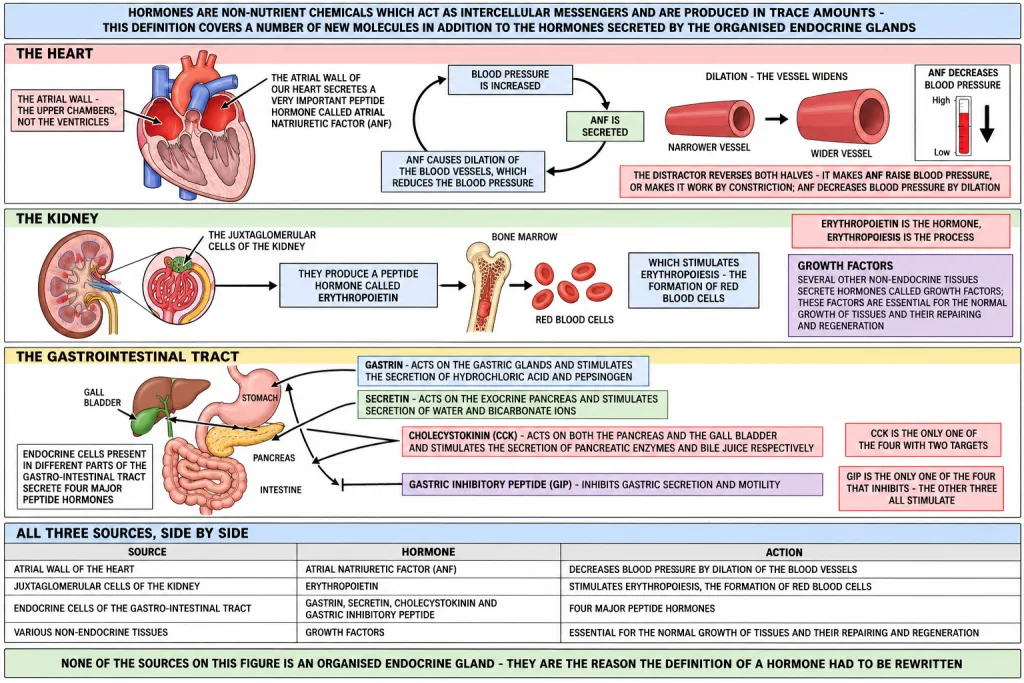
[NEET Important] Four is the count, and an option offering three or five is wrong on the chapter's own word. GIP is the only inhibitor, and an item asking which gastro-intestinal hormone inhibits gastric secretion and motility has exactly one right answer. CCK is the only one with two targets. And in the reverse direction - which hormone acts on the gastric glands - the answer is gastrin, with the other three of the same set as distractors.
Quick Recap
- Hormones are also secreted by some tissues which are not endocrine glands - this whole section exists because the definition of a hormone was widened to cover them.
- The atrial wall of our heart secretes a very important peptide hormone called atrial natriuretic factor (ANF), which DECREASES blood pressure.
- When blood pressure is increased, ANF is secreted, which causes DILATION of the blood vessels. This reduces the blood pressure.
- The juxtaglomerular cells of the kidney produce a peptide hormone called erythropoietin, which stimulates erythropoiesis (formation of RBC).
- Endocrine cells present in different parts of the gastro-intestinal tract secrete four major peptide hormones: gastrin, secretin, cholecystokinin (CCK) and gastric inhibitory peptide (GIP).
- Gastrin acts on the gastric glands and stimulates the secretion of hydrochloric acid and pepsinogen.
- Secretin acts on the exocrine pancreas and stimulates secretion of water and bicarbonate ions.
- CCK acts on both the pancreas and the gall bladder and stimulates the secretion of pancreatic enzymes and bile juice respectively.
- GIP inhibits gastric secretion and motility - it is the only one of the four that inhibits.
- Several other non-endocrine tissues secrete hormones called growth factors, which are essential for the normal growth of tissues and their repairing and regeneration.
Solved Examples
Question 1
Q. List the hormones secreted by the atrium. This is one of the chapter-end exercises.
Answer. The atrial wall of the heart secretes one hormone:
- Atrial natriuretic factor (ANF) - a peptide hormone which decreases blood pressure. When blood pressure is increased, ANF is secreted, which causes dilation of the blood vessels, and that reduces the blood pressure.
Question 2
Q. List the hormones secreted by the kidney. This is one of the chapter-end exercises.
Answer. The kidney secretes one hormone, and it comes from a named group of cells:
- Erythropoietin - a peptide hormone produced by the juxtaglomerular cells of the kidney, which stimulates erythropoiesis, that is, the formation of RBC.
Question 3
Q. List the hormones secreted by the G-I tract. This is one of the chapter-end exercises.
Answer. Endocrine cells present in different parts of the gastro-intestinal tract secrete four major peptide hormones:
- Gastrin - acts on the gastric glands and stimulates the secretion of hydrochloric acid and pepsinogen.
- Secretin - acts on the exocrine pancreas and stimulates secretion of water and bicarbonate ions.
- Cholecystokinin (CCK) - acts on both the pancreas and the gall bladder and stimulates the secretion of pancreatic enzymes and bile juice respectively.
- Gastric inhibitory peptide (GIP) - inhibits gastric secretion and motility.
Question 4
Q. Give example(s) of a blood pressure lowering hormone. This is one of the chapter-end exercises.
Answer. Atrial natriuretic factor (ANF), secreted by the atrial wall of the heart. It fits the category because it decreases blood pressure - when blood pressure is increased, ANF is secreted, which causes dilation of the blood vessels, and this reduces the blood pressure.
Question 5
Q. How does ANF bring the blood pressure down?
Answer. By dilation of the blood vessels. The sequence is: blood pressure is increased, so ANF is secreted by the atrial wall of the heart, and it causes dilation of the blood vessels, which reduces the blood pressure. Wider vessels mean the same blood presses less hard against their walls.
Question 6
Q. Which cells of the kidney produce erythropoietin, and what does it do?
Answer. The juxtaglomerular cells of the kidney. Erythropoietin is a peptide hormone and it stimulates erythropoiesis - the formation of RBC. Keep the two words apart: erythropoietin is the hormone, erythropoiesis is the process it stimulates.
Question 7
Q. Which of the four gastro-intestinal hormones inhibits rather than stimulates, and what does it inhibit?
Answer. Gastric inhibitory peptide (GIP). It inhibits gastric secretion and motility - it slows both the making of gastric juice and the movement of the stomach. Gastrin, secretin and CCK all stimulate something; GIP is the only inhibitor of the four, and its name carries the word inhibitory.
Question 8
Q. Which gastro-intestinal hormone has two target organs, and what does it do at each?
Answer. Cholecystokinin (CCK). It acts on both the pancreas and the gall bladder and stimulates the secretion of pancreatic enzymes and bile juice respectively - pancreatic enzymes from the pancreas, bile juice from the gall bladder. The other three hormones of the set have one target each.
Question 9
Q. Match each gastro-intestinal hormone with the organ it acts on.
Answer.
| Hormone | Acts on |
|---|---|
| Gastrin | The gastric glands |
| Secretin | The exocrine pancreas |
| Cholecystokinin (CCK) | The pancreas and the gall bladder |
| Gastric inhibitory peptide (GIP) | The stomach, whose secretion and motility it inhibits |
Question 10
Q. Why are the hormones of this section not covered by the classical definition of a hormone?
Answer. Because the classical definition said a hormone is a chemical produced by endocrine glands. The atrial wall of the heart, the juxtaglomerular cells of the kidney and the endocrine cells of the gastro-intestinal tract are not endocrine glands - each of those organs has a different full-time job. The current definition drops the source and says only that hormones are non-nutrient chemicals which act as intercellular messengers and are produced in trace amounts, so it covers a number of new molecules in addition to the hormones secreted by the organised endocrine glands - and these are those molecules.
Question 11
Q. What are growth factors, where do they come from, and what are they for?
Answer. Growth factors are hormones secreted by several non-endocrine tissues. They are essential for the normal growth of tissues and their repairing and regeneration. No single growth factor is named in this chapter and no gland makes them - they are the widest example of the point that a hormone need not come from an endocrine gland.
Question 12
Q. Three hormones in this chapter affect red blood cells. Name all three and say which one exists for that job alone.
Answer. Erythropoietin from the juxtaglomerular cells of the kidney stimulates erythropoiesis, the formation of RBC - that is its only stated action, so it is the one that exists for the job. The thyroid hormones also support the process of red blood cell formation, among many other actions. And cortisol, the main glucocorticoid of the adrenal cortex, stimulates RBC production alongside its other effects.
Question 13
Q. A student writes that ANF is secreted when blood pressure falls, and raises it by constricting the blood vessels. Correct every error.
Answer. Both directions are inverted. ANF is secreted when blood pressure is INCREASED, not when it falls. It causes DILATION of the blood vessels, not constriction. And the result is that it DECREASES blood pressure, it does not raise it.