
The Testis - A Sex Organ That Is Also a Gland
A pair of testis is present in the scrotal sac, outside the abdomen, of male individuals. That position matters enough to be quoted: the testes are the only glands in this chapter that sit outside the body cavity, unlike the ovaries, which are a pair located in the abdomen.
The testis performs DUAL functions - as a primary sex organ AND as an endocrine gland. That phrase is the headline of the section. As a primary sex organ it produces the spermatozoa; as an endocrine gland it produces hormones and releases them into the blood. Both jobs go on in the same organ at the same time, in two different tissues.
Testis is composed of seminiferous tubules and stromal or interstitial tissue. The two tissues divide the two jobs between them, and the endocrine half is the one this chapter is about:
| Structure | Where it is | What it does |
|---|---|---|
| Seminiferous tubules | The coiled tubules that make up the bulk of the testis | The site of spermatogenesis - the sex-organ half of the dual function |
| Stromal or interstitial tissue | The tissue between the tubules | Carries the Leydig cells - the endocrine half |
| LEYDIG CELLS, also called INTERSTITIAL CELLS | Present in the INTERTUBULAR SPACES, that is between the tubules | Produce a group of hormones called ANDROGENS, mainly TESTOSTERONE |
Three things about the Leydig cells are asked separately, so learn them as three separate answers: their second name is interstitial cells, their position is the intertubular spaces, and their product is the androgens, mainly testosterone. Leydig is a person's name, so it is written as a name and not italicised.
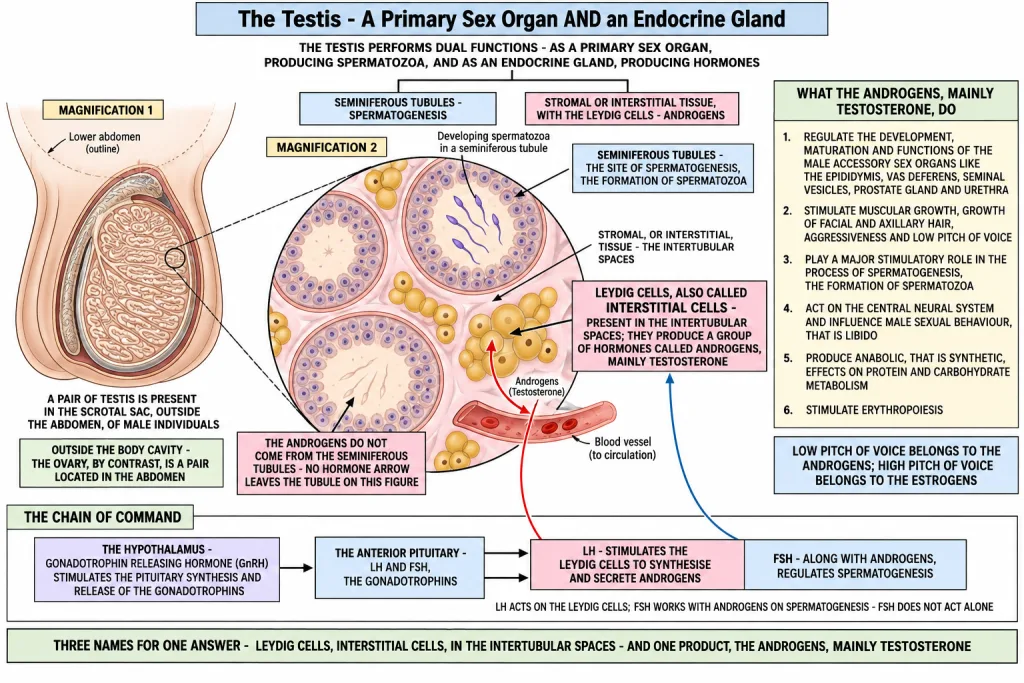
[NEET Important] The androgens do not come from the seminiferous tubules. They come from the Leydig cells in the intertubular spaces, and an option placing hormone secretion inside the tubules is the standard distractor. The dual function phrase is the other quoted item - primary sex organ and endocrine gland - and both halves must be in the answer.
What the Androgens Do
The androgens, mainly testosterone, have a long list of actions, and the chapter asks for them as a set. Learn all of them, because a question of the form "which of the following is NOT an action of androgens" picks its wrong option from just outside this list.
- They regulate the development, maturation and functions of the male accessory sex organs like the epididymis, vas deferens, seminal vesicles, prostate gland and urethra.
- They stimulate muscular growth, growth of facial and axillary hair, aggressiveness and low pitch of voice.
- They play a major stimulatory role in the process of spermatogenesis (formation of spermatozoa).
- They act on the central neural system and influence male sexual behaviour (libido).
- They produce anabolic (synthetic) effects on protein and carbohydrate metabolism.
- The chapter summary adds that androgens also stimulate erythropoiesis, the formation of red blood cells.
Two of those need a second look:
- Low pitch of voice belongs to the androgens; HIGH pitch of voice belongs to the estrogens. The pair is set as a single question more often than anything else in the gonad sections.
- Anabolic means synthetic - building up. Androgens build protein, which is why they also stimulate muscular growth, and the two facts are really one fact stated twice.
Now the endocrine grid for the testis, in the four columns that get asked:
| Hormone | Where it comes from | What it does | What controls it |
|---|---|---|---|
| Androgens, mainly testosterone | The Leydig cells (interstitial cells) in the intertubular spaces of the testis | Development, maturation and function of the male accessory sex organs; muscular growth, facial and axillary hair, aggressiveness, low pitch of voice; spermatogenesis; male sexual behaviour (libido); anabolic effects on protein and carbohydrate metabolism; erythropoiesis | LH from the anterior pituitary |
[NEET Important] The set of actions is asked as an odd-one-out. High pitch of voice, development of ovarian follicles and support of pregnancy all belong to the ovarian hormones and are the usual wrong options. Remember that spermatogenesis appears in this list - androgens stimulate it - even though FSH is also needed.
The Chain of Command - From the Hypothalamus Down to the Leydig Cells
The testis sits at the bottom of a three-step chain that was set up earlier in the chapter, and the whole chain gets asked as one item.
- The hypothalamus releases gonadotrophin releasing hormone (GnRH), which stimulates the pituitary synthesis and release of the gonadotrophins.
- The anterior pituitary releases the two gonadotrophins, LH and FSH, which stimulate gonadal activity.
- In males, LH stimulates the synthesis and secretion of androgens from the testis, acting on the Leydig cells; and FSH, together with androgens, regulates spermatogenesis.
So the two gonadotrophins split the two halves of the testis between them:
| Pituitary hormone | What it does in the male |
|---|---|
| LH | Stimulates the Leydig cells to synthesise and secrete androgens |
| FSH | Along with androgens, regulates spermatogenesis |
Notice what this means for the dual function. The endocrine half of the testis is run by LH, and the sex-organ half is run by FSH together with the androgens the Leydig cells have just made - so the two halves are not independent. The androgens made under LH are part of what drives spermatogenesis, which is why the chapter lists a major stimulatory role in spermatogenesis among the actions of the androgens themselves.
[NEET Important] LH acts on the Leydig cells; FSH works with androgens on spermatogenesis. Swapping the two gonadotrophins is the standard error. Note also that GnRH is hypothalamic, not gonadal, despite its name, so the chain begins in the brain and not in the testis.
Quick Recap
- A pair of testis is present in the scrotal sac, outside the abdomen, of male individuals.
- Testis performs dual functions as a primary sex organ as well as an endocrine gland.
- Testis is composed of seminiferous tubules and stromal or interstitial tissue.
- The Leydig cells, or interstitial cells, which are present in the intertubular spaces, produce a group of hormones called androgens, mainly testosterone.
- Androgens regulate the development, maturation and functions of the male accessory sex organs like the epididymis, vas deferens, seminal vesicles, prostate gland and urethra.
- These hormones stimulate muscular growth, growth of facial and axillary hair, aggressiveness and low pitch of voice.
- Androgens play a major stimulatory role in the process of spermatogenesis (formation of spermatozoa).
- Androgens act on the central neural system and influence the male sexual behaviour (libido).
- These hormones produce anabolic (synthetic) effects on protein and carbohydrate metabolism, and the summary adds that they also stimulate erythropoiesis.
- LH from the anterior pituitary stimulates the Leydig cells to secrete androgens, and FSH, along with androgens, regulates spermatogenesis - the chain starting from GnRH in the hypothalamus.
Solved Examples
Question 1
Q. List the hormones secreted by the testis. This is one of the chapter-end exercises.
Answer. The testis secretes one group of hormones, from one kind of cell:
- Androgens, mainly TESTOSTERONE, produced by the Leydig cells (interstitial cells) present in the intertubular spaces of the testis. They regulate the development, maturation and functions of the male accessory sex organs - the epididymis, vas deferens, seminal vesicles, prostate gland and urethra; they stimulate muscular growth, growth of facial and axillary hair, aggressiveness and low pitch of voice; they play a major stimulatory role in spermatogenesis; they act on the central neural system and influence male sexual behaviour (libido); and they produce anabolic effects on protein and carbohydrate metabolism, as well as stimulating erythropoiesis.
Question 2
Q. Write short notes on the functions of androgens. This is one of the chapter-end exercises.
Answer. Androgens are the group of hormones produced by the Leydig cells or interstitial cells lying in the intertubular spaces of the testis, and the main one is testosterone.
They regulate the development, maturation and functions of the male accessory sex organs like the epididymis, vas deferens, seminal vesicles, prostate gland and urethra. They are responsible for the male secondary sex characters: they stimulate muscular growth, growth of facial and axillary hair, aggressiveness and low pitch of voice. They play a major stimulatory role in the process of spermatogenesis, the formation of spermatozoa, working there along with FSH from the anterior pituitary. They act on the central neural system and influence the male sexual behaviour (libido). And they produce anabolic (synthetic) effects on protein and carbohydrate metabolism, which is the building-up action behind the muscular growth; the chapter summary adds that they also stimulate erythropoiesis, the formation of red blood cells.
Their secretion is itself under the control of LH from the anterior pituitary, which stimulates the Leydig cells to synthesise and secrete them.
Question 3
Q. Where are the testes located?
Answer. A pair of testis is present in the scrotal sac, which is outside the abdomen, in male individuals. Compare this with the ovaries, which are a pair located in the abdomen - the two gonads sit in different places and questions do ask which is which.
Question 4
Q. What are the dual functions of the testis?
Answer. The testis performs dual functions as a primary sex organ as well as an endocrine gland. As a primary sex organ it produces the male gametes, the spermatozoa, in the seminiferous tubules. As an endocrine gland it produces androgens, mainly testosterone, in the Leydig cells of the interstitial tissue, and releases them into the blood.
Question 5
Q. What is the testis composed of?
Answer. Seminiferous tubules and stromal or interstitial tissue. The seminiferous tubules are where spermatogenesis happens, and the interstitial tissue between them carries the Leydig cells, which make the hormones.
Question 6
Q. Name the cells that produce androgens, give their other name, and say exactly where they lie.
Answer. They are the LEYDIG CELLS, also called the INTERSTITIAL CELLS, and they are present in the INTERTUBULAR SPACES of the testis - that is, in the tissue between the seminiferous tubules, not inside them. They produce a group of hormones called androgens, mainly testosterone.
Question 7
Q. Which is the main androgen?
Answer. Testosterone. The chapter says the Leydig cells produce a group of hormones called androgens, mainly testosterone - so androgens is the group name and testosterone is the main member of it.
Question 8
Q. Name the male accessory sex organs whose development androgens regulate.
Answer. The epididymis, the vas deferens, the seminal vesicles, the prostate gland and the urethra. Androgens regulate the development, maturation and functions of all of them.
Question 9
Q. What role do androgens play in spermatogenesis?
Answer. They play a major stimulatory role in the process of spermatogenesis (formation of spermatozoa). They do not work alone: earlier in the chapter it is stated that FSH and androgens regulate spermatogenesis together, so both are needed.
Question 10
Q. Which pituitary hormone stimulates the Leydig cells, and what does it make them do?
Answer. Luteinizing hormone (LH), one of the two gonadotrophins of the anterior pituitary. In males, LH stimulates the synthesis and secretion of androgens from the testis by acting on the Leydig cells.
Question 11
Q. Trace the chain of control that ends in the secretion of testosterone.
Answer. Three steps, starting in the brain.
- The hypothalamus secretes gonadotrophin releasing hormone (GnRH), which stimulates the pituitary synthesis and release of the gonadotrophins.
- The anterior pituitary releases LH and FSH.
- LH stimulates the Leydig cells of the testis to synthesise and secrete androgens, mainly testosterone, while FSH, along with those androgens, regulates spermatogenesis.
The one line that gets the mark: hypothalamus (GnRH) - anterior pituitary (LH) - Leydig cells (testosterone).
Question 12
Q. A student writes: "Androgens are secreted by the seminiferous tubules of the testis and give a high pitch of voice." Correct every error.
Answer. Two errors, and both are standard distractors.
- Androgens are not secreted by the seminiferous tubules. They are produced by the Leydig cells or interstitial cells, present in the intertubular spaces. The seminiferous tubules are where spermatogenesis happens.
- Androgens give a LOW pitch of voice, not a high one. High pitch of voice is one of the female secondary sex characters brought about by the estrogens of the ovary.
The corrected sentence: androgens are secreted by the Leydig cells in the intertubular spaces of the testis and give a low pitch of voice.