
Why the Body Needs a Second Coordinating System
The previous chapter gave the body one coordinating system - the neural system, which provides a point-to-point rapid coordination among organs. This chapter opens by explaining why that is not enough, and the reasoning is worth learning as three separate statements, because each one is examinable on its own:
- Neural coordination is fast but SHORT-LIVED. The impulse arrives, the effect happens, and it is over. Nothing about a nerve impulse keeps a cell adjusted for hours.
- The nerve fibres do not innervate all the cells of the body. A wired system can only reach what it is wired to, and most cells have no nerve running to them.
- The cellular functions need to be CONTINUOUSLY regulated. Metabolism, growth and development do not happen in bursts, so they cannot be run by bursts.
So a special kind of coordination and integration has to be provided, and this function is carried out by hormones. The closing sentence of the opening paragraph is the one that gets quoted: the neural system and the endocrine system JOINTLY coordinate and regulate the physiological functions in the body.
| Neural coordination | Chemical coordination | |
|---|---|---|
| The messenger | The nerve impulse | Hormones |
| The route | A fixed point-to-point wired path | The blood, reaching every cell that has the right receptor |
| Speed | Fast | Slower to arrive |
| Duration | Short-lived | Continuous and sustained |
| Reach | Only cells the nerve fibres innervate | Cells the nerve fibres cannot reach as well |
[NEET Important] The three reasons are asked as a set, and "fast but short-lived" is the
phrase most often quoted verbatim. An option saying neural coordination is slow, or that the two
systems work as alternatives rather than jointly, is wrong on the chapter's own words.
Exocrine and Endocrine - What Makes a Gland Ductless
Glands come in two kinds, and the difference is a duct.
| Exocrine gland | Endocrine gland | |
|---|---|---|
| Duct | Has a duct | Lacks a duct - hence ductless gland |
| Where the secretion goes | Poured through the duct onto a surface or into a cavity | Released directly into the blood |
| What the secretion is called | An exocrine secretion - enzymes, mucus, sweat, milk | A hormone |
| Where it acts | On the surface or cavity it was poured into, close by | On a distantly located target organ |
| Examples | Salivary glands, sweat glands, the exocrine part of the pancreas | Pituitary, thyroid, adrenal, the endocrine part of the pancreas |
Endocrine glands lack ducts and are hence called ductless glands. Their secretions are called hormones. That is the sentence the chapter uses, and the word ductless is the marked one.
The definition of a hormone has been rewritten, and the chapter gives you both versions.
- The classical definition: a hormone is a chemical produced by endocrine glands and released into the blood and transported to a distantly located target organ.
- The current scientific definition: hormones are non-nutrient chemicals which act as intercellular messengers and are produced in trace amounts.
Three phrases carry the new definition and all three are marked: non-nutrient, intercellular messengers, trace amounts. And the reason the definition was widened is stated plainly - the new definition covers a number of new molecules in addition to the hormones secreted by the organised endocrine glands. Under the old definition, a chemical made by the heart or the stomach lining was not a hormone; under the new one it is, and the chapter has a whole section on exactly those.
Across the animal kingdom: invertebrates possess very simple endocrine systems with few hormones, whereas a large number of chemicals act as hormones and provide coordination in the vertebrates.
[NEET Important] The current definition is asked word for word, and the trap is a distractor
that keeps the phrase "produced by endocrine glands" in it - that belongs to the classical
definition, and dropping it is the whole point of the change. Non-nutrient is the other word
people forget: a hormone is not a food, it carries no energy, and it is needed only in trace
amounts.
The Human Endocrine System - Who Is In It
The endocrine glands and hormone-producing diffused tissues and cells located in different parts of our body constitute the endocrine system.
The chapter divides its members into two groups, and the split is asked directly.
The organised endocrine bodies - eight entries, with the gonads counted as one:
| Gland | Where it sits |
|---|---|
| Pituitary | In a bony cavity at the base of the brain, attached to the hypothalamus by a stalk |
| Pineal | On the dorsal side of the forebrain |
| Thyroid | Two lobes on either side of the trachea |
| Parathyroid | Four glands on the back side of the thyroid, one pair in each lobe |
| Thymus | Between the lungs, behind the sternum, on the ventral side of the aorta |
| Adrenal | One pair, one above each kidney |
| Pancreas | Below and behind the stomach, in the loop of the duodenum |
| Gonads | Testis in males, in the scrotal sac; ovary in females, in the abdomen |
The hypothalamus is described alongside these, and the chapter says so explicitly - it gives an account of all the major endocrine glands AND the hypothalamus. It is a part of the brain that behaves as an endocrine organ, which is why it opens the tour rather than sitting in the list above.
In addition to these, some other organs also produce hormones: the gastrointestinal tract, the liver, the kidney and the heart. These are not endocrine glands - they are organs with other full-time jobs that also secrete hormones - and they get their own section later in the chapter.
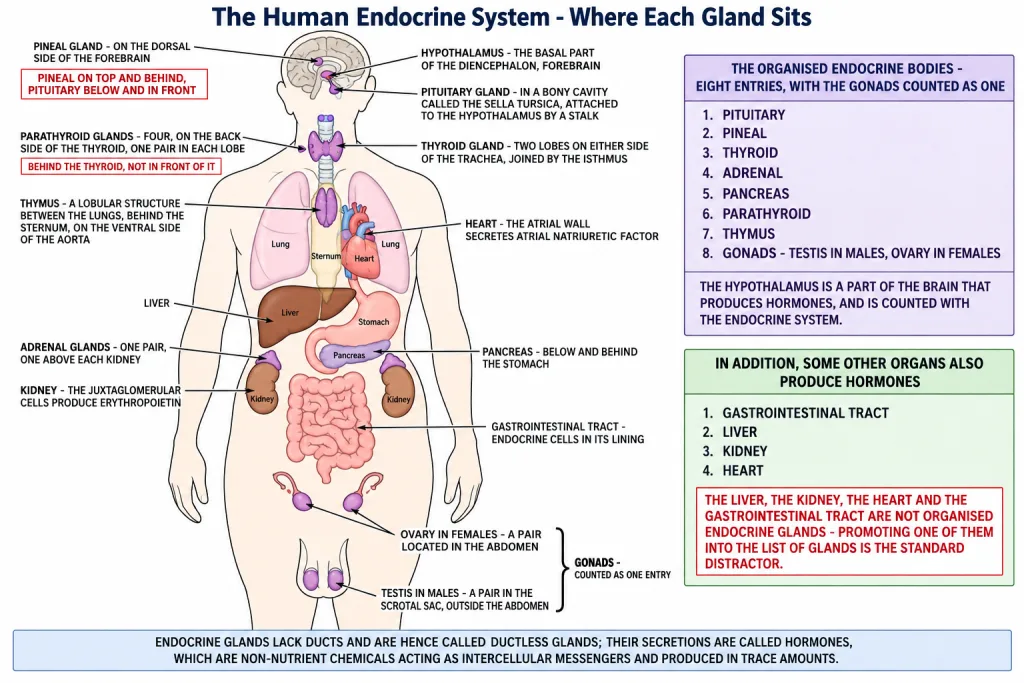
[NEET Important] Two lists, and questions swap items between them. The liver, the kidney, the
heart and the gastrointestinal tract are NOT organised endocrine glands - an item asking you to
pick the organised endocrine bodies is testing exactly that boundary. In the other direction, an
item asking which of the following is not an endocrine gland will hide the thymus or the
pineal among the distractors, and both of those genuinely are glands.
Quick Recap
- Neural coordination is fast but short-lived, the nerve fibres do not innervate all cells of the body, and cellular functions need to be continuously regulated - so a special kind of coordination is provided, and this function is carried out by hormones.
- The neural system and the endocrine system JOINTLY coordinate and regulate the physiological functions in the body.
- Endocrine glands lack ducts and are hence called ductless glands. Their secretions are called hormones.
- Classical definition of a hormone: a chemical produced by endocrine glands and released into the blood and transported to a distantly located target organ.
- Current definition: hormones are non-nutrient chemicals which act as intercellular messengers and are produced in trace amounts.
- The new definition covers a number of new molecules in addition to the hormones secreted by the organised endocrine glands.
- Invertebrates possess very simple endocrine systems with few hormones; a large number of chemicals act as hormones in vertebrates.
- The organised endocrine bodies: pituitary, pineal, thyroid, adrenal, pancreas, parathyroid, thymus and gonads (testis in males and ovary in females).
- In addition, the gastrointestinal tract, liver, kidney and heart also produce hormones.
- The hypothalamus is covered with the endocrine glands even though it is a part of the brain.
Solved Examples
Question 1
Q. Define an exocrine gland. This is one of the chapter-end exercises.
Answer. An exocrine gland is a gland that has a duct. Its secretion is not released into the blood - it is carried through the duct and poured onto a body surface or into a body cavity, where it acts close to where it was made. The salivary glands, the sweat glands, the gastric glands and the exocrine part of the pancreas are all exocrine, and their secretions are things like enzymes, mucus and sweat rather than hormones.
The contrast that gets the mark: an exocrine gland has a duct and pours its secretion onto a surface; an endocrine gland has none and releases its secretion into the blood.
Question 2
Q. Define an endocrine gland. This is one of the chapter-end exercises.
Answer. An endocrine gland is a gland that lacks a duct, and is for that reason called a ductless gland. Its secretions are hormones, and they are released directly into the blood, which carries them to a distantly located target organ. The pituitary, thyroid, parathyroid, adrenal, pineal and thymus are endocrine glands, and so are the endocrine parts of the pancreas and the gonads.
Question 3
Q. Define a hormone. This is one of the chapter-end exercises.
Answer. The definition has been updated, and both versions are worth knowing.
The classical definition described a hormone as a chemical produced by endocrine glands, released into the blood, and transported to a distantly located target organ.
The current scientific definition is wider: hormones are non-nutrient chemicals which act as intercellular messengers and are produced in trace amounts.
The three phrases that carry it are non-nutrient - a hormone is not a food and supplies no energy; intercellular messenger - it carries a message from one cell to another; and trace amounts - a very small quantity does the whole job. The reason for the change is that the new definition covers a number of new molecules in addition to the hormones secreted by the organised endocrine glands, such as the ones made by the heart, the kidney and the gut.
Question 4
Q. Indicate the location of the various endocrine glands in our body. This is one of the chapter-end exercises.
Answer. Work down the body from the head, and the picture draws itself.
In the head
- Hypothalamus - the basal part of the diencephalon in the forebrain, at the floor of the brain.
- Pituitary - just below the hypothalamus, in a bony cavity called the sella tursica, and attached to the hypothalamus by a stalk.
- Pineal - on the dorsal side of the forebrain, behind and above the pituitary.
In the neck
- Thyroid - two lobes lying on either side of the trachea, joined across the front by a thin flap of connective tissue called the isthmus.
- Parathyroid - four small glands on the BACK side of the thyroid, one pair embedded in each thyroid lobe. They are drawn on the dorsal view, not the ventral one.
In the thorax
- Thymus - a lobular structure between the two lungs, behind the sternum, on the ventral side of the aorta.
- Heart - the atrial wall secretes a hormone, so mark the heart even though it is not a gland.
In the abdomen
- Adrenals - one pair, one sitting like a cap above each kidney.
- Pancreas - below and behind the stomach, in the loop of the duodenum; only its Islets of Langerhans are endocrine.
- Kidneys - a pair, low in the back of the abdomen; they too secrete a hormone.
- Gastrointestinal tract - the stomach and intestine, whose lining cells secrete hormones.
In the pelvis and below
- Ovaries - a pair in the abdomen, in females.
- Testes - a pair in the scrotal sac, outside the abdomen, in males.
Label the eight organised glands in one colour and the four hormone-producing organs - heart, kidney, liver and gastrointestinal tract - in another, because the exam question is usually about which list a structure belongs to.
Question 5
Q. Give three reasons why the body needs chemical coordination in addition to neural coordination.
Answer. Neural coordination is fast but short-lived, so it cannot keep a function adjusted over time. The nerve fibres do not innervate all the cells of the body, so a wired system cannot reach everything. And the cellular functions need to be continuously regulated, which a burst of impulses cannot do. For these three reasons a special kind of coordination and integration has to be provided, and it is carried out by hormones.
Question 6
Q. Why are endocrine glands called ductless glands?
Answer. Because they lack ducts. An exocrine gland sends its secretion out through a duct; an endocrine gland has none, so its secretion - a hormone - goes straight into the blood.
Question 7
Q. What was wrong with the classical definition of a hormone, and how does the current definition fix it?
Answer. The classical definition said a hormone is a chemical produced by endocrine glands. That ties the definition to the gland rather than to what the molecule does, so a hormone made somewhere that is not an endocrine gland - the atrial wall of the heart, the juxtaglomerular cells of the kidney, the lining of the gastrointestinal tract - would not count.
The current definition drops the source altogether: hormones are non-nutrient chemicals which act as intercellular messengers and are produced in trace amounts. It covers a number of new molecules in addition to the hormones secreted by the organised endocrine glands, which is exactly what it was widened for.
Question 8
Q. Name the eight organised endocrine bodies of the human body.
Answer. Pituitary, pineal, thyroid, adrenal, pancreas, parathyroid, thymus and the gonads - the testis in males and the ovary in females, counted together as one entry.
Question 9
Q. Which organs, other than the organised endocrine glands, produce hormones?
Answer. The gastrointestinal tract, the liver, the kidney and the heart. They are not endocrine glands - each has another full-time job - but each of them secretes hormones.
Question 10
Q. Is the pancreas an exocrine gland or an endocrine gland?
Answer. Both. The pancreas is a composite gland. Most of it is exocrine, sending digestive enzymes down a duct into the duodenum, while the Islets of Langerhans scattered through it are endocrine and release their hormones into the blood.
Question 11
Q. Compare the endocrine system of invertebrates with that of vertebrates, as the chapter describes it.
Answer. Invertebrates possess very simple endocrine systems with few hormones. In vertebrates, by contrast, a large number of chemicals act as hormones and provide coordination. The human endocrine system described in this chapter is the vertebrate case at its most elaborate.
Question 12
Q. A student writes that a hormone is a nutrient chemical produced in large amounts that acts inside the cell that made it. Correct every error in that sentence.
Answer. Three errors, and each one inverts a marked word.
- A hormone is non-nutrient, not nutrient - it carries no food value.
- It is produced in trace amounts, not large amounts.
- It acts as an intercellular messenger - between cells - not inside the cell that made it.
The correct sentence is: hormones are non-nutrient chemicals which act as intercellular messengers and are produced in trace amounts.
Question 13
Q. Where is the hypothalamus placed in this chapter, and why?
Answer. It is described alongside the endocrine glands, at the start of the tour. The chapter says it gives an account of all the major endocrine glands and the hypothalamus of the human body. The reason is that the hypothalamus is a part of the brain that produces hormones - its neurosecretory cells make releasing and inhibiting hormones that control the pituitary - so it is the point where the neural system and the endocrine system meet.