
The Ovary - The Primary Female Sex Organ
Females have a pair of ovaries located in the abdomen. They are the female half of the gonads, and like the testis they hold two jobs at the same time.
- The ovary is the primary female sex organ, and in that role it produces one ovum during each menstrual cycle. One ovum, one cycle - the number is stated and it gets asked.
- In addition, the ovary also produces two groups of steroid hormones called estrogen and progesterone. That is the endocrine job, and it is what this chapter is about.
Both ovarian hormones are steroid hormones. Hold on to that word, because the last section of the chapter sorts hormones by chemical class and puts the steroids in the group that enters the target cell instead of signalling from outside it.
The parallel with the testis is exact and worth setting side by side, because a question will often give you one and ask for the other.
| Testis | Ovary | |
|---|---|---|
| Number and position | A pair in the scrotal sac, outside the abdomen | A pair located in the abdomen |
| Primary sex organ role | Produces spermatozoa | Produces one ovum during each menstrual cycle |
| Hormone-secreting tissue | Leydig cells of the intertubular space | Growing ovarian follicles and the corpus luteum |
| Hormones | Androgens, mainly testosterone | Estrogen and progesterone |
| Chemical class | Steroid | Steroid |
[NEET Important] The stated count is one ovum during each menstrual cycle - an option saying the ovary releases several ova per cycle is wrong on the chapter's own wording. The second marked phrase is two groups of steroid hormones: estrogen and progesterone are steroids, not peptides, and an item that lists them with insulin and glucagon is testing exactly that.
Which Structure Makes Which Hormone - Before and After Ovulation
The ovary is composed of ovarian follicles and stromal tissues. The hormone-making work is done by the follicles, and which hormone comes out depends on when you look - before ovulation or after it. This single fact is the most-asked thing in the section, so learn it as a timeline rather than as a list.
The estrogen is synthesised and secreted mainly by the GROWING OVARIAN FOLLICLES. After ovulation, the ruptured follicle is converted to a structure called the CORPUS LUTEUM, which secretes mainly PROGESTERONE.
| Before ovulation | After ovulation | |
|---|---|---|
| The structure present | The growing ovarian follicle | The corpus luteum, formed from the ruptured follicle |
| Hormone secreted mainly | Estrogen | Progesterone |
| Chemical class | Steroid | Steroid |
| What that hormone is doing | Building the female secondary sex organs and characters, and developing the growing follicles themselves | Supporting pregnancy, and preparing the mammary alveoli |
| Pituitary hormone that drives it | FSH stimulates growth and development of the ovarian follicles | LH induces ovulation and then maintains the corpus luteum |
Read the middle row in both directions, because the exam does. Growing follicle to estrogen is one question; corpus luteum to progesterone is the other; and "which structure secretes progesterone" is the same question turned around again.
The word corpus luteum is worth taking apart. It is not a separate gland. It is the same follicle, after the ovum has left it and the wall has collapsed - the ruptured follicle converted into a new structure. So the ovary does not gain an organ at ovulation; one structure changes into another, and the hormone it makes changes with it.
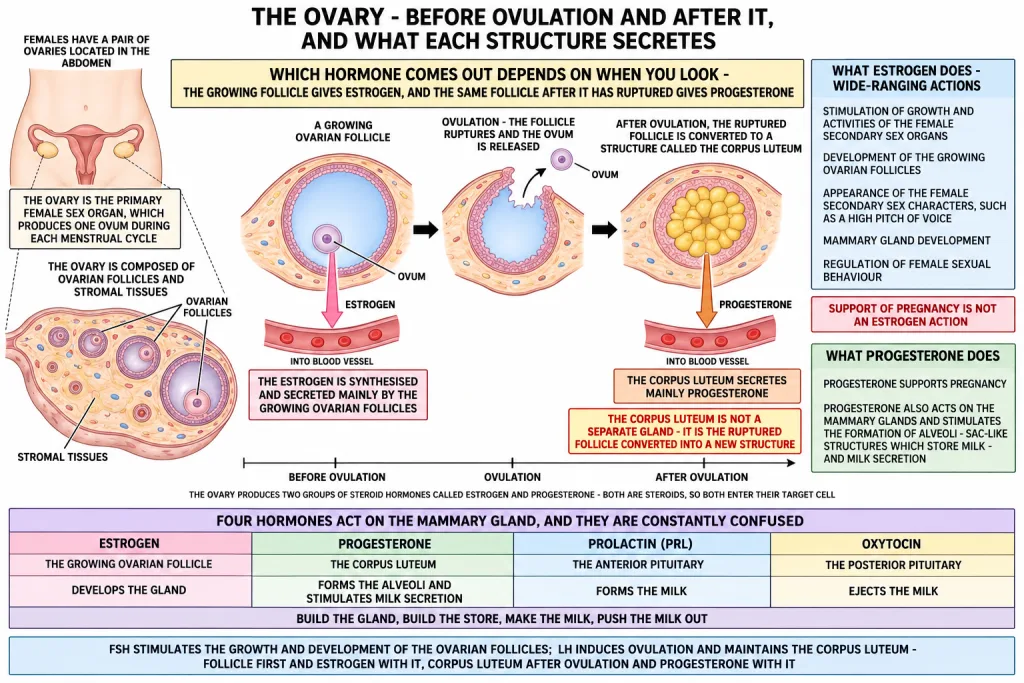
[NEET Important] The trap is the swap: an option that credits estrogen to the corpus luteum or progesterone to the growing follicle. Both are wrong, and both appear constantly. Fix the order in your head - follicle first and estrogen with it, corpus luteum after ovulation and progesterone with it. A second item hides here: the ovary is composed of ovarian follicles and stromal tissues, and a distractor will offer seminiferous tubules, which belong to the testis.
What Estrogen Does, What Progesterone Does, and Who Owns the Mammary Gland
Estrogens produce wide-ranging actions. The chapter lists them, and the phrase wide ranging is a fair warning - estrogen turns up in almost every female structure the syllabus names.
- Stimulation of growth and activities of the female secondary sex organs.
- Development of the growing ovarian follicles - estrogen helps build the very structures that make it.
- Appearance of the female secondary sex characters, for example the high pitch of voice.
- Mammary gland development.
- Regulation of female sexual behaviour.
Progesterone SUPPORTS PREGNANCY. That is its headline action and the reason it is called a progestational hormone. Progesterone also acts on the mammary glands and stimulates the formation of alveoli - sac-like structures which store milk - and milk secretion.
| Hormone | Where it comes from | What it does |
|---|---|---|
| Estrogen | Growing ovarian follicles | Growth and activities of the female secondary sex organs; development of the growing ovarian follicles; female secondary sex characters such as high pitch of voice; mammary gland development; regulation of female sexual behaviour |
| Progesterone | Corpus luteum | Supports pregnancy; acts on the mammary glands, stimulating formation of the alveoli (sac-like structures which store milk) and milk secretion |
Now sort out the mammary gland, because FOUR hormones act on it and they are constantly confused. Each one does a different step, and a question naming any one of the steps expects exactly one of these four names back.
| Step | Hormone | Where it comes from |
|---|---|---|
| Develops the gland | Estrogen | Growing ovarian follicles |
| Forms the alveoli (which store milk) and stimulates milk secretion | Progesterone | Corpus luteum |
| Forms the milk - growth of the mammary glands and formation of milk in them | Prolactin (PRL) | Anterior pituitary (pars distalis) |
| Ejects the milk - milk ejection from the mammary gland | Oxytocin | Posterior pituitary (synthesised by the hypothalamus) |
Read that table as a sequence and it stops being confusing: build the gland, build the store, make the milk, push the milk out. Two of the four are ovarian, two are pituitary.
[NEET Important] Progesterone forms the alveoli; prolactin forms the milk; oxytocin ejects it. The commonest wrong answer swaps prolactin and oxytocin - one makes milk, the other moves it. The second trap sits in the estrogen list: support of pregnancy is NOT an estrogen action, it belongs to progesterone, and an item asking which of the following is not an action of estrogens plants it there.
Quick Recap
- Females have a pair of ovaries located in the abdomen.
- The ovary is the primary female sex organ, which produces one ovum during each menstrual cycle.
- In addition, the ovary produces two groups of steroid hormones called estrogen and progesterone.
- The ovary is composed of ovarian follicles and stromal tissues.
- The estrogen is synthesised and secreted mainly by the growing ovarian follicles.
- After ovulation, the ruptured follicle is converted to a structure called the corpus luteum, which secretes mainly progesterone.
- Estrogens produce wide-ranging actions: stimulation of growth and activities of the female secondary sex organs, development of the growing ovarian follicles, appearance of the female secondary sex characters such as a high pitch of voice, and mammary gland development.
- Estrogens also regulate female sexual behaviour.
- Progesterone supports pregnancy.
- Progesterone also acts on the mammary glands and stimulates the formation of alveoli - sac-like structures which store milk - and milk secretion.
- Four hormones act on the mammary gland: estrogen develops the gland, progesterone forms the alveoli and stimulates milk secretion, prolactin forms the milk, and oxytocin ejects it.
Solved Examples
Question 1
Q. List the hormones secreted by the ovary. This is one of the chapter-end exercises.
Answer. The ovary secretes two groups of steroid hormones:
- Estrogen - synthesised and secreted mainly by the growing ovarian follicles. It stimulates the growth and activities of the female secondary sex organs, drives the development of the growing ovarian follicles, brings out the female secondary sex characters such as a high pitch of voice, causes mammary gland development, and regulates female sexual behaviour.
- Progesterone - secreted mainly by the corpus luteum, the structure the ruptured follicle is converted into after ovulation. It supports pregnancy, and it acts on the mammary glands to stimulate the formation of alveoli and milk secretion.
Question 2
Q. Write short notes on the functions of estrogens. This is one of the chapter-end exercises.
Answer. Estrogen is a steroid hormone of the ovary, synthesised and secreted mainly by the growing ovarian follicles, and estrogens produce wide-ranging actions. They stimulate the growth and the activities of the female secondary sex organs. They drive the development of the growing ovarian follicles themselves, so the hormone helps build the structure that makes it. They bring about the appearance of the female secondary sex characters, of which the chapter's own example is the high pitch of voice. They cause mammary gland development - the growth of the breast tissue, though not the milk itself, which is the work of prolactin. And they regulate female sexual behaviour. What estrogens do not do is support pregnancy; that is progesterone.
Question 3
Q. Give example(s) of a progestational hormone. This is one of the chapter-end exercises.
Answer. Progesterone, secreted mainly by the corpus luteum of the ovary. It qualifies as a progestational hormone because it supports pregnancy - that is its defining action - and it also acts on the mammary glands to stimulate the formation of alveoli and milk secretion, which prepares the body for feeding the baby that the pregnancy produces.
Question 4
Q. Where are the ovaries located, and what are their two functions?
Answer. Females have a pair of ovaries located in the abdomen. The ovary has a dual function, exactly as the testis does. As the primary female sex organ it produces one ovum during each menstrual cycle. As an endocrine gland it produces two groups of steroid hormones, estrogen and progesterone.
Question 5
Q. The ovary is composed of which two kinds of tissue?
Answer. Ovarian follicles and stromal tissues. The follicles are where the hormones are made - estrogen from the growing follicles, and progesterone from the corpus luteum that a ruptured follicle turns into.
Question 6
Q. What is the corpus luteum, how is it formed, and what does it secrete?
Answer. The corpus luteum is a structure inside the ovary. After ovulation, the ruptured follicle is converted to a structure called the corpus luteum. It is not a new gland - it is the same follicle after the ovum has left it. It secretes mainly progesterone.
Question 7
Q. Which ovarian structure secretes estrogen, and which secretes progesterone?
Answer. Estrogen is synthesised and secreted mainly by the GROWING OVARIAN FOLLICLES, which are present before ovulation. Progesterone is secreted mainly by the CORPUS LUTEUM, which exists after ovulation. The pairing runs in time order - follicle then estrogen, corpus luteum then progesterone - and swapping them is the commonest error in this section.
Question 8
Q. To which chemical class do estrogen and progesterone belong, and why does that matter?
Answer. Both are steroid hormones - the chapter calls them two groups of steroid hormones. It matters because of the mechanism of hormone action: steroids interact with intracellular receptors, so they enter the target cell and regulate gene expression or chromosome function by the interaction of the hormone-receptor complex with the genome, instead of generating second messengers from outside the cell the way a peptide hormone does.
Question 9
Q. Four hormones act on the mammary gland. Name each one, say where it comes from, and say what it does there.
Answer.
| Hormone | Source | Action on the mammary gland |
|---|---|---|
| Estrogen | Growing ovarian follicles | Mammary gland development |
| Progesterone | Corpus luteum | Formation of the alveoli (sac-like structures which store milk) and milk secretion |
| Prolactin (PRL) | Anterior pituitary | Growth of the mammary glands and formation of milk in them |
| Oxytocin | Posterior pituitary | Milk ejection from the mammary gland |
In order: estrogen builds the gland, progesterone builds the store, prolactin makes the milk, oxytocin pushes it out.
Question 10
Q. How many ova does the ovary produce during one menstrual cycle?
Answer. One. The chapter states that the ovary produces one ovum during each menstrual cycle.
Question 11
Q. A student writes: "The corpus luteum secretes mainly estrogen, and the growing follicles secrete progesterone." Correct the sentence.
Answer. Both halves are the wrong way round. The estrogen is synthesised and secreted mainly by the GROWING OVARIAN FOLLICLES, and the CORPUS LUTEUM, formed from the ruptured follicle after ovulation, secretes mainly PROGESTERONE.
Question 12
Q. A high pitch of voice in females and a low pitch of voice in males are each brought about by which hormone?
Answer. The high pitch of voice in females is one of the female secondary sex characters whose appearance is caused by estrogens from the growing ovarian follicles. The low pitch of voice in males is caused by androgens, mainly testosterone, from the Leydig cells of the testis. Both are steroid hormones from a gonad, and they act on the same character in opposite directions.
Question 13
Q. Which single action of progesterone is the one it is named for, and what else does it do?
Answer. Progesterone supports pregnancy - that is the action it is named for, and it is why progesterone is called a progestational hormone. Besides that, it acts on the mammary glands and stimulates the formation of alveoli (sac-like structures which store milk) and milk secretion.