
Where the Thyroid Sits and How It Is Built
The thyroid gland is composed of TWO LOBES which are located on either side of the trachea, one lobe to the left of the windpipe and one to the right. Both the lobes are interconnected with a thin flap of connective tissue called the ISTHMUS, which crosses the front of the trachea and joins them, so the whole gland has the shape of a butterfly lying across the throat.
Look inside and there are two levels of structure, and both are named:
- The thyroid gland is composed of FOLLICLES and STROMAL TISSUES. The follicles do the secreting; the stromal tissue is the supporting framework they sit in.
- Each thyroid follicle is composed of FOLLICULAR CELLS, enclosing a cavity. So a follicle is a little ball of cells with a hollow space in the middle, and it is the follicular cells lining that cavity that make the thyroid hormones.
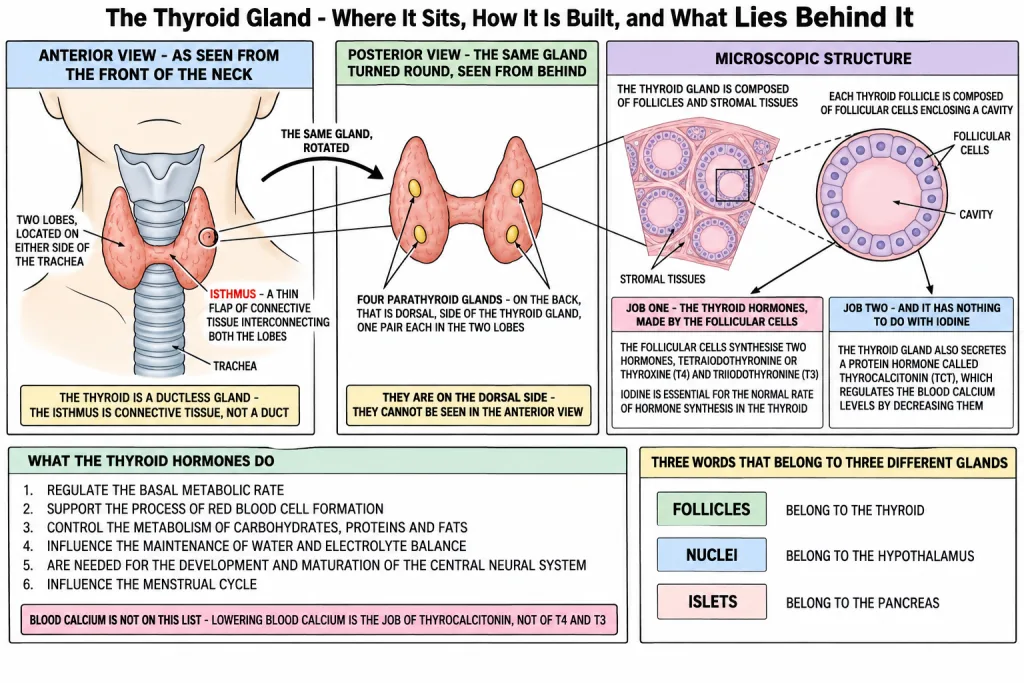
Fix the vocabulary now, because this chapter reuses the same three words for three different glands and swapping them is a standing trap. Follicles belong to the THYROID (and later to the ovary). Nuclei belong to the HYPOTHALAMUS. Islets belong to the PANCREAS. All three are real words in this chapter and all three turn up as distractors in each other's questions.
[NEET Important] Three phrases get quoted from this paragraph alone: "two lobes on either side of the trachea", "a thin flap of connective tissue called the isthmus" and "follicular cells enclosing a cavity". The commonest distractor puts the thyroid behind the trachea or makes the isthmus a duct - it is neither, it is connective tissue, and the thyroid is a ductless gland.
The Two Kinds of Hormone the Thyroid Makes
The thyroid does two quite separate jobs, made by two different routes, and keeping them apart is half the marks in this section.
Job one - the thyroid hormones, made by the follicular cells. These follicular cells synthesise two hormones, tetraiodothyronine or thyroxine () and triiodothyronine (). Learn both names for the first one: thyroxine IS tetraiodothyronine, and the exam uses either. The numbers in the subscripts are the number of iodine atoms in the molecule - four in , three in - which is why the next sentence follows straight on: iodine is essential for the normal rate of hormone synthesis in the thyroid. No iodine in the diet, no thyroid hormone, and the whole disorder half of this section grows out of that one fact.
Job two - thyrocalcitonin, and it is nothing to do with iodine. The thyroid gland ALSO secretes a PROTEIN hormone called thyrocalcitonin (TCT), which regulates the blood calcium levels - and the chapter's summary adds the direction: it does so by DECREASING it. TCT is not made by the follicular-cell iodine route at all. It is a protein hormone, where and are iodothyronines; it acts on calcium, where the thyroid hormones act on metabolism; and it is the thyroid's completely separate second job.
| Thyroid hormones | Thyrocalcitonin (TCT) | |
|---|---|---|
| Which cells make it | The follicular cells | The thyroid gland, by a separate route |
| Chemical nature | Iodothyronines - and | A PROTEIN hormone |
| Does it need iodine | Yes - iodine is essential for their synthesis | No |
| What it controls | Basal metabolic rate and general metabolism | The blood calcium levels |
| Direction of the effect | Raises the metabolic rate | DECREASES blood calcium |
[NEET Important] Two items live here. "Which hormone of the thyroid is a protein?" - the answer is TCT, never or . And "what does TCT do to blood calcium?" - it decreases it. The distractor makes TCT raise calcium, because that is what the parathyroid hormone next door does, and the two glands are stacked on top of each other.
What the Thyroid Hormones Actually Do
The chapter lists the actions of and as a set, and they get asked as a set, so learn them as a numbered list:
- They play an important role in the regulation of the BASAL METABOLIC RATE. This is the headline action - the rate at which the body burns fuel at rest is set by the thyroid.
- They support the process of RED BLOOD CELL FORMATION.
- They control the metabolism of CARBOHYDRATES, PROTEINS AND FATS - all three, not just one.
- The maintenance of WATER AND ELECTROLYTE BALANCE is also influenced by thyroid hormones.
The chapter's summary adds two more that are easy to miss and are worth carrying:
- They are needed for the development and maturation of the CENTRAL NEURAL SYSTEM. This is why a deficiency before birth damages the brain rather than only slowing the body down.
- They influence the MENSTRUAL CYCLE, which is why an adult woman with hypothyroidism has irregular periods.
Notice that calcium is not on this list. Calcium is TCT's business, and an option that smuggles "regulation of blood calcium" into a list of thyroid hormone functions is testing exactly that boundary.
[NEET Important] "Basal metabolic rate" is the phrase asked most often, and "support the process of red blood cell formation" is the one students forget - erythropoietin from the kidney is not the only hormone with a hand in making RBCs. Read a list-type option carefully: if it says "metabolism of carbohydrates only", it is wrong, because the chapter says carbohydrates, proteins and fats.
The Thyroid Disorders - Both Directions, and Goitre in Both
Every disorder in this chapter is a triple: the gland, the direction, and the name. The thyroid has faults in both directions, and the chapter gives four named conditions.
| Disorder | Direction of the fault | What causes it | What it looks like |
|---|---|---|---|
| Simple goitre | UNDER-secretion - hypothyroidism | Deficiency of iodine in our diet | Hypothyroidism and enlargement of the thyroid gland, commonly called goitre |
| Cretinism | UNDER-secretion - hypothyroidism during PREGNANCY | Maternal hypothyroidism, so the growing baby is affected | Defective development and maturation of the growing baby: stunted growth (cretinism), mental retardation, low intelligence quotient, abnormal skin and deaf-mutism |
| Irregular menstrual cycle | UNDER-secretion - hypothyroidism | Hypothyroidism in adult women | The menstrual cycle becomes irregular |
| Hyperthyroidism | OVER-secretion | Cancer of the thyroid gland, or development of nodules of the thyroid gland | The rate of synthesis and secretion of the thyroid hormones is increased to abnormally high levels, which adversely affects the body physiology |
| Exophthalmic goitre (Graves' disease) | OVER-secretion - a form of hyperthyroidism | Hyperthyroidism | Enlargement of the thyroid gland, protrusion of the eyeballs, increased basal metabolic rate and weight loss |
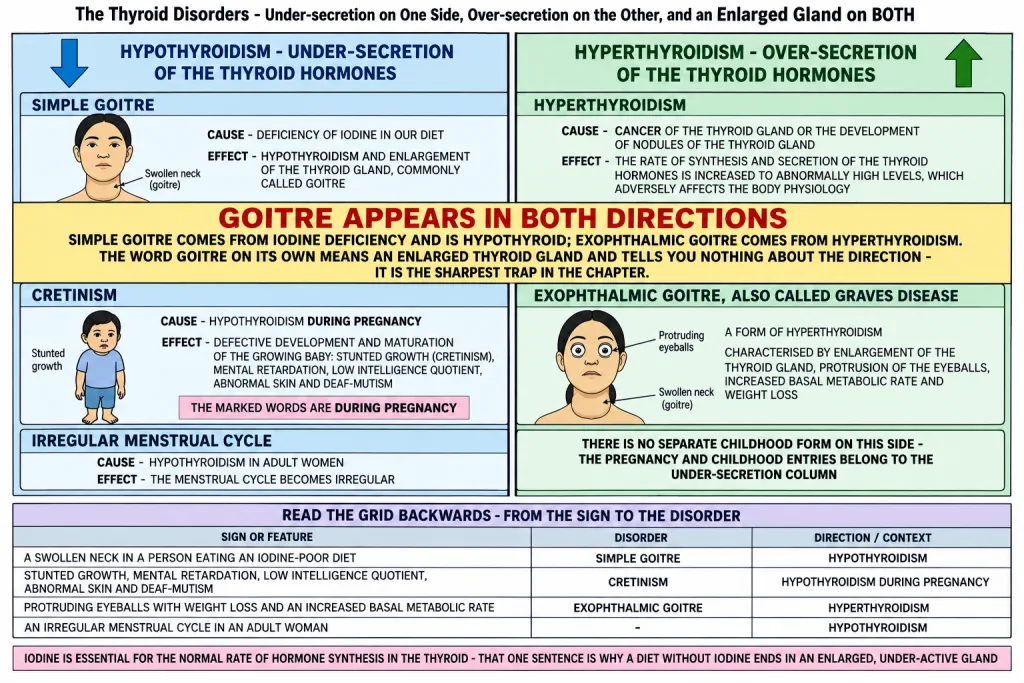
Goitre appears in BOTH directions, and this is the sharpest trap in the chapter.
- Simple goitre comes from iodine DEFICIENCY and is hypothyroid. The gland swells because it is being driven hard and cannot make hormone without iodine.
- Exophthalmic goitre comes from HYPERTHYROIDISM. The gland is enlarged here too, but the hormone level is high, not low, and the giveaway extras are the protruding eyeballs, the increased basal metabolic rate and the weight loss.
So "goitre" on its own means an enlarged thyroid gland and tells you nothing about the direction. Read the rest of the option before choosing. Exophthalmic goitre is also called Graves' disease, and Graves is a person's name.
Reading the grid backwards, which is how half the questions come:
- Stunted growth, mental retardation, low IQ, abnormal skin and deaf-mutism point back to cretinism, therefore to hypothyroidism, therefore to the thyroid, and behind that to iodine deficiency in the mother's diet during pregnancy.
- Protruding eyeballs point to exophthalmic goitre, therefore to hyperthyroidism.
- A swollen neck in a person eating an iodine-poor diet points to simple goitre, therefore to hypothyroidism.
[NEET Important] The examiner's favourite pairing is goitre against exophthalmic goitre. Also watch the timing word in cretinism - the deficiency must occur during pregnancy, that is, while the baby is developing. Hypothyroidism appearing in an adult gives irregular menstrual cycles, not cretinism, because the growing period is over.
Quick Recap
- The thyroid gland is composed of two lobes located on either side of the trachea, and both lobes are interconnected with a thin flap of connective tissue called the isthmus.
- The thyroid gland is composed of follicles and stromal tissues. Each thyroid follicle is composed of follicular cells enclosing a cavity.
- The follicular cells synthesise two hormones, tetraiodothyronine or thyroxine () and triiodothyronine ().
- Iodine is essential for the normal rate of hormone synthesis in the thyroid.
- The thyroid gland also secretes a PROTEIN hormone called thyrocalcitonin (TCT), which regulates the blood calcium levels - it DECREASES them.
- Thyroid hormones regulate the basal metabolic rate, support the process of red blood cell formation, control the metabolism of carbohydrates, proteins and fats, and influence the maintenance of water and electrolyte balance. They are also needed for the development and maturation of the central neural system and they influence the menstrual cycle.
- Deficiency of iodine in our diet results in hypothyroidism and enlargement of the thyroid gland, commonly called goitre.
- Hypothyroidism during pregnancy causes defective development and maturation of the growing baby, leading to stunted growth (cretinism), mental retardation, low intelligence quotient, abnormal skin and deaf-mutism.
- In adult women, hypothyroidism may cause the menstrual cycle to become irregular.
- Cancer of the thyroid gland, or development of nodules of the thyroid gland, increases the rate of synthesis and secretion of the thyroid hormones to abnormally high levels, leading to hyperthyroidism, which adversely affects the body physiology.
- Exophthalmic goitre is a form of hyperthyroidism, characterised by enlargement of the thyroid gland, protrusion of the eyeballs, increased basal metabolic rate and weight loss - also called Graves' disease.
- Goitre occurs in both directions: simple goitre from iodine deficiency (hypothyroidism), and exophthalmic goitre from hyperthyroidism.
Solved Examples
Question 1
Q. List the hormones secreted by the thyroid. This is one of the chapter-end exercises.
Answer. The thyroid secretes three hormones, and they fall into two quite different groups:
- Tetraiodothyronine, also called thyroxine () - made by the follicular cells; it regulates the basal metabolic rate and the general metabolism of the body.
- Triiodothyronine () - also made by the follicular cells; it does the same work as , and iodine is essential for the synthesis of both.
- Thyrocalcitonin (TCT) - a protein hormone, quite separate from the other two, which regulates the blood calcium levels by decreasing them.
Question 2
Q. Write short notes on the functions of thyroid hormones. This is one of the chapter-end exercises.
Answer. The thyroid hormones are thyroxine or tetraiodothyronine () and triiodothyronine (), made by the follicular cells of the thyroid, and iodine is essential for their synthesis. Their most important action is that they play an important role in the regulation of the BASAL METABOLIC RATE - the rate at which the body uses energy at rest. They also support the process of red blood cell formation, and they control the metabolism of carbohydrates, proteins and fats, so all three classes of food are handled under thyroid control. The maintenance of water and electrolyte balance is also influenced by thyroid hormones. Beyond this, they are needed for the development and maturation of the central neural system, which is why a shortage before birth damages the brain and produces cretinism, and they influence the menstrual cycle, which is why an adult woman who is hypothyroid has irregular periods. Note carefully that regulating blood calcium is not one of their jobs - that belongs to thyrocalcitonin (TCT), the thyroid's other, protein hormone.
Question 3
Q. Which hormonal deficiency is responsible for goitre? This is one of the chapter-end exercises.
Answer. The hormone: the thyroid hormones - thyroxine or tetraiodothyronine () and triiodothyronine (). The gland: the thyroid gland. The direction: UNDER-secretion, that is hypothyroidism.
Behind the deficiency lies a diet problem. Iodine is essential for the normal rate of hormone synthesis in the thyroid, so deficiency of iodine in our diet results in hypothyroidism and enlargement of the thyroid gland, commonly called goitre. The gland swells while the hormone level stays low, which is why this is called simple goitre.
One caution worth writing down: an enlarged thyroid also occurs in the opposite direction, as exophthalmic goitre, which is a form of hyperthyroidism and is recognised by the protrusion of the eyeballs, the increased basal metabolic rate and the weight loss that come with it.
Question 4
Q. Which hormonal deficiency is responsible for cretinism? This is one of the chapter-end exercises.
Answer. The hormone: the thyroid hormones, and . The gland: the thyroid gland. The direction: UNDER-secretion, that is hypothyroidism.
When the deficiency has to occur is the marked part of this answer: DURING PREGNANCY, while the baby is still developing. Hypothyroidism during pregnancy causes defective development and maturation of the growing baby, giving stunted growth (cretinism), mental retardation, low intelligence quotient, abnormal skin and deaf-mutism. The same deficiency arriving later, in an adult woman, does not cause cretinism - it makes the menstrual cycle irregular.
Question 5
Q. Describe the position and gross structure of the thyroid gland.
Answer. The thyroid is composed of two lobes, located on either side of the trachea. Both the lobes are interconnected with a thin flap of connective tissue called the ISTHMUS. Inside, the gland is composed of follicles and stromal tissues, and each thyroid follicle is composed of follicular cells enclosing a cavity. The follicular cells are the ones that make the thyroid hormones.
Question 6
Q. Why is iodine in the diet important for the thyroid?
Answer. Because iodine is essential for the normal rate of hormone synthesis in the thyroid. The two thyroid hormones are tetraiodothyronine () and triiodothyronine (), and the names give the reason away - they are built around four and three iodine atoms respectively. Without dietary iodine the follicular cells cannot make them, and the result is hypothyroidism with enlargement of the thyroid gland, commonly called goitre.
Question 7
Q. What is thyrocalcitonin, and how is it different from the other thyroid hormones?
Answer. Thyrocalcitonin (TCT) is a PROTEIN hormone secreted by the thyroid gland, and it regulates the blood calcium levels by DECREASING them. It differs from and on every count that matters: those two are iodothyronines made by the follicular cells and needing iodine, and they control metabolism; TCT needs no iodine, is a protein, and controls calcium. The thyroid is doing two separate jobs, and TCT is the second one.
Question 8
Q. Distinguish between simple goitre and exophthalmic goitre.
Answer.
| Feature | Simple goitre | Exophthalmic goitre |
|---|---|---|
| Direction of the fault | Hypothyroidism - under-secretion | Hyperthyroidism - over-secretion |
| Cause | Deficiency of iodine in the diet | Over-activity of the thyroid |
| The thyroid gland | Enlarged | Enlarged |
| The eyes | Normal | Protrusion of the eyeballs |
| Basal metabolic rate | Lowered | Increased |
| Body weight | Tends to rise | Weight loss |
| Other name | - | Graves' disease |
The one line that gets the mark: the gland is enlarged in both, so goitre by itself does not tell you the direction - the eyes, the metabolic rate and the weight do.
Question 9
Q. A newborn is found to have stunted growth, a low intelligence quotient, abnormal skin and deaf-mutism. Name the condition and explain what went wrong and when.
Answer. The condition is cretinism. It arises from hypothyroidism during pregnancy, which causes defective development and maturation of the growing baby. The mother's thyroid hormone supply was low - most often because of iodine deficiency in the diet - and because thyroid hormones are needed for the development and maturation of the central neural system, the damage falls on growth and on the brain. The timing is the whole answer: the deficiency has to occur while the baby is developing, not later.
Question 10
Q. How does hyperthyroidism arise, according to this chapter?
Answer. Due to cancer of the thyroid gland, or due to development of nodules of the thyroid gland, the rate of synthesis and secretion of the thyroid hormones is increased to abnormally high levels, and this condition is called hyperthyroidism. It adversely affects the body physiology. Exophthalmic goitre is a form of hyperthyroidism.
Question 11
Q. What is exophthalmic goitre, and by what other name is it known?
Answer. Exophthalmic goitre is a form of hyperthyroidism, and it is characterised by enlargement of the thyroid gland, protrusion of the eyeballs, increased basal metabolic rate and weight loss. It is also called Graves' disease.
Question 12
Q. An adult woman is found to be hypothyroid. What effect does the chapter mention?
Answer. In adult women, hypothyroidism may cause the menstrual cycle to become irregular. This is consistent with the fact that thyroid hormones influence the menstrual cycle. She will not develop cretinism - that condition belongs to a baby whose development took place under hypothyroid conditions.
Question 13
Q. Fill in the blanks: the two lobes of the thyroid are joined by the ; the hormone-making cells are the cells; and the thyroid's protein hormone is , which blood calcium.
Answer. The two lobes of the thyroid are joined by the isthmus; the hormone-making cells are the follicular cells; and the thyroid's protein hormone is thyrocalcitonin (TCT), which decreases blood calcium.
Question 14
Q. Which of the thyroid's actions is often wrongly credited to it, and to which hormone does it really belong?
Answer. Raising the blood calcium level is often wrongly credited to the thyroid. The thyroid does handle calcium, but in the opposite direction - TCT decreases blood calcium. Raising blood calcium is the job of parathyroid hormone (PTH), from the parathyroid glands, which sit on the back of the thyroid. The two glands are neighbours doing opposite jobs, which is exactly why the question works.