
Same Syllabus. A Different Exam.
The Important Questions and Answers section worked this chapter the way a written paper does - describe the pituitary, explain what PTH does, compare insulin with glucagon. NEET does not ask you to explain anything here. It names one hormone, one gland or one disorder, gives four options, and you have about half a minute.
The marking is +4 for a correct answer and -1 for a wrong one. In a written answer, "the adrenal gland secretes adrenaline and some corticoids" earns most of the mark. Here, choosing adrenal medulla where the answer is adrenal cortex is worth -1, which is five marks behind someone who left it blank.
This chapter is the purest address grid in the book, and that is good news. There is no mechanism to derive and almost no arithmetic. Everything is which gland, which hormone, which action, which disorder - four columns, and every question is one cell of that table. It is also the highest-yield chapter in Class 11 Biology for exactly that reason: a table you can recite is a table you cannot be tricked on.
Revise it as a table, not as a chapter. Read the gland-hormone table below until you can go both ways - gland to hormone and hormone to gland - because NEET asks both, and a one-way memory fails half the time. Then read the disorder table until every disease name brings its gland and its direction with it, because the direction is what the option list is built to invert.
The Four Shapes This Chapter Is Asked In
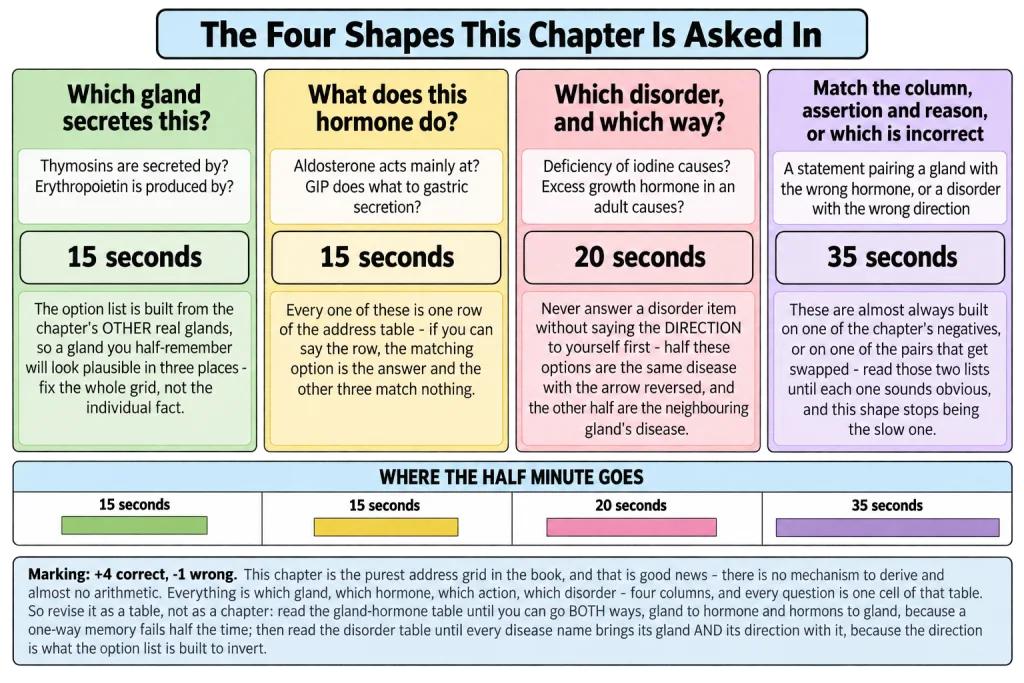
Shape 1 - Which gland secretes this? "Thymosins are secreted by?" "Erythropoietin is produced by?" Budget 15 seconds. The shortcut: the option list is built from the chapter's OTHER real glands, so a gland you half-remember will look plausible in three places. Fix the whole grid, not the individual fact.
Shape 2 - What does this hormone do? "Aldosterone acts mainly at?" "GIP does what to gastric secretion?" Budget 15 seconds. The shortcut: every one of these is one row of the address table. If you can say the row, the matching option is the answer and the other three match nothing.
Shape 3 - Which disorder, and which way? "Deficiency of iodine causes?" "Excess growth hormone in an adult causes?" Budget 20 seconds. The shortcut: never answer a disorder item without saying the DIRECTION to yourself first. Half these options are the same disease with the arrow reversed, and the other half are the neighbouring gland's disease.
Shape 4 - Match the column, assertion and reason, or "which is incorrect". Budget 35 seconds. The shortcut: these are almost always built on one of the negatives listed below, or on one of the pairs that get swapped. Read those two lists until each one sounds obvious, and this shape stops being the slow one.
The Address Table - Every Hormone in the Chapter
Learn this both ways. Cover the left column and name the hormone; cover the right and name the gland.
| Hormone | Where it comes from | Its one line |
|---|---|---|
| Releasing hormones, e.g. GnRH | Hypothalamus | Stimulate secretion of pituitary hormones |
| Inhibiting hormones, e.g. somatostatin | Hypothalamus | Inhibit secretion of pituitary hormones - somatostatin holds back GH |
| Growth hormone (GH) | Pars distalis | Growth of the body |
| Prolactin (PRL) | Pars distalis | Growth of the mammary glands and formation of milk |
| Thyroid stimulating hormone (TSH) | Pars distalis | Synthesis and secretion of thyroid hormones |
| Adrenocorticotrophic hormone (ACTH) | Pars distalis | Synthesis and secretion of glucocorticoids from the adrenal cortex |
| Luteinizing hormone (LH) | Pars distalis | Androgens from the testis; ovulation and the corpus luteum in females |
| Follicle stimulating hormone (FSH) | Pars distalis | Spermatogenesis with androgens; growth of ovarian follicles |
| Melanocyte stimulating hormone (MSH) | Pars intermedia - its only hormone | Acts on melanocytes, regulates skin pigmentation |
| Oxytocin | Made in the hypothalamus, stored and released by the posterior pituitary | Contraction of smooth muscle; uterine contraction at child birth; milk ejection |
| Vasopressin (ADH) | Made in the hypothalamus, stored and released by the posterior pituitary | Resorption of water and electrolytes by the DISTAL TUBULES; reduces diuresis |
| Melatonin | Pineal | The 24-hour (diurnal) rhythm - sleep-wake cycle, body temperature |
| Thyroxine (T4) and triiodothyronine (T3) | Thyroid, from the follicular cells | Basal metabolic rate; RBC formation; metabolism of carbohydrates, proteins and fats |
| Thyrocalcitonin (TCT) | Thyroid - a protein hormone | DECREASES blood calcium |
| Parathyroid hormone (PTH) | Parathyroid - a peptide hormone | INCREASES blood calcium - hypercalcemic |
| Thymosins | Thymus - peptide hormones | Differentiation of T-lymphocytes, cell-mediated immunity; also antibodies, humoral immunity |
| Adrenaline / epinephrine | Adrenal medulla | Fight or flight; alertness, pupil dilation, piloerection, sweating, heart beat, respiration |
| Noradrenaline / norepinephrine | Adrenal medulla | The second catecholamine, same emergency effects |
| Glucocorticoids, chiefly cortisol | Adrenal cortex | Carbohydrate metabolism; gluconeogenesis, lipolysis, proteolysis; anti-inflammatory, suppresses immunity |
| Mineralocorticoids, chiefly aldosterone | Adrenal cortex | Water and electrolyte balance; reabsorbs sodium and water, excretes potassium and phosphate |
| Androgenic steroids | Adrenal cortex, in small amounts | Axial, pubic and facial hair at puberty |
| Glucagon | Alpha cells of the Islets of Langerhans | HYPERglycemic; glycogenolysis and gluconeogenesis in the hepatocytes |
| Insulin | Beta cells of the Islets of Langerhans | HYPOglycemic; glucose uptake by hepatocytes and adipocytes, glycogenesis |
| Androgens, chiefly testosterone | Leydig cells of the testis | Male accessory sex organs, secondary sex characters, spermatogenesis, libido, anabolic effects |
| Estrogen | Growing ovarian follicles | Female secondary sex organs and characters, mammary gland development |
| Progesterone | Corpus luteum | Supports pregnancy; alveoli of the mammary gland and milk secretion |
| Atrial natriuretic factor (ANF) | Atrial wall of the heart | DECREASES blood pressure by dilating the blood vessels |
| Erythropoietin | Juxtaglomerular cells of the kidney | Erythropoiesis - formation of RBC |
| Gastrin | Gastrointestinal tract | On the gastric glands: secretion of hydrochloric acid and pepsinogen |
| Secretin | Gastrointestinal tract | On the exocrine pancreas: secretion of water and bicarbonate ions |
| Cholecystokinin (CCK) | Gastrointestinal tract | On pancreas AND gall bladder: pancreatic enzymes and bile juice |
| Gastric inhibitory peptide (GIP) | Gastrointestinal tract | INHIBITS gastric secretion and motility - the only inhibitor of the four |
The Disorder Table - Name, Gland, Direction
Every disorder item is one row of this table, and the column that decides the mark is the last one.
| Disorder | Hormone | Gland | Direction |
|---|---|---|---|
| Gigantism | GH | Pars distalis | Over-secretion, before growth stops |
| Pituitary dwarfism | GH | Pars distalis | Low secretion |
| Acromegaly | GH | Pars distalis | Over-secretion in an adult, especially in middle age |
| Diabetes insipidus | ADH / vasopressin | Posterior pituitary, hormone made in the hypothalamus | Impaired synthesis or release |
| Goitre (simple) | T4 and T3 | Thyroid | Under - from dietary iodine deficiency |
| Cretinism | T4 and T3 | Thyroid | Under, during pregnancy - affects the growing baby |
| Hyperthyroidism | T4 and T3 | Thyroid | Over - from cancer or nodules of the gland |
| Exophthalmic goitre, or Graves' disease | T4 and T3 | Thyroid | Over - a form of hyperthyroidism |
| Addison's disease | Corticoids | Adrenal CORTEX | Under-production |
| Diabetes mellitus | Insulin | Beta cells of the pancreas | Under - prolonged hyperglycemia |
Read the three tightest pairs off that table before you go any further:
- Gigantism and acromegaly are the SAME excess at two different ages - before growth stops it makes you tall, after it makes you disfigured.
- Goitre appears in BOTH directions. Simple goitre is iodine deficiency and hypothyroidism; exophthalmic goitre is hyperthyroidism. The swelling is the same; the arrow is not.
- Diabetes insipidus and diabetes mellitus share nothing but the word. Insipidus: ADH, posterior pituitary, water lost. Mellitus: insulin, pancreas, glucose lost.
And the three symptom sets worth having word-perfect:
- Cretinism: stunted growth, mental retardation, low intelligence quotient, abnormal skin, deaf-mutism.
- Exophthalmic goitre: enlargement of the thyroid gland, protrusion of the eyeballs, increased basal metabolic rate, weight loss.
- Diabetes mellitus: loss of glucose through urine, and formation of ketone bodies.
The Negatives, and the Pairs That Get Swapped
The negatives
- The posterior pituitary does NOT synthesise oxytocin or vasopressin. It stores and releases them; the hypothalamus makes them and sends them down axons.
- The hypothalamus does NOT act on the thyroid or the adrenal directly. It acts on the pituitary, and the pituitary acts on them.
- GnRH is NOT made in the gonads and TSH is NOT made in the thyroid. Both are named after their target, not their source.
- The pars intermedia does NOT secrete several hormones. It secretes only one - MSH - and in humans it is almost merged with the pars distalis.
- Thyrocalcitonin is NOT made by the parathyroid. It is a thyroid hormone, and it lowers blood calcium while PTH from the parathyroid raises it.
- The adrenal MEDULLA is the inner tissue and the CORTEX the outer - not the other way round.
- Addison's disease is NOT a medulla fault. It is under-production by the cortex.
- The adrenal cortex layers run zona reticularis (inner), zona fasciculata (middle), zona glomerulosa (outer) - the source lists them inner first.
- Glucagon comes from the alpha cells and insulin from the beta cells, not the reverse.
- The Islets of Langerhans are only 1 to 2 per cent of the pancreatic tissue - the rest is exocrine.
- Estrogen is NOT secreted by the corpus luteum. It comes from the growing ovarian follicles; the corpus luteum secretes mainly progesterone.
- ANF does not raise blood pressure. It lowers it, by dilating the blood vessels.
- GIP is the only gastrointestinal hormone that INHIBITS. Gastrin, secretin and CCK all stimulate.
- Hormones that use membrane-bound receptors do NOT enter the target cell. They generate second messengers.
- Thyroid hormones are NOT steroids, but they act like them - iodothyronines use intracellular receptors and the genome.
The pairs that get swapped
| This | Not this |
|---|---|
| PTH: parathyroid, RAISES calcium | TCT: thyroid, LOWERS calcium |
| Insulin: beta cells, LOWERS glucose | Glucagon: alpha cells, RAISES glucose |
| Prolactin FORMS the milk | Oxytocin EJECTS the milk |
| Estrogen: growing follicle | Progesterone: corpus luteum |
| Cortisol: glucocorticoid, carbohydrates | Aldosterone: mineralocorticoid, water and electrolytes |
| Aldosterone reabsorbs sodium and water | and excretes potassium and phosphate |
| Anterior pituitary: portal circulation | Posterior pituitary: direct neural regulation |
| Adrenal medulla: catecholamines | Adrenal cortex: corticoids |
| Melatonin: pineal, 24-hour rhythm | Thymosins: thymus, T-lymphocytes |
| Simple goitre: iodine deficiency, UNDER | Exophthalmic goitre: hyperthyroidism, OVER |
| Diabetes insipidus: ADH, water | Diabetes mellitus: insulin, glucose |
| Erythropoietin: kidney | ANF: atrial wall of the heart |
| Secretin acts on the exocrine pancreas | CCK acts on the pancreas AND the gall bladder |
Solved Examples at NEET Pace
Each item names the shortcut it uses, because the shortcut is the thing worth carrying into the exam hall.
Question 1
Q. Which hormone is secreted by the pars intermedia of the pituitary?
Answer. Melanocyte stimulating hormone (MSH), and it is the only one. Shortcut: pars intermedia, one hormone. It acts on the melanocytes and regulates skin pigmentation, and in humans the pars intermedia is almost merged with the pars distalis.
Question 2
Q. Oxytocin and vasopressin are released from the posterior pituitary. Where are they made?
Answer. In the hypothalamus. Shortcut: the posterior pituitary is a store, not a factory. They are transported axonally to the neurohypophysis, which only stores and releases them. An option naming the pars nervosa as the site of synthesis is the trap.
Question 3
Q. Which hormone raises blood calcium, and which lowers it?
Answer. PTH from the parathyroid RAISES it - it is a hypercalcemic hormone. Thyrocalcitonin (TCT) from the thyroid LOWERS it. Shortcut: the parathyroid pushes calcium up, the thyroid pulls it down, even though the two glands sit on top of each other.
Question 4
Q. A patient has an enlarged thyroid, protruding eyeballs, a raised basal metabolic rate and weight loss. Name the condition and its direction.
Answer. Exophthalmic goitre, also called Graves' disease - a form of HYPERthyroidism, so an over-secretion. Shortcut: eyeballs mean over. The swelling alone would not decide it, because simple goitre from iodine deficiency is an under-secretion with the same swelling.
Question 5
Q. Which cells of the Islets of Langerhans secrete insulin, and what does insulin do to blood glucose?
Answer. The beta cells. Insulin is hypoglycemic - it enhances cellular glucose uptake and utilisation by hepatocytes and adipocytes and stimulates glycogenesis, so blood glucose falls. Shortcut: B for beta, B for bringing glucose down. Alpha cells give glucagon, which does the opposite.
Question 6
Q. Which hormone acts mainly at the renal tubules to reabsorb sodium and water?
Answer. Aldosterone, the main mineralocorticoid of the adrenal cortex. It also causes the excretion of potassium and phosphate ions. Shortcut: mineralo means minerals, and minerals means the electrolytes. Cortisol, the main glucocorticoid, handles carbohydrates instead.
Question 7
Q. Which gland secretes thymosins, and what immunity do they provide?
Answer. The thymus. Thymosins drive the differentiation of T-lymphocytes, which provide cell-mediated immunity, and they also promote antibody production, which provides humoral immunity. Shortcut: T for thymus, T for T-lymphocyte. Both kinds of immunity belong in the answer - an option offering only one is incomplete.
Question 8
Q. Erythropoietin is produced by which cells, and what does it do?
Answer. The juxtaglomerular cells of the kidney, and it stimulates erythropoiesis, the formation of RBC. Shortcut: the kidney sits next to the blood it filters, so it is the organ that notices when there is not enough of it.
Question 9
Q. Which hormone decreases blood pressure, and where is it made?
Answer. Atrial natriuretic factor (ANF), made by the atrial wall of the heart. When blood pressure rises, ANF is secreted and causes dilation of the blood vessels, which reduces the blood pressure. Shortcut: the heart feels the pressure first, so the heart makes the hormone that drops it.
Question 10
Q. Which of the four gastrointestinal hormones inhibits rather than stimulates?
Answer. Gastric inhibitory peptide (GIP), which inhibits gastric secretion and motility. Shortcut: it says inhibitory in its own name. Gastrin, secretin and CCK all stimulate.
Question 11
Q. Excess growth hormone in a middle-aged adult produces which condition?
Answer. Acromegaly - severe disfigurement, especially of the face. Shortcut: same excess, different age. Before growth stops the same excess gives gigantism; a low secretion gives pituitary dwarfism.
Question 12
Q. ACTH acts on which part of which gland, and causes the release of what?
Answer. On the adrenal CORTEX, causing the synthesis and secretion of the steroid hormones called glucocorticoids. Shortcut: ACTH is corticotrophin, and cortico means cortex. An option naming the adrenal medulla is the standard distractor - the medulla is not under pituitary control.
Question 13
Q. After ovulation, which structure forms, and which hormone does it secrete?
Answer. The corpus luteum, formed from the remnants of the graafian follicle, and it secretes mainly progesterone. Shortcut: before ovulation the follicle makes estrogen, after ovulation the corpus luteum makes progesterone. The changeover is what the question is testing.
Question 14
Q. Which cells of the testis secrete androgens, and where do they lie?
Answer. The Leydig cells, also called interstitial cells, which lie in the intertubular spaces. Their chief product is testosterone. Shortcut: inter for interstitial, inter for intertubular - they sit between the seminiferous tubules, not inside them.
Question 15
Q. A hormone binds a receptor on the cell membrane and never enters the cell. What happens next, and name two second messengers.
Answer. The hormone-receptor complex generates second messengers, which regulate cellular metabolism. Two named in the chapter are cyclic AMP and IP3 - calcium ions are the third. Shortcut: peptide and protein hormones stay outside and send a messenger in; steroids and thyroid hormones go in themselves and act on the genome.
Question 16
Q. Melatonin comes from which gland, and what does it regulate?
Answer. The pineal gland, on the dorsal side of the forebrain. It regulates the 24-hour (diurnal) rhythm of the body - the sleep-wake cycle and body temperature - and also influences metabolism, pigmentation, the menstrual cycle and defense capability. Shortcut: the previous chapter said the brain runs the 24-hour rhythm and named no hormone; this is the hormone.
A Drill Before You Move On
Decide each one before you read the verdict. Aim for 15 to 20 seconds per question.
- Endocrine glands lack ducts. - True. That is why they are called ductless glands.
- The current definition of a hormone says it is produced by endocrine glands. - False. That belongs to the classical definition. The current one is non-nutrient chemicals which act as intercellular messengers and are produced in trace amounts.
- The posterior pituitary synthesises oxytocin. - False. The hypothalamus makes it; the posterior pituitary stores and releases it.
- The anterior pituitary is reached through a portal circulatory system. - True. The posterior pituitary is under direct neural regulation.
- Somatostatin stimulates the release of growth hormone. - False. It inhibits it.
- The pars distalis produces six hormones. - True. GH, PRL, TSH, ACTH, LH and FSH.
- MSH is secreted by the pars nervosa. - False. By the pars intermedia, its only hormone.
- Melatonin is secreted by the pineal gland and regulates the 24-hour rhythm. - True.
- The isthmus connects the two lobes of the thyroid. - True. It is a thin flap of connective tissue.
- Thyrocalcitonin is secreted by the parathyroid gland. - False. By the thyroid, and it decreases blood calcium.
- PTH is a hypocalcemic hormone. - False. It is hypercalcemic - it increases blood calcium.
- There are four parathyroid glands, on the back side of the thyroid. - True. One pair in each thyroid lobe.
- Thymosins provide only humoral immunity. - False. They drive T-lymphocyte differentiation for cell-mediated immunity and also promote antibodies for humoral immunity.
- The adrenal cortex is the inner tissue of the adrenal gland. - False. The medulla is inner, the cortex outer.
- Addison's disease results from under-production by the adrenal cortex. - True.
- Adrenaline and noradrenaline are called catecholamines. - True. They are the emergency hormones, the hormones of fight or flight.
- Alpha cells secrete insulin. - False. Alpha cells secrete glucagon; beta cells secrete insulin.
- Diabetes insipidus is caused by insulin deficiency. - False. That is diabetes mellitus. Insipidus is an ADH fault.
- Estrogen is secreted mainly by the corpus luteum. - False. By the growing ovarian follicles; the corpus luteum secretes mainly progesterone.
- Steroid hormones interact with intracellular receptors and regulate gene expression. - True. Iodothyronines do the same, even though they are not steroids.