
The Adrenal Cortex - The Outer Tissue of the Gland
The adrenal gland is built out of two tissues, and the last section dealt with the inner one. The adrenal CORTEX is the OUTER tissue of the adrenal gland, the layer that wraps around the centrally located medulla. Everything from here on belongs to that outer layer.
The adrenal cortex can be divided into three layers, and the chapter names them working from the inside outwards:
| Layer | Where it lies |
|---|---|
| Zona reticularis | The INNER layer |
| Zona fasciculata | The MIDDLE layer |
| Zona glomerulosa | The OUTER layer |
Read that order once more, because it is where the marks are lost. The source lists the INNER layer first - reticularis, then fasciculata, then glomerulosa - which is the reverse of the direction almost every other list in this book runs in. Fix the sequence in both directions so that neither wording catches you out:
- Inner to outer: reticularis - fasciculata - glomerulosa.
- Outer to inner: glomerulosa - fasciculata - reticularis.
Whichever way you read it, the middle layer is zona fasciculata, and that is the one entry the two orders agree on. Note also that glomerulosa, the outer layer, sounds like the glomerulus of the kidney but has nothing to do with it - the adrenal simply sits above the kidney.
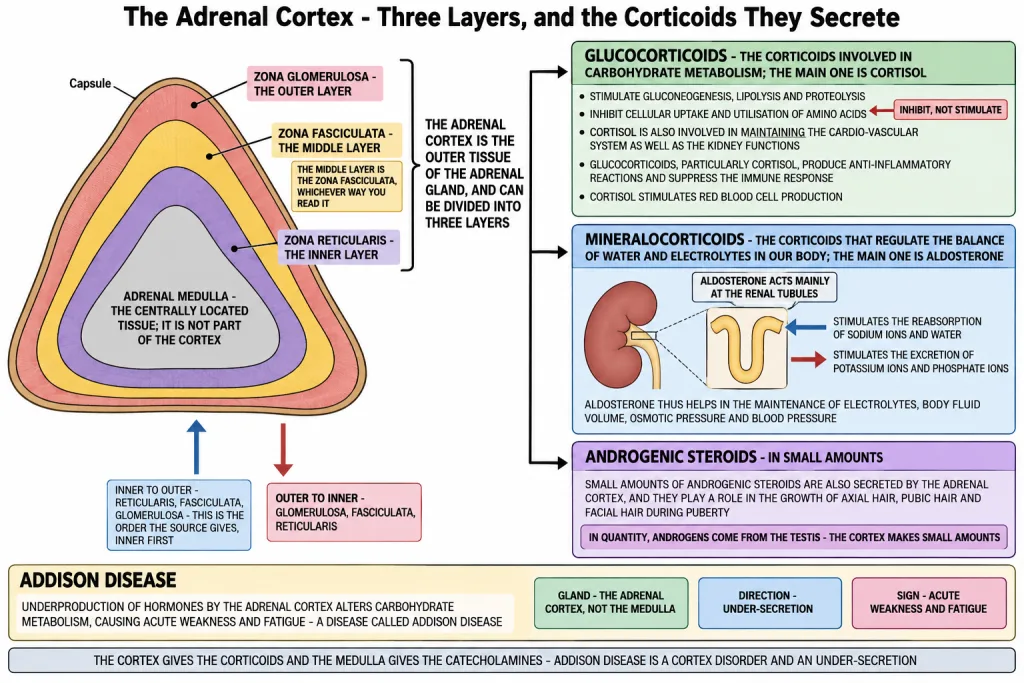
[NEET Important] Three layers, and the source names the inner one first. The commonest item gives you the three names and asks for the order, and the distractor is the same three names in outer-to-inner order. The other item asks which layer is the middle one - the answer is zona fasciculata and it cannot be caught out by the direction. Do not confuse these layers with the medulla, which is not a layer of the cortex at all but the separate tissue at the centre.
The Corticoids - Two Named Groups and a Small Third
The adrenal cortex secretes many hormones, commonly called corticoids. That word covers all of them, and the chapter then splits them by what they control.
| Group of corticoids | What it is involved in | The main hormone of the group |
|---|---|---|
| Glucocorticoids | Carbohydrate metabolism | Cortisol |
| Mineralocorticoids | The balance of water and electrolytes in our body | Aldosterone |
| Androgenic steroids | Secreted in small amounts; growth of axial hair, pubic hair and facial hair during puberty | Not individually named in this chapter |
That table is most of the adrenal question in the exam. Gluco- goes with glucose, so glucocorticoids handle carbohydrate metabolism and the main one is cortisol. Mineralo- goes with minerals, so mineralocorticoids handle water and electrolytes and the main one is aldosterone.
What the glucocorticoids do
- They stimulate gluconeogenesis, lipolysis and proteolysis - the making of new glucose, the breakdown of fat and the breakdown of protein.
- They INHIBIT cellular uptake and utilisation of amino acids. That one is an inhibition, not a stimulation, and it is the single most swapped word in this list.
- Cortisol is also involved in maintaining the cardio-vascular system as well as the kidney functions.
- Glucocorticoids, particularly cortisol, produce anti-inflammatory reactions and suppress the immune response.
- Cortisol stimulates RBC production. The chapter summary puts the same fact as glucocorticoids stimulate erythropoiesis, and adds that they affect blood pressure and the glomerular filtration rate.
What the mineralocorticoids do
- Aldosterone acts mainly at the RENAL TUBULES. That is its site of action, and the kidney is where every one of its effects happens.
- It stimulates the reabsorption of and water - sodium and water are kept in the body.
- It stimulates the excretion of and phosphate ions - potassium and phosphate are thrown out.
- Thus aldosterone helps in the maintenance of electrolytes, body fluid volume, osmotic pressure and blood pressure.
The androgenic steroids. Small amounts of androgenic steroids are also secreted by the adrenal cortex, and they play a role in the growth of axial hair, pubic hair and facial hair during puberty. They are a real cortical secretion, so an option listing them under the cortex is correct even though the testis is the main source of androgens in the body.
Now put the two main hormones side by side, because that pairing is what most adrenal questions are built on:
| Cortisol | Aldosterone | |
|---|---|---|
| Group of corticoids | Glucocorticoid | Mineralocorticoid |
| What it is involved in | Carbohydrate metabolism | Water and electrolyte balance |
| Position in its group | The main glucocorticoid | The main mineralocorticoid |
| Where it acts | Widely - cardio-vascular system, kidney, immune system, bone marrow | Mainly at the renal tubules |
| Signature action | Gluconeogenesis, lipolysis, proteolysis; anti-inflammatory; stimulates RBC production | Reabsorption of and water, excretion of and phosphate ions |
[NEET Important] Two swaps carry most of the marks here. The first swaps the pair - an option calling aldosterone the main glucocorticoid, or cortisol the hormone of water and electrolyte balance, is wrong. The second swaps the ions - aldosterone reabsorbs and excretes , never the other way round. And remember that glucocorticoids inhibit cellular uptake and utilisation of amino acids while they stimulate gluconeogenesis, lipolysis and proteolysis.
Addison's Disease - and Reading the Adrenal Grid Backwards
Underproduction of hormones by the adrenal cortex alters carbohydrate metabolism, causing acute weakness and fatigue - a disease called ADDISON'S DISEASE.
Take that sentence apart, because all three of its pieces are asked:
| The question asked | The answer |
|---|---|
| Which gland? | The adrenal |
| Which tissue of it? | The CORTEX, not the medulla |
| Which direction? | UNDER-secretion, not over-secretion |
| What is disturbed? | Carbohydrate metabolism |
| What the patient feels | Acute weakness and fatigue |
Both the cortex and the under get swapped in options, and they get swapped in the same item, so read a distractor to the end before accepting it. The name Addison is a person's name, so it is written with a plain apostrophe as Addison's disease.
Now the grid backwards. The exam asks "which gland secretes X" as often as "what does X do", so run the adrenal list in reverse until it is automatic:
- Cortisol points back to the adrenal cortex, as a glucocorticoid.
- Aldosterone points back to the adrenal cortex, as a mineralocorticoid.
- Adrenaline and noradrenaline point back to the adrenal MEDULLA, as catecholamines - not to the cortex.
- Addison's disease points back to the adrenal cortex and to under-secretion.
- Androgenic steroids in small amounts point back to the adrenal cortex; androgens in quantity point back to the testis.
- Going one step further up the chain, ACTH from the anterior pituitary stimulates the synthesis and secretion of the glucocorticoids from the adrenal cortex - so the cortex, unlike the medulla, sits under pituitary control.
[NEET Important] Addison's disease is a CORTEX disorder and an UNDER-secretion. An option attributing it to the adrenal medulla, or to over-secretion of corticoids, is wrong on both counts. Pair it in your revision with the other under-secretion disorders of this chapter - pituitary dwarfism from low GH, diabetes insipidus from impaired ADH, and goitre and cretinism from hypothyroidism - so that you never have to guess the direction.
Quick Recap
- The adrenal cortex is the OUTER tissue of the adrenal gland; the medulla is the centrally located one.
- The adrenal cortex can be divided into three layers: zona reticularis (inner layer), zona fasciculata (middle layer) and zona glomerulosa (outer layer) - the source lists them inner first.
- The adrenal cortex secretes many hormones, commonly called corticoids.
- The corticoids which are involved in carbohydrate metabolism are called glucocorticoids, and cortisol is the main glucocorticoid.
- Corticoids which regulate the balance of water and electrolytes in our body are called mineralocorticoids, and aldosterone is the main mineralocorticoid.
- Glucocorticoids stimulate gluconeogenesis, lipolysis and proteolysis, and INHIBIT cellular uptake and utilisation of amino acids.
- Cortisol is also involved in maintaining the cardio-vascular system as well as the kidney functions.
- Glucocorticoids, particularly cortisol, produce anti-inflammatory reactions and suppress the immune response.
- Cortisol stimulates RBC production; the summary states this as glucocorticoids stimulate erythropoiesis, and adds that they affect blood pressure and the glomerular filtration rate.
- Aldosterone acts mainly at the renal tubules and stimulates the reabsorption of and water and the excretion of and phosphate ions.
- Aldosterone thus helps in the maintenance of electrolytes, body fluid volume, osmotic pressure and blood pressure.
- Small amounts of androgenic steroids are also secreted by the adrenal cortex, which play a role in the growth of axial hair, pubic hair and facial hair during puberty.
- Underproduction of hormones by the adrenal cortex alters carbohydrate metabolism, causing acute weakness and fatigue - a disease called Addison's disease.
Solved Examples
Question 1
Q. List the hormones secreted by the adrenal. This is one of the chapter-end exercises.
Answer. The adrenal gland has two tissues, and each secretes its own set of hormones.
From the adrenal MEDULLA - the two catecholamines:
- Adrenaline, also called epinephrine - an emergency hormone, or hormone of Fight or Flight, which increases alertness, pupilary dilation, piloerection and sweating, increases the heart beat, the strength of heart contraction and the rate of respiration, and stimulates the breakdown of glycogen, raising blood glucose.
- Noradrenaline, also called norepinephrine - the second catecholamine, secreted rapidly in response to stress of any kind and during emergency situations, with the same actions on the heart, the respiration rate and the breakdown of glycogen, lipids and proteins.
From the adrenal CORTEX - the corticoids:
- Glucocorticoids, of which cortisol is the main one - they are the corticoids involved in carbohydrate metabolism, stimulating gluconeogenesis, lipolysis and proteolysis while inhibiting cellular uptake and utilisation of amino acids; cortisol also maintains the cardio-vascular system and the kidney functions, produces anti-inflammatory reactions, suppresses the immune response and stimulates RBC production.
- Mineralocorticoids, of which aldosterone is the main one - they regulate the balance of water and electrolytes; aldosterone acts at the renal tubules, reabsorbing and water and excreting and phosphate ions, and so maintains body fluid volume, osmotic pressure and blood pressure.
- Androgenic steroids, secreted in small amounts - they play a role in the growth of axial hair, pubic hair and facial hair during puberty.
Question 2
Q. Name the three layers of the adrenal cortex in the order the chapter gives them.
Answer. Zona reticularis, the inner layer; zona fasciculata, the middle layer; and zona glomerulosa, the outer layer. The chapter names the inner layer first, which is the reverse of the way most lists run, so read the direction in the question before choosing.
Question 3
Q. What are corticoids, and what are the two main groups called?
Answer. Corticoids are the many hormones secreted by the adrenal cortex - the name simply means "of the cortex". The two main groups are:
- Glucocorticoids, the corticoids involved in carbohydrate metabolism;
- Mineralocorticoids, the corticoids which regulate the balance of water and electrolytes in our body.
Small amounts of androgenic steroids are secreted as well.
Question 4
Q. Write down what the glucocorticoids do.
Answer. They are the corticoids of carbohydrate metabolism, and cortisol is the main glucocorticoid. They stimulate gluconeogenesis, lipolysis and proteolysis - making new glucose, breaking down fat and breaking down protein - and they inhibit cellular uptake and utilisation of amino acids. Cortisol is also involved in maintaining the cardio-vascular system as well as the kidney functions, it produces anti-inflammatory reactions and suppresses the immune response, and it stimulates RBC production, which the summary calls erythropoiesis.
The one line that gets the mark: glucocorticoids stimulate gluconeogenesis, lipolysis and proteolysis but inhibit the cellular uptake and utilisation of amino acids.
Question 5
Q. Which is the main mineralocorticoid, and where does it act?
Answer. Aldosterone. It acts mainly at the renal tubules, that is in the kidney. There it stimulates the reabsorption of and water and the excretion of and phosphate ions.
Question 6
Q. How does aldosterone help maintain blood pressure?
Answer. By holding on to salt and water. At the renal tubules it reabsorbs and water back into the body instead of letting them go out in the urine, and it excretes and phosphate ions. Keeping sodium and water in keeps the volume of body fluid up, so aldosterone helps in the maintenance of electrolytes, body fluid volume, osmotic pressure and blood pressure.
Question 7
Q. Which ions does aldosterone keep in the body, and which does it throw out?
Answer. It keeps , together with water, by stimulating their reabsorption. It throws out and phosphate ions, by stimulating their excretion. Sodium in, potassium out - reversing that pair is the commonest mistake in this chapter.
Question 8
Q. Which hormonal fault is responsible for Addison's disease?
Answer. Underproduction of hormones by the adrenal CORTEX - that is, too little of the corticoids. It alters carbohydrate metabolism, causing acute weakness and fatigue, and the condition is called Addison's disease.
Three things must be right in the answer: the gland is the adrenal, the tissue is the cortex and not the medulla, and the direction is under-secretion and not over-secretion.
Question 9
Q. Distinguish between glucocorticoids and mineralocorticoids.
Answer.
| Feature | Glucocorticoids | Mineralocorticoids |
|---|---|---|
| Source | The adrenal cortex | The adrenal cortex |
| What they are involved in | Carbohydrate metabolism | The balance of water and electrolytes |
| Main hormone | Cortisol | Aldosterone |
| Main site of action | Widely spread - liver, cardio-vascular system, kidney, immune system | Mainly the renal tubules |
| Signature actions | Gluconeogenesis, lipolysis, proteolysis; anti-inflammatory; suppress the immune response; stimulate RBC production | Reabsorption of and water, excretion of and phosphate ions |
Question 10
Q. Does the adrenal cortex secrete any sex hormones?
Answer. Yes. Small amounts of androgenic steroids are also secreted by the adrenal cortex. They play a role in the growth of axial hair, pubic hair and facial hair during puberty. The quantity is small - the testis is the body's main source of androgens - but the adrenal cortex is a genuine source and an option saying so is correct.
Question 11
Q. Which corticoid produces anti-inflammatory reactions and suppresses the immune response?
Answer. Cortisol, the main glucocorticoid. The chapter says glucocorticoids, particularly cortisol, produce anti-inflammatory reactions and suppress the immune response. This is why cortisol-like drugs are given to bring down swelling and to hold back an over-active immune system.
Question 12
Q. A student writes: "Aldosterone is a glucocorticoid that raises blood glucose, and cortisol is a mineralocorticoid secreted by the adrenal medulla." Correct every error.
Answer. Four errors, and each one is a swap.
- Aldosterone is a mineralocorticoid, not a glucocorticoid.
- Aldosterone does not raise blood glucose - it regulates the balance of water and electrolytes, acting at the renal tubules.
- Cortisol is a glucocorticoid, not a mineralocorticoid, and it is the one involved in carbohydrate metabolism.
- Both are secreted by the adrenal CORTEX, not the medulla. The medulla secretes adrenaline and noradrenaline.
The corrected sentence: cortisol is the main glucocorticoid and aldosterone the main mineralocorticoid, and both are secreted by the adrenal cortex.