
Where the Pituitary Sits and How It Is Divided
The pituitary gland is located in a bony cavity called the SELLA TURSICA, a small saddle-shaped hollow in the floor of the skull, and it is attached to the hypothalamus by a stalk. That stalk is the whole reason the previous section had to come first - the pituitary is the organ the hypothalamus gives its orders to.
Anatomically the gland is divided into an ADENOHYPOPHYSIS and a NEUROHYPOPHYSIS, and the adenohypophysis itself consists of two portions, the PARS DISTALIS and the PARS INTERMEDIA. So the gland has three working parts, not two, and each of the three secretes a different set of hormones.
The naming is where marks are lost, because the exam uses the anatomical name and the common name interchangeably and expects you to know they are the same thing:
| Anatomical name | Part of | Common name | What it does |
|---|---|---|---|
| Pars distalis | Adenohypophysis | Anterior pituitary | Produces six hormones |
| Pars intermedia | Adenohypophysis | (no separate common name) | Secretes only one hormone, MSH |
| Pars nervosa | Neurohypophysis | Posterior pituitary | Stores and releases two hormones |
Read the table both ways. Pars distalis IS the anterior pituitary. Pars nervosa IS the neurohypophysis IS the posterior pituitary. An option that pairs the pars intermedia with the posterior pituitary, or the pars nervosa with the adenohypophysis, is wrong.
This section takes the pars distalis - the anterior pituitary - and does nothing else. The next one takes the other two parts.
[NEET Important] Sella tursica is asked as a one-word answer, and the distractors are other named structures from this chapter - the isthmus belongs to the thyroid and the graafian follicle to the ovary. The second item is the division: adenohypophysis = pars distalis + pars intermedia, and an option that puts the pars nervosa inside the adenohypophysis is the commonest wrong answer.
The Six Hormones of the Pars Distalis
The pars distalis produces SIX hormones. Learn them as a grid - each hormone, the gland or organ it acts on, and what it makes that target do. Every row here is a question in its own right.
| Hormone | Full name | Target | What it does there |
|---|---|---|---|
| GH | Growth hormone | The body as a whole - bones and tissues | Drives growth of the body; too much or too little gives the disorders in the next block |
| PRL | Prolactin | The mammary glands | Regulates the growth of the mammary glands and the formation of milk in them |
| TSH | Thyroid stimulating hormone | The thyroid gland | Stimulates the synthesis and secretion of thyroid hormones from the thyroid gland |
| ACTH | Adrenocorticotrophic hormone | The adrenal cortex | Stimulates the synthesis and secretion of steroid hormones called GLUCOCORTICOIDS from the adrenal cortex |
| LH | Luteinizing hormone | The gonads - testis and ovary | Stimulates gonadal activity; the detail is split by sex in the next block |
| FSH | Follicle stimulating hormone | The gonads - testis and ovary | Stimulates gonadal activity; the detail is split by sex in the next block |
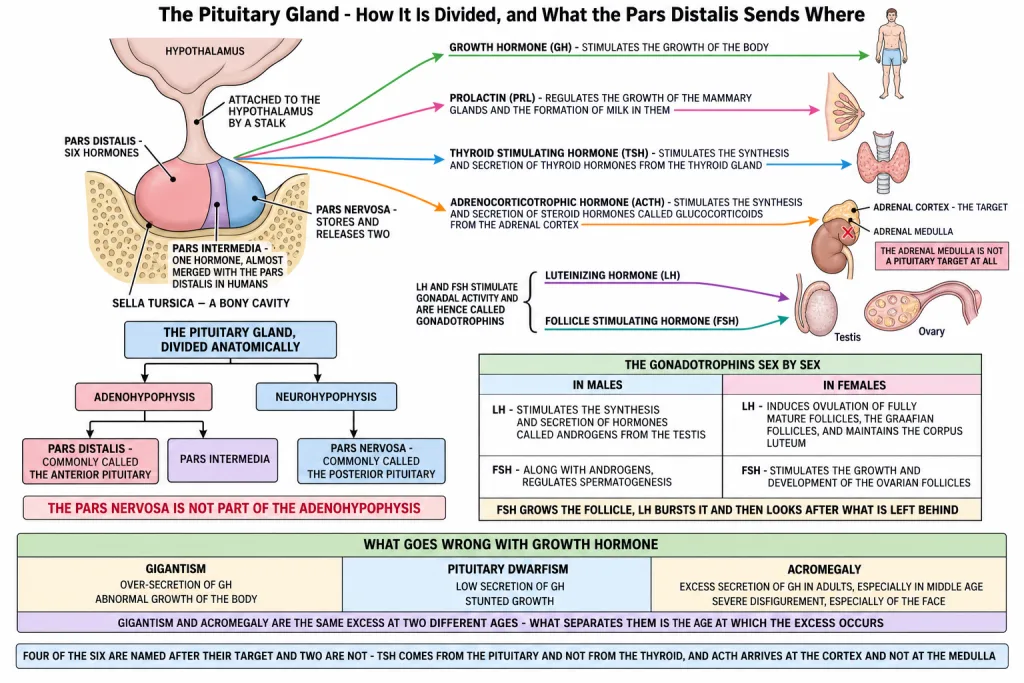
Now read the grid backwards, because that is the other half of the exam. Given a target, name the hormone that reaches it:
- The thyroid gland is reached by TSH - and note that TSH comes from the pituitary, not from the thyroid, despite its name.
- The adrenal CORTEX is reached by ACTH. The adrenal MEDULLA is not a pituitary target at all - it is under neural control, and that is a favourite trap.
- The mammary glands are reached by PRL, which forms the milk. A second hormone, oxytocin, reaches the same organ to eject the milk, but that one comes from the posterior pituitary and belongs to the next section.
- The gonads are reached by LH and FSH.
Four of the six are named after their target and one is not. TSH, ACTH, FSH and, by its group name, the pair of gonadotrophins all carry their target in their name. GH and PRL do not.
[NEET Important] The single most asked row is ACTH - adrenal CORTEX - glucocorticoids, and the marked words are cortex and glucocorticoids. Options offering the adrenal medulla, or mineralocorticoids instead of glucocorticoids, are both wrong. The other frequent item is PRL versus oxytocin on the mammary gland: prolactin forms the milk, oxytocin ejects it.
The Gonadotrophins - LH and FSH, Sex by Sex
LH and FSH stimulate gonadal activity and are hence called GONADOTROPHINS. That group name is worth a question by itself: if an item asks for an example of a gonadotrophic hormone, the answer is LH and FSH, and nothing else in the chapter qualifies.
What each of them actually does depends on the sex, and the chapter states four separate facts. Keep them in a two-column table, because the exam swaps the sexes over:
| In males | In females | |
|---|---|---|
| LH | Stimulates the synthesis and secretion of hormones called ANDROGENS from the testis | Induces OVULATION of fully mature follicles (graafian follicles) and maintains the CORPUS LUTEUM |
| FSH | Along with androgens, regulates SPERMATOGENESIS | Stimulates the growth and development of the OVARIAN FOLLICLES |
Three details inside that table are marked and easy to lose:
- In males it is LH that reaches the testis first. LH makes the testis secrete androgens, and then FSH and androgens together regulate spermatogenesis. So FSH does not act alone - the chapter names the pair.
- In females, ovulation is triggered by LH, not by FSH. FSH grows the follicle; LH bursts it. That division is the single most asked line of the pair.
- The corpus luteum is formed from the remnants of the graafian follicle after ovulation, and it is LH that maintains it.
[NEET Important] The trap is always the swap. FSH stimulates growth and development of the ovarian follicles; LH induces ovulation of the fully mature graafian follicle and maintains the corpus luteum. An option crediting FSH with ovulation, or LH with follicle growth, is wrong. In the male column, an option saying FSH alone regulates spermatogenesis misses androgens, which the chapter names alongside it.
What Goes Wrong with Growth Hormone
Growth hormone is the one pars distalis hormone whose disorders the chapter names, and it names three. Every one of them needs the direction of the fault attached to it - too much or too little - and, for the excess, the age at which the excess happens.
| Disorder | Direction of the fault | Age | What is seen |
|---|---|---|---|
| Gigantism | OVER-secretion of GH | In the growing years | Abnormal growth of the body - an abnormally tall person |
| Pituitary dwarfism | LOW secretion of GH | In the growing years | Stunted growth |
| Acromegaly | EXCESS secretion of GH | In adults, especially in middle age | Severe disfigurement, especially of the face |
Gigantism and acromegaly are the SAME excess at two DIFFERENT ages. That is the sentence to carry into the exam. While the long bones can still lengthen, extra GH makes the whole body overgrow and the person becomes a giant. Once growth has finished and the bones can no longer lengthen, the same excess in an adult thickens the bones and soft tissues that can still respond - the hands, the feet and above all the face - and that is acromegaly. Same hormone, same direction, different age, different name.
Acromegaly carries two extra clauses that get quoted. It may lead to serious complications and premature death if unchecked, and it is hard to diagnose in the early stages, so it often goes undetected for many years, until changes in the external features become noticeable. The reason is exactly the slowness - the face changes so gradually that nobody around the patient notices.
The reverse mapping, which is how the disorder questions are actually set:
- An abnormally tall person - gigantism - points back to GH, over-secretion, in childhood.
- A person of stunted growth - pituitary dwarfism - points back to GH, low secretion. Note that cretinism also gives stunted growth, but that is a thyroid fault in a later section, not a pituitary one.
- A disfigured face in middle age - acromegaly - points back to GH, excess, in the adult.
[NEET Important] Two items live here. The first asks you to match the disorder to the direction: over-secretion gives gigantism, low secretion gives pituitary dwarfism, and reversing the two is the classic error. The second asks for the difference between gigantism and acromegaly, and the answer is the age at which the excess occurs, not the hormone and not the direction.
Quick Recap
- The pituitary gland is located in a bony cavity called the sella tursica and is attached to the hypothalamus by a stalk.
- It is divided anatomically into an adenohypophysis and a neurohypophysis.
- The adenohypophysis consists of two portions, the pars distalis and the pars intermedia.
- The pars distalis is commonly called the anterior pituitary; the pars nervosa, or neurohypophysis, is the posterior pituitary.
- The pars distalis produces SIX hormones: growth hormone (GH), prolactin (PRL), thyroid stimulating hormone (TSH), adrenocorticotrophic hormone (ACTH), luteinizing hormone (LH) and follicle stimulating hormone (FSH).
- PRL regulates the growth of the mammary glands and the formation of milk in them.
- TSH stimulates the synthesis and secretion of thyroid hormones from the thyroid gland.
- ACTH stimulates the synthesis and secretion of steroid hormones called glucocorticoids from the adrenal cortex.
- LH and FSH stimulate gonadal activity and are hence called gonadotrophins.
- In males, LH stimulates the synthesis and secretion of androgens from the testis, and FSH and androgens together regulate spermatogenesis.
- In females, LH induces ovulation of fully mature follicles (graafian follicles) and maintains the corpus luteum, which is formed from the remnants of the graafian follicle after ovulation; FSH stimulates the growth and development of the ovarian follicles.
- Over-secretion of GH gives gigantism - abnormal growth of the body.
- Low secretion of GH gives stunted growth, pituitary dwarfism.
- Excess GH in adults, especially in middle age, gives acromegaly - severe disfigurement especially of the face, which may lead to serious complications and premature death if unchecked, and which is hard to diagnose in the early stages.
- Gigantism and acromegaly are the same excess of GH at two different ages.
Solved Examples
Question 1
Q. Hypothalamic hormones - target gland: __. This is one of the chapter-end exercises.
Answer. Hypothalamic hormones - target gland: the PITUITARY.
The hypothalamic releasing and inhibiting hormones act on the pituitary and nowhere else. They reach the anterior pituitary through a portal circulatory system and regulate the synthesis and secretion of pituitary hormones. The hypothalamus does not act on the thyroid or the adrenal itself - it acts on the pituitary, and the pituitary acts on those.
Question 2
Q. Thyrotrophin (TSH) - target gland: __. This is one of the chapter-end exercises.
Answer. Thyrotrophin (TSH) - target gland: the THYROID GLAND.
TSH stimulates the synthesis and secretion of thyroid hormones from the thyroid gland. Note that TSH itself is made in the pars distalis of the pituitary, not in the thyroid - the name tells you where it goes, not where it comes from.
Question 3
Q. Corticotrophin (ACTH) - target gland: __. This is one of the chapter-end exercises.
Answer. Corticotrophin (ACTH) - target gland: the ADRENAL CORTEX.
ACTH stimulates the synthesis and secretion of steroid hormones called glucocorticoids from the adrenal cortex. The word cortex is the marked one. The adrenal medulla, which makes adrenaline and noradrenaline, is not an ACTH target.
Question 4
Q. Gonadotrophins (LH, FSH) - target gland: __. This is one of the chapter-end exercises.
Answer. Gonadotrophins (LH, FSH) - target gland: the GONADS - the TESTIS in males and the OVARY in females.
LH and FSH stimulate gonadal activity, and that is why they are called gonadotrophins. In males LH acts on the testis to make it secrete androgens, and FSH, along with those androgens, regulates spermatogenesis. In females LH induces ovulation and maintains the corpus luteum, while FSH stimulates the growth and development of the ovarian follicles.
Question 5
Q. Give example(s) of gonadotrophic hormones. This is one of the chapter-end exercises.
Answer. The gonadotrophic hormones are luteinizing hormone (LH) and follicle stimulating hormone (FSH), both from the pars distalis of the pituitary.
- LH fits the category because it acts on the gonads - in males it stimulates the synthesis and secretion of androgens from the testis, and in females it induces ovulation of the mature graafian follicle and maintains the corpus luteum.
- FSH fits because it too acts on the gonads - in males it regulates spermatogenesis along with androgens, and in females it stimulates the growth and development of the ovarian follicles.
Both stimulate gonadal activity, and hence they are called gonadotrophins.
Question 6
Q. Where exactly is the pituitary gland situated?
Answer. It lies in a bony cavity called the SELLA TURSICA, in the floor of the skull just below the brain, and it is attached to the hypothalamus by a stalk.
Question 7
Q. Name the two anatomical divisions of the pituitary, and say which parts each one contains.
Answer. The pituitary is divided anatomically into an ADENOHYPOPHYSIS and a NEUROHYPOPHYSIS.
- The adenohypophysis consists of two portions - the PARS DISTALIS and the PARS INTERMEDIA. The pars distalis is commonly called the anterior pituitary.
- The neurohypophysis is the PARS NERVOSA, also known as the posterior pituitary.
The one line that gets the mark: the pars nervosa is not part of the adenohypophysis - it is the whole of the neurohypophysis.
Question 8
Q. Name the six hormones produced by the pars distalis.
Answer. Growth hormone (GH), prolactin (PRL), thyroid stimulating hormone (TSH), adrenocorticotrophic hormone (ACTH), luteinizing hormone (LH) and follicle stimulating hormone (FSH).
Question 9
Q. Two hormones act on the mammary gland. Name them and say what each one does.
Answer. Prolactin (PRL) and oxytocin.
- Prolactin, from the pars distalis, regulates the growth of the mammary glands and the formation of milk in them. It makes the milk.
- Oxytocin, released from the posterior pituitary, stimulates milk ejection from the mammary gland. It pushes the milk out.
The one line that gets the mark: prolactin FORMS the milk, oxytocin EJECTS it.
Question 10
Q. In females, which gonadotrophin causes ovulation, and which one grows the follicle?
Answer. LH induces ovulation of the fully mature follicles, the graafian follicles, and then maintains the corpus luteum, which is formed from the remnants of the graafian follicle after ovulation. FSH stimulates the growth and development of the ovarian follicles.
So the order of events is: FSH grows the follicle, LH bursts it and then looks after what is left behind.
Question 11
Q. How is spermatogenesis regulated by the pituitary hormones?
Answer. In two steps. LH stimulates the synthesis and secretion of hormones called androgens from the testis. Then FSH and androgens together regulate spermatogenesis. FSH does not do it alone - the chapter names androgens alongside it, so the testis has to be switched on by LH first.
Question 12
Q. Which hormonal fault is responsible for gigantism, and which for pituitary dwarfism?
Answer. Both involve the same hormone, growth hormone (GH) from the pars distalis of the pituitary, and they differ only in direction.
- Gigantism - OVER-secretion of GH, which stimulates abnormal growth of the body.
- Pituitary dwarfism - LOW secretion of GH, which results in stunted growth.
Question 13
Q. Distinguish between gigantism and acromegaly.
Answer. Both are caused by excess growth hormone. The difference is the age at which the excess occurs.
| Gigantism | Acromegaly | |
|---|---|---|
| Hormone | GH | GH |
| Direction | Over-secretion | Excess secretion |
| Age | During the growing years | In adults, especially in middle age |
| What is seen | Abnormal growth of the body - abnormal height | Severe disfigurement, especially of the face |
Acromegaly may lead to serious complications and premature death if unchecked, and it is hard to diagnose in the early stages, often going undetected for many years until changes in the external features become noticeable.
Question 14
Q. Why is acromegaly so often diagnosed late?
Answer. Because it is hard to diagnose in the early stages. The changes it produces are changes in the external features, mainly of the face, and they come on so slowly that they often go undetected for many years, until those changes become noticeable. By then the condition may already have caused serious complications, and if unchecked it may lead to premature death.
Question 15
Q. Fill in the blanks: the pituitary lies in a cavity called the , the region of the adenohypophysis is commonly called the anterior pituitary, and it produces __ hormones.
Answer. The pituitary lies in a cavity called the sella tursica, the pars distalis region of the adenohypophysis is commonly called the anterior pituitary, and it produces six hormones.