
The Pancreas - One Organ Doing Two Different Jobs
Pancreas is a composite gland which acts as both an exocrine and an endocrine gland. No other gland in this chapter is described that way, and the word composite is the one that gets quoted.
- As an exocrine gland it has a duct, and it pours digestive enzymes down that duct into the duodenum. That is the bulk of the organ.
- As an endocrine gland it is ductless, and it releases hormones straight into the blood. That is the small scattered part.
The endocrine pancreas consists of the 'Islets of Langerhans' - little islands of hormone-making cells buried in the sea of exocrine tissue. The name comes from the person who described them, so Langerhans is written as a name, with plain quotation marks around the whole phrase.
Two figures go with those islets, and they are the only numbers of this kind in the chapter:
- There are about 1 to 2 million Islets of Langerhans in a normal human pancreas.
- They represent only 1 to 2 per cent of the pancreatic tissue.
A million islets sounds like a lot until you see the second figure - the whole endocrine pancreas is one to two hundredths of the organ, and the other ninety-eight per cent is exocrine.
The two main types of cells in the Islet of Langerhans are called -cells and -cells, and each makes one hormone:
| Cell type | Hormone it secretes | What that hormone does to blood glucose |
|---|---|---|
| -cells | Glucagon | Raises it - hyperglycemic |
| -cells | Insulin | Lowers it - hypoglycemic |
The pairing is alphabetical in both directions, which is the easiest way to hold it: with glucagon, with insulin.
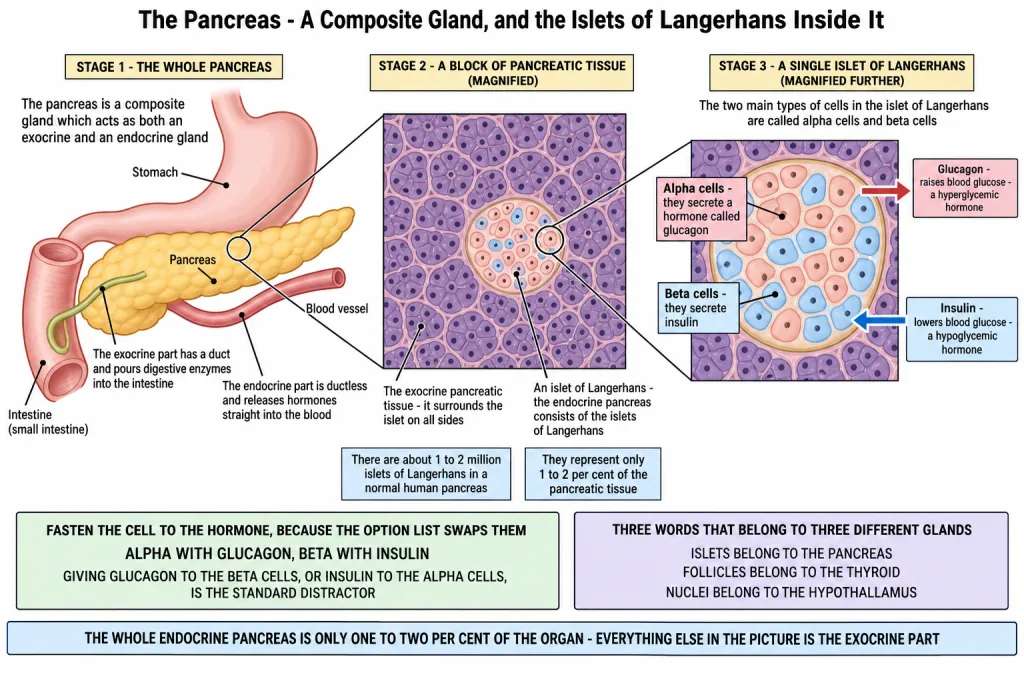
[NEET Important] Composite gland, 'Islets of Langerhans', 1 to 2 million and 1 to 2 per cent are all quoted verbatim in questions, and the two figures are offered as each other's distractors. The cell-to-hormone pairing is the other item: an option giving glucagon to the -cells or insulin to the -cells is the standard trap, and it appears in almost every paper.
Glucagon and Insulin - Two Hormones Pulling in Opposite Directions
Glucagon is a peptide hormone, and plays an important role in maintaining the normal blood glucose levels. Its three actions all push the same way - upwards:
- It acts mainly on the liver cells (hepatocytes) and stimulates GLYCOGENOLYSIS, the breakdown of stored glycogen, resulting in an increased blood sugar (hyperglycemia).
- It also stimulates the process of GLUCONEOGENESIS, the making of fresh glucose from non- carbohydrate sources, which also contributes to hyperglycemia.
- It reduces the cellular glucose uptake and utilisation, so the glucose that is made stays in the blood instead of being taken into cells.
Thus, glucagon is a HYPERGLYCEMIC hormone.
Insulin is a peptide hormone, which plays a major role in the regulation of glucose homeostasis. Its actions all push the other way - downwards:
- It acts mainly on hepatocytes and adipocytes (cells of adipose tissue) and enhances cellular glucose uptake and utilisation.
- As a result, there is a rapid movement of glucose from blood to hepatocytes and adipocytes, resulting in decreased blood glucose levels (hypoglycemia).
- It also stimulates conversion of glucose to glycogen (GLYCOGENESIS) in the target cells, so the glucose that has just arrived is locked away as a store.
The glucose homeostasis in blood is thus maintained JOINTLY by the two - insulin and glucagon. Neither hormone works alone; the level in the blood is the balance between them, which is exactly why the chapter says jointly.
| Insulin | Glucagon | |
|---|---|---|
| Cell of origin | -cells of the Islets of Langerhans | -cells of the Islets of Langerhans |
| Chemical nature | Peptide hormone | Peptide hormone |
| Effect on blood glucose | Decreases it - hypoglycemia | Increases it - hyperglycemia |
| Process it stimulates | Glycogenesis - glucose converted to glycogen; cellular glucose uptake and utilisation | Glycogenolysis and gluconeogenesis |
| Target cells | Hepatocytes and adipocytes | Mainly the liver cells (hepatocytes) |
| What it is called | A hypoglycemic hormone | A HYPERGLYCEMIC hormone |
Three long words in that table are constantly mixed up, so separate them once:
- Glycogenolysis - lysis means breaking - glycogen is broken down into glucose. Glucagon does this.
- Glycogenesis - genesis means making - glycogen is made from glucose. Insulin does this.
- Gluconeogenesis - new glucose is made from things that were not carbohydrate. Glucagon does this, and so do the glucocorticoids of the adrenal cortex.
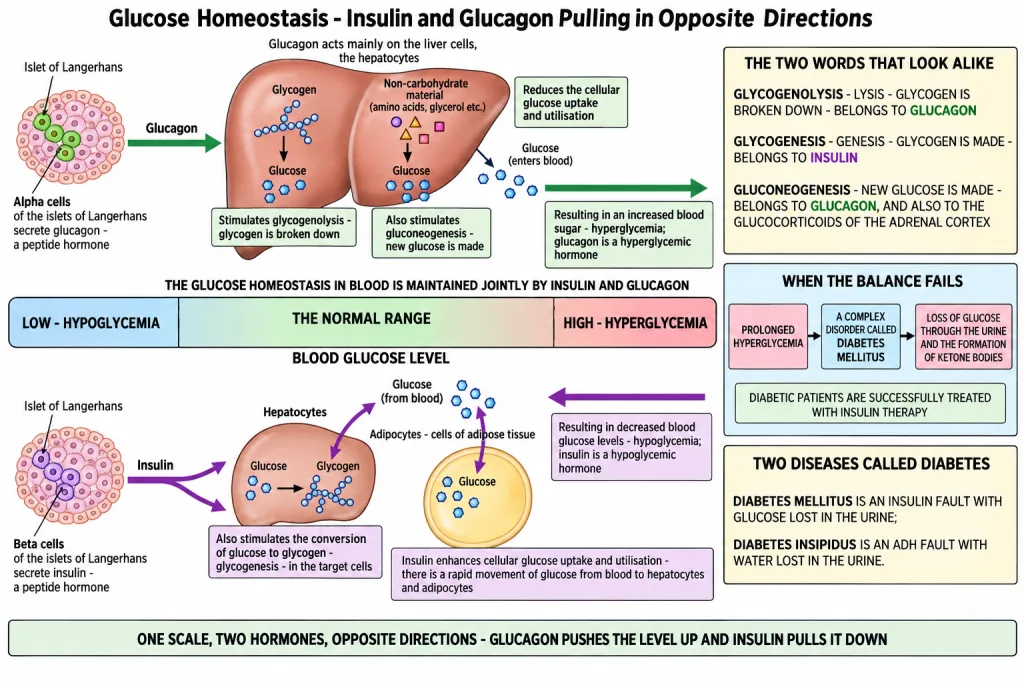
[NEET Important] The direction words are the whole question. Glucagon is hyperglycemic, insulin is hypoglycemic, and an item that simply swaps the two prefixes catches a surprising number of students. Glycogenolysis belongs to glucagon and glycogenesis to insulin - the two words differ by three letters. And the mark for jointly is real: glucose homeostasis is maintained by both hormones together, not by insulin alone.
Diabetes Mellitus - and Why It Is Not Diabetes Insipidus
Prolonged hyperglycemia leads to a complex disorder called DIABETES MELLITUS. The chapter gives three things about it, and all three are asked:
| Question | The answer |
|---|---|
| What causes it | Prolonged hyperglycemia - the blood glucose stays high |
| What is lost | Glucose through the urine |
| What harmful compounds form | KETONE BODIES |
| How it is treated | Diabetic patients are successfully treated with insulin therapy |
| The hormone at fault | Insulin, from the -cells of the Islets of Langerhans |
| The direction of the fault | Under-secretion, or the hormone failing to act |
Two diseases in this chapter are called diabetes, and they are completely different. Keep them apart with a table, because putting one gland's disorder against the other's is the easiest question to set:
| Diabetes mellitus | Diabetes insipidus | |
|---|---|---|
| Hormone at fault | Insulin | Vasopressin, that is ADH |
| Where that hormone comes from | The -cells of the Islets of Langerhans, in the pancreas | The hypothalamus, released from the posterior pituitary |
| What goes out in the urine | Glucose | Water |
| What builds up or is lost | High blood glucose and ketone bodies | Water loss and dehydration |
| Treatment named in the chapter | Insulin therapy | Not stated |
Say it in one line: diabetes mellitus is an insulin fault with glucose lost in the urine, while diabetes insipidus is an ADH fault with water lost in the urine. Two different hormones, two different glands, two different diseases - the shared word "diabetes" only means that a lot of urine is passed.
[NEET Important] Ketone bodies are named only here, and an item asking which disorder is associated with their formation has diabetes mellitus as the answer. The other standard item puts diabetes insipidus among the options for "which hormonal deficiency causes diabetes mellitus" - the answer is insulin, and ADH belongs to insipidus.
Quick Recap
- The pancreas is a composite gland which acts as both an exocrine and an endocrine gland.
- The endocrine pancreas consists of the 'Islets of Langerhans'.
- There are about 1 to 2 million Islets of Langerhans in a normal human pancreas, representing only 1 to 2 per cent of the pancreatic tissue.
- The two main types of cells in the Islet of Langerhans are called -cells and -cells.
- The -cells secrete a hormone called glucagon, while the -cells secrete insulin.
- Glucagon is a peptide hormone which plays an important role in maintaining the normal blood glucose levels.
- Glucagon acts mainly on the liver cells (hepatocytes) and stimulates glycogenolysis, resulting in an increased blood sugar (hyperglycemia).
- Glucagon also stimulates the process of gluconeogenesis, which also contributes to hyperglycemia, and it reduces the cellular glucose uptake and utilisation.
- Glucagon is a hyperglycemic hormone.
- Insulin is a peptide hormone which plays a major role in the regulation of glucose homeostasis.
- Insulin acts mainly on hepatocytes and adipocytes (cells of adipose tissue) and enhances cellular glucose uptake and utilisation.
- There is a rapid movement of glucose from blood to hepatocytes and adipocytes, resulting in decreased blood glucose levels (hypoglycemia).
- Insulin also stimulates conversion of glucose to glycogen (glycogenesis) in the target cells.
- The glucose homeostasis in blood is maintained JOINTLY by insulin and glucagon.
- Prolonged hyperglycemia leads to a complex disorder called diabetes mellitus, which is associated with loss of glucose through urine and formation of harmful compounds known as ketone bodies.
- Diabetic patients are successfully treated with insulin therapy.
- Diabetes mellitus is an insulin fault with glucose in the urine; diabetes insipidus is an ADH fault with water lost in the urine.
Solved Examples
Question 1
Q. List the hormones secreted by the pancreas. This is one of the chapter-end exercises.
Answer. Only the endocrine part of the pancreas - the Islets of Langerhans - secretes hormones, and it secretes two:
- Glucagon, from the -cells - a peptide hormone which acts mainly on the liver cells (hepatocytes), stimulates glycogenolysis and gluconeogenesis and reduces cellular glucose uptake and utilisation, so that blood sugar rises (hyperglycemia). It is a hyperglycemic hormone.
- Insulin, from the -cells - a peptide hormone which acts mainly on hepatocytes and adipocytes, enhances cellular glucose uptake and utilisation and stimulates glycogenesis, so that blood glucose falls (hypoglycemia). It is a hypoglycemic hormone.
The glucose homeostasis in blood is maintained jointly by these two.
Question 2
Q. Write short notes on the functions of insulin and glucagon. This is one of the chapter-end exercises.
Answer.
Insulin. Insulin is a peptide hormone secreted by the -cells of the Islets of Langerhans, and it plays a major role in the regulation of glucose homeostasis. It acts mainly on hepatocytes and adipocytes (cells of adipose tissue) and enhances cellular glucose uptake and utilisation. As a result there is a rapid movement of glucose from blood to hepatocytes and adipocytes, resulting in decreased blood glucose levels (hypoglycemia). Insulin also stimulates conversion of glucose to glycogen (glycogenesis) in the target cells. Its failure gives prolonged hyperglycemia, which leads to diabetes mellitus, with loss of glucose through urine and formation of ketone bodies; such patients are successfully treated with insulin therapy.
Glucagon. Glucagon is a peptide hormone secreted by the -cells of the Islets of Langerhans, and it plays an important role in maintaining the normal blood glucose levels. It acts mainly on the liver cells (hepatocytes) and stimulates glycogenolysis, resulting in an increased blood sugar (hyperglycemia). It also stimulates the process of gluconeogenesis, which also contributes to hyperglycemia, and it reduces the cellular glucose uptake and utilisation. Glucagon is therefore a hyperglycemic hormone.
Together: the two hormones act in opposite directions on the same quantity, and the glucose homeostasis in blood is thus maintained jointly by the two - insulin and glucagon.
Question 3
Q. Give example(s) of a hyperglycemic hormone and a hypoglycemic hormone. This is one of the chapter-end exercises.
Answer.
- Hyperglycemic hormone - GLUCAGON, because it stimulates glycogenolysis and gluconeogenesis and reduces cellular glucose uptake, so the blood sugar rises.
- Hypoglycemic hormone - INSULIN, because it enhances cellular glucose uptake and utilisation by hepatocytes and adipocytes and stimulates glycogenesis, so the blood glucose falls.
Question 4
Q. Which hormonal deficiency is responsible for diabetes mellitus? This is one of the chapter-end exercises.
Answer. A deficiency of INSULIN. It is a peptide hormone secreted by the -cells of the Islets of Langerhans in the endocrine pancreas, and the fault is an under-secretion - too little insulin, or insulin failing to act. Without enough of it the blood glucose cannot be moved into the cells, so prolonged hyperglycemia follows and leads to a complex disorder called diabetes mellitus, which is associated with loss of glucose through urine and formation of harmful compounds known as ketone bodies. Diabetic patients are successfully treated with insulin therapy.
Question 5
Q. Why is the pancreas called a composite gland?
Answer. Because it acts as both an exocrine and an endocrine gland. The exocrine part has a duct and sends digestive enzymes into the duodenum; the endocrine part - the Islets of Langerhans - is ductless and releases insulin and glucagon straight into the blood.
Question 6
Q. What are the Islets of Langerhans, how many are there, and what fraction of the pancreas do they make up?
Answer. They are the endocrine part of the pancreas - islands of hormone-secreting cells scattered through the exocrine tissue. There are about 1 to 2 million Islets of Langerhans in a normal human pancreas, and they represent only 1 to 2 per cent of the pancreatic tissue. So the endocrine pancreas is a very small fraction of a large organ.
Question 7
Q. Which cells of the Islet of Langerhans secrete glucagon, and which secrete insulin?
Answer. The two main types of cells in the Islet of Langerhans are called -cells and -cells. The -cells secrete a hormone called glucagon, while the -cells secrete insulin. Reversing that pair is the commonest error in this section.
Question 8
Q. How does glucagon raise the blood sugar level?
Answer. In three ways, all of which push glucose into the blood or keep it there.
- It acts mainly on the liver cells (hepatocytes) and stimulates glycogenolysis - stored glycogen is broken back down to glucose, resulting in increased blood sugar (hyperglycemia).
- It stimulates gluconeogenesis - fresh glucose is made from non-carbohydrate sources - which also contributes to hyperglycemia.
- It reduces the cellular glucose uptake and utilisation, so the glucose is not pulled out of the blood.
Glucagon is therefore a hyperglycemic hormone.
Question 9
Q. How does insulin lower the blood glucose level?
Answer. It acts mainly on hepatocytes and adipocytes (cells of adipose tissue) and enhances cellular glucose uptake and utilisation. Because those cells now take glucose in quickly, there is a rapid movement of glucose from blood to hepatocytes and adipocytes, resulting in decreased blood glucose levels (hypoglycemia). Inside the target cells insulin also stimulates conversion of glucose to glycogen (glycogenesis), so the glucose that has arrived is stored away rather than returning to the blood.
Question 10
Q. Distinguish between diabetes mellitus and diabetes insipidus.
Answer.
| Feature | Diabetes mellitus | Diabetes insipidus |
|---|---|---|
| Hormone at fault | Insulin | Vasopressin (ADH) |
| Source of that hormone | -cells of the Islets of Langerhans, in the pancreas | Synthesised by the hypothalamus, released from the posterior pituitary |
| What is lost in the urine | Glucose | Water |
| Other feature | Prolonged hyperglycemia and the formation of ketone bodies | Dehydration from the water loss |
| Treatment named | Insulin therapy | Not stated in the chapter |
The one line that gets the mark: mellitus - insulin - glucose in the urine; insipidus - ADH - water lost in the urine.
Question 11
Q. What are ketone bodies, and in which disorder are they formed?
Answer. They are the harmful compounds that form in diabetes mellitus. The chapter states that the disorder is associated with loss of glucose through urine and formation of harmful compounds known as ketone bodies. They appear because the body, unable to use the glucose in the blood, is forced to break down fat instead.
Question 12
Q. Separate the three words glycogenolysis, glycogenesis and gluconeogenesis, and say which hormone stimulates each.
Answer.
| Process | What happens | Stimulated by |
|---|---|---|
| Glycogenolysis | Glycogen is broken down to glucose | Glucagon |
| Glycogenesis | Glucose is converted to glycogen in the target cells | Insulin |
| Gluconeogenesis | New glucose is made from non-carbohydrate sources | Glucagon, and also the glucocorticoids of the adrenal cortex |
The endings do the work: -lysis is breaking, -genesis is making, and neo- means new.
Question 13
Q. Fill in the blanks: the endocrine pancreas consists of the , of which there are about in a normal human pancreas, representing only _ of the pancreatic tissue; its -cells secrete glucagon and its _-cells secrete insulin.
Answer. The endocrine pancreas consists of the 'Islets of Langerhans', of which there are about 1 to 2 million in a normal human pancreas, representing only 1 to 2 per cent of the pancreatic tissue; its -cells secrete glucagon and its -cells secrete insulin.