
The Pars Intermedia and Its Single Hormone
The pituitary has three working parts. The previous section took the pars distalis and its six hormones. This section takes the other two, and both of them are small.
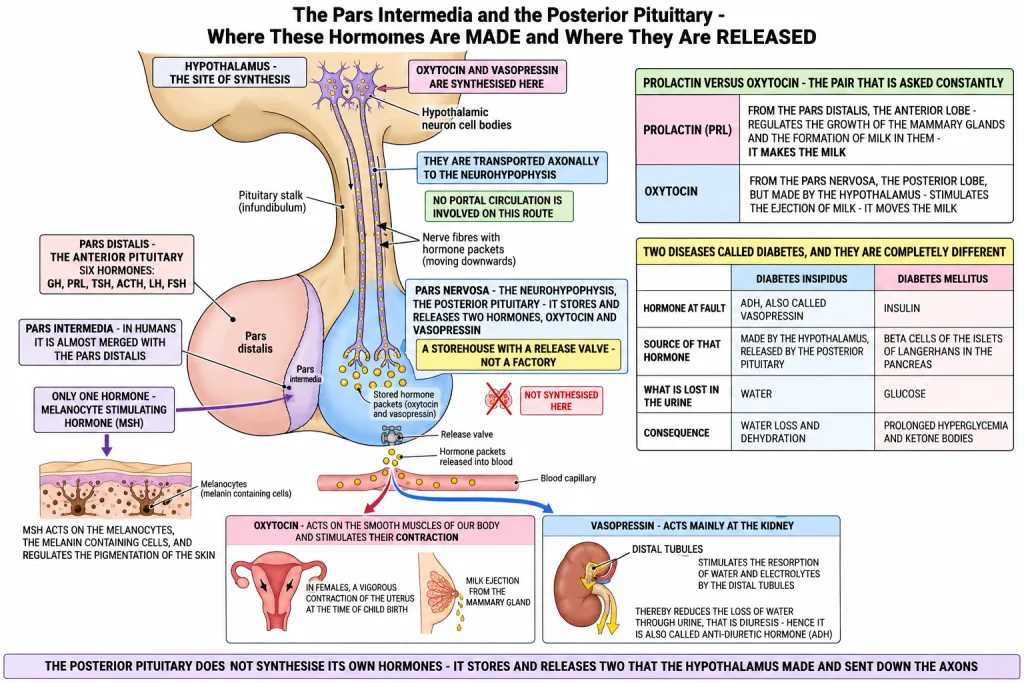
The pars intermedia secretes only ONE hormone, melanocyte stimulating hormone (MSH). That count is examinable on its own - one hormone, not two, and not six.
MSH acts on the MELANOCYTES, which are the melanin containing cells, and regulates the pigmentation of the skin. Melanin is the dark pigment of the skin, the melanocytes are the cells that hold it, and MSH is the pituitary hormone that turns their activity up.
There is one extra fact about the pars intermedia that the chapter states plainly and that gets asked as a stand-alone item: in humans, the pars intermedia is almost merged with the pars distalis. In many other animals it is a distinct band of tissue between the two lobes; in us it is so reduced that it is hard to tell apart from the anterior pituitary next to it.
| Pars intermedia | |
|---|---|
| Part of | The adenohypophysis |
| Number of hormones | Only one |
| The hormone | Melanocyte stimulating hormone (MSH) |
| What it acts on | The melanocytes - the melanin containing cells |
| What it does | Regulates the pigmentation of the skin |
| Special note in humans | Almost merged with the pars distalis |
[NEET Important] Two clean one-mark items. MSH is a pars INTERMEDIA hormone, not a pars distalis one, so an item asking which hormone the pars distalis does NOT produce is answered by MSH. And in humans the pars intermedia is almost merged with the pars distalis - the distractor says it is merged with the pars nervosa, which is wrong.
The Posterior Pituitary Is a Store, Not a Factory
This is the headline fact of the whole section, and it is stated in the chapter as carefully as it is asked in the exam.
The neurohypophysis (pars nervosa), also known as the POSTERIOR PITUITARY, STORES AND RELEASES two hormones called OXYTOCIN and VASOPRESSIN, which are actually SYNTHESISED BY THE HYPOTHALAMUS and are TRANSPORTED AXONALLY to the neurohypophysis.
Take that apart into the three things it says:
- The two hormones are oxytocin and vasopressin. No third one.
- The posterior pituitary does not make them. They are synthesised by the HYPOTHALAMUS.
- They travel from the hypothalamus to the posterior pituitary along AXONS, not in the blood - the neurosecretory cells of the hypothalamus send their axons down the stalk and end inside the posterior pituitary. This is the direct neural regulation the previous section described.
So the posterior pituitary is a storehouse with a release valve, and the factory is one floor up. That is why the anterior lobe needs a portal circulatory system to be told what to do, while the posterior lobe needs no releasing hormone at all - the hypothalamic neuron simply delivers the finished hormone to the door and fires an impulse to let it out.
| Anterior pituitary (pars distalis) | Posterior pituitary (pars nervosa) | |
|---|---|---|
| Who makes the hormones released there | The lobe itself | The hypothalamus |
| How the hormones get there | Made on the spot | Transported axonally |
| How the hypothalamus controls it | Releasing and inhibiting hormones through a portal circulatory system | Direct neural regulation |
| Hormones | Six - GH, PRL, TSH, ACTH, LH, FSH | Two - oxytocin and vasopressin |
[NEET Important] The marked verb is STORES AND RELEASES. An option calling the posterior pituitary the site of synthesis of oxytocin or vasopressin is wrong, however tempting, because both are synthesised by the hypothalamus. The second half of the item is the route - axonal transport, not the blood and not a portal system.
Oxytocin - The Contraction Hormone
Oxytocin acts on the SMOOTH MUSCLES of our body and stimulates their CONTRACTION. That general statement is the definition, and everything else is a special case of it, because the two organs the chapter names are both made of smooth muscle.
In females:
- It stimulates a vigorous contraction of the UTERUS at the time of CHILD BIRTH. This is the contraction that pushes the baby out.
- It stimulates MILK EJECTION from the mammary gland. The milk is already made and sitting in the gland; oxytocin squeezes the muscle around the stores so that it comes out.
Now put oxytocin next to prolactin from the previous section, because this pair is asked constantly. Both act on the mammary gland, and they do two completely different jobs:
| Prolactin (PRL) | Oxytocin | |
|---|---|---|
| Comes from | Pars distalis - the anterior pituitary | Pars nervosa - the posterior pituitary; actually made by the hypothalamus |
| Acts on the mammary gland to | Regulate its growth and the FORMATION of milk in it | Stimulate the EJECTION of milk from it |
| One word | Makes the milk | Moves the milk |
Prolactin FORMS the milk, oxytocin EJECTS it. Learn that line as it stands.
[NEET Important] Three items sit in this block. Oxytocin acts on smooth muscle and causes contraction is the definition; uterine contraction at childbirth and milk ejection are the two named examples; and the prolactin versus oxytocin swap is the distractor. An option giving oxytocin the job of milk formation is wrong.
Vasopressin, ADH and Diabetes Insipidus
Vasopressin acts mainly at the KIDNEY and stimulates the resorption of water and electrolytes by the DISTAL TUBULES, and thereby reduces the loss of water through urine (diuresis). Hence it is also called ANTI-DIURETIC HORMONE (ADH).
Three parts of that sentence are marked, and each has its own trap:
- The site is the kidney, and inside the kidney it is the DISTAL TUBULES. Not the glomerulus and not the proximal tubule - the chapter names the distal tubules and nothing else.
- What is resorbed is water AND electrolytes.
- Diuresis means loss of water through urine, so an anti-diuretic hormone is one that reduces that loss. Vasopressin IS ADH - the two names are the same molecule, and the exam uses them interchangeably.
The disorder. An impairment affecting the synthesis or release of ADH results in a diminished ability of the kidney to conserve water, leading to water loss and dehydration. This condition is known as DIABETES INSIPIDUS. Note the direction of the fault: too little ADH, not too much.
Diabetes insipidus and diabetes mellitus are two completely different diseases. They share only the word diabetes, which simply means passing large volumes of urine. Keep them apart with a table, because putting insulin against diabetes insipidus is one of the commonest single errors in this chapter:
| Diabetes insipidus | Diabetes mellitus | |
|---|---|---|
| The hormone at fault | ADH (vasopressin) | Insulin |
| Where that hormone comes from | The posterior pituitary, made by the hypothalamus | The Islets of Langerhans of the pancreas |
| The fault | Impaired synthesis or release of ADH | Prolonged hyperglycemia from an insulin fault |
| What is lost in the urine | WATER | GLUCOSE |
| The result | Water loss and dehydration | Loss of glucose through urine and the formation of ketone bodies |
[NEET Important] Distal tubules is the phrase most often blanked out in a fill-in item, and anti-diuretic hormone is the alternative name that must come to mind the moment vasopressin is named. The disorder item is nearly always the mix-up: diabetes insipidus is an ADH failure with water loss; diabetes mellitus is an insulin failure with glucose loss.
Quick Recap
- The pars intermedia secretes only ONE hormone, melanocyte stimulating hormone (MSH).
- In humans, the pars intermedia is almost merged with the pars distalis.
- MSH acts on the melanocytes, the melanin containing cells, and regulates the pigmentation of the skin.
- The neurohypophysis, or pars nervosa, is also known as the posterior pituitary.
- It STORES AND RELEASES two hormones, oxytocin and vasopressin, which are actually SYNTHESISED BY THE HYPOTHALAMUS and are transported axonally to the neurohypophysis.
- Oxytocin acts on the smooth muscles of our body and stimulates their contraction.
- In females, oxytocin stimulates a vigorous contraction of the uterus at the time of child birth, and milk ejection from the mammary gland.
- Prolactin forms the milk; oxytocin ejects it.
- Vasopressin acts mainly at the kidney and stimulates the resorption of water and electrolytes by the distal tubules, and thereby reduces the loss of water through urine (diuresis).
- Vasopressin is hence also called anti-diuretic hormone (ADH).
- An impairment affecting the synthesis or release of ADH results in a diminished ability of the kidney to conserve water, leading to water loss and dehydration - a condition known as DIABETES INSIPIDUS.
- Diabetes insipidus is an ADH fault with loss of water; diabetes mellitus is an insulin fault with loss of glucose. They are two entirely different diseases.
Solved Examples
Question 1
Q. List the hormones secreted by the pituitary. This is one of the chapter-end exercises.
Answer. The pituitary has three parts, and all nine hormones are best listed part by part.
From the pars distalis, the anterior pituitary - six hormones:
- Growth hormone (GH) - drives the growth of the body.
- Prolactin (PRL) - regulates the growth of the mammary glands and the formation of milk in them.
- Thyroid stimulating hormone (TSH) - stimulates the synthesis and secretion of thyroid hormones from the thyroid gland.
- Adrenocorticotrophic hormone (ACTH) - stimulates the synthesis and secretion of glucocorticoids from the adrenal cortex.
- Luteinizing hormone (LH) - a gonadotrophin; stimulates androgen secretion from the testis in males and induces ovulation and maintains the corpus luteum in females.
- Follicle stimulating hormone (FSH) - a gonadotrophin; regulates spermatogenesis along with androgens in males and stimulates growth of the ovarian follicles in females.
From the pars intermedia - one hormone:
- Melanocyte stimulating hormone (MSH) - acts on the melanocytes and regulates the pigmentation of the skin.
Stored and released by the pars nervosa, the posterior pituitary - two hormones:
- Oxytocin - acts on smooth muscles and stimulates their contraction, giving uterine contraction at child birth and milk ejection from the mammary gland.
- Vasopressin, or ADH - stimulates the resorption of water and electrolytes by the distal tubules of the kidney, reducing the loss of water through urine.
The point that must be added: the last two are not synthesised by the pituitary. Oxytocin and vasopressin are synthesised by the HYPOTHALAMUS and are only transported axonally to the posterior pituitary, which stores and releases them.
Question 2
Q. Melanotrophin (MSH) - target gland: __. This is one of the chapter-end exercises.
Answer. Melanotrophin (MSH) - target: the MELANOCYTES of the SKIN.
MSH acts on the melanocytes, which are the melanin containing cells, and regulates the pigmentation of the skin. MSH itself comes from the pars intermedia of the pituitary.
Question 3
Q. How many hormones does the pars intermedia secrete, and which one?
Answer. Only one - melanocyte stimulating hormone (MSH).
Question 4
Q. What is special about the pars intermedia in humans?
Answer. In humans the pars intermedia is almost merged with the pars distalis. It is not a separate visible band of tissue as it is in many other animals.
Question 5
Q. Which two hormones does the posterior pituitary release, and where are they made?
Answer. The neurohypophysis, or pars nervosa, also known as the posterior pituitary, STORES AND RELEASES oxytocin and vasopressin. Both are actually SYNTHESISED BY THE HYPOTHALAMUS and are transported axonally to the neurohypophysis.
The one line that gets the mark: the posterior pituitary is a store, not a factory.
Question 6
Q. By what route do oxytocin and vasopressin reach the posterior pituitary?
Answer. They are transported AXONALLY. The neurosecretory neurons of the hypothalamus make them, and the hormones travel down those neurons' axons, which run into the posterior pituitary itself. There is no portal circulation involved here - that route serves the anterior pituitary.
Question 7
Q. What is the general action of oxytocin, and what are its two named effects in females?
Answer. Oxytocin acts on the smooth muscles of our body and stimulates their contraction. In females this shows up as two things: a vigorous contraction of the uterus at the time of child birth, and milk ejection from the mammary gland.
Question 8
Q. Prolactin and oxytocin both act on the mammary gland. Are they doing the same job?
Answer. No. Prolactin regulates the growth of the mammary glands and the FORMATION of milk in them. Oxytocin stimulates the EJECTION of milk from the mammary gland. One makes the milk, the other pushes it out - and they come from different lobes, prolactin from the pars distalis and oxytocin from the pars nervosa.
Question 9
Q. Where in the kidney does vasopressin act, and what does it do there?
Answer. Vasopressin acts mainly at the kidney and stimulates the resorption of water and electrolytes by the DISTAL TUBULES. By doing that it reduces the loss of water through urine (diuresis).
Question 10
Q. Why is vasopressin also called anti-diuretic hormone?
Answer. Because diuresis means the loss of water through urine, and vasopressin reduces it by making the distal tubules resorb water and electrolytes back into the body. A hormone that works against diuresis is an anti-diuretic hormone (ADH). Vasopressin and ADH are two names for the same hormone.
Question 11
Q. What causes diabetes insipidus?
Answer. An impairment affecting the synthesis or release of ADH. With too little ADH the kidney has a diminished ability to conserve water, so water is lost in the urine and the person becomes dehydrated. That condition is diabetes insipidus. The fault is UNDER-secretion, and the hormone is ADH, also called vasopressin.
Question 12
Q. How does diabetes insipidus differ from diabetes mellitus?
Answer. They are two completely different diseases that share only the word diabetes.
| Diabetes insipidus | Diabetes mellitus | |
|---|---|---|
| Hormone at fault | ADH (vasopressin) | Insulin |
| Source of that hormone | Made by the hypothalamus, released from the posterior pituitary | The pancreas |
| What goes wrong | Impaired synthesis or release of ADH | Prolonged hyperglycemia |
| What is lost | Water - dehydration | Glucose through urine, with ketone bodies formed |
Question 13
Q. Fill in the blanks: the _ secretes only one hormone, , while the stores and releases and , both of which are synthesised by the _.
Answer. The pars intermedia secretes only one hormone, MSH, while the pars nervosa, the posterior pituitary, stores and releases oxytocin and vasopressin, both of which are synthesised by the hypothalamus.
Question 14
Q. A student writes: "The posterior pituitary synthesises oxytocin, which forms milk in the mammary gland." Correct every error.
Answer. Two errors, both marked.
- The posterior pituitary does not synthesise oxytocin. Oxytocin is synthesised by the hypothalamus and only stored and released by the posterior pituitary, having been transported axonally to it.
- Oxytocin does not form milk. It stimulates milk EJECTION from the mammary gland. The hormone that regulates the growth of the mammary glands and the formation of milk in them is prolactin, from the pars distalis.