
Stop Reading. Start Scoring.
Sections 1 to 13 taught you the chapter. This section finds out whether you can use it under a clock, which is a completely different skill. There is no new theory here — just 30 questions built to the JEE Main pattern on Chemical Bonding and Molecular Structure, and a marking scheme that punishes the thing students do most: guessing.
The rules of engagement
Key Point: Do not treat this as a reading exercise. Sit down with a blank sheet, a pen and a timer, and attempt all 30 questions in one unbroken sitting before you look at a single explanation.
| The setup | What it is |
|---|---|
| Number of questions | 30 (26 single-correct MCQs + 4 numerical-value-type questions, all given with four options here) |
| Marking scheme | correct, incorrect, unattempted |
| Maximum score | marks |
| Minimum possible score | marks |
| Suggested time limit | 35 minutes (JEE Main pace is about 1 minute per question) |
| Allowed | rough sheet, your own brain, and the data listed below |
| Not allowed | calculator, a printed table of hybridisations or MO diagrams, looking back at Sections 1 to 13 |
What you are allowed to assume
Bonding is a rules-and-pictures chapter more than a numbers chapter, so let us be clear about what you may carry into the drill from memory. Anything else a question needs, it gives you.
| Data or convention you may assume | Values |
|---|---|
| Internuclear axis | the -axis, so forms head-on and , sideways |
| MO energy order, to (and their ions) | |
| MO energy order, , , (and their ions) | |
| Heteronuclear diatomics (CO, , , NO) | use the -type ordering and count total electrons |
| Bond order | ; one unpaired electron anywhere makes the species paramagnetic |
| Dipole unit conversion | ; electronic charge |
| Standard VSEPR angles | 109.5°, 107°, 104.5°, 120°, 180°, 120° and 90°, 90° |
| Standard bond lengths | C-C 154, C=C 133, C≡C 120, C-O 143, C=O 121, C≡O 113, N≡N 109, O=O 121, F-F 144 pm; HCl 127 pm |
| Standard bond enthalpies | H-H 435.8, O=O 498, N≡N 946.0 kJ/mol; the two O-H bonds of water 502 and 427 kJ/mol |
| Textbook dipole moments | HF 1.78, HCl 1.07, 1.85, 1.47, 0.23, 1.04 D; , , , all 0 D |
Unless a question says otherwise, "shape" means the arrangement of atoms only (lone pairs left out), "geometry" means the arrangement of all electron pairs, hybridisation is worked out from the steric number, and all species are in the gas phase and in their ground states.
[Board] That is not decoration. In the real paper, four wild guesses that produce one lucky hit earn you mark for four minutes of work — a terrible trade. But a question you have narrowed down to two options is worth attempting: on average that gives marks per attempt. Bonding questions are exactly where this pays off — you can usually kill two options with a single check (does it have a lone pair? is the electron count odd? is the bond order going up or down when an antibonding electron leaves?), and then the last two are a coin worth flipping. Leave blank only what you cannot narrow at all. For the numerical-value-type questions there is no negative marking in the actual JEE Main paper, but we keep here on purpose — it forces you to check your arithmetic instead of typing the first number you get.
What this set covers
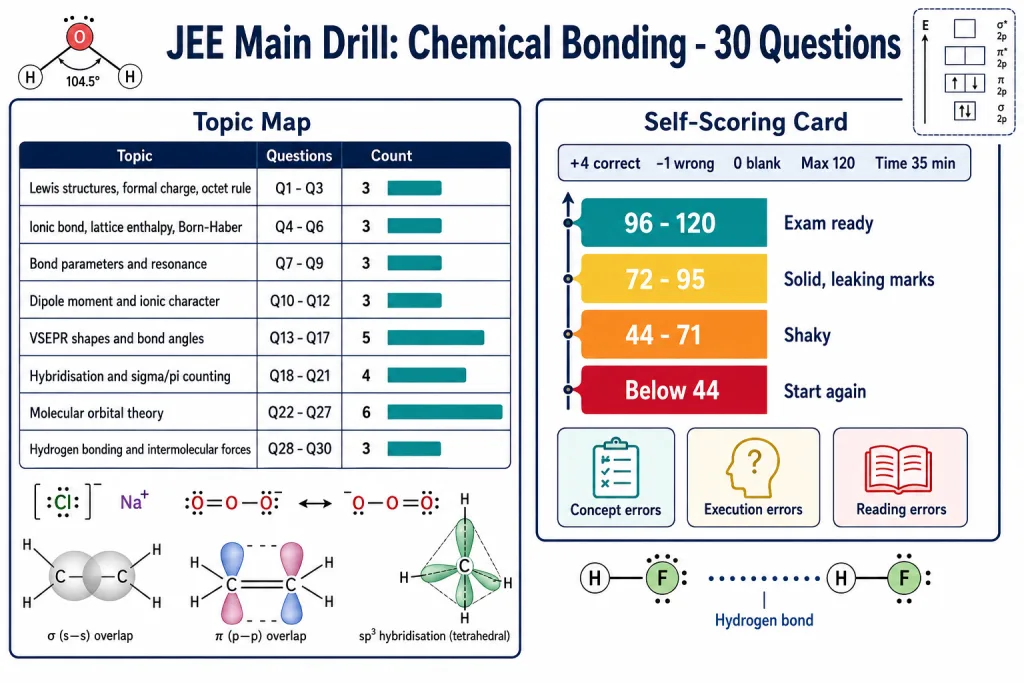
| Topic | Questions | How many |
|---|---|---|
| Lewis structures, formal charge and the octet rule with its exceptions | Q1 to Q3 | 3 |
| Ionic bond formation, lattice enthalpy orders and the Born-Haber cycle | Q4 to Q6 | 3 |
| Bond parameters and resonance: bond order of hybrids, bond-length orders, bond-enthalpy calculations | Q7 to Q9 | 3 |
| Dipole moment: zero or non-zero, vector addition, per cent ionic character | Q10 to Q12 | 3 |
| VSEPR shapes, lone-pair placement, Bent's and Drago's rules, bond-angle orders | Q13 to Q17 | 5 |
| Hybridisation: identifying it, changes on reaction, sigma/pi counting, s-character and bond length | Q18 to Q21 | 4 |
| Molecular orbital theory: bond orders of ions, magnetism, bond-length orders, electron addition and removal, heteronuclear diatomics | Q22 to Q27 | 6 |
| Hydrogen bonding and intermolecular forces: boiling-point orders, intramolecular H-bonds, the structure of ice | Q28 to Q30 | 3 |
That spread is deliberate — it mirrors how JEE Main actually samples this chapter. VSEPR, hybridisation and MOT together account for 15 of the 30 questions, because in the real paper a "shape of the species", "count the sigma and pi bonds" or "bond order and magnetism of an ion" question appears almost every single year, and often two of the three do. Dipole moment and hydrogen bonding are asked less often but reliably, and the ionic-bond block is where the one numerical of the paper tends to hide. The difficulty mix is roughly 20% easy, 50% medium and 30% hard, so do not panic if a few feel brutal; they are meant to. Questions 6, 9, 11 and 12 are written in the numerical-value style: the answer is a number you must compute exactly, and the four options are there only so you can mark yourself.
Scoring Yourself Honestly
Mark your sheet with the real scheme — , , — and total it. Do not award yourself half marks for "I knew that one really" or "I only forgot the lone pair on xenon". The number you get is the number that matters.
The bands
| Your score (out of 120) | Verdict | What to do next |
|---|---|---|
| 96 to 120 | Exam ready. You are at 80% or above on a hard set. | Move on. Chemical Bonding will not cost you marks. Revisit only the specific questions you missed. |
| 72 to 95 | Solid, but leaking marks. | These are almost always slips, not gaps — the MO ordering used for , the lone pair put axial instead of equatorial in a trigonal bipyramid, the half forgotten in , the dissociation counted as a full 244. Redo every wrong question without looking at the explanation first. |
| 44 to 71 | Shaky. The ideas are there; the execution is not. | For each wrong answer, go back to the section it came from (use the topic map above) and re-work its solved examples before re-attempting. |
| Below 44 | Start again. | Work through Sections 1 to 11 properly, then Section 12's solved examples and Section 13's JEE Corner, then come back. Re-attempting this set now teaches you nothing. |
Read your own answer sheet
Before you touch the explanations, sort your mistakes into three piles. This is the most valuable ten minutes in the whole section.
- Concept errors — you did not know that is linear while is bent, that the lone pairs in sit opposite each other so the molecule is square planar, that removing an electron from strengthens the bond, that has a smaller dipole than even though N-F bonds are more polar, or that HF boils above HI. Fixable by revision, and quickly.
- Execution errors — right method, wrong arithmetic: you counted 16 valence electrons for instead of 18, forgot to halve the bond-dissociation enthalpy of in a Born-Haber cycle, wrote the formal charge as valence electrons minus bonds instead of valence minus non-bonding minus half the bonding electrons, or multiplied by when you should have divided. Fixable by slowing down for four seconds at the last step.
- Reading errors — you gave the geometry (tetrahedral) when the question asked for the shape (bent), counted species with zero dipole when the question said non-zero, ranked "increasing bond length" when the options were written "increasing bond order", or answered for when the question said . These are the cheapest marks in the paper to win back, and the ones students refuse to take seriously.
Key Point: A student who scores 76 with three concept errors is in far better shape than one who scores 76 with nine reading errors. The first has three things to learn. The second has a habit to break, and habits take longer.
[Board] Every explanation below is written as a full step-by-step solution, so this set doubles as revision material. Read the explanation even for the questions you got right — sometimes you got there the slow way, and the fast way ("steric number = bond pairs + lone pairs, 5 means ", "lone pairs go equatorial in a trigonal bipyramid, axial in an octahedron", "electron out of an antibonding orbital: bond order up, bond shorter", "more s-character, shorter bond") is what you will need in the exam hall.