
How NEET Tests This Chapter — and the 40-Second Mindset
Chemical Bonding is a reliable scorer: 2 to 4 questions every year, almost all of them recall plus one decision. No Born-Haber cycles, no percentage ionic character calculations, no Bent's rule essays. Know the tables in this section cold and each of those questions is a 40-second .
What actually comes up:
| Question style | What it looks like | Time you should spend |
|---|---|---|
| Shape or hybridisation (the big one) | "The shape of / / is…" / "The hybridisation of the central atom in is…" | 30 seconds |
| MO bond order and magnetism | "Which species has the highest bond order?" / "Which is paramagnetic?" / "Bond order of is…" | 40 seconds |
| Bond-angle ordering | "Correct order of bond angle: , , " / " vs " | 30 seconds |
| Dipole moment | "Which molecule has zero dipole moment?" / " vs " | 25 seconds |
| Sigma and pi count | "Number of and bonds in " | 20 seconds |
| Hydrogen bonding | "Correct boiling-point order of , , , " / "intramolecular H-bond is present in…" | 25 seconds |
| Resonance and bond order | "Bond order of C-O in " / "which has all equal bond lengths" | 30 seconds |
| Lewis and formal charge | "Formal charge on the central O in ozone" / "which does not obey the octet rule" | 30 seconds |
| Assertion-Reason / statement-type | "Assertion: is paramagnetic. Reason: it has two unpaired electrons in orbitals" | 40 seconds |
All nine styles live in this section.
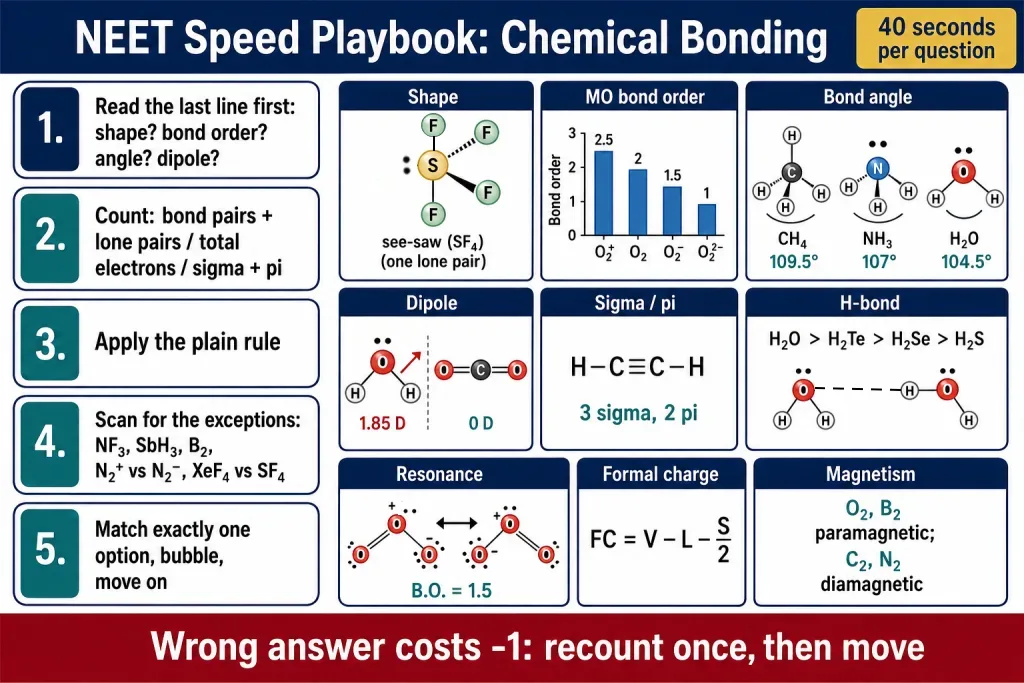
Favourite topics, ranked
If you have time for only five things:
- The shape-and-hybridisation table — steric number 2 to 7, with and without lone pairs, angles and the stock examples (, , , , , , ).
- The MO bond-order card — to and the oxygen and nitrogen ions, with magnetism.
- Bond-angle orders — lone-pair squeeze, electronegativity effects, and the hydride series.
- Dipole moment — zero or not, and the / story.
- Hydrogen bonding — boiling-point orders and the intramolecular cases.
The 40-second mindset
NEET is 180 questions in 200 minutes. A bonding question is where you bank time for Biology. The target is to answer in 40 seconds and move on.
- Read the last line first. It names the property — shape, hybridisation, bond order, angle, dipole, magnetism, boiling point. Fix the property before looking at the species.
- Count before you think. Shape: bond pairs plus lone pairs on the central atom. MO: total electrons. Sigma/pi: single bonds plus one per multiple bond. Counting is faster and safer than remembering.
- Apply the plain rule, then check whether a famous exception is sitting there — in a dipole list, in a boiling-point list, in a magnetism list, next to .
- Watch the word. "Geometry" versus "shape", "increasing" versus "decreasing", "stability" versus "bond length" (opposite orders), "paramagnetic" versus "diamagnetic".
- Match to the options and go. If your answer appears exactly once, bubble it. If it appears nowhere, you miscounted — recount once, then move on.
Key Point: This chapter rewards counting — electron pairs, total electrons, sigma bonds — rather than reasoning from first principles under the clock. Treat it as a counting chapter with a short list of famous exceptions.
[NEET] Negative marking () makes a 40-second wrong answer worse than a 40-second skip. If a shape question matches no option after one recount, mark it for review and come back.
What NEET does NOT ask from this chapter
- Born-Haber cycle arithmetic — that is JEE territory.
- Percentage ionic character from dipole moments — rare, and never with awkward numbers.
- MO diagrams of heteronuclear molecules beyond bond order and magnetism of CO, NO, , .
- Bent's rule, Drago's rule by name, or -orbital participation debates — you only need the orders they produce.
If a question here takes more than 90 seconds, you are using the wrong tool. Move.
The Verbatim-Recall Table — Definitions NEET Asks Word for Word
NEET lifts a definition, changes one word, and asks "which statement is correct". Learn these as flash-cards; the bold words are the ones a paper-setter changes.
Table 1: The definitions
| Term | Definition as NEET wants it | Instant example or number |
|---|---|---|
| Octet rule (Kössel-Lewis, 1916) | Atoms combine by transfer or sharing of valence electrons so as to have eight electrons in their outermost shell | Exceptions: , (incomplete), NO, (odd electron), , (expanded) |
| Electrovalent (ionic) bond | Bond formed by complete transfer of one or more electrons from one atom to another, held by electrostatic attraction between the ions | NaCl, ; favoured by low of the metal, high negative of the non-metal, high lattice enthalpy |
| Covalent bond (Lewis; the word is Langmuir's, 1919) | Bond formed by mutual sharing of an electron pair, each atom contributing one electron | , , |
| Coordinate (dative) bond | A covalent bond in which both shared electrons come from one atom | , , , one of the three bonds in CO |
| Lattice enthalpy | The energy required to completely separate one mole of a solid ionic compound into gaseous constituent ions | NaCl: 788 kJ/mol |
| Bond length | The equilibrium distance between the nuclei of two bonded atoms in a molecule; | 74 pm, 109 pm, 199 pm |
| Bond angle | The angle between the orbitals containing bonding electron pairs around the central atom | 104.5° |
| Bond enthalpy | The energy required to break one mole of bonds of a particular type between two atoms in the gaseous state | 435.8, 498, 946.0 kJ/mol |
| Bond order (Lewis) | The number of bonds between the two atoms in a molecule | 1, 2, 3 |
| Bond order (MO) | Half the difference between the number of electrons in bonding and antibonding molecular orbitals | : |
| Resonance | When a single Lewis structure cannot describe a molecule accurately, several structures with similar energy, the same positions of nuclei, and the same number of bonding and non-bonding pairs are taken as canonical structures of the resonance hybrid | (both O-O 128 pm), , , benzene |
| Dipole moment | The product of the magnitude of charge and the distance between the centres of positive and negative charge; a vector quantity; unit Debye | ; |
| VSEPR postulates (Sidgwick and Powell 1940; Nyholm and Gillespie 1957) | Shape depends on the number of valence-shell electron pairs (bonded and non-bonded) around the central atom; pairs repel and take positions that minimise repulsion; a multiple bond counts as one super pair; repulsion order lp-lp lp-bp bp-bp | 109.5°, 107°, 104.5° |
| Hybridisation | The intermixing of atomic orbitals of slightly different energies to give an equal number of new orbitals of equivalent energy and shape | one 2s + three 2p of C gives four |
| Sigma () bond | Formed by end-to-end (head-on) overlap of orbitals along the internuclear axis; s-s, s-p or p-p | Every single bond is a sigma bond |
| Pi () bond | Formed by sidewise overlap of p orbitals whose axes are parallel and perpendicular to the internuclear axis; weaker than a sigma bond | Second bond of ; second and third of |
| Bonding MO | Formed by addition (constructive interference) of atomic wave functions; lower energy, high electron density between the nuclei | , |
| Antibonding MO | Formed by subtraction (destructive interference); higher energy, a node between the nuclei | , |
| Hydrogen bond | The attractive force that binds the hydrogen atom of one molecule with a highly electronegative atom (F, O or N) of another molecule (or another part of the same molecule); shown by a dotted line; weaker than a covalent bond, stronger than van der Waals forces | HF, , , alcohols, DNA base pairs |
Key Point (Definition): Three phrases NEET deletes to make a statement false — "gaseous" in bond enthalpy and lattice enthalpy, "same positions of nuclei" in resonance, and "one atom supplies both electrons" in coordinate bond. An option missing the phrase is the wrong option.
Table 2: The three formulas NEET actually uses
| Formula | Statement | Worked one-liner |
|---|---|---|
| Formal charge | , where = valence electrons of the free atom, = lone-pair (non-bonding) electrons, = shared (bonding) electrons | Central O in : ; end O with double bond: ; end O with single bond: |
| MO bond order | : ; : | |
| Resonance bond order | , or equivalently | : ; : ; : 1.33; : 1.5; benzene C-C: 1.5 |
[NEET] Formal charge is a book-keeping number, not a real charge; the formal charges sum to the charge on the species (zero for , for ). The structure with the lowest formal charges is the most stable, and the negative formal charge sits preferably on the more electronegative atom.
Bond-order rule of thumb: higher bond order means shorter bond length and higher bond enthalpy. Isoelectronic species share a bond order — , CO, , all have bond order 3; and both have bond order 1.
The Shape-and-Hybridisation Master Table
This table answers more NEET questions than any other in Chapter 4. Learn it row by row.
The steric-number one-liner
Key Point: Steric number (atoms bonded to the central atom) (lone pairs on the central atom). Steric number 2 is , 3 is , 4 is , 5 is , 6 is , 7 is . A double or triple bond counts as one bonded atom.
For a quick lone-pair count on the central atom: lone pairs , where is the group valence electrons of the central atom and is the number of electrons it uses in bonds (one per single bond to a monovalent atom, two for a double bond to O). Add the charge for an anion, subtract for a cation. Faster still is the hybrid-orbital count , with the number of monovalent atoms attached (H, halogens), the cation charge and the anion charge; doubly bonded oxygen atoms are not counted in :
| Species | Charge | Hybridisation | |||
|---|---|---|---|---|---|
| 6 | 4 | 0 | |||
| 8 | 4 | 0 | |||
| 5 | 4 | ||||
| 7 | 2 | ||||
| 7 | 0 | ||||
| 5 | 0 | ||||
| 5 | 0 | ||||
| 6 | 0 | 0 |
The master table
| Steric no. | Hybridisation | Lone pairs | Electron geometry | Molecular shape | Bond angle(s) | Examples |
|---|---|---|---|---|---|---|
| 2 | 0 | Linear | Linear | 180° | , , , , , , , | |
| 3 | 0 | Trigonal planar | Trigonal planar | 120° | , , (monomer), , , , , | |
| 3 | 1 | Trigonal planar | Bent (V-shaped) | slightly less than 120° | , , , (gas) | |
| 4 | 0 | Tetrahedral | Tetrahedral | 109.5° | , , , , , , , | |
| 4 | 1 | Tetrahedral | Trigonal pyramidal | 107° in | , , , , , , , | |
| 4 | 2 | Tetrahedral | Bent (V-shaped) | 104.5° in | , , , , , | |
| 5 | 0 | Trigonal bipyramidal | Trigonal bipyramidal | 120° (equatorial), 90° (axial) | , , , | |
| 5 | 1 | Trigonal bipyramidal | See-saw | less than 120° and 90° | , , | |
| 5 | 2 | Trigonal bipyramidal | T-shaped | slightly less than 90° | , , | |
| 5 | 3 | Trigonal bipyramidal | Linear | 180° | , , | |
| 6 | 0 | Octahedral | Octahedral | 90° | , , , | |
| 6 | 1 | Octahedral | Square pyramidal | slightly less than 90° | , , | |
| 6 | 2 | Octahedral | Square planar | 90° | , , | |
| 7 | 0 | Pentagonal bipyramidal | Pentagonal bipyramidal | 72° (equatorial), 90° (axial) | ||
| 7 | 1 | Pentagonal bipyramidal | Distorted octahedral | — |
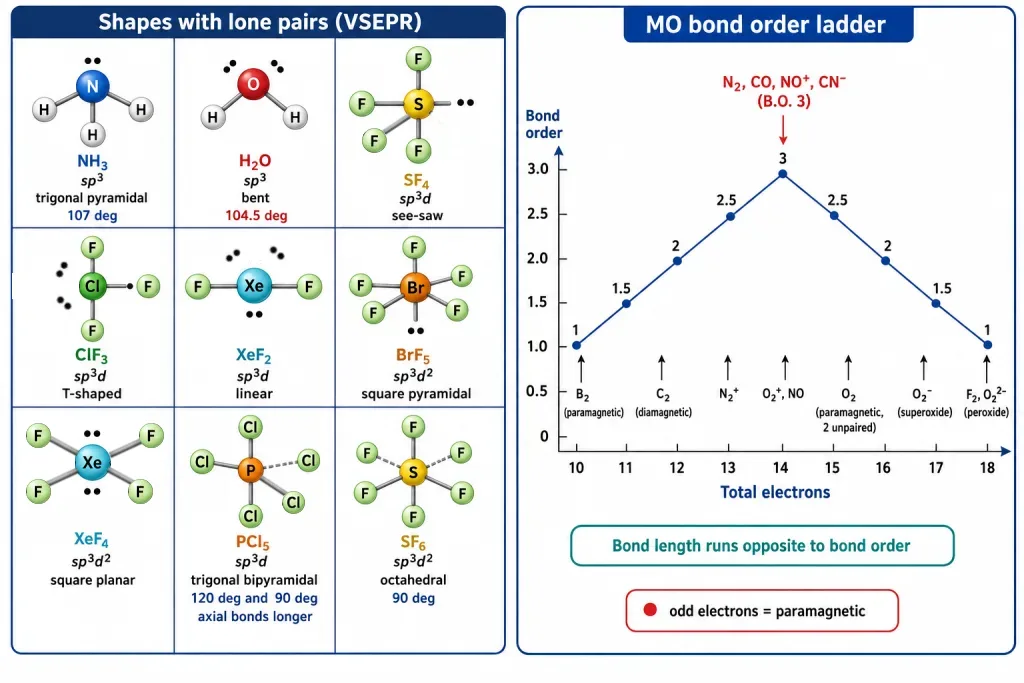
Where the lone pairs sit
- Trigonal bipyramidal (steric number 5): lone pairs always go equatorial — an equatorial position has only two 90° neighbours, an axial one has three. So is see-saw, is T-shaped and is linear (three lone pairs fill the whole equatorial plane).
- Octahedral (steric number 6): the first lone pair can go anywhere (square pyramidal, ); the second goes opposite to it to minimise lp-lp repulsion (square planar, ).
- PCl5 detail: the three equatorial bonds are at 120° in one plane; the two axial bonds are at 90° to that plane. Axial bond pairs suffer more repulsion from the equatorial pairs, so the axial P-Cl bonds are slightly longer and weaker, which is why is reactive.
The orbital and character facts that ride along
| Hybridisation | Orbitals mixed | Percentage s-character | Which d orbitals |
|---|---|---|---|
| one s + one p | 50 percent | — | |
| one s + two p | 33.3 percent | — | |
| one s + three p | 25 percent | — | |
| one s + three p + one d | 20 percent | ||
| one s + three p + two d | 16.7 percent | and | |
| one s + three p + three d | 14.3 percent | , , |
More s-character means a shorter, stronger bond and a more electronegative carbon. C-H bond length: ethyne (sp) ethene () ethane (); C-C bond length: 120 pm 133 pm 154 pm.
Carbon in organic molecules at a glance: four single bonds means ; one double bond means ; one triple bond or two double bonds means . In allene the end carbons are and the middle carbon is ; the two planes are perpendicular.
[NEET] Three hybridisation conditions that appear as statements: the orbitals must belong to the valence shell; the orbitals must have nearly the same energy; promotion of an electron is not a necessary condition; and filled orbitals of the valence shell can also take part (that is how the lone pair of sits in an orbital). Hybridisation is a model applied once the shape is known, not the cause of the shape.
Lone-Pair Squeeze, the Bond-Angle Order Sets, and the Sigma/Pi Counting Rule
Rule 1: lone pairs squeeze bond angles
Repulsion order: lp-lp lp-bp bp-bp. A lone pair is held by only one nucleus, so it spreads out and pushes the bond pairs together. Each extra lone pair on a tetrahedral centre knocks the angle down:
| Molecule | Lone pairs on central atom | Angle | Shape |
|---|---|---|---|
| 0 | 109.5° | tetrahedral | |
| 1 | 107° | trigonal pyramidal | |
| 2 | 104.5° | bent |
So , and by the same argument (109.5°) (107°) (about 104°), and .
Rule 2: down a group, the angle falls (bigger, less electronegative central atom)
The bond pairs sit farther from a big, less electronegative central atom, so they repel each other less and the lone pair wins more of the space. Some students remember this as "more p-character in the bonds".
| Series | Order | Angles to quote |
|---|---|---|
| Group 15 hydrides | 107°, about 94°, about 92°, about 91° | |
| Group 16 hydrides | 104.5°, about 92°, about 91°, about 90° |
Rule 3: a more electronegative outer atom pulls the bond pair away and shrinks the angle
| Series | Order | Why |
|---|---|---|
| vs | (107°) (about 102°) | F pulls bond pairs away from N; bond pairs repel less, the lone pair squeezes more |
| Phosphorus trihalides | Same reason, reversed as the halogen becomes less electronegative | |
| Oxygen series | (about 103°) (104.5°) (about 111°) | F shrinks it; the big Cl atoms crowd each other and open it |
| Boron trihalides | All , no lone pair — no change |
Rule 4: multiple bonds and charge
A double bond takes more room than a single bond. In ethene is a little less than 120° and a little more. For the nitrogen dioxide family:
is with no lone pair; has a single odd electron on N (a half lone pair, small squeeze); has a full lone pair (big squeeze).
Key Point: Three questions in order: how many lone pairs on the central atom (more means smaller), is the central atom bigger or less electronegative (smaller angle), are the outer atoms more electronegative (smaller angle). Ask them in sequence and any angle-order item takes 30 seconds.
[NEET] The ready-made orders, largest angle first: ; ; ; ; ; ; (120°) (107°) (104.5°).
The sigma/pi counting rule
Key Point: Every single bond is one sigma. Every double bond is one sigma plus one pi. Every triple bond is one sigma plus two pi. The number of sigma bonds equals the total number of bonds drawn between atoms; the number of pi bonds equals (number of double bonds) (number of triple bonds).
Two speed shortcuts: for a neutral, acyclic molecule, sigma bonds (total atoms) ; for benzene and other rings, sigma bonds total atoms, because the ring adds one bond.
| Molecule | Structure in words | Sigma | Pi | Total |
|---|---|---|---|---|
| (ethyne) | 3 (two C-H, one C-C) | 2 | 5 | |
| (ethene) | 5 (four C-H, one C-C) | 1 | 6 | |
| (ethane) | 7 | 0 | 7 | |
| (benzene) | ring of six C, six C-H | 12 (six C-C, six C-H) | 3 | 15 |
| 2 | 2 | 4 | ||
| HCN | 2 | 2 | 4 | |
| (allene) | two double bonds, four C-H | 6 | 2 | 8 |
| (vinylacetylene) | one double, one triple, four C-H, one C-C single | 7 | 3 | 10 |
| 1 | 2 | 3 | ||
| (one Lewis structure) | with one double bond drawn | 2 | 1 | 3 |
| (formic acid) | 4 | 1 | 5 | |
| (acetonitrile) | three C-H, one C-C, one C-N triple | 5 | 2 | 7 |
Check ethyne with the shortcut: 4 atoms, acyclic, so sigma. Benzene: 12 atoms in a ring, so 12 sigma. Allene: 7 atoms, so 6 sigma.
The sigma bond is stronger than the pi bond (head-on overlap beats sidewise), a pi bond cannot exist alone between two atoms — it always rides on a sigma bond — and rotation about a double bond is restricted because it would break the pi overlap. The bond enthalpy of 946 kJ/mol is among the highest for a diatomic, which is why nitrogen is so unreactive.
[NEET] In a bond-line or resonance question, count pi bonds in one canonical structure — the hybrid does not have "one and a half" pi bonds for counting purposes. Benzene has 3 pi bonds, has 1, has 1, (with two S=O drawn) has 2.
The MO Bond-Order and Magnetism Card
Fill the molecular orbitals in energy order, count bonding and antibonding electrons, and bond order, stability, bond length and magnetism all fall out.
The two energy orders
For , (and ) — 16 or more electrons, below the pair:
For to — 14 or fewer electrons, where - mixing pushes above the pair:
The difference matters only for the magnetism of and : with the second order, puts its last two electrons one each into the degenerate and (paramagnetic), and fills both (diamagnetic). Bond orders come out the same either way.
The card
| Species | Total electrons | Valence MO configuration (after where applicable) | Bond order | Unpaired electrons | Magnetism | ||
|---|---|---|---|---|---|---|---|
| 1 | 1 | 0 | 0.5 | 1 | paramagnetic | ||
| 2 | 2 | 0 | 1 | 0 | diamagnetic | ||
| 3 | 2 | 1 | 0.5 | 1 | paramagnetic | ||
| 4 | 2 | 2 | 0 | 0 | does not exist | ||
| 6 | 4 | 2 | 1 | 0 | diamagnetic | ||
| 8 | 4 | 4 | 0 | 0 | does not exist | ||
| 10 | 6 | 4 | 1 | 2 | paramagnetic | ||
| 12 | 8 | 4 | 2 | 0 | diamagnetic | ||
| 13 | 9 | 4 | 2.5 | 1 | paramagnetic | ||
| 14 | 10 | 4 | 3 | 0 | diamagnetic | ||
| 15 | 10 | 5 | 2.5 | 1 | paramagnetic | ||
| 15 | 10 | 5 | 2.5 | 1 | paramagnetic | ||
| 16 | 10 | 6 | 2 | 2 | paramagnetic | ||
| (superoxide) | 17 | 10 | 7 | 1.5 | 1 | paramagnetic | |
| (peroxide) | 18 | 10 | 8 | 1 | 0 | diamagnetic | |
| 18 | same as | 10 | 8 | 1 | 0 | diamagnetic | |
| 20 | 10 | 10 | 0 | 0 | does not exist | ||
| CO | 14 | isoelectronic with | 10 | 4 | 3 | 0 | diamagnetic |
| 14 | isoelectronic with | 10 | 4 | 3 | 0 | diamagnetic | |
| 14 | isoelectronic with | 10 | 4 | 3 | 0 | diamagnetic | |
| NO | 15 | isoelectronic with | 10 | 5 | 2.5 | 1 | paramagnetic |
The counts include the four electrons of for second-period species, which cancel; drop them and the bond order is unchanged.
The speed trick — count total electrons, read the bond order
For any second-period diatomic (or isoelectronic ion), the bond order depends only on the total electron count:
| Total electrons | 10 | 11 | 12 | 13 | 14 | 15 | 16 | 17 | 18 |
|---|---|---|---|---|---|---|---|---|---|
| Bond order | 1 | 1.5 | 2 | 2.5 | 3 | 2.5 | 2 | 1.5 | 1 |
Bond order rises by 0.5 per electron up to 14 and falls by 0.5 per electron after 14. 14 electrons is the peak (, CO, , , ). Magnetism: 13, 15 and 17 electrons have one unpaired electron; 16 has two (); 10 has two (); 12, 14 and 18 are diamagnetic.
The ordered sets NEET asks
| Question | Order |
|---|---|
| Bond order of oxygen species | |
| Stability of oxygen species | same as bond order: |
| Bond length of oxygen species | reverse: |
| Bond order of nitrogen species | |
| Stability of vs | — same bond order, but carries an extra antibonding electron |
| Bond length of nitrogen species | |
| Which gains stability on losing an electron | (2 to 2.5), NO (2.5 to 3), (1 to 1.5) — anything with electrons in antibonding orbitals; and CO lose stability (3 to 2.5) |
| Which gains stability on gaining an electron | (2 to 2.5), (1 to 1.5); , , all lose |
| Bond order 3 club | , CO, , , |
| Bond order 1 club | , , , , |
| Zero bond order (do not exist) | , , |
Key Point: Paramagnetic means at least one unpaired electron; diamagnetic means all paired. Among the neutral second-period diatomics only and are paramagnetic. Every odd-electron species (, , , , , NO) is automatically paramagnetic. The paramagnetism of is what MO theory explains and valence bond theory cannot.
[NEET] Three conditions for atomic orbitals to combine into molecular orbitals: same or nearly the same energy, same symmetry about the molecular axis, and maximum overlap. The number of MOs formed equals the number of AOs combined; atomic orbitals give bonding and antibonding MOs.
The Dipole-Moment Checklist and the Hydrogen-Bonding Orders
Dipole moment — zero or not, in three ticks
A molecule has zero dipole moment if the individual bond dipoles cancel by symmetry. The checklist:
- Is it a symmetrical shape with identical outer atoms? Linear , trigonal planar , tetrahedral , trigonal bipyramidal , octahedral , square planar and linear with three lone pairs all give zero.
- Does the central atom have lone pairs that break the symmetry? Bent, pyramidal, see-saw, T-shaped and square pyramidal molecules are polar.
- Are the outer atoms different? , , HCl, COS are polar even with a symmetrical shape.
| Zero dipole moment () | Non-zero dipole moment () |
|---|---|
| , , , , (linear) | (1.85 D), (0.95 D), , , (bent) |
| , , , (trigonal planar) | (1.47 D), (0.23 D), , (pyramidal) |
| , , , (tetrahedral) | (1.04 D), , (unequal outer atoms) |
| , (trigonal bipyramidal) | (see-saw), (T-shaped) |
| (octahedral), (square planar), (linear) | , (square pyramidal), |
| , , , (homonuclear) | HF (1.78 D), HCl (1.07 D), HBr (0.79 D), HI (0.38 D), CO (small, about 0.1 D) |
| trans-1,2-dichloroethene, p-dichlorobenzene, benzene, | cis-1,2-dichloroethene, o- and m-dichlorobenzene, chlorobenzene |
The ordered sets
| Set | Order | Reason |
|---|---|---|
| Hydrogen halides | HF (1.78) HCl (1.07) HBr (0.79) HI (0.38) D | Electronegativity difference falls down the group |
| Group 16 hydrides | (1.85) (0.95) | Same, plus the angle closes toward 90° |
| Group 15 hydrides | (1.47) | Same |
| vs | (1.47) (0.23) D | In the lone-pair dipole and the three N-H dipoles point the same way (toward N) and add; in the N-F dipoles point toward F, opposite to the lone pair, and nearly cancel it |
| Chloromethanes | (0) | Vector addition of C-Cl dipoles; is 1.04 D |
| Dichlorobenzenes | ortho meta para (0) | Two C-Cl dipoles at 60°, 120°, 180° |
| vs vs | (0) | is linear; its two C=O dipoles cancel |
Key Point: Dipole moment tells you shape. If a question says " has zero dipole moment", the molecule is linear; if it says " has a non-zero dipole moment", it is pyramidal, not planar.
[NEET] Percentage ionic character grows with dipole moment for the same bond length; at an electronegativity difference of about 1.7 the bond is roughly 50 percent ionic, and larger differences mean mostly ionic. Fajans' rules give trends, not laws. Ionic character orders: (bigger cation, less polarising); (smaller anion, less polarisable); ; is largely covalent (small, highly charged ).
Hydrogen bonding — the boiling-point orders
Hydrogen bonding needs H attached to F, O or N. It raises boiling points, melting points and water solubility, and it lowers the density of ice.
| Hydride series | Boiling-point order | The story |
|---|---|---|
| Group 16 | Water is abnormally high (100 °C) because of extensive H-bonding; the rest rise with molar mass (van der Waals) | |
| Group 17 | HF is abnormally high (zig-zag H-bonded chains); the rest rise with size | |
| Group 15 | is high because of H-bonding, but is so heavy that its van der Waals forces win; is second, not first | |
| Group 14 | No H-bonding at all; plain molar-mass order |
Other pairs: ethanol (, about 78 °C) dimethyl ether (, about °C), same formula but only the alcohol H-bonds; ; carboxylic acids exist as H-bonded dimers (acetic acid in benzene shows twice the expected molar mass).
H-bond strength order: , following electronegativity of the acceptor. Typical strength is a few tens of kJ/mol, far below a covalent bond (hundreds) but above van der Waals.
Intermolecular versus intramolecular
| Type | Where | Effect | Stock examples |
|---|---|---|---|
| Intermolecular | Between two different molecules (same or different compounds) | Raises boiling point, melting point, viscosity, solubility in water | HF, , ice, , alcohols, carboxylic-acid dimers, p-nitrophenol, p-hydroxybenzoic acid, DNA base pairs, proteins |
| Intramolecular | Between two groups inside the same molecule, usually forming a 5- or 6-membered ring (chelation) | Lowers boiling point and water solubility relative to the para isomer; makes the ortho isomer steam-volatile | o-nitrophenol, salicylaldehyde, salicylic acid (o-hydroxybenzoic acid), o-chlorophenol, chloral hydrate |
Key Point: Ortho-nitrophenol is more volatile than para-nitrophenol — intramolecular H-bonding in the ortho isomer means no bonds between molecules, so it escapes easily. The para isomer is locked by intermolecular H-bonds and boils much higher.
Ice is less dense than water because H-bonding holds each water molecule in an open tetrahedral cage (four H-bonds per molecule); on melting, some bonds break, the molecules pack closer, and density rises up to 4 °C. Solid and liquid HF is a zig-zag chain, and (containing ) exists because of the very strong bond — the reason HF is a weak acid while HCl is strong.
The NEET Traps List — Where the Minus One Comes From
Trap 1: geometry versus shape
"Geometry" (electron-pair geometry) counts lone pairs; "shape" (molecular shape) ignores them. : geometry tetrahedral, shape bent. : geometry tetrahedral, shape trigonal pyramidal. : geometry trigonal bipyramidal, shape see-saw. : geometry trigonal bipyramidal, shape linear. When both appear in the options, read which word the question used. VSEPR predicts the shape from the electron-pair geometry, with lone pairs distorting the angles.
Trap 2: square planar versus see-saw
Both have four fluorines, but S has 6 valence electrons and Xe has 8. : , , one lone pair (equatorial), see-saw, polar. : , , two lone pairs (opposite), square planar, non-polar. Keep these separate too: linear (, 3 lone pairs), square planar (, 2 lone pairs), distorted octahedral (, 1 lone pair); T-shaped, square pyramidal, pentagonal bipyramidal.
Trap 3: versus — 2.5 versus 1.5
Removing an electron from takes it out of an antibonding orbital, so bond order rises to 2.5; adding one puts it into , so bond order falls to 1.5. The order is for bond order and stability, and the reverse for bond length. Students who think "positive ion, fewer electrons, weaker bond" get it backwards.
Trap 4: dipole moment
Both are pyramidal, both , both have a lone pair — yet is 1.47 D and only 0.23 D. In the N-H dipoles point toward N, in the same direction as the lone-pair dipole; in the N-F dipoles point toward F, opposing the lone pair. The same trap in disguise: (1.85 D) ; and beats because N is far more electronegative.
Trap 5: and paramagnetic, diamagnetic
With the correct energy order for ( below ), its last two electrons go singly into and : paramagnetic. fills both: diamagnetic, with two pi bonds and no sigma bond between the carbons. has two unpaired electrons and is paramagnetic — something Lewis theory could not explain, and a favourite Assertion-Reason. and share bond order 2.5, but is the more stable (it lost a bonding electron, whereas gained an antibonding electron).
Trap 6: ionic character orders
Fajans' idea in one line: small, highly charged cation and big, soft anion mean covalent — these are trends, not laws. Ionic character increases and ; LiI is the most covalent lithium halide, LiF the most ionic; is covalent while is ionic; is more covalent than . Do not confuse this with the bond-polarity order HF HCl HBr HI, which is about electronegativity difference — both orders point the same way (fluoride most ionic), which is why NEET mixes them.
Trap 7: axial versus equatorial
Axial bonds are longer and weaker, not shorter. The axial Cl atoms face three equatorial bond pairs at 90°, the equatorial ones only two, so the axial bonds are pushed out. Two bond lengths, five bonds that are not all equivalent — and the reason is reactive and exists as in the solid. , by contrast, has six equivalent bonds.
Trap 8: "resonance hybrid" statements
The hybrid is more stable than any canonical structure (resonance stabilisation energy), has lower energy, and all its bond lengths between equivalent atoms are equal ( 128 pm, both bonds). Canonical structures do not exist separately and the molecule does not flip between them — they are contributors to a single hybrid. Resonance structures differ only in the position of electrons, never in the position of nuclei. Options saying "the molecule oscillates between structures" or "the hybrid has the highest energy" are wrong.
Trap 9: which octet exception is which
Incomplete octet: (4 electrons on Be), , , (6 on B or Al). Odd electron: NO (11 valence electrons), (17), . Expanded octet: (10), (12), , (14). Noble gases form compounds (, , ) despite already having octets. The octet rule says nothing about shape or stability — its silence on shape is one of its listed drawbacks.
Trap 10: bond order from Lewis versus from MO
For , , and use the resonance formula (total bonds divided by number of positions): 1.33, 1.33, 1.5, 1.5. For diatomics use . Applying the MO formula to gives nonsense. And in CO the bond order is 3 (one of the three is a coordinate bond from O), not 2.
Trap 11: hybridisation and the number of hybrid orbitals
Hybridisation of an ion changes with the charge: is (linear), is (bent), is , is (planar) and is (pyramidal). Hybrid orbitals are equal in number to the atomic orbitals mixed, all have the same energy and shape, and the lone pair also occupies a hybrid orbital — that last statement is true, and NEET offers it as a "wrong" option.
Trap 12: boiling point of and the "H-bond wins" reflex
tops group 16 and HF tops group 17, so students put at the top of group 15. It is not: boils higher than , because the N-H…N hydrogen bond is the weakest of the three and antimony's van der Waals forces are large. Order: .
Key Point: Most NEET losses here are word errors: geometry versus shape, stability versus bond length, paramagnetic versus diamagnetic, intermolecular versus intramolecular, "canonical structure" versus "hybrid". Underline the noun in the last line, then answer.
The 40-second checklist (say it before you bubble)
- Did I read which property — shape, hybridisation, bond order, angle, dipole, magnetism, boiling point — and which direction (increasing or decreasing)?
- Did I count — bond pairs plus lone pairs for shape; total electrons for MO; single bonds plus multiples for sigma/pi?
- Did I scan for the famous exceptions — , , , , versus , versus , ortho-nitrophenol?
- For an MO item, did I use 14 electrons is the peak and remember that bond length runs opposite to bond order?
- Does my answer match exactly one option?
Solved Examples
Question 1: Shape and hybridisation of , and
Give the hybridisation, number of lone pairs on the central atom and the shape of , and .
Answer:
For : Xe has 8 valence electrons and four go into Xe-F bonds, so electrons are left, which is 2 lone pairs. Steric number , so . The two lone pairs sit opposite each other, leaving the four F atoms in a plane — square planar.
For : S has 6 valence electrons, four in bonds, 2 left, so 1 lone pair. Steric number 5, so . The lone pair takes an equatorial spot of the trigonal bipyramid — see-saw.
For : Cl has 7 valence electrons, three in bonds, 4 left, so 2 lone pairs. Steric number 5, so . Both lone pairs are equatorial, so the three F atoms make a T-shape.
Ans: : , 2 lone pairs, square planar. : , 1 lone pair, see-saw. : , 2 lone pairs, T-shaped.
Watch out: The same number of fluorines does not mean the same shape — the leftover electrons on the central atom decide. Count them every time instead of guessing from the formula.
Question 2: Bond order and magnetism of the oxygen family
Arrange , , and in order of decreasing bond order, and state which are paramagnetic.
Answer:
First I count electrons: has 16, 15, 17, 18.
By the peak-at-14 rule, every electron after 14 goes into an antibonding orbital and cuts the bond order by 0.5. So 15 gives 2.5, 16 gives 2, 17 gives 1.5, 18 gives 1.
Checking with the formula: has , , . : . : . : .
For magnetism I look at the pair: 1 electron in (one unpaired), 2 in (one in each, two unpaired), 3 in (one unpaired), 4 in (all paired).
Ans: Bond order . Paramagnetic: , , . Diamagnetic: .
Watch out: Losing an electron from strengthens the bond because it comes out of an antibonding orbital. Bond length runs the opposite way: longest, shortest.
Question 3: Bond-angle order with lone pairs
Arrange , , and in increasing order of bond angle and give the reason in one line.
Answer:
has no lone pair and only three bond pairs, so it is and flat: 120°. has four bond pairs and no lone pair, a regular tetrahedron: 109.5°. has one lone pair pushing the three bonds closer: 107°. has two lone pairs pushing harder still: 104.5°.
Ans: .
Watch out: Fewer electron pairs means a wider angle; for the same number of pairs, each lone pair squeezes the angle by roughly 2 to 3 degrees.
Question 4: Why has a larger dipole moment than
Both and are pyramidal, yet D and D. Explain.
Answer:
Both have nitrogen with one lone pair pointing up, away from the three bonds, so each has a lone-pair dipole pointing toward the lone pair.
In N-H, nitrogen is the more electronegative atom, so each bond dipole points toward N — the same direction as the lone-pair dipole. They add.
In fluorine is more electronegative, so each N-F dipole points toward F, opposite to the lone-pair dipole. They cancel most of each other.
Ans: In the bond dipoles and the lone-pair dipole reinforce; in they oppose, leaving a small net moment.
Watch out: Shape alone does not fix the dipole moment — direction matters. When the outer atom is more electronegative than the central atom, expect the moment to shrink.
Question 5: Counting sigma and pi bonds
Count the sigma and pi bonds in (a) , (b) and (c) benzene.
Answer:
(a) Allene has four C-H single bonds and two C=C double bonds. Sigma: . Pi: one per double bond, so 2. Shortcut check: 7 atoms, so sigma.
(b) Vinylacetylene has one C-H on the end alkyne carbon, one C-C triple, one C-C single, one C=C double and three C-H on the vinyl part. Sigma: . Pi: . Check: 8 atoms, so 7 sigma.
(c) Benzene has six C-C bonds in the ring and six C-H bonds: 12 sigma. One Kekulé structure has three double bonds: 3 pi. Check: 12 atoms in a ring, so 12 sigma.
Ans: (a) 6 sigma, 2 pi; (b) 7 sigma, 3 pi; (c) 12 sigma, 3 pi.
Watch out: Count bonds, not atoms. Every bond drawn is one sigma; each extra line in a double or triple bond is one pi.
Question 6: Formal charge and bond order in ozone
For one Lewis structure of ( with the central atom carrying one lone pair), find the formal charge on each oxygen and the O-O bond order in the hybrid.
Answer:
The central O has one lone pair (2 electrons) and shares three bonds (6 electrons): .
The double-bonded end O has two lone pairs (4 electrons) and two bonds (4 electrons): .
The single-bonded end O has three lone pairs (6 electrons) and one bond (2 electrons): .
Check: , matching the neutral molecule.
For bond order, two resonance structures share three O-O bonds over two positions: . Both bonds measure 128 pm, between a single (148 pm) and a double (121 pm) bond.
Ans: Formal charges (central), and (ends); bond order 1.5.
Watch out: Formal charge is a book-keeping number that sums to the real charge. The equal bond lengths in are experimental evidence that the hybrid, not either canonical structure, is the real molecule.
Question 7: Boiling-point order and hydrogen bonding
Arrange , , and in decreasing order of boiling point and explain the odd one out.
Answer:
On mass alone, a heavier molecule has stronger van der Waals forces, so boiling point should rise down the group: .
Water breaks that pattern. Its H is bonded to O, which is small and highly electronegative, so water molecules link up by hydrogen bonds. Breaking those takes much more energy, and water boils at 100 °C, far above the others.
So I move water to the top and keep the rest in mass order.
Ans: .
Watch out: In groups 16 and 17 the first hydride tops the list because of H-bonding. In group 15 it does not: beats because N-H…N bonds are weak.
Question 8: Ortho- versus para-nitrophenol
Why is o-nitrophenol steam-volatile and less soluble in water than p-nitrophenol?
Answer:
In the ortho isomer the OH and groups are neighbours, so the phenolic H bonds to an oxygen of the nitro group inside the same molecule — an intramolecular hydrogen bond closing a six-membered ring.
That H is then unavailable: it cannot hydrogen-bond to other molecules or to water. The molecules separate easily (low boiling point, steam-volatile) and dissolve poorly.
In the para isomer the groups are far apart, so the OH bonds to a neighbouring molecule instead — intermolecular hydrogen bonding. The molecules stick together (high boiling point) and also bond to water, so solubility is higher.
Ans: o-Nitrophenol has intramolecular H-bonding; p-nitrophenol has intermolecular H-bonding, which raises boiling point and water solubility.
Watch out: Intramolecular uses up the hydrogen bond privately; intermolecular shares it and glues molecules together.
Question 9: Stability of versus , and what happens to NO on ionisation
(a) and have the same bond order. Which is more stable? (b) Does the bond in NO become stronger or weaker when it forms ?
Answer:
(a) has 13 electrons and has 15; both are one step from the 14-electron peak, so both have bond order 2.5.
The difference is where the change happened. lost a bonding electron (); gained an antibonding one (). More antibonding electrons means more repulsion and a weaker, longer bond, so is more stable and has the longer bond.
(b) NO has 15 electrons, bond order 2.5, with one electron in . Removing it leaves 14 electrons and bond order 3, so the bond gets stronger and shorter, and is diamagnetic.
Ans: (a) is more stable than ; (b) the bond strengthens (bond order 2.5 to 3) on going from NO to .
Watch out: Equal bond order is a tie only on paper; the species with fewer antibonding electrons wins. Any species with an electron in an antibonding orbital gets stronger when it loses one.