
How an Ionic Bond Forms — The Two Conditions
Not every pair of atoms swaps electrons. Carbon and hydrogen share; sodium and chlorine transfer. The Kössel-Lewis treatment says what decides which.
Key Point: The formation of an ionic compound depends on
- the ease of forming the positive and negative ions from the neutral atoms, and
- the arrangement of those ions in the solid, that is, the crystal lattice of the compound.
Condition 1(a): the cation must be cheap to make
A positive ion is made by ionization — pulling one or more electrons off a neutral gaseous atom:
Ionization is always endothermic: dragging a negative electron away from a positive nucleus costs energy. Elements with low ionization enthalpy — metals, especially the alkali and alkaline-earth metals — form cations easily. Sodium needs 495.8 kJ/mol, one of the lowest bills in the table.
Condition 1(b): the anion must be easy to make
A negative ion is made by electron gain — adding an electron to a neutral gaseous atom:
Electron gain can be exothermic or endothermic, depending on the atom. For the halogens it is strongly exothermic: chlorine releases 348.7 kJ/mol on accepting an electron, so kJ/mol. Elements with a high negative electron gain enthalpy — non-metals, especially groups 16 and 17 — form anions readily. The older term electron affinity is the negative of the energy change on electron gain.
Key Point: Ionic bonds form most easily between an element of comparatively low ionization enthalpy and an element of comparatively high negative electron gain enthalpy — in practice a metal cation and a non-metal anion.
One famous exception to the "cation from a metal" pattern is the ammonium ion, : built entirely from non-metals, yet the cation in compounds such as and .
Condition 2: the ions must pack into a lattice
Once and exist, they attract each other and settle into an ordered three-dimensional solid:
This step releases a great deal of energy, and that release pays for making the ions. An ionic compound is not a bag of loose ion pairs but a crystal, and the crystal is the reason it exists.
Electrovalency and the formulas of ionic compounds
The number of unit charges on an ion is its electrovalency: calcium loses two electrons, ; chlorine gains one, . A crystal must be electrically neutral, so the formula is whatever ratio of ions makes the total charge zero.
| Cation | Anion | Charge balance | Formula |
|---|---|---|---|
Quick route: the electrovalency of the metal becomes the subscript of the non-metal and vice versa, then cancel any common factor. Aluminium () and oxygen () give ; magnesium () and oxygen () give , which reduces to .
[Board] To "show the formation of using Lewis symbols", write Ca with two dots, two F atoms with seven dots each, then with no valence dots and two ions with eight dots each in square brackets. State that calcium loses two electrons (electrovalency ) and each fluorine gains one ().
The Sodium Chloride Energy Balance — Why Isolated Ions Are Not Enough
Take a gaseous sodium atom and a gaseous chlorine atom and let them swap one electron. Both end up with an octet. Do the accounts.
Step 1: make the sodium ion
Energy in: 495.8 kJ per mole of sodium ionized.
Step 2: make the chloride ion
Energy out: chlorine gives back 348.7 kJ per mole on accepting the electron.
Step 3: add them up
The sum is positive. Forming one mole of and one mole of from the gaseous atoms is endothermic, costing 147.1 kJ. Chlorine's enthusiasm for the electron does not cover sodium's reluctance to give it up.
So if the story ended at "each atom now has an octet", sodium chloride should not form — yet it is one of the most stable compounds you will meet. Something is missing from the balance sheet.
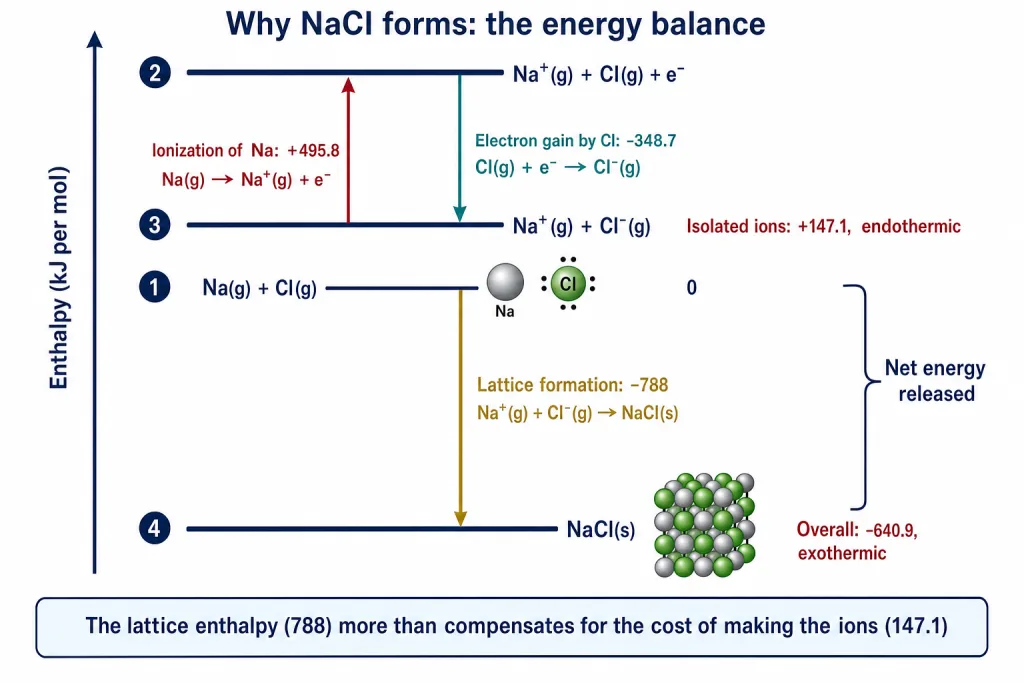
Step 4: let the ions pack into a crystal
The missing item is the enthalpy released when the gaseous ions come together into the solid lattice:
That is the enthalpy of lattice formation of NaCl, enormous against the 147.1 kJ deficit.
| Step | Process | (kJ/mol) |
|---|---|---|
| Ionization of Na | ||
| Electron gain by Cl | ||
| Subtotal: isolated gaseous ions | ||
| Lattice formation | ||
| Overall |
The overall change is strongly exothermic. Sodium chloride forms not because two atoms got their octets, but because a mole of ions falling into a crystal lattice releases 788 kJ.
Key Point: In an ionic solid the sum of the ionization enthalpy and the electron gain enthalpy may well be positive, yet the compound is still stable because of the large energy released when the crystal lattice forms. A qualitative measure of the stability of an ionic compound is its enthalpy of lattice formation, not simply the achievement of an octet around the gaseous ions.
Reading the sign correctly
- Enthalpy of lattice formation: , kJ/mol. Negative: energy released.
- Lattice enthalpy (as defined in your textbook): the energy required to separate into gaseous ions, kJ/mol. Positive: energy absorbed.
Same process, opposite directions. "The lattice enthalpy of NaCl is 788 kJ/mol" means separating the solid costs 788 kJ, so forming it from gaseous ions releases 788 kJ. Either way the magnitude 788 tells you how tightly the ions are held.
[JEE Main] The comparison matters more than 495.8 or 348.7 alone: . A question handing you an ionization enthalpy, an electron gain enthalpy and a lattice enthalpy wants three signed numbers added and the sign of the result read off.
Ionic Compounds in the Crystalline State
There are no molecules in a salt crystal
Ionic compounds in the crystalline state consist of orderly three-dimensional arrangements of cations and anions held together by coulombic (electrostatic) attraction. Every positive ion is surrounded by negative ions on all sides, and every negative ion by positive ions. No cation "belongs" to any particular anion.
Sodium chloride has the rock-salt structure. Each ion sits at the centre of an octahedron of six ions, and each at the centre of an octahedron of six ions: 6 : 6 coordination, the coordination number being 6 for both ions.
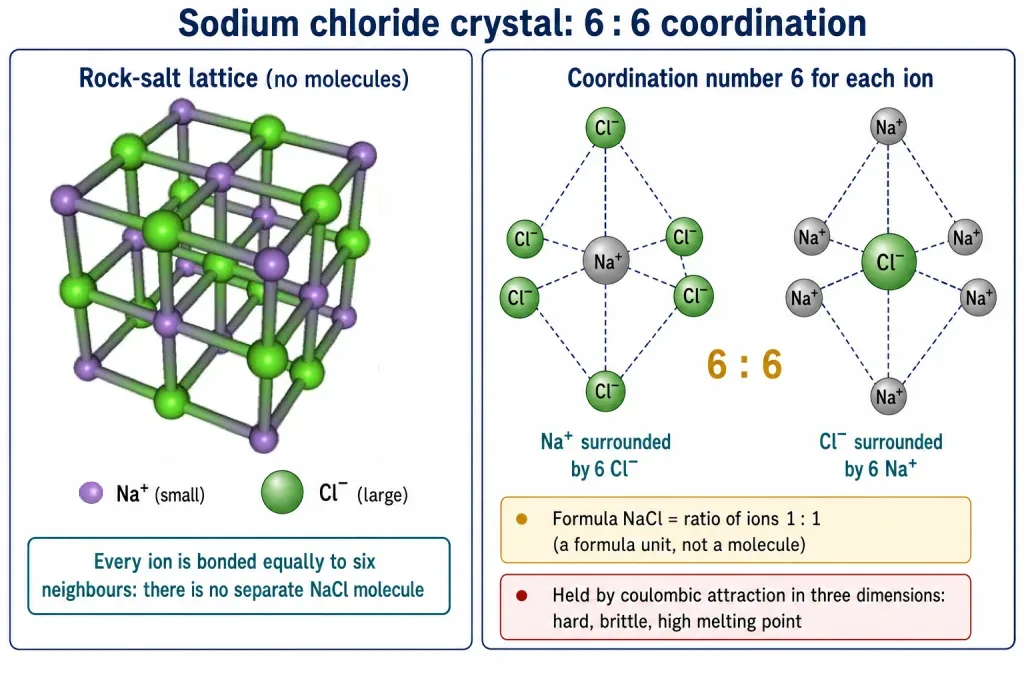
With each ion bonded equally to six neighbours, there is no discrete " molecule" in the solid. The formula gives only the ratio of ions (1 : 1). Chemists therefore say formula unit rather than "molecule".
Key Point: In the solid state a molecule of NaCl does not exist. The formula represents the simplest ratio of to ions in a crystal in which each ion is surrounded by six oppositely charged ions (6 : 6 coordination).
Different ionic compounds crystallise in different structures, decided by the relative sizes of the ions, how they pack most efficiently and other factors. CsCl has 8 : 8 coordination, since the large ion fits eight chloride ions around itself. These structures come in the solid-state chapter of Class 12.
The properties follow from the lattice
| Property | Observation | Why |
|---|---|---|
| Hardness | Salts are hard, rigid solids | Strong electrostatic forces act in all three directions; the ions cannot slide past each other. |
| Brittleness | A crystal shatters when struck | A blow shifts one layer of ions by one position, bringing like charges face to face. They repel, and the crystal splits along that plane. |
| High melting and boiling points | NaCl melts at about 1074 K (801 °C) | Melting means breaking up the whole lattice; that takes an energy comparable to the lattice enthalpy. |
| No conduction in the solid | Solid NaCl is an insulator | The ions are locked in place and cannot carry charge. |
| Conduction when molten or dissolved | Molten NaCl and brine conduct well | The ions are free to move towards the electrodes, and it is ions, not electrons, that carry the current. |
| Solubility | Most salts dissolve in water, not in petrol | Polar water molecules surround each ion and their attraction (hydration enthalpy) pays for pulling the lattice apart; non-polar solvents cannot do this. |
Brittleness is often explained wrongly. It is not "because the bonds are weak" — they are very strong. A small displacement lines up like charges, and the repulsion cleaves the crystal.
[Board] "Why does NaCl conduct electricity in the molten state but not in the solid state?" — in the solid the ions occupy fixed lattice positions and cannot move; in the melt the lattice has broken down and the ions migrate under an applied field.
Melting, dissolving and shattering all fight the same electrostatic network, and the number summarising how strongly an ionic solid holds together is its lattice enthalpy.
Lattice Enthalpy — Definition and Why It Cannot Be Measured Directly
Key Point (Definition): The lattice enthalpy of an ionic solid is the energy required to completely separate one mole of a solid ionic compound into its gaseous constituent ions. For sodium chloride, : it takes 788 kJ to separate one mole of solid NaCl into one mole of and one mole of , pulled apart to an infinite distance from each other.
Every phrase earns its place.
- One mole of the solid: a molar quantity, in kJ/mol.
- Completely separate: the ions end so far apart that they no longer interact. Half-melting a crystal does not count.
- Gaseous ions: not gaseous atoms, and not ions in water. Dissolving NaCl also breaks the lattice, but the ions are then hydrated — a different and much smaller energy change.
Why it takes so much energy
Each ion feels attraction to ions of opposite charge (every is pulled by its six nearest neighbours, more weakly by ions in distant shells) and repulsion from ions of like charge (the twelve next-nearest neighbours). Attractions outweigh repulsions, since opposite charges are closer. Separating the lattice means overcoming that net attraction for every ion, so the number runs into hundreds or thousands of kJ per mole.
Why you cannot simply calculate it — or measure it
Adding up all the attractions and repulsions from Coulomb's law does not work. Each ion interacts with an infinite number of others at different distances, and the pattern of those distances depends on the geometry of the crystal (rock salt, caesium chloride, fluorite and so on). Factors associated with the crystal geometry have to be included, the ions are not perfect point charges, and at short range there is an extra repulsion between electron clouds that Coulomb's law ignores.
Measurement fails too: it would mean turning a mole of solid NaCl into a gas of separate ions, but heating NaCl gives a vapour of NaCl ion pairs and atoms, not free and at infinite separation.
Key Point: Lattice enthalpy cannot be calculated directly from the forces of attraction and repulsion alone (the crystal geometry must be included), and it cannot be measured directly by experiment. It is obtained indirectly, from other measurable enthalpy changes.
A first look at the Born-Haber cycle
The indirect route uses Hess's law: enthalpy is a state function, so the change is the same whatever path you take. The formation of NaCl(s) from its elements can be written two ways:
- Direct path: , with the measurable enthalpy of formation kJ/mol.
- Step-wise path: sublime the sodium (enthalpy of sublimation), split the chlorine molecule (half the bond enthalpy), ionize the sodium (495.8), let chlorine gain the electron (), and finally let the gaseous ions collapse into the lattice.
Every step on the long path is measurable except the last. Both paths add up to the same , so the lattice enthalpy is the one unknown and drops straight out. This closed loop of enthalpies is the Born-Haber cycle, worked through with all the numbers in the JEE Corner, and it is how the value 788 kJ/mol for NaCl was obtained.
[JEE/NEET] Two definitions, two signs. "Lattice enthalpy" in the textbook sense is the energy required to break the lattice, so it is positive (+788 for NaCl). The "enthalpy of lattice formation" is the energy released when the lattice forms, so it is negative (). Read the question to see which is meant; the magnitude is what you compare.
What Decides Lattice Enthalpy — Charge and Size of the Ions
Coulomb's law lets you predict which of two ionic solids has the larger lattice enthalpy without calculating anything: the attraction between two ions is proportional to the product of their charges and inversely proportional to the distance between their centres.
and are the magnitudes of the ionic charges; is the distance between the centres of a touching cation-anion pair, the sum of their ionic radii.
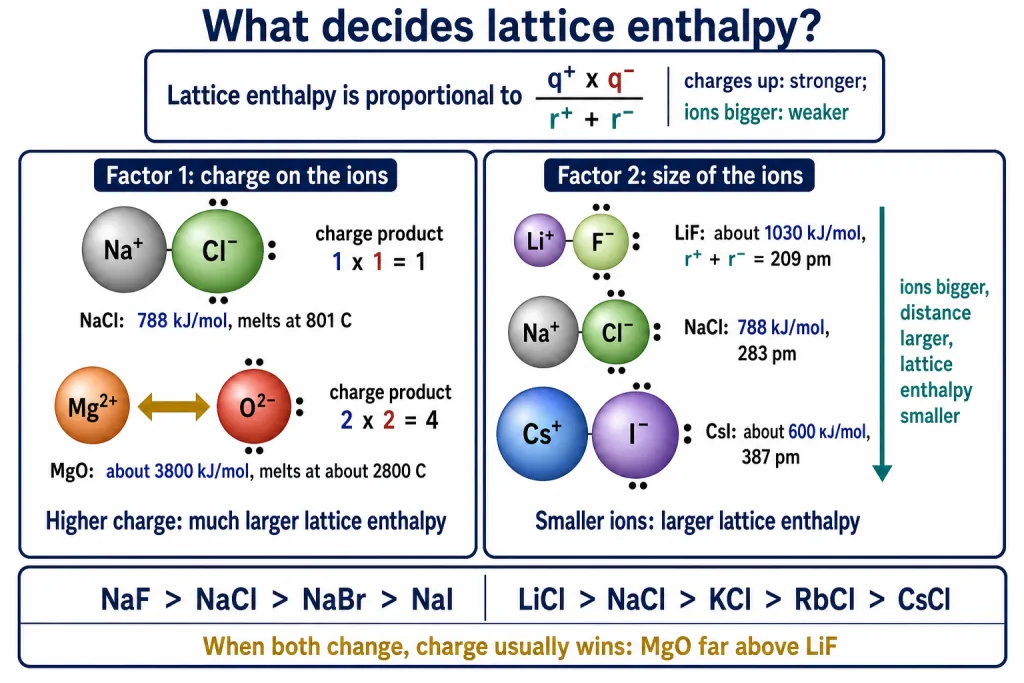
Factor 1: charge on the ions
NaCl and MgO share the rock-salt structure and have ions of similar size, but NaCl is built from and ions and MgO from and ions. The charge product goes from to , so the attraction is roughly four times as strong, and the doubly charged ions are somewhat smaller too.
| Compound | Ions | Charge product | Lattice enthalpy (kJ/mol) | Melting point |
|---|---|---|---|---|
| NaCl | , | 1 | 788 | about 1074 K (801 °C) |
| MgO | , | 4 | about 3800 | about 3100 K (2800 °C) |
Magnesium oxide lines furnaces for this reason: its lattice stays solid at temperatures that would vaporise NaCl.
Key Point: Higher ionic charges give a larger lattice enthalpy. Doubling both charges increases the attraction about fourfold.
Factor 2: size of the ions
Smaller ions get closer, and a shorter distance means stronger attraction. LiF and CsI are both / salts, but (about 76 pm) and (about 133 pm) are the smallest cation and anion in their groups, while (about 167 pm) and (about 220 pm) are among the largest.
| Compound | (pm, approx.) | Lattice enthalpy (kJ/mol, approx.) |
|---|---|---|
| LiF | 209 | about 1030 |
| NaCl | 283 | 788 |
| CsI | 387 | about 600 |
The trend runs through whole families:
- Down the halides of one metal: (anion getting bigger).
- Down the chlorides of group 1: (cation getting bigger).
Key Point: Smaller ions give a larger lattice enthalpy. For ions of the same charge, the lattice enthalpy decreases as the size of either ion increases.
Which factor wins
When both change at once, charge usually beats size. Going from to multiplies the attraction by four; going from the smallest to the largest ions in a group changes the distance by less than a factor of two. So MgO (about 3800) sits far above even LiF (about 1030).
What lattice enthalpy controls
A large lattice enthalpy means a high melting point, greater hardness, greater thermal stability, and often lower solubility in water, since the hydration enthalpy of the ions has to pay for breaking the lattice — MgO and are almost insoluble while NaCl dissolves freely.
[JEE Main] For "arrange in order of lattice enthalpy", compare charges first (higher product wins), then sizes (smaller wins); the same order holds for melting point and hardness. For solubility, be careful: both lattice enthalpy and hydration enthalpy fall as ions get larger, and which falls faster decides the trend.
Ionic Character, Electronegativity Difference and a Peek at Fajans' Rules
Real bonds live on a scale between fully ionic and fully covalent, and two tools place them on it.
Electronegativity difference as a guide
When two atoms differ greatly in electronegativity (their pull on shared electrons), the more electronegative atom takes the electrons almost completely and the bond is essentially ionic. When the difference is small the electrons are shared evenly and the bond is covalent. In between sits a polar covalent bond with partial ionic character. As a rough working rule, a difference greater than about 1.7 on the Pauling scale marks a bond as predominantly ionic.
Pauling values worth memorising:
| Element | Li | K | N | O | F | S | Cl |
|---|---|---|---|---|---|---|---|
| Electronegativity | 1.0 | 0.8 | 3.0 | 3.5 | 4.0 | 2.5 | 3.0 |
Apply them: arrange the bonds in LiF, , , and in order of increasing ionic character.
| Molecule | Bond | Electronegativity difference | Nature |
|---|---|---|---|
| purely covalent | |||
| polar covalent | |||
| polar covalent | |||
| ionic | |||
| ionic |
and tie on the crude difference, but chlorine and fluorine are both halogens sharing electrons in a small, non-metal-only molecule, while the S-O bond involves the more polarisable sulphur bonded to highly electronegative oxygen; the accepted order places just below .
Key Point: Increasing ionic character: . The bigger the electronegativity difference, the more ionic the bond.
The favourable factors, collected
An ionic bond is favoured when:
- the cation-forming element has a low ionization enthalpy (metals, especially groups 1 and 2, and larger atoms lower in a group);
- the anion-forming element has a high negative electron gain enthalpy (non-metals, especially groups 16 and 17);
- the resulting solid has a high lattice enthalpy (small, highly charged ions packed efficiently);
- the electronegativity difference between the two elements is large (roughly 1.7 or more).
Points 1 and 3 pull against each other: the easiest cations to make are the big ones, but the tightest lattices come from small ones. There is therefore no single "most ionic" compound, though CsF is usually quoted as the closest.
A preview of Fajans' rules
Lattice enthalpy has a flip side. A small cation with a high charge pulls so hard on the electron cloud of a large anion that it distorts (polarises) it, dragging electron density back between the nuclei, and the bond acquires covalent character — the idea behind Fajans' rules:
| Favours covalent character | Example |
|---|---|
| Small, highly charged cation | is largely covalent; is ionic |
| Large, easily polarised anion | is more covalent than |
| Cation without a noble-gas configuration (pseudo-inert or 18-electron shell) | is more covalent than |
These rules are trends, not laws; the polarising power of the cation and the polarisability of the anion come in the section on bond polarity. Keep the paradox: the same features that raise lattice enthalpy push a compound away from being purely ionic. There is no 100 per cent ionic bond, just as there is no 100 per cent covalent bond between different atoms.
[JEE Main] For "which is most ionic / most covalent", run two checks: electronegativity difference (bigger = more ionic) and Fajans (small, highly charged cation with a big anion = more covalent). They almost always agree.
Solved Examples
Question 1: The favourable factors for an ionic bond
Write the factors that favour the formation of an ionic bond.
Answer:
Three enthalpies and one difference.
- Low ionization enthalpy of the metal. Making a cation costs energy, so the less it costs the easier the cation forms. The alkali and alkaline-earth metals are the best cation makers.
- High negative electron gain enthalpy of the non-metal. When accepting an electron releases a lot of energy (a strongly negative ), the anion forms easily. Halogens and oxygen are the best anion makers.
- High lattice enthalpy of the solid. The gaseous ions release a large amount of energy on packing into a crystal, and small, highly charged ions give the biggest release — which is what makes the process worthwhile.
- Large electronegativity difference between the two atoms, so the electron really moves over rather than being shared.
Ans: (i) Low ionization enthalpy of the electropositive element, (ii) high negative electron gain enthalpy of the electronegative element, (iii) high lattice enthalpy of the resulting crystal, and (iv) a large electronegativity difference between the combining atoms.
Question 2: Electrovalency and the formulas of ionic compounds
Using ionization and electron-gain equations, state the electrovalency of each element and derive the formulas of the compounds formed between (a) calcium and fluorine, (b) aluminium and oxygen, (c) magnesium and nitrogen.
Answer:
Calcium is and loses both electrons: , electrovalency . Fluorine is and needs one: , . Two fluorides balance one calcium ion: .
Aluminium is and loses three: , electrovalency . Oxygen is and gains two: , electrovalency . The charges must cancel, so I take the lowest common multiple of 3 and 2, that is 6: two () and three (), giving .
Magnesium () loses two, giving , . Nitrogen () gains three, giving , . The lowest common multiple of 2 and 3 is 6: three () and two (), giving .
Ans: (a) Ca , F , ; (b) Al , O , ; (c) Mg , N , .
Watch out: Cross the charges to get subscripts, then cancel common factors — becomes .
Question 3: The sodium chloride energy balance
The ionization enthalpy of sodium is 495.8 kJ/mol and the electron gain enthalpy of chlorine is kJ/mol. (a) Is the formation of one mole each of and from gaseous atoms exothermic or endothermic, and by how much? (b) Given that the enthalpy of lattice formation of NaCl(s) is kJ/mol, find the overall enthalpy change for , and explain why the compound forms.
Answer:
The two ion-forming steps with signs: , kJ/mol (absorbed); , kJ/mol (released). Adding: kJ/mol. Positive, so forming the pair of isolated gaseous ions is endothermic by 147.1 kJ/mol; on this step alone NaCl would never form.
Now the lattice: , kJ/mol. Overall kJ/mol, strongly exothermic. The 788 kJ released far exceeds the 147.1 kJ needed to create the ions, so the solid is stable. The octets are a bonus, not the reason.
Ans: (a) Endothermic, kJ/mol. (b) kJ/mol; NaCl forms because the enthalpy of lattice formation ( kJ/mol) more than compensates for the net cost of making the gaseous ions.
Watch out: Whenever the ion-formation subtotal comes out positive, look to the lattice enthalpy to rescue the compound.
Question 4: Why there is no molecule of NaCl
"Sodium chloride consists of NaCl molecules." Is this statement correct? Explain with reference to the structure of solid NaCl.
Answer:
A molecule is a discrete group of atoms held together by bonds, with a definite boundary — a molecule is one carbon and two oxygens and nothing else.
The crystal is not like that. In solid NaCl every ion is surrounded by six ions at equal distances, and every by six ions: 6 : 6 coordination in the rock-salt structure, repeating in all three directions. Since each ion is attracted equally to six neighbours, I cannot say which chloride "belongs" to a given sodium; the crystal is a single continuous network of ions.
The formula says only that the ions are present in a 1 : 1 ratio, which is what electrical neutrality demands. It is the formula of a formula unit, not of a molecule.
Ans: The statement is incorrect. Solid NaCl is a three-dimensional lattice in which each is surrounded by six and each by six ; no discrete NaCl molecule exists, and the formula represents only the ratio of ions.
Watch out: For ionic solids say "formula unit", never "molecule". The phrases "6 : 6 coordination" and "three-dimensional lattice" carry the marks.
Question 5: Hard, brittle, and a conductor only when melted
Explain why ionic compounds (a) are hard, (b) are brittle, and (c) conduct electricity when molten or dissolved in water but not in the solid state.
Answer:
Hard. Each ion is gripped by strong electrostatic attractions from oppositely charged neighbours on every side. Scratching or denting the crystal would mean shifting ions out of those positions against those forces, so the solid resists deformation.
Brittle. Strong does not mean flexible. A blow slides one layer of ions by a single position, and then faces and faces across the slip plane. Like charges repel, the layers fly apart, and the crystal cleaves. A metal has a sea of electrons that keeps the bonding intact when layers slide, so it bends instead.
Conduction. Current needs mobile charged particles. In the solid the ions are locked in fixed lattice positions and can only vibrate, so it is an insulator. On melting the lattice collapses and the ions move freely; in water they separate and become surrounded by water molecules, again free to move. In both cases the charge carriers are ions, not electrons.
Ans: (a) Strong multidirectional electrostatic attractions resist deformation. (b) A small slip brings like charges together, and the repulsion splits the crystal. (c) Ions are immobile in the solid but free to move in the melt or in solution, and these mobile ions carry the current.
Question 6: Defining lattice enthalpy and why it is found indirectly
Define lattice enthalpy with an example. Why can it not be calculated directly from Coulomb's law or measured directly by experiment?
Answer:
Lattice enthalpy is the energy required to completely separate one mole of a solid ionic compound into its gaseous constituent ions. For NaCl, , kJ/mol: 788 kJ pulls one mole of solid NaCl apart into gaseous ions at infinite separation.
Coulomb's law alone will not give it. Each ion attracts ions of opposite charge and repels ions of like charge, with every other ion, at all sorts of distances. How many neighbours lie at each distance depends on the crystal geometry — rock salt differs from caesium chloride — and at very short range there is an extra repulsion between electron clouds that a point-charge model ignores.
Experiment will not give it either: heating NaCl until it vaporises gives NaCl ion pairs and atoms, not free and at infinite distance, so the defining process cannot be carried out.
It is found indirectly, using Hess's law. The formation of NaCl from its elements is written as a series of steps (sublimation of Na, dissociation of , ionization of Na, electron gain by Cl, lattice formation), and since every step except lattice formation is measurable, lattice enthalpy comes out by difference. This is the Born-Haber cycle.
Ans: Lattice enthalpy is the energy needed to separate one mole of an ionic solid into gaseous ions (NaCl: 788 kJ/mol). It cannot be calculated directly because the three-dimensional crystal geometry must be accounted for beyond simple attraction and repulsion, nor measured directly because the process cannot be carried out cleanly; it is determined indirectly from a Born-Haber cycle.
Watch out: Give both halves — why it is not directly available (geometry, infinite lattice) and how instead (Born-Haber).
Question 7: Why magnesium oxide melts so much higher than sodium chloride
NaCl and MgO both crystallise in the rock-salt structure with 6 : 6 coordination, yet MgO melts at about 2800 °C while NaCl melts at about 801 °C. Explain by comparing their lattice enthalpies.
Answer:
Both solids pack their ions the same way, so geometry is not the difference. NaCl has and (, ), MgO has and (, ).
Lattice enthalpy goes as divided by the distance between ion centres. The charge product is for NaCl and for MgO, so on charge alone MgO ions attract about four times as strongly. Size helps too: (about 72 pm) is smaller than (about 102 pm), and (about 140 pm) smaller than (about 181 pm), so the ions sit closer and the attraction is stronger still.
NaCl has a lattice enthalpy of 788 kJ/mol, MgO about 3800 kJ/mol, roughly five times as much. The thermal energy needed to shake a lattice apart scales with its lattice enthalpy, so MgO needs a far higher temperature.
Ans: MgO has doubly charged, smaller ions, so its lattice enthalpy (about 3800 kJ/mol) is about five times that of NaCl (788 kJ/mol); much more thermal energy is needed to break the MgO lattice, hence its far higher melting point.
Watch out: Charge first, then size. Doubling both charges multiplies the attraction by four, which is why oxides are the refractory materials of the furnace industry.
Question 8: Ordering lattice enthalpies by ion size
Arrange the following in decreasing order of lattice enthalpy and justify: (a) LiF, NaCl, CsI; (b) NaF, NaCl, NaBr, NaI; (c) LiCl, KCl, CsCl.
Answer:
Charges first: every compound listed is a salt, so the charge product is 1 throughout and the only variable is . Smaller ions come closer, the attraction is stronger, and the lattice enthalpy is larger.
(a) and are the smallest ions of their groups, and the largest: (about 1030 > 788 > about 600 kJ/mol).
(b) Same cation; the anion grows from to : .
(c) Same anion; the cation grows from to : .
Ans: (a) ; (b) ; (c) . In each series the charges are the same, so the compound with the smaller ions (shorter inter-ionic distance) has the larger lattice enthalpy.
Question 9: Ordering bonds by ionic character
Arrange the bonds in the following molecules in order of increasing ionic character: LiF, , , , .
Answer:
The larger the electronegativity difference, the more completely the electrons shift to one side and the more ionic the bond. Pauling values: Li 1.0, K 0.8, N 3.0, O 3.5, F 4.0, S 2.5, Cl 3.0.
: two identical nitrogen atoms, difference , electrons shared perfectly evenly — purely covalent, zero ionic character.
and : S-O difference ; Cl-F difference . Both polar covalent, and they tie on the crude number; the accepted order puts slightly below , since the Cl-F bond involves fluorine, the most electronegative element.
: K-O difference , a metal with a non-metal, so the bond is ionic.
LiF: Li-F difference , the largest here, so LiF is the most ionic of the set.
Ans: .
Watch out: Homonuclear bond at the bottom, metal-non-metal at the top. Memorise the handful of Pauling values and this becomes arithmetic.
Question 10: Will the compound form? A potassium chloride check
For potassium, the first ionization enthalpy is 419 kJ/mol; for chlorine, the electron gain enthalpy is kJ/mol; the lattice enthalpy of KCl is 718 kJ/mol. (a) Calculate the enthalpy change for forming isolated and from the gaseous atoms. (b) Calculate the overall enthalpy change for . (c) Compare with NaCl ( kJ/mol) and comment.
Answer:
(a) kJ/mol. Endothermic, but less so than for sodium (), since potassium's electron is easier to remove.
(b) The 718 kJ/mol breaks the lattice, so forming it releases kJ/mol. Overall kJ/mol, strongly exothermic, so KCl forms readily.
(c) KCl has the smaller lattice enthalpy (718 against 788, since is bigger than ), yet its overall value () is close to NaCl's (): potassium's lower ionization enthalpy (419 against 495.8) almost exactly offsets its weaker lattice. A bigger cation is easier to make but packs less tightly.
Ans: (a) kJ/mol (endothermic); (b) kJ/mol (exothermic); (c) comparable to NaCl because the lower ionization enthalpy of K compensates for the lower lattice enthalpy of KCl.
Watch out: Down a group the ion-formation cost and the lattice payback move in opposite directions, so compute the full sum before deciding which salt is "more favourable".
Question 11: A doubly charged cation — the MgCl balance
The first and second ionization enthalpies of magnesium are 738 and 1451 kJ/mol; the electron gain enthalpy of chlorine is kJ/mol; the lattice enthalpy of is about 2526 kJ/mol. Show that is exothermic even though forming costs more than four times as much as forming .
Answer:
Cost of the cation: , kJ/mol — about 4.4 times the 495.8 for . Payback from the anions: kJ/mol.
Isolated ions subtotal: kJ/mol, about ten times worse than NaCl's . On the face of it looks hopeless.
The lattice rescues it: releases kJ/mol, since the small, doubly charged pulls the chlorides in far more strongly than can. Overall kJ/mol, comfortably exothermic — more so per mole than NaCl.
Ans: kJ/mol, so the formation of from gaseous atoms is exothermic. The very large lattice enthalpy that comes with a cation more than pays for the expensive second ionization.
Watch out: Higher charge makes the ion dearer to make but the lattice far stronger, and the lattice usually wins — which is why magnesium forms and not .
Question 12: Which compound is more ionic?
In each pair, pick the compound with the greater ionic character and give one reason: (a) NaCl or ; (b) LiF or LiI; (c) CsF or LiF.
Answer:
(a) NaCl. Sodium's electronegativity (0.9) is lower than aluminium's (1.5), so the Na-Cl difference is larger. By Fajans' idea, is tiny and charged, so it strongly polarises the chloride's electron cloud and pulls electron density back between the nuclei, giving substantial covalent character; polarises very little.
(b) LiF. The Li-F difference () beats Li-I (), and the small, hard resists polarisation whereas the big, soft is easily distorted by .
(c) CsF. Caesium has the lowest electronegativity of any stable element (about 0.7), so the Cs-F difference (about 3.3) beats Li-F (3.0). The large has very little polarising power, while the small polarises even fluoride a little. CsF is usually quoted as the most ionic of all binary compounds.
Ans: (a) NaCl; (b) LiF; (c) CsF. In each case the more ionic compound has the larger electronegativity difference and the less polarising cation or less polarisable anion.
Watch out: A large electronegativity gap and a big cation with a small anion push towards ionic; small, highly charged cations with big anions push towards covalent.