
Why Phosphorus Can Do What Nitrogen Cannot
Nitrogen and phosphorus share a group and five valence electrons, yet phosphorus forms and has never been made. Sulphur forms ; oxygen stops at . The difference is a set of orbitals.
Nitrogen and oxygen have only four valence orbitals — one and three — which hold at most eight electrons, and that is the octet. A orbital does not exist, so a second-period atom has nowhere to put a ninth or tenth electron. Phosphorus and sulphur are in the third shell, which has , and . Those orbitals are empty in the ground state, but their energy is not far above and .
Key Point: Third-period and heavier elements have vacant orbitals of energy comparable to their and orbitals. These can join in hybridisation, letting the central atom hold more than eight electrons — the expanded octet. Second-period elements have no orbitals, so they can never expand beyond eight.
Which orbitals are allowed to mix
Hybridisation works only between orbitals of nearly equal energy. In a third-period atom , and are close enough for mixing. The orbitals also lie close to and , so works too — the and hybridisation of coordination compounds in Class 12. A mixture of , and is not possible; that gap is too large.
| Combination | Allowed? | Reason |
|---|---|---|
| Yes | comparable energies within the same shell | |
| Yes | lies close to and | |
| No | and are too far apart in energy | |
| Impossible | no orbital exists |
The excited-state trick
Carbon reaches four bonds by promoting a electron into an empty orbital. Phosphorus and sulphur do the same, with a orbital as the destination.
- Phosphorus (), ground state — three unpaired electrons, hence . Excited state — five unpaired electrons, hence .
- Sulphur (), ground state — two unpaired electrons, hence or . First excited state — four unpaired, hence . Second excited state — six unpaired, hence .
The promotion costs energy, but the extra bonds pay it back, especially with a small, very electronegative partner (F, Cl, O). That is why expanded-octet compounds — , , , — are almost always fluorides, chlorides or oxides.
Key Point: The number of unpaired electrons in the excited state equals the number of bonds the atom can make, and the total number of orbitals that hybridise, including any holding lone pairs, decides the shape.
[JEE Main] is known and is not, and the reason is neither size nor electronegativity — it is the absence of orbitals in the valence shell of nitrogen.
[NEET] Expanded octet = a period-3-or-below central atom with vacant orbitals: (, 10 electrons around P) and (, 12 electrons around S).
Hybridisation — and the Trigonal Bipyramid
Step 1 — the configurations
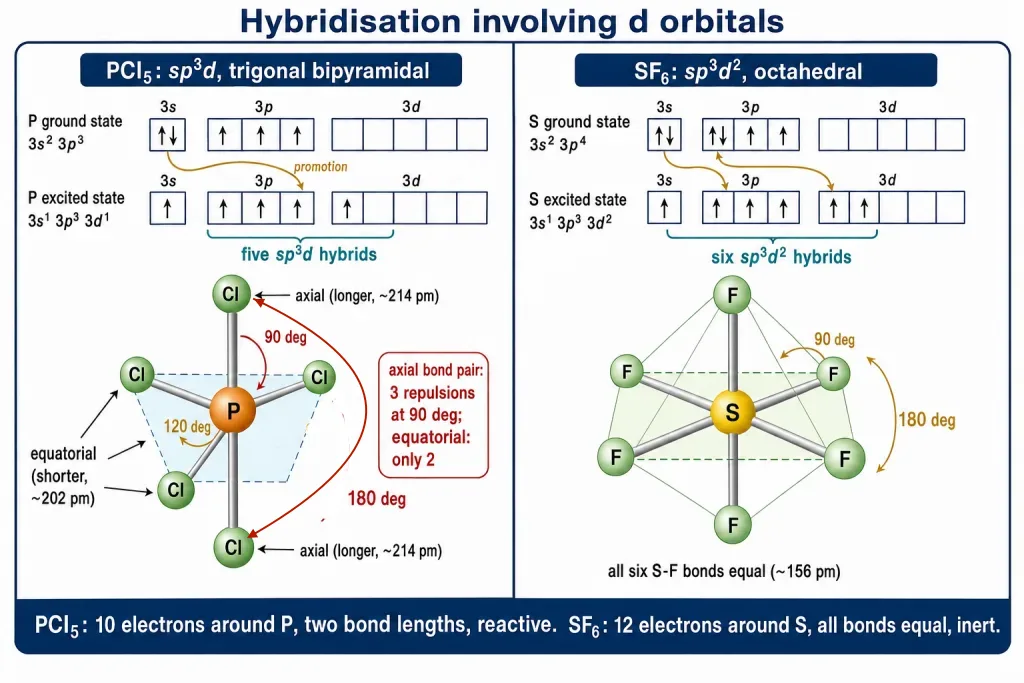
Phosphorus in its ground state has the outer configuration , with only three unpaired electrons. For five bonds, one electron is promoted into an empty orbital:
Five orbitals — one , three , one — now carry a single electron each.
Step 2 — the mixing
These five half-filled orbitals mix to give five equivalent-looking hybrid orbitals. To keep their electron clouds as far apart as possible they can arrange themselves only one way: pointing to the five corners of a trigonal bipyramid — a flat triangle with one arm straight up and one straight down.
Step 3 — the bonds
Each hybrid overlaps head-on with the singly occupied orbital of a chlorine atom, giving five sigma bonds. Phosphorus keeps no lone pairs, so the electron geometry and the molecular shape are the same: trigonal bipyramidal.
Two kinds of bonds in one molecule
Not all five bonds are equivalent.
| Bond type | How many | Where | Angle |
|---|---|---|---|
| Equatorial | 3 | in the horizontal plane, through the centre | 120° to each other |
| Axial | 2 | one above and one below the plane | 90° to every equatorial bond; 180° to each other |
For the full angle census, take any two of the five chlorines: pairs — six axial-equatorial (90°), three equatorial-equatorial (120°) and one axial-axial (180°).
Why the axial bonds are longer and weaker
An axial bond pair has three equatorial pairs at 90° from it — three close neighbours pushing on it. An equatorial bond pair has only the two axial pairs at 90°; its other two neighbours sit at a comfortable 120°.
The axial bond pairs are pushed slightly further from the phosphorus, and a longer bond is a weaker bond. Experimentally the axial bond is about 214 pm and the equatorial one about 202 pm — slight, but measurable.
Key Point: In , axial bonds are slightly longer and weaker than equatorial bonds because each axial bond pair is repelled by three bond pairs at 90°, whereas each equatorial bond pair is repelled by only two.
Why this makes reactive
Two weak, stretched bonds make far less stable than . It dissociates easily into and on heating, fumes in moist air, and is a powerful chlorinating agent, and in each case the axial bonds break first. Solid even rearranges into the ionic pair — tetrahedral cation plus octahedral anion — rather than staying as trigonal bipyramidal molecules.
[JEE Main] Because the two positions differ, the five hybrids are not truly equivalent: the equatorial set is closer to in character and the axial pair closer to . So "all five orbitals are equivalent" is false, whereas the six orbitals in genuinely are equivalent.
Hybridisation — and the Regular Octahedron
Sulphur () in its ground state has the outer configuration , that is — only two unpaired electrons. That explains and , but not .
The double promotion
Six bonds need six unpaired electrons. Sulphur gets them by promoting one electron and one electron into two empty orbitals:
Six orbitals — one , three , two — are now singly occupied. They hybridise into six equivalent hybrid orbitals pointing to the six corners of a regular octahedron: four in a square plane, one above and one below. Each hybrid overlaps the singly occupied orbital of a fluorine to make six sigma bonds.
Why every bond is the same
From any vertex of an octahedron the picture is identical — four neighbours at 90°, one at 180°. There is no equatorial or axial distinction, so
- all six bonds have the same length (about 156 pm),
- every adjacent angle is exactly 90°,
- every opposite pair is at 180°.
Angle census: pairs, of which 12 are at 90° and 3 at 180°.
Key Point: is a regular octahedron with hybridised sulphur, all six bonds equal and all adjacent bond angles 90°. It is non-polar because six equal dipoles pointing to the corners of an octahedron cancel exactly.
Why is so unreactive
is the opposite of : a colourless, non-toxic gas that does not react with water, acids or bases, used as an insulating gas in high-voltage equipment. The reason is geometric. Six fluorines completely surround the small sulphur atom, leaving no room for a reagent to reach the centre, and there are no weak axial bonds to attack. The bonds are also very strong. This steric shielding is why resists hydrolysis even though the reaction with water is thermodynamically favourable.
Comparing the two textbook molecules
| Central atom, ground state | P: | S: |
| Excited state | ||
| Hybridisation | (5 orbitals) | (6 orbitals) |
| Shape | trigonal bipyramidal | octahedral |
| Bond angles | 120° (eq-eq), 90° (ax-eq), 180° (ax-ax) | 90° (adjacent), 180° (opposite) |
| Are all bonds equal? | No — axial longer and weaker | Yes — all six identical |
| Electrons around central atom | 10 | 12 |
| Dipole moment | 0 (symmetric) | 0 (symmetric) |
| Reactivity | high; axial bonds break first | extremely low |
[JEE Main] The reasoning behind also fixes the shape of , , and : six sigma bonds, no lone pairs, , octahedral. Count electrons around the central atom, not the charge on the ion.
The Master Table — Every Hybridisation and Its Shape
This is the full set of hybridisations a Class 11 or 12 paper can use.
| Hybridisation | Orbitals mixed | Number of hybrids | Shape (no lone pairs) | Bond angle | Examples |
|---|---|---|---|---|---|
| 2 | linear | 180° | , , , | ||
| 3 | trigonal planar | 120° | , , , | ||
| 4 | tetrahedral | 109.5° | , , | ||
| 5 | trigonal bipyramidal | 120° and 90° | , , | ||
| 6 | octahedral | 90° | , , | ||
| (JEE extra) | 4 | square planar | 90° | , | |
| (JEE extra) | 6 | octahedral | 90° | ||
| (JEE extra) | 7 | pentagonal bipyramidal | 72° and 90° |
Inner-orbital and outer-orbital: versus
Both give six hybrids and an octahedron. The difference is which orbitals are used. In the orbitals come from the same shell as the and ( in ) — "outer" orbitals. In they come from the shell below ( with in ) — "inner" orbitals. Both are legal because is close in energy to both and , and the order of the letters says which is meant. For main-group molecules in this chapter it is always .
— seven bonds
Iodine () promotes three electrons into orbitals to reach : seven unpaired electrons, seven hybrids. The shape is a pentagonal bipyramid — five fluorines in a flat pentagon at 72° to each other, two axial fluorines at 90° to the plane. It is the only common molecule with this shape.
Percentage character of the hybrids
If orbitals mix, each hybrid carries of every orbital that went in, so the share of character is , and likewise for and .
| Hybridisation | % | % | % | |
|---|---|---|---|---|
| 2 | 50 | 50 | 0 | |
| 3 | 33.3 | 66.7 | 0 | |
| 4 | 25 | 75 | 0 | |
| 5 | 20 | 60 | 20 | |
| 6 | 16.7 | 50 | 33.3 | |
| 7 | 14.3 | 42.9 | 42.9 |
More character means a shorter, stronger bond and a more electronegative atom. As orbitals enter, the share keeps falling.
A question asking for "hybridisation of the central atom" wants the letters (); one asking for "geometry" or "shape" wants the word (trigonal bipyramidal). With lone pairs present the two answers differ, which is the next block.
[JEE Main] Two exceptions to "same hybridisation, same shape": is the only hybridisation whose positions are non-equivalent, hence the axial/equatorial story, and gives a square rather than a tetrahedron despite having four hybrids, because the orbital that enters lies in a plane.
Lone Pairs on and Centres
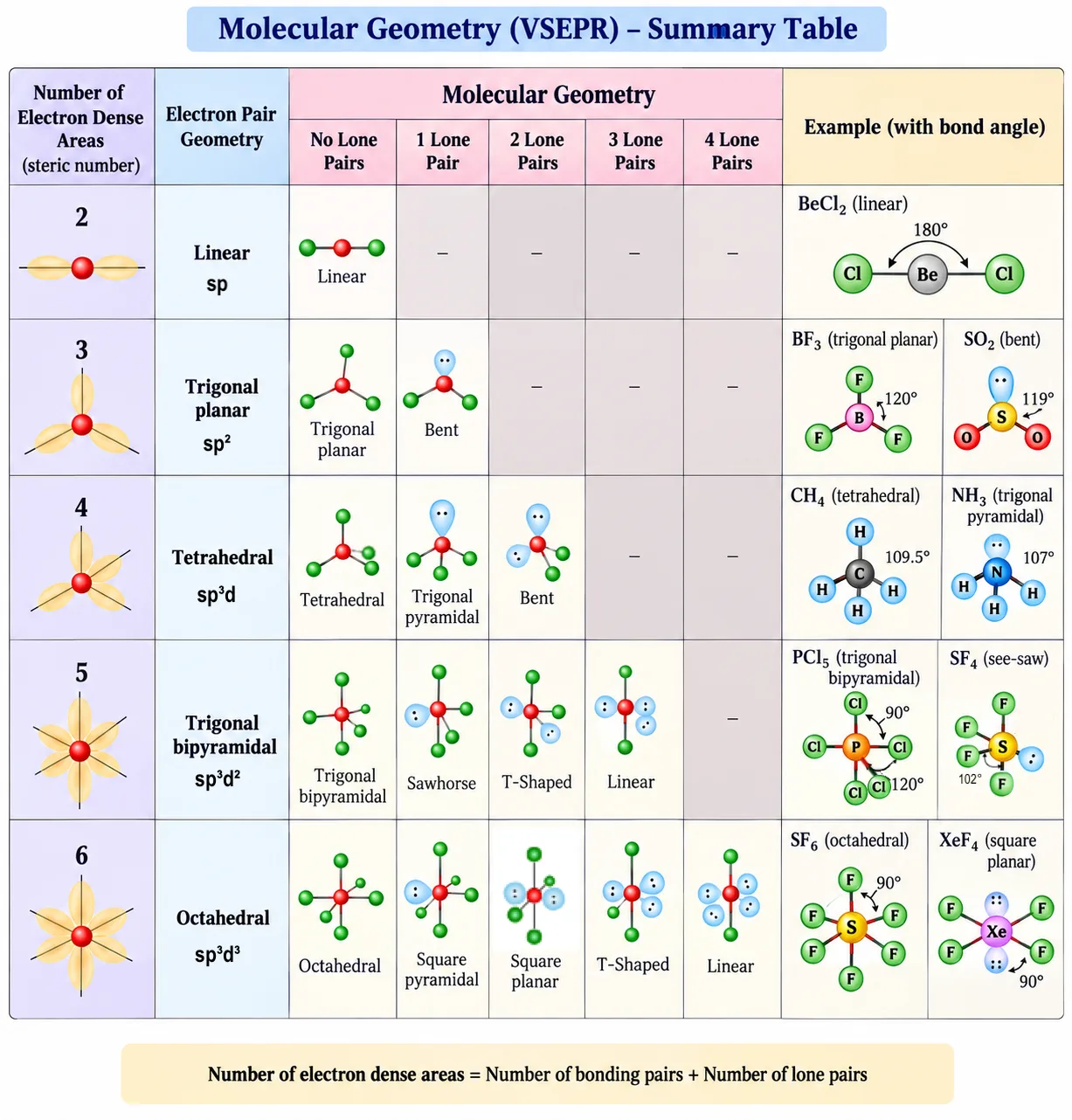
Now let one or more hybrid orbitals hold a lone pair instead of a bond. The hybridisation and the arrangement of electron pairs stay the same, but the shape we name — the arrangement of atoms only — changes. This is the VSEPR treatment used for and , extended to five and six pairs.
The steric-number method, extended
| SN | Hybridisation | Electron geometry |
|---|---|---|
| 2 | linear | |
| 3 | trigonal planar | |
| 4 | tetrahedral | |
| 5 | trigonal bipyramidal | |
| 6 | octahedral | |
| 7 | pentagonal bipyramidal |
For the lone pairs: lone pairs , adding electrons for a negative charge and subtracting for a positive one, and counting only sigma bonds (a double bond still uses one hybrid orbital).
Five electron pairs: where does a lone pair sit?
In a trigonal bipyramid the two positions differ, so a lone pair has a choice. A lone pair is bulkier than a bond pair and repels harder, so it takes the position with the fewest 90° neighbours — the equatorial position, with two such neighbours rather than three. Rule: in species, lone pairs always go equatorial.
| Species | Bond pairs | Lone pairs | Hybridisation | Shape | Angles (approx.) |
|---|---|---|---|---|---|
| 5 | 0 | trigonal bipyramidal | 120°, 90° | ||
| 4 | 1 | see-saw | ~102° (eq), ~173° (ax) | ||
| 3 | 2 | T-shaped | ~87.5° | ||
| , | 2 | 3 | linear | 180° |
- : sulphur has 6 valence electrons, 4 in bonds, leaving one lone pair. SN = 5, . The lone pair takes an equatorial slot and the four fluorines fill the remaining two equatorial and two axial positions, giving a see-saw (a distorted tetrahedron). It squeezes the axial fluorines from 180° to about 173° and the equatorial pair from 120° to about 102°.
- : chlorine has 7 valence electrons, 3 in bonds, so two lone pairs. SN = 5. Both go equatorial, 120° apart. The three fluorines — one equatorial, two axial — form a T, the axial ones bending towards the equatorial F to give about 87.5° rather than 90°.
- : xenon has 8 valence electrons, 2 in bonds, so three lone pairs. All three go equatorial at 120° from each other, leaving the two fluorines axial — a perfectly linear molecule. is the same case (7 + 1 = 8 electrons on the central iodine, two bonds, three lone pairs).
Six electron pairs: a lone pair can go anywhere at first
In an octahedron all six positions are equivalent, so the first lone pair has no preference. The second does: it goes opposite (trans, 180°) to the first, keeping the two bulky lone pairs as far apart as possible.
| Species | Bond pairs | Lone pairs | Hybridisation | Shape | Angles |
|---|---|---|---|---|---|
| 6 | 0 | octahedral | 90° | ||
| , | 5 | 1 | square pyramidal | ~85° | |
| 4 | 2 | square planar | 90° |
- : bromine has 7 valence electrons, 5 in bonds, one lone pair. SN = 6. One position holds the lone pair; the five fluorines form a square base with one on top — a square pyramid. The lone pair pushes the four basal fluorines upward, so the basal angles are about 85° rather than 90°.
- : xenon has 8 valence electrons, 4 in bonds, two lone pairs. SN = 6. The lone pairs sit opposite each other, one above and one below, and the four fluorines lie in a perfect square plane at exactly 90°. Because the lone pairs are trans and cancel, is non-polar.
Key Point: Same hybridisation, different shape. : trigonal bipyramidal → see-saw → T-shaped → linear as lone pairs go from 0 to 3. : octahedral → square pyramidal → square planar as lone pairs go from 0 to 2. Lone pairs go equatorial in a trigonal bipyramid and trans to each other in an octahedron.
[NEET] Shapes to match instantly: see-saw, T-shaped, linear, square pyramidal, square planar, pentagonal bipyramidal.
Polarity, Oxo-Species and the Traps Examiners Set
Which and molecules are non-polar?
A molecule is non-polar when its bond dipoles cancel, which needs the surrounding atoms arranged symmetrically and any lone pairs placed symmetrically too.
| Species | Shape | Polar? | Why |
|---|---|---|---|
| , | trigonal bipyramidal | No | three equatorial dipoles cancel in the plane; two axial cancel each other |
| see-saw | Yes | lone pair on one side, no cancellation | |
| T-shaped | Yes | two lone pairs and three bonds do not balance | |
| linear | No | two opposite dipoles cancel; three lone pairs are symmetric in the plane | |
| octahedral | No | six dipoles cancel in pairs | |
| square pyramidal | Yes | the apical bond and lone pair do not cancel | |
| square planar | No | four in-plane dipoles cancel; two lone pairs are trans | |
| pentagonal bipyramidal | No | fully symmetric |
Among molecules with lone pairs, only those whose lone pairs are symmetric — three equatorial in , two trans in — come out non-polar.
Oxo-species of xenon and phosphorus
A double bond uses one hybrid orbital for its sigma part; the pi part comes from an unhybridised orbital. For the steric number, a double-bonded oxygen counts as one neighbour.
| Species | Sigma neighbours | Lone pairs | SN | Hybridisation | Shape |
|---|---|---|---|---|---|
| 3 | 1 | 4 | trigonal pyramidal | ||
| 5 | 1 | 6 | square pyramidal | ||
| 4 | 1 | 5 | see-saw | ||
| 6 | 1 | 7 | distorted octahedral | ||
| 4 | 0 | 4 | tetrahedral | ||
| 4 | 0 | 4 | tetrahedral | ||
| 6 | 0 | 6 | octahedral | ||
| 6 | 0 | 6 | octahedral |
Two checks. In xenon has 8 valence electrons; 2 go to the double bond and 4 to the single bonds, leaving 2 = one lone pair. Five neighbours + one lone pair = SN 6, ; the oxygen sits opposite the lone pair and the four fluorines form the square base. In phosphorus has 5 valence electrons plus 1 from the charge = 6, all in bonds, SN 6, ; gives the same result from .
Bond-angle effects with lone pairs at these centres
Lone pairs squeeze bond angles here as they do at tetrahedral centres:
- : 120° → about 102° (equatorial), 180° → about 173° (axial).
- : 90° → about 87.5°.
- : 90° → about 85° between the apical and basal bonds.
- and : no distortion (180° and 90° exactly), because the lone pairs are symmetric and their pushes cancel.
The five traps
- " or exists." It does not — nitrogen has no orbitals. Same for , .
- "All bonds in are equal." No — the two axial bonds are longer. All bonds in are equal.
- "Linear means ." and are linear but . "Square planar means ." is square planar but .
- "Lone pairs go axial in a trigonal bipyramid." They go equatorial — fewer 90° neighbours.
- "Number of hybrid orbitals = number of bonds." It equals bonds plus lone pairs. makes three bonds but uses five orbitals.
[JEE/NEET] The three most-asked facts here: why has two bond lengths; the shapes of , , , , ; and why nitrogen and oxygen cannot expand their octet.
Solved Examples
Question 1: Hybridisation in and why the axial bonds are longer
Describe the hybridisation in . Why are the axial bonds longer than the equatorial bonds?
Answer:
Phosphorus has the outer configuration — three unpaired electrons, enough for but not . So I excite it: one electron moves into an empty orbital, giving , five orbitals with one electron each.
Those five mix into five hybrids pointing to the corners of a trigonal bipyramid. Each overlaps a half-filled orbital of a chlorine, giving five sigma bonds — three in a plane at 120° to each other (equatorial), two above and below that plane at 90° to it (axial).
Now the lengths. Every axial bond pair has three equatorial pairs pushing on it at 90°. Every equatorial bond pair has only the two axial pairs at 90°, its other two neighbours being far away at 120°. Three shoves beat two, so the axial pairs get pushed slightly further from the phosphorus. A longer bond is a weaker bond, which is why is so reactive — the axial bonds go first.
Ans: (excited P: ), trigonal bipyramidal; three equatorial bonds at 120°, two axial at 90° to the plane; axial bonds longer and weaker, from three 90° repulsions against two.
Watch out: The three-versus-two count of 90° repulsions is the whole answer — state it in those terms.
Question 2: Excited-state configurations of P and S, and the shape of
Write the ground-state and excited-state valence configurations of phosphorus in and sulphur in . Hence describe the hybridisation and geometry of .
Answer:
Phosphorus: ground state (3 unpaired), excited state (5 unpaired) → five hybrids → .
Sulphur: ground state (2 unpaired). For six unpaired electrons it must promote twice — one electron and one electron each to an empty orbital — giving (6 unpaired).
Those six orbitals mix into six equivalent hybrids pointing to the six corners of a regular octahedron. Each overlaps head-on with the singly occupied orbital of a fluorine, giving six sigma bonds, with no lone pairs left on sulphur.
So the geometry is octahedral: every adjacent angle is 90°, every opposite pair 180°, and all six bonds identical in length because every corner of an octahedron is equivalent.
Ans: P: (); S: (). is a regular octahedron with six equal bonds at 90°.
Watch out: One promotion gives five unpaired electrons and ; two promotions give six and . The number of unpaired electrons after excitation is the number of bonds.
Question 3: Why exists but does not
Nitrogen and phosphorus are both in group 15. Explain why phosphorus forms while nitrogen cannot form .
Answer:
I count nitrogen's valence orbitals first. Nitrogen is in period 2, so its valence shell is : one and three — four orbitals, a maximum of eight electrons, that is four bonds or bonds-plus-lone-pairs.
Five bonds would need five half-filled orbitals. Nitrogen's ground state has three, and getting more would mean promoting a electron somewhere. There is nowhere: a orbital does not exist. So nitrogen stops at three bonds plus one lone pair.
Phosphorus is in period 3, valence shell : , and five empty orbitals of comparable energy. Promoting one electron into gives — five unpaired electrons, five hybrids, five bonds. The promotion costs energy, but the two extra bonds release more than enough to pay for it.
Ans: Phosphorus has vacant orbitals close in energy to and , so it expands its octet to ten electrons through hybridisation; nitrogen has no valence-shell orbitals, cannot exceed eight electrons, and cannot form five bonds.
Watch out: "No orbitals in the second period" is the reason behind every expanded-octet question with N, O or F as the central atom.
Question 4: Counting the bond angles in and
How many angles of 90°, 120° and 180° are there in ? Do the same count for in .
Answer:
For I label three equatorial chlorines () at 120° to each other in the plane and two axial ones () above and below. Every angle belongs to one pair of chlorines, so I count pairs: .
- Axial-equatorial: each axial Cl pairs with each of the three equatorial → pairs at 90°.
- Equatorial-equatorial: pairs at 120°.
- Axial-axial: 1 pair at 180°.
- Check: .
For , six fluorines sit at the corners of an octahedron, so pairs. Each fluorine has four neighbours at 90° and one directly opposite at 180°. Opposite pairs: 3, one per axis. The rest, , are at 90°, which checks out as adjacent pairs.
Ans: : six angles of 90°, three of 120°, one of 180°. : twelve angles of 90°, three of 180°, none of 120°.
Watch out: Count pairs with and sort them by position type — guessing the totals is where marks go.
Question 5: and — where do the lone pairs go?
Find the hybridisation and shape of and . Explain where the lone pairs are placed and why.
Answer:
first. Sulphur has 6 valence electrons; 4 go into four bonds, leaving 2 electrons = one lone pair. Steric number → , trigonal bipyramidal electron geometry.
A lone pair is bulky and repels strongly, so it takes the spot with the fewest close (90°) neighbours: an axial spot has three, an equatorial spot only two, so it goes equatorial.
The four fluorines then occupy two equatorial and two axial positions. Counting atoms only, that is a see-saw. The lone pair pushes the axial F's in to about 173° and the equatorial F's to about 102°.
Now . Chlorine has 7 valence electrons; 3 are used in bonds, leaving 4 = two lone pairs, so SN → .
Both lone pairs take equatorial slots, 120° apart, each with only two 90° bond-pair neighbours. The fluorines fill the remaining equatorial position and the two axial ones, and two axial F's with one equatorial F make a T. The lone pairs bend the axial F's toward the equatorial F, giving about 87.5° instead of 90°.
Ans: : , one equatorial lone pair, see-saw shape. : , two equatorial lone pairs, T-shaped.
Watch out: In a trigonal bipyramid lone pairs always go equatorial. Remove one equatorial arm and you get a see-saw; remove two and you get a T.
Question 6: and — linear and square planar without or
Work out the hybridisation and shape of and . Why is linear even though its hybridisation is not ?
Answer:
: xenon has 8 valence electrons. Two go into bonds, leaving 6 = three lone pairs. SN → , trigonal bipyramidal arrangement of pairs.
All three lone pairs go equatorial at 120° from one another, leaving the two axial positions for the fluorines. Two atoms on opposite axial arms give a linear molecule, = 180°. It is linear not because the hybridisation is , but because the three lone pairs fill the equatorial plane and cancel each other's push.
: 8 valence electrons, 4 in bonds, 4 left = two lone pairs. SN → , octahedral arrangement. The lone pairs go trans (180°) to stay as far apart as possible, one above and one below, and the four fluorines lie in the middle square: square planar, all = 90°. They push equally on both sides, so there is no distortion and no net dipole.
Ans: : , three equatorial lone pairs, linear. : , two trans lone pairs, square planar. Both are non-polar.
Watch out: Hybridisation comes from the steric number, not from the shape. Linear and square planar can hide and centres.
Question 7: and
Determine the hybridisation, shape and approximate bond angles of and . Which of the two is polar?
Answer:
: bromine has 7 valence electrons; 5 go into bonds, 2 are left = one lone pair. SN → , octahedral arrangement.
All octahedral positions are equivalent, so the lone pair takes any one — say the bottom. Four fluorines form a square around the bromine with the fifth on top: square pyramidal. The lone pair below pushes the basal fluorines upward, so the apical-to-basal angle shrinks from 90° to about 85°.
: iodine has 7 valence electrons, all 7 in bonds, no lone pairs. SN → , from excited iodine . The seven hybrids point to the corners of a pentagonal bipyramid: five fluorines in a flat pentagon at from each other, two axial fluorines at 90° to the plane and 180° to each other.
is fully symmetric — five in-plane dipoles cancel, two axial dipoles cancel — so it is non-polar. has one lone pair and one apical bond on the same axis with nothing to balance them, so it is polar.
Ans: : , square pyramidal, about 85°, polar. : , pentagonal bipyramidal, 72° and 90°, non-polar.
Watch out: One lone pair on an octahedron gives a square pyramid, and is the only pentagonal-bipyramidal molecule you need.
Question 8: Hybridisation in ions — , and
Solid exists as . Find the hybridisation and shape of each ion, and of .
Answer:
First I adjust the electron count for charge: subtract one electron from the central atom per unit positive charge, add one per unit negative charge.
: P has 5 valence electrons; charge → 4. All four go into four bonds, no lone pair. SN = 4 → , tetrahedral, 109.5°.
: P has 5; charge → 6. All six in bonds, no lone pair. SN = 6 → , octahedral, 90°.
: Si has 4; charge → 6. Six bonds, no lone pair. SN = 6 → , octahedral, 90°.
The solid rearranges because the trigonal bipyramid has two weak axial bonds. Passing one between two units gives a tetrahedron and an octahedron — shapes in which every bond is equivalent and the crystal packs better.
Ans: : , tetrahedral. and : , octahedral. So solid holds phosphorus in two hybridisation states, and , and none in .
Watch out: Correct the electron count for the ionic charge before counting lone pairs. Silicon in and phosphorus in both use orbitals — carbon and nitrogen could never form or .
Question 9: Xenon oxo-species — and
Predict the hybridisation and shape of and . Remember that oxygen is doubly bonded to xenon in both.
Answer:
The sigma part of uses one hybrid orbital and the pi part an unhybridised orbital, so for the steric number a doubly bonded O is one neighbour — but it uses two of xenon's electrons.
: Xe has 8 electrons. The double bond to O uses 2 and the four single bonds to F use 4, leaving 2 = one lone pair. Five neighbours + one lone pair = SN 6 → , octahedral arrangement. The lone pair takes one corner, the oxygen sits trans to it, and the four fluorines form the square in between: square pyramidal with O at the apex.
: three double bonds use electrons, leaving 2 = one lone pair. Three neighbours + one lone pair = SN 4 → , tetrahedral arrangement with one corner a lone pair. Shape: trigonal pyramidal, like , with angles a little under 109.5°.
Ans: : , square pyramidal (O apical, one lone pair trans to O). : , trigonal pyramidal.
Watch out: Multiple bonds count once for the steric number but twice (or thrice) for the electrons they use.
Question 10: Which of the species is non-polar?
Among , , and , which molecules have zero dipole moment? Explain with their shapes.
Answer:
All four are : trigonal bipyramidal (0 lone pairs), see-saw (1), T-shaped (2), linear (3).
: the three equatorial dipoles at 120° add to zero in the plane, like , and the two axial dipoles are equal and opposite. Net , non-polar.
: the lone pair takes one equatorial slot, so the two remaining equatorial dipoles have no third to cancel them and the axial pair is bent slightly. A net dipole points away from the lone pair. Polar.
: the two axial dipoles nearly cancel, but the single equatorial dipole has nothing to balance it. Polar.
: the two bonds are exactly opposite at 180° and cancel, and the three lone pairs sit symmetrically at 120° in the equatorial plane and cancel too. Net , non-polar.
Ans: and are non-polar; and are polar.
Watch out: Among lone-pair molecules only those with symmetric lone pairs — three equatorial () or two trans () — are non-polar.
Question 11: Percentage character and the steric-number check
(a) Calculate the percentage , and character of each hybrid orbital in and . (b) Use the steric number to find the hybridisation of the central atom in , and .
Answer:
(a) If orbitals mix, each hybrid contains of each contributing orbital, so I add the fractions. For , : , , . For , : , , .
(b) : central I has electrons; two bonds use 2, leaving 6 = three lone pairs. SN → , three equatorial lone pairs, linear.
: central I has ; four bonds use 4, leaving 4 = two lone pairs. SN → , trans lone pairs, square planar.
: Sb (group 15) has 5 electrons, all in bonds, no lone pair. SN → , trigonal bipyramidal, like .
Ans: (a) : 20% , 60% , 20% ; : 16.7% , 50% , 33.3% . (b) linear; square planar; trigonal bipyramidal.
Watch out: The steric number — bonds plus lone pairs, after correcting for charge — gives the hybridisation every time.
Question 12: Bond-angle and bond-length comparisons at and centres
Arrange and justify: (a) the angles in versus the ideal 120° and 180°; (b) the bond lengths in ; (c) why is linear but is bent.
Answer:
(a) The single lone pair in is equatorial. It repels the two equatorial bond pairs harder than they repel each other, dropping that angle from 120° to about 102°, and it leans on both axial pairs, dropping 180° to about 173°. Both are smaller than ideal.
(b) is the same story as : five hybrids, trigonal bipyramid. Each axial bond pair feels three 90° repulsions and each equatorial only two, so axial > equatorial (about 158 pm versus 153 pm).
(c) In the central I has electrons, two bonds and three lone pairs, SN 5, ; the lone pairs fill the equatorial plane and the two iodines go axial, giving a linear ion at 180°. In it has electrons, two bonds and two lone pairs, SN 4, ; two lone pairs on a tetrahedral centre give a bent shape like , somewhat below 109.5°.
Ans: (a) In both angles are squeezed: ~102° (eq) and ~173° (ax). (b) In the axial bonds are longer than the equatorial. (c) (, three equatorial lone pairs) is linear; (, two lone pairs) is bent.
Watch out: One extra or one missing electron changes the steric number, and with it the whole shape.