
Why Atoms Combine at All
Almost nothing around you is made of free single atoms. Oxygen travels in pairs (), water is , salt is a stack of and ions. Under ordinary conditions the only elements existing as lone atoms are the noble gases — helium, neon, argon, krypton, xenon and radon.
A group of atoms that stays together as one species with its own characteristic properties is a molecule. What holds those atoms together is the chemical bond.
Key Point (Definition): A chemical bond is the attractive force that holds the various constituents — atoms, ions and so on — together in a chemical species.
Several questions follow. Why do atoms combine, and why are only certain combinations possible — but never a stable neutral , but never ? Why does sodium bond with chlorine while argon bonds with nobody, and why is water bent while carbon dioxide is straight? Four theories answer these in turn — the Kössel-Lewis approach, VSEPR theory, valence bond theory and molecular orbital theory — each explaining a little more than the last.
The one idea underneath every theory
Key Point: Every system tends to become more stable, and bonding is nature's way of lowering the energy of a system so that it becomes more stable. Two hydrogen atoms bonded as have lower energy than two separate hydrogen atoms; that energy difference is why the bond exists.
If joining two atoms does not lower the energy, no bond forms — the situation with two argon atoms.
The noble-gas clue
The first electronic explanations of bonding both started from one observation: the noble gases are inert. In 1916, working independently, the German chemist Walther Kössel and the American chemist Gilbert N. Lewis argued that this inertness comes from their electronic configuration, and that other atoms bond in order to reach it.
A noble gas has a full outer shell. Helium has — two electrons, a duplet. The rest have the outer configuration — eight electrons, an octet. Eight in the outer shell, or two for the first shell, is exceptionally stable, and an atom with it need not gain, lose or share anything.
| Noble gas | Outer configuration | Outer electrons |
|---|---|---|
| He | 2 (duplet) | |
| Ne | 8 (octet) | |
| Ar | 8 | |
| Kr | 8 | |
| Xe | 8 |
The Kössel-Lewis idea in one sentence: atoms combine so that each ends up with the outer-shell configuration of the nearest noble gas. Sodium () has one electron too many for a neon-like shell; chlorine () has one too few for argon. Put them together and one electron changes hands.
Lewis's picture of the atom
Lewis imagined the atom as a positively charged kernel — the nucleus with the inner electrons — surrounded by an outer shell holding at most eight electrons, pictured at the eight corners of a cube. Sodium's one outer electron occupied a single corner; a noble gas filled all eight. Langmuir dropped the cube in 1919, but the number survived as the octet rule.
[Board] A two-mark "why do atoms combine" answer wants two things: to attain the stable noble-gas configuration, octet or duplet, and because the bonded state has lower energy, so it is more stable.
Lewis Symbols and What They Tell You
When atoms bond, only the outermost-shell electrons take part. These are the valence electrons. Inner-shell electrons sit close to the nucleus and generally play no part in bonding, so a notation showing only the valence electrons is what we need. Lewis gave us one.
Key Point (Definition): A Lewis symbol (or Lewis dot symbol) is the chemical symbol of an element with its valence electrons shown as dots around it. The symbol itself stands for the kernel — the nucleus plus all inner electrons.
The second period, dot by dot
Across the second period, lithium to neon, the valence electron counts run 1 to 8:
| Element | Configuration | Valence electrons | Lewis symbol (dots around the symbol) |
|---|---|---|---|
| Li | 1 | Li with 1 dot | |
| Be | 2 | Be with 2 dots (one on each of two sides) | |
| B | 3 | B with 3 single dots | |
| C | 4 | C with 4 single dots, one on each side | |
| N | 5 | N with one pair and three single dots | |
| O | 6 | O with two pairs and two single dots | |
| F | 7 | F with three pairs and one single dot | |
| Ne | 8 | Ne with four pairs, one on each side |
The convention: four positions around the symbol — top, bottom, left, right. Put one dot in each position first, then pair up. Carbon shows four single dots; oxygen, with six, shows two pairs and two singles.
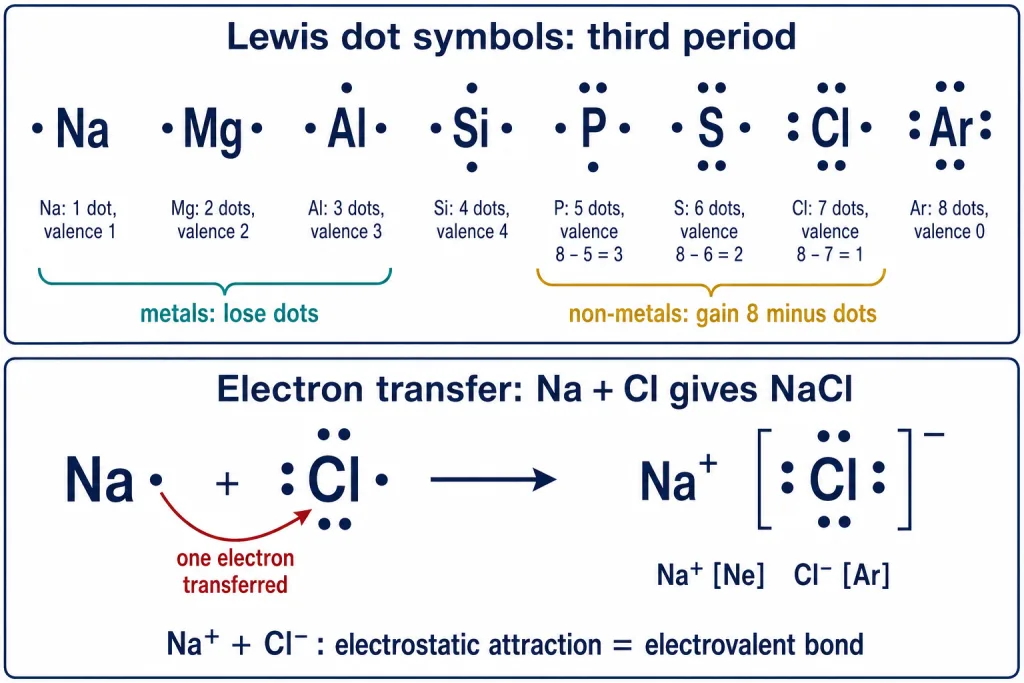
The third period repeats the same patterns: Na (1 dot), Mg (2), Al (3), Si (4), P (5), S (6), Cl (7), Ar (8). Elements in the same group share a Lewis symbol because they have the same number of valence electrons — which is why they behave alike.
Reading valence from a Lewis symbol
The number of dots gives the valence electron count, which predicts the common or group valence — how many bonds the element forms, or how many charges its ion carries.
Key Point: The group valence of an element is generally either equal to the number of dots in its Lewis symbol or equal to 8 minus the number of dots.
Which of the two applies depends on which route to a full shell is shorter.
| Element | Dots | Route to noble-gas shell | Valence |
|---|---|---|---|
| Na | 1 | lose 1 (easier than gaining 7) | 1 |
| Mg | 2 | lose 2 | 2 |
| Al | 3 | lose 3 | 3 |
| Si | 4 | share 4 | 4 |
| P | 5 | gain or share 3 | |
| S | 6 | gain or share 2 | |
| Cl | 7 | gain or share 1 | |
| Ne | 8 | nothing needed | 0 |
Metals on the left give their dots away, so valence equals the number of dots. Non-metals on the right need more, so valence equals 8 minus the dots. Carbon and silicon, with four, share.
The dot count also equals the group number for groups 1 and 2, and the group number minus 10 for groups 13 to 18: Al (group 13) has 3 dots, S (group 16) has 6, Br (group 17) has 7.
The octet rule
Kössel and Lewis built these observations into the electronic theory of chemical bonding, whose central rule is the octet rule.
Key Point (Definition): The octet rule states that atoms can combine either by transfer of valence electrons from one atom to another (gaining or losing) or by sharing of valence electrons, in order to have an octet in their valence shells.
Transfer gives ionic (electrovalent) bonds; sharing gives covalent bonds. Both leave every atom looking, at least in its outer shell, like a noble gas. Hydrogen is the exception: its nearest noble gas is helium, so it aims for a duplet of two electrons.
[NEET] For a one-line definition, say "transfer or sharing of valence electrons to attain eight electrons in the valence shell". The rule has limitations — incomplete octets, odd-electron molecules, expanded octets — covered in the next section.
The Electrovalent (Ionic) Bond — Bonding by Transfer
Kössel drew attention to a set of facts about the periodic table in 1916, worth knowing as a set.
Kössel's observations
- In the periodic table, the highly electronegative halogens (group 17) and the highly electropositive alkali metals (group 1) are separated by the noble gases (group 18). A halogen is one electron short of a noble gas; an alkali metal is one electron past one.
- The formation of a negative ion from a halogen atom and a positive ion from an alkali metal atom goes with the gain and loss of an electron respectively.
- The negative and positive ions so formed attain stable noble-gas electronic configurations. The noble gases, helium excepted with its duplet, have a particularly stable outer-shell configuration of eight electrons, .
- The negative and positive ions are stabilised by electrostatic attraction.
Sodium chloride, step by step
Sodium is : one electron beyond neon. Chlorine is : one electron short of argon. Sodium hands its electron to chlorine.
In Lewis symbols: sodium starts with one dot, chlorine with seven. Afterwards has no dots (its outer shell is now the neon core) and has eight, four complete pairs, drawn inside square brackets with the charge outside. The two ions attract electrostatically, and the bond formed is the electrovalent bond.
Calcium fluoride — when one atom feeds two
Calcium is and has two electrons to give. Fluorine, , can take only one, so one calcium supplies two fluorines:
The formula falls out of the dot counts: calcium has 2 dots to lose, fluorine needs 1, so two fluorines are needed and the compound is .
Electrovalence
Key Point (Definition): The bond formed as a result of the electrostatic attraction between the positive and negative ions is the electrovalent bond. The electrovalence of an element is equal to the number of unit charges on its ion.
Calcium has a positive electrovalence of two, sodium one, chlorine and fluorine a negative electrovalence of one, and oxygen (which gains two electrons to become ) a negative electrovalence of two.
| Atom | Configuration | Electrons lost/gained | Ion | Electrovalence |
|---|---|---|---|---|
| Na | loses 1 | , | ||
| Ca | loses 2 | , | ||
| Al | loses 3 | , | ||
| Cl | gains 1 | , | ||
| O | gains 2 | , | ||
| N | gains 3 | , |
A recipe for any ionic formula from Lewis symbols
- Count the metal's dots: that is how many electrons it will lose.
- For the non-metal, work out : that is how many it will gain.
- Balance the electrons given and taken using the smallest whole numbers of atoms. Al (3 to give) with N (3 to take) is , . K (1) with S (2) needs two potassiums, . Ca (2) with O (2) is .
- Write the cation with no dots and the anion with eight dots in brackets, charges outside.
What Kössel's ideas did — and did not — explain
Kössel's postulates underpin everything we say about ion formation by electron transfer and about ionic crystalline compounds. But a very large number of compounds do not fit. Chlorine gas is — two identical atoms, neither with any reason to give an electron to the other. Water, methane and the whole of organic chemistry involve no ions at all. Those need a second idea: sharing.
[JEE Main] The word stabilised carries weight. Ionising sodium costs 495.8 kJ/mol, and chlorine's electron gain pays back only 348.7 kJ/mol, so transfer alone would not be worthwhile. It works because the ions then attract each other in a lattice and release far more. The fourth postulate is what makes the other three work.
The Covalent Bond — Bonding by Sharing
In 1919 Irving Langmuir refined Lewis's ideas. He threw out the stationary cubical octet and introduced a term for a bond made by sharing: the covalent bond. The result is sometimes called the Lewis-Langmuir theory.
Chlorine, the simplest case
A chlorine atom is , one electron short of argon. When two meet, neither gives up an electron — they are identical. Each contributes one electron to a shared pair sitting between the nuclei, counted towards both octets.
Each Cl brought seven electrons, fourteen in all. Two form the shared pair; the other twelve stay as three lone pairs on each chlorine. Each atom then has 6 from its lone pairs plus the shared pair's 2, counted in full for each atom — the argon octet. The shared pair is drawn as a line: .
Key Point: The dots in these drawings are electrons. Structures that show all the valence electrons of a molecule as dots (with shared pairs often drawn as lines) are called Lewis dot structures or simply Lewis structures.
The rules of sharing
Lewis structures can be written for any molecule, whether the combining atoms are identical (as in ) or different (as in ). The conditions:
- Each bond is formed by the sharing of an electron pair between the atoms.
- Each combining atom contributes at least one electron to the shared pair.
- As a result of the sharing, the combining atoms attain the outer-shell noble-gas configuration.
The third condition is the octet rule applied to sharing. Oxygen in water (6 valence electrons) shares one pair with each hydrogen and keeps two lone pairs: , with each hydrogen at its duplet. Carbon in (4 valence electrons) shares one pair with each of four chlorines for its octet; each chlorine keeps three lone pairs and gets its octet from the shared pair.
Bond pairs and lone pairs
Key Point (Definition): A bond pair (shared pair) is a pair of electrons shared between two atoms and forming a covalent bond. A lone pair (non-bonding pair) is a pair of valence electrons that stays on one atom and takes no part in bonding.
| Molecule | Valence electrons | Bond pairs | Lone pairs | Where the lone pairs sit |
|---|---|---|---|---|
| 14 | 1 | 6 | three on each Cl | |
| 8 | 2 | 2 | both on O | |
| 8 | 3 | 1 | on N | |
| 8 | 4 | 0 | none | |
| 32 | 4 | 12 | three on each Cl |
Lone pairs decide molecular shapes (Section 6) and polarity (Section 5), so keep counting them.
Single, double and triple bonds
Two atoms sharing one pair have a single covalent bond, one line.
Two atoms sharing two pairs have a double bond, two lines. Carbon dioxide: carbon has four valence electrons and each oxygen six, 16 in all. Single bonds to each O use 4, and no distribution of the remaining 12 gives everyone an octet. Two double bonds do it: , with two lone pairs on each oxygen. Carbon has four shared pairs (8); each oxygen two shared pairs plus two lone pairs (8).
Ethene, : twelve valence electrons (). Each carbon bonds to two hydrogens, and the carbons share two pairs with each other: . Every carbon has four shared pairs and a full octet; no lone pairs.
Two atoms sharing three pairs have a triple bond, three lines. Nitrogen, : five valence electrons each, 10 in all. Three shared pairs use 6, leaving one lone pair on each N: , each N seeing . Ethyne, : 10 valence electrons, , no lone pairs. Hydrogen cyanide, HCN: valence electrons, , one lone pair on N. Carbon has four shared pairs (8), nitrogen three shared pairs plus one lone pair (8), hydrogen its duplet.
| Bond | Shared pairs | Shared electrons | Symbol | Examples |
|---|---|---|---|---|
| Single | 1 | 2 | , , , | |
| Double | 2 | 4 | , , | |
| Triple | 3 | 6 | , , HCN, CO |
Key Point: A multiple bond is the octet rule refusing to be satisfied by single bonds. Whenever single bonds leave some atom short of eight, move a lone pair from a neighbour into the bond and try again.
[JEE/NEET] A triple bond is 6 shared electrons and, in the language of later sections, one sigma bond plus two pi bonds. Ethyne has 3 sigma and 2 pi bonds; ethene 5 sigma and 1 pi. Those counts start from the Lewis structure.
The Recipe for Drawing a Lewis Structure
A Lewis structure says nothing about shape, and sometimes (Section 2) cannot be drawn without cheating, but it explains the formation and properties of a molecule remarkably well for a thirty-second drawing. The method:
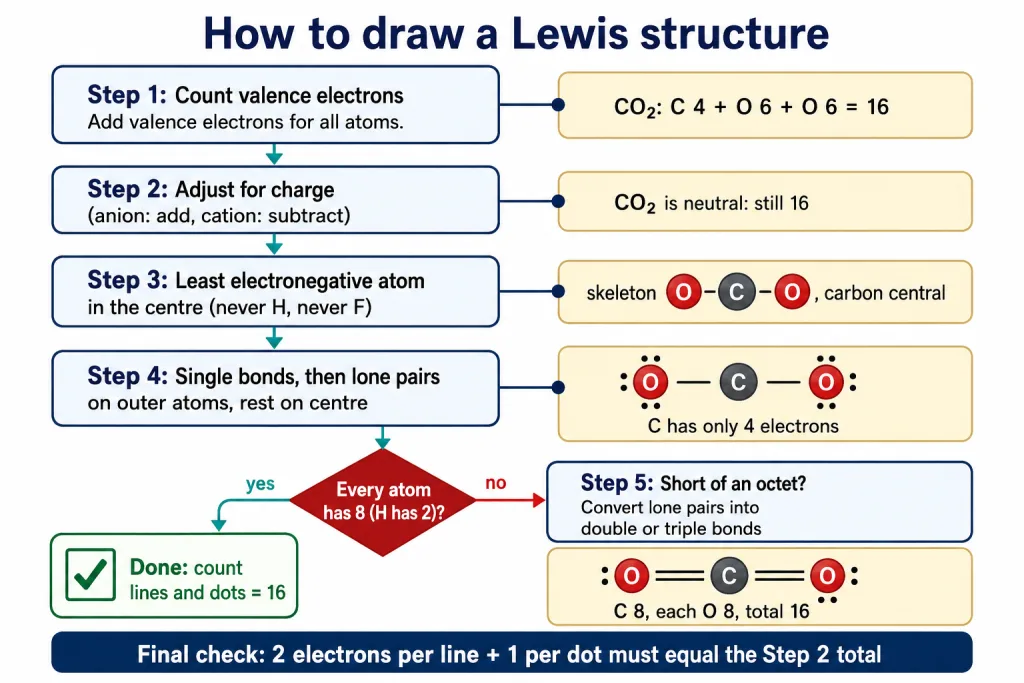
Step 1 — Count the valence electrons
Add up the valence electrons of all the atoms. For , carbon brings 4 and each hydrogen 1, so electrons are available. For , . For , .
Step 2 — Adjust for the charge on an ion
For an anion, each negative charge means one extra electron: add it. For a cation, each positive charge means one electron lost: subtract it. So has electrons and has .
Step 3 — Write the skeleton and pick the central atom
Key Point: In general the least electronegative atom occupies the central position in a molecule or ion. In nitrogen is central and the fluorines are terminal; in carbon is central and the oxygens are terminal.
Two rules of thumb save you from silly skeletons. Hydrogen is never central, since it forms only one bond, and fluorine is never central for the same reason. Carbon in an organic molecule is almost always in the chain or centre.
Step 4 — Draw single bonds and distribute the rest
Join the central atom to each terminal atom by one shared pair (one line), each bond using two electrons. Hand out the remaining electrons as lone pairs, terminal atoms first to complete their octets (duplets for hydrogen); the rest goes onto the central atom.
Step 5 — If an octet is missing, make multiple bonds
If the central atom is still short of eight, take a lone pair from a terminal atom and turn it into a second or third shared pair. Repeat until every atom, except hydrogen with its two, has an octet.
The recipe in action
Methane, . Eight electrons, carbon central. Four single bonds use all 8: carbon has four shared pairs (octet), each hydrogen one (duplet). No lone pairs.
Water, . Eight electrons, oxygen central. Two bonds use 4; the other 4 form two lone pairs on oxygen. Oxygen: ; each hydrogen 2. Written with two pairs of dots on O.
Nitrogen trifluoride, . Twenty-six electrons, nitrogen central. Three bonds use 6, leaving 20. Each fluorine takes three lone pairs (18 electrons); the last 2 form one lone pair on nitrogen. Nitrogen: ; each fluorine . Total lone pairs: 10.
Carbon dioxide, . Sixteen electrons, carbon central. Two single bonds use 4, leaving 12. Three lone pairs on each oxygen (12 electrons) gives each oxygen 8 but carbon only 4. Step 5: move one lone pair from each oxygen into the bond, giving — two double bonds, two lone pairs on each oxygen, none on carbon. Carbon: four shared pairs, 8. Each oxygen: two shared pairs plus two lone pairs, 8.
| Species | Valence electrons | Central atom | Bonds | Lone pairs | Octet check |
|---|---|---|---|---|---|
| 8 | C | 4 single | 0 | C 8, H 2 each | |
| 8 | O | 2 single | 2 on O | O 8, H 2 each | |
| 26 | N | 3 single | 1 on N, 3 on each F | all 8 | |
| 16 | C | 2 double | 2 on each O | all 8 |
One check that catches almost every mistake
After drawing, count the dots and lines. Every line is 2 electrons, every dot is 1, and the total must equal the number from Steps 1 and 2. For : 4 lines (8) plus 4 lone pairs (8) makes 16. For : 3 lines (6) plus 10 lone pairs (20) makes 26. If the count is off, you have invented or lost electrons, and the structure is wrong however tidy it looks.
[Board] In a three-mark "draw the Lewis structure" question, show the count. Write " electrons" before you draw — method marks go to the count and the octet check even when the drawing has a slip.
Lewis Structures of Ions and a Gallery of Examples
The same five steps handle ions; the only new thing is Step 2, the charge adjustment.
Ammonium ion,
Valence electrons: nitrogen 5, four hydrogens 4, minus 1 for the positive charge . Nitrogen central. Four single bonds use all 8, so nitrogen has four shared pairs — a full octet — and no lone pair; each hydrogen has its duplet. Put it in square brackets with a outside. It looks exactly like methane with the nucleus swapped: and are isoelectronic — same number of electrons, same Lewis structure, and (Section 6) the same tetrahedral shape.
Carbonate ion,
Valence electrons: carbon 4, three oxygens 18, plus 2 for the charge . Carbon central, oxygens terminal. Three single bonds use 6, leaving 18 — exactly three lone pairs per oxygen. Every oxygen has 8, but carbon has only 6. Step 5: move one lone pair from one oxygen into a double bond, giving carbon four shared pairs (8). Final: one and two ; the double-bonded oxygen carries two lone pairs, each single-bonded oxygen three; 8 lone pairs in all. Electrons: 4 bonds (8) plus 8 lone pairs (16) . Square brackets, outside.
Any of the three oxygens can take the double bond — an observation that leads to resonance in Section 4, and to formal charge in Section 2, which puts the two negative charges on the two single-bonded oxygens.
Ozone,
Eighteen valence electrons (). All three atoms are the same element, so "least electronegative" gives no help and the skeleton is simply . Two single bonds use 4, leaving 14. The terminal oxygens take three lone pairs each (12), and the last 2 give the central oxygen one lone pair, leaving it at — short by two. Move a lone pair from one terminal oxygen into a double bond. Final: one and one ; the central O has one lone pair, the double-bonded terminal O two, the single-bonded terminal O three; 6 lone pairs plus 3 bonds gives . Ozone is the standard example for formal charge in the next section.
The gallery
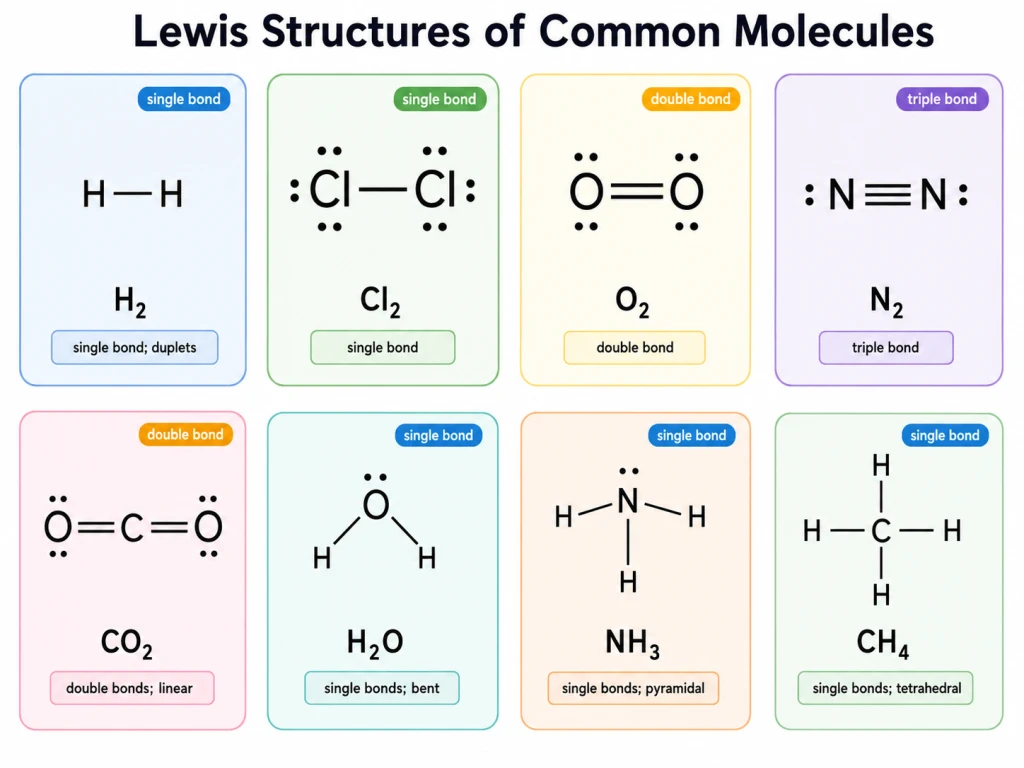
| Species | Total valence electrons | Bonds | Lone pairs (location) | Notes |
|---|---|---|---|---|
| 2 | 1 single | 0 | each H has a duplet | |
| 14 | 1 single | 3 on each Cl | 6 lone pairs | |
| 12 | 1 double | 2 on each O | ||
| 10 | 1 triple | 1 on each N | ||
| 8 | 1 single | 3 on F | ||
| 8 | 2 single | 2 on O | bent (Section 6) | |
| 8 | 3 single | 1 on N | ||
| 8 | 4 single | 0 | ||
| 26 | 3 single | 1 on N, 3 on each F | 10 lone pairs | |
| 16 | 2 double | 2 on each O | ||
| 12 | 1 double (C=C), 4 single (C-H) | 0 | ||
| 10 | 1 triple, 2 single | 0 | ||
| HCN | 10 | 1 single, 1 triple | 1 on N | |
| CO | 10 | 1 triple | 1 on C, 1 on O | |
| 8 | 4 single | 0 | brackets, | |
| 24 | 1 double, 2 single | 2 on the C=O oxygen, 3 on each C-O oxygen | brackets, | |
| 18 | 1 double, 1 single | 1 on N, 2 on the N=O oxygen, 3 on the N-O oxygen | brackets, | |
| 18 | 1 double, 1 single | 1 on central O, 2 and 3 on terminals |
Two entries are solved in full as Questions 5 and 6 below. Carbon monoxide has only 10 electrons for two atoms that each want eight; the only fix is a triple bond with one lone pair on each atom, so oxygen ends up sharing two of its own electrons with carbon — which matters for formal charge. Nitrite needs the same Step 5 trick as carbonate.
What a Lewis structure does not tell you
Key Point: A Lewis structure shows which atoms are bonded, by how many pairs, and where the lone pairs are. It does not show the shape of the molecule, the actual charge on any atom, or which of several equivalent structures is "real". Those are the jobs of formal charge (Section 2), resonance (Section 4) and VSEPR theory (Section 6).
[NEET] Questions like "which species has the same number of lone pairs on the central atom" are common. Practise the gallery until you can reproduce the lone-pair column from memory: 0 for and , 1 for and , 2 for on the central atom.
Solved Examples
Question 1: Explaining the formation of a chemical bond
Explain the formation of a chemical bond.
Answer:
Atoms rarely stay alone — only the noble gases do. When atoms stick together as a molecule or a crystal, the force holding them is the chemical bond, an attractive force between the constituents (atoms or ions) of the species.
Kössel and Lewis (1916) pointed at the noble gases, unreactive because their outer shell is full — a duplet for helium, an octet () for the rest. Every other atom lacks that arrangement, and bonding is how it gets there. That is the octet rule: atoms combine by transferring or sharing valence electrons so each has eight electrons in its valence shell.
Two routes do it. If one atom gives electrons easily and another takes them easily — sodium and chlorine — electrons are transferred, ions form and attract each other: an electrovalent (ionic) bond. If neither will give up electrons — two chlorine atoms, or hydrogen and oxygen — they share pairs, each pair counting towards both octets: a covalent bond.
Either way the bonded arrangement has lower energy than the separated atoms, and nature moves towards lower energy.
Ans: A chemical bond forms because atoms, by transferring or sharing valence electrons, attain the stable noble-gas octet (or duplet) and thereby lower their energy; transfer gives an ionic bond, sharing gives a covalent bond.
Watch out: Give both reasons — the octet reason and the energy reason — and name both kinds of bond.
Question 2: Lewis dot symbols of Mg, Na, B, O, N and Br
Write Lewis dot symbols for atoms of the following elements: Mg, Na, B, O, N, Br.
Answer:
The dots show only the valence electrons. I take the configuration, count the valence electrons, and put one dot in each of the four positions around the symbol before pairing up. For Br the electrons are inner and are not shown.
| Atom | Configuration | Group | Valence electrons | Lewis symbol |
|---|---|---|---|---|
| Mg | 2 | 2 | Mg with 2 single dots | |
| Na | 1 | 1 | Na with 1 dot | |
| B | 13 | 3 | B with 3 single dots | |
| O | 16 | 6 | O with 6 dots (2 pairs + 2 singles) | |
| N | 15 | 5 | N with 5 dots (1 pair + 3 singles) | |
| Br | 17 | 7 | Br with 7 dots (3 pairs + 1 single) |
Ans: Mg 2 dots, Na 1, B 3, O 6, N 5, Br 7, arranged as in the table.
Watch out: For Br, do not count the ten electrons. Valence electrons for a main-group element equal the group number (groups 1, 2) or the group number minus 10 (groups 13 to 18).
Question 3: Lewis symbols of atoms and their ions
Write Lewis symbols for the following atoms and ions: S and ; Al and ; H and .
Answer:
S is , 6 valence electrons; gains two to reach the argon octet. Al is , 3 valence electrons; loses all three, so its outer shell is the neon core and it carries no dots at all. H is ; , the hydride ion, gains one electron to reach the helium duplet.
| Species | Electrons shown | Lewis symbol |
|---|---|---|
| S | 6 | S with 2 pairs + 2 singles |
| 8 | [S with 4 pairs] | |
| Al | 3 | Al with 3 single dots |
| 0 | , no dots | |
| H | 1 | H with 1 dot |
| 2 | [H with 2 dots] |
Ans: S 6 dots and 8 dots in brackets with ; Al 3 dots and with no dots; H 1 dot and 2 dots in brackets with .
Watch out: A cation that has lost its whole valence shell shows no dots at all; an anion shows a full octet (or duplet for ). Put the charge outside the bracket, never on the dots.
Question 4: Electron transfer with Lewis symbols — K and S, Ca and O, Al and N
Use Lewis symbols to show electron transfer between the following atoms to form cations and anions: (a) K and S, (b) Ca and O, (c) Al and N.
Answer:
(a) K and S. K is : one dot to give. S is : six dots, needs two. One sulfur therefore needs two potassium atoms, each giving its single electron:
Each has no dots (argon core); has 8 dots in brackets with outside. Formula , or .
(b) Ca and O. Ca is : two dots to give. O is : six dots, needs two. A one-to-one match:
with no dots; with 8 dots in brackets, outside.
(c) Al and N. Al is : three dots to give. N is : five dots, needs three. Again one to one:
with no dots; with 8 dots in brackets, outside.
Checking the bookkeeping, electrons given equal electrons taken: (a) , (b) , (c) . Every ion ends noble-gas-like: and argon-like; argon-like and neon-like; and neon-like.
Ans: (a) , giving ; (b) , giving ; (c) , giving — cations without dots, anions with a complete octet of eight dots in brackets.
Watch out: Electrons lost must equal electrons gained. The dot counts fix the formula: metal dots to give, non-metal dots to take, then the smallest ratio that balances.
Question 5: The Lewis structure of carbon monoxide
Write the Lewis dot structure of the CO molecule.
Answer:
Carbon is (4 valence electrons) and oxygen is (6), so 10 are available. With only two atoms the skeleton is simply C O.
A single bond uses 2 electrons, leaving 8. Oxygen takes three lone pairs (6 electrons) for its octet, and the last 2 go to carbon as one lone pair. Oxygen then sees , but carbon sees only .
So I go to multiple bonding. A double bond would give carbon 6 — still short. A triple bond is needed: move two lone pairs from oxygen into the bond, giving three shared pairs (6 electrons), one lone pair on carbon and one on oxygen, . Carbon sees and oxygen . Both octets complete, and the structure is .
Ans: CO has a triple bond between carbon and oxygen and one lone pair on each atom: (10 valence electrons; 6 in the triple bond, 4 in the two lone pairs).
Watch out: When the electron count is low for the number of octets to fill, multiple bonds are unavoidable. Ten electrons for two octets forces a triple bond — the same reason is (CO and are isoelectronic).
Question 6: The Lewis structure of the nitrite ion
Write the Lewis structure of the nitrite ion, .
Answer:
N is (5), O is (6 each), and the single negative charge adds one electron: . Nitrogen is less electronegative than oxygen, so it goes in the middle: O N O.
Two single bonds use 4, leaving 14. Each oxygen takes three lone pairs (12 electrons) for its octet, and the remaining 2 form a lone pair on nitrogen. Each oxygen is then at , but nitrogen has two shared pairs plus one lone pair, — short.
I move one lone pair from one oxygen into an double bond. Nitrogen now has three shared pairs and one lone pair, . The double-bonded oxygen keeps two lone pairs (); the single-bonded oxygen keeps three ().
Final count: one double bond (4 electrons) and one single (2) ; lone pairs 1 on N, 2 on one O, 3 on the other O pairs electrons. . Square brackets with outside.
Ans: with one lone pair on nitrogen, two on the double-bonded oxygen and three on the single-bonded oxygen; 18 valence electrons in all.
Watch out: Since the double bond can sit on either oxygen, nitrite has two equivalent Lewis structures — that is resonance (Section 4). Formal charge (Section 2) says which oxygen carries the negative charge: the single-bonded one.
Question 7: Lewis structures of H2S, SiCl4 and BeF2
Draw the Lewis structures for the following molecules: , , .
Answer:
. Count: S 6, two H 2, total 8. Sulfur is central, since hydrogen never is. Two bonds use 4; the remaining 4 form two lone pairs on sulfur. Sulfur , each H 2. Structure with two pairs of dots on S — the same pattern as water.
. Count: Si 4, four Cl , total 32. Silicon, less electronegative, is central. Four bonds use 8; the remaining 24 are three lone pairs on each chlorine (12 lone pairs). Silicon: four shared pairs, 8. Each Cl: . No lone pair on Si — the same pattern as and .
. Count: Be 2, two F , total 16. Beryllium is central. Two bonds use 4; the remaining 12 are three lone pairs on each fluorine, each F reaching . Beryllium has only two shared pairs — 4 electrons, not 8. No electrons are left to fix this, and fluorine does not form double bonds, so stands as it is. Beryllium has an incomplete octet, one of the recognised exceptions to the octet rule (Section 2).
| Molecule | Valence electrons | Structure | Lone pairs |
|---|---|---|---|
| 8 | 2 on S | ||
| 32 | Si with four single bonds to Cl | 3 on each Cl (12 total) | |
| 16 | 3 on each F (6 total); Be has only 4 electrons |
Ans: As tabulated — with 2 lone pairs on S; with 3 on each Cl; with 3 on each F and an incomplete octet on Be.
Watch out: The recipe sometimes leaves the central atom short, as Be is with 4. Do not invent electrons — note the incomplete octet and move on.
Question 8: Lewis structures of the carbonate ion and formic acid
Draw the Lewis structures for and HCOOH.
Answer:
. Count: C 4, three O 18, plus 2 for the charge — 24 electrons. Carbon central, three oxygens around it. Three single bonds use 6; the other 18 give three lone pairs to each oxygen. Every oxygen has 8, carbon 6. I move one lone pair from any one oxygen into a double bond, giving carbon 8. Final: one double bond, two single bonds; the oxygen has 2 lone pairs, each oxygen has 3. Electrons: 4 bonds (8) 8 lone pairs (16) . Brackets with outside.
HCOOH. Count: H 1, C 4, O 6, O 6, H 1 — 18 electrons. Formic acid is a carboxylic acid: the carbon carries one H, one oxygen by itself, and a second oxygen carrying the other H.
Single bonds first: , , , — 8 electrons, leaving 10. The O bonded to H needs two lone pairs to reach 8 (4 electrons); the other O gets three (6). That uses all 10, but carbon has only 6.
I move a lone pair from the lone oxygen into a double bond. Final: , two lone pairs on each oxygen. Carbon 8, both oxygens 8. Electrons: 5 bonds (10) 4 lone pairs (8) .
Ans: : carbon at the centre with one (2 lone pairs on that O) and two (3 lone pairs on each), 24 electrons, in brackets with . HCOOH: , two lone pairs on each oxygen, 18 electrons.
Watch out: For an organic molecule the skeleton comes from the functional group — a carboxylic acid always has a and a on the same carbon.
Question 9: Bond pairs and lone pairs
What do you understand by bond pairs and lone pairs of electrons? Illustrate by giving one example of each type.
Answer:
When two atoms form a covalent bond they share a pair of electrons. That shared pair sits between the nuclei and counts in the octet of both atoms: a bond pair, or shared pair, and every line in a Lewis structure is one. A pair of valence electrons that stays on one atom unshared is a lone pair, or non-bonding pair, shown as two dots.
Water has both. Of its 8 valence electrons, two pairs form the bonds (bond pairs) and two sit on oxygen taking no part in bonding (lone pairs). has three bond pairs and one lone pair on nitrogen; methane has four bond pairs and none.
The distinction matters because lone pairs occupy space around the central atom just as bond pairs do, and repel more strongly. That is why the angle in water () is smaller than the angle in ammonia (), which is smaller than the angle in methane ().
Ans: A bond pair is an electron pair shared between two bonded atoms (each pair in water); a lone pair is an electron pair on one atom that is not shared (the two pairs on oxygen in water). Water has 2 bond pairs and 2 lone pairs; ammonia 3 and 1; methane 4 and 0.
Watch out: Count both. The bond-pair/lone-pair count is the input for VSEPR shapes in Section 6.
Question 10: Correcting the Lewis structure of acetic acid
The skeletal structure of is correct, but a draft Lewis structure shows every bond as a single bond and gives every oxygen three lone pairs. Write the correct Lewis structure for acetic acid.
Answer:
Count first: two carbons (8), four hydrogens (4), two oxygens (12), so valence electrons.
Acetic acid is a methyl group on a carboxylic acid group: the first carbon carries three H and joins the second, which joins two oxygens, one alone and one carrying a hydrogen. That is 7 single-bond connections — three , one , two , one .
The draft fails twice. Seven single bonds use 14 electrons and three lone pairs on each oxygen use 12 more — 26, two more than the molecule has. The second carbon would also sit at 6 electrons.
Correcting it: after the seven single bonds (14 electrons), 10 remain. The oxygen takes two lone pairs (4 electrons); the other oxygen takes three (6). All 24 are used, but the carboxyl carbon has 6. I move one lone pair from the lone oxygen into a double bond, giving that carbon four shared pairs (8) and that oxygen two shared pairs plus two lone pairs (8).
Final: — eight bonds (three , one , one , one , one ), two lone pairs on each oxygen. Electrons: 8 bond lines (16) 4 lone pairs (8) .
Ans: A double bond on the carboxyl carbon, a single-bonded oxygen, two lone pairs on each oxygen, all other bonds single; 24 valence electrons.
Watch out: "All single bonds" is the commonest wrong draft. End with the electron count: if it is off, or a carbon has fewer than four shared pairs, a double bond is missing.
Question 11: Lewis structures of C2H4, N2 and HCN — counting the shared pairs
Draw the Lewis structures of ethene, dinitrogen and hydrogen cyanide. For each, state the number of bond pairs, the number of lone pairs and the number of electrons shared in the multiple bond.
Answer:
Ethene, . Count . The carbons are joined, each with two hydrogens. Five single bonds use 10, leaving 2. As a lone pair those 2 give one carbon 8 and leave the other at 6, so I share them and make the a double bond. : 6 bond pairs, 0 lone pairs, 4 electrons in the double bond, each carbon at 8.
Dinitrogen, . Count . A single bond uses 2, leaving 8 — two lone pairs on each N, but each N then sees only . I move one lone pair from each nitrogen into the bond: a triple bond (6 electrons) plus one lone pair on each N. — 3 bond pairs, 2 lone pairs, 6 electrons in the triple bond, each N at .
Hydrogen cyanide, HCN. Count . Carbon is central: hydrogen cannot be, and carbon is less electronegative than nitrogen. and single bonds use 4, leaving 6 — three lone pairs on N gives N an octet but C only 4. Moving two of them into the bond gives — 4 bond pairs, 1 lone pair on N, 6 electrons in the triple bond. Carbon 8, nitrogen , hydrogen 2.
| Molecule | Electrons | Structure | Bond pairs | Lone pairs | Electrons in multiple bond |
|---|---|---|---|---|---|
| 12 | 6 | 0 | 4 | ||
| 10 | 3 | 2 | 6 | ||
| HCN | 10 | 4 | 1 | 6 |
Ans: As tabulated — 6 bond pairs, 0 lone pairs, 4 shared electrons; 3, 2 and 6; 4, 1 and 6.
Watch out: Ten electrons shared between two atoms that both want octets always means a triple bond (, CO, , and the C-N part of HCN). Twelve electrons over two carbons plus four hydrogens always means one double bond.
Question 12: Reading a Lewis symbol for valence, and predicting formulas
The Lewis symbols of four elements W, X, Y and Z show 1, 2, 6 and 7 dots respectively, and all four are in the third period. (a) Identify the elements. (b) State the valence of each and say whether each will form a cation or an anion. (c) Predict the formulas of the compounds W with Z, X with Y, and W with Y, and say which noble-gas configuration each ion has.
Answer:
(a) Third-period elements have valence electrons 1 to 8 from Na to Ar. One dot is Na, two Mg, six S, seven Cl.
(b) For metals valence equals the dots: Na 1, Mg 2, losing electrons to form and . For non-metals valence equals dots: S , Cl , gaining electrons to form and .
(c) Balancing electrons given and taken: Na gives 1 and Cl takes 1, one to one, ; Mg gives 2 and S takes 2, one to one, ; Na gives 1 and S takes 2, so two sodiums per sulfur, .
() and (same) are neon-like; () and (same) are argon-like — each with an outer-shell octet, which is why the transfer happens.
Checking electrovalence — Na , Mg , S , Cl — total positive equals total negative in every formula: gives .
Ans: (a) W = Na, X = Mg, Y = S, Z = Cl. (b) Valences 1, 2, 2, 1; Na and Mg form cations, S and Cl form anions. (c) NaCl, MgS, ; and are neon-like, and are argon-like.
Watch out: A Lewis symbol is a compressed periodic table entry. Dots give the group, the group gives the valence, and the valence gives the formula.