
Why We Need a Theory of Shape
The Lewis structure of water is with two lone pairs on oxygen; carbon dioxide is . On paper both are three atoms in a row. In reality water is bent at 104.5° and carbon dioxide is straight at 180°. The Lewis picture is flat: it tells you who is bonded to whom, not where the atoms sit in space. Shape decides whether a molecule has a dipole moment, how it packs in a crystal, how it fits into an enzyme.
Sidgwick and Powell (1940) gave the first usable answer: the electron pairs in the valence shell of the central atom are all negatively charged, so they repel one another and arrange themselves as far apart as possible, with the attached atoms following. Nyholm and Gillespie (1957) added that a lone pair takes up more room than a bonding pair, and the theory became the Valence Shell Electron Pair Repulsion (VSEPR) theory.
Key Point (Definition): VSEPR theory predicts the shape of a covalent molecule from the number of electron pairs (bonding and non-bonding) in the valence shell of the central atom, on the principle that these pairs arrange themselves as far apart as possible so that repulsion between them is minimised.
The five postulates
- The shape of a molecule depends on the number of valence-shell electron pairs (bonded or non-bonded) around the central atom. Count the pairs first; everything follows from that count.
- Pairs of electrons in the valence shell repel one another, because their electron clouds are negatively charged.
- These pairs occupy positions in space that minimise repulsion and so maximise the distance between them. Two pairs go opposite each other (180°), three to the corners of a triangle (120°), four to the corners of a tetrahedron (109.5°), five to a trigonal bipyramid, six to an octahedron.
- The valence shell is taken as a sphere, with the electron pairs localised on its surface at maximum distance from one another. Balloons tied at one knot behave the same way: two point opposite ways, three spread into a flat Y, four form a tetrahedron.
- A multiple bond is treated as a single electron pair. The two or three pairs of a double or triple bond sit in the same region of space between the same two nuclei, so for shape-counting they act as one super pair. That is why , with two double bonds, behaves like a two-pair molecule and is linear.
A sixth rule is often added: where two or more resonance structures can represent a molecule, VSEPR can be applied to any one of them — all have the same number of electron domains around the central atom, so all give the same shape. Ozone is bent whichever canonical structure you pick.
Bond pairs, lone pairs and the repulsion order
A bond pair (bp) is shared between the central atom and one neighbour. A lone pair (lp) belongs to the central atom alone. The repulsion between pairs falls in the order
A bonding pair is pulled by two nuclei and stretches along the bond, so it is slim. A lone pair is held by one nucleus only, spreads sideways and occupies more angular space. Two fat clouds repel more than a fat and a slim one, which repel more than two slim ones. Every distorted shape in this section — the 107° of ammonia, the 104.5° of water, the T-shape of — is this inequality at work.
[Board] For "State the postulates of VSEPR theory", write postulates 1 to 5 and add the repulsion order with its one-line reason.
Two categories of molecules
| Category | Central atom has | Shape equals | Examples |
|---|---|---|---|
| (i) | no lone pair | the ideal arrangement of the pairs | , , , , |
| (ii) | one or more lone pairs | the ideal arrangement minus the lone-pair positions, with angles squeezed | , , , , |
The first family comes next.
Category (i): No Lone Pairs on the Central Atom — the Five Ideal Shapes
When every valence-shell pair on the central atom A is a bond pair, all the pairs are alike, the repulsions are all equal, and the atoms B sit where the pairs point. The shape of the molecule is the ideal arrangement itself. Five cases, with their bond angles.
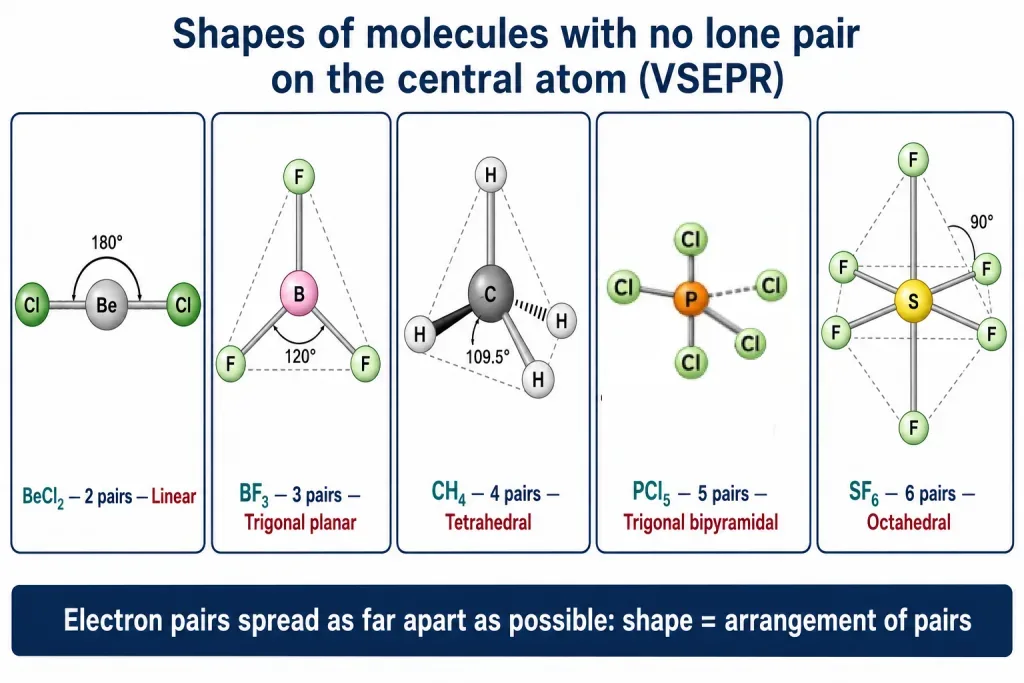
The master table for molecules of type with no lone pairs
| Number of electron pairs | Arrangement of pairs | Molecular type | Shape | Bond angle | Examples |
|---|---|---|---|---|---|
| 2 | Linear | Linear | 180° | , , | |
| 3 | Trigonal planar | Trigonal planar | 120° | , | |
| 4 | Tetrahedral | Tetrahedral | 109.5° | , , | |
| 5 | Trigonal bipyramidal | Trigonal bipyramidal | 120° (equatorial), 90° (axial-equatorial) | , , | |
| 6 | Octahedral | Octahedral | 90° |
Walking through the five
Two pairs — linear (180°). Beryllium in has two valence electrons and forms two bonds, nothing else on Be. Two pairs get farthest apart pointing in opposite directions: , 180°. is the same. also lands here — its two double bonds count as two super pairs, so is linear.
Three pairs — trigonal planar (120°). Boron in has three valence electrons and three bonds, six electrons in all, no lone pair. Three pairs spread to the corners of an equilateral triangle with boron at the centre, all four atoms in one plane, every F-B-F angle 120°.
Four pairs — tetrahedral (109.5°). Carbon in has four bond pairs. The farthest-apart arrangement of four points on a sphere is not a square (90°) but a tetrahedron, every H-C-H angle 109.5°, often written 109°28'. Carbon sits at the centre, the four hydrogens at the corners.
Five pairs — trigonal bipyramidal (120° and 90°). Phosphorus in has five bond pairs, and five points cannot all be equivalent on a sphere. Three chlorines sit in a plane around P at 120° to each other — the equatorial positions — and two above and below that plane on a line through P — the axial positions. Each axial Cl makes 90° with the three equatorial ones, and the two axial chlorines are 180° apart. An axial pair suffers three 90° repulsions against an equatorial pair's two, so the axial bonds are slightly longer and weaker: in the axial P-Cl bonds are 219 pm and the equatorial ones 204 pm. Lone pairs, when they come, always choose the roomier equatorial slots.
Six pairs — octahedral (90°). Sulphur in has six bond pairs, spread to the six corners of a regular octahedron: four in a square plane around S, one above, one below. Every neighbouring F-S-F angle is 90°, and unlike the trigonal bipyramid all six positions are equivalent.
Key Point: In category (i), shape = arrangement of electron pairs. Two pairs: linear 180°; three: trigonal planar 120°; four: tetrahedral 109.5°; five: trigonal bipyramidal 120°/90°; six: octahedral 90°.
Tetrahedral rather than square planar
Methane could in principle be square planar, with carbon at the centre of a square and the four hydrogens at the corners. In a square the bond pairs would be 90° apart; in a tetrahedron they are 109.5° apart. VSEPR puts pairs at maximum separation, so the tetrahedron, with less repulsion, wins. Square planar does occur, but only for six-pair systems with two lone pairs (like ), where the lone pairs take the two axial slots and force the four bonds into a plane.
[JEE/NEET] ions appear here too: , , , are tetrahedral; , trigonal planar; linear. The counting recipe in the last notes block handles the charge.
Category (ii): Lone Pairs Change Everything — the Squeeze
Put one or more lone pairs on the central atom. The arrangement of electron pairs (the geometry) is still whichever ideal pattern matches the total number of pairs — but a lone pair is invisible in the shape, because no atom sits on it. So the shape of the molecule is the ideal pattern with one or more corners missing, and the bond angles are pushed in by the extra repulsion of the lone pair.
Key Point (Definition): The geometry (electron-pair arrangement) counts all pairs, bonding and lone. The shape (molecular geometry) describes the positions of the atoms only. In the geometry is tetrahedral (four pairs) but the shape is trigonal pyramidal (three atoms around N).
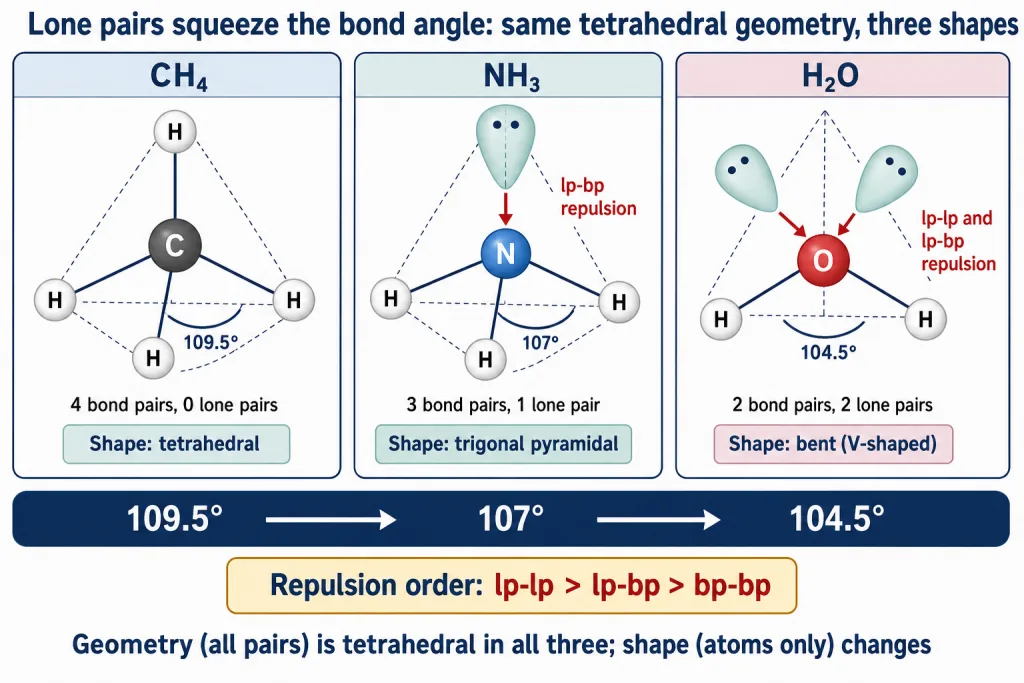
The classic three: methane, ammonia, water
All three have four pairs on the central atom, so all three are tetrahedral in geometry. What changes is how many of those pairs are lone.
| Molecule | Bond pairs | Lone pairs | Geometry (all pairs) | Shape (atoms only) | Bond angle |
|---|---|---|---|---|---|
| 4 | 0 | Tetrahedral | Tetrahedral | 109.5° | |
| 3 | 1 | Tetrahedral | Trigonal pyramidal | 107° | |
| 2 | 2 | Tetrahedral | Bent (V-shaped) | 104.5° |
Methane. Four identical bond pairs, four identical repulsions, perfect tetrahedron, 109.5°.
Ammonia. Nitrogen has five valence electrons; three go into N-H bonds and two stay as a lone pair. Four pairs, tetrahedral geometry. The lone pair is fat and spread out and repels the three N-H bond pairs harder than they repel each other (lp-bp > bp-bp), pushing them together. The H-N-H angle closes from 109.5° to 107°. Three atoms on a tetrahedron with the lone pair at the fourth corner trace a triangular pyramid with N at the apex: trigonal pyramidal.
Water. Oxygen has six valence electrons; two go into O-H bonds and four stay as two lone pairs. Still four pairs, still tetrahedral geometry. Two fat lone pairs bring the strongest repulsion of all, lp-lp; they push apart from each other and both bear down on the two bond pairs. The H-O-H angle closes to 104.5°. Two atoms on a tetrahedron trace a bend: bent or V-shaped.
107° for ammonia, 104.5° for water
Both have four electron pairs, so both start from a tetrahedral arrangement at 109.5°. Ammonia has one lone pair, so the only extra repulsion is lp-bp, closing the angle to 107°. Water has two lone pairs, so there is an lp-lp repulsion — the strongest kind — plus twice as many lp-bp repulsions, and the bond pairs are pushed together more, to 104.5°.
Each lone pair costs roughly 2 to 2.5° of bond angle in a four-pair system.
[NEET] For "Although the geometries of and are distorted tetrahedral, the bond angle in water is less than in ammonia", the answer needs three things: both are four-pair tetrahedral; has one lone pair and two; lp-lp > lp-bp > bp-bp so two lone pairs squeeze harder. Quote 107° and 104.5°.
Where the lone pairs come from — the electron-count view
Count the central atom's valence electrons and ask how many are spent on bonds.
| Central atom | Valence electrons | Used in bonds to H | Left over | Lone pairs |
|---|---|---|---|---|
| C (in ) | 4 | 4 | 0 | 0 |
| N (in ) | 5 | 3 | 2 | 1 |
| O (in ) | 6 | 2 | 4 | 2 |
Every element to the right of carbon in period 2 keeps some electrons to itself, and every retained pair is a lone pair that will distort a shape.
The same story with three pairs: sulphur dioxide and ozone
Sulphur in has six valence electrons. It forms two double bonds to oxygen (each a super pair) and keeps one lone pair: three pairs, so trigonal planar geometry at 120°. The lone pair takes one corner and squeezes the two S=O super pairs together, giving a bent molecule with an O-S-O angle of about 119.5°, just under 120°. Ozone, , has the same count on its central oxygen (one lone pair, two bonding domains) and is bent for the same reason, at about 117°. Carbon in keeps no lone pair: two super pairs, linear. Same three-atom formula, completely different shape, and the lone pair is the whole difference.
Key Point: Lone pairs occupy corners of the geometry but do not appear in the shape. Each lone pair compresses the neighbouring bond angles because lp-bp repulsion is stronger than bp-bp repulsion.
The Full Catalogue of Lone-Pair Shapes
The five-pair and six-pair families follow the same logic with one new decision: which position the lone pair takes. The complete set of shapes, in the standard notation, where B is a bonded atom and E is a lone pair.
Shapes of molecules with lone pairs on the central atom
| Type | Bond pairs | Lone pairs | Total pairs | Arrangement (geometry) | Shape | Examples |
|---|---|---|---|---|---|---|
| 2 | 1 | 3 | Trigonal planar | Bent | , | |
| 3 | 1 | 4 | Tetrahedral | Trigonal pyramidal | ||
| 2 | 2 | 4 | Tetrahedral | Bent | ||
| 4 | 1 | 5 | Trigonal bipyramidal | See-saw | ||
| 3 | 2 | 5 | Trigonal bipyramidal | T-shaped | ||
| 2 | 3 | 5 | Trigonal bipyramidal | Linear | ||
| 5 | 1 | 6 | Octahedral | Square pyramidal | ||
| 4 | 2 | 6 | Octahedral | Square planar |
Why each shape is what it is
| Type | Shape | Reason for the shape |
|---|---|---|
| Bent | Trigonal planar arrangement with one corner a lone pair. lp-bp > bp-bp, so the angle between the two bonds falls from 120° to 119.5°. | |
| Trigonal pyramidal | Tetrahedral had the lone pair been a bond pair. lp-bp > bp-bp pushes the three bonds together, from 109.5° to 107°. | |
| Bent | Tetrahedral if all four were bond pairs, but two are lone pairs. lp-lp > lp-bp > bp-bp, so the two bonds are squeezed hardest: 109.5° to 104.5°. | |
| See-saw | Trigonal bipyramidal arrangement. An axial lone pair suffers three lp-bp repulsions at 90°, an equatorial one only two, so equatorial wins. The four bonds form a distorted tetrahedron, a folded square, a see-saw. | |
| T-shaped | Both lone pairs go equatorial, 120° apart, where they meet the fewest 90° neighbours. The three bonds left (two axial, one equatorial) form a T. | |
| Linear | All three lone pairs take the equatorial slots, 120° apart. The two bonds are left on the axis, 180° apart. | |
| Square pyramidal | Octahedral arrangement; all six positions are equivalent, so the lone pair takes any one. Five bonds remain: a square base with one atom at the apex. | |
| Square planar | Two lone pairs in an octahedron go trans (opposite, 180° apart) to avoid each other; the four bonds are left in a square plane. |
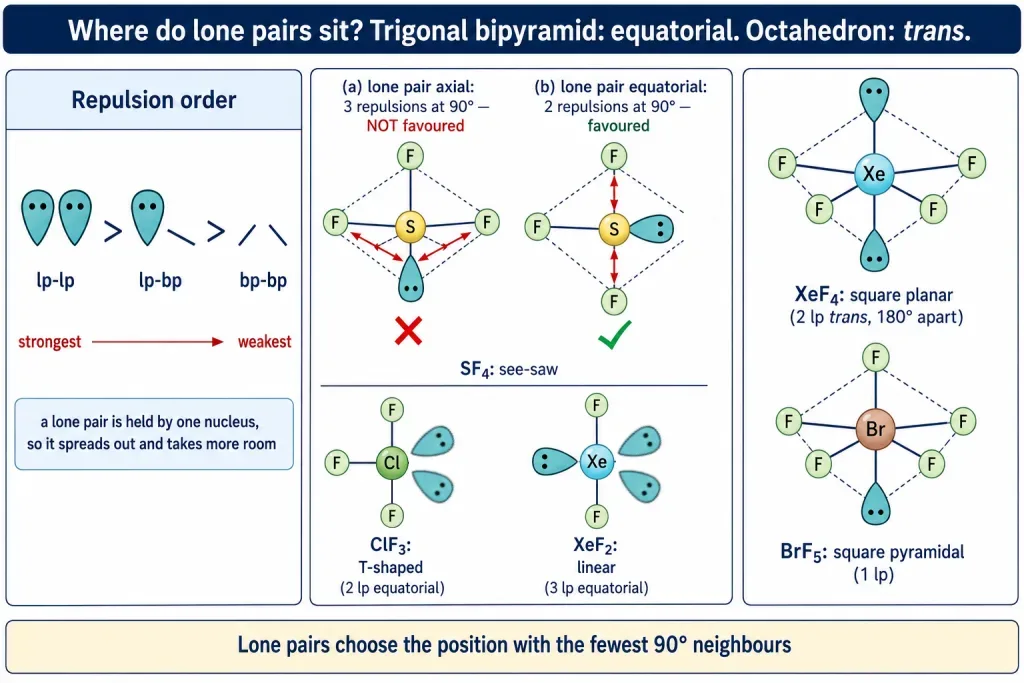
The five-pair decision: lone pairs go equatorial
In a trigonal bipyramid the two kinds of position are not equivalent. Count the closest neighbours of each:
| Position | Neighbours at 90° | Neighbours at 120° | Neighbours at 180° |
|---|---|---|---|
| Axial | 3 (all equatorial) | 0 | 1 (other axial) |
| Equatorial | 2 (both axial) | 2 (other equatorials) | 0 |
The repulsions that hurt are the 90° ones; 120° and 180° neighbours matter much less. An axial lone pair would have three 90° contacts, an equatorial lone pair only two. Being the bulkiest thing in the shell, a lone pair takes the seat with the fewest close neighbours: equatorial, always. That rule gives see-saw (, one equatorial lone pair), T-shape (, two equatorial lone pairs) and linear (, three equatorial lone pairs, bonds axial).
The lone pairs still squeeze what is left. In the equatorial F-S-F angle closes from 120° to about 102° and the axial F-S-F from 180° to about 173°. In the axial-equatorial angle shrinks from 90° to about 87.5°. stays exactly linear because the three lone pairs sit symmetrically around the axis and push on the two bonds equally.
The six-pair decision: lone pairs go trans
In an octahedron all six positions are equivalent, so a single lone pair () can go anywhere and the result is always a square pyramid; the lone pair pushes the four basal fluorines slightly up towards the apical one, so the apical-basal angle is about 85° instead of 90°. Two lone pairs () are the worst possible neighbours, so instead of sitting cis (90° apart) they go trans, 180° apart, leaving the four fluorines in a perfect square plane with 90° angles.
Key Point: Trigonal bipyramid: lone pairs occupy equatorial positions (fewer 90° repulsions). Octahedron: two lone pairs occupy trans (opposite) positions. These two rules, plus the repulsion order, generate every shape in the table.
[JEE Main] is linear, not bent — the lone pairs are equatorial and the bonds axial. Similarly (2 bp, 3 lp) is linear, and (4 bp, 2 lp) is square planar like .
The Recipe: Predicting Any Shape in Five Steps
Everything so far reduces to counting the pairs on the central atom correctly. This recipe works for neutral molecules and ions, for single and multiple bonds.
The five steps
- Write down the number of valence electrons of the central atom. Use the group number: Be 2, B 3, C 4, N 5, O 6, F/Cl/Br/I 7, Xe 8, S 6, P 5, Si 4.
- Add one electron for each atom bonded by a single bond (H or a halogen brings one electron to share). For an oxygen or sulphur atom (divalent, usually joined by a double bond), add zero — it shares two electrons of its own and adds none to the central atom's count.
- Adjust for charge. For an anion add the number of negative charges; for a cation subtract the number of positive charges.
- Divide by two to get the total number of electron pairs. This fixes the geometry: 2 linear, 3 trigonal planar, 4 tetrahedral, 5 trigonal bipyramidal, 6 octahedral.
- Subtract the number of bonded atoms (bond pairs, with multiple bonds counted once) to get the number of lone pairs. Read the shape from the table.
As a formula, with the valence electrons of the central atom, the number of monovalent atoms attached, the charge on the ion (positive for cations, negative for anions):
Worked at speed
| Species | Charge adjustment () | Electrons | Total pairs | Bond pairs | Lone pairs | Shape | ||
|---|---|---|---|---|---|---|---|---|
| 2 | 2 | 0 | 4 | 2 | 2 | 0 | Linear | |
| 4 | 0 (double bonds) | 0 | 4 | 2 | 2 | 0 | Linear | |
| 5 | 0 | 4 | 2 | 2 | 0 | Linear | ||
| 3 | 3 | 0 | 6 | 3 | 3 | 0 | Trigonal planar | |
| 5 | 0 | 6 | 3 | 3 | 0 | Trigonal planar | ||
| 6 | 0 | 0 | 6 | 3 | 2 | 1 | Bent | |
| 5 | 0 | 6 | 3 | 2 | 1 | Bent | ||
| 4 | 4 | 0 | 8 | 4 | 4 | 0 | Tetrahedral | |
| 5 | 4 | 8 | 4 | 4 | 0 | Tetrahedral | ||
| 6 | 0 | 8 | 4 | 4 | 0 | Tetrahedral | ||
| 5 | 3 | 0 | 8 | 4 | 3 | 1 | Trigonal pyramidal | |
| 6 | 3 | 8 | 4 | 3 | 1 | Trigonal pyramidal | ||
| 7 | 0 | 8 | 4 | 3 | 1 | Trigonal pyramidal | ||
| 6 | 2 | 0 | 8 | 4 | 2 | 2 | Bent | |
| 5 | 5 | 0 | 10 | 5 | 5 | 0 | Trigonal bipyramidal | |
| 6 | 4 | 0 | 10 | 5 | 4 | 1 | See-saw | |
| 7 | 3 | 0 | 10 | 5 | 3 | 2 | T-shaped | |
| 8 | 2 | 0 | 10 | 5 | 2 | 3 | Linear | |
| 7 | 2 | 10 | 5 | 2 | 3 | Linear | ||
| 6 | 6 | 0 | 12 | 6 | 6 | 0 | Octahedral | |
| 7 | 5 | 0 | 12 | 6 | 5 | 1 | Square pyramidal | |
| 8 | 4 | 0 | 12 | 6 | 4 | 2 | Square planar | |
| 7 | 4 | 12 | 6 | 4 | 2 | Square planar |
The oxo-anions are worth a second look. In the four oxygens are treated as double-bonded (contributing nothing) and the two negative charges add two electrons: , four pairs, four bond pairs, tetrahedral. In : , four pairs, three bond pairs, one lone pair, pyramidal. A Lewis structure drawn with single bonds to negatively charged oxygens gives the same answer — the recipe is a shortcut for what the Lewis structure would tell you.
Reading the answer
Say the shape in three parts, because that is how marks are awarded: number of bond pairs and lone pairs, geometry (arrangement of all pairs), shape (arrangement of atoms) with the bond angle. For : "3 bp + 2 lp = 5 pairs; trigonal bipyramidal geometry; both lone pairs equatorial; T-shaped, with F-Cl-F angles slightly less than 90°."
Common traps
| Trap | The fix |
|---|---|
| Treating as four pairs because it has two double bonds | A multiple bond is one super pair. has two pairs and is linear. |
| Calling "tetrahedral" | Tetrahedral is its geometry; its shape is trigonal pyramidal. Say which one you mean. |
| Forgetting the charge in or | Subtract for positive, add for negative, before halving. |
| Putting a lone pair axial in or | Lone pairs in a trigonal bipyramid are always equatorial. |
| Placing the two lone pairs of cis | They go trans, giving a square plane. |
| Saying is bent because it has lone pairs | Three equatorial lone pairs leave the two bonds axial: linear. |
| Comparing bond angles of and using VSEPR alone | Same count (2 bp, 2 lp), both bent, but is about 92°. The extra shrinkage is an electronegativity and size effect. |
What VSEPR does and does not do
VSEPR predicts the geometry of a very large number of molecules, especially p-block compounds, remarkably well, and usually gets the answer right even when the energy gap between rival shapes is small. But it is a set of rules, not a physical explanation: it does not say why the pairs behave as if they repel in just this way, it has no theoretical basis that everyone accepts, and it cannot explain bond energies or bond lengths. Those need the quantum-mechanical theories of the next two sections, valence bond theory and molecular orbital theory. VSEPR is the fast, reliable field guide; hybridisation explains why the guide works.
Solved Examples
Question 1: Shapes of three molecules with no lone pairs
Discuss the shapes of , and using the VSEPR model.
Answer:
For : beryllium has 2 valence electrons and each Cl brings one, so electrons, 2 pairs. Both are bond pairs, no lone pair on Be. Two pairs get as far apart as they can by pointing in opposite directions, so the molecule is linear, , bond angle 180°.
For : boron has 3 valence electrons, three chlorines add 3, giving 6 electrons, 3 pairs, all bonding. Three pairs spread to the corners of a triangle, so the molecule is trigonal planar, all four atoms in one plane, every Cl-B-Cl angle 120°.
For : silicon has 4 valence electrons (same group as carbon), four chlorines add 4, giving 8 electrons, 4 pairs, all bonding. Four pairs go to the corners of a tetrahedron, so the molecule is tetrahedral like and , Cl-Si-Cl angles 109.5°.
Ans: linear (180°); trigonal planar (120°); tetrahedral (109.5°). None has a lone pair, so shape and geometry coincide.
Question 2: Shapes of three more molecules, two of them with lone pairs
Discuss the shapes of , and using the VSEPR model.
Answer:
Arsenic is in group 15 with 5 valence electrons; five fluorines add 5, giving 10 electrons, 5 pairs, all bonding, no lone pair. Five pairs adopt the trigonal bipyramidal arrangement, so is trigonal bipyramidal like : three equatorial As-F bonds at 120° to each other, two axial bonds at 90° to the equatorial plane and 180° to each other.
Sulphur in has 6 valence electrons; two hydrogens add 2, giving 8 electrons, 4 pairs, of which 2 are bond pairs and 2 lone pairs. Four pairs mean tetrahedral geometry with two corners holding lone pairs. Those lone pairs repel each other and the bond pairs strongly (lp-lp > lp-bp > bp-bp), squeezing the two S-H bonds together. So is bent (V-shaped) like water, with an angle below 109.5° — in fact about 92°.
Phosphorus in has 5 valence electrons; three hydrogens add 3, giving 8 electrons, 4 pairs: 3 bond pairs and 1 lone pair. Tetrahedral geometry with one corner taken by the lone pair, which pushes the three P-H bonds closer. So is trigonal pyramidal like ammonia, H-P-H angle less than 109.5° (about 93.5°).
Ans: trigonal bipyramidal (no lone pair); bent, 2 bp + 2 lp; trigonal pyramidal, 3 bp + 1 lp.
Watch out: and have the same pair counts and shapes as and , but their numerical angles are much smaller.
Question 3: Why water's bond angle is smaller than ammonia's
Although the geometries of and are both distorted tetrahedral, the bond angle in water (104.5°) is less than that in ammonia (107°). Explain.
Answer:
First I count the pairs. N in : 5 valence electrons + 3 from H = 8, so 4 pairs, 3 bond pairs and 1 lone pair. O in : 6 + 2 = 8, so 4 pairs, 2 bond pairs and 2 lone pairs.
Both have four pairs, so both have a tetrahedral arrangement of electron pairs and an ideal angle of 109.5°. That is what "distorted tetrahedral" means.
A lone pair is held by only one nucleus, so it spreads out and takes more room than a bond pair. Hence the repulsion order lp-lp > lp-bp > bp-bp.
Ammonia has one lone pair, which pushes the three N-H bond pairs together through lp-bp repulsion, shrinking the angle from 109.5° to 107°.
Water has two lone pairs, so there is now an lp-lp repulsion, the strongest of all, plus twice as many lp-bp repulsions. The two O-H bond pairs are squeezed much harder and the angle shrinks further, to 104.5°.
Ans: Both are four-pair, tetrahedral-based molecules, but water has two lone pairs against ammonia's one. The extra lp-lp and lp-bp repulsion in water compresses the H-O-H angle to 104.5°, below the 107° of ammonia.
Watch out: On the same geometry, more lone pairs means a smaller bond angle: 109.5° (0 lp) > 107° (1 lp) > 104.5° (2 lp).
Question 4: Why methane is not square planar
Apart from the tetrahedral geometry, another possible geometry for is square planar, with the four H atoms at the corners of a square and C at its centre. Explain why is not square planar.
Answer:
Carbon in methane has four bond pairs and no lone pair. VSEPR says these four pairs take the positions that put them as far from one another as possible, minimising repulsion.
In a square planar arrangement the four C-H bonds lie in one plane with carbon at the centre, and each bond pair has two neighbours at only 90°. In a tetrahedral arrangement every pair of bonds is separated by 109.5°.
109.5° is larger than 90°, so the bond pairs are farther apart in the tetrahedron and repel each other less. The tetrahedral arrangement has lower energy, so methane adopts it.
Square planar is only seen with six pairs around the central atom, two of them lone pairs placed opposite each other, as in — not for a four-pair molecule.
Ans: Methane is tetrahedral, not square planar, because the tetrahedral arrangement separates the four bond pairs by 109.5° while the square would separate them by only 90°; the tetrahedron therefore has the minimum electron-pair repulsion.
Watch out: Do not answer with "maximum separation" alone — quote the two angles, 109.5° against 90°.
Question 5: Three triatomic molecules, three different shapes
Predict and explain the shapes of , and . All three are triatomic; why are they not all the same shape?
Answer:
Carbon in has 4 valence electrons; each oxygen is joined by a double bond and contributes nothing extra. That is 4 electrons, 2 pairs. Each C=O double bond is one super pair, so carbon has 2 bond pairs and 0 lone pairs. Two pairs point opposite ways: linear, , 180°.
Sulphur in has 6 valence electrons; the two double-bonded oxygens contribute nothing. That is 6 electrons, 3 pairs: 2 super pairs and 1 lone pair. Three pairs make a trigonal planar arrangement at 120°, but one corner is the lone pair, which pushes the two S=O bonds a little closer. The shape is bent, O-S-O angle about 119.5°.
Oxygen in has 6 valence electrons; two hydrogens add 2. That is 8 electrons, 4 pairs: 2 bond pairs and 2 lone pairs. Tetrahedral arrangement with two corners taken by lone pairs, both squeezing the O-H bonds. The shape is bent, angle 104.5°.
So the formula tells you nothing by itself. The shape depends on how many lone pairs the central atom keeps: none (linear), one (bent, near 120°), two (bent, near 104.5°).
Ans: linear (2 bp, 0 lp); bent, about 119.5° (2 bp, 1 lp on a trigonal planar geometry); bent, 104.5° (2 bp, 2 lp on a tetrahedral geometry).
Watch out: Two "bent" molecules can come from completely different geometries, so state the geometry as well as the shape.
Question 6: Shapes of two positive ions, and
Predict the shapes of the ammonium ion and the hydronium ion, and give the approximate bond angle in each.
Answer:
For : nitrogen has 5 valence electrons, four hydrogens add 4, giving 9; the positive charge means one electron has been lost, so I subtract 1, leaving 8 electrons, 4 pairs. Four N-H bonds means 4 bond pairs and 0 lone pairs — a perfect tetrahedron like methane, every H-N-H angle 109.5°. The extra hydrogen is bonded through nitrogen's old lone pair, now a bond pair.
For : oxygen has 6 valence electrons, three hydrogens add 3, giving 9; subtract 1 for the positive charge, leaving 8 electrons, 4 pairs. Three O-H bonds means 3 bond pairs and 1 lone pair, so tetrahedral geometry with one corner a lone pair, and the shape is trigonal pyramidal like ammonia. The lone pair pushes the O-H bonds together, so the angle is a little less than 109.5°: at this level taken as close to ammonia's 107°, and certainly larger than water's 104.5°, because has one lone pair while water has two.
Ans: is tetrahedral, 109.5°; is trigonal pyramidal with an angle close to 107°.
Watch out: is isoelectronic with and with ; isoelectronic species with the same number of bonded atoms have the same shape.
Question 7: The trigonal bipyramid family — , , and
All four of these molecules have five electron pairs around the central atom. Predict the shape of each and say where the lone pairs sit.
Answer:
The counts: P: 5 + 5 = 10 electrons, 5 pairs, 5 bp, 0 lp. S: 6 + 4 = 10, 5 pairs, 4 bp, 1 lp. Cl: 7 + 3 = 10, 5 pairs, 3 bp, 2 lp. Xe: 8 + 2 = 10, 5 pairs, 2 bp, 3 lp. All four have a trigonal bipyramidal arrangement of pairs.
In a trigonal bipyramid an axial position has three neighbours at 90°, an equatorial position only two. A lone pair is bulky and wants the fewest close neighbours, so lone pairs always take equatorial positions.
has no lone pair, so the shape is the full trigonal bipyramid: three equatorial Cl at 120°, two axial Cl at 90° to them and 180° to each other.
has one equatorial lone pair. The remaining four fluorines (two axial, two equatorial) form a see-saw, also called a distorted tetrahedron or folded square. The lone pair squeezes the equatorial F-S-F angle to about 102° and bends the axial fluorines away from it, to about 173°.
has two lone pairs, both equatorial and 120° apart. The three fluorines left — two axial, one equatorial — make a T-shape, with the axial-equatorial angles compressed to about 87.5°.
has three lone pairs filling all three equatorial slots. The two fluorines are left on the axis, so the molecule is linear, exactly 180°, because the three lone pairs push on the bonds symmetrically.
Ans: trigonal bipyramidal; see-saw (lone pair equatorial); T-shaped (two equatorial lone pairs); linear (three equatorial lone pairs, bonds axial).
Watch out: In the five-pair family the shapes run trigonal bipyramid, see-saw, T, linear as the lone pairs go from 0 to 3, and every lone pair sits equatorial.
Question 8: The octahedral family — , and
Predict the shape of each molecule and explain where the lone pairs are placed.
Answer:
The counts: S: 6 + 6 = 12 electrons, 6 pairs, 6 bp, 0 lp. Br: 7 + 5 = 12, 6 pairs, 5 bp, 1 lp. Xe: 8 + 4 = 12, 6 pairs, 4 bp, 2 lp. All three have an octahedral arrangement of pairs.
has six bond pairs and no lone pair, so it is a regular octahedron: four fluorines in a square around S, one above, one below, every neighbouring F-S-F angle 90°. All six positions are equivalent.
has one lone pair, and since every octahedral position is equivalent it can take any one — say the bottom. The five fluorines left are four in a square plus one on top: square pyramidal. The lone pair pushes the four basal fluorines slightly upwards, so the apical Br-F to basal Br-F angle is about 85° rather than 90°.
has two lone pairs. Cis would put them only 90° apart with a strong lp-lp repulsion, the worst kind, so they go trans, 180° apart, one above and one below. The four fluorines lie in the square plane between them: square planar, F-Xe-F angles exactly 90°.
Ans: octahedral (90°); square pyramidal (1 lp); square planar (2 lp trans).
Watch out: In the six-pair family the shapes run octahedral, square pyramidal, square planar as the lone pairs go 0, 1, 2, and two lone pairs always sit trans.
Question 9: Shapes of the polyhalide ions and
Predict the shapes of the triiodide ion and the tetrachloroiodate(III) ion.
Answer:
In the central iodine has 7 valence electrons, the two terminal iodines bring one each () and the negative charge adds one: 10 electrons, 5 pairs. With 2 bond pairs, lone pairs sit on the central iodine. Five pairs mean trigonal bipyramidal geometry; the three lone pairs take the equatorial positions 120° apart and the two I-I bonds are left axial. So is linear, like , I-I-I angle 180°.
In iodine has 7 valence electrons, four chlorines add 4 () and the negative charge adds 1: 12 electrons, 6 pairs. Four I-Cl bond pairs leave lone pairs. Six pairs mean octahedral geometry, and the two lone pairs go trans, 180° apart, to keep lp-lp repulsion at a minimum. The four chlorines are left in a plane, so is square planar, like , Cl-I-Cl angles 90°.
Ans: : 2 bp + 3 lp, trigonal bipyramidal geometry, linear shape. : 4 bp + 2 lp, octahedral geometry, square planar shape.
Watch out: Add one electron for every negative charge before halving. is isostructural with and with .
Question 10: Three nitrogen-oxygen species with three different shapes
Predict the shapes of , and , and arrange them in order of decreasing O-N-O bond angle.
Answer:
Nitrogen has 5 valence electrons. The oxygens are counted as double-bonded and contribute nothing; only the charge changes the count.
: electrons, 2 pairs. Two N=O super pairs, no lone pair, so they point opposite ways: linear, , 180°. It is isoelectronic with .
: electrons, 3 pairs — two bonding domains and 1 lone pair. Trigonal planar geometry with one corner a lone pair gives a bent shape, angle a little below 120° (about 115°). Both resonance structures give this shape, as postulate six says.
: electrons, 3 pairs. Three bonding domains (one N=O and two N-O in any one resonance structure), 0 lone pairs: trigonal planar, all angles 120°, all three N-O bonds identical because of resonance.
By angle: (180°, no lone pair) > (120°, three bonded atoms, no lone pair) > (about 115°, a lone pair squeezing two bonds).
Ans: linear; trigonal planar; bent. Bond angle: .
Watch out: Same central atom, same partner atom, three shapes — the charge alone decides how many pairs nitrogen has, so adjust for it before halving.
Question 11: Shapes of the oxo-anions and
Predict the shape of the sulphate ion and the chlorate ion. State the geometry, the shape and the approximate bond angle in each.
Answer:
For sulphur has 6 valence electrons. I treat each oxygen as doubly bonded (zero contribution) and add 2 for the two negative charges: electrons, 4 pairs. Four S-O bonding domains give 4 bond pairs and 0 lone pairs, so geometry and shape are both tetrahedral, every O-S-O angle 109.5°. Resonance makes all four S-O bonds identical, and the shape is the same in every canonical structure.
For chlorine has 7 valence electrons; the oxygens contribute zero and the negative charge adds 1: electrons, 4 pairs. Three Cl-O bonding domains give 3 bond pairs and 1 lone pair, so the geometry is tetrahedral with one corner taken by the lone pair. The shape is trigonal pyramidal, like , and the lone pair squeezes the O-Cl-O angle slightly below 109.5° (about 106°).
A Lewis structure drawn with single bonds and negative oxygens — Cl with three single bonds to and one lone pair — gives the same 3 bp + 1 lp count.
Ans: : 4 bp + 0 lp, tetrahedral, 109.5°. : 3 bp + 1 lp, tetrahedral geometry, trigonal pyramidal shape, angle a little under 109.5°.
Watch out: For an oxo-anion, add the negative charges to the central atom's valence electrons and halve; the number of oxygens is the number of bond pairs.
Question 12: Ordering bond angles across a mixed set
Arrange , , , , and in decreasing order of bond angle, and explain the order in one line each.
Answer:
The pair count and lone-pair count fix the angle in each case.
: 2 pairs, 0 lp, linear, 180°. Nothing beats two pairs opposite each other.
: 3 pairs, 0 lp, trigonal planar, 120°.
: 3 pairs, 1 lp on a trigonal planar geometry, bent, about 119.5° — the lone pair nudges the two S=O super pairs slightly closer than 120°.
: 4 pairs, 0 lp, tetrahedral, 109.5°.
: 4 pairs, 1 lp, trigonal pyramidal, 107° — one lone pair squeezing three bonds.
: 4 pairs, 2 lp, bent, 104.5° — two lone pairs, lp-lp repulsion, the hardest squeeze of the set.
Ans: (180°) > (120°) > (about 119.5°) > (109.5°) > (107°) > (104.5°).
Watch out: Two rules settle any bond-angle ordering: fewer total pairs means a larger ideal angle, and at a fixed number of pairs, more lone pairs means a smaller actual angle.