
The Part of Bonding Your Textbook Left Out
Sections 1 to 11 cover what the Board paper can ask about bonding. JEE Main asks something else: the lattice enthalpy of NaCl from a Born-Haber cycle, which lithium halide is the most covalent, why AgCl is white but AgI yellow, why the bond angle of is 93.6° and not 107°, why is planar, whether has a shorter bond than NO, and above all arrange the following by lattice enthalpy, covalent character, dipole moment, bond angle, bond order, bond length or boiling point.
This section builds that toolkit on top of what you already know.
What "beyond the textbook" means here
| Textbook gives you | JEE Main also wants | JEE Advanced adds |
|---|---|---|
| NaCl: IE 495.8, , lattice enthalpy 788 kJ/mol | the full Born-Haber cycle with sublimation and bond dissociation, solving for an unknown | second electron gain enthalpy in MgO, lattice-hydration balance for solubility |
| Fajans' rules in two lines | pseudo-noble-gas cations, colour, melting point and solubility consequences | ionic potential, ordering mixed sets like / / / |
| , vs | vector addition with , disubstituted benzenes, per cent ionic character | bond-dipole back-calculation, from symmetry alone |
| VSEPR shapes and angles | the electronegativity and size rules for angles, lone-pair positions | Bent's rule, Drago's rule, back-bonding, where the formula breaks |
| MO diagram of , | CO, NO, , , HF; the rule | s-p mixing and why and behave oppositely; HOMO/LUMO; magnetic moments |
| resonance in , | fractional bond orders and bond-length orders | s-character and bond length, bond-enthalpy anomalies () |
| H-bonds in HF, water, ice | boiling-point orders with the surprise, | acidity puzzles (ortho vs para hydroxybenzoic acid), intermolecular force types |
Key Point: Almost everything here is a competition between two numbers. Lattice enthalpy against hydration enthalpy decides solubility. Polarising power against polarisability decides covalent character. Central-atom electronegativity against terminal-atom electronegativity decides a bond angle. A bonding electron against an antibonding electron decides bond order. Name the two quantities that are fighting and which one wins, and you can answer the question.
The Born-Haber Cycle and What Controls Lattice Enthalpy
The cycle for NaCl
Lattice enthalpy cannot be measured directly. Born and Haber built a closed loop of steps whose enthalpies can be measured and let Hess's law do the rest. For sodium chloride, all values in kJ/mol:
| Step | Process | Why this sign | |
|---|---|---|---|
| 1 | sublimation: breaking the metallic lattice costs energy | ||
| 2 | ionization is always endothermic | ||
| 3 | half the Cl-Cl bond enthalpy (242) — one Cl atom is needed | ||
| 4 | electron gain of chlorine is exothermic | ||
| 5 | opposite charges coming together release energy | ||
| Sum | the enthalpy of formation |
The measured value is kJ/mol; the 1 kJ gap is rounding. The first three steps cost 725 kJ and the electron gain returns only 349, so it is the lattice — 788 kJ released — that makes the whole thing worthwhile. Sodium chloride does not exist because sodium "wants" to give an electron to chlorine (that transfer alone is uphill by kJ/mol); it exists because the lattice pays.
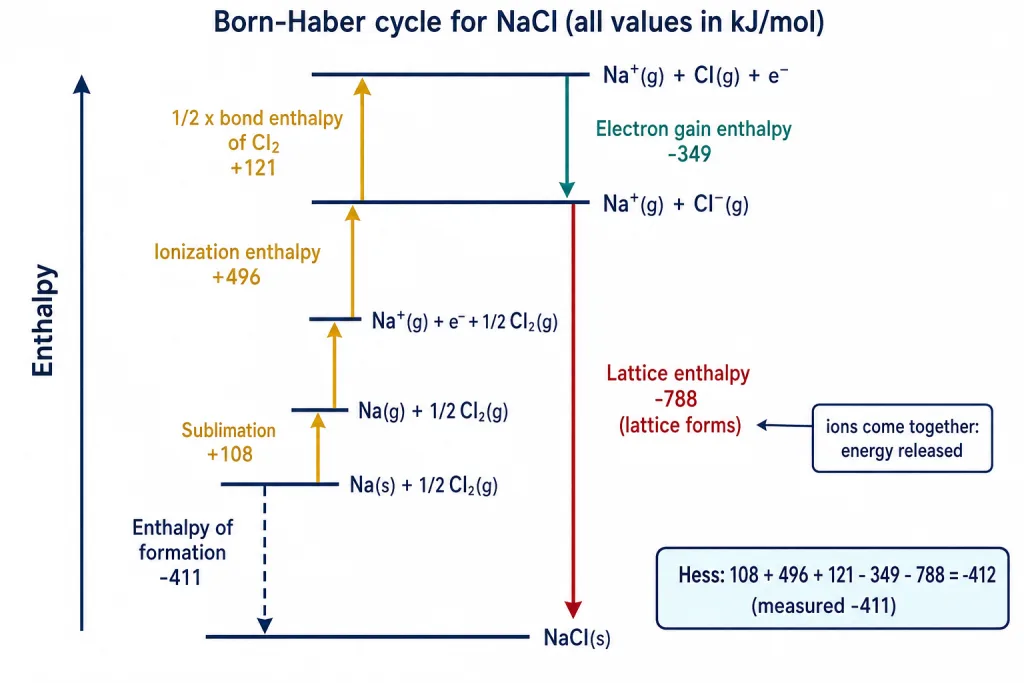
Sign convention — read the question
Lattice enthalpy is the enthalpy change when one mole of the ionic solid is separated into gaseous ions: , kJ/mol. Many JEE questions instead quote the enthalpy of lattice formation, kJ/mol, for the reverse process. Same magnitude, opposite sign. Give each arrow the sign its direction needs; when you compare "lattice enthalpies", compare magnitudes.
Solving for the unknown
Given five of the six numbers, rearrange for the sixth:
For NaCl with : kJ/mol. The same rearrangement run for KCl is Question 1(b). Four things to watch: halve the bond enthalpy (242 per mole of , 121 per mole of Cl atoms); for a bromide or iodide add the vaporisation or sublimation step that turns liquid or solid into gas before the bond is broken; for a divalent metal like Mg put in both ionization enthalpies (); for an oxide put in both electron gain enthalpies ( and ), the second one positive.
What controls the size of the lattice enthalpy
Coulomb's law for a crystal gives, to a good approximation,
The Kapustinskii equation is good enough for estimates: , where is the number of ions per formula unit and pm. You need only recognise its shape. Two levers:
| Lever | Effect | Data (kJ/mol) |
|---|---|---|
| Charge product | dominant: doubling both charges roughly quadruples the pull, and the ions are smaller too | NaCl 788; MgO about 3900; CaO 3400; about 15,000 |
| Sum of radii | smaller ions, closer nuclei, larger lattice enthalpy | LiF 1037 NaF 923 KF 821 RbF 785 CsF 740; NaF 923 NaCl 788 NaBr 747 NaI 704 |
The rule for ordering: compare charges first; if the charges match, the smaller ion pair wins. MgO beats NaCl by a factor of five although and are not much smaller than and — the charge product 4 against 1 does most of the work. Among the alkali halides, LiF has the highest lattice enthalpy and CsI the lowest (about 600).
Lattice enthalpy against hydration enthalpy — solubility
Dissolving costs and returns (negative) when water surrounds the ions. The sign of
is a small difference between two big numbers. NaCl: kJ/mol, slightly endothermic, so it dissolves a little more in hot water. Both terms fall as ions get bigger; which falls faster decides the trend.
- Anion small (, ): the lattice enthalpy is dominated by the cation's size and drops steeply down the group, faster than hydration enthalpy does. Solubility rises down the group: ; same for the group-2 fluorides.
- Anion large (, ): the lattice enthalpy is set by the big anion and hardly changes down the group, but the cation's hydration enthalpy keeps falling. Solubility falls: — hence the barium sulfate test for sulfate.
- Size mismatch means soluble: LiF is the least soluble lithium halide (both ions tiny, lattice enthalpy 1037 wins), CsI the least soluble caesium halide (both huge, hydration poor). LiI and CsF are the soluble extremes.
Melting points follow the lattice, with one warning
For genuinely ionic solids, melting point tracks lattice enthalpy: NaF 993 °C NaCl 801 NaBr 747 NaI 661; MgO 2852 °C against NaCl 801. But LiF (845 °C) melts below NaF (993 °C) despite its higher lattice enthalpy, and (405 °C) far below (714 °C). The warning is covalent character: a small, hard cation polarises the anion and the solid is no longer purely ionic.
[JEE Main] Write the five steps in a column with signs before the arithmetic, then check your answer against the ballpark: alkali halides 600 to 1050, group-2 oxides 3000 to 4000 kJ/mol. An answer of 200 or 8000 is a sign error.
Fajans' Rules — When an Ionic Bond Is Not Really Ionic
The picture
Put a small, highly charged cation next to a big, soft anion. The cation's field distorts the anion's outer electron cloud until some electron density sits between the two nuclei — which is what a covalent bond is. Fajans (1923) listed what makes this polarisation worse. A cation's ability to distort is its polarising power; an anion's willingness to be distorted is its polarisability. These are trends that rank compounds, not laws that give numbers.
| Factor | More covalent character when… | Reason | Example |
|---|---|---|---|
| Cation size | cation is small | field at the surface is | more covalent than |
| Cation charge | cation charge is high | same reason | (covalent, sublimes at 180 °C) vs |
| Anion size | anion is large | outer electrons far from its nucleus, loosely held | more covalent than |
| Anion charge | anion charge is high | extra electrons are loosely held | more covalent than |
| Cation configuration | cation has a pseudo-noble-gas (-electron, ) or shell | d electrons shield the nuclear charge poorly, so the effective field is higher than a noble-gas cation of the same size | vs ; vs ; vs |
The first two factors merge into the ionic potential : higher ionic potential, greater polarising power. ( pm) beats () easily, which is why beryllium chloride is a covalent, polymeric solid soluble in organic solvents while barium chloride is a textbook ionic salt.
Key Point (Definition): Polarising power of a cation increases with its charge and decreases with its size (high ). Polarisability of an anion increases with its size and charge. High polarising power plus high polarisability means a distorted anion, shared electron density, and covalent character in a nominally ionic bond.
The pseudo-noble-gas cation
(102 pm) and (96 pm) match in size and charge, so size and charge alone say NaCl and CuCl should be equally ionic. They are not: CuCl is insoluble in water, NaCl freely soluble. is , a tight octet; is , and its outermost ten d electrons shield the nucleus badly, so a chloride ion next to feels a stronger pull. The same story separates from (AgCl insoluble, KCl soluble), from (radii 74 and 72 pm; melts at 290 °C, at 714 °C), and from ( is a molecular solid soluble in ethanol). Rule: for the same size and charge, an -electron cation polarises more than an -electron one.
What covalent character does to the compound
| Property | More covalent character means… | Evidence |
|---|---|---|
| Melting / boiling point | lower — lattice partly molecular | 405 °C 714 772; sublimes at 180 °C; is a liquid (b.p. 114 °C) while is a solid (m.p. 247 °C) |
| Solubility in water | lower; solubility in organic solvents higher | LiCl dissolves in ethanol and pyridine; AgCl, CuCl, insoluble in water |
| Electrical conductivity of the melt | lower | molten is a poor conductor |
| Colour | deeper — polarisation shrinks the energy gap for moving charge from anion to cation, so the solid absorbs visible light | AgCl white, AgBr pale yellow, AgI yellow; white, red; white, yellow; black |
| Thermal stability of carbonates, nitrates | lower — the polarising cation pulls out of the anion | decomposes on gentle heating, does not; unstable, stable to 1360 °C |
The colour rule deserves a second look. NaCl, KCl and CsCl are all white — no polarisation to speak of. Silver halides run white to yellow as the anion gets bigger and softer: the more polarisable hands electron density to more readily, the charge-transfer transition drops into the visible, and the solid turns yellow.
Ready-made orderings
| Set | Order | Which factor |
|---|---|---|
| Ionic character, group 2 chlorides | cation size grows, polarising power falls | |
| Covalent character, lithium halides | — LiI most covalent | anion polarisability grows |
| Covalent character, period 3 chlorides | cation charge grows, size falls | |
| Same element, two oxidation states | (ionic, solid) (covalent, liquid); ; ; | higher charge, smaller cation |
| Same anion, pseudo-noble-gas vs noble-gas cation | ; ; ; | shielding |
| Melting point, sodium halides | lattice enthalpy, all still ionic | |
| Melting point, alkali chlorides | (605 °C) (801) (770) (718) (645) | NaCl is the peak: LiCl loses to covalent character, the rest to falling lattice enthalpy |
| Mixed set | covalent; AgF is the only water-soluble silver halide | anion polarisability |
[JEE Main] When a set mixes the factors, decide the winner in this order: (1) cation charge, (2) cation size, (3) anion size, (4) vs octet cation. Keep the sign of each consequence straight — covalent character lowers melting point and water solubility, raises solubility in organic solvents, deepens colour, lowers thermal stability of oxo-salts. "Most covalent" and "lowest melting point" are usually the same answer; "most ionic" and "most soluble in water" usually match too, unless lattice enthalpy (LiF, CsI) intervenes.
Dipole Moments as Vectors
The cosine rule
A bond dipole is a vector: magnitude , direction along the bond from the positive to the negative end (chemists draw the arrow with its head at the negative end). The molecular dipole is the vector sum. For two bond dipoles and with angle between them,
Water. Each O-H bond dipole is about 1.5 D and the angle is 104.5°: D, matching the measured 1.85 D. Backwards, from D and 104.5°, the bond dipole is D. (The lone pairs also contribute; the "bond dipole" you get this way quietly includes their share.)
Ammonia and . Three N-H dipoles pointing toward N add to a resultant along the pyramid axis, and the lone-pair dipole points the same way — total 1.47 D. In the three N-F dipoles point away from N (F is more electronegative) while the lone pair still points away from the fluorines, so the two contributions oppose and the total is only 0.23 D. Same shape, opposite arithmetic. Compare 1.47 D against 0.58 D: the P-H bonds are almost non-polar (electronegativity 2.1 against 2.1) and the lone pair is in an orbital with high s-character (Drago, later), which is less directional.
Disubstituted benzenes — the ratio question
Take two identical C-Cl bond dipoles on a benzene ring. The angle between them is 60° for ortho, 120° for meta and 180° for para:
| Isomer | Ratio | Measured (D) | ||
|---|---|---|---|---|
| ortho | 60° | 2.50 | ||
| meta | 120° | 1 | 1.72 | |
| para | 180° | 0 | 0 | 0 |
So for two identical substituents, and the meta isomer has the same dipole as the monosubstituted compound (chlorobenzene 1.69 D — close to 1.72). The measured ortho value (2.50) falls short of because two chlorines crowded on adjacent carbons partly cancel each other's electron pull; the ideal ratio is what the exam wants unless it hands you data. For 1,3,5-trisubstitution, three equal dipoles at 120° sum to zero. For two different substituents use the full cosine rule, and remember that an electron-donating group's dipole points into the ring: in para-chlorotoluene ( withdrawing, donating) the dipoles reinforce, while in para-nitrochlorobenzene they partly cancel — p-chloronitrobenzene 2.6 D nitrobenzene 4.2 D.
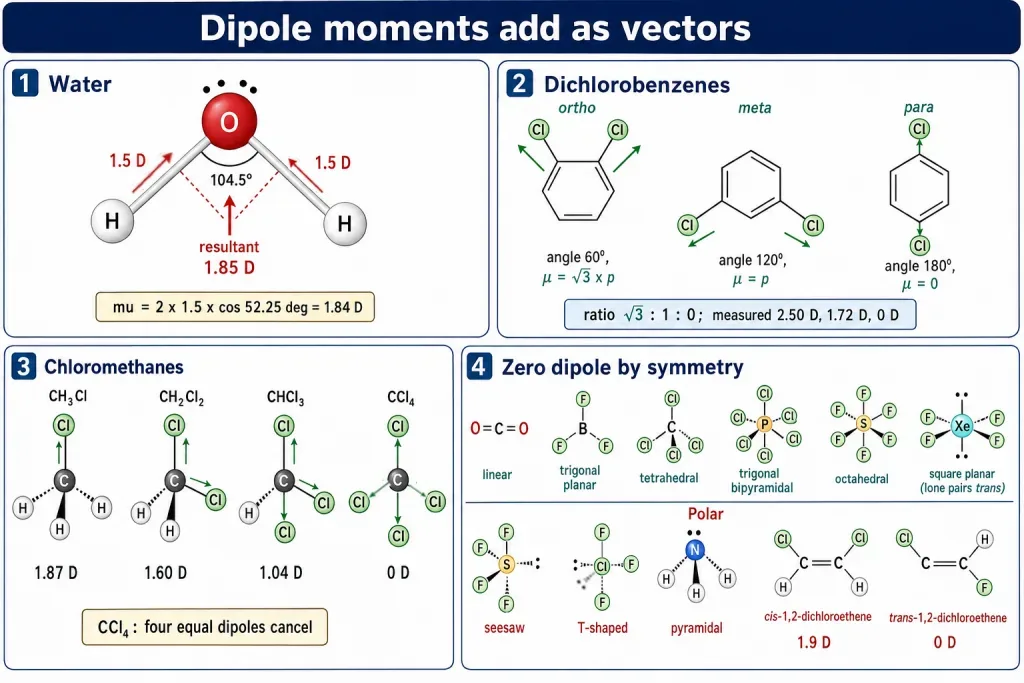
The chloromethanes:
Measured: 1.87, 1.60, 1.04, 0 D. is easy — four equal tetrahedral dipoles cancel exactly. The rest need one geometric fact: in a regular tetrahedron the vector sum of any three bond directions equals minus the fourth, so three C-Cl dipoles at 109.5° add to exactly one C-Cl dipole along the C-H axis. On paper and should then both be worth about one C-Cl dipole plus what the C-H bonds add. They are not equal because three chlorines competing for the same carbon each get less electron density than a lone chlorine does, so each C-Cl bond in is weaker as a dipole and the resultant (1.04 D) is little more than half of 's (1.87 D). sits between: two C-Cl dipoles at 109.5° give , and with the reduced bond polarity the measured 1.60 D lands where you expect.
cis against trans
Two identical polar substituents on a C=C: trans puts them 180° apart in a planar molecule, so the dipoles cancel (trans-1,2-dichloroethene 0 D); cis puts them roughly 60° apart and they add (1.90 D). cis-2-butene has a small dipole (0.33 D), trans-2-butene none. The same rule makes trans- non-polar and cis-platin polar.
Per cent ionic character
If a bond of length were 100 % ionic, a full electronic charge would sit at each end: . The conversion is D, so
| Molecule | (D) | (pm) | (D) | % ionic |
|---|---|---|---|---|
| HF | 1.78 | 92 | 4.42 | 40 |
| HCl | 1.07 | 127 | 6.10 | 17.5 |
| HBr | 0.79 | 141 | 6.77 | 11.7 |
| HI | 0.38 | 160 | 7.68 | 4.9 |
Constants, if the question supplies SI units: C, C m. Ionic character falls HF HCl HBr HI while acid strength rises the other way — polarity and acidity run opposite down a group because bond strength, not polarity, decides acidity there.
The checklist
A molecule is non-polar when its bond dipoles cancel by symmetry: every position around the central atom holds the same atom and the shape is one of the symmetric ones. Lone pairs are allowed only if they too sit symmetrically.
| Shape | Zero-dipole members | Watch out |
|---|---|---|
| Linear | , , , , (three lone pairs at 120° in the equatorial plane), , | HCN, OCS, polar |
| Trigonal planar | , , , , | (pyramidal), (bent) polar |
| Tetrahedral | , , , , | , polar; (seesaw) polar |
| Trigonal bipyramidal | , | zero only if both F are axial; , polar |
| Octahedral | , | (square pyramidal) polar |
| Square planar | , , trans- | cis isomer polar |
| Planar organics | benzene, p-dichlorobenzene, trans-alkenes, ethene, 1,3,5-trichlorobenzene | o-, m-, cis- all polar |
| Homonuclear | , , , , , | is polar (0.53 D) — bent |
[JEE Main] Three checks settle most dipole questions. (1) Are all terminal atoms identical? If not, the molecule is polar (except accidental near-cancellations JEE does not ask). (2) Is the shape one of the symmetric set — linear, trigonal planar, tetrahedral, trigonal bipyramidal, octahedral, square planar? Bent, pyramidal, seesaw, T-shaped and square pyramidal are always polar. (3) Do lone pairs sit symmetrically (, : yes; , , : no)?
VSEPR Fine Print — Bond-Angle Rules, Bent's Rule, Drago's Rule and Back-Bonding
Rule 1: a more electronegative central atom opens the angle
| Series | Angles | Trend |
|---|---|---|
| Group 15 hydrides | 107° 93.6° 91.8° 91.3° | angle falls down the group |
| Group 16 hydrides | 104.5° 92.1° 91° 90° | same |
The usual VSEPR reason: a more electronegative central atom pulls the bond pairs closer to itself, they end up closer to each other, and their mutual repulsion opens the angle. A bigger, less electronegative centre lets the bond pairs drift outward, and the lone pair squeezes the bonds together. But the drop is sharp — 107° to 93.6° — and the values then park near 90°. That "near 90°" is Drago's rule (below), the better explanation.
Rule 2: more electronegative terminal atoms close the angle
| Pair | Angles | Why |
|---|---|---|
| vs | 107° vs 102.3° | F drags the bond pairs away from N; less bp-bp repulsion near N; the angle shrinks |
| vs | 100.3° vs 97.8° | same |
| 97.8°, 100.3°, 101°, 102° | electronegativity of X falls, size of X rises — both open the angle | |
| vs | 104.5° vs 103.1° | F pulls the bond pairs away from O |
Two effects act on the terminal atom: electronegativity (pulls bond density away from the centre, angle shrinks) and size (big atoms bump into each other, angle opens). For H against F only electronegativity matters — H is tiny. For the heavier halogens size takes over. Hence the order JEE likes to test:
is below water because fluorine is more electronegative than hydrogen. is above water because the two chlorines are large and their lone pairs repel each other across a small oxygen; chlorine is also less electronegative than fluorine, so the bond pairs stay nearer oxygen. (Some books add partial delocalisation of oxygen's lone pairs into chlorine's empty 3d orbitals.) F closes, Cl opens. Same pattern in 102.3° 107° 107.1°.
Rule 3: multiple bonds take more room
A double bond holds four electrons and pushes the neighbouring bonds together. In phosgene the Cl-C-Cl angle is 111.8° and each Cl-C=O angle 124.1°; in formaldehyde H-C-H is 116° and H-C=O 122°; in ethene H-C-H is 117.6° and H-C=C 121.2°. Rank the repulsions: triple double single, and lone pair any of them.
against . Both are bent, with one lone pair on the central atom, but ozone's angle is 116.8° and sulfur dioxide's 119.5°. In both S-O bonds are full double bonds (sulfur can use its 3d orbitals to hold two bonds at once) and resist the lone pair's squeeze; in the two bonds share one bond (order 1.5 each) and the small oxygens bring the lone pair closer. The order is the point; the -orbital story is a common way to argue it.
Lone-pair positions: equatorial in a trigonal bipyramid, trans in an octahedron
An axial position has three neighbours at 90°; an equatorial position only two (the other two at 120°). Lone pairs, being bulkiest, take the fewest 90° contacts — equatorial. So is a seesaw (one equatorial lone pair), T-shaped (two), and linear (three). In an octahedron every position is equivalent, so the first lone pair goes anywhere (, : square pyramidal) and the second goes trans to it, 180° away (, : square planar). Lone pairs also bend what is left: 's axial F-S-F closes to 173°, 's F-Cl-F to 87.5°.
Bent's rule
Key Point (Bent's rule): s-character concentrates in the orbitals directed toward electropositive substituents, and p-character in the orbitals directed toward electronegative substituents. Lone pairs count as the most electropositive "substituent" of all and take the most s-character.
An electronegative atom pulls the bonding electrons toward itself, so the central atom gains little from spending its low-energy s orbital on that bond; it saves the s-character for bonds where the electrons stay close, and for lone pairs. Three consequences JEE uses:
- Angles. More p-character means an angle nearer 90°; more s-character, nearer 180°. In the C-F bond takes extra p-character and the three C-H bonds extra s-character, so H-C-H opens to about 110° and each H-C-F closes to about 108.7°. In F-C-F is 108.3° and H-C-H 113°.
- Bond lengths. More p-character means a longer bond. In the single C-F bond soaks up most of carbon's p-character and is long (139 pm); in four fluorines share it equally, so each C-F bond is shorter (132 pm).
- Position in a trigonal bipyramid. The set is an trio (equatorial, 33 % s) plus a pair (axial, no s-character), so the most electronegative substituents go axial: has both fluorines axial and three chlorines equatorial, making it non-polar; has two F axial and one F plus two Cl equatorial; in the axial P-Cl bonds (219 pm) are longer than the equatorial (204 pm). Lone pairs and double bonds go equatorial — the same conclusion VSEPR reached by counting 90° repulsions.
Drago's rule
Drago's rule is Bent's rule pushed to the limit. When the central atom is from period 3 or lower (P, As, Sb, S, Se, Te) and is bonded to atoms whose electronegativity is about 2.1 or less — in practice, hydrogen — the - gap is large and the bonds are weak, so hybridisation does not pay. The central atom bonds with almost pure p orbitals, at 90° to each other, and parks its lone pair in the pure s orbital.
| Molecule | Angle | Molecule | Angle |
|---|---|---|---|
| 93.6° | 92.1° | ||
| 91.8° | 91° | ||
| 91.3° | 90° |
That is why the angles crash from 107° (, real ) to 93.6° and then sit near 90°. Two side-effects: a lone pair in a pure s orbital is spherical and held tight, so is a far weaker base than and does not hydrogen-bond; and the P-H bond, made from a pure 3p orbital, is long and weak. Mind the conditions: Drago does not apply to (period 2) or to (F far too electronegative — is with the angle pulled to 97.8° by Rule 2 and Bent's rule).
Back-bonding
When an atom with a filled p orbital sits next to an atom with an empty p (or d) orbital of the right symmetry, the lone pair partly delocalises into it: a - or - back-bond. It adds partial double-bond character, shortens the bond, and changes shape and basicity.
| Case | What is seen | Explanation |
|---|---|---|
| B-F 130 pm against the 152 pm expected from covalent radii; is the weakest Lewis acid of the trihalides: | each F donates filled-2p density into boron's empty 2p (-); boron's vacancy is partly filled, so it accepts an external lone pair less eagerly. Overlap is best for F (2p matches B), worse for bigger halogens | |
| boron goes from planar to tetrahedral , B-F lengthens to about 138 pm, F-B-F closes from 120° to about 109° | the nitrogen lone pair fills boron's empty orbital, switching off the F to B back-bonding, so B-F loses its double-bond character | |
| vs | trisilylamine is planar ( N, Si-N-Si 120°) and a very weak base; trimethylamine is pyramidal (, C-N-C 108°) and a good base | N's lone pair delocalises into Si's empty 3d orbitals (-), which needs a pure p lone pair, hence planar N; a delocalised pair cannot be donated. Carbon has no low-lying d orbital, so trimethylamine keeps its pyramid |
The hybridisation formula — and when it fails
For a quick steric number, count
= valence electrons of the central atom, = number of monovalent atoms attached (H, halogens), = positive charge, = negative charge. Divalent oxygen and sulfur count zero (they bring two electrons and take two). means .
| Species | Hybridisation | Shape | |
|---|---|---|---|
| tetrahedral | |||
| seesaw (one lone pair) | |||
| square planar (two lone pairs) | |||
| linear (three lone pairs) | |||
| tetrahedral | |||
| linear |
Where it fails. (1) Odd-electron species: gives and gives 3.5 — meaningless; both are really with the odd electron in the hybrid or p orbital. (2) Drago's molecules: and score 4, but the central atom is essentially unhybridised. (3) Back-bonded molecules: scores 4 () but its nitrogen is planar ; scores 3 correctly, yet the formula cannot see the extra bonding. (4) Molecules with no single central atom (, , — run it per atom). Use it as a fast first pass, then check against the steric number from a Lewis structure — bonds plus lone pairs on the central atom — which is the definition and never fails for main-group species.
[JEE Main] For a bond-angle comparison, ask in this order: (1) same central atom, different terminal atoms — terminal electronegativity closes the angle, size opens it (H vs F: electronegativity only; Cl, Br, I: size wins); (2) same terminal atoms, different central atom — a heavy p-block hydride means Drago, about 90°, otherwise a more electronegative centre means a bigger angle; (3) multiple bond or lone pair present — it takes more room; (4) trigonal bipyramid — lone pairs and double bonds equatorial, the most electronegative atoms axial.
Heteronuclear Molecular Orbitals and the Half-Electron Rule
Two atoms, two different energies
In a homonuclear molecule the two atoms contribute equally to every MO. In a heteronuclear one the more electronegative atom has lower-lying atomic orbitals, so the bonding MOs are weighted toward the more electronegative atom and the antibonding MOs toward the less electronegative one. That explains why CO binds metals through carbon and why the HF bond is polar.
CO — the triple bond you did not expect
Carbon monoxide has valence electrons, exactly like . It uses the ordering (the s-p mixed one, below ):
So CO has a triple bond — one and two — is diamagnetic, and has the shortest (113 pm) and strongest (1072 kJ/mol) bond of any diatomic molecule, stronger even than 's 946. Its Lewis structure, with a formal charge of on C and on O, says the same thing. The HOMO is , concentrated on carbon — essentially the carbon lone pair, which is why CO attaches to a metal through C in carbonyls like . The LUMO is the pair, also mostly on carbon, which accepts back-donation from filled metal d orbitals. The measured dipole moment is tiny (0.11 D) and has its negative end on carbon — the lone pair on C outweighs the electronegativity difference.
Isoelectronic with CO (10 valence electrons, bond order 3, diamagnetic): , , , (the acetylide ion in ).
NO — bond order 2.5 and a paramagnetic molecule
Nitric oxide has valence electrons. Filling with the -type ordering (the ordering used for NO in every JEE key; the bond order comes out the same either way):
One unpaired electron in an antibonding orbital: NO is paramagnetic ( BM), has a bond length of 115 pm — between a double (about 122) and a triple (106) N-O bond — and, with its odd electron in a high-energy antibonding orbital, is easily oxidised. Remove that electron and you get the nitrosonium ion : bond order 3, diamagnetic, bond length 106 pm, found in , and . Add an electron instead (): bond order 2, bond length 127 pm, two unpaired electrons like . So
(9 valence electrons) is the mirror case: bond order 2.5, paramagnetic; add an electron to the bonding and has bond order 3 and is diamagnetic — adding an electron strengthened the bond, because it went into a bonding orbital.
HF — one bond, three lone pairs
Hydrogen's 1s orbital ( eV) is close in energy only to fluorine's 2p ( eV); fluorine's 2s ( eV) is far too low to mix, and only the F pointing at hydrogen has the right symmetry for a bond. So: one bonding orbital (mostly F ), one (mostly H 1s), and three non-bonding orbitals on fluorine — 2s, , — the three lone pairs. Eight valence electrons fill and the three non-bonding orbitals; is empty. Bond order , diamagnetic, and because the bonding pair lives mostly on fluorine the molecule is strongly polar (, 1.78 D). The , electrons do not count in the bond order — they are neither bonding nor antibonding.
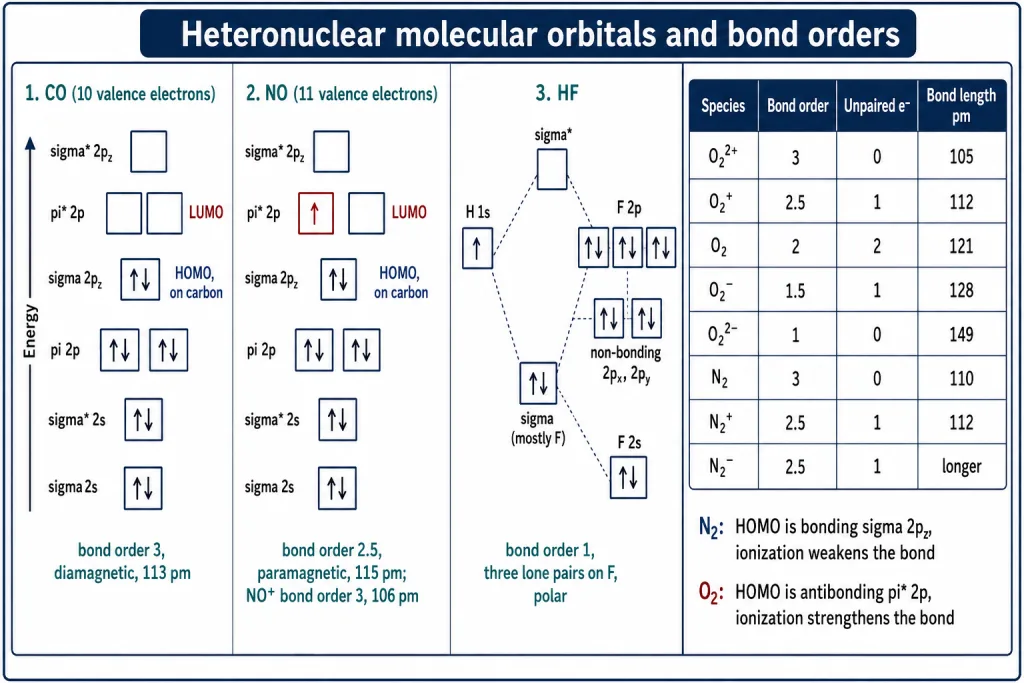
The half-electron rule
Key Point: Adding or removing one electron changes the bond order by exactly . Which way depends only on which orbital the electron enters or leaves: bonding orbital emptied or antibonding orbital filled, bond order falls by ; antibonding orbital emptied or bonding orbital filled, bond order rises by .
So an "arrange the species" question is two steps: locate the HOMO (for removal) or LUMO (for addition), then add or subtract .
| Species | Configuration of the last electrons | B.O. | Unpaired | Bond length (pm) |
|---|---|---|---|---|
| 3 | 0 | about 105 | ||
| 2.5 | 1 | 112 | ||
| 2 | 2 | 121 | ||
| (superoxide) | 1.5 | 1 | 128 | |
| (peroxide) | 1 | 0 | 149 |
For oxygen every added electron goes into (antibonding) and every removed electron comes out of , so the pattern is monotonic. Nitrogen behaves differently:
| Species | Last electrons | B.O. | Unpaired | Note |
|---|---|---|---|---|
| 2.5 | 1 | electron removed from a bonding orbital | ||
| 3 | 0 | 110 pm, 946 kJ/mol | ||
| 2.5 | 1 | electron added to an antibonding orbital |
and share bond order 2.5 but are not equally stable: an antibonding electron destabilises a bond a little more than a bonding electron stabilises it, so (3 antibonding electrons) is weaker and longer than (2). Bond length ; stability . The same tie-break makes more stable than (both 0.5).
Why ionising weakens the bond but ionising strengthens it — s-p mixing
The answer is the two energy orderings:
- For , , (and CO, NO, CN): the 2s and 2p atomic orbitals are close in energy, so the and MOs, which have the same symmetry, mix. Mixing pushes up — above the pair. Order: .
- For , , : the 2s-2p gap is large (the higher nuclear charge pulls 2s down much more than 2p), mixing is negligible, and sits below . Order: .
The gap doubles across the period: about 5 eV for B, 8 for C, 12 for N, 15 for O, 21 for F. So the HOMO of is the bonding — the first electron removed comes from a bonding orbital and the bond weakens (, 2.5). The HOMO of is the antibonding — the first electron removed comes from an antibonding orbital and the bond strengthens (, 2.5, shorter than ). Two more consequences of the mixed ordering: is paramagnetic (its two electrons occupy and singly) and is diamagnetic with two bonds and no bond. Without s-p mixing would be diamagnetic — experiment says otherwise, which is the evidence for the mixing.
| Molecule | HOMO | LUMO |
|---|---|---|
| (bonding) | ||
| (half-filled — also the SOMO) | (the next empty orbital) | |
| CO | (carbon lone pair) | (mostly on C) |
| NO | (singly occupied) | the other |
Magnetic moments
Count unpaired electrons and use BM: , 1.73; , 2.83; , 3.87.
| Species | Unpaired | (BM) | Species | Unpaired | (BM) |
|---|---|---|---|---|---|
| , , | 2 | 2.83 | , , , CO, , , | 0 | 0 |
| , , NO, CN, , , , , | 1 | 1.73 | , (B.O. 0, do not exist) | — | — |
[JEE Main] Memorise both orderings and the dividing line ( mixed, unmixed). Then every question is mechanical: count valence electrons (add for anions, subtract for cations), fill, read off bond order, unpaired electrons and the HOMO. Use the ordering for CO, NO, , . The bond-length orders — , , — follow from bond order first and antibonding count second.
Bond-Length and Bond-Strength Puzzles
Bond order in a resonance hybrid
When a molecule is a hybrid of equivalent resonance structures, every equivalent bond gets the average of what the structures give it:
| Species | One structure has | Equivalent positions | Bond order | Bond length (pm) |
|---|---|---|---|---|
| 1 C=O + 2 C-O = 4 bonds | 3 | 129 | ||
| 1 N=O + 2 N-O = 4 | 3 | 1.33 | 124 | |
| 1 N=O + 1 N-O = 3 | 2 | 1.5 | 124 | |
| 1 O=O + 1 O-O = 3 | 2 | 1.5 | 128 | |
| 2 S=O + 2 S-O = 6 | 4 | 1.5 | 149 | |
| 3 Cl=O + 1 Cl-O = 7 | 4 | 1.75 | 144 | |
| 1 P=O + 3 P-O = 5 | 4 | 1.25 | 154 | |
| benzene | 3 C=C + 3 C-C = 9 | 6 | 1.5 | 139 |
| (azide) | / / : 4 bonds | 2 | 2 | 116 (both equal) |
| 3 S=O (expanded octet) | 3 | 2 | 142 |
These are not separate structures the ion flips between, but contributors to one hybrid. For the oxo-anions the shortcut is , with the central atom expanding its octet to the maximum number of double bonds its formal charge allows: S in sulfate two, Cl in perchlorate three, P in phosphate one. So , and the bond lengths the reverse. (Some texts stay strictly within the octet and quote as 1.0 with all bonds single; JEE keys use the expanded-octet values above.)
C-O bond lengths in one line
's C=O (116 pm) is shorter than the average C=O of 121 pm — its two systems are delocalised across both bonds, giving each a little extra order. The same ladder for nitrogen: N-O single (145). Higher bond order, shorter bond, higher bond enthalpy — the three go together for the same pair of atoms.
s-character shortens a bond and makes carbon more electronegative
A hybrid orbital with more s-character is held closer to the nucleus and is lower in energy. Two consequences:
| Carbon type | s-character | C-H length (pm) | C-H bond enthalpy (kJ/mol, approx.) | of carbon | Acidity of C-H |
|---|---|---|---|---|---|
| (ethane) | 25 % | 110 | 420 | 2.5 | |
| (ethene) | 33 % | 108 | 445 | 2.75 | about 44 |
| (ethyne) | 50 % | 106 | 520 | 3.3 | 25 |
And for C-C single bonds, which depend on both carbons: (ethane) 154 pm (propene) 150 (the middle bond of 1,3-butadiene) 147 (propyne) 146 (the middle bond of butadiyne) 138. Give the table's explanation — more s-character means shorter orbitals and shorter bonds — not any argument about resonance or hyperconjugation, which JEE does not accept for the central bond of butadiene at this level. Ethyne's C-H is acidic enough to be removed by sodamide because the carbon can hold the resulting negative charge: the same fact from the other side.
Bond length also tracks the size of the atoms: 74 92 127 141 160 pm; 144 199 228 267 pm.
The bond-enthalpy anomalies
Longer usually means weaker, but three families break the rule.
| Set | Bond enthalpies (kJ/mol) | Anomaly and reason |
|---|---|---|
| Halogens | 243 193 159 151 | is the shortest bond yet weaker than and : the three lone pairs on each tiny fluorine sit so close that their repulsion cancels much of the bonding; also no d orbitals to relieve it. Same reason is such a strong oxidising agent |
| Single bonds of period-2 atoms | C-C 348, N-N 163, O-O 146, F-F 159 | N-N and O-O are weak for the same lone-pair reason; hence catenation is a carbon speciality and peroxides, hydrazine are reactive |
| Multiple bonds | 946 vs 490; 614 vs weak | - overlap collapses for period-3 atoms (long bonds, diffuse 3p), so nitrogen is but phosphorus is with six P-P single bonds |
| Sigma vs pi | C-C 348, C=C 614, C≡C 839 | the second bond adds 266, the third only 225: a bond is weaker than a bond |
[JEE Main] Bond-order arithmetic first (resonance average, or MO count), then s-character, then atomic size — that order of priority sorts any bond-length list. For bond enthalpy lists, first check whether , N-N or O-O is in the set: if so, the lone-pair anomaly overrides length.
Hydrogen Bonding and Intermolecular Forces at JEE Level
How strong is a hydrogen bond?
| H-bond | Strength (kJ/mol) | Where |
|---|---|---|
| about 40 (up to 155 in the symmetric ion) | HF zigzag chains, | |
| 20 to 30 | water, ice, alcohols, carboxylic acid dimers | |
| 8 to 30 | proteins, DNA base pairs | |
| about 13 | ammonia |
A typical H-bond is one tenth of a covalent bond and ten times a van der Waals contact. It needs H attached to N, O or F (small, very electronegative) and a lone pair on another N, O or F. Strength grows with the electronegativity of the atoms and with the linearity of the unit. forms up to four per molecule (two through its H atoms, two through its lone pairs), HF only two, effectively one (three H atoms, one lone pair to receive).
The bifluoride ion and HF's odd acidity
has the strongest hydrogen bond known — the proton sits exactly midway, 113 pm from each fluorine, in a linear, symmetric, three-centre-four-electron bond. So is a stable salt while does not exist; and hydrofluoric acid is a weak acid in dilute solution ( 3.2) partly because the it releases is immediately trapped by another HF as — and becomes stronger as it is concentrated, because formation drives the dissociation forward.
Boiling-point puzzles
| Series | Boiling points (°C) | Reading |
|---|---|---|
| Group 16 hydrides | 100 | water out of line (H-bonds); the rest rise with molar mass (London forces) |
| Group 17 hydrides | HF 19.5 HI HBr HCl | HF out of line |
| Group 15 hydrides | the trap: 's H-bonds are weak enough that the heavy overtakes it on London forces alone | |
| The three H-bonded hydrides | 100 HF 19.5 | water beats HF although is the stronger bond, because water makes twice as many H-bonds per molecule |
| Ethanol vs dimethyl ether (both ) | 78 vs | O-H present vs absent |
| o- vs p-nitrophenol | 214 vs 279; o- steam-volatile and less water-soluble | ortho: intramolecular H-bond (the OH bonds to the neighbouring inside the molecule), so no intermolecular association; para: intermolecular H-bonds, molecules stick together |
Intramolecular hydrogen bonding — a five- or six-membered ring closed by an contact — lowers boiling point and water solubility and raises volatility, because the molecule has used up its H-bonding on itself. Look for it in o-nitrophenol, o-hydroxybenzaldehyde (salicylaldehyde), o-chlorophenol, salicylic acid, maleic acid and the enol of acetylacetone.
Acidity puzzles
Ortho-hydroxybenzoic (salicylic) acid, 2.97, is a stronger acid than benzoic acid (4.20), while para-hydroxybenzoic acid (4.58) is weaker than benzoic. The para OH pushes electron density into the ring by resonance, destabilising the carboxylate — a weaker acid. The ortho isomer has the same resonance effect, but its neighbouring OH forms an intramolecular H-bond with the carboxylate oxygen, stabilising the anion strongly, so it ends up about seventeen times stronger than benzoic. (The general "ortho effect" — nearly every ortho-substituted benzoic acid is stronger than benzoic — is partly steric, but for OH the H-bond dominates.) The same logic makes maleic acid ( 1.9) a stronger first acid than fumaric ( 3.0): the cis geometry lets the remaining COOH hydrogen-bond to the carboxylate — and then a weaker second acid ( 6.2 against 4.4), because that H-bond has to be broken.
The density of ice
In ice each oxygen is tetrahedrally surrounded by four others at 276 pm, through two covalent O-H bonds (about 100 pm) and two hydrogen bonds (about 176 pm). The framework is a hexagonal cage with a lot of empty space, so ice (0.917 g/cm³) is about 9 % less dense than water (1.000 at 4 °C, where the density peaks). Melting collapses some cages and the molecules pack closer; above 4 °C ordinary thermal expansion wins again. Ice floating is why lakes freeze from the top; the 9 % expansion is why pipes burst and rocks crack.
Van der Waals forces — the three types and who has them
| Force | Between | Energy | Typical size (kJ/mol) | Example |
|---|---|---|---|---|
| Dipole-dipole (Keesom) | two permanent dipoles | (rotating molecules) | 5 to 25 | HCl-HCl, acetone |
| Dipole-induced dipole (Debye) | a permanent dipole and a polarisable molecule | 2 to 10 | HCl-Ar, dissolved in water | |
| Dispersion / London (induced dipole-induced dipole) | any two molecules — the only force between non-polar ones | 0.05 to 40 | noble gases, , hydrocarbons | |
| Ion-dipole (not a van der Waals force, but in the same list) | ion and polar molecule | 40 to 600 | in water |
Strength ranking for the same size: ion-ion ion-dipole hydrogen bond dipole-dipole dipole-induced dipole London. But London forces grow with size and surface area (more electrons, more polarisable), and for large molecules they beat everything else — which is why is a solid and a gas although HCl is polar and is not. Orders set by London forces alone: He Ne Ar Kr Xe; ; and among isomers n-pentane (36 °C) isopentane (28 °C) neopentane (9.5 °C) — branching lowers surface contact.
[JEE Main] For a boiling-point order: (1) is H-bonding possible (H on N, O, F)? If yes, that molecule goes to the top unless it is against ; (2) is it intramolecular (ortho isomer)? Then it goes down; (3) otherwise rank by dipole and then by size. For an acidity puzzle involving an ortho OH, look for an H-bond that stabilises the anion.
The Traps JEE Sets (read before every test)
These are the errors that survive knowing the rules.
| # | Trap | The fix |
|---|---|---|
| 1 | Lattice enthalpy entered as when the arrow runs ions solid | formation of the lattice is ; separation is . Match sign to direction |
| 2 | MgO cycle with one ionization and one electron gain | both: for , for — the second electron gain is positive |
| 3 | "LiF has the highest lattice enthalpy, so it must be the most soluble lithium halide" | the opposite: highest lattice enthalpy makes LiF the least soluble; LiI is the most soluble and the most covalent |
| 4 | Comparing and by size only | same size, but is (pseudo-noble-gas): far more polarising, CuCl covalent and insoluble |
| 5 | "Higher charge on the cation, more ionic" | higher charge means more polarising, more covalent: is a covalent liquid, an ionic solid |
| 6 | LiF melting point above NaF because of higher lattice enthalpy | LiF 845 °C NaF 993 °C: covalent character in LiF (Fajans) |
| 7 | given a larger dipole than because F is more electronegative | the lone-pair dipole opposes the N-F dipoles: 0.23 D, 1.47 D |
| 8 | Per cent ionic character computed with in D and in pm without converting | ; HCl: D, so |
| 9 | given a larger angle than "because F is bigger than H" | 103.1° 104.5° 110.9°: F closes the angle by electronegativity; Cl opens it by size |
| 10 | Fluorines placed equatorial in | Bent's rule: the most electronegative atoms take the axial (pure p/d) positions; both F axial, molecule non-polar |
| 11 | given a longer bond than NO | the electron removed was antibonding: B.O. 3, 106 pm NO 2.5, 115 pm |
| 12 | Removing an electron from treated like removing one from | HOMO is bonding (bond weakens, 3 2.5); HOMO is antibonding (bond strengthens, 2 2.5) |
| 13 | Sulfate bond order written as 1 | with two S=O in each structure, ; 1.75, 1.25, 1.33 |
[JEE Main] Most questions from this section are one rule in a costume. Strip it: "enthalpy of formation of KCl from the given data" is "write five steps, halve the value"; "which silver halide is yellow" is "most polarisable anion"; "ratio of dipole moments of the dichlorobenzenes" is ""; "which has the larger bond angle" is "terminal electronegativity closes, size opens, heavy central atom means Drago"; "which is paramagnetic with bond order 2.5" is "11 or 15 valence electrons"; "which is the stronger acid" is "look for the intramolecular H-bond". Translate first, then answer.
Solved Examples
Question 1: The Born-Haber cycle for NaCl and KCl
(a) Using sublimation enthalpy of Na , ionization enthalpy of Na , bond enthalpy of , electron gain enthalpy of Cl and lattice enthalpy of NaCl kJ/mol, calculate the enthalpy of formation of NaCl(s). (b) For KCl the measured enthalpy of formation is kJ/mol; with sublimation enthalpy of K and ionization enthalpy kJ/mol, find the lattice enthalpy of KCl. (c) Why is KCl's lattice enthalpy lower than NaCl's, and why does KCl still form?
Answer:
(a) I list the five steps with the sign each direction demands. : . : . : , since only one chlorine atom is needed. : . : the lattice forms, so . Adding, kJ/mol against an accepted ; the difference is rounding.
(b) Rearranging the same cycle: , with the sublimation enthalpy of K, its ionization enthalpy, half the bond enthalpy and the electron gain enthalpy of Cl. So kJ/mol. (Literature value 715.)
(c) (138 pm) is bigger than (102 pm), so the ions sit farther apart and attract less — lattice enthalpy . But potassium is also cheaper to sublime (89 against 108) and to ionise (419 against 496). The lattice returns 717, the costs are 280, and KCl is still 437 kJ/mol downhill — more exothermic than NaCl.
Ans: (a) kJ/mol; (b) 717 kJ/mol; (c) the larger lowers the lattice enthalpy, but lower sublimation and ionization costs keep KCl stable.
Watch out: Give the lattice step the sign its direction demands, and halve the diatomic bond enthalpy before adding.
Question 2: MgO — two ionizations, two electron gains
Data (kJ/mol): sublimation of Mg ; first and second ionization enthalpies of Mg and ; bond enthalpy of ; first and second electron gain enthalpies of O and ; enthalpy of formation of MgO . (a) Find the lattice enthalpy of MgO. (b) The total "cost" of making and is over 3000 kJ/mol — why does magnesium not settle for instead? (c) Compare with NaCl (788) and explain the factor of five.
Answer:
(a) The column of steps: sublimation ; ionization to , ; half an bond, ; electron gain to , . Total spent before the lattice: kJ/mol. Then , so kJ/mol.
(b) Stopping at singly charged ions would save the second ionization (1451) and the second electron gain (780) — 2231 kJ/mol. But a lattice at roughly the same spacing returns only about a quarter of 3827, near 950 kJ/mol, a loss of nearly 2900. Losing 2900 to save 2231 is a bad trade, so the doubly charged lattice wins by about 650 kJ/mol. That is why exists in solids although it cannot exist in the gas phase.
(c) Lattice enthalpy . Charge product MgO against NaCl , a factor of 4. Radii pm against pm, another factor of 1.33. Product about 5.3, close to .
Ans: (a) 3827 kJ/mol (tables give 3800 to 3900); (b) the lattice returns far more than the extra ionization and electron gain cost; (c) charge product 4 and smaller ions.
Watch out: For a oxide put both ionizations and both electron gains in, and remember the second electron gain is positive.
Question 3: Lattice enthalpy, hydration enthalpy and solubility
(a) Arrange LiF, NaF, KF, NaCl, NaI and MgO in decreasing order of lattice enthalpy. (b) Explain why the solubility of group-2 hydroxides increases down the group while that of the sulfates decreases. (c) Which lithium halide is the least soluble in water, and which caesium halide? (d) Why does LiF melt at 845 °C, lower than NaF at 993 °C, despite its higher lattice enthalpy?
Answer:
(a) Charge first, then size. MgO is the only solid, so it leads (about 3900). Among the salts the smallest ion pair wins: LiF (1037) NaF (923) KF (821); down the sodium halides NaF (923) NaCl (788) NaI (704). Combined: .
(b) Dissolving costs the lattice enthalpy and recovers the hydration enthalpies, and both fall as the cation grows — the question is which falls faster. With a small anion () the cation's size controls , so the lattice enthalpy drops sharply from Be to Ba, faster than hydration enthalpy does, and dissolving gets easier: almost insoluble, fairly soluble. With a large anion (, 230 pm) the anion dominates , the lattice enthalpy barely changes down the group, and the cation's hydration enthalpy keeps falling ( , kJ/mol). Less recovered, same spent: solubility falls, and is the classic insoluble sulfate.
(c) Two small ions give a very high lattice enthalpy that hydration cannot repay, so LiF is the least soluble lithium halide (about 0.13 g per 100 g water). At the other end and are both so poorly hydrated that CsI is the least soluble caesium halide. Mismatch (LiI, CsF) means most soluble.
(d) Fajans. is tiny and polarises enough to give LiF some covalent character, so the solid is not held purely by the ionic lattice and melts sooner than a "purer" ionic NaF. Lattice enthalpy predicts melting points only while the compound stays fully ionic.
Ans: (a) ; (b) small anion: lattice enthalpy falls faster (solubility rises); large anion: hydration enthalpy falls faster (solubility falls); (c) LiF and CsI; (d) covalent character in LiF.
Question 4: Fajans' rules on mixed sets
(a) Arrange , , , in increasing order of melting point and explain. (b) Why is AgCl white but AgI yellow, and why is AgF the only silver halide soluble in water? (c) and have nearly the same radius; explain why CuCl is insoluble in water while NaCl dissolves freely. (d) Which is more covalent, or ? Give physical evidence. (e) Which lithium halide is the most covalent, and which is the most soluble in ethanol?
Answer:
(a) All four have cations and the same anion, so the only variable is cation radius: 45 pm, 72, 100, 135. Smaller cation, higher ionic potential , more polarisation of , more covalent the solid, lower the melting point: (405 °C) (714) (772) (962). is a covalent chain polymer in the solid and a molecular vapour.
(b) (220 pm) is much bigger and more polarisable than (181 pm). Next to the polarising cation , iodide's electron cloud is pulled so far toward silver that the energy needed to move charge from anion to cation drops into the visible: the solid absorbs blue-violet light and looks yellow. AgCl's charge-transfer absorption stays in the ultraviolet, so it is white; AgBr is in between (pale yellow). Solubility runs the other way: AgF is nearly purely ionic ( is hard to polarise) and dissolves like a normal salt, while AgCl, AgBr and AgI are increasingly covalent and insoluble.
(c) is , a closed octet that shields its nucleus well. is , and d electrons shield poorly, so a chloride ion beside feels a much stronger effective positive charge than one beside of the same size. CuCl is therefore substantially covalent (zinc-blende structure with tetrahedral Cu), poorly hydrated, and insoluble.
(d) is smaller and carries twice the charge of , so its polarising power is far higher. is a covalent molecular liquid boiling at 114 °C that fumes in moist air and dissolves in organic solvents; is a white ionic solid melting at 247 °C that dissolves in water. Same pattern in , , against , , .
(e) Cation fixed, anion growing: LiF LiCl LiBr LiI in covalent character. LiI is the most covalent, and covalent character means solubility in organic solvents, so LiI (and LiCl, LiBr) dissolve in ethanol while NaCl scarcely does.
Ans: (a) ; (b) polarisable shifts the charge-transfer absorption into the visible, and AgF is ionic; (c) is and shields poorly; (d) — a liquid, b.p. 114 °C; (e) LiI on both counts.
Watch out: Work down cation charge, cation size, anion size, then the exception.
Question 5: Dipole vectors — water, sulfur dioxide and ammonia
(a) The dipole moment of water is 1.85 D and the H-O-H angle 104.5°; find the O-H bond dipole. (b) Sulfur dioxide has D and a bond angle of 119.5°; find the S-O bond dipole. (c) Show that for (bond angle 107°) the three N-H bond dipoles alone would give a resultant of about , and explain why has a dipole of only 0.23 D against ammonia's 1.47 D. (d) Why is the dipole of (0.58 D) so much smaller than that of ?
Answer:
(a) Two equal dipoles at angle give , so D.
(b) Same formula, bigger angle: D. The molecule's dipole is small partly because the angle is close to 120°, where cancellation is heavy.
(c) For three equal bonds with mutual angle , each bond makes an angle with the symmetry axis where . With : , so , and the resultant is along the axis toward the nitrogen side. In the N-H dipoles point toward N (up the axis) and the lone pair, sticking out of the top of the pyramid, points the same way: together 1.47 D. In the N-F dipoles point toward F — down the axis — while the lone pair still points up, so they cancel almost completely: 0.23 D.
(d) Electronegativity P 2.1, H 2.1, so the P-H bond dipole is nearly zero. What remains is the lone pair, but by Drago's rule it sits in an almost pure 3s orbital, spherical and centred on P — a poor dipole. So has a small dipole of 0.58 D, mostly from the lone pair, and is a poor hydrogen-bond partner.
Ans: (a) 1.51 D; (b) 1.62 D; (c) , with the lone pair adding in and opposing in ; (d) non-polar P-H bonds and a spherical s lone pair.
Watch out: for two bonds, for three — and always ask which way the lone pair points relative to the bond dipoles.
Question 6: Dichlorobenzenes, chloromethanes and per cent ionic character
(a) If the dipole moment of meta-dichlorobenzene is 1.72 D, predict the dipole moments of the ortho and para isomers from vector addition, and compare with the measured 2.50 and 0 D. (b) Arrange , , , by dipole moment with reasons. (c) The bond length of HBr is 141 pm and its dipole moment 0.79 D; calculate the per cent ionic character ( C, 1 D C m). (d) A diatomic molecule with bond length 150 pm has 20 % ionic character; what is its dipole moment?
Answer:
(a) Two identical dipoles at angle give . meta (120°): , so D is one C-Cl bond dipole. ortho (60°): D. para (180°): 0. The measured ortho value is 2.50 D, lower than 2.98, because two chlorines on adjacent carbons compete for the same ring electrons and weaken each other's pull; the para prediction of zero is exact by symmetry.
(b) : four tetrahedral C-Cl dipoles cancel, 0 D. In the three C-Cl dipoles add to exactly one C-Cl dipole along the C-H axis (tetrahedral geometry), but each C-Cl bond is less polar than in because three chlorines share one carbon's electrons: 1.04 D. has a single, fully polar C-Cl bond helped by the three C-H dipoles: 1.87 D. has two C-Cl dipoles at 109.5° giving of a somewhat weakened bond dipole: 1.60 D. Order .
(c) C m D. Per cent ionic . (Shortcut: D.)
(d) Backwards: D, and D. In SI: C m.
Ans: (a) ortho 2.98 D predicted (2.50 measured), para 0; ratio ; (b) ; (c) 11.7 %; (d) 1.44 D.
Watch out: meta equals one bond dipole, ortho is times that, para is zero; and is the fully ionic dipole in debye, so convert pm to angstrom first.
Question 7: Bond-angle orders with reasons
Arrange each set by bond angle and explain: (a) , , , ; (b) , , ; (c) , , ; (d) , , , ; (e) and ; (f) the two angles in .
Answer:
(a) The central atom changes, terminal H is fixed: 107° 93.6° 91.8° 91.3°. Nitrogen is electronegative enough to hold the bond pairs close, so they repel each other and open the angle to near-tetrahedral. P, As and Sb are heavy atoms of electronegativity about 2.1 bonded to hydrogen (2.1), so Drago's rule applies: the central atom uses almost pure p orbitals (90° apart) for bonding and keeps its lone pair in the s orbital. The angles sit just above 90° and creep toward it as the atom gets bigger.
(b) Now the terminal atom changes: 102.3° 107° 107.1°. Fluorine drags the bond pairs away from N, so the angle shrinks. Chlorine is less electronegative and much bigger; the bulky chlorines repel each other and the angle recovers to about the ammonia value.
(c) 103.1° 104.5° 110.9°. Same two effects pulling opposite ways: F closes the angle by electronegativity, Cl opens it by size. H is small and less electronegative than F, so water sits between.
(d) 97.8° 100.3° 101° 102°. Down the halogens electronegativity falls and size rises; here both effects open the angle, so there is no competition to resolve.
(e) 116.8° 119.5°. Both are bent with one lone pair on an centre, but in each S-O bond is a full double bond and two fat double bonds hold their ground against the lone pair, while in the two bonds share a single bond (order 1.5) and the small oxygen keeps the lone pair close to them.
(f) The C=O double bond occupies more space than a C-Cl single bond, so it pushes the two chlorines together: Cl-C-Cl , each Cl-C=O (the three add to 360°, as a planar centre requires).
Ans: (a) (Drago); (b) ; (c) ; (d) ; (e) ; (f) 111.8° and 124.1°.
Watch out: Terminal electronegativity closes an angle and terminal size opens it, so the two can pull opposite ways in the same set; a heavy hydride goes to about 90° by Drago.
Question 8: Bent's rule and Drago's rule in action
(a) Predict the structure of : which positions do the fluorines occupy, and is the molecule polar? (b) In the H-C-H angle is about 110° and the H-C-F angle about 108.7°; explain with Bent's rule and predict how the C-F bond length in (139 pm) compares with that in (132 pm). (c) The bond angle in is 93.6°. State Drago's rule, apply it, and use it to explain why is a much weaker base than . (d) Why does Drago's rule not apply to ?
Answer:
(a) Phosphorus with five single bonds is , trigonal bipyramidal, and by Bent's rule the most electronegative substituents take the axial positions (the ones with no s-character). So both fluorines are axial and the three chlorines equatorial. The two axial P-F dipoles are equal and opposite, and the three equatorial P-Cl dipoles at 120° cancel, so is non-polar. (Had the fluorines been equatorial the molecule would be polar — that is the option the setter plants.)
(b) Fluorine is the electronegative substituent, so the C-F bond takes extra p-character and the three C-H bonds share extra s-character. More s-character between the C-H bonds means an angle above 109.5° — about 110° — and the H-C-F angles fall correspondingly to about 108.7°. A C-F bond rich in p-character is long: 139 pm in . In all four bonds are C-F and must share the carbon's p-character equally, so each gets less of it and is shorter: 132 pm.
(c) Drago's rule: if the central atom is from period 3 or below and the attached atoms have electronegativity of about 2.1 or less, the central atom bonds using nearly pure p orbitals and keeps its lone pair in the s orbital. For : P is period 3 and H has electronegativity 2.1, so the three P-H bonds use three mutually perpendicular 3p orbitals, giving an angle near 90°, observed 93.6° (bond-pair repulsion nudges it up a little). The lone pair sits in the 3s orbital: spherical, close to the nucleus, low in energy. A base needs a lone pair that sticks out and can be donated; ammonia's lone pair does, phosphine's 3s lone pair does not. So is a far weaker base ( about 27 against 4.75 for ) and does not hydrogen-bond.
(d) The rule needs low-electronegativity substituents. Fluorine (4.0) is far above 2.1, so is a normal pyramidal molecule with the angle pulled down to 97.8° — not a Drago molecule, and it is a reasonable ligand, since its P lone pair is available.
Ans: (a) F axial, Cl equatorial, non-polar; (b) more s-character in C-H opens H-C-H to 110°, and C-F is longer in (139 pm) than in (132 pm); (c) near-90° angle from pure p bonding, lone pair in 3s hence weakly basic; (d) fluorine is too electronegative.
Watch out: Drago's rule has two conditions — heavy central atom and substituent electronegativity about 2.1 or less. Drop either one and you are back to ordinary with Bent's rule.
Question 9: Back-bonding and the hybridisation formula
(a) The B-F bond in is 130 pm, shorter than the 152 pm expected from covalent radii, and is a weaker Lewis acid than . Explain both facts with one idea. (b) What happens to the B-F length and the geometry at boron when forms the adduct ? (c) Explain why is planar and a very weak base while is pyramidal and a good base. (d) Apply to , , , and , and say where it fails and why.
Answer:
(a) The one idea is - back-bonding: fluorine lone-pair density flows from a filled 2p into boron's empty 2p, giving each B-F bond partial double-bond character. So the bond is shorter and stronger than a single bond, 130 pm instead of 152; and boron's empty orbital, being partly occupied, accepts an external lone pair less eagerly, which makes the weakest Lewis acid of the trihalides. The 2p-2p overlap is best for F and progressively worse for the larger 3p, 4p and 5p orbitals of Cl, Br, I, so back-bonding fades and Lewis acidity rises: .
(b) The nitrogen lone pair fills boron's empty 2p orbital, so boron re-hybridises from to : the half goes from planar to tetrahedral, the F-B-F angle closes from 120° to about 109°, and the B-F bond, having lost its back-bonding, lengthens to about 138 pm. The new B-N bond is about 160 pm.
(c) Silicon has empty, low-lying 3d orbitals; carbon has none. In the nitrogen lone pair, kept in a pure 2p orbital, delocalises into the Si 3d orbitals of all three silicons (-). That forces nitrogen to be — planar, Si-N-Si — and a delocalised lone pair is not available for donation, so the amine is almost non-basic. In there is nowhere for the lone pair to go, nitrogen stays (C-N-C 108°), and the localised lone pair makes it a good base. The phosphorus analogue stays pyramidal because the large, diffuse 3p lone pair of P overlaps poorly with Si 3d.
(d) : , , linear with three equatorial lone pairs. : , , T-shaped. : , , pyramidal (one lone pair; the oxygens count zero). : , , square pyramidal. : — nonsense. The formula fails for odd-electron species because it assumes electrons come in pairs; is really and bent (134°) with the odd electron in an orbital. It also fails for (gives 4, real ) and says nothing useful for (gives 4, but there is essentially no hybridisation). In both the electron count is right, but the molecule chooses a different arrangement for a reason the count cannot see.
Ans: (a) F-to-B - back-bonding shortens the bond and blunts the Lewis acidity; (b) , angle 120° 109°, B-F 130 138 pm; (c) - delocalisation of N's lone pair into Si 3d forces planarity and removes basicity; (d) 5, 5, 4, 6 and 2.5 — the formula fails for (odd electron), (back-bonding) and (Drago).
Watch out: The counting formula is a fast first pass, not the last word — check it against a real Lewis structure whenever the species has an odd electron, back-bonding, or a heavy central atom bonded to hydrogen.
Question 10: CO, NO and their ions
(a) Write the MO configurations of CO, NO, , and ; give the bond order and number of unpaired electrons of each. (b) Arrange NO, , by bond length. (c) Why does CO coordinate to metals through carbon, not oxygen? (d) Which of these species is isoelectronic with , and what is the magnetic moment of NO?
Answer:
(a) I count valence electrons and fill the -type order (). CO (10): . B.O. ; 0 unpaired. NO (11): . B.O. ; 1 unpaired. (10): same as CO. B.O. 3; 0 unpaired. (12): . B.O. ; 2 unpaired (like ). (10): same as CO. B.O. 3; 0 unpaired.
(b) Bond length follows bond order: (B.O. 3, 106 pm) NO (2.5, 115 pm) (2, 127 pm). Removing NO's electron empties an antibonding orbital, so the bond shortens and strengthens — which is why salts like exist. Adding an electron fills further and the bond lengthens.
(c) It depends on where the HOMO lives. The HOMO, , is concentrated on carbon and is effectively the carbon lone pair — the one carrying the formal charge in — and a metal takes a lone pair from wherever it is most available, so CO binds through carbon. The LUMO () is also mostly on carbon, letting the metal push electrons back, which is why metal carbonyls are so stable.
(d) CO, and each have 10 valence electrons (14 total), like : triple-bonded and diamagnetic. NO has one unpaired electron, so BM, paramagnetic.
Ans: (a) CO 3 (0), NO 2.5 (1), 3 (0), 2 (2), 3 (0); (b) ; (c) the HOMO is the carbon lone pair; (d) CO, , ; 1.73 BM.
Watch out: Ten valence electrons means "like " (triple bond, diamagnetic); eleven means one electron (2.5, paramagnetic). Losing an antibonding electron shortens the bond.
Question 11: Why is weaker than but is stronger than
(a) Write the configurations of , , , , , , and give bond orders. (b) Arrange the oxygen species by bond length, and the nitrogen species by stability. (c) Explain, using s-p mixing, why removing an electron weakens the N-N bond but strengthens the O-O bond. (d) Give the HOMO and LUMO of and , and the magnetic moment of and of .
Answer:
(a) Two orderings are needed. Nitrogen (mixed order, below ): (10 valence): , B.O. 3. (9): , B.O. 2.5. (11): , B.O. 2.5. Oxygen (unmixed order, below ): (12): , B.O. 2. (11): , B.O. 2.5. (13): , B.O. 1.5. (14): , B.O. 1.
(b) Oxygen bond length is the inverse of bond order: (149 pm) (128) (121) (112). Nitrogen stability: (3) (2.5, two antibonding electrons) (2.5, three antibonding electrons) — equal bond orders are split by counting antibonding electrons, because an antibonding electron hurts a bond slightly more than a bonding electron helps.
(c) Nitrogen's 2s-2p gap (about 12 eV) is small enough for and to mix, which pushes above the pair; oxygen's gap (about 15 eV) is not, so stays below . Applied here: 's last electron sits in the bonding , so removing it drops the bond order 3 to 2.5 and the bond lengthens (110 to 112 pm) and weakens. 's last electrons are in antibonding , so removing one raises the bond order 2 to 2.5 and the bond shortens (121 to 112 pm).
(d) : HOMO , LUMO . : HOMO the half-filled pair, LUMO . has one unpaired electron: BM. (6 valence electrons: ) has two: BM.
Ans: (a) 3, 2.5, 2.5, 2, 2.5, 1.5, 1; (b) ; ; (c) loses a bonding electron, an antibonding one; (d) : / ; : / ; 1.73 BM and 2.83 BM.
Watch out: The HOMO decides what ionization does: a bonding HOMO (, CO) means the cation is weaker; an antibonding HOMO (, NO, ) means the cation is stronger. Pick the right ordering before you fill.
Question 12: Bond-order and hydrogen-bond puzzles
(a) Find the bond order of the X-O bond in , , , and , and arrange the C-O bond lengths of CO, , and . (b) Both N-N bonds in the azide ion are 116 pm; what bond order does resonance give? (c) Arrange , , , by boiling point and explain the surprise. (d) ortho-Hydroxybenzoic acid has 2.97, benzoic acid 4.20 and para-hydroxybenzoic acid 4.58. Explain both departures from benzoic acid. (e) Why does exist but not ?
Answer:
(a) I count the bonds in one resonance structure and divide by the number of equivalent oxygens. : one N=O and two N-O, . : same, 1.33. : two S=O, two S-O, . : three Cl=O, one Cl-O, . : one P=O, three P-O, . C-O bond lengths rise as bond order falls: CO (3, 113 pm) (2, 116 pm) (1.33, 129 pm) (1, 143 pm).
(b) The structures , and each contain four N-N bonds shared over two positions, so each bond order is . A double bond of 116 pm is consistent (N=N is about 120 pm, N≡N 110), and the two bonds are equal because the hybrid is symmetric — these are not separate structures the ion flips between, but contributors to one hybrid.
(c) ( °C) ( °C) ( °C) ( °C). Ammonia hydrogen-bonds, which lifts it far above phosphine, but bonds are the weakest of the three types (about 13 kJ/mol) and ammonia has only one lone pair to receive them. From to the London forces grow with molar mass (34, 78, 125), and by stibine they overtake ammonia's weak H-bonding. Water and HF, with stronger H-bonds, stay on top of their groups.
(d) Both departures come from the OH, acting two different ways. para: the OH pushes electron density into the ring by resonance, that density reaches the carboxyl carbon, and the carboxylate is destabilised — weaker than benzoic ( 4.58 against 4.20). ortho: the same resonance effect is present, but the OH hydrogen also closes a six-membered intramolecular H-bond onto the carboxylate oxygen, and that stabilisation wins — 2.97, about seventeen times stronger than benzoic.
(e) is small and very electronegative, so it forms the strongest hydrogen bond known with HF: the linear, symmetric , stable enough to crystallise with as . Chloride is large and less electronegative; a bond is far weaker, and no such salt survives.
Ans: (a) 1.33, 1.33, 1.5, 1.75, 1.25; ; (b) 2; (c) ; (d) para OH donates by resonance (weaker), ortho OH stabilises the anion by an intramolecular H-bond (stronger); (e) the symmetric ion is uniquely stable.
Watch out: Divide bonds by positions for a resonance bond order; for boiling points weigh H-bond strength against London forces, since the heavier hydride can win.